When I was young I discovered the record section of Birmingham Central Library (something that sadly would be all but impossible now in more than one way, and will become utterly impossible if this government gets its way). I discovered many things within those thing cardboard sleeves, sounds that I’d never heard or imagined could be made. I devoured Nielsen’s symphonies, Stockhausen’s Telemusik and Miles Davies’ Bitches Brew with equal enthusiasm, if not immediate understanding. I pored over the sleeve notes for the Stockhausen. They were all but impenetrable, and if I’d been relying on them to guide me into the music I doubt I’d have made it far. Fortunately I just liked the sounds and didn’t worry about what I was supposed to think about them. It was gratifying years later to hear Stockhausen himself introduce his music. His advice on how to listen to his music mentioned nothing of tone rows or retrograde inversions, but boiled down to: you will hear some sounds. Listen to them and hear what happens to them. It turned out Karlheinz was a lot easier to get my head round than Miles.
Tuesday, May 31, 2011
Friday, April 04, 2008
Alone again with the dawn coming up
 There's a link here somewhere with yesterday's post; something to do with blurring the boundaries of what constitute sound and music, of what sounds we might use to make music. This all goes back to John Cage, of course, and quite possibly beyond; Berlioz scored for thunder in The Trojans, after all*.
Monday, November 26, 2007
On the Corner
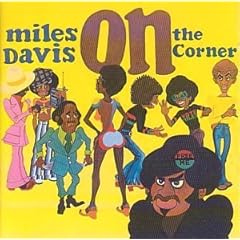 On the Corner is probably just about the most contentious thing Miles Davis ever did, and even now you'll still find plenty of jazz-heads who'll foam at the mouth and brain you if you even mention it, let alone suggest that it's good, or even jazz. I'm reminded of it by the fact that a big box set of the complete sessions has recently come out, and currently sits in the "highest priority" part of my Amazon wish list (hint), and that's reminded me that it's about time I pulled it off the shelf again and had another listen.
Its origins lie in Miles' realisation in the early '70s that jazz had been largely abandoned by young black kids, who were listening to Sly Stone and James Brown instead. He realised he needed to do something that would connect with them, speak to the kids on the street. So he made a funk album, of course. But being Miles, he couldn't make any old Stone-derived sound. He needed to bring something new to the party. And what he decided was the killer concept, that would bring his sound to the kids on the street was the ideas and processes of Karlheinz Stockhausen. Well, obviously.
I remember when I was a teenager first listening to Miles, and finding things like Bitches Brew bewildering, in a way probably only matched by Trout Mask Replica, another album it took me a long time to get my head round. But I always felt there was something in them, something that was just out of reach, that I needed to keep digging and find. Anything of real worth requires effort, because the effort makes the reward that much sweeter. So when Miles decides that what funk-jazz needs is the influence of the German avant-garde, god dammit, you've just got to go with it, because in the end you'll see he's right.
What Miles specifically takes from Stockhausen is his concept of space. On the Corner is an album that isn't much concerned with harmonic progressions, being on the surface a sequence of one-chord jams (or to be more accurate, cut and paste collages derived from one-chord jams). It's in the placing of the sounds that it gets its power, taking what could almost be described as a pointillist approach, short staccato phrases juxtaposed in varying combinations, never resting, always moving, but also static, creating a real sense of an environment in which we stay for a while. I'm reminded of the way Birtwistle describes many of his works, in terms of a single unchanging object viewed from changing perspectives.
If this sounds dauntingly intellectual, the effect on the ear is visceral and immediate (as is the actual music of Stockhausen and Birtwistle, if you ignore all the talking about it and just listen). Those foam-mouthed jazz-heads need to open up their perspectives and stop worrying about whether this is jazz or not. It's an extraordinary record that even now sounds like something that arrived in our midst from outer space.
Oh, did I mention that it's also damn funky?




