Beautiful. Just beautiful.
Showing posts with label film. Show all posts
Showing posts with label film. Show all posts
Tuesday, April 29, 2008
Tuesday, March 11, 2008
Mozartballs
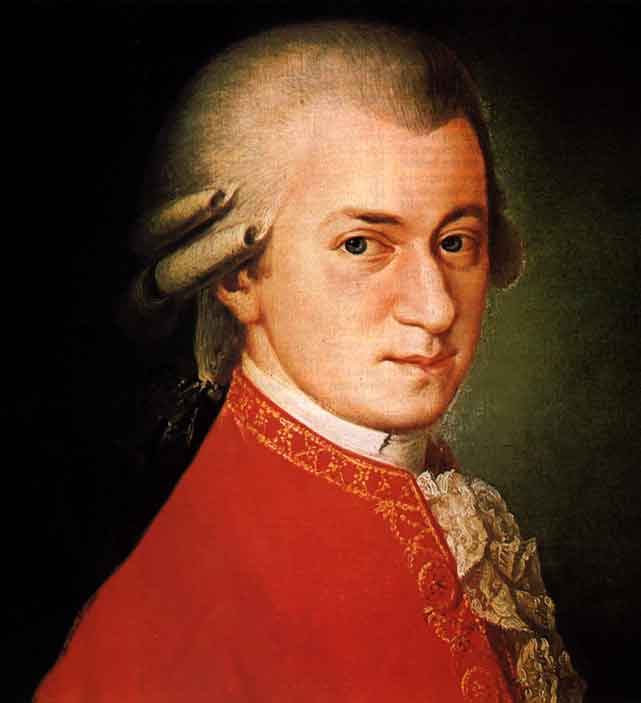 Steph Waller believes she is the reincarnation of Mozart. She gives talks "in character" (and costume) to schoolkids about him, along with her partner Lynette Erwin, who claims to be the reincarnation of the first singer to play the role of Susanna (and alleged tryster with the composer) Anna Storace. Personally I think if I'd been subjected to this as a child I may have been too traumatised ever to listen to Mozart again, but maybe that's just me.
David Cope, meanwhile, has written a program that enables a computer to "compose" like Mozart. He persuades Steven Isserlis to play through a cello concerto written by this program. Isserlis confesses to developing a certain fondness for the work, despite it being "really bad". That's not just a professional opinion, by the way - my companion has no musical training at all, and she managed to recognise its awfulness, a jumble of classical cliches that fitted together in the way a random selection of clothes bought from charity shops might.
These are just some of the characters we encounter in the documentary film, Mozartballs, which was on BBC4 the other night, named after the sickly sweet chocolate balls known as "Mozartkugeln" that act as the most prominent evidence that there is nothing on this earth so tacky that the Viennese won't slap a picture of Mozart on it and sell you.
It's quite an entertaining film, and not simply in a "look at the nutters!" way. To an English mindset the title brings connotations of Private Eye, but this is an American film, and hence lacking the acid that might imply. Rather, it's an affectionate portrait of some eccentric people who've made Mozart the focus of their obsession. Whether this says something about the continuing power Mozart's myth holds over us or the desperate desire of us all to bask in associated glory I don't know, but rather than mocking the film's subjects I find myself warming to them. We live in such a drab, conformist world in so many ways. Who can blame someone for wanting to be Mozart?
Thursday, January 31, 2008
Here's Johnny
 Johnny Hicklenton drew some of the most distinctive, visceral, and plain old bizarre art you could hope to have seen in the pages of 2000ad in the late 80s and early 90s. At a time when the entire industry seemed to be in the grip of Bisley clones churning out brown painted art, he stood out as someone doing something utterly unlike anything else around, and there's still really no-one quite like him.
Johnny's also got Multiple Sclerosis, and can't walk anymore. Fortunately he can still draw, but he knows it's a matter of time before that's taken from him too.
 Fortunately Johnny's too much of a fighter to sit back and accept this, and one of the ways he's fightiong back against this horrible disease is by working with Animal Monday to make a film about his condition, "Here's Johnny", the first screening of which I attended last night at the Science Museum's Dana Centre. It's a powerful piece that pulls no punches in letting you know what the (often uncomforatbly personal) effects of multiple sclerosis are, not just physically but pstychologically. This coukld make for uncomfortable viewing, but it transcends the awfulnes of its subject matter simply by the fact that Johnny's such an irrepressible, tenacious and funny man. It's being screened at Sight and Sound in Austen next month, whether or not it gets a cinema release remains to be seen, but as channel 4 have part-funded its making it'll doubtless be coming to a tv screen soon, and you really should keep an eye out for it and make sure you see it, because it's a provocative and thoughtful piece of film-making, the sort of thing you used to see all the time on Channel 4 before they gave themselves over to Wife Swap and Big Brother.
Monday, January 07, 2008
I'm Not There
 This has been described as a biopic of Bob Dylan, but it isn't, really; it's more of a series of riffs on the idea of Bob Dylan.
There can't be anyone alive who's been so mythologised as Dylan, to the point where he hardly seems like a real person. For years he's fought against his own legend - I remain convinced that all those notoriously, um, wayward performances and records from the 70s until the 90s represent him trying to destroy Bob the Legend. Then, when he realised that being a shambles only reinforced the myth, he resigned himself to his status, and decided not to worry about it, after which we got the wonderful trilogy of albums of the past few years, the delightful Theme Time Radio Hour, and Chronicles, all of which showcase a Bob apparently more at ease with himself than he's seemed for years.
So what we get in this film isn't any kind of conventional biography. Instead there are 7 different characters, all standing in for various aspects and periods of Dylan's career and persona: a young black kid trying to fake his way through the blues, a young Rimbaud obsessive called, er, Arthur Rimbaud; an earnest young Woody Guthrie-a-like; the iconic super-hip sharp talker of the mid-60s (played by a woman); an actor with a failing marriage; a born-again preacher; and a country hobo who turns out to be more than he seems.
None of these personae presents any accurate depiction of events; this is clearest in the "60s" Bob, where events documented on film are presented in versions that play up to the mythology of what happened. Cate Blanchett's astonishing turn as "Jude Quinn" is the only one of the seven Dylans that is pitched as an impersonation of him; these are intended as archetypes that resonate with one or more perceptions of Dylan and his work. Even Blanchett's performance is more myth than reality, and comes across as the one attempt to "do Bob" more because Dylan's 60's image is one that rock stars ever since have appropriated in an attempt to seem sharp.
If you try and fit the film to the life too closely you'll end up frustrated. I'm reminded to some extent of Burrough's later work such as The Place of Dead Roads, where one character plays out his story in multiple times and dimensions. I suppose in a way one of the major themes of this film is the impossibility of nailing down who Dylan is or what he represents. At the end of the film, as Richard Gere rides off on a train, strumming one of his younger selves' guitar, perhaps a nod to Dylan's recent work, where he's become for real the great bluesman he started of pretending to be, we finally see Dylan himself, in a piece of footage from a live concert. He doesn't sing, he just blows his harmonica and strums his guitar, inscrutable and unreachable, and strangely peaceful. It's a moment that, like a lot of this film, lingers in the mind long after the credits have rolled. Maybe it shows what Dylan himself has always insisted: whatever roles and significances we may try and pin to him, he's really just a song and dance man.
Whether it's a help or a hindrance to know a great deal about Dylan before you watch this film I'm not sure. It'd be interesting to hear the views of someone who knew next to nothing about him
Tuesday, June 05, 2007
Daemon Days
It's time for another one of these spurious internet personality tests. This one's a tie-in with the imminent film adaptations of Philip Pullman's Dark Materials books. Mine's a gibbon, apparently. A funky one, I hope. What do you think?
Wednesday, March 14, 2007
The mind boggles
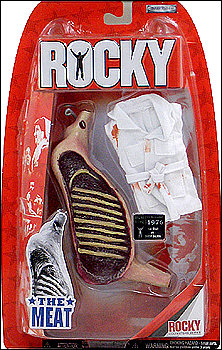 Remember that bit in Rocky where he's doing his training by punching a hung slab of meat? Well, you lucky people, you can now recreate that seminal scene in your own home with this fantastic new action figure. No, really.
Also, I was bemused by the list of books we haven't finished. I mean, I'll 'fess up to not finishing Ulysses (although I shall one day, oh yes), but what's so difficult about Vernon God Little? I remember it being an easy read. Are we becoming so dumb? Judging by this story, HMV seems to think we are.
Subscribe to:
Posts (Atom)




