 Or should that be plus-minus ensemble at King's Place? Or +/- @ kingsplace? This sort of typographical quandry is par for the course in the world of Modern Music.
And this gig was definitely Modern Music, with capitals and all. I felt like I'd been transported back to the late 80s. Within seconds of arriving I saw my first Man Dressed In Black.
When I was a nipper, there was a certain set of clichés about Modern Music and the people who went to hear it. Men (always men), almost certainly dressed in black, either bald as a coot or hirsute, possibly of questionable hygiene, never smiling. This is Modern Music. It's Serious. It's Art. NO SMILING. Angular, difficult, hard edged music. Music for Men. Men who smoke and shun deodorant. Men who probably write similar music themselves.
If you believe what you read on the internet (and why wouldn't you?) this sort of thing's yesterday's news. We're no longer scared of music written by non-dead people, we all love each other and even know girls. There were actually some girls there, but they tended not to be talking to the boys, a bit like a school disco. I did see a couple of people smiling, so things haven't remained entirely static since 1989 for these folks.
(I'm uncomfortably aware, by the way, that if you drew a Venn diagram of people who fit into the category I'm talking about, I'd have at least one foot inside it. A lot of these guys are dressed like 80s-90s students, i.e. exactly like I did when I was a student, and sometimes still do. Although I rarely wear all-black these days, it feels weird when I inadvertently do.)
Like Goths and Catholicism, though, the old guard survives, and you'll find them at a gig like this. The particularly fearsome man who sat stiff-backed, hands at the ready to applause the second the Xenakis finished to show he knows when it ends (and is therefore better than the rest of us), paunch nearly covered by grubby shirt and leather jacket, the gentle smell of stale fag smoke wafting gently from his person, was only the most striking example of this Lost World of Modern Music fans (as in fanatics). Gruffly barking "Bravo!" to show he understands and appreciates Difficult Music more than the rest.
Back in the day you'd have gone to a church or a school drama studio to hear this sort of stuff. Fortunately King's Place Hall two has much the same vibe as a drama studio, so there's some continuity there. The presentation is resolutely old-school, too. No talking to the audience or anything like that, just a procession of musicians coming on, playing, and walking off again. This is Difficult Music. If you don't understand it there's no point trying to explain it to you.
I've heard pieces by Xenakis that knocked me out, and others that bored me senseless. Neither of the works that began and ended the first half were at either extreme, though I preferred the piano solo Evryali to the violin and piano piece Dikhthas. Evryali came over like a cross between Ligeti's Piano Etudes and Ustvolskaya's Sonatas without being quite as compelling as either. In between came Rebecca Saunders' Vermilion. Saunders is published by Peters Edition, who despite their signing of the likes of Jonathan Dove in recent years will always be for me the publisher non plus ultra of Difficult Modern Music, printed in Very Big Scores. The scores in this case were surprisingly normal-sized, but it was still definitely the sort of piece where everyone plays from a score. Saunders clearly has a fine ear for texture, and there was much to admire in that respect, but I'm afraid it left me cold, neither seducing nor provoking me. It was there and it was OK, but I didn't feel any sense of its existence as being necessary.
It was the second half I was actually there for. I like Bryn Harrison's music, but there's no getting away from the fact that it's basically a massive rip-off of Morton Feldman. Talent borrows, genius steals, they say, which puts him firmly in the talented camp. If you're going to borrow on this scale though, you may as well do it well, and Harrison (Head of Composition at Huddersfield University) does. I do wish he'd reference something other than other pieces of his in his programme notes though. Unless you're deeply acquainted with his work it's unhelpful and irritating. The lengths he went to to avoid mentioning Feldman were amusing though. Repetitions in Extended Time was commissioned by the Huddersfield Festival.
I find myself wondering though. The Xenakis pieces are, what, 30-40 years old now? Which is old enough that the style has acquired a comfortably quaint, nostalgic patina. Is there some weird thing happening here where composers like that are for people like this what Beethoven and Mahler are for mainstream classical audiences? Something old and familiar, that they feel comfortable with (and therefore almost certainly no longer understand)? And is the Feldmanesque trope now becoming so common (there a a lot of other composers ripping him off, myself included) that it's in danger of going the same way? I'm certain that one day that style will seem just as quaint and cute as Xenakis does now. I'm sure the New Music Men see themselves as keepers of a flame. If there's one thing that's definitely better now than 40 years ago it's that there's no style police telling us what sort of music we can and can't write or listen to, so in a way it's reassuring that they're still about. But maybe they're just as hung up on nostalgia as everyone else. The trouble with writing the music of the future is that it tends to skip the present and go straight to being the music of the past.
Monday, April 12, 2010
Ensemble Plus Minus, Kings Place
Saturday, June 06, 2009
Feldman: Crippled Symmetry (Endymion, Kings Place)
It's redundant to dissect a performance of Feldman's music in a way: Not that there isn't great skill and musicianship needed to bring it off, but the music itself places itself so far outside the traditional notion of "performance" that it's very difficult to say anything of the performers beyond the bare facts that they turned up, played the notes, and had the stamina and concentration to get through the hour and a half (in this case) that the piece takes to play.
So at the risk of seeming to damn with faint praise (I don't mean to), I should say straight off that the three members of Endymion who performed "Crippled Symmetry" at Kings Place on Friday night turned up, played the notes and demonstrated the requisite stamina with aplomb. The thing is, this is music that one one level isn't about the performers at all, and yet on another is absolutely about them. The extreme duration, and the demands of playing so softly and slowly (much more tiring than playing fast, busy music) mean that it's all about the physical and mental stamina needed to maintain concentration. And yet the music itself demands the players to abandon the normal ideas of self-expression. Feldman's music lies beyond ideas of expression. It simply is.
This removing of theatrical display or gesture, the creation of what you might call a flat surface, like the canvases of his friend Mark Rothko, with whose work his has much in common, doesn't lead to an uninvolving experience though. The reduction of everything to the minimum actually makes the smallest detail assume immense significance. So it is that the flute's tonal pallor comes to seem sharp and piercing in contrast to its bigger, softer sibling, the bass flute. And the glockenspiel and piano likewise acquire a brighter presence next to their more muted doubles, vibraphone and celesta.
"Crippled Symmetry" is one of the few Feldman works to carry a title other than the names of the instruments it's written for. It's a title that could apply to most all of his work though: the small patterns that almost, but don't quite repeat. The sense of stillness that conceals enormous movement: like a glacier, it appears from moment to moment to be static, but in fact is moving with a power that can cut through mountains.
Feldman's music makes no claim to "meaning" beyond the fact if its existence and the actions that bring it into existence. But that doesn't make it meaningless. It simply makes that meaning something so vast that it can't be expressed in any terms than the sounds that make it. It's something best experienced live rather than on record. In your living room there are too many distractions. This demands, and deserves, your full and undivided attention. That's not easy over such a long span of time. It's music that conveys and demands quiet courage, for both its performers and audience.
Thursday, October 09, 2008
Fit for a king?
 London's latest arts centre is open. The fashionably apostropheless Kings Place opened for business last week with a festival of "100 concerts in 5 days". It's to be the new home for the London Sinfonietta and the Orchestra of the Age of Enlightenment, as well as featuring two galleries and providing office space for the Grauniad.
I went there to have a snoop round on Sunday. First impressions of the building are good: it's an impressive space that feels open and not too cluttered. Picking up tickets from the box office needed a bit of queuing, but probably no more than you'd expect from a newly opened venue where things are still settling. I'm not impressed with the catering though: A packet of crisps and a sandwich left little change from a fiver, which wouldn't have been so bad if the sandwich wasn't small, soggy and not very nice, and the crisps a smaller packet than a bog-standard packet of Walkers. If you're going to charge three or four quid for something as basic as two pieces of bread with some filling, you need to come up with something better than this.
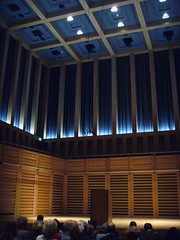 Hall One, the main performance space, is great, not as luxurious a place as the Wigmore Hall which is its most obvious rival, but it's a smart, clean design of a hall.
The first event we're here for is a lecture by Sir Peter Maxwell Davies, entitled Musica Speculum Mundi? [Music a mirror of the world?]. He strolls onto the platform, and announces that he's been asked to write his speech down and recite it, not the way he'd normally speak in public. This makes it a little hard to get into what he's saying at first, as reading from a script makes his delivery a little stilted, but he warms up and sweeps us along with his talk, which, rather like a lot of his music, begins with a series of scraps of stories which gradually coalesce into a wider narrative. it's intimidating that he quotes form so many source in the original language, whether it be Italian, German, Latin or Greek. It's probably a sign of a generation gap that he can say something along the lines of "Of course, we all remember from school what Sophocles said...", but he's an engaging and intelligent speaker, and we're swept along by his argument, which becomes more and more personal and passionate as he touches on such subjects as his writing his Third Naxos Quartet in response to the invasion of Iraq. His conclusion is that writing a piece of music makes no practical difference to the world - he never imagined Blair, Brown or Bush would listen to his piece - but nevertheless it is immensely important that a composer reflect his world and act as a witness to it.
Max returns to the stage for the next show, a performance of two works for string quartet from the spnm shortlist selected by him and performed by the Brodsky Quartet. I've discussed this elsewhere, but it's a shame the speakers weren't miked up (as Max was for his lecture): we can hear what Max is saying (he's used to speaking in public) but the two composers, who aren't, mumble a bit and a lot of their words are lost beneath various rustlings from the audience. The acoustic is very clear, and hence very unforgiving in this respect, compulsive coughers note.
Another thing: please, please will someone at the spnm think of some compulsory course in programme-note writing for the composers on their shortlist? What we had to read was absolutely rotten and did nothing to enhance our enjoyment of the pieces. I was convinced from reading his note I was going to hate and/or be bored stupid by Oliver Waespi's piece, but was pleasantly surprised to be confronted with a beguiling piece that I'd like to hear again. It's difficult enough to persuade a lot of people to engage with this stuff as it is, and composers do themselves no favours by presenting such unenlightening writing.
Tuesday, October 07, 2008
New adventures in sound
 I went to have a look at Kings Place on Sunday. I'll post something about it later, but in the meantime here's my review of the concert I saw.




