 London's latest arts centre is open. The fashionably apostropheless Kings Place opened for business last week with a festival of "100 concerts in 5 days". It's to be the new home for the London Sinfonietta and the Orchestra of the Age of Enlightenment, as well as featuring two galleries and providing office space for the Grauniad.
I went there to have a snoop round on Sunday. First impressions of the building are good: it's an impressive space that feels open and not too cluttered. Picking up tickets from the box office needed a bit of queuing, but probably no more than you'd expect from a newly opened venue where things are still settling. I'm not impressed with the catering though: A packet of crisps and a sandwich left little change from a fiver, which wouldn't have been so bad if the sandwich wasn't small, soggy and not very nice, and the crisps a smaller packet than a bog-standard packet of Walkers. If you're going to charge three or four quid for something as basic as two pieces of bread with some filling, you need to come up with something better than this.
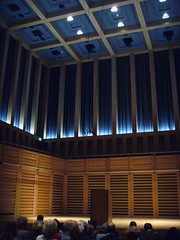 Hall One, the main performance space, is great, not as luxurious a place as the Wigmore Hall which is its most obvious rival, but it's a smart, clean design of a hall.
The first event we're here for is a lecture by Sir Peter Maxwell Davies, entitled Musica Speculum Mundi? [Music a mirror of the world?]. He strolls onto the platform, and announces that he's been asked to write his speech down and recite it, not the way he'd normally speak in public. This makes it a little hard to get into what he's saying at first, as reading from a script makes his delivery a little stilted, but he warms up and sweeps us along with his talk, which, rather like a lot of his music, begins with a series of scraps of stories which gradually coalesce into a wider narrative. it's intimidating that he quotes form so many source in the original language, whether it be Italian, German, Latin or Greek. It's probably a sign of a generation gap that he can say something along the lines of "Of course, we all remember from school what Sophocles said...", but he's an engaging and intelligent speaker, and we're swept along by his argument, which becomes more and more personal and passionate as he touches on such subjects as his writing his Third Naxos Quartet in response to the invasion of Iraq. His conclusion is that writing a piece of music makes no practical difference to the world - he never imagined Blair, Brown or Bush would listen to his piece - but nevertheless it is immensely important that a composer reflect his world and act as a witness to it.
Max returns to the stage for the next show, a performance of two works for string quartet from the spnm shortlist selected by him and performed by the Brodsky Quartet. I've discussed this elsewhere, but it's a shame the speakers weren't miked up (as Max was for his lecture): we can hear what Max is saying (he's used to speaking in public) but the two composers, who aren't, mumble a bit and a lot of their words are lost beneath various rustlings from the audience. The acoustic is very clear, and hence very unforgiving in this respect, compulsive coughers note.
Another thing: please, please will someone at the spnm think of some compulsory course in programme-note writing for the composers on their shortlist? What we had to read was absolutely rotten and did nothing to enhance our enjoyment of the pieces. I was convinced from reading his note I was going to hate and/or be bored stupid by Oliver Waespi's piece, but was pleasantly surprised to be confronted with a beguiling piece that I'd like to hear again. It's difficult enough to persuade a lot of people to engage with this stuff as it is, and composers do themselves no favours by presenting such unenlightening writing.





