You know as soon as you see Alan Titchmarsh that you're not in for anything nasty. The housewives' favourite isn't going to preside over the sort of laughing at the mentally ill and desperate that Simon Cowell fronts in the early episodes of the X-Factor, is he? And so it proves in ITV's latest attempt to get some decent viewing figures by cobbling together spare parts from other TV shows like a cathode ray Frankenstein. You have to admire Mylene Kalss's professionalism, too. She stands next to Alan as he does his bumblingly affable schtick, and then delivers her lines with a steely determination. There's barely a hint of the pounding fear that must underlie every waking moment when you've rescued your career by wearing a bikini in the jungle and are absolutely, fiercely resolute that you are going to hang on to the spotlight this time, oh yes.
The judges on PopStar to Opera Star are a bizarre combination. One wonders what drugs the production staff were on when they chose them. I assumed before I switched on that Lawrence Llewellyn-Bowen must have been chosen because he's a bit frilly and poncey - y'know, like classical music? - but it turns out he's on because he's a DJ on Classic FM these days, presumably because he's a bit frilly and poncey - y'know, like classical music? Meat Loaf, of course, is famous for his operatic records. Operatic in the sense of wildly ridiculous and over the top, that is. Which is the point at which you begin to realise exactly how opera fits into the scheme here.
The other two judges are also the coaches for the celebs, which is disappointing, because it means no-one's ever going to be anything other than nice to the contestants. This is surely going to be a strain when they get to Alex James, who is surely the undisputed king of Being Shit At Classical Music On Telly. They are Kathryn Jenkins and Animal from the Muppets. Ironically, Animal is the only person here who's actually been in an opera. That's not half as ironic as the presence of Katherine Jenkins, though - a woman famous for singing everything the same on a programme whose whole point is supposed to be about singing things differently to normal. There
 must be a personality buried somewhere beneath the blonde hair, makeup and cleavage - maybe she's really filthy in bed? - but if there is it's never allowed to break through the relentlessly bland facade.
The format follows the pattern we all know from Strictly X-Maestro Academy. Each celeb in turn is shown "in training", then emerges onto the set to bawl out a popular aria, every warble the subject of frenzied cheering form the (allegedly) live audience. There's no insight into how "operatic" singing differs from "pop" singing, or of why the celebs should want to do it (other than being paid to appear in an 8-week TV series, which is steady work for a couple of months, isn't it?). "I only know my song from the Stella ad!" exclaims Kym Marsh, to the hilarity of some canned laughter. Of course, most people only know that song from the Stella ad, but we'll let that pass, eh?
Animal and the Jenkster are never gong to be nasty to their pupils on live telly, not even Alex James, but you'd hope one of the other two might offer a more jaded counterbalance to their gushing. But no. Meat Loaf appears to be channelling John Barrowman, while Lawrence Fop, appears at first as though he might do a Craig Revel-Horwood, but as soon as he opens his mouth it becomes clear nothing's going to upset the applecart. You'd hope that at least a mild frisson would develop when Kym and Mylene have to share a stage, but even they manage to put on a half decent pretence of liking each other.
There's a decent idea for a TV show struggling to get out of all this. Well, there might have been, but it's been strangled at birth. There's no insight into how classical singing differs from pop singing, no indication why either might be worth attempting (oh, how I'd love to see a programme where Kitty J was made to try and sing in a "pop" style, or indeed to inject any sense of insight or understanding into anything she sings, ever). The complete absence of any criticism means that there's nothing to be learned. It's not really anything to do with opera, either. But I suppose "PopStar to PopStar Singing In A More Wobbly Voice" wouldn't have been such a catchy title.
Some will probably say that this is dumbing down classical music or opera. Well, duh. There's not really much point in fretting over that though. The classical music business sold itself down the river a long time ago, and really only has itself to blame that it's become the musical equivalent of a posh bubble bath. Anyway, this is ITV. We didn't come here to be educated. But you might at least hope to be entertained. You'd be disappointed.
ITV's absolute fear of doing anything that might be dangerous, or risky, or innovative, means that all the tropes they've stolen from other shows are neutered. There isn't even any danger that the celebs might look a bit shit, not even Alex James, the King of Being Shit At Classical Music On Telly. I know this because I saw his bit on YouTube this Morning. We actually switched off halfway through Kym Marsh's introduction, unable to take another seven contestants when we could be doing, well, almost anything else. I was hoping it'd be a bit of trashy fun, but it was just dull. That's what you've done, ITV: you've made a programme so dull I couldn't keep watching long enough to see Alex James being Shit at Classical Music On Telly. And that is surely the nadir of dull.
Sunday, January 17, 2010
PopStar to Opera Star
Thursday, August 13, 2009
New Definitions: Classical Music
 Happy birthday to me!
To celebrate, and in the vain hope of kick-starting this blog into something like action, I've been thinking about definitions.
We all like to define things, don't we? And it's even more fun when we can have good fight about it. A spate of letters recently in Private Eye has debated the rights and wrongs of Classic FM's playlist, and whether the music from ET is classical or not. Classic FM seems to take the view that if it's got an orchestra or a wobbly cod-operatic voice on it, it's classical. Others disagree.
It's a perennial argument. Once upon a time, "Classical Music" meant simply music written between about 1760 and 1830, a particular style as exemplified by Haydn, Mozart and Beethoven. But the advent of the twentieth century and the invenion of recording, pop music and marketing means that now anything written from the 12th century to today might be called classical, if only we could agree what that means. According to recent reports, classical music is apprently something soothing to distract you from the recession. This implies that Bacharach is classical, but Beethoven isn't. Hmm. tricky, isn't it?
Kyle Gann has also been in on the argument recently, offering a definition given him by Robert Ashley -under 5 minutes is pop, over 5 minutes is classical - and I can see the attraction of that. It's simple, it sidesteps all those thorny issues of whether a particular genre might be inherently classical or not-classical, and it pisses off a few people in the process who probably deserve to be pissed off.
My definition is even simpler, though, and it sidesteps all those tricky borderline issues, such as whether Blue Monday by New Order is clasical, but True Faith isn't. And it's this:
Classical Music is music written by dead people.
So: Beethoven, Bach, Josquin, Stockhausen: Classical. As is Frank Zappa, who's an excellent example, as he was treated with disdain and contempt by the classical music establishment until he died, whereupon he became OK and can now be found cropping up in classical concerts, and is represented by a classical publisher. And Michael Jackson is the latest inductee to the classical canon. Of course.
Britney, Take That, Thomas Ades, Björk and me, however, are Not Classical. We're just breathing too much.
The Beatles, meanwhile, count as crossover, I guess.
So there you go: if they're dead, it's classical. Much simpler. Glad we cleared that one up.
There are probably a few naive people out there who think it doesn't matter, and that the only important question about a piece of music is whether it's any good or not, but of course we pay no heed to such people.
Friday, April 03, 2009
A dog's life
Once upon a time, Man and Wolf came to an accommodation: Man provided food and shelter, and in return Wolf became dog and provided companionship and protection. Over time Man realised that he could manipulate dog to become all kinds of useful shapes.
Eventually the uses themselves disappeared, but the shapes remained. Nobody could remember why that particular dog was that particular shape and had those particular features emphasised, only that it was good and desirable that it should be so.
So the dogs kept being bred into more and more unlikely shapes, until eventually they ended up wonderful to behold, but completely impractical, and so far removed from their wolvish origins that they were incapable of surviving without Man to provide food and shelter.
Then one day Man decided to stop feeding dog and kicked him out, and he died a slow, painful death from starvation and neglect.
And that's pretty much the story of (so-called) classical music.
Why don't young people listen to classical music?
Well, why should they?
Saturday, December 27, 2008
Farewell My Cadence (2)
I pulled on my mac and pulled my hat down low to keep the rain off my face. It was a dirty night, cold and wet, and plenty of folks would be glad to be indoors, but in my line of work you go where the action is, when it is.
There was this guy, the German. Lot of folks had his number, they said, a lot of suspicion pointing his way. He wasn't the kind of guy who liked to do things anyone else's way, kinda the dominating type, if you know what I mean - I'd heard pretty strange things about his domestic, too. Kind of man who keeps more than one woman at home is going to be careless with the rest of them they said. And he was into crazy stuff too, weird group action and saying he was from outer space. I wasn't convinced - a bit of kinky doesn't make you a killer, and just because he liked to have the dame in unusual positions didn't mean he'd offed her, just that he had a different appreciation of her.
I was too late, anyhow - the German was already dead himself. Looked like heart trouble, but you never know - guy like that makes a lot of enemies, and some of them are smart, smart enough to make foul play look like happenstance. I was going to have to check that out, but not now. I had to get to the bottom of the case. I decided to grill the German's accomplice - the Frenchman. I pounded the sidewalk again, wondering if I was going to find a killer or a victim. Damn this rain.
Friday, December 26, 2008
Farewell My Cadence
or, Who Killed Classical Music? An exciting Christmas thriller in 12 parts (or fewer, depending how quickly I get bored).
Part 1
Classical Music was dead. Sure, she'd left a good-looking corpse - she was one hell of a dame in her time, and if you didn't look too close she could still turn your eye, and hell, some people were still trying to turn hers. Jeez, some people. If you've got an automobile with no wheels and no engine, it don't matter if it's a Rolls - it's still a jalopy, and it ain't right to take it out for a ride.
Question was, who'd done the deed? Sure, there were some people who wanted her dead, but most folks, if you asked them, were surprised she hadn't bitten the dust years ago, if they even knew who she was. Or cared.
Just because most didn't though, didn't mean that the ones who did hadn't come up with a whole heap of suspects. This was one investigation that wouldn't be wrapped up before the bars opened.
Thursday, October 16, 2008
Delta
 I don't believe in fate, or synchronicity, or whatever you want to call it. But sometimes you have to wonder.
Christopher Small suddenly seems to be everywhere. I'd never read a word of his before last week, when one of those chains of link following that you do sometimes led me to his book Music, Society, Education. Reading it, I had the sensation of both elation and crushing disappointment, that someone had articulated thoughts and ideas that I've been half-having for years, much better and more cogently than I have, and 30 years earlier. And suddenly I seem to see references to this book, that I'd never heard of (why hadn't I heard of it?) and its author, here and there and everywhere. There's that sudden relief in knowing you're not alone, and that sudden disconcerting realisation that you're not alone. And all this is coming to the surface even as I write a whole series of pieces that touch on a lot of these ideas about performance, tradition, the whole question of what the Western European musical culture is, and what it needs to do to stop its slide into utter obsolescence. Or if it can do anything.
I don't believe in fate, or synchronicity, or whatever you want to call it. But sometimes you have to wonder. Sometimes things seem to pop up at an alarmingly prescient moment.
(By the way, is classical music dead? some people ask. The pedantic, correct answer, of course is that it died in 1827.)
Wednesday, August 27, 2008
Johannes Brahms?!
I wouldn't normally do this sort of thing, but this is such a headfuck I just had to. Poor old Brahms must rue the day he quit the job playing in a brothel.
found via Michael Sippy.
Wednesday, August 20, 2008
Kingdom of the Bland
 Oh Jesus shitting Christ, Classic FM are at it again. Not content with encouraging awful, awful acts like G4, Bleak, and The Divs to sing REM and Queen in a horrible cod-operatic warble, sometimes in Italian, as if that offered any insight into anything at all, now they're encouraging artists such as Emma Johnson and Julian Lloyd Webber to sully the air with instrumental "classical" arrangements of pop songs, which will apparently reveal some inner genius we weren't aware of already. This is apparently a reflection of a new genre, they tell us.
Actually, Classic Fucking Mediocre dissemble, because it's a very old genre - the genre of Fucking Horrible Arrangements Of Recent Pop Hits To Make A Quick Buck. FHAORPHTMAQB has a long and frequently ignoble history, although I have to confess to an entirely unjustifiable fascination with Deep Purple and Malcolm Arnold's seminal* collaboration, Concerto for Group and Orchestra, which is not quite the same thing, admittedly, but is a closely related genre, also being of the phylum "Terrible Things That Happen When the Rock and Classical Worlds meet" (see also: Metallica's gig with the San Francisco Symphony, Philip Glass's rotten orchestral inflations of David Bowie and the Queen Symphony). I don't include the Orchestral Tubular Bells here because it's no worse than the original.
It works the other way around too, of course, and honourable mention here must go to Waldo de Los Rios's fantastically tasteless '70s arrangements of popular classical pieces by Mozart, Dvořák, and others, which, like doughnuts and crack, are irresistible even though they're clearly not good for you.
These chimeras differ from Classic FM concept in one important respect though; they're ill-advised, overblown and gloriously lacking in taste or restraint, which in time lends them a certain charm. Classic FM's album is all about being tasteful, music to put on in the background as you sit round your coffee table with your estate agent friends discussing what car you're driving these days and when mortgage rates might come down. There's a terrible and insidious snobbishness about the whole enterprise: the implication is that, on the one hand, these songs must be tarted up in "classical" clothes in order to be acceptable, and on the other hand that Classic FM's audience isn't really clever enough to listen to proper classical music, and shouldn't get any ideas that they deserve any better than this. The first is the sort of thinking that leads to Paul McCartney's "classical" follies, which only a lunatic could believe can hold a candle to his magnificent work with the Beatles; the second is essentially the same sort of mindset that thinks it's a jolly big shame that the natives are now running their own countries in the former British Empire, and that the working classes no longer doff their caps to the toffs. it betrays an attitude of paternalistic contempt by Classic FM for its listeners: it does nothing for either pop or classical or any other type of music, it creates nothing, refreshes nothing; it just leaches and leaches until the blood is drained from its victim.
When I was a kid, you'd see "Top of the Pops" albums in the bargain bins in Woolworth's and W.H. Smiths, offering the promise of the latest chart smashes all on one disc. When you got it home and slapped it on the record player, what you got was a bunch of cheap knocked off cover versions performed by session musicians. But you couldn't really complain, because they'd never actually said it was the original recordings, so you were stuck with the record and a vague sense of empty despair. This is the legacy of FHAORPHTMAQB, and Classic FM's tawdry product is no better, demeaning everyone and everything its fetid embrace encompasses.
Of course, it's entirely possible that I'm wrong, and that, far from being a cynical piece of opportunistic marketing tat, Songs Without Words (see what they did there?) is a triumph of artistic innovation that provides hitherto unglimpsed insights into the songs featured, and charts new lands in music. In which case, Yay, Go Classic FM.
*seminal: consisting of semen, i.e. a load of wank.
Wednesday, July 30, 2008
The centre cannot hold
Some interesting and thought provoking stuff in this article, which I found via Molly Sheridan.
I was particularly taken by this:
Nobody in Winnipeg's classical community was upset last year when the Winnipeg
Symphony Orchestra played a new concerto for turntable and orchestra written by
Nicole Lizée, who plays keyboards for the Montreal band Besnard Lakes. I think
that's because the WSO and Lizée (who studied composition at McGill University)
were seen to be absorbing a dynamic bit of pop culture into the body of
classical music.
That's not so different from what Bartok did when he
imported elements of Hungarian folk music into his works for classical
performers. In both cases, something was pulled from the margin into the centre,
and the centre became stronger.
It occurred to me that this is actually phrased the wrong way round: it assumes that So-Called-Classical-Music is the mainstream. But surely it's the DJ who's at the centre of contemporary culture, and the orchestra that's at the margins?
Dvořák once thought that Black American music, in the form of spirituals, would be the future of composition. He was right, but not in the way he thought. He assumed that the melodic and harmonic principles of the spiritual would be absorbed into the traditional structures of European art music (the symphony and so on) and renew them. In fact, what happened was that the melodic and harmonic principles of European art music were imported into an entirely new structural aesthetic to create Jazz. I wonder if something similar might be happening here.
Tuesday, June 24, 2008
Inobservant
Take a look at Anthony Holden's review from this week's Observer. Skip the bit about Strauss - Mr Holden doesn't like to stray too far from the opera house, so his reviews are usually about operas, especially expensive ones with big names in them. But occasionally he remembers that there are other classical music genres, and manages to get himself to one of those concert hall places. This week he's managed to navigate his way to Snape Maltings in Aldeburgh (probably relatively easy, as it was established by Britten, who of course was primarily a composer of operas). He's also aware of the current artistic director of the Aldeburgh Festival, Thomas Ades (presumably because he's seen his name about the Royal Opera House advertising one of those high-profile opera commissions that stop Mr Ades writing something more interesting), although the sub who prepared the copy doesn't seem to realise that Ades doesn't feature in this concert. But the excellent French pianist Pierre-Laurent Aimard, who's due to replace Mr Ades as thge Aldeburgh Festival'sartistic director next year, does.
Consider this:
"taste-free modern slices of Schoenberg, Kurtag, Webern and Charles Ives amid some nourishing Haydn and Mozart."
Taste-free? I've heard the above composers accused of many things in my time, but blandness certainly isn't one of them. How anyone can think such things of The Unanswered Question, or Webern's Five Movements, is beyond me. And "modern"? Kurtág's still living and breathing, sure, but of the rest the most recently animate is Ives, and he died in 1954 (that's 54 years ago, Mr Holden). Those four composers represent a remarkably wide spectrum of twentieth century musical trends, and it seems unfair to brush them aside in this manner.
Mr Holden also seems confused at the difference between conducting and directing from the keyboard. He describes Aimard's conducting of Haydn's Symphony No.22 as "sprightly", and specifically states that "All went well until Aimard attempted to conduct from the keyboard." And yet his conclusion is that it's
"Just as well, perhaps, that Aimard has disavowed any ambition to give up the piano for conducting."Huh? You just said his conducting was good! It was his directing from the keyboard in the concerto that went wrong, you said. So not only is that little dig at the end nasty and petty, it's also factually wrong.
So there you go - three paragraphs which say next to nothing about the music, and are a set-up for a punchline that doesn't work.
If someone's got a narrow viewpoint, I can put up with it (well, just about, as long as you don't ask me to talk to them for any length of time). But if you're going to be a narrow-minded music critic, you'd better write with a Swiftian level of wit and be prepared to back your opinion up rather than just casually dismiss the past century of music. Maybe if you didn't gorge your palate with late-romantic opera you'd have taste buds clear enough to appreciate other flavours.
Friday, May 09, 2008
Playing with fire
 A big weekend looms: tomorrow night I'll be off to the South Bank to hear Luigi Nono's Prometeo, about which I shall doubtless have more to say later. I'll be rehearsing on Sunday for the KSO concert on Monday, so annoyingly I won't get to see the Bowmans at the Borderline, but you should if you can.
Tuesday, April 15, 2008
Tuesday Link-o-rama
Oh, has it come to this? Am I now on that slippery slope to being just another blog with a bunch of links to the words of other, far more intelligent and interesting people than me? I'll try not to make a habit of it. Anyway, in the absence of anything interesting to say coming out of my brain, here are a few things to read:
EMI's planned job cuts have been delayed by some piddling legal process. Damn those pesky Europeans with their crazy ideas that big multinational corporations can't just shit on people as they please.
The Graunaiad is publishing daily extracts from one of the Defeatist's number one heroes, Mark E. Smith. Part one is here and part two is here.
Harrison Birtwistle's new opera The Minotaur premieres tonight. Here are some interviews with the composer, director and protagonist. I'm interested in the way the media seem to have moved from portraying Birtwistle as a terrifying figure to almost the cuddly face of modernism.
Monday, April 14, 2008
And the painted ponies go up and down
During that time the firm supported Boosey & Hawkes’ management in executing
a transformation from a traditional classical music publisher into a 21st
century music rights group. It has outsourced a number of non-core activities
such as printing and distribution and developed a series of new revenue streams.
In particular it has developed a strong presence in the market for music in
advertising and film, where revenues are currently growing at approximately 30%
per annum.
Here's Daniel Wolf on the changing relationship between composer and publisher. My own experience dealing with all levels of music publishing suggests to me that an outfit such as Frog Peak can be a very effective way for composers to pool resources, while self-publishing composers vary in their effectiveness, from someone like Christopher Fox, who runs a very effective cottage industry, to the Stockhausen verlag, which, surprisingly for the imprint of a composer who was so much at the forefront of technology, doesn't even take credit cards. Meanwhile, the big old publishing houses seem to expend more effort in restricting access to their music than promoting it.
Thursday, April 10, 2008
You've spun me round And knocked me off my axis mundi
 The 2008 Proms have been announced.
And you know what? There's some pretty darn good stuff in there. Obviously the Stockhausen day will be a highlight for me, but there's also a hefty wad of Messiaen and Carter (and it's not often you get to celebrate the centenary of someone who's not only still alive, but still very active), and a couple of "populist" gigs which I think are both excellent ideas - although not everyone agrees with me.
It's all very well to say "If we build it they will come", but the fact is that kids today have next to no experience of classical music, concert halls are seen as forbidding places, and many people simply won't enter one (a bit like the way quite a lot of people won't watch a programme simply because it's on BBC2 - which is why shows that transfer to BBC1 get such a huge hike in viewing figures). Personally I think that juxtaposing Doctor Who and Turnage is a great idea, not only in terms of getting people inside the hall who might never otherwise go, but putting a message out that it's ok to like both. It's not going to create a brand new audience overnight, but it's a step in the right direction, and puts the whole thing ahead of the usual game for "family" concerts.
The folk day is also exactly in line with what the Proms ought to be doing - a type of music that's intimately linked with so-called classical music, and presented with some of the cultural paraphernalia that surrounds it rather than in isolation like a butterfly in a glass case. I'm looking forward to having a dance round the maypole, so there! And the Ceilidh is a great way to finish it off. If we take it for granted that the Proms is bound to the Albert Hall for the foreseeable future (and I think it is), then for all the place's faults it should be embraced, and stuff like this makes an imaginative use of the space.
Some of the concerts look a bit bizarre to my eye in terms of the wild oscillations between full symphonic works and solo piano pieces, not to mention some strange programme orders (Mahler 5 as an opener??) , but if the Proms are to survive and flourish they have to be open to innovation and experiment, and one of the things about experiments is that they don't always work. The point is, it feels like a fresh breeze is blowing over the season after the increasingly stultifying Kenyon years. There's an eclecticism and a lack of reliance on tired barrel-scraping themes and the like that leaves me feeling uncharacteristically upbeat.
So bring on the daleks, the maypole, the electronica, I say: If it works, great; if it doesn't, at least they tried. Next year they could try putting a big Wicker Man up in Kensington Gardens.
... and everything decays.
Monday, March 10, 2008
Empire of the senseless
Whether EMI will still want to buy Boosey's once they've seen what sort of state it's in remains to be seen - it doesn't bode well if the current owners really have been trying to get rid of it since shortly after they bought it.
Boosey and Hawkes is a company, like most music publishers, that has grown complacent and reliant on the exploitation of some big names it was lucky enough to acquire rather than trying to create a future for the art form it purports to represent. It'd be nice to think a new owner might begin to reverse this trend, but I can't say I feel confident that a bunch of asset-strippers, which is essentially what Guy Hands' business is, will have any new approach to the selling of classical music.
Friday, December 14, 2007
What's next?
Once upon a time composers were artisans, servants like any other. Composing was part of musicianship; all composers performed and most performers composed. Then Beethoven came along and suddenly composers were Artists. Beethoven went deaf and was forced to retire as a performer, and thus was born the Great Composer, the mystic sage who came down from on high bearing the Score, which the musicians then dutifully followed.
This was the end of the Classical style, and the beginning of Classical Music - the canon, the tradition, the myth of the unbroken line inexorably moving forward through history: Beethoven, Wagner, Mahler, Schoenberg, Webern, Stockhausen... at the turn of the 19th and 20th centuries Mahler codified the rituals of concert-giving and going, and the Classical Concert became a quasi-religious ceremony. The composer was a Shaman, exalted and separate.
Stockhausen is dead, and with him dies the Great Composer. We no longer believe the march of that history. Our history is messier, less sure. It seems to me that the music of the future will most likely be collaborative; the roles of composer and performer will merge again, we will all become composers, all performers. There are plenty of talented composers writing fine music (and even more untalented ones writing bad music - and who may judge which is which?), but there are no more Great Composers, and there may never be.
We shouldn't mourn this. This is simply the way things are. Creativity is being democratised, and there is no longer a place for the shaman. Music is not a god to be worshipped. It's not a product to be passively consumed. It is an activity to be participated in, a means for people to come together. There will be new music, and some of it will grow from his ideas, but Stockhausen is part of another time. What's next? We shall find out.
Sunday, December 09, 2007
Idiots attack other idiots
The Observer today features an attack by director Tony Palmer on the BBC after he received a rejection letter demonstrating some quite spectacularly slack-jawed meejaspeak drivel. This sort of thing should rightly be lambasted, but before the Observer gets on its high horse it might like to double check such things as what a symphony is, which isn't The Lark Ascending, or indeed the Fantasia on Greensleeves. The fact that the same paper goes on to feature this witless tribute to Stockhausen, which seems to think his greatest contribution to music was "realising that Wagner was rock 'n' roll", in a section featuring a large photo of Simon Cowell on the front, says quite a lot about the Observer's cultural priorities.
Wednesday, November 28, 2007
What's difficult?
 So, we played Sibelius and Schubert last night, and they came off very well (they seemed to like it at Classical Scourge), although it was an exhausting programme, both emotionally (Sibelius) and physically (Schubert).
What I found particularly interesting, though, was the response of the audience (or at least those who came because I badgered them). These people (in the main not musically educated) all said they preferred the Sibelius. Now, the Fourth Symphony is a powerful work, one of the greatest symphonies of the twentieth, or any century, but it's also the part of the programme that would be considered a "difficult" piece - essentially because it' s relatively dissonant, emotionally dark and introverted, ending in grey resignation rather than any kind of triumphant peroration (or indeed the opposite, breast-beating despair). And it occurs to me that this is obviously how it should be, not because the Schubert's not a wonderful and great piece (it is, of course it is) but because Sibelius lived in a time closer to our own, and we need to do less work to understand the context he worked in. But the conventional approach to concert programming is entirely based on the premise that anything modern or contemporary is inevitably harder to understand for the non-cognoscenti, and should be approached with caution, buttered up with Beethoven or Brahms.
Is there any other art form where this sort of thinking is considered normal? Can you imagine anyone suggest that you shouldn't even attempt to watch a modern play before you've got to grips with Shakespeare? Or that you should avert your eyes from Picasso or Damien Hirst until you've got the hang of Holbein?
What rot. All my experience tells me that this idea that "uneducated" people need to be coddled in the face of new music is just rubbish. They may not like it, but give them the opportunity to listen and they'll appreciate it - in fact, I suspect the untrained ear may be more open to new sounds than that conditioned and brow-beaten by years of propaganda dripped into it by the education system. We live in an age, after all, where the charts contain music far more abrasive than anything Schoenberg ever wrote, and where the influence of that giant of the post-war musical bogeymen, Stockhausen, can be heard in ways beyond anything you, or he, might have imagined. Isn't it time the classical music establishment woke up to itself and admitted it's got everything the wrong way round, and that this misguidedly timid approach is helping to destroy the art form it's supposed to be enriching?
When a newspaper such as the Observer can print such a closed-minded viewpoint as this review of the Huddersfield Festival by Anthony Holden, there is something deeply rotten at the heart of our relationship with music, an awful combination of intolerance and conservatism that seems to betray an active hatred of music. The point about something like Huddersfield is that it's experimental, it's not going to conform to preconceived ideas, and yes, it will inevitably attract a small audience, and not everything you hear there will work (because it's experimental, remember?) but that's OK, because it's not meant to be mainstream, any more than Stockhausen's works were before they influenced the likes of Warp records' roster. For a major broadsheet paper's music critic to fail to grasp this is an extraordinary failure of the critical process.
It's time we started treating audiences as grown-ups who can listen without prejudice, not as children who need to be protected from the nasty frightening modern composers.
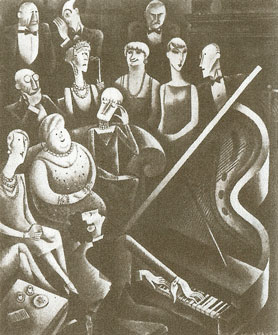
Image (a cartoon from Vanity Fair in 1929) swiped from here.
Friday, October 05, 2007
Scenes from the death of classical music #1
"So, do you think we'll be playing Julian Anderson in 100 years?" a violinist friend asked me last night in the break during our rehearsal for the next KSO concert. Well, will we? Does it matter?
The shortest and probably most honest answer is "I don't know". Who can possibly say with certainty what will and won't be heard in a century? Acclaim in your own lifetime is no guarantee of an equal posthumous reputation - just ask Spohr, Clementi, and any number of other dead also-rans. Who can even say with certainty whether the symphony orchestra will still exist as a performing group? (I have my doubts about this.)
Does it matter? One one level, not at all, as I'll be long dead by then. On another level, it matters immensely, as I'm a composer, and no matter what I may say, I'll always have one eye on posterity. At least some of the motivation for creating anything, whether it be art, music, a building, social reform, whatever, is ego-driven: the desire for immortality. At a tangent to this is professional envy - I don't want some other bugger being remembered if I'm not.
I hope he isn't. This isn't anything to do with him or my opinion of his music. Up until comparatively recently it was normal for a composer to be forgotten after his death, because it was normal to have new music. But something happened in the 19th century, starting with Beethoven - the first composer whose work remained in the standard repertoire after his death, and has never left it* - and now new music is seen as at best novelty, at worst something to be actively avoided. There's too much posterity now. We need to remember to forget. Then there will be room for new musics. Otherwise classical music is just an embalmed corpse. Embalmed corpses are of course interesting to study, but they don't make very good conversationalists. I'd rather spend time with the living.
*"Beethoven started the rot", said Britten. Messiaen on the other hand speculated that music went wrong sometime in the 11th or 12th century, roughly when we started to write it down.




