Sunday, May 31, 2009

Haydn

For any number or combination of players. Everyone works through the sequence at their own pace, moving on to the next bar when they feel they have explored the previous one fully. The notes may be played in any register at any speed. Repeat each bar/grouping as many times as seems right. When each player reaches the final D they hold it until everyone is there, then all crescendo and finish.

Two variants are below. They use exactly the same sequence of notes (derived from the keys of Haydn's symphonies). Both variants may be performed simultaneously. Other variants may be devised and played with or without others. The "chords" in Variant 2 are not intended necessarily to be sounded together, though they may be, in part or in full, as the performers please.


variant:

Thursday, May 21, 2009

Rambling on my mind

I've got a very long, rambling post about Mahler sitting in my drafts folder yet. I keep looking at it and wondering how to make it more coherent. Or even if I should post it up. it's kind of personal. Oh well, we'll see. Look, a cat!

Wired for sound

Sunday, May 17, 2009

Schoenberg, Marquis of Granby


Schoenberg, Marquis of Granby
Originally uploaded by petemaskreplica.

Who knew?

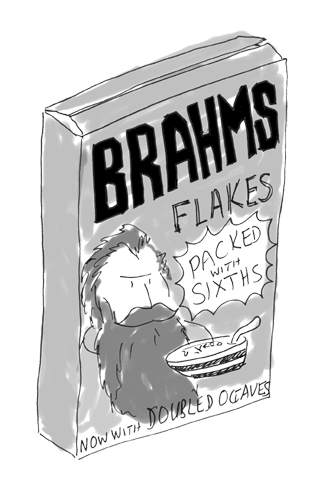
Commercial Break: Brahms

Saturday, May 16, 2009

Sprouts

I'll get back to Mahler in a minute. It's a tricky subject, it'll take a while. But it rarely if ever stands still round here, and I must now think hard about what to writ about the next KSO gig. It's always tricky making that start. It's a matter of finding that thing that brings it all into focus. It might be a quote, it might be one of those random sudden moments of clarity where you suddenly see what it's all about.

Elgar, Strauss (ugh), Brahms.

I have decided that this time, it's all about facial hair.

Wednesday, May 13, 2009

Programme notes: Mahler Symphony No.9

Here's the note I wrote for KSO's concert on Monday. I'll probably have more to say about Mahler later.

Gustav Mahler (1860-1911)
Symphony No.9

1. Andante comodo
2. Im Tempo eines gemächlichen Ländlers (Etwas täppisch und sehr derb) (In the speed of a leisurely Ländler [folk-dance] (somewhat clumsy and very crude)
3. Rondo – Burleske
4. Adagio


“…So in the first place it is completely untrue that any affaires have brought me down. I have not been brought down at all. I am leaving of my own accord because I wish to have complete independence… after ten years of hard work I have decided to leave a post which has remained mine to keep, right up to the moment of my final decision; of that I can assure you most decidedly.”

Not the words of a disgraced cabinet minister fending off accusations of misconduct, but part of an interview that Gustav Mahler gave to the Neues Wiener Tagblatt in June 1907, following his resignation from the Vienna State Opera. Disquiet about the way the House was managed had been growing over several years. Direktor Mahler became the focus of a campaign that made uncomfortable accusations about the artistic direction of the House, as well as its financial management. Many asked why Mahler was drawing an exorbitant salary from an opera house that was going to rack and ruin while hawking his own compositions on long foreign tours.

Then as now, a superstar conductor who seemed less than wholeheartedly committed to his prominent, well-paid job was sure to provoke resentment. But the complaints were the result of more than artistic or economic concerns. Anti-Semitism was rife throughout Vienna and Europe at the turn of the twentieth century. Mahler was acutely aware of this. He had had to deny his own roots and convert to Catholicism in order to obtain the post in Vienna. He once commented, “I am thrice homeless, as a native of Bohemia in Austria, as an Austrian amongst Germans, as a Jew throughout the world. Always an intruder, never welcomed.”

Having jumped before he was pushed, Mahler wasted no time: even before his resignation was officially accepted, newspapers announced that he had been appointed to conduct at the Metropolitan Opera in New York. No wonder he felt able to be so bullish in his public comments about his departure from Vienna. But his fortunes were about to take a turn for the worse. In July 1907 Mahler’s elder daughter Maria-Anna contracted diphtheria and died suddenly, aged five. A few days later his doctor diagnosed a disease of the cardiovascular valves and ordered him to limit his physical activity. The condition was not deadly; Mahler’s doctor almost certainly exaggerated the gravity of the situation, in order to persuade his workaholic patient to limit his routines. Nevertheless, these two blows hot on the heels of the plotting in Vienna left Mahler devastated.

The trauma of all this is reflected in the vast triptych of works he composed between 1907 and his own death in 1911: the song-symphony Das Lied von der Erde [The Song of the Earth], the ninth symphony and the unfinished tenth.

It is ironic that the piece we hear tonight was his last completed work: A common superstition of the time was that following Beethoven’s epic final symphony, and Bruckner’s death weeks from completing his, nine symphonies represented some kind of limit. To go beyond this number was to search after knowledge forbidden to mortals. Mahler, a man of his time, was not immune to such thoughts, and shied away from numbering Das Lied von der Erde as his ninth symphony – which, it is clear from his letters, is what he considered it to be. He then began what we know as his Symphony No.9, consoling himself that as it was really his tenth, he had circumnavigated the issue. Tempting fate rarely ends well.

The symphony’s design is unusual: two vast, largely slow movements, between which come two shorter interludes. The main theme, heard after a stuttering, unsure opening, is filled with an insatiable longing, always stretching out for a resolution, never quite finding it. It carries on almost directly from the closing bars of Das Lied von der Erde’s ‘Abschied’ [Farewell], to the extent that it almost seems like an instrumental commentary on the vocal work. Over and over the music reaches for joy and triumph, and over and over it is battered into numbness. Towards the end of the movement a solo violin transforms the main theme into an ironic quotation of Johann Strauss’s waltz Freut euch des Lebens! [“Rejoice in Life!”]

If the opening represents crisis, the subsequent movements may stand for the classic pattern of reaction to grief: denial, anger, resignation and acceptance. The second movement is based on the traditional Austrian country waltz, the Ländler. This had always been a symbol for Mahler of the joys of life, of simple revelry and love of nature, but here it becomes something else: the joy has gone, and what is left is an empty and shallow distraction.

The subtitle “Burleske” suggests more distraction. But in contrast to the disconnected Ländler, this extraordinary outburst throws the listener into a seething mass of activity. Having left Vienna for New York, Mahler had quickly fallen out with the management of the Metropolitan Opera, and left for the New York Philharmonic, which he also fell out with. It is tempting to see a reflection of this professional turbulence and hyperactivity here. The music strains and splinters at the edges in a complex mass of sound that teeters on the edge of chaos. For a brief moment the clouds roll back and a glimpse of hope emerges. But it is a mirage, and eventually the restraints are broken and the movement races out of control to its car-crash conclusion.

The distractions cannot continue, and the finale returns to the world of the opening movement, at once lushly beautiful and filled with anguish. The main theme’s allusion to “Abide With Me” may or may not be intentional, but the reference is entirely appropriate. The vision from the Burleske returns, now merely a memory. Later there is one more quotation, from the fourth of his Kindertotenlieder [Songs on the Death of Children], ‘Oft denk’isch, sie sind nur ausgegangen’ [Often I think they’ve just gone out]:

“Wir holen sie auf jenen Höh’n
Im Sonnenschein! Der Tag ist schön auf jenen Höh’n!”
[We’ll go and fetch them up on the hills
In the sunshine! It’s a beautiful day up on the hills!].
From here everything retreats slowly to silence, and in the last moments, a suggestion of acceptance.

Friday, May 08, 2009

Old Fart at Play

I resent the caution that comes with age.

When you're young you're reckless. You don't think about the consequences of your actions. You don't wonder if the idea's any good — it doesn't even occur to you that an idea you've had might not be. You just plow on, what the hell. If everything goes to shit, oh well — the next idea's here already, and this one's brilliant.

As you grow older, you question your ideas. I've heard it said that you get fewer, but I don't think this is so: I think it's more that you accept each one less uncritically, you question, and fewer get past that initial thought and make it to something realised. This isn't necessarily bad, of course. It's got something to do with wisdom, the experience that enables you to dismiss the idea that isn't going to go anywhere. You learn to conserve energy, because you don't have so much. You think of the boundless energy you had when you were young, and stupid, and thoughtless, and profligate in your thoughts, and wish you had that energy now, now that you've got the wisdom to expend it on valuable activities more than frivolous ones.

There's more to it than that, though. Sometimes I start to think, is this wisdom stopping me doing this? Or the complacency that received wisdom generates? Or is it fear? Growing older you learn the tricks, you negotiate the traps better, you avoid the failures. But failure's not always such a bad thing is it? Sometimes the mistakes are more valuable than the assured, competent execution, because they shake you out of your viewpoint. Sometimes they can give you that sudden realisation that there's another way to do things, that you hadn't thought of before. That's what keeps music, or any art, alive.

Of course sometimes mistakes are just shit and you're wasting your time, but you've got to take the risk.

That's what I resent about the caution. It stops you fucking up, but it can also stop the interesting fucking up that real proper actual art comes from. It's easy to learn, harder to un-learn.

Saturday, April 25, 2009

Heiner Goebbels: Songs from Wars I have seen (QEH)

It's an essential part of the contemporary so-called-classical scene that the show you're at will overrun. A good yardstick of the quality of what you've been listening to is therefore how much that irritates you. I found myself not at all bothered by the fact on this occasion, so well done Heiner*.

To be fair, at least part of the overrun was down to the man who walked on and announced "My name is Andrew Burke Chief Executive of the London Sinfonietta" (how remarkable to have a name that suits your job, I thought) and proceeded to beg for money in that way that people desperate for money who don't want you to have the impression they're begging for it do. A lot of talk of wanting to connect with those who buy their tickets on the door (subtext: please book in advance, we've been shitting brick about advance sales), building relationships with their audiences (subtext: we're really worried about how the hell we get people to come to these things) and so on. All couched in friendly, "hey, we love you and we want to connect" language, but going on slightly too long not to come across as a bit desperate. Maybe I'm completely wrong, the London Sinfonietta feels completely recession-proof and has a mailing list as long as your arm, but it sure as hell didn't come across that way.

I have a problem with the London Sinfonietta; they make me slightly suspicious. Partly this is because they're the Establishment: I think of what Morton Feldman said, that the music you hear in London sounds official, like it was written for the London Sinfonietta. And the Establishment can't ever do anything really innovative or different, because innovation and difference challenges the established order. It's hide-bound by its position, by the deadweight of the one-of-each-instrument lineup that fills so much of its repertoire, from which so little interesting comes. Then there are things like those collaboration nights with Warp Records, which seem slightly pointless: is the Sinfonietta desperately chasing after the cool kids, or is it saying that by rearranging electronica for "classical" forces it's conferring a greater artistic legitimacy on it than it otherwise has? Which would seem to imply some level of contempt for the other, cooler music. The classical world is infested with the notion that its music is inherently better than any other kind.**

That said, it would be dumb to dismiss anything they do because of who they are, and tonight's concert of two pieces by Heiner Goebbels is an impressive one that shows that there's still life in this thing if you're clever enough to know where to look. Which Goebbels is. He understands that this genre of ours is essentially dramatic (why else dos it take place on a stage?) and both the pieces here are to some degree overtly theatrical. The use of samples of other records, as well as quotations of other musics performed by the musicians, emphasises this. It's to Goebbels' credit that these elements don't distract - although it's impossible not to have a moment of trying to remember where that drum loop's from - but manage to integrate in a way that earlier stylistic cross-dressers like Schnittke don't really manage, so the flow from tonality to atonality, from baroque to postwar modernism and back comes to seem natural.

Maybe this just where I'm coming from these days, but it's at its most impressive when there's less going on. "Songs of Wars I have seen" underpins Gertrude Stein's words with subtle, elusive sounds that seem to drift in and out of focus, lending a dreamlike quality. The combination of modern instruments with the period ones of the OAE lends another layer: the quieter baroque strings and winds lend an inward quality. Having the narration provided by the musicians rather than actors or singers is a masterstroke. It helps draw the listener in, almost as though we're being read bedtime stories. It manages to be hugely evocative without ever labouring to make a point. And the final moments, when a lone trumpet spins a melody over the ringing of prayer-bowls, coming over like Miles Davis sounding the last post, are magical, intimate and tender.


*I'm being over-familiar there. I don't actually know him or anything.

**Plus they don't play my stuff. Motherfuckers.

Sunday, April 19, 2009

Trapped in the aviary

Hell, I swore I wouldn't do this, but I ended up crawling back onto Twatter again. If you're one of the 3 people (apart from my parents, I should imagine) who've never heard of it, it's kind of like blogging for people too lazy to write a whole paragraph. It's clearly vile and narcissistic, but equally clearly an easy way to massage my monstrously huge ego.

Every day we get nearer to the logical conclusion of the interweb networking madness, where everyone in the world simply hits a button every few minutes to make the message "LOOK AT ME! LOOK AT ME! I'M ON THE INTERNET! LOOK AT ME!" appear on www.ihavenothingtosaybutthat'snotgoingtostopme.com. If I had any sense I'd set the damn thing up myself, wait for the inevitable rush, and then sell it to Murdoch or whoever for a fucking fortune, just as the Guardian picks up on it (which is always a sure-fire sign that something is over).

Still, it beats doing anything constructive.

Tuesday, April 14, 2009

Good Friday


Saturday, April 04, 2009

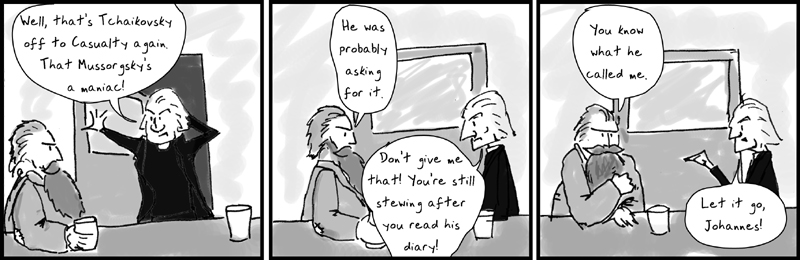
Brahms and Liszt: The Russians are Coming (2)

Eliza Carthy, Mick Jagger Centre

I don't mean to be rude, but Dartford really is a horrible place. In my kinder moments I think of it as being what Brighton would be like if it wasn't next to the sea. But that makes it sound nicer than it is.

No matter, because we're here in the arse end of nowhere to see the splendid Eliza Carthy at the Mick Jagger Centre.

Mick Jagger's from Dartford, you know. He set this arts centre up. you know. They sure as hell don't let you forget who paid for the place. The walls are festooned with murals of Mick's face with its big mouth, and everyone working there wears a T-shirt with Mick's face with its big mouth. Sorry, that's Sir Mick. I'm sure he wouldn't want us to forget that.

Having attempted to negotiate the giant roundabout full of chavs being stalked by the police and arrived late, we find everyone else milling about, There are technical problems. Eventually we get into the hall and settle down for the support, the trickily punctuated mawkin:causley.

They're good. We like them. They play good music well. It's a nicely put together sound. I'd probably have bought their new CD if it had been on sale in the foyer afterwards. But there's something not quite there. I can't quite put my finger on what it was. It's that edge. They're a bit polite and tame. I wish they were a bit rougher and sparky. To be fair, they're not helped by the audience, which is as flat a crowd as I've seen in a while. Somehow I expected the audience at an Eliza Carthy gig to be reasonably young, but I find myself in a position I rarely do these days outside a classical gig: I'm bringing the average age down. Age is no excuse for being as subdued as this, though. "Good evening!" the lead singer says. "Good evening." they mumble back politely. "How are you?" he asks. "mmmwmmmwfffverywellthankyou," is the gist of the murmur that follows. It's like a primary school assembly, only with pensioners. Is this what they mean by second childhood? Maybe it's just what Dartford does to you.

Eliza Carthy does have that thing I can't put my finger on. Ah yes, I remember: presence. There's that extra bit of electricity in the air from the moment she appears, the sort that comes from being experienced and utterly confident at this.

Unfortunately the technical gremlins are still hanging about, and there's a bit of a hiatus just as the band's warming up: microphone problems threaten to put a halt to the set altogether. She handles it well - I'm not sure I'd stay so level-headed in this sort of situation - and manages somehow to give the impression that the gig's still happening when it's clearly not. Eventually they manage to sport things out, but by then there's been some momentum lost and there's a bit of a sag until they get back into the swing of things. That may also be partly because by then I'm feeling a bit hot and stuffy though. It may also be the continuing lack of audience reaction -just a smattering of polite applause between songs. I wouldn't want to have to work this crowd, it's like a morgue. Or a classical concert. It's OK though: by the end the energy's all back again, and we even get an excellent encore about blow jobs to send us out into the night, where the pubs are starting to empty out. We get the fuck out of Dartford.

Friday, April 03, 2009

A dog's life

Once upon a time, Man and Wolf came to an accommodation: Man provided food and shelter, and in return Wolf became dog and provided companionship and protection. Over time Man realised that he could manipulate dog to become all kinds of useful shapes.

Eventually the uses themselves disappeared, but the shapes remained. Nobody could remember why that particular dog was that particular shape and had those particular features emphasised, only that it was good and desirable that it should be so.

So the dogs kept being bred into more and more unlikely shapes, until eventually they ended up wonderful to behold, but completely impractical, and so far removed from their wolvish origins that they were incapable of surviving without Man to provide food and shelter.

Then one day Man decided to stop feeding dog and kicked him out, and he died a slow, painful death from starvation and neglect.

And that's pretty much the story of (so-called) classical music.

Why don't young people listen to classical music?

Well, why should they?

Thursday, April 02, 2009

Post-It Score #3: Blue

The thing about Post-its is that they come in different colours:

After I did this one, I started wondering to myself: is the mood determined b the colour or the colour by the mood? So here's the same image on yellow. Does it make a difference?


Tuesday, March 31, 2009

Post-It Score #2


Land, sea and sky (?)
(or whatever you want to see)

Saturday, March 28, 2009

Brahms and Liszt: The Russians are Coming (1)

Post-It Score

A slow day, a doodle, a vague desire to do something a bit loose... who needs staves anyway?

Thursday, March 26, 2009

Collective nouns for orchestral musicians

I've got a soft spot for collective nouns. Apparently they were all made up by some vicar in the nineteenth century or something, but so what. I like the random yet strangely appropriate feel of things like a pride of lions or a murder of crows. But what of the world of musicians, I hear you ask?* Well, I@m glad you asked.** because I've been wondering about that too. Here's a few possibilities:

An oversubscription of flutes

a mallard of oboes

an intonation of trumpets

a flatulence of trombones

an accelleration of percussionists

a payment of harps

a hubris of first violins

a neurosis of second violins

an oppression of violas

an indulgence of cellos

Any more? I've been concentrating on orchestral sections, but there must be some good ideas out there for drummers too, at least.


* I know you didn't. So what?
** see above.

Saturday, March 21, 2009

Survival strategies for the average composer (6)

6: Play music

This actually happened the other day. The words are a paraphrase, but the gist of the conversation is exact:

Girl 1: My partner is a composer, he writes music.

Girl 2: What does he play?

Girl 1: Oh, he doesn't play anything.

And there you have in a nutshell one of the biggest things that's gone wrong with so-called classical music in the past century or so.

We're very clever, us composers*, with our writing-things-down behaviour. You can do lots of impressive, complex things written down, sometimes so complicated that no-one can actually play them. There's a difference between pushing a player's technique and stamping all over it, and the only way you'll learn the difference is if you play music yourself.

As I typed that last sentence I horrified myself. Does it really need to be said that you should play? Well apparently it does. Theory's all well and good - hell, I'm full of theories - but practice is what really matters. Notations and systems and scores can blind you to the most important thing: Music isn't an object. It's an activity. There may be something more perverse you can do than write music while not performing it, but I can't think what it might be.

*"Composers" here refers specifically to people writing down stuff in the tradition of Western European "Art" music. I'm not sure other musical traditions make this sort of distinction.

Thursday, March 19, 2009

Capital Moments

Spring has sprung, it seems. Out for a walk at lunchtime in the West End, the sky is brilliant blue and there seems to be that indefinable sense of everyone being a little bit happier. I walk down Berwick Street, pick up a bit of veg. "Cheers mate," I say to the vegetable man in that Mockney way I've learned over a decade in the capital. I try hard not to look over the shoulder of the girl standing at the bottom of the street drawing the sex shop opposite, because I'm on a mission, and have to be back at the office in 40 minutes. I swing across towards the London Graphics centre to pick up a few drawing implements, when suddenly I'm confronted with the sight of an enormous dildo on top of the Palace Theatre:


A few steps further reveals the truth: it's just a giant stiletto heel advertising the new musical version of Priscilla, Queen of the Desert.


Just another normal day, then. I move on, pausing only briefly to reflect on the fact that it didn't seem terribly bizarre to have a giant dildo on top of the Palace Theatre. As I walk back to the office, I pass the girl, still intently sketching the sex shop at the corner of Walker's Court. Once, when I was a child, this place was the Soho sex industry. Now it's just another back street full of porn and what we then called marital aids. But it still retains that whiff of scandal, even amid the gentrification that seeps into it. I consider the walkers, and where they may now be. Then continue back to the office, pausing only to linger and gaze at other temptations offered for sale