One of the problems for a composer trying to write a programme note is that the experience of listening to a piece of music is almost the precise opposite of the experience of writing it. When you compose, you begin with an idea, a concept of what impression you want the piece to give. The process of producing the music is then a process of unpacking this idea, expanding it and rolling it out into a time span. The listener does this process more or less backwards: over the time span, he or she absorbs the notes, the textures and so on and (if the composer’s done the job well) at the end will have a concept of the work in the mind (which may bear a greater or lesser similarity to the concept the composer had in the fist place). Moreover, what concerns and interests a composer in the act of writing isn’t necessarily what concerns the listener. The composer is concerned with processes: how do I put things together so a to realise this idea of sound? Of course, once he’s worked this out he feels very excited and pleased, and wants to tell people how he did it. But that’s exactly what a listener doesn’t need or want to know. Roberto Gerhard wrote, “Understanding comes first; knowledge second.” There’s a fundamental mistake that’s made all the time in the classical music world: people who like classical music know a lot about it, gos the reasoning, so if you tell people a lot about it they’ll like it. In fact what happens is that if you bombard people with technical detail they start to think that unless they know about it they can’t possibly like or even begin to listen to it. If people like a piece they may well find out more about it, and they may get into the nitty gritty of theory and technique, but that’s for later. Programme notes in which the composer drones on about the clever technical devices he used to write the piece are therefore the biggest turn off imaginable, and such notes often lose the audience’s sympathy before they’ve heard a note.
Wednesday, June 01, 2011
Tuesday, May 31, 2011
Essays before a composition (1)
When I was young I discovered the record section of Birmingham Central Library (something that sadly would be all but impossible now in more than one way, and will become utterly impossible if this government gets its way). I discovered many things within those thing cardboard sleeves, sounds that I’d never heard or imagined could be made. I devoured Nielsen’s symphonies, Stockhausen’s Telemusik and Miles Davies’ Bitches Brew with equal enthusiasm, if not immediate understanding. I pored over the sleeve notes for the Stockhausen. They were all but impenetrable, and if I’d been relying on them to guide me into the music I doubt I’d have made it far. Fortunately I just liked the sounds and didn’t worry about what I was supposed to think about them. It was gratifying years later to hear Stockhausen himself introduce his music. His advice on how to listen to his music mentioned nothing of tone rows or retrograde inversions, but boiled down to: you will hear some sounds. Listen to them and hear what happens to them. It turned out Karlheinz was a lot easier to get my head round than Miles.
Friday, February 11, 2011
Ben Johnston: String Quartets 1, 5 and 10 (Kepler Quartet; New World Records)

This time, the Keplers present Johnston's first and last quartets, together with one from the middle of the sequence. The Fifth Quartet opens the disc, and is quite simply one of the most astonishing pieces of music I've heard in a very long time. It's a set of variations on the Appalachian song "Lonesome Valley," and in this respect is a natural successor to the Fourth Quartet (included on the previous release), which is a set of variations on "Amazing Grace." Whereas that quartet expanded the harmonic language to include harmonies derived from the seventh partial, the slightly "flat" seventh that lies just outside the normal scope of conventional Western harmony, this one goes further, deriving its sound world from the distinctly more alien intervals to be found at the 11th and 13th limits. The effect is ambiguous and unsettling to ears used only to the "major-minor" standard Western harmony. The "Lonesome Valley" of the song's title is the"Valley of the Shadow of Death", and the quartet is not merely a clever exercise in weird harmony; it's a profound and disquieting mediation on death that resonates in the mind long after it's over. The piece dates from the 1970s, but feels like something from the distant future, while at the same time speaking with an ancient voice.
Johnston's tenth and most likely final quartet (although still very much with us, he's in frail health and hasn't composed for some years now) belongs to a later style, which might be described as revisionist. Here he explicitly draws on old models such as Haydn, not as pastiche, but as a way of exploring how Western music might have developed had we not locked down our tuning system to a twelve note scale sometime around 1600. This quartet dates from 1995, but paradoxically feels like the work of someone younger. it's an energetic, smart and witty piece, ebullient and extrovert where the fifth is inward and contemplative. The last movement acts as a kind of précis of the history of music, beginning in quasi-medieval mode. It eventually turns out that the movement is another set of variations on a famous tune - a tune so famous, in fact, that's it's a high risk strategy to use it, as in lesser hands the point where its identity is revealed could be a moment of appalling kitsch. In the event, it's a wonderful coup de théâtre that will leave all but the most curmudgeonly listener with an enormous grin on their face.
The final work on the disc is Johnston's First Quartet, the only one of the cycle not written in JI, and perhaps something of a period piece in its post-Webern serial style, typical of its 50s origins. The experience of learning to pitch the exotic intervals in the later quartets has clearly paid off though, because the Kepler's performance brings a luminous quality that makes the piece (another set of variations, though of a much less obvious sort) seem much more voluptuous and much less "difficult" than this sort of music is commonly characterised as being.
If the earlier disc of the second, third, fourth and ninth quartets was a revelation, this set of three is no less so, and confirms that Johnston's is one of the finest and richest quartet cycles of the 20th century. It's to be fervently hoped that the Kepler Quartet manage to raise the funds to complete the cycle (including the so-far unperformed Seventh Quartet, one of the most complex and adventurous things Johnston has written). In the meantime, anyone who cares about music and what it's capable of should immerse themselves in these extraordinary works. All three of these quartets are stunning, but for me it's the Fifth which is the standout, a genuinely overwhelming experience not quite like anything else you've heard.
Tuesday, March 23, 2010
They all move slowly towards a bright light

Image generated by random pausing of Windows Media Player while playing this excellent CD.
Monday, March 01, 2010
Have One On Me
There are probably some naive souls who'll listen to Joanna Newsom's new album on its own merits and conclude that she's a singular talent who doesn't need to be lazily compared to other female singers. But none of these people will be music journalists. As everyone who knows anything knows, all women in rock and pop can and must be compared to a very small number of other women. Using this simple equation we can construct a compass which enables us to categorise all female artists without having to think about it very much. So rather than say anything genuinely insightful about Ms Newsom's excellent new release, I offer this handy graphic depiction of where she's come from and where she's at, as derived from sundry reviews of the record:
Thursday, December 31, 2009
We're all retro now

Everyone and his dog seems to be drawing up lists of their favourite/ the best (pretty much interchangeable terms in fact) records of the past 10 years . I hesitate to do it too, because most of them are fairly uninteresting. But what the hell, opinions are like arseholes, and we all seem to like displaying them on the web, so here's a random selection of recordings I've picked up since 2000 that have touched me in some way. Not all of them originate from the past decade. Some were reissued, some are ancient things that I just didn't come across before. I make no claims to this being a list of the best or most innovative or fashionable or zeitgeisty or whatever you think a record ought to be. They're just things that came by at the right time and made some sort of impact on me. Being the right thing at the right time is what makes a great record. The fragmentation of public taste, the explosion of media that's happened lately means that big "event" records that mean a great deal to a sizable proportion of the population are becoming rarer. We all have to find our own milestones now. Some of us have always worked that way.
John Luther Adams: The Light That Fills the World
Beethoven in the Temperaments
Six Degrees of Tonality
Björk: Medúlla
The Bowmans: Far From Home / The Bowmans
Sam Brown: Ukulele and Voice
Bruckner: Symphony No.9 with reconstructed finale (Sinfonieorchester Aachen, cond. Marcus Bosch)
Kate Bush: Aerial
R. Crumb's Heroes of Blues, Jazz and Country
Smog: A River Ain't too Much to Love
Eliza Carthy: Dreams of Breathing Underwater
Tounami Diabaté: The Mandé Variations
Bob Dylan: Love and Theft
Julius Eastman: Unjust Malaise
The Fall: The Unutterable
The Feelies: Crazy Rhythms
Morton Feldman: String Quartet No.2 (Flux Quartet)
Fleet Foxes
Flight of the Conchords
PJ Harvey: White Chalk
Grinderman
Schoenberg: Violin Concerto (Hilary Hahn)
Glenn Gould: The Solitude Trilogy
The Imagined Village
Ben Johnston: String Quartets No.s 2, 3, 4 and 9
Elizabeth Maconchy: Complete String Quartets
Lubica Marić: Byzantine Concerto etc.
The Mules: Save Your Face
Joanna Newsom: The Milk-Eyed Mender
Harry Partch: The Wayward / 17 Lyrics of Li-Po
Radiohead: Kid A
Rasputina: Frustration Plantation
Zeitkratzer: Metal Machine Music
Kronos Quartet: Floodplain
Bella Hardy: Night Visiting
Viktor Ullmann: Symphonies/ Piano Sonatas
Vialka: Plus vite que la musique
Tom Waits: Real Gone
Scott Walker: The Drift
M Ward: Transfiguration of Vincent
Brian Wilson: Smile
Amy Winehouse: Back to Black
Cantigas de Santa Maria
Kathryn Williams & Neill MacColl: Two
Enough with the back-glances. Happy New Year, everyone, maybe time to push things forward in 2010.
Friday, June 12, 2009
A mute point
"it is more expensive," said the man in the shop as I contemplated the £7 rubber practice mute or the £25 (shiny!) metal one. "But - I play violin, and I find with the rubber one the sound's quite fuzzy. with the metal one you get more clarity of tone."
Easy decision, then. I bought the rubber one. Sounds much more interesting.
Tuesday, April 14, 2009


Tuesday, October 14, 2008
More thoughts on Haydn
 I'm entering the final stage of my trek through Haydn's symphonies, in the early 80's now, and the landmarks are starting to seem familiar as those works that are better known - the big, public works for Paris and London after the years of splendid isolation at Esterhazy - loom into view.
Saturday, September 06, 2008
Stuck in the middle with you

Doing the washing up, I find my head filled with "Do-Re-Mi" from the Sound of Music. You know the one, the song that gives cutesy names and puns to all the notes of the diatonic scale. Except one.
"La - a note to follow So [sew]."
That's the sixth, what's technically known as the submediant, and Rodgers and Hammerstein hold it in such contempt that they can't even be bothered to think up a decent line. It's nothing special, La, it's just a stopping place on the way from the bright lights of So to the glittering wonders of Ti (a drink with jam and bread). Sort of like a motorway service station - you need the facilities, but you wouldn't choose to go there if you had any real choice in the matter.
Even the technical term's an insult - submediant, i.e. like the mediant, only not as good. Don't get any ideas above your station, Mr Sixth, we're only hanging round with you because we can't get close to the mediant for all the cool kids crowding him as he determines major and minor.
It doesn't get any better when you consider the unfortunate interval from a tonal perspective, either. In the tonal hierarchy, the submediant is the location of the relative minor key. Now, you may think the minor mode's proved its popularity over the years, but consider this: When you're in a major key, you modulate to the dominant. The exciting, virile, even more major dominant. Never to the relative minor. Yet when you begin in a minor key, the accepted path is to get away as quickly as possible to the relative major (which is located in the prime territory of the mediant. Yes, the Mr Big Shot mediant, so much more U than the boring old submediant. Who'd want to go there, eh? It's the tonal equivalent of Wolverhampton.
Not everyone hates the submediant - Brahms loved nothing better than to pile the sixths on, and there's a wonderful bit in the finale of Beethoven's Choral Symphony, when a massive dominant chord is emptied of its harmony, and then the single note left behind is reinterpreted in a new context, which swings the tonality unexpectedly towards the submediant key. It's an awe-inspiring moment, although Beethoven ruins it by prancing off on a thoroughly silly march, so maybe he didn't like our middling friend so much after all.
Well, I say it's time to stick up for the little guy. What's so bloody great about all these so-called perfect intervals, anyway? Let's hear it for the submediant - the tone that's not afraid to be different.
Friday, July 11, 2008
Judas
They've just finished the second song, and the crowd seem restless. There's a lot of slow clapping going on. They carry on, anyway. The sound's raw, loud, kind of sloppy. But it's exciting and immediate too. At least that's how it sounds to me. I'm not hearing it like those unhappy people in the audience, a sinking in that we're not in Kansas anymore. I know I'm not in Kansas anymore, I wasn't even born when we left.
There's some enthusiastic cheering as they reach the end of song 3. So it's not a given that what they're doing is alienating. Some people like it.
It really is loud, though. I want to turn the volume down on my earphones (an option not available to the people in the hall), but I'm going to stick it out, because there's a thrill in it, a sense that I'm transgressing something, even though it's only in my own mind (and whatever tinny hiss is escaping my headphones and reaching those at the desks next to me).
The slow hand-clapping starts off, and he tails off his introduction to the next song... the audience falls silent, and he continues. The cat-calls resume, and are starting to grow. There's a definite air of menace. I can only hear, of course, but it sounds fair to say the audience is divided.
Well, that one seemed to push them a bit far. The guitarist's tuning, and the jeering is growing. The singer is mumbling into his mike, speaking nonsense as far as I can tell. Eventually the claps subside as people realise he's talking and they can't hear what he's saying: "...mblmblmblmblmblif you only wouldn't clap so hard." There's a smatter of applause at this, so I guess he still has his supporters, they haven't all turned against him.
The thing is, you can't really tell what the audience is doing during the songs, because it really is fucken loud.
The guitarist is tuning again now, and the atmosphere really does sound like it's getting ugly. The piano starts off, and this song' different to the rest; where there's been a lot of exuberance before, now there's palpable menace, the hostility in the audience reflected back at them. "Something is happening, and you don't know what it is..."
They finish, there's more heckling, the audience laughs. One man shouts out. He's just saying what he thinks, he doesn't know he's just become part of a myth.
The singer's exasperated. "I don't believe you!". Then he realises the literal meaning of what he's just said. "You're a liar!"
Then, to the band:
"Play it fucking loud!"
How does it feel?
Thrilling.
(There's some clapping at the end. A few stuck it out, then. Animated discussion. The national anthem comes across the tannoy. Then the tape cuts out.)
(Seems someone's always upset about something, aren't they?)
(Now go here.)
Wednesday, July 09, 2008
Eight Songs for a Mad King
 A heated debate on the Grauniad blogs in response to an article by Joe Queenan on why all modern SCCM* is rubbish (of course I put my tuppenceworth in) takes me back to when I was 11 or 12 and encountered my first bit of real, proper, honest-to-god modern music: Peter Maxwell Davies' Eight Songs for a Mad King.
It was an LP in school, performed by the excitingly named Fires of London, conducted by the composer and with a chap called Julius Eastman singing (well, vocalising, anyway) and it was one of the most extraordinary things I had ever heard. I started off laughing, then being delighted at the extraordinary sounds that were coming out of the speakers, then finally captivated and shocked by the realisation that what I'd first taken for comedy was in fact searing horror.
I grew up in a house where music abounded, but I'd heard nothing like this: my parents' favourite composers were Mozart and Haydn, and the other sounds I heard were my brothers' and sister's rock and pop records. This was something entirely new: it was wild, crazy, untameable stuff, and it felt as though I'd lived a life in black and white** and suddenly been catapulted into the most garish technicolour imaginable.
I (and several of my friends) became obsessed with the piece; I ordered in the score from my local music shop and marvelled at it - it seemed to function as much as a work of art in itself as a set of instructions for which notes to play when. We harboured the idea that we might try and get hold of the parts, construct the giant cages in which the players sit, and perform it. We never did of course. I wish we had, though. It would almost certainly have been a terrible performance, but it would have been a hell of an exciting thing to do.
It's that feeling of intense excitement, that I'd discovered a new world and could never think of things in quite the same way ever again, that set me off on the road to this disreputable role we call "composer", and it's the feeling I still look for even now, which is why I still listen to new music and refuse to sink into comfortable middle-aged predictability. It's also why, when I want to explain what contemporary SCCM is and how magical it can be, I think of that record first.
*So-Called Classical Music
*Well, orange and brown; I grew up in the 70s, after all.
Tuesday, April 29, 2008
Portishead: Third

Parr-zed (as you call them if you actually come from Portishead) are also pretty much The Fall's polar opposite in terms of their style, too, but there's a connection in the way they've managed to revitalise their sound while remaining recognisably themselves - "always the same, always different".
What's remarkable about this album is the juxtaposition of two entirely different textures: most of the music is harsh and stark, underpinned by brutally minimalist beats, and this is thrown into sharp relief by Beth Gibbons's fragile, pleading vocals. The effect isn't too far removed from Scott Walker's latter-day stuff, and it's interesting that this album is getting a lot of positive mention where Tilt was received with bafflement by many when it came out. Maybe this is a sign of how we've moved on.
The other music that comes top my mind as I listen to this album is that of Galina Ustvolskaya - there's a similar feel of supplications to an indifferent God, humanity somewhere deep in the midst of a vast, uncaring machine of a universe.
This isn't easy listening - there'll be few dinner parties with this on in the background, as Portishead's first album was unfairly condemned to - but it's powerful stuff, that reveals itself more and more with each listen. And it takes a very special kind of confidence to be able to produce this stark, oppressive sound, and then throw a ukulele into the middle of it, as happens on "Deep Water".
Monday, April 28, 2008
The Fall: Imperial Wax Solvent
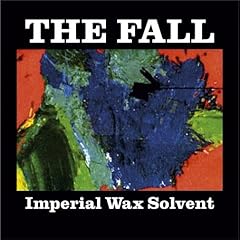
There are, apparently, still some people who remain wilfully blind to the genius of The Fall, and I suppose at this stage it's too late for them; I can only pity them and the drab lives they must lead.
Because there is not one band who has managed what Smith and his many cohorts have achieved: to sustain a career in this strange beast we call rock and roll for three decades that maintains an extraordinarily high quality level (I maintain they've never released a bad album: sure, there are Fall albums that are less good than the others, but their slightest effort is still several rungs above almost anyone else) and still retains its full creative force and originality.
Having established recent incarnations of The Fall as the Ur-garage band, Smith on this album seems to be playing with that sounds, pulling it apart and reconstructing it from the inside out. So what we get are a lot of startling jump cuts between textures and tempi, which seem to bring The Fall's latent Beefheart influence to the fore. now Beefheart's not someone you can emulate unless you're very sure of yourself, and of course The Fall manage to let that sound come out without ever once sounding like anything other than the Fall, which of course is the essence of their genius.
It's compelling, genuinely adult music ("I'm a 50-year old man, and I like it!" exclaims Smith) ; a big thick juicy steak of a record, in comparison to the thin gruel so many bands serve up. And it's great to dance to, too. The Fall come from the land of Northern Soul, remember; they understand the value of dancing.
Friday, April 04, 2008
Alone again with the dawn coming up
Thursday, April 03, 2008
chaos and beauty
 Lou Reed's Metal Machine Music, one of the more remarkable albums of the seventies, has always had a special place in my heart. It's, in essence, an hour of feedback, and is often voted somewhere near the top of lists of the worst albums ever made. When I was a sullen pretentious teenager this clearly made it a cause to be championed in my own contrary way. Hell, Ian Curtis had once said it was his favourite album, and it was, y'know, really loud.
Actually, there was always more to it than that, but my appreciation of it has only grown over the years as I've gotten old enough to drop the posturing nonsense, and heard enough of the right sort of music to begin to appreciate the place it occupies in the scheme of things. It's stating the obvious that it's in part the extreme logical conclusion to what Reed did with John Cale in the Velvet Underground, but there are deeper roots in there, in Cale and original Velvets drummer Angus MacLise's earlier work with LaMonte Young's Theater of Eternal Music.
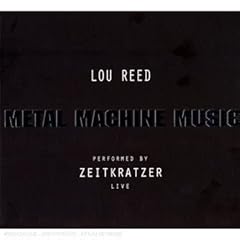 What got me thinking about it again was the remarkable CD by the German ensemble Zeitkratzer, who perform a painstakingly transcribed arrangement for acoustic instruments (joined in the latter stages by Reed himself on guitar). So what better way to follow this up by digging out the original for a comparison? And what better time to do this than a Thursday lunchtime?
The thing that strikes you coming back to it, is how un-atonal it is, in direct contradiction to its reputation. Reed knew this, of course - the deadpan sleeve note he specifies "avoidance of any type of atonality". The thing about feedback is, that it originates from the overtones in the source vibration, and so when you use specific open tunings, as Reed does to the guitars he used to record the album, you actually end up with something that has the sort of oblique tonal/modal feel that a lot of contemporary classical music references.
The other thing, quite unexpected if you're coming to it through its reputation, is that if you turn the volume down it's not harsh at all, simply a glittering web of melodies and harmonies, an energetic tumble of waves of notes dancing on the surface of a vast, deep ocean of drones.
It's always portrayed as a vicious, harsh, masculine "fuck you" record, but what keeps me coming back to it, and what should bring you to it, is the increasing realisation that it's a sensuous, beautiful piece of music. Try it with your sandwiches on a sunny day.
Sunday, December 02, 2007
Late Starters
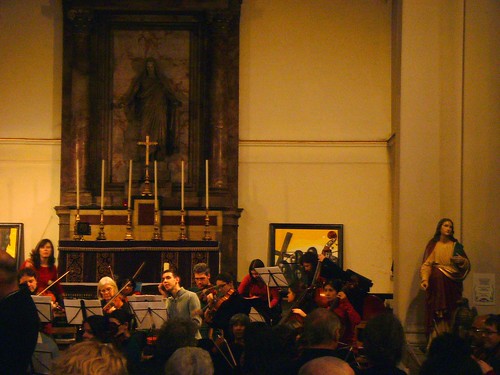
I've been playing the cello for over 30 years now, and composing nearly as long, so I ought to have some sort of handle on how this music lark works by now. But not everyone is as lucky as I was as a kid to have access to the wherewithal to pursue it, and the way music education is going there'll be even fewer in the future, so organisations like the East London Late Starters Orchestra are doing something very valuable. The idea is that people who've never had the opportunity to learn an instrument, or perhaps learned as a child then abandoned it for years, can have the opportunity to pick one up and have a go.
It's not really about the result (although of course all involved want to play the best they can), but about the act of getting up and doing it, I think; some of the players I hear had never touched an instrument until a couple of months ago, and to stand up and perform in public after that short a time takes a huge amount of guts, much more than I have certainly. And it also makes a statement that classical music isn't something obscure or difficult, to be the preserve of a few, but something that anyone can have in their life, if they want it.
There's such a strong vested interest in the music industry from professional bodies, record companies and the like that wants to promote music as a product to be passively consumed. This is so wrong. Music is an activity, something to be participated in, something to do, and it's this idea that really makes projects such as this important, not worrying about the "excellence" that ministers like to talk up (translation: leave it to the professionals, sit back, consume, buy, buy, don't think, BUY) but revelling in the act of creating it. Music's a social force, and that's what I bring away more than anything from this evening. There's little division between performers and audience; there's a unity of community, a joy and pleasure in the gathering together and the sharing of a moment.
Monday, November 26, 2007
On the Corner
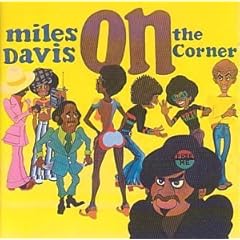
Its origins lie in Miles' realisation in the early '70s that jazz had been largely abandoned by young black kids, who were listening to Sly Stone and James Brown instead. He realised he needed to do something that would connect with them, speak to the kids on the street. So he made a funk album, of course. But being Miles, he couldn't make any old Stone-derived sound. He needed to bring something new to the party. And what he decided was the killer concept, that would bring his sound to the kids on the street was the ideas and processes of Karlheinz Stockhausen. Well, obviously.
I remember when I was a teenager first listening to Miles, and finding things like Bitches Brew bewildering, in a way probably only matched by Trout Mask Replica, another album it took me a long time to get my head round. But I always felt there was something in them, something that was just out of reach, that I needed to keep digging and find. Anything of real worth requires effort, because the effort makes the reward that much sweeter. So when Miles decides that what funk-jazz needs is the influence of the German avant-garde, god dammit, you've just got to go with it, because in the end you'll see he's right.
What Miles specifically takes from Stockhausen is his concept of space. On the Corner is an album that isn't much concerned with harmonic progressions, being on the surface a sequence of one-chord jams (or to be more accurate, cut and paste collages derived from one-chord jams). It's in the placing of the sounds that it gets its power, taking what could almost be described as a pointillist approach, short staccato phrases juxtaposed in varying combinations, never resting, always moving, but also static, creating a real sense of an environment in which we stay for a while. I'm reminded of the way Birtwistle describes many of his works, in terms of a single unchanging object viewed from changing perspectives.
If this sounds dauntingly intellectual, the effect on the ear is visceral and immediate (as is the actual music of Stockhausen and Birtwistle, if you ignore all the talking about it and just listen). Those foam-mouthed jazz-heads need to open up their perspectives and stop worrying about whether this is jazz or not. It's an extraordinary record that even now sounds like something that arrived in our midst from outer space.
Oh, did I mention that it's also damn funky?
Thursday, November 08, 2007
Raising Sand

Wednesday, October 10, 2007
In Rainbows
So, how much did you fork out for the new Radiohead album? Me, being the nerd I am, I forked out the forty quid for the big exciting box with books and pictures and extra music and lovely vinyl. So I have a posh bit of product to look forward to in 6 weeks or so. In the meantime, there's the download version, which I was emailed the link for this morning.
And hurrah! It's absolutely brilliant! What immediately strikes me at the first listen is that they've managed to combine their experimentalism with their undoubted knack for a good pop song in the killer way they've been threatening to for a while. So you've got twisted dance beats, weird retro-futurist sounds, but also big guitars and tunes. So it sounds more than anything like a band.
I ummed and ah-ed for a while about whether to have the big box, or whether to go for the pay-what-you-want download only option. I wonder what I'd have paid if I'd done the latter? Of course it's tempting to pay nothing, but that just seems wrong to me. I vaguely wondered about getting the download and then if I liked it going the whole hog, but in the end I decided to put my faith in them to deliver, and they've come through for me.
I think the way they've released "In Rainbows" is a fascinating experiment (apparently there'll be a conventional CD release next year), and I hope they give us an idea of how many people downloaded and what most people paid. They're lucky enough to be in a position where they can take a risk like this, and if it works, it'll have huge consequences for the record business and bands' relations with record labels.


