Showing posts with label innovation. Show all posts

Wednesday, July 30, 2008

The centre cannot hold

Some interesting and thought provoking stuff in this article, which I found via Molly Sheridan.

I was particularly taken by this:

Nobody in Winnipeg's classical community was upset last year when the Winnipeg
Symphony Orchestra played a new concerto for turntable and orchestra written by
Nicole Lizée, who plays keyboards for the Montreal band Besnard Lakes. I think
that's because the WSO and Lizée (who studied composition at McGill University)
were seen to be absorbing a dynamic bit of pop culture into the body of
classical music.
That's not so different from what Bartok did when he
imported elements of Hungarian folk music into his works for classical
performers. In both cases, something was pulled from the margin into the centre,
and the centre became stronger.

It occurred to me that this is actually phrased the wrong way round: it assumes that So-Called-Classical-Music is the mainstream. But surely it's the DJ who's at the centre of contemporary culture, and the orchestra that's at the margins?

Dvořák once thought that Black American music, in the form of spirituals, would be the future of composition. He was right, but not in the way he thought. He assumed that the melodic and harmonic principles of the spiritual would be absorbed into the traditional structures of European art music (the symphony and so on) and renew them. In fact, what happened was that the melodic and harmonic principles of European art music were imported into an entirely new structural aesthetic to create Jazz. I wonder if something similar might be happening here.

Wednesday, July 09, 2008

Eight Songs for a Mad King

A heated debate on the Grauniad blogs in response to an article by Joe Queenan on why all modern SCCM* is rubbish (of course I put my tuppenceworth in) takes me back to when I was 11 or 12 and encountered my first bit of real, proper, honest-to-god modern music: Peter Maxwell Davies' Eight Songs for a Mad King.

It was an LP in school, performed by the excitingly named Fires of London, conducted by the composer and with a chap called Julius Eastman singing (well, vocalising, anyway) and it was one of the most extraordinary things I had ever heard. I started off laughing, then being delighted at the extraordinary sounds that were coming out of the speakers, then finally captivated and shocked by the realisation that what I'd first taken for comedy was in fact searing horror.

I grew up in a house where music abounded, but I'd heard nothing like this: my parents' favourite composers were Mozart and Haydn, and the other sounds I heard were my brothers' and sister's rock and pop records. This was something entirely new: it was wild, crazy, untameable stuff, and it felt as though I'd lived a life in black and white** and suddenly been catapulted into the most garish technicolour imaginable.

I (and several of my friends) became obsessed with the piece; I ordered in the score from my local music shop and marvelled at it - it seemed to function as much as a work of art in itself as a set of instructions for which notes to play when. We harboured the idea that we might try and get hold of the parts, construct the giant cages in which the players sit, and perform it. We never did of course. I wish we had, though. It would almost certainly have been a terrible performance, but it would have been a hell of an exciting thing to do.

It's that feeling of intense excitement, that I'd discovered a new world and could never think of things in quite the same way ever again, that set me off on the road to this disreputable role we call "composer", and it's the feeling I still look for even now, which is why I still listen to new music and refuse to sink into comfortable middle-aged predictability. It's also why, when I want to explain what contemporary SCCM is and how magical it can be, I think of that record first.


*So-Called Classical Music

*Well, orange and brown; I grew up in the 70s, after all.

Wednesday, July 02, 2008

Access all areas*

The Internet Music Score Library Project is back online.


Attention, publishers: This sort of thing could be good for you, if you work with it rather than against it.


*Well, except the ones you can't access, of course.

Wednesday, June 18, 2008

Computer Love

The earliest known recording of computer generated music has been unearthed.

(Intriguingly, the 1950s computer shows a healthy disdain for the puny human concept of the tempered scale, as you'll hear every time it hits the dominant.)


Careful! We know where this sort of thing leads:


Thursday, January 24, 2008

The Great and Good

Playing Martinů's Fantaisies Symphoniques got me thinking about him, and his place in the greater scheme of things. This is partly a matter of his relative obscurity, which baffles me (as it does in the case of Nielsen), as i find it hard to understand why he's not a massively more popular or played composer. Possibly not more popular because not more played, of course, and given the timidity of much concert programming, not more played because not more popular - the perennial Catch-22.

There's a strange thing in classical music, I suppose because it leans on the past more than any other art form, of an insistence when talking about composers talking up their "genius". It's perfectly possible to talk of, say, Dickens as a great novelist while acknowledging his faults (all that sentimental Tiny Tim nonsense, for example), but we like to keep quiet about the second rate pieces Beethoven churned out amongst the jewels (such as the rotten Battle Symphony) . It's as though we're scared that if we admit any weakness in our musical gods, the entire edifice will come crashing down around our ears.

Martinů is a really good (and underrated) composer, and amazingly consistent for someone so prolific, but he's not a Great Composer. I think this is something to do with the fact that he's almost completely uninfluential (there's no "Martinů School" trailing in his wake), but also to do with an attitude, or lack of it, on his part towards his craft. He wrote well crafted, attractive and moving music, but there's never really a sense of him really trying to stamp himself onto history or change the course of his art for anyone but himself. He just tried to write good music.

This makes me stop and think, what do we really mean by a "Great Composer"? The whole idea of the Artist making a Statement begins with Beethoven (of course), which means that Bach, Haydn and Mozart (to pick only the 3 most obvious names) aren't really Great Composers, because the concept didn't exist for them. Significant, influential, great even; but not Great.

A Great Composer doesn't have to be a good composer; in fact I wonder if the two are very compatible, as it's entirely possible for a Great Composer to be a dreadful composer (Berlioz springs to mind, and Wagner - these are my prejudices, of course, you may have your own candidates for bad Great composers). even Beethoven, a Great composer who's generally also a good composer, sails pretty close to the wind - the 5th, 7th and 9th symphonies are exercises in increasing self-importance and bombast, and I maintain that after the astounding opening 30 seconds or so of the ninth, it's downhill pretty much all the way. But in the face of Greatness, quality's a secondary consideration

The line runs out almost exactly 200 years after Ludwig van, with the death of Stravinsky in 1971, and then the demise of Stockhausen at the end of last year; the Great Composer is essentially an idea of the 19th century that lingered through the 20th, and with the decline of so-called- classical music as a vital force rather than a museum, it's an idea whose time has gone. Which is not to say there aren't some great composers out there still, but are there really any Great ones?

Monday, January 14, 2008

Hooray for Radiohead!

Regular readers will be aware that the internal post people at my place of work are a bunch of utter bastards who have lost or stolen the lovely Radiohead discbox I ordered before Christmas.

So many hearty cheers for the lovely people at Radiohead's online shop, who were very kind and helpful and have sent me a replacement box which now sits enticingly by the hi-fi, waiting for me to get the vinyl out and give it a spin. Good, heavy vinyl too, none of your flimsy rubbish. It was great today to hear the album on CD, the better-than-the-download sound quality makes it glow.And the CD of extra songs is great as well. All in all it's a very beautiful object, definitely worth the 40 quid, and you won't be disappointed if you order one yourself while they still have some left.

I've written before about the possible impact the "honesty box" release of In Rainbows might have on the record industry, and it's wonderful to see them leading the way through the innovative method of being nice to their customers beyond what's strictly necessary. I'm a very happy bunny, for once.

Monday, December 17, 2007

Removing the safety net

Alex Ross (whose excellent book The Rest Is Noise I'm reading at the moment) calculates that today is the centenary of atonality. This of course is something you can argue about until the cows come home, and is probably a bit arbitrary, but I like the idea as today is also Beethoven's birthday, and happenstance always appeals to me.

Beethoven these days is rather less controversial than he once was, but atonality still has a power to annoy, which pleases me greatly, as those who get annoyed are on the whole small-minded people who deserve to be annoyed.

Atonality has a special significance for me, as it was those school exercises in listening to and repeating an atonal melody, and later writing one (which I found quite easy to do, despite its being trailed as a more difficult exercise than the similar tasks we were given with tonal melodies) that really first put the idea in my head that composing wasn't necessarily just practised by dead people, but was something I might have a go at myself.

Schoenberg didn't actually like the word, preferring to talk about pantonality. It's a significant distinction, as it makes it about extending and enriching something rather than removing it, which is what you can hear happening in Schoenberg's music leading to his break with key signatures. It was something that was in the air (Schoenberg wasn't the only composer moving in this direction), but he was the first to stand up and say what he was doing (and more importantly the first that anyone took any notice of). It wasn't the action that was radical, so much as speaking its name.

Friday, December 14, 2007

What's next?

Once upon a time composers were artisans, servants like any other. Composing was part of musicianship; all composers performed and most performers composed. Then Beethoven came along and suddenly composers were Artists. Beethoven went deaf and was forced to retire as a performer, and thus was born the Great Composer, the mystic sage who came down from on high bearing the Score, which the musicians then dutifully followed.

This was the end of the Classical style, and the beginning of Classical Music - the canon, the tradition, the myth of the unbroken line inexorably moving forward through history: Beethoven, Wagner, Mahler, Schoenberg, Webern, Stockhausen... at the turn of the 19th and 20th centuries Mahler codified the rituals of concert-giving and going, and the Classical Concert became a quasi-religious ceremony. The composer was a Shaman, exalted and separate.

Stockhausen is dead, and with him dies the Great Composer. We no longer believe the march of that history. Our history is messier, less sure. It seems to me that the music of the future will most likely be collaborative; the roles of composer and performer will merge again, we will all become composers, all performers. There are plenty of talented composers writing fine music (and even more untalented ones writing bad music - and who may judge which is which?), but there are no more Great Composers, and there may never be.

We shouldn't mourn this. This is simply the way things are. Creativity is being democratised, and there is no longer a place for the shaman. Music is not a god to be worshipped. It's not a product to be passively consumed. It is an activity to be participated in, a means for people to come together. There will be new music, and some of it will grow from his ideas, but Stockhausen is part of another time. What's next? We shall find out.

Thursday, December 13, 2007

Stockhausen is dead

But didn't he die a long time ago? What about the people I overheard in Huddersfield in 1996, dismissive and contemptuous of pretty much anything he'd written since the 70s? Wasn't he regarded as someone who'd long since ceased to be worth paying attention to, who'd disappeared down a path of self-indulgent, egomaniacal mysticism? I used to hear such opinions regularly. The he died and no-one wanted to say that anymore.

I was thinking more about that Brian Eno interview, where he suggested that he was more interested in Stockhausen's ideas than his music. Is the actual music so ungrateful? John Humphreys lapped up any suggestion that you wouldn't want to listen to it, of course. Personally I never found his music that hard to listen to. Thorny, certainly. But those people in Huddersfield were berating him for producing music they regarded as too accessible, too easy on the ear, too melodic, not confrontational enough.

So, to the avant-gardists (or at least former avant-gardists; is there actually any such thing as an avant-garde anymore?) he's frozen in amber, a figure from a long time ago, when giants walked the earth. To the anti-modernists he's the bogeyman, the frightening creature under the bed who ruined it for everyone, who can't be buried quickly enough. There's precious little room for Stockhausen himself, underneath all the opinions about him. Either way, there seems to be a consensus between the two poles that he's a figure of the past, whether a past you wish to revive or to bury is up to you to decide.

To the vast majority of people, of course, he means absolutely nothing. Innovation, adventure, risk; these are qualities that find little resonance today in our lowest common denominator Tesco world. Is Stockhausen dead? Did he ever live? The avant-garde is no longer the terrible threat it once was, not something to be railed against, just a curiosity, maybe worth a snigger, then brushed aside. Not relevant. To many people it never was, if they even stopped to think about it, or even became aware of it, however briefly.

Stockhausen is dead, and all we have left is ourselves. And what shall we do with that?

Sunday, December 09, 2007

Karlheinz Stockhausen 1928-2007

Stockhausen is dead. Or maybe he's just returned to Sirius. Somehow the latter seems more believable. And now I'm sitting here wondering how I can sum up his achievement, and what he means to me.

I can't, of course. Stockhausen's influence is so profound that entire movements define themselves by opposition to him (or at least their idea of what he stands for, which is generally wrong), so pervasive that you often don't even realise it's there. Half the music in the charts owes something to him, even if its creators don't realise it.

But there's more to him than just an outré name for art-school graduates to drop. Stockhausen's music carries with it ideas about the space created by sound, both literally and figuratively, that have profound consequences for our understanding of our relationship with music, with the people who create and perform it, and those who listen to the results.

What struck me most the first time I heard his music was how approachable it was. His name had such a fearsome reputation, and the texts written by the greybeards who propagated his cult seemed obfuscatory and impenetrably complex and cerebral. But the actual music isn't like that at all. It's visceral and playful, and filled with wonder at the possibilities of sound. To hear the man himself introduce his music was to have all the fog lifted. He used complex methods to produce his scores, but, he insisted, it wasn't at all necessary for the listener to worry about the method. All the listener has to do was hear a sound, then another, and another, and follow these sounds as they grew and changed through time and space. Whether it's the literally visceral approach to the piano he takes in his Klavierstücke (one of which hangs on my wall) or the quiet spirituality of Stimmung, or the grasping of space of Gruppen and Sternklang, his music always seems to me to speak directly and immediately, in a way that isn't always recognised. He was feared as a terrifying, complex and forbidding composer, but I always found the reality simple and instinctive and wonderful.

I encountered him three times, and not once did I pluck up the courage to speak to him (although I'm pleased to report that on two of those occasions he was wearing his famous orange jumper). I remember once in Huddersfield seeing someone go up to him and expound some long, complicated theory as to what had happened to the characters in one of his operas after the end, and whether Mr Stockhausen could confirm whether he was right? Mr Stockhausen replied, bemusedly, that nothing had happened to them, as that was the end of the opera and they were fictional characters.

I wish I had spoken to him. Just to say how much I loved his music; its humanity and its wonderful directness. Stockhausen wasn't a difficult composer, whatever anyone says. In many ways he was as straightforward as anyone could be. It's just difficult to explain ideas as big as his. Far easier to understand them. What I take most of all is a sense of endless, boundless possibility.

Wednesday, December 05, 2007

Record company in good idea shock

Interesting times in the world of online music, the recent unveiling of the new Deutsche Grammophon web shop being followed by the Philharmonia's. Both offer higher quality files than you'd find at the likes of iTunes (320kbps, since you ask, which is near as dammit CD-quality), and DG's are DRM free (it's not made clear whether this is the case with the Philharmonia, but I'll give them the benefit of the doubt). Certainly initial reactions to the DG shop sound very promising, and it seems they've succeeded where many record companies have failed so far in managing to put together a carefully thought out and imaginative response to the challenges posed by the digital revolution. If some of the bigger companies follow their lead, it'll be all to the good. Although EMI seem too busy worrying about the productivity of their artists (who lest we forget, tend to produce a record less than every two years largely due to the way big record companies run their business) to think about any proper long term ideas.

Monday, November 26, 2007

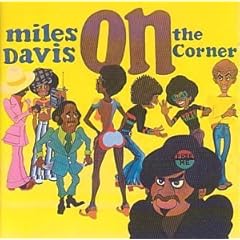
On the Corner

On the Corner is probably just about the most contentious thing Miles Davis ever did, and even now you'll still find plenty of jazz-heads who'll foam at the mouth and brain you if you even mention it, let alone suggest that it's good, or even jazz. I'm reminded of it by the fact that a big box set of the complete sessions has recently come out, and currently sits in the "highest priority" part of my Amazon wish list (hint), and that's reminded me that it's about time I pulled it off the shelf again and had another listen.

Its origins lie in Miles' realisation in the early '70s that jazz had been largely abandoned by young black kids, who were listening to Sly Stone and James Brown instead. He realised he needed to do something that would connect with them, speak to the kids on the street. So he made a funk album, of course. But being Miles, he couldn't make any old Stone-derived sound. He needed to bring something new to the party. And what he decided was the killer concept, that would bring his sound to the kids on the street was the ideas and processes of Karlheinz Stockhausen. Well, obviously.

I remember when I was a teenager first listening to Miles, and finding things like Bitches Brew bewildering, in a way probably only matched by Trout Mask Replica, another album it took me a long time to get my head round. But I always felt there was something in them, something that was just out of reach, that I needed to keep digging and find. Anything of real worth requires effort, because the effort makes the reward that much sweeter. So when Miles decides that what funk-jazz needs is the influence of the German avant-garde, god dammit, you've just got to go with it, because in the end you'll see he's right.

What Miles specifically takes from Stockhausen is his concept of space. On the Corner is an album that isn't much concerned with harmonic progressions, being on the surface a sequence of one-chord jams (or to be more accurate, cut and paste collages derived from one-chord jams). It's in the placing of the sounds that it gets its power, taking what could almost be described as a pointillist approach, short staccato phrases juxtaposed in varying combinations, never resting, always moving, but also static, creating a real sense of an environment in which we stay for a while. I'm reminded of the way Birtwistle describes many of his works, in terms of a single unchanging object viewed from changing perspectives.

If this sounds dauntingly intellectual, the effect on the ear is visceral and immediate (as is the actual music of Stockhausen and Birtwistle, if you ignore all the talking about it and just listen). Those foam-mouthed jazz-heads need to open up their perspectives and stop worrying about whether this is jazz or not. It's an extraordinary record that even now sounds like something that arrived in our midst from outer space.

Oh, did I mention that it's also damn funky?

Friday, October 12, 2007

Time, please, gentlemen

I read on a crappy free paper on the train home that a survey of 3,000 people who downloaded the new Radiohead album reveals that a third of them paid nothing for it, but the band still got an average of £4 per copy, which puts them quids in on what they'd get if they were signed to a major label. Apparently 12 out of these 2000 paid over £40, which must mark them out as insane, as they could have got the lovely discbox like 351 others of the sample (and me) and got the download thrown in free.

Overall I think this makes the experiment a success, and a heartening one at that, as it suggests that far from the internet heralding the death of the business of recorded music, that people will pay up for music they have faith in. Great news for those producing good music, bad news for corporate companies churning out soulless crap. Which is exactly how it should be.

Wednesday, October 10, 2007

In Rainbows

So, how much did you fork out for the new Radiohead album? Me, being the nerd I am, I forked out the forty quid for the big exciting box with books and pictures and extra music and lovely vinyl. So I have a posh bit of product to look forward to in 6 weeks or so. In the meantime, there's the download version, which I was emailed the link for this morning.

And hurrah! It's absolutely brilliant! What immediately strikes me at the first listen is that they've managed to combine their experimentalism with their undoubted knack for a good pop song in the killer way they've been threatening to for a while. So you've got twisted dance beats, weird retro-futurist sounds, but also big guitars and tunes. So it sounds more than anything like a band.

I ummed and ah-ed for a while about whether to have the big box, or whether to go for the pay-what-you-want download only option. I wonder what I'd have paid if I'd done the latter? Of course it's tempting to pay nothing, but that just seems wrong to me. I vaguely wondered about getting the download and then if I liked it going the whole hog, but in the end I decided to put my faith in them to deliver, and they've come through for me.

I think the way they've released "In Rainbows" is a fascinating experiment (apparently there'll be a conventional CD release next year), and I hope they give us an idea of how many people downloaded and what most people paid. They're lucky enough to be in a position where they can take a risk like this, and if it works, it'll have huge consequences for the record business and bands' relations with record labels.

Wednesday, September 26, 2007

White Chalk

Honestly, you wait ages for a decent record then two turn up at once.

Hot on the heels of Joni Mitchell comes Polly Harvey with her latest album, White Chalk. And like Mitchell, Harvey is someone determined not to rest on her laurels. This album finds her abandoning her guitar for piano and an array of string instruments (by which I mean zithers and autoharps rather than violins), as well as abandoning her growly, bluesy voice for a much higher, purer tone, almost like a choirboy.

This is the sort of sound that chimes very well with all sorts of things I've been thinking of lately, so it may be that I'm feeling particularly receptive, but this album's absolutely brilliant. To step so far out of one's comfort zone is an achievement in itself, to do it with such aplomb and success is astonishing. It's also strangely uplifting, in a macabre sort of way. I've loved Polly's music for a very long time, and my admiration for her has grown pretty consistently with each new release, but it's rocketed with this one. To be able to come to this from "Rid of Me" all those years ago puts her into the same league as Joni.

Two wonderful albums from two fantastic musicians in one week is a rare treat. Just to reassure you that the world hasn't suddenly started making sense, there's a new Westlife album on the way. Can't win 'em all.

Tuesday, August 14, 2007

Prom 41: Gershwin (BBC4)

What a fascinating, if flawed, experiment this was. The BBC Scottish Symphony Orchestra joined forces with the Marcus Roberts Trio for Gershwin's Rhapsody in Blue, with the trio contributing extensive improvised passages.

As the talking heads before noted, Rhapsody in Blue is itself a clash between jazz and "classical" styles, so on the face of it it's entirely natural to bring a jazz trio into the mix. The problem is that the excellent Roberts and his cohorts play in a post-Coltrane, post-Monk idiom, so what we ended up with was a three-way clash between classicism, pre-war and post-war jazz, with none emerging unscathed. Roberts' solos were wonderful, and when his rhythm section of Roland Guerin and Jason Marsalis kicked in things really took flight, but when they played along with the orchestra in the "composed" bits the result was oddly stilted, the stiffer '20s rhythms jarring against the more fluid post-bop element. I'd love to hear the trio alone improvise on the Rhapsody, as what they gave us tonight was exquisite, but I'm not convinced the middle of a "conventional" reading really works as the place to do it. Having said that, all involved acquitted themselves well, and this was an imaginative piece of programming, so full marks to the Proms for bringing it to us.

Roberts, Guerin and Marsalis gave us an encore, a delicious take on "I Got Rhythm" that had me hungering to hear more of them.


(Sorry, I can't comment on the rest of this show as I was watching Jamie Oliver on the other side, who showed me some excellent ways with courgettes.)

Thursday, February 01, 2007

A short ride in an alternative machine


A spontaneous moment! As we leave the office, L tells me she's off to the Barbican, where ahead of the LSO concert of John Adams works there's a free performance of an arrangement of Mr Adams' "A Short Ride in a Fast Machine" for Gamelan, of all things. Well, I'm a sucker for free stuff, and there's bugger all on telly, so I tag along.

It's great, and when you hear it, it all makes perfect sense, of course - the pulsing rhythms and post-minimalist repetitions of Adams' style transfer very well indeed to the Gamelan. They play it twice, and it's better second time around - people have drifted away and it's easier to get a good view of the players. That ringing, metallic sound is captivating, a sound I know well from second hand imitations by numerous 20th century composers, and (somewhat to my shame) rather less so from hearing the genuine article. It's nice to hear the distinctive tonality, too - when you're surrounded by the western scale, as we all are, it's good to be reminded every now and again that there's always a different way to do things.

At work today, in the middle of researching something else entirely, I came across a review that I didn't realise existed of a piece of mine that was performed in 2001 (I already knew about the one in the Guardian). According to David Harrison of the Manchester Evening News, "The world premiere of Peter Nagle's Infinite Breathing proved a spectral sort of affair with attenuated chords in the violins and violas."

I suspect this is the sort of thing a reviewer writes when he doesn't like the music, but doesn't want to say so.