 The thing is this: I like Rothko. I really like him. Well, his paintings, I mean. It's wonderful to be able to see these enormous, imposing canvases laid out like this, to be able to stand in front of them and let myself be drawn into those huge expanses of space, that seem so blank and flat and forbidding at first, then, as your eyes adjust, reveal ll kinds of shade, and turn out to be filled with eventfulness, dark reflections of whole other worlds.
What I don't like is being surrounded by hoards of people. Of course it's inevitable, especially when you don't get round to going until the last day of the exhibition, and sure the crowds are nothing compared to the Monet show a few years back. But I really don't need to be surrounded by ghastly, vacuous people, plugged into i-Pods rented at great expense to tell them what someone else thinks about the paintings, talking about them, spouting that pseudo-religious bullshit that surrounds Rothko and cheapens him with every word uttered. I don't want any of that stuff. I don't want anything, physical or emotional or conceptual, to get between me and the canvas. I just want to be there, face to face with that thing that requires no words of explanation, that just is.
Sunday, February 01, 2009
Rothko
Friday, September 12, 2008
Something fishy

It's perfectly natural for composers to wish to retain control over their creations, of course, just as a parent would like their children to grow up and act like they'd like them to. But with music as with offspring, once they're in the world they rarely end out how you imagined. Some children grow up to be junkies, and some songs grow up to be Republican soundtracks - just ask Bruce Springsteen. All you can do is hope that the gentle nudge you gave them as you sent them out will be enough to put them on the right path. It's difficult to let go, but music can't be preserved in aspic, nor should it be. Composing begins with following the example of those who've gone before you, and you have to accept that if you have any decent ideas, they in turn will be taken up by those who come after you.
Here's something for the weekend: a different take on the song in dispute, by the splendid Rasputina:
*McCain's habit of violating copyright is a bit unfortunate, given his zealous support of extension and protection of it. Hey, maybe if he hadn't supported all those term extensions there'd be more public domain music he could use for his campaign.
Friday, July 04, 2008
What we call the beginning is often the end
And then there are those pieces that are indisputably unfinished. I think in particular of Bruckner's Ninth Symphony, which I've been listening to and thinking about a lot recently. And in particular the realisation of the finale, a controversial project.
Where his finished symphonies offer one sense of an incomplete project in their multiple workings of the same material, the surviving sketches for this movement offer another side: the work that can only be experienced as work in progress.
This is where facts, traditions and romanticism collide: the tradition has grown up that the three complete movements are in themselves complete, and therefore it's unnecessary to attempt to complete the fourth. But it's certain that Bruckner didn't think this: on his deathbed, realising he wouldn't live to finish the symphony, he suggested that his Te Deum be used as a substitute finale. So whatever else he may have thought, he definitely didn't consider it as a three-movement piece.
In was amazed when I discovered that there was a playable version of the finale: I grew up, like most people, thinking that nothing existed of it beyond a few scraps, and yet it turns out that there's enough there to show that Bruckner had the design fully formed in his mind, and was probably only weeks from completing a draft score.
It's remarkable how hostile some people seem to be to the idea of this reconstruction. Of course it's to some extent speculative, as it has to be to provide a satisfying listen (you can't listen to an unfinished piece of music and really get much from the fragments in the way you can look at an unfinished painting), but isn't it better to have an idea of what the composer intended rather than cling to a delusion?
Gottfried von Einem, by the way, wrote a piece called "Bruckner Dialogue", which uses the chorale from the finale of the ninth, which seems another alternative. It's certainly far from what Bruckner would have intended, but it does acknowledge the truth that there is an enormous vacuum in the wake of the slow movement. It seems to me better to recognise, and not deny, this absence.
The finished and the incomplete are two extreme ends of a spectrum, and there's a lot of space in between, a strange and forbidding place that nevertheless can offer great rewards to those brave enough to explore it.
Wednesday, July 02, 2008
The end is where we start from
When is something finished?
I crawl through my manuscript, typing it slowly and painstakingly onto my PC, changing notations here, making cuts there, elsewhere inserting or rewriting passages. When I've got to the final bar I'll go back again and may well see other points ripe for change. And then I may do it again.
But at what point will I decide that enough's enough? It's a question that every composer has to face. One of the composers who taught me told me that his rule of thumb is that a piece will have to be draughted about six times before it's ready. If you're lucky you might get it done by the third or fourth.
Art is never finished, only abandoned, as one artist said; some take this to extremes - Pierre Boulez designates pretty much his entire oeuvre as "work in progress", which seems a bit extreme to me. When I worked for a music publisher, often were the times that a piece seemed doomed forever to stay in revision hell - one (very fine) composer in particular had enormous trouble with the concept of letting go, and continued to tweak and tweak at scores for years after their premieres. It's one thing to rewrite music that doesn't work as well as it might, but endless tiny alterations seem top me to be a symptom of neurosis, which I guess stems from the awful pressure on composers to produce "Masterpieces" - that strange quirk of the so-called classical music world where it seems unacceptable to admit that a piece may be a great work while still containing weaknesses.
I think of Bruckner as well, re-writing his symphonies (sometimes on his own initiative, sometimes at the behest of well-meaning but misguided supporters) to such an extent that different versions stand as entirely different works that just happen to use the same material. There's a parallel to be drawn here with Boulez and his re-writes - the piece as an ever-evolving entity, that cannot be definitively fixed. This goes against the dogma of the score as Bible that underpins all SCCM since the late 19th century, the same dogma that sparks the kind of neurosis mentioned above, and perhaps, as infuriating to librarians and cataloguers as it is, it represents a way out of the straitjacket of the score, and the Masterpiece.
Friday, March 28, 2008
Written in smoke
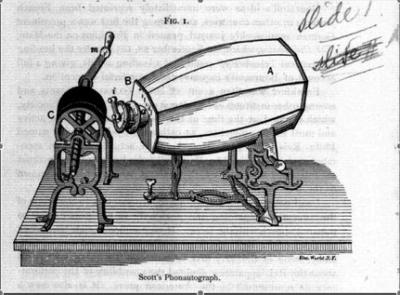
There's something extraordinary and wonderful about this. This voice, the name of whose owner was apparently not considered important enough to be recorded, preserved on nothing more substantial than soot on paper, all that remains of someone from a distant past, untouchable but made tantalisingly close by this tiny fragment. Something about the fragility of existence and the tenaciousness with which we cling to it.
Thursday, January 24, 2008
The Great and Good
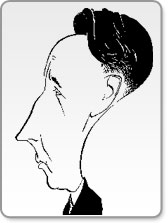
There's a strange thing in classical music, I suppose because it leans on the past more than any other art form, of an insistence when talking about composers talking up their "genius". It's perfectly possible to talk of, say, Dickens as a great novelist while acknowledging his faults (all that sentimental Tiny Tim nonsense, for example), but we like to keep quiet about the second rate pieces Beethoven churned out amongst the jewels (such as the rotten Battle Symphony) . It's as though we're scared that if we admit any weakness in our musical gods, the entire edifice will come crashing down around our ears.
Martinů is a really good (and underrated) composer, and amazingly consistent for someone so prolific, but he's not a Great Composer. I think this is something to do with the fact that he's almost completely uninfluential (there's no "Martinů School" trailing in his wake), but also to do with an attitude, or lack of it, on his part towards his craft. He wrote well crafted, attractive and moving music, but there's never really a sense of him really trying to stamp himself onto history or change the course of his art for anyone but himself. He just tried to write good music.
This makes me stop and think, what do we really mean by a "Great Composer"? The whole idea of the Artist making a Statement begins with Beethoven (of course), which means that Bach, Haydn and Mozart (to pick only the 3 most obvious names) aren't really Great Composers, because the concept didn't exist for them. Significant, influential, great even; but not Great.
A Great Composer doesn't have to be a good composer; in fact I wonder if the two are very compatible, as it's entirely possible for a Great Composer to be a dreadful composer (Berlioz springs to mind, and Wagner - these are my prejudices, of course, you may have your own candidates for bad Great composers). even Beethoven, a Great composer who's generally also a good composer, sails pretty close to the wind - the 5th, 7th and 9th symphonies are exercises in increasing self-importance and bombast, and I maintain that after the astounding opening 30 seconds or so of the ninth, it's downhill pretty much all the way. But in the face of Greatness, quality's a secondary consideration
The line runs out almost exactly 200 years after Ludwig van, with the death of Stravinsky in 1971, and then the demise of Stockhausen at the end of last year; the Great Composer is essentially an idea of the 19th century that lingered through the 20th, and with the decline of so-called- classical music as a vital force rather than a museum, it's an idea whose time has gone. Which is not to say there aren't some great composers out there still, but are there really any Great ones?
Monday, December 31, 2007
List fatigue
Well, did you have a Happy Christmas? I did: thanks to the relentless plugging of my Amazon wish list to all and sundry I ended up with a bunch of presents I actually wanted, we managed to slim down the commitments and travelling so that it actually feels like we've had a holiday, and now I'm looking forward to a cosy New Year's Eve with a shepherd's pie and a bottle of fizzy booze.
So now's the time of year when we all make up big lists of what we liked in 2007, isn't it? Top Tens, all that. Well, I thought about doing that, but you know what? I'm not going to. I've written about most of the things I've liked (and not liked) here at some point over the year, so if you're really interested in what I think you can spend a while browsing through the last 12 months' posts.
And anyway, why make lists? Of course, being a boy I spent a fair portion of my youth drawing up lists in the semi-autistic way that boys do; top ten records, TV programmes, films, books, gigs, and so on. But now it all seems so pointless and arbitrary. Why try to make value judgements between, say, Radiohead and Bill Callahan? How can I choose which goes higher up my book list, Ulysses or Strontium Dog Case Files Volume 3? Can I say that Vialka were a better gig than PJ Harvey? Did I enjoy either more than the other? And isn't whether I liked something just about the least interesting thing I can say about it anyway? And haven't there been way too many rhetorical questions in this paragraph?
So, no lists here*. Because it's all worthwhile. The good things (such as those mentioned above) and the bad things too, because the jewels stand out all the better for the shit thy float in. Because what I may say is my favourite today may change tomorrow. Because lists attempt to set in stone something that is, and should be, fluid. Because a butterfly is more beautiful fluttering than pinned to a board. And experience changes every moment.
And may I wish you a happy new year, and more of it in 2008, whatever it may be.
* I did briefly consider doing a list of the best lists I've read. But that would be too much smart-arse wankery, even for me.
Friday, December 14, 2007
What's next?
Once upon a time composers were artisans, servants like any other. Composing was part of musicianship; all composers performed and most performers composed. Then Beethoven came along and suddenly composers were Artists. Beethoven went deaf and was forced to retire as a performer, and thus was born the Great Composer, the mystic sage who came down from on high bearing the Score, which the musicians then dutifully followed.
This was the end of the Classical style, and the beginning of Classical Music - the canon, the tradition, the myth of the unbroken line inexorably moving forward through history: Beethoven, Wagner, Mahler, Schoenberg, Webern, Stockhausen... at the turn of the 19th and 20th centuries Mahler codified the rituals of concert-giving and going, and the Classical Concert became a quasi-religious ceremony. The composer was a Shaman, exalted and separate.
Stockhausen is dead, and with him dies the Great Composer. We no longer believe the march of that history. Our history is messier, less sure. It seems to me that the music of the future will most likely be collaborative; the roles of composer and performer will merge again, we will all become composers, all performers. There are plenty of talented composers writing fine music (and even more untalented ones writing bad music - and who may judge which is which?), but there are no more Great Composers, and there may never be.
We shouldn't mourn this. This is simply the way things are. Creativity is being democratised, and there is no longer a place for the shaman. Music is not a god to be worshipped. It's not a product to be passively consumed. It is an activity to be participated in, a means for people to come together. There will be new music, and some of it will grow from his ideas, but Stockhausen is part of another time. What's next? We shall find out.
Thursday, December 13, 2007
Stockhausen is dead
But didn't he die a long time ago? What about the people I overheard in Huddersfield in 1996, dismissive and contemptuous of pretty much anything he'd written since the 70s? Wasn't he regarded as someone who'd long since ceased to be worth paying attention to, who'd disappeared down a path of self-indulgent, egomaniacal mysticism? I used to hear such opinions regularly. The he died and no-one wanted to say that anymore.
I was thinking more about that Brian Eno interview, where he suggested that he was more interested in Stockhausen's ideas than his music. Is the actual music so ungrateful? John Humphreys lapped up any suggestion that you wouldn't want to listen to it, of course. Personally I never found his music that hard to listen to. Thorny, certainly. But those people in Huddersfield were berating him for producing music they regarded as too accessible, too easy on the ear, too melodic, not confrontational enough.
So, to the avant-gardists (or at least former avant-gardists; is there actually any such thing as an avant-garde anymore?) he's frozen in amber, a figure from a long time ago, when giants walked the earth. To the anti-modernists he's the bogeyman, the frightening creature under the bed who ruined it for everyone, who can't be buried quickly enough. There's precious little room for Stockhausen himself, underneath all the opinions about him. Either way, there seems to be a consensus between the two poles that he's a figure of the past, whether a past you wish to revive or to bury is up to you to decide.
To the vast majority of people, of course, he means absolutely nothing. Innovation, adventure, risk; these are qualities that find little resonance today in our lowest common denominator Tesco world. Is Stockhausen dead? Did he ever live? The avant-garde is no longer the terrible threat it once was, not something to be railed against, just a curiosity, maybe worth a snigger, then brushed aside. Not relevant. To many people it never was, if they even stopped to think about it, or even became aware of it, however briefly.
Stockhausen is dead, and all we have left is ourselves. And what shall we do with that?
Tuesday, December 11, 2007
Posterity
A lot of people, including me, have pointed out the influence Stockhausen had beyond the supposedly marginal constituency he occupied. (You can hear Brian Eno discussing this with John Humphreys on Today at The Rambler. Eno is as considered as you'd expect, Humphreys is as ignorant and simplistic as you'd expect.*)
But is that really the most important thing? No Stockhausen, no Radiohead? It's very odd, the way so much of the coverage of his death that tries to express his importance takes this tack. The man who fearlessly pursued his own path, regardless of whether anyone followed him, remembered in terms of commercial success by others.
What about the integrity, the single mindedness, the spirit of exploration, the willingness to pursue an idea?
*By the way, Mr Humphreys, the last time I went to a Stockhausen gig it was sold out. So there.
Wednesday, November 28, 2007
What's difficult?
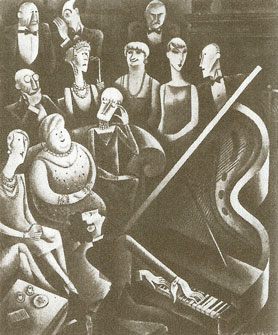
What I found particularly interesting, though, was the response of the audience (or at least those who came because I badgered them). These people (in the main not musically educated) all said they preferred the Sibelius. Now, the Fourth Symphony is a powerful work, one of the greatest symphonies of the twentieth, or any century, but it's also the part of the programme that would be considered a "difficult" piece - essentially because it' s relatively dissonant, emotionally dark and introverted, ending in grey resignation rather than any kind of triumphant peroration (or indeed the opposite, breast-beating despair). And it occurs to me that this is obviously how it should be, not because the Schubert's not a wonderful and great piece (it is, of course it is) but because Sibelius lived in a time closer to our own, and we need to do less work to understand the context he worked in. But the conventional approach to concert programming is entirely based on the premise that anything modern or contemporary is inevitably harder to understand for the non-cognoscenti, and should be approached with caution, buttered up with Beethoven or Brahms.
Is there any other art form where this sort of thinking is considered normal? Can you imagine anyone suggest that you shouldn't even attempt to watch a modern play before you've got to grips with Shakespeare? Or that you should avert your eyes from Picasso or Damien Hirst until you've got the hang of Holbein?
What rot. All my experience tells me that this idea that "uneducated" people need to be coddled in the face of new music is just rubbish. They may not like it, but give them the opportunity to listen and they'll appreciate it - in fact, I suspect the untrained ear may be more open to new sounds than that conditioned and brow-beaten by years of propaganda dripped into it by the education system. We live in an age, after all, where the charts contain music far more abrasive than anything Schoenberg ever wrote, and where the influence of that giant of the post-war musical bogeymen, Stockhausen, can be heard in ways beyond anything you, or he, might have imagined. Isn't it time the classical music establishment woke up to itself and admitted it's got everything the wrong way round, and that this misguidedly timid approach is helping to destroy the art form it's supposed to be enriching?
When a newspaper such as the Observer can print such a closed-minded viewpoint as this review of the Huddersfield Festival by Anthony Holden, there is something deeply rotten at the heart of our relationship with music, an awful combination of intolerance and conservatism that seems to betray an active hatred of music. The point about something like Huddersfield is that it's experimental, it's not going to conform to preconceived ideas, and yes, it will inevitably attract a small audience, and not everything you hear there will work (because it's experimental, remember?) but that's OK, because it's not meant to be mainstream, any more than Stockhausen's works were before they influenced the likes of Warp records' roster. For a major broadsheet paper's music critic to fail to grasp this is an extraordinary failure of the critical process.
It's time we started treating audiences as grown-ups who can listen without prejudice, not as children who need to be protected from the nasty frightening modern composers.
Image (a cartoon from Vanity Fair in 1929) swiped from here.
Monday, October 29, 2007
"I love dealines. I like the whooshing sound they make as they go past" - Douglas Adams
It's not easy, this being creative lark. Especially when you find yourself doing it for cash, in a medium you're not entirely confident in, with a deadline looming ominously, as I do now. It's at times like this you find out what you can do if you're stretched, I guess. I used to think that being arty involved following your muse without concern for practicalities, writing for posterity, like what the Great Composers like that Beethoven did. Except of course this is all a big fat lie. Beethoven was as much a businessman as a composer, he made damn sure his music got an audience in his lifetime, because if you try to write the music of the future, it'll end up being the music of the past without ever being the music of the present. So hang posterity; just get on with it and let others worry about that sort of thing. I have realised (possibly too late in life) the tremendous creative spur that a deadline offers, and so maybe in my own small way I have achieved a small amount of wisdom, which can only be a good thing.
Many things going on in the world of classical music blogs that I ought to be pontificating on if I had the time, but I shall make mention of the new project Daniel Wolf is planning for his November posting, because it's very similar to how I started this blog. I'm going to start doing that again soon, I promise. As soon as I've got all these deadlines out of the way. I'm very conscious of my almost total lack of compositional activity recently, especially as I'm supposed to be starting work on a new piece for bassoon (something a bit special, sort of a follow-up to "Le tombeau de Feldman").
And now I must stop this internet navel gazing and do the things I am paid to do, and then go home and finish the damn comic strip.
Monday, October 15, 2007
Dodecaphony 2.0

(Link from the estimable Alex Ross.)
Friday, October 05, 2007
Scenes from the death of classical music #1
"So, do you think we'll be playing Julian Anderson in 100 years?" a violinist friend asked me last night in the break during our rehearsal for the next KSO concert. Well, will we? Does it matter?
The shortest and probably most honest answer is "I don't know". Who can possibly say with certainty what will and won't be heard in a century? Acclaim in your own lifetime is no guarantee of an equal posthumous reputation - just ask Spohr, Clementi, and any number of other dead also-rans. Who can even say with certainty whether the symphony orchestra will still exist as a performing group? (I have my doubts about this.)
Does it matter? One one level, not at all, as I'll be long dead by then. On another level, it matters immensely, as I'm a composer, and no matter what I may say, I'll always have one eye on posterity. At least some of the motivation for creating anything, whether it be art, music, a building, social reform, whatever, is ego-driven: the desire for immortality. At a tangent to this is professional envy - I don't want some other bugger being remembered if I'm not.
I hope he isn't. This isn't anything to do with him or my opinion of his music. Up until comparatively recently it was normal for a composer to be forgotten after his death, because it was normal to have new music. But something happened in the 19th century, starting with Beethoven - the first composer whose work remained in the standard repertoire after his death, and has never left it* - and now new music is seen as at best novelty, at worst something to be actively avoided. There's too much posterity now. We need to remember to forget. Then there will be room for new musics. Otherwise classical music is just an embalmed corpse. Embalmed corpses are of course interesting to study, but they don't make very good conversationalists. I'd rather spend time with the living.
*"Beethoven started the rot", said Britten. Messiaen on the other hand speculated that music went wrong sometime in the 11th or 12th century, roughly when we started to write it down.
Wednesday, October 03, 2007
There are none so deaf as those that will not hear

Now, maybe I'm going out on a limb here, but it seems obvious to me that this is a deeply ambiguous work, steeped in suggestions that not all is well (and, I suspect, not necessarily in relation to the war). Double meanings in the arts were endemic in Stalin's Russia, and that's what I hear in the ferocious bombast of much of this symphony. I expect to read positivist guff in "official" soviet articles and the like, but what about all those who've written the books, sleeve notes etc since? How can they seriously write that this is a piece that ends happily? Have any of them actually listened to it?
Tuesday, September 25, 2007
They paved paradise and put up a coffee shop
 It does seem odd - Joni Mitchell, countercultural icon, bringing out her album on the label of top corporate exploiticons Starbucks. But Mitchell of all people has earned the right to do what she damn well pleases, and in a way she's being just as stubborn and contrary as she always was. And the legend "© 2007 Joni Mitchell" reveals the reason she's decided to take her first new material for over a decade to the mocha-mongers; artistic freedom, and ownership of the result. After the things she said after her spectacular exit from the music business, it was never likely she'd want anything to do with a conventional record company again.
"You don't know what you've got til it's gone", sings Joni in the startling (and effective) reworking of "Big Yellow Taxi". Sometimes you're lucky enough to get it back.
Thursday, September 20, 2007
Silence

It's 50 years since Sibelius died, and approximately 80 years since he produced any significant work. I can't think of any parallel to this. It seems he worked on an eighth symphony for some years, before burning everything he had written in 1943. Tom Service in today's Guardian suggests that this 30 year silence was simply the only appropriate response Sibelius could make after what he achieved in his final symphonies and Tapiola; he simply could say nothing which would not diminish those achievements.
There's probably some truth in this, although it may be romanticising crippling self-doubt on the part of Sibelius. After he burnt the eighth symphony, he became much happier. Maybe this was because he had reached a point where he felt able to let go of his idea of himself as a composer.
I often think about what makes one a composer*, especially when I'm not actually writing anything. If I at what point do I cease to be a composer? Elisabeth Lutyens used to say "If you're a composer, you bloody well compose", which implies that you're only a composer if you're actually writing. This appeals to me, as I've always felt uncomfortable with the presumption and pretension that seems to go with a declaration of "I am a COMPOSER!". And yet, I'm always conscious, even during those dry, unproductive periods, that I feel that I am, in some way. And this is a disturbing feeling, because if I'm a composer, why am I not composing? Generally, before the suspicion that I'm not a composer anymore takes complete hold, I have an idea, start writing,and become myself again.
But that awesome, oppressive 30 year silence of Sibelius continues to haunt me, and sometimes seems as powerful as anything he wrote. I wonder if that happiness that was noted in him after his immolation was due to a sense of freedom, that he had finally abandoned ambition, had unshackled himself from reputation, had admitted to himself that he was a man who had once been a composer, but no longer was.
*Harrison Birtwistle once gave a talk to an audience of schoolchildren, one of whom asked him, "But how do you become a composer?" Birtwistle replied, "Well, you've got to write music. There's no way round it."
Tuesday, September 11, 2007
Comics Britannia

It's quite a decent show, although I'd rather read Little Plum myself than watch Steve Bell reading it, to be honest. Comics is such a personal medium (as the great Leo Baxendale pointed out) and it seems intrusive to watch other people reading them out, as well as inadequate - it's a medium you really have to engage with yourself.
It's an exaggeration to say that Baxendale, Dudley D. Watkins and Ken Reid were single-handedly responsible for all British comics from the 30s to the 80s - but not that much. it was great to see their work discussed like this, and BBC 4 have assembled a wonderful array of talking heads. Good to see such issues as the incredibly racist (to our 21st century eyes) characters that have been quietly forgotten, as well as the wartime propaganda strips.
It tends towards a bit of a nostalgia-fest for my liking, but maybe the impression that comics are something that happened in the past will dissipate as the series goes on, and I suppose given the parlous state of the industry in this country, it's inevitable that it's going to be rather backward-looking. I'd have liked to see some mention or discussion of, say, the recent relaunch of the Dandy, but maybe that would have been too depressing a note to end on.
Anyway, it's worth watching, it seems to be repeated about 20 times over the week, and there's two more programmes to follow, as well as a welter of associated documentaries and reruns of Batman, so give it a look. Or better still, go out and buy some comics and stop them going down the pan.
Thursday, September 06, 2007
Pavarotti R.I.P.
So farewell then, Fat Lucy. In between all the references to the World Cup, and possibly the odd reference to the fact that he was an actual proper opera singer who sang whole operas, on stage (not something certain other "opera singers" can claim to have done), let us not forget his abiding fondess for elephants.
Friday, August 31, 2007
Sonic Youth, Roundhouse
Sonic Youth have always trodden a fine line between experimentalism and indulgence, occasionally stepping over it. One thing they don't have much truck with, though, is nostalgia, so this performance of their classic 1988 album Daydream Nation was never going to be a matter of running through a reproduction of what's on the record. They didn't go as far as John Martyn did when I saw his Don't Look Back concert, where Solid Air was performed in a completely different order and completely different arrangements to the original recording (Martyn's reasoning being that as he didn't have his 1973 band with him there was no point in playing it like that), but when you're a band that deals in feedback as a staple of your sound a certain amount of unpredictability is inescapable before you've even played a note.
Listening to the album before the gig I was struck by how gentle a lot of it sounds now (which may be due to the fact that pretty much all music now seems to be recorded at a monotonously blistering level). Live, you're reminded that Sonic Youth's roots are in the New York punk scene, with the emphasis put on the driving rhythms and a much rawer sound than on record. Then there are those extended moments of feedback, where they sit back and let nature take its course with just the odd movement to manipulate the sound. Although (of course) very loud, there's a strange beauty in here (I'm reminded of the extended feedback Neil Young and Crazy Horse are prone to live, which they even edited into an album). In a way, they're at their most compelling when there's almost nothing happening.
It'd be easy to poke fun at the idea of a band with "youth" in its name consisting of people mostly in their 50s, but Sonic Youth belie this contradiction. Daydream Nation stands up well after 20 years, and, gangling enthusiastically about the stage like the Bash Street Kids with guitars, they play it with the same enthusiasm and commitment they bring to the newer songs they play as encores. Although "encores" isn't really the right word, as it's effectively a whole other set. They bring to mind the observation that youth is simply a state of mind.


