As a friend remarked, Lux Interior always looked like he'd died about 30 years ago and crawled out of the grave, so it doesn't seem quite right that he's actually gone. The Cramps remain one of the best bands I ever saw live. Damn shame.
Showing posts with label genius. Show all posts
Showing posts with label genius. Show all posts
Thursday, February 05, 2009
R.I.P. Lux Interior
Thursday, January 15, 2009
Tuesday, October 14, 2008
More thoughts on Haydn
 I'm entering the final stage of my trek through Haydn's symphonies, in the early 80's now, and the landmarks are starting to seem familiar as those works that are better known - the big, public works for Paris and London after the years of splendid isolation at Esterhazy - loom into view.
It's a source of continuing amazement to me that there's such a wealth of imagination throughout these works, hardly a hint of routine. If these later symphonies, composed for very different circumstances than the earlier ones, seem less obviously questing in the search for innovation, that's not a reflection of any dimming of inspiration, rather perhaps the sign of a composer with absolute mastery of his medium writing for an audience less committed, and hence perhaps less open to overt experimentation, than the prince for whom he composed and performed every day for so many years. It's one of the things I admire moist about Haydn: his ability to write something that can engage on both a casual and deeper level - none of the schism between art and entertainment that we worry about so much these days here. And yet surprises abound; I think of the opening of the Symphony No.73, which sounds like nothing so much as an anticipation of minimalism. And where does the extraordinary moment in Symphony No.85 originate, when the raging fire of the Farewell Symphony suddenly erupts into the surrounding grandeur?
It always surprises me that not more interest is shown in things like this: Ian MacDonald's exhaustive unraveling of the web of self-quotation in Shostakovich is all too readily derided by academia (mainly because he was seen as not having the right credentials, not being a paid-up member of their club). The greybeards pore over every detail of a composer's life and technique, but can't abide the thought that elements from life might intrude on theory. Why did Haydn feel the need to insert the memory of something written over a decade previously here? It was highly unlikely that many, if anyone, would recognise the reference. What private thoughts determined this strange, disturbing intrusion?
Tuesday, September 02, 2008
First thoughts on Haydn

I'm always surprised how dismissive some musicians are of him; something along the lines of "well, it all sounds the same doesn't it?" - which is a sure sign they can't have listened to very much of it. I find it amazing, and inspiring, that anyone could produce such a huge amount of music, with such constant innovation, coupled with equally consistent quality and no hint of routine at all.
*Some count 107, but they're nit-picking.
Sunday, August 03, 2008
Proms: Stockhausen Day
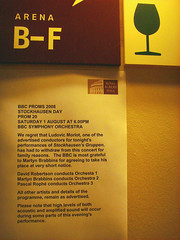
I first heard Gruppen about 10 years ago, when it was performed by the CBSO in Birmingham. Then, as now, the piece was given twice; this works very well, as the piece is so much about the spacial placement of sounds that shuffling about to a different spot for the second performance seems almost a necessity to start to have a proper sense of it. So this is the third time I've heard it.
It doesn't grab me as much this time as before; we're standing in a very crowded arena, with all the really tall people in front of us obscuring any view. Two of the groups have been placed in the arena itself (hence the crowding), but they're at the front end, close to the stage where the third is, so there's very little scope to get right in the middle of the sound field. This seems like poor planning. Wouldn't it have been better to have them at the back, or even construct platforms over some of the stalls? It's not as if they're full, although the turnout's quite respectable (I'm reminded of the adage that there's no hall like the Albert Hall for looking half-empty when it's half-full). That would have left both more space in the arena and more space between the orchestras. As it is, it feels like I'm only really hearing half a performance, only getting a dim sense of the interplay between the groups. And the iconic brass chord that hockets around towards the end doesn't seem to take flight, quite.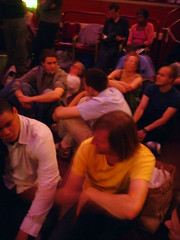
There are 24 loops repeating at 24 different speeds (I read later in the programme notes - one occasion where I should have read them before, I think). From the point of view of the listener, there's a swirling, pulsating mass of sound hanging in the air above us, and it's maybe closer to the aural equivalent of looking at a sculpture than listening to a conventional piece of music. I change my mind about it at least three times during its 32 minute course, at first fascinated by its whirling texture, and overwhelmed by the experience of hearing the sounds swoop around in such a large space. Then as it continues it seems to become oppressive, and I wonder if this isn't a perfect demonstration of the megalomania that many wild accuse Stockhausen of, the sense of himself as God. Certainly I feel like I'm a tiny mortal gazing up at an ineffable and indifferent universe. I feel pinned down by one enormous ego, forcing me to accede to his will. Perhaps this is the sound we will hear when the aliens arrive from Sirius to take over our world. By the end, as the loops gradually complete their cycles and the texture thins out, I'm filled with wonder again, as the skies seem to clear.
The solo trumpet of Harmonien, part of the fifth hour of Klang, follows, and it seems like a breeze blowing though the hall after the swirling dense clouds of Cosmic Pulses. It's a very simple piece, essentially a succession of elaborately embellished melodies that seem heartwarming in their straightforwardness.
Finally, an interval! I've heard some wonderful music, but I've been standing up for an hour and a half, and I'm grateful for a chance to sit for a bit. When I go back in I still can't get into the middle (although that tall man who stood in front of me and farted all the way through Cosmic Pulses has managed to get there - honestly, there's no justice), so I settle for a position right by the other orchestra in the arena. At least I'll get a view of something this time. I become aware of a voice droning on behind me. The wanker in the orange shirt (who talked all the way through Cosmic Pulses, by the way - obviously not so enamoured of Stockhausen that he feels the need to listen that hard) has moved too and is still behind me! I'm obviously being punished by the cosmic forces for my doubts earlier on.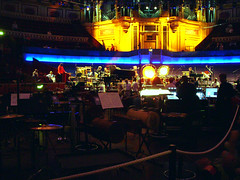
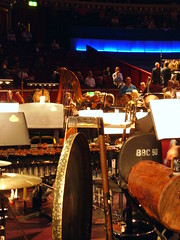
Afterwards, I reflect on how there often seems in Stockhausen's music to be a moment, near the end, when the violent, thorny textures subside, and something more introspective and lyrical comes through, a lyricism that he tries to suppress but can't entirely. If you ignore the received wisdom about his fearsome reputation and just listen, you come to the conclusion that he is in essence a Romantic composer.
It's easy to make fun of this sort of thing, but it works because it's done with sincerity, and it highlights the home-made feel that a lot of Stockhausen seems to have, which gets derided by some but to me is an essential part of his appeal.
That one chord, slowly changing through time, punctuated only by occasional speech, is an extraordinary thing to experience, lying on your back staring up at the ceiling once more. There's a terrible wrench when it finally winds down to its close, and I have to run out as the applause starts to catch the last train home. I feel awake, and don't want the evening to end. That chord gets inside you and resonates, so that long after the performance is over it still seems to be sounding, buzzing inside your skull as you walk home.
Friday, July 11, 2008
Judas
They've just finished the second song, and the crowd seem restless. There's a lot of slow clapping going on. They carry on, anyway. The sound's raw, loud, kind of sloppy. But it's exciting and immediate too. At least that's how it sounds to me. I'm not hearing it like those unhappy people in the audience, a sinking in that we're not in Kansas anymore. I know I'm not in Kansas anymore, I wasn't even born when we left.
There's some enthusiastic cheering as they reach the end of song 3. So it's not a given that what they're doing is alienating. Some people like it.
It really is loud, though. I want to turn the volume down on my earphones (an option not available to the people in the hall), but I'm going to stick it out, because there's a thrill in it, a sense that I'm transgressing something, even though it's only in my own mind (and whatever tinny hiss is escaping my headphones and reaching those at the desks next to me).
The slow hand-clapping starts off, and he tails off his introduction to the next song... the audience falls silent, and he continues. The cat-calls resume, and are starting to grow. There's a definite air of menace. I can only hear, of course, but it sounds fair to say the audience is divided.
Well, that one seemed to push them a bit far. The guitarist's tuning, and the jeering is growing. The singer is mumbling into his mike, speaking nonsense as far as I can tell. Eventually the claps subside as people realise he's talking and they can't hear what he's saying: "...mblmblmblmblmblif you only wouldn't clap so hard." There's a smatter of applause at this, so I guess he still has his supporters, they haven't all turned against him.
The thing is, you can't really tell what the audience is doing during the songs, because it really is fucken loud.
The guitarist is tuning again now, and the atmosphere really does sound like it's getting ugly. The piano starts off, and this song' different to the rest; where there's been a lot of exuberance before, now there's palpable menace, the hostility in the audience reflected back at them. "Something is happening, and you don't know what it is..."
They finish, there's more heckling, the audience laughs. One man shouts out. He's just saying what he thinks, he doesn't know he's just become part of a myth.
The singer's exasperated. "I don't believe you!". Then he realises the literal meaning of what he's just said. "You're a liar!"
Then, to the band:
"Play it fucking loud!"
How does it feel?
Thrilling.
(There's some clapping at the end. A few stuck it out, then. Animated discussion. The national anthem comes across the tannoy. Then the tape cuts out.)
(Seems someone's always upset about something, aren't they?)
(Now go here.)
Wednesday, June 11, 2008
Big Ideas: Don't get any
Some time ago Radiohead held a competition for remixes of "Nude" from "In Rainbows". This is one of the entries. Be patient, it kicks off at about 1'10". It's not samples, it's actual equpiment playing live, as James Houston explains on the YouTube page:
Sinclair ZX Spectrum - Guitars (rhythm & lead)
Epson LX-81 Dot Matrix Printer - Drums
HP Scanjet 3c - Bass Guitar
Hard Drive array - Act as a collection of bad speakers - Vocals & FX
Utterly brilliant.
Tuesday, June 03, 2008
Bo Diddley Is Jesus
R.I.P. Bo Diddley. One of those guys who, hovering behind a huge number of bands in my record collection as a kid, influenced me before I even knew it.
Tuesday, April 29, 2008
Monday, April 28, 2008
The Fall: Imperial Wax Solvent
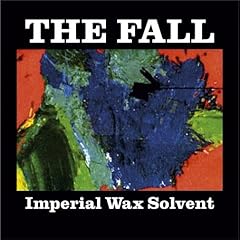
There are, apparently, still some people who remain wilfully blind to the genius of The Fall, and I suppose at this stage it's too late for them; I can only pity them and the drab lives they must lead.
Because there is not one band who has managed what Smith and his many cohorts have achieved: to sustain a career in this strange beast we call rock and roll for three decades that maintains an extraordinarily high quality level (I maintain they've never released a bad album: sure, there are Fall albums that are less good than the others, but their slightest effort is still several rungs above almost anyone else) and still retains its full creative force and originality.
Having established recent incarnations of The Fall as the Ur-garage band, Smith on this album seems to be playing with that sounds, pulling it apart and reconstructing it from the inside out. So what we get are a lot of startling jump cuts between textures and tempi, which seem to bring The Fall's latent Beefheart influence to the fore. now Beefheart's not someone you can emulate unless you're very sure of yourself, and of course The Fall manage to let that sound come out without ever once sounding like anything other than the Fall, which of course is the essence of their genius.
It's compelling, genuinely adult music ("I'm a 50-year old man, and I like it!" exclaims Smith) ; a big thick juicy steak of a record, in comparison to the thin gruel so many bands serve up. And it's great to dance to, too. The Fall come from the land of Northern Soul, remember; they understand the value of dancing.
Sunday, April 27, 2008
R.I.P. Humph

Monday, April 14, 2008
Mothman about the house
 I thoroughly enjoy reading Ben Clark's Magic Beans Comics. And so should you.
Thursday, January 24, 2008
The Great and Good
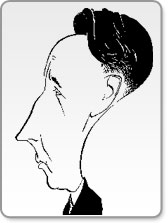
There's a strange thing in classical music, I suppose because it leans on the past more than any other art form, of an insistence when talking about composers talking up their "genius". It's perfectly possible to talk of, say, Dickens as a great novelist while acknowledging his faults (all that sentimental Tiny Tim nonsense, for example), but we like to keep quiet about the second rate pieces Beethoven churned out amongst the jewels (such as the rotten Battle Symphony) . It's as though we're scared that if we admit any weakness in our musical gods, the entire edifice will come crashing down around our ears.
Martinů is a really good (and underrated) composer, and amazingly consistent for someone so prolific, but he's not a Great Composer. I think this is something to do with the fact that he's almost completely uninfluential (there's no "Martinů School" trailing in his wake), but also to do with an attitude, or lack of it, on his part towards his craft. He wrote well crafted, attractive and moving music, but there's never really a sense of him really trying to stamp himself onto history or change the course of his art for anyone but himself. He just tried to write good music.
This makes me stop and think, what do we really mean by a "Great Composer"? The whole idea of the Artist making a Statement begins with Beethoven (of course), which means that Bach, Haydn and Mozart (to pick only the 3 most obvious names) aren't really Great Composers, because the concept didn't exist for them. Significant, influential, great even; but not Great.
A Great Composer doesn't have to be a good composer; in fact I wonder if the two are very compatible, as it's entirely possible for a Great Composer to be a dreadful composer (Berlioz springs to mind, and Wagner - these are my prejudices, of course, you may have your own candidates for bad Great composers). even Beethoven, a Great composer who's generally also a good composer, sails pretty close to the wind - the 5th, 7th and 9th symphonies are exercises in increasing self-importance and bombast, and I maintain that after the astounding opening 30 seconds or so of the ninth, it's downhill pretty much all the way. But in the face of Greatness, quality's a secondary consideration
The line runs out almost exactly 200 years after Ludwig van, with the death of Stravinsky in 1971, and then the demise of Stockhausen at the end of last year; the Great Composer is essentially an idea of the 19th century that lingered through the 20th, and with the decline of so-called- classical music as a vital force rather than a museum, it's an idea whose time has gone. Which is not to say there aren't some great composers out there still, but are there really any Great ones?
Tuesday, January 15, 2008

Sunday, December 09, 2007
Karlheinz Stockhausen 1928-2007

I can't, of course. Stockhausen's influence is so profound that entire movements define themselves by opposition to him (or at least their idea of what he stands for, which is generally wrong), so pervasive that you often don't even realise it's there. Half the music in the charts owes something to him, even if its creators don't realise it.
But there's more to him than just an outré name for art-school graduates to drop. Stockhausen's music carries with it ideas about the space created by sound, both literally and figuratively, that have profound consequences for our understanding of our relationship with music, with the people who create and perform it, and those who listen to the results.
What struck me most the first time I heard his music was how approachable it was. His name had such a fearsome reputation, and the texts written by the greybeards who propagated his cult seemed obfuscatory and impenetrably complex and cerebral. But the actual music isn't like that at all. It's visceral and playful, and filled with wonder at the possibilities of sound. To hear the man himself introduce his music was to have all the fog lifted. He used complex methods to produce his scores, but, he insisted, it wasn't at all necessary for the listener to worry about the method. All the listener has to do was hear a sound, then another, and another, and follow these sounds as they grew and changed through time and space. Whether it's the literally visceral approach to the piano he takes in his Klavierstücke (one of which hangs on my wall) or the quiet spirituality of Stimmung, or the grasping of space of Gruppen and Sternklang, his music always seems to me to speak directly and immediately, in a way that isn't always recognised. He was feared as a terrifying, complex and forbidding composer, but I always found the reality simple and instinctive and wonderful.
I encountered him three times, and not once did I pluck up the courage to speak to him (although I'm pleased to report that on two of those occasions he was wearing his famous orange jumper). I remember once in Huddersfield seeing someone go up to him and expound some long, complicated theory as to what had happened to the characters in one of his operas after the end, and whether Mr Stockhausen could confirm whether he was right? Mr Stockhausen replied, bemusedly, that nothing had happened to them, as that was the end of the opera and they were fictional characters.
I wish I had spoken to him. Just to say how much I loved his music; its humanity and its wonderful directness. Stockhausen wasn't a difficult composer, whatever anyone says. In many ways he was as straightforward as anyone could be. It's just difficult to explain ideas as big as his. Far easier to understand them. What I take most of all is a sense of endless, boundless possibility.
Friday, November 30, 2007

Thursday, November 29, 2007
Black Dossier

Black Dossier is the latest episode in Alan Moore and Kevin O'Neill's magnificent League of Extraordinary Gentlemen (try to put the rubbish film out of your mind). It's not Volume 3 proper; rather it's the "short intermission" promised at the end of Volume 2, which through the plot device of the eponymous dossier explores the background of the League, both in Mina Murray's group and earlier incarnations.
What this entails is a collection of spoofs and pastiches of all kinds of literature, from lost Shakespeare plays through Bertie Wooster vs. Cthuhlu and the New Adventures of Fanny Hill to a migraine-inducing Kerouac homage. The strips that link these (all documents in the Dossier, which our heroes read through the course of the book) are set in a post-WW2 world derived from 1984, Dan Dare and Ian Fleming. There are, as in the previous books, hundreds of allusions to all sorts of fictional worlds and characters, some obvious (a suave yet sadistic secret agent called "Jimmy"; the character who turns up towards the end to save our heroes, whom I can't describe, because it'd ruin an absolutely brilliant and funny reveal), others obscure. This is par for the course, of course, but what's remarkable about the Black Dossier is that where the first two volumes were clever, beautifully constructed romps, this raises the whole idea of the series above the level of a brilliant conceit to something much more substantial, relating it to the ideas on magic and creativity Moore has increasingly been concerned with in recent years, particularly in Promethea. The final sequence is presented in 3-D (you get the glasses with the book), and is both a very funny and affectionate spoof on a lot of the elements of '50s 3-D movies, and a magical conclusion (both literally and metaphorically) which makes very effective and imaginative use of what could easily have been just a gimmick.
This is the final book of Moore's to be published under Wildstorm's ABC banner; he has been vocally unhappy since DC bought the company, and volume 3 of the League, and all his future comics work, will be published by Top Shelf Comics. This book is also unavailable in the U.K., allegedly due to copyright restrictions - although I would have thought the get-out clauses of transformative parody would apply (there seems to have been no issue with the previous books containing allusions to H.G. Wells' work, which remains copyright in Europe), so perhaps this is indeed DC spiting the great bearded one. Anyway, there are ways and means around this, and it's well worth getting hold of a copy, because it certainly left a big stupid grin on my face. I mean - 3D!
Monday, November 26, 2007
On the Corner
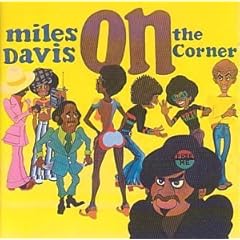
Its origins lie in Miles' realisation in the early '70s that jazz had been largely abandoned by young black kids, who were listening to Sly Stone and James Brown instead. He realised he needed to do something that would connect with them, speak to the kids on the street. So he made a funk album, of course. But being Miles, he couldn't make any old Stone-derived sound. He needed to bring something new to the party. And what he decided was the killer concept, that would bring his sound to the kids on the street was the ideas and processes of Karlheinz Stockhausen. Well, obviously.
I remember when I was a teenager first listening to Miles, and finding things like Bitches Brew bewildering, in a way probably only matched by Trout Mask Replica, another album it took me a long time to get my head round. But I always felt there was something in them, something that was just out of reach, that I needed to keep digging and find. Anything of real worth requires effort, because the effort makes the reward that much sweeter. So when Miles decides that what funk-jazz needs is the influence of the German avant-garde, god dammit, you've just got to go with it, because in the end you'll see he's right.
What Miles specifically takes from Stockhausen is his concept of space. On the Corner is an album that isn't much concerned with harmonic progressions, being on the surface a sequence of one-chord jams (or to be more accurate, cut and paste collages derived from one-chord jams). It's in the placing of the sounds that it gets its power, taking what could almost be described as a pointillist approach, short staccato phrases juxtaposed in varying combinations, never resting, always moving, but also static, creating a real sense of an environment in which we stay for a while. I'm reminded of the way Birtwistle describes many of his works, in terms of a single unchanging object viewed from changing perspectives.
If this sounds dauntingly intellectual, the effect on the ear is visceral and immediate (as is the actual music of Stockhausen and Birtwistle, if you ignore all the talking about it and just listen). Those foam-mouthed jazz-heads need to open up their perspectives and stop worrying about whether this is jazz or not. It's an extraordinary record that even now sounds like something that arrived in our midst from outer space.
Oh, did I mention that it's also damn funky?
Sunday, November 04, 2007
History of the future.
It's only slightly distracting that Gerry Finley-Day looks like Lou Carpenter out of Neighbours.
He's at the ICA for an ultra-rare public appearance with Pat Mills as part of Paul Gravett's Comica festival, to talk about their work on comics, and in particular on Tammy. In an ironic reflection of what various sources have claimed about their relationship when Pat was editor and Gerry writer for 2000ad, Gerry is filled with marvellous stories but has some trouble getting to the point, while Pat seems to spend a lot of time telling us what Gerry thinks. They're clearly revelling in the chance to talk about Tammy though - Pat is adamant that those early 70s girls' comics were an important part of the history of the medium in Britain whose significance is yet to be fully appreciated, and it's a wonderful privilege to be able to hear these two grand old men of British comics trade stories and reflections. Gerry joined the T.A. at one point, essentially for reference purposes. Now that's commitment. Halfway through, a man sidles in through the door and sits down next to me, it's Kevin O'Neill. I struggle to maintain a dignified composure and not jump up and down shouting "YOU'RE KEVIN O'NEILL!" or anything embarrassing like that. I succeed, just. When I was about 12 and sure my future was as a comics artist, Kevin was the artist I wanted to be like more than anyone.
He's up at the front for the second half of the talk, and it's an equal pleasure to hear him and Pat talk about the early days of 2000ad, the struggles with management, the strip by Ken Reid they almost got for 2000ad (the greatest lost strip in British comics, according to O'Neill), how Action got away with it and eventually didn't, and the fact that, astonishingly, Mills and the estate of Joe Colquhoun still aren't getting any payment for reprints of Charley's War.
Friday, November 02, 2007
"It's either Romana, or Fred"

The Key to Time is the complete 16th series of Doctor Who, first broadcast in 1978, and a novelty for the series at the time in having what we'd now call a story arc throughout the season, i.e. a vague plot linking all the stories together. This comes from the height of my first obsession with Doctor Who, so buying this was a shameless act of nostalgia on my part. I remember vividly reciting all the best lines from each episode on Monday morning in the playground, but of course it's 30 years later, and everybody knows the effects were crap and you couldn't get away with that now, don't we?
Well, ya boo sucks. I thoroughly enjoyed it. It's surprising how well it all stands up. See, it doesn't matter that the effects were crap (and actually, considering how little money they had, what they achieved and the ingenuity they show in achieving it is remarkable), or that it's sometimes a bit hammy, because there's more imagination in the least of these stories (probably "the Power of Kroll") than a month of most kids' TV now. Tom Baker's in great form, funny and mad and not yet a parody of himself, Mary Tamm as Romana talks back, not something the Doctor had been used to before, and there are some genuinely wonderful stories in here, best of the bunch being the Prisoner of Zenda spoof "The Androids of Tara". And in "The Armagedon Factor" K-9 actually gets something to do other than make smart-alec comments to cover up the fact that he's got stuck in the gravel again. Lots of extras (I've not listened to any of the commentaries yet, but as Baker, Tamm and John Leeson are all present, along with a number of supporting actors and directors, I anticipate some fun there), including a very funny interview with Tom Baker on Nationwide where he accuses Frank Bough of being a fictional character. And of course in "The Pirate Planet" and the final scene of "The Armageddon factor" you've got some significant early writing by the late Douglas Adams. Perhaps not the very best of old-skool Who, but a welcome reminder nevertheless of why it was the best thing on TV ever when I was 8.
Subscribe to:
Posts (Atom)


