
Doing the washing up, I find my head filled with "Do-Re-Mi" from the Sound of Music. You know the one, the song that gives cutesy names and puns to all the notes of the diatonic scale. Except one.
"La - a note to follow So [sew]."
That's the sixth, what's technically known as the submediant, and Rodgers and Hammerstein hold it in such contempt that they can't even be bothered to think up a decent line. It's nothing special, La, it's just a stopping place on the way from the bright lights of So to the glittering wonders of Ti (a drink with jam and bread). Sort of like a motorway service station - you need the facilities, but you wouldn't choose to go there if you had any real choice in the matter.
Even the technical term's an insult - submediant, i.e. like the mediant, only not as good. Don't get any ideas above your station, Mr Sixth, we're only hanging round with you because we can't get close to the mediant for all the cool kids crowding him as he determines major and minor.
It doesn't get any better when you consider the unfortunate interval from a tonal perspective, either. In the tonal hierarchy, the submediant is the location of the relative minor key. Now, you may think the minor mode's proved its popularity over the years, but consider this: When you're in a major key, you modulate to the dominant. The exciting, virile, even more major dominant. Never to the relative minor. Yet when you begin in a minor key, the accepted path is to get away as quickly as possible to the relative major (which is located in the prime territory of the mediant. Yes, the Mr Big Shot mediant, so much more U than the boring old submediant. Who'd want to go there, eh? It's the tonal equivalent of Wolverhampton.
Not everyone hates the submediant - Brahms loved nothing better than to pile the sixths on, and there's a wonderful bit in the finale of Beethoven's Choral Symphony, when a massive dominant chord is emptied of its harmony, and then the single note left behind is reinterpreted in a new context, which swings the tonality unexpectedly towards the submediant key. It's an awe-inspiring moment, although Beethoven ruins it by prancing off on a thoroughly silly march, so maybe he didn't like our middling friend so much after all.
Well, I say it's time to stick up for the little guy. What's so bloody great about all these so-called perfect intervals, anyway? Let's hear it for the submediant - the tone that's not afraid to be different.
Saturday, September 06, 2008
Stuck in the middle with you
Friday, March 14, 2008
Thursday, February 07, 2008
Daniel Barenboim plays Beethoven (Royal Festival Hall)
There are so many things I could say about Barenboim's playing. It's unshowy, deeply humane and puts music above shallow showmanship at all times. When at the end of the Appassionata Sonata he works himself into such a frenzy that he pounds the pedals and the floor violently with his feet it comes across as the perfectly natural unleashing of tension and passion that he has held carefully in check up till now. It's a pleasure to hear him play the two op. 49 sonatas, the "easy" ones that even I can (or at least used to be able to) have a stab at. There's no danger of being overwhelmed by sheer technique, as you would in one of the more note-stuffed sonatas, and yet of course you see his brilliant technical abilities all the more, and see it entirely in a musical light. I come away thiunking I'm glad I saw him play these simple (but not simplistic) pieces rather than one of the phenominally difficult warhorses that you can hear any pro playing most weeks.
I could also talk about his lack of pomposity or self-importance, his air of absolute straightforwardness and openness, the wonderful intimacy created by his having audience all around him, rather than being perched in front of us on a stage, unreachable and separate.
But the thing I keep noticing is the handkerchief. He mops his brow with it, then throws it into the piano, then retrieves it again later. There's one point where he does this in the middle of a movement, while only his right hand is occupied with the keyboard, which lends a brief nervousness to my mood. But mostly the handkerchief stays out of sight, only momentarily appearing between sonatas. It's such a mundane thing, but it sticks with me, and somehow seems to stand for what it is about him that makes this such a satisfying evening, filled with insight and humanity.
Thursday, January 24, 2008
The Great and Good
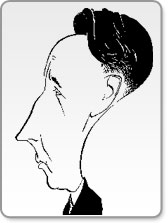
There's a strange thing in classical music, I suppose because it leans on the past more than any other art form, of an insistence when talking about composers talking up their "genius". It's perfectly possible to talk of, say, Dickens as a great novelist while acknowledging his faults (all that sentimental Tiny Tim nonsense, for example), but we like to keep quiet about the second rate pieces Beethoven churned out amongst the jewels (such as the rotten Battle Symphony) . It's as though we're scared that if we admit any weakness in our musical gods, the entire edifice will come crashing down around our ears.
Martinů is a really good (and underrated) composer, and amazingly consistent for someone so prolific, but he's not a Great Composer. I think this is something to do with the fact that he's almost completely uninfluential (there's no "Martinů School" trailing in his wake), but also to do with an attitude, or lack of it, on his part towards his craft. He wrote well crafted, attractive and moving music, but there's never really a sense of him really trying to stamp himself onto history or change the course of his art for anyone but himself. He just tried to write good music.
This makes me stop and think, what do we really mean by a "Great Composer"? The whole idea of the Artist making a Statement begins with Beethoven (of course), which means that Bach, Haydn and Mozart (to pick only the 3 most obvious names) aren't really Great Composers, because the concept didn't exist for them. Significant, influential, great even; but not Great.
A Great Composer doesn't have to be a good composer; in fact I wonder if the two are very compatible, as it's entirely possible for a Great Composer to be a dreadful composer (Berlioz springs to mind, and Wagner - these are my prejudices, of course, you may have your own candidates for bad Great composers). even Beethoven, a Great composer who's generally also a good composer, sails pretty close to the wind - the 5th, 7th and 9th symphonies are exercises in increasing self-importance and bombast, and I maintain that after the astounding opening 30 seconds or so of the ninth, it's downhill pretty much all the way. But in the face of Greatness, quality's a secondary consideration
The line runs out almost exactly 200 years after Ludwig van, with the death of Stravinsky in 1971, and then the demise of Stockhausen at the end of last year; the Great Composer is essentially an idea of the 19th century that lingered through the 20th, and with the decline of so-called- classical music as a vital force rather than a museum, it's an idea whose time has gone. Which is not to say there aren't some great composers out there still, but are there really any Great ones?
Monday, December 17, 2007
Removing the safety net
Alex Ross (whose excellent book The Rest Is Noise I'm reading at the moment) calculates that today is the centenary of atonality. This of course is something you can argue about until the cows come home, and is probably a bit arbitrary, but I like the idea as today is also Beethoven's birthday, and happenstance always appeals to me.
Beethoven these days is rather less controversial than he once was, but atonality still has a power to annoy, which pleases me greatly, as those who get annoyed are on the whole small-minded people who deserve to be annoyed.
Atonality has a special significance for me, as it was those school exercises in listening to and repeating an atonal melody, and later writing one (which I found quite easy to do, despite its being trailed as a more difficult exercise than the similar tasks we were given with tonal melodies) that really first put the idea in my head that composing wasn't necessarily just practised by dead people, but was something I might have a go at myself.
Schoenberg didn't actually like the word, preferring to talk about pantonality. It's a significant distinction, as it makes it about extending and enriching something rather than removing it, which is what you can hear happening in Schoenberg's music leading to his break with key signatures. It was something that was in the air (Schoenberg wasn't the only composer moving in this direction), but he was the first to stand up and say what he was doing (and more importantly the first that anyone took any notice of). It wasn't the action that was radical, so much as speaking its name.
Thursday, November 22, 2007
Abscheid

Friday, October 05, 2007
Scenes from the death of classical music #1
"So, do you think we'll be playing Julian Anderson in 100 years?" a violinist friend asked me last night in the break during our rehearsal for the next KSO concert. Well, will we? Does it matter?
The shortest and probably most honest answer is "I don't know". Who can possibly say with certainty what will and won't be heard in a century? Acclaim in your own lifetime is no guarantee of an equal posthumous reputation - just ask Spohr, Clementi, and any number of other dead also-rans. Who can even say with certainty whether the symphony orchestra will still exist as a performing group? (I have my doubts about this.)
Does it matter? One one level, not at all, as I'll be long dead by then. On another level, it matters immensely, as I'm a composer, and no matter what I may say, I'll always have one eye on posterity. At least some of the motivation for creating anything, whether it be art, music, a building, social reform, whatever, is ego-driven: the desire for immortality. At a tangent to this is professional envy - I don't want some other bugger being remembered if I'm not.
I hope he isn't. This isn't anything to do with him or my opinion of his music. Up until comparatively recently it was normal for a composer to be forgotten after his death, because it was normal to have new music. But something happened in the 19th century, starting with Beethoven - the first composer whose work remained in the standard repertoire after his death, and has never left it* - and now new music is seen as at best novelty, at worst something to be actively avoided. There's too much posterity now. We need to remember to forget. Then there will be room for new musics. Otherwise classical music is just an embalmed corpse. Embalmed corpses are of course interesting to study, but they don't make very good conversationalists. I'd rather spend time with the living.
*"Beethoven started the rot", said Britten. Messiaen on the other hand speculated that music went wrong sometime in the 11th or 12th century, roughly when we started to write it down.
Monday, August 27, 2007
Proms 53 & 54 (RAH)
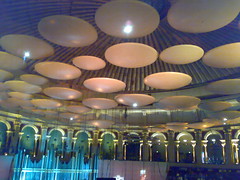
Well, Bruckner's like that, and it took me years to get him. Once I've got something, though, I tend to forget how much work it took to find my way in, so it was a salutary reminder when my companion at Prom 54, at which Bernard Haitink and the Royal Concertgebouw Orchestra performed his Eighth Symphony, came out with this conclusion. Bruckner is hard work, especially when you're stuck in a hall for an hour and a half, and it's a credit to him that although she was left bemused, she was also surprised that it had been that long. My first impressions of Bruckner as a lad were that nothing happened, and it didn't happen for a very long time. My mature impressions are actually pretty much the same, only now I think that this is a Good thing. It seems superfluous to say that the performance was superb, but I shall say so nonetheless, because it was.
It's not often I have the luxury of going to a late-night Prom, so it was especially fortunate that one of the few occasions when circumstances allowed me to stay for the late shift that we should be treated to the wonderful Pierre-Laurent Aimard performing some of Ligeti's wonderful Piano Studies. These works are real gems, mind-bending in their complexity, yet also generous in their approachability, and I can never tire of hearing them, especially in the hands of such a wonderful player as Aimard. Before this, he took on the role of conductor for a romp through Haydn's 102nd Symphony with the Mahler Chamber Orchestra. This juxtaposition emphasised the generosity and humanity of both composers. Next to these, Beethoven, whose 2nd Piano Concerto finished the concert, seemed overbearing, though this may have been down to the fact that we were tiring rapidly by this point. They played it beautifully though, and those parts where Beethoven wasn't intent on showing off were beautiful. These two concerts constituted a marathon, and we struggled to stay awake on the train home, though our exhaustion was tempered with a sense of worlds traversed.


