Daniel Wolf links to a prime cut of Norman Lebrecht, full of the factual accuracy that afficionados of Stormin' Norman have come to expect. Daniel expresses surprise that Norm, a professional newspaper columnist, could display such a level of ignorance about a major figure in a field about which he professes to be expert, and, the general disregard hacks have in this country for the truth aside, he's got a point. After all, if that were the case, then given Lebrecht's dismissals of bloggers as a bunch of amateurs who don't get their facts right, that would make him a big fat hypocite, and surely he can't be that? So it goes that as I read the hairy blusterer's attack on Stockhausen with the bluntest of hatchets, the thought occurs to me: Maybe Norman Lebrecht dosn't really exist.
Think about it: there have been cases before of spoof columnists who paraded a ludicrous series of columns before the public, who nevertheless took it seriously; Chris Morris's suicide journalist in the Observer springs to mind. If you were to create a satirical character, a music journalist filled with utter pomposity and egomania, entirely convinced of his own correctness despite his inability to do basic research properly, who assumes a stance of integrity and moral probity even as he trawls through the gutter looking for his next scurrilous bit of gossip, what would you come up with?
So, let others deride his ignorance and self-importance. I say, praise him! Praise the nameless shadow who has created one of the greatest caricatures of our age! Laudibus regina Jocasta in pestilentibus Thebis!
(It is of course possible, though highly unlikely I think, that I'm wrong, and Norm is a real person. If anyone can show me satisfactory evidence that Lebrecht does exist, and is not a fictional entity, I shall buy them a pint, or equivalent drink of their choice. Bet you can't.)
Tuesday, February 05, 2008
Does Norman Lebrecht exist?
Wednesday, January 23, 2008
Blind vision
Well, the concert went very well yesterday. (This bloke was a bit sniffy about it, but what does he know? He's just some bloke on the internet, and we all know what their opinions are worth.) Cadogan Hall proved to be a very convivial venue, and we'll definitely be returning there. Unlike the Queen Elizabeth Hall, unfortunately. We've played there regularly over the years, and hoped to do so this month too, but after much dogged pursuit of a date, we were told that we couldn't be guaranteed a date due to all the other things in store for January, and finally that KSO doesn't fit in with the South Bank's artistic vision, although they might consider at some point putting on some sort of festival of amateur music making, in which case we might be lucky enough to be invited to take part. Pretty much told to bugger off and stop bothering them, really.
Now, I could argue against the idea that an organisation like KSO has no part in the artistic vision of somewhere like the SBC, but if they feel they've already ticked their boxes for classical/orchestral/amateur performance without us, that's their loss. But the fact is that of the 31 days in January 2008, 21 are dark at the QEH, and you have to wonder what kind of artistic vision sees itself as so important that it's better to have a publicly-funded venue empty than to have a respected amateur band like KSO in it. This is not vision, it's an obscenity, and someone needs to start asking what the hell is going on. This Grauniad article from 2006 profiling artistic director Jude Kelly (one of a large number of plum arts jobs she's landed) gives a worrying picture of how she thinks, all bland meaningless buzzwords and platitudes unencumbered by any concrete ideas, and from what I gather talking to various people involved in performing arts at all sorts of levels, there seems to be a feeling that while she is very insistent about what doesn't fit in with her "vision", no-one seems to be able to say exactly what, in any definite terms, that vision is.
If you go to the SBC website and click on "Venue hire" (right at the bottom, not very obvious), you see this:
As well as being a world-class arts venue, Southbank Centre has a variety of auditoria, rooms and spaces that can be hired for a wide range of events, including conferences, AGMs, product launches, graduation ceremonies, receptions, dinners and weddings.
Nothing about concerts or anything like that, you'll notice.
Dark nights and wedding receptions. Is this the bold artistic vision driving the South Bank Centre?
Wednesday, November 28, 2007
What's difficult?
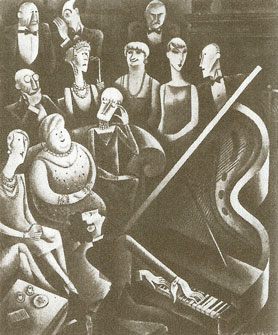
What I found particularly interesting, though, was the response of the audience (or at least those who came because I badgered them). These people (in the main not musically educated) all said they preferred the Sibelius. Now, the Fourth Symphony is a powerful work, one of the greatest symphonies of the twentieth, or any century, but it's also the part of the programme that would be considered a "difficult" piece - essentially because it' s relatively dissonant, emotionally dark and introverted, ending in grey resignation rather than any kind of triumphant peroration (or indeed the opposite, breast-beating despair). And it occurs to me that this is obviously how it should be, not because the Schubert's not a wonderful and great piece (it is, of course it is) but because Sibelius lived in a time closer to our own, and we need to do less work to understand the context he worked in. But the conventional approach to concert programming is entirely based on the premise that anything modern or contemporary is inevitably harder to understand for the non-cognoscenti, and should be approached with caution, buttered up with Beethoven or Brahms.
Is there any other art form where this sort of thinking is considered normal? Can you imagine anyone suggest that you shouldn't even attempt to watch a modern play before you've got to grips with Shakespeare? Or that you should avert your eyes from Picasso or Damien Hirst until you've got the hang of Holbein?
What rot. All my experience tells me that this idea that "uneducated" people need to be coddled in the face of new music is just rubbish. They may not like it, but give them the opportunity to listen and they'll appreciate it - in fact, I suspect the untrained ear may be more open to new sounds than that conditioned and brow-beaten by years of propaganda dripped into it by the education system. We live in an age, after all, where the charts contain music far more abrasive than anything Schoenberg ever wrote, and where the influence of that giant of the post-war musical bogeymen, Stockhausen, can be heard in ways beyond anything you, or he, might have imagined. Isn't it time the classical music establishment woke up to itself and admitted it's got everything the wrong way round, and that this misguidedly timid approach is helping to destroy the art form it's supposed to be enriching?
When a newspaper such as the Observer can print such a closed-minded viewpoint as this review of the Huddersfield Festival by Anthony Holden, there is something deeply rotten at the heart of our relationship with music, an awful combination of intolerance and conservatism that seems to betray an active hatred of music. The point about something like Huddersfield is that it's experimental, it's not going to conform to preconceived ideas, and yes, it will inevitably attract a small audience, and not everything you hear there will work (because it's experimental, remember?) but that's OK, because it's not meant to be mainstream, any more than Stockhausen's works were before they influenced the likes of Warp records' roster. For a major broadsheet paper's music critic to fail to grasp this is an extraordinary failure of the critical process.
It's time we started treating audiences as grown-ups who can listen without prejudice, not as children who need to be protected from the nasty frightening modern composers.
Image (a cartoon from Vanity Fair in 1929) swiped from here.
Thursday, November 22, 2007
Abscheid

Monday, November 05, 2007
Another gratuitous plug
Bryan,who describes himself as a long time reader of this blog (something I find flattering and terrifying in equal measure), draws my attention to a band called Your 33 Black Angels, who have released an album all by themselves without a big record company, and are therefore Splendid (even though I haven't had time to listen to them properly yet). Rolling Stone like them too, but don't let that put you off ;)
As I haven't had time (etc), feel free to pop over to their MySpaz and come back here and say what you think. This is of course an example of internet democracy in action, and not just a lazy way of whoring for comments. Honest.


