 The thing is this: I like Rothko. I really like him. Well, his paintings, I mean. It's wonderful to be able to see these enormous, imposing canvases laid out like this, to be able to stand in front of them and let myself be drawn into those huge expanses of space, that seem so blank and flat and forbidding at first, then, as your eyes adjust, reveal ll kinds of shade, and turn out to be filled with eventfulness, dark reflections of whole other worlds.
What I don't like is being surrounded by hoards of people. Of course it's inevitable, especially when you don't get round to going until the last day of the exhibition, and sure the crowds are nothing compared to the Monet show a few years back. But I really don't need to be surrounded by ghastly, vacuous people, plugged into i-Pods rented at great expense to tell them what someone else thinks about the paintings, talking about them, spouting that pseudo-religious bullshit that surrounds Rothko and cheapens him with every word uttered. I don't want any of that stuff. I don't want anything, physical or emotional or conceptual, to get between me and the canvas. I just want to be there, face to face with that thing that requires no words of explanation, that just is.
Sunday, February 01, 2009
Rothko
Thursday, July 24, 2008
Simplicity is a complex business
Obviously, living in this Google-Age of interweb ionformation overload, nowadays I've got the attention span of a goldfish, and not a particularly bright one at that. But I would like to draw your attention to this excellent post by Kyle Gann, which says a lot of very intelligent and insightful things that I agree with but don't posess the writing ability to express as beautifully as like wot he does, and is so good that I read right to the end, despite it being more than two paragraphs long.
Friday, July 18, 2008
each moment gone as it comes
There's an undeniably manic-depressive element to composing (or any creation): ideas, and the energy to work on them, do not flow constantly, but splutter, sometimes disappear to the extent that one is ready to declare them extinct, then suddenly flood forth without warning, to such an extent that one struggles to catch them, and must surreptitiously scribble while keeping paperwork handy to preserve the illusion that one is getting on with the uninteresting things that are nevertheless what justify the wage that keeps the bills paid and the food stocked. Notebooks become like buckets, filled with as much of the deluge as the clumsy pen skittering across the page can manage, in hope that these fragments may provide some nourishment when the drought returns. Fecundity ought to be something to be celebrated, revelled in, but it becomes another source of anxiety: what happens if this doesn't last?
This is the root of it: to get down the ideas, as many of them as quickly as possible, while they still come. While they do come it feels as though this is the only way it could be; and the same is true when they disappear and will not come, no matter how much one may long for it.
Too much or too little; dissatisfaction; achievement. And the hope that what has been achieved will serve us through the lean times.
And what then? The hope that it begins again. And so we continue.
Thursday, July 17, 2008
My precioussss!

I can see why the EU is concerned about artists' income, but it really isn't about starving singers, it's about big corporate companies clinging onto their cash cows.
95 years? 95?? Just how long do you need to recoup an investment? Forever, I'm sure they think.
I'm not at all convinced by the get-out clause, either. It reminds me of the sort of contractual thing that DC used to screw Alan Moore.
If the record companies put half as much effort into nurturing new talent as they do in clinging onto their old warhorses, the music industry would be in a hell of a rosy state.
Thursday, March 06, 2008
A powerful beat
We are a product of our environment. But our environment is also in part a product of us. I'm an untidy person. I create the mess that surrounds me. And yet, when I get around to tidying it up, I become aware of how much the mess around me creates untidiness in my mind, that turns a creatively non-sequential mindset slowly into an impenetrable thicket, so cluttered with detritus that I can no longer fight my way to the important matters buried within. And this process creates a feedback loop, so that the thicket of thought builds up a dam against action, the mess in the physical world builds and thus feeds the mess in the imaginative world, until something breaks and insists this will not do. And once the clutter begins to disappear somehow the mind begins to clear also, and one begins to think again of productive thought rather than the tiny, time-strapped whirring that dominates all too often.
There's nothing wrong with this cycle; it's a rhythm, and life needs a rhythm, sometimes simple, sometimes complex, and the simple rhythm must build to complexity and the complexity must in its turn give way to simplicity. It's just a shame that the moment of Nothing that acts as the agent of this change too often arouses out of imposition (of illness, say), rather than being allowed to emerge of its own will. Or is the illness simply a manifestation of this need occasionally to stop?
Monday, February 25, 2008
Neckwear for second childhood
 It's a good and necessary thing to have goals, and it occurs to me that I'm sorely in need of an objective or two at the moment.
I wonder if adulthood isn't a matter of putting away childish things, but more of an opportunity to accrue the childish things you couldn't get hold of because you were only a child.
Now, I must make the momentous decision: which scarf should I make? The original model, the replacement that came along a few series later when the first one had had one too many bits shot off by daleks and the like (which I guess is the one I really remember, as it coincides with my getting old enough to become really obsessed with the show) or the burgundy one from Tom's last season, which came in with the shirt with question marks on the collar that I associate with the beginning of the slide into 80s awfulness?
Wednesday, February 13, 2008
The Image Game
 Some time ago I found myself in the strange position of being offered money to draw comics, not something I ever thought would happen. The first fruits of that job are in the public eye now, and as the Classical Music Competitions supplement has now been out for a bit, I thought I'd post the strip I drew for it. The second one, for the Summer Shools supplement is just out, and the third, for the Music Festivals one is due in May. Well worth getting if you have any kind of interest in those subjects, and the strips look lovely on the page.
It's an odd feeling, seeing something I drew in print on nice glossy paper in a magazine, a strange mixture of excitement and terror, but one I could get used to, I think.
I might put up the second one tomorrow, it'd be appropriate given the date, ha-ha.
Monday, December 31, 2007
List fatigue
Well, did you have a Happy Christmas? I did: thanks to the relentless plugging of my Amazon wish list to all and sundry I ended up with a bunch of presents I actually wanted, we managed to slim down the commitments and travelling so that it actually feels like we've had a holiday, and now I'm looking forward to a cosy New Year's Eve with a shepherd's pie and a bottle of fizzy booze.
So now's the time of year when we all make up big lists of what we liked in 2007, isn't it? Top Tens, all that. Well, I thought about doing that, but you know what? I'm not going to. I've written about most of the things I've liked (and not liked) here at some point over the year, so if you're really interested in what I think you can spend a while browsing through the last 12 months' posts.
And anyway, why make lists? Of course, being a boy I spent a fair portion of my youth drawing up lists in the semi-autistic way that boys do; top ten records, TV programmes, films, books, gigs, and so on. But now it all seems so pointless and arbitrary. Why try to make value judgements between, say, Radiohead and Bill Callahan? How can I choose which goes higher up my book list, Ulysses or Strontium Dog Case Files Volume 3? Can I say that Vialka were a better gig than PJ Harvey? Did I enjoy either more than the other? And isn't whether I liked something just about the least interesting thing I can say about it anyway? And haven't there been way too many rhetorical questions in this paragraph?
So, no lists here*. Because it's all worthwhile. The good things (such as those mentioned above) and the bad things too, because the jewels stand out all the better for the shit thy float in. Because what I may say is my favourite today may change tomorrow. Because lists attempt to set in stone something that is, and should be, fluid. Because a butterfly is more beautiful fluttering than pinned to a board. And experience changes every moment.
And may I wish you a happy new year, and more of it in 2008, whatever it may be.
* I did briefly consider doing a list of the best lists I've read. But that would be too much smart-arse wankery, even for me.
Friday, December 14, 2007
What's next?
Once upon a time composers were artisans, servants like any other. Composing was part of musicianship; all composers performed and most performers composed. Then Beethoven came along and suddenly composers were Artists. Beethoven went deaf and was forced to retire as a performer, and thus was born the Great Composer, the mystic sage who came down from on high bearing the Score, which the musicians then dutifully followed.
This was the end of the Classical style, and the beginning of Classical Music - the canon, the tradition, the myth of the unbroken line inexorably moving forward through history: Beethoven, Wagner, Mahler, Schoenberg, Webern, Stockhausen... at the turn of the 19th and 20th centuries Mahler codified the rituals of concert-giving and going, and the Classical Concert became a quasi-religious ceremony. The composer was a Shaman, exalted and separate.
Stockhausen is dead, and with him dies the Great Composer. We no longer believe the march of that history. Our history is messier, less sure. It seems to me that the music of the future will most likely be collaborative; the roles of composer and performer will merge again, we will all become composers, all performers. There are plenty of talented composers writing fine music (and even more untalented ones writing bad music - and who may judge which is which?), but there are no more Great Composers, and there may never be.
We shouldn't mourn this. This is simply the way things are. Creativity is being democratised, and there is no longer a place for the shaman. Music is not a god to be worshipped. It's not a product to be passively consumed. It is an activity to be participated in, a means for people to come together. There will be new music, and some of it will grow from his ideas, but Stockhausen is part of another time. What's next? We shall find out.
Monday, December 10, 2007
Arrival
Give up everything, we were on the wrong track.
Begin with yourself:
you are a musician.
You can transform all the vibrations of the world into sounds.
if you firmly believe this and from now on never doubt it,
begin with the simplest exercises.
Become quite still, until you no longer think, want, feel anything
Sense your soul, a little below your chest.
let its radiance slowly permeate your whole body
both upwards and downwards at the same time.
open your head on top in the center, a little towards the back,
and let the current that hovers above you there, like a dense sphere
enter into you.
Let the current slowly fill you from head to foot
and continue flowing.
Quietly take your instrument and play, at first single sounds.
Let the current flow through the whole instrument.
Whatever you want to play, even written
music of any sort, begin only
when you have done what I have recommended.
you will then experience everything on your own.
before you play, you may let your thoughts
run free, you may train the muscles
of your fingers, of your larynx, etc.
But now you know what you think and train for,
and even the thinking and training
will be completely new, completely different from before.
Nothing is as it used to be.
as long as you retain this consciousness,
everything you do will be right and good.
excerpt from Aus den Sieben Tagen, by Karlheinz Stockhausen. © 1970 by Universal Edition.
Wednesday, November 28, 2007
What's difficult?
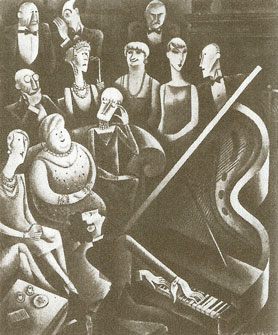
What I found particularly interesting, though, was the response of the audience (or at least those who came because I badgered them). These people (in the main not musically educated) all said they preferred the Sibelius. Now, the Fourth Symphony is a powerful work, one of the greatest symphonies of the twentieth, or any century, but it's also the part of the programme that would be considered a "difficult" piece - essentially because it' s relatively dissonant, emotionally dark and introverted, ending in grey resignation rather than any kind of triumphant peroration (or indeed the opposite, breast-beating despair). And it occurs to me that this is obviously how it should be, not because the Schubert's not a wonderful and great piece (it is, of course it is) but because Sibelius lived in a time closer to our own, and we need to do less work to understand the context he worked in. But the conventional approach to concert programming is entirely based on the premise that anything modern or contemporary is inevitably harder to understand for the non-cognoscenti, and should be approached with caution, buttered up with Beethoven or Brahms.
Is there any other art form where this sort of thinking is considered normal? Can you imagine anyone suggest that you shouldn't even attempt to watch a modern play before you've got to grips with Shakespeare? Or that you should avert your eyes from Picasso or Damien Hirst until you've got the hang of Holbein?
What rot. All my experience tells me that this idea that "uneducated" people need to be coddled in the face of new music is just rubbish. They may not like it, but give them the opportunity to listen and they'll appreciate it - in fact, I suspect the untrained ear may be more open to new sounds than that conditioned and brow-beaten by years of propaganda dripped into it by the education system. We live in an age, after all, where the charts contain music far more abrasive than anything Schoenberg ever wrote, and where the influence of that giant of the post-war musical bogeymen, Stockhausen, can be heard in ways beyond anything you, or he, might have imagined. Isn't it time the classical music establishment woke up to itself and admitted it's got everything the wrong way round, and that this misguidedly timid approach is helping to destroy the art form it's supposed to be enriching?
When a newspaper such as the Observer can print such a closed-minded viewpoint as this review of the Huddersfield Festival by Anthony Holden, there is something deeply rotten at the heart of our relationship with music, an awful combination of intolerance and conservatism that seems to betray an active hatred of music. The point about something like Huddersfield is that it's experimental, it's not going to conform to preconceived ideas, and yes, it will inevitably attract a small audience, and not everything you hear there will work (because it's experimental, remember?) but that's OK, because it's not meant to be mainstream, any more than Stockhausen's works were before they influenced the likes of Warp records' roster. For a major broadsheet paper's music critic to fail to grasp this is an extraordinary failure of the critical process.
It's time we started treating audiences as grown-ups who can listen without prejudice, not as children who need to be protected from the nasty frightening modern composers.
Image (a cartoon from Vanity Fair in 1929) swiped from here.
Monday, November 19, 2007
Inconvenient inspirations
Periodically I find myself returning to the question: at what point does a composer's inactivity pass a point where he is no longer a composer? The idea of a piece floats before me constantly, but any actual content with which to realise this idea remains elusive. I think on this from a slightly different perspective today as I contemplate the prospect of No Music Day, which I found a very thought-provoking experience last year and shall be observing again this year. I bet I'm suddenly overwhelmed with brilliant ideas on the day I'm committed to having nothing to do with them. It's a variant on the muse of meetings, who brings you all your best ideas when you're stuck in some tedious pointless meeting and can't write it down.
Tuesday, October 30, 2007
following a line
 You'd think that, being a cellist myself, drawing a cellist would be a simple matter. But it's actually incredibly difficult to do something that looks even vaguely convincing. I persuaded two fellow cellists in my orchestra to let me take photos of them for reference at the last rehearsal. The results revealed that the sketches I'd done, which seemed plausible at the time, were way off the mark as to how the boy wraps itself around a large, annoyingly curved object. The players in question were a bit suspicious at first - "This sounds a bit suspicious", they said - but I persuaded them it was all in a good cause, and I'd show them the result. Here's a bit of it - I'll put the whole thing up once it's been published. it was weird, typing that; I still can't quite get used to the idea. After all the worries, about whether the idea was strong enough, about whether i was up to executing it, I'm quite pleased with the end result. I think it has one or two nice subtle touches, and I'm pleased with the page layout I came up with, which is (I hope) easy to read while also being reasonably complex. I've tried to use everything, from the poses of the figures, to the colours, to even the hairstyles, to add layers to the story. Strangely, drawing makes me think afresh about composing, of different ways of putting ideas together, of creating a form that serves rather than dictates the content.
I hope someone finds it funny...
So, one deadline conquered, and another immediately looms. So, thoughts now turn to Schubert, and Sibelius, and the prospect of thinking about bassoons grows closer.
Monday, October 29, 2007
"I love dealines. I like the whooshing sound they make as they go past" - Douglas Adams
It's not easy, this being creative lark. Especially when you find yourself doing it for cash, in a medium you're not entirely confident in, with a deadline looming ominously, as I do now. It's at times like this you find out what you can do if you're stretched, I guess. I used to think that being arty involved following your muse without concern for practicalities, writing for posterity, like what the Great Composers like that Beethoven did. Except of course this is all a big fat lie. Beethoven was as much a businessman as a composer, he made damn sure his music got an audience in his lifetime, because if you try to write the music of the future, it'll end up being the music of the past without ever being the music of the present. So hang posterity; just get on with it and let others worry about that sort of thing. I have realised (possibly too late in life) the tremendous creative spur that a deadline offers, and so maybe in my own small way I have achieved a small amount of wisdom, which can only be a good thing.
Many things going on in the world of classical music blogs that I ought to be pontificating on if I had the time, but I shall make mention of the new project Daniel Wolf is planning for his November posting, because it's very similar to how I started this blog. I'm going to start doing that again soon, I promise. As soon as I've got all these deadlines out of the way. I'm very conscious of my almost total lack of compositional activity recently, especially as I'm supposed to be starting work on a new piece for bassoon (something a bit special, sort of a follow-up to "Le tombeau de Feldman").
And now I must stop this internet navel gazing and do the things I am paid to do, and then go home and finish the damn comic strip.
Wednesday, October 10, 2007
ill tempered klavier

Blüthners have a very different tone to the Steinway sound you're almost certain to hear in a concert hall - it's a dark, rich, velvety sound. It feels different to play, too - the action on the keyboard is very heavy, and even now, whenever I play any other piano the action seems strangely insubstantial.
It's an interesting question, whether the near-ubiquity of the Steinway sound is inhibiting composers in their writing for piano - maybe the prepared piano is in part a subconscious rebellion against this homogeneity of sound. I also think of such things as Thomas Ades' Asyla, which features in its scoring grand, upright and honky-tonk pianos. Another piano-related memory of mine is when my university bought a fortepiano. I was fascinated by the sound, and the feel of playing it - it felt like a revelation to hear something that was a piano, yet radically different to the archetype in my mind.
There's always a danger that homogeneity will stifle creativity - but there's always the hope thatimagination will subvert conformity.
* I am particularly excited by the fact that Pleyel use fossilised mammoth tusks for the ivory on their keys!
In Rainbows
So, how much did you fork out for the new Radiohead album? Me, being the nerd I am, I forked out the forty quid for the big exciting box with books and pictures and extra music and lovely vinyl. So I have a posh bit of product to look forward to in 6 weeks or so. In the meantime, there's the download version, which I was emailed the link for this morning.
And hurrah! It's absolutely brilliant! What immediately strikes me at the first listen is that they've managed to combine their experimentalism with their undoubted knack for a good pop song in the killer way they've been threatening to for a while. So you've got twisted dance beats, weird retro-futurist sounds, but also big guitars and tunes. So it sounds more than anything like a band.
I ummed and ah-ed for a while about whether to have the big box, or whether to go for the pay-what-you-want download only option. I wonder what I'd have paid if I'd done the latter? Of course it's tempting to pay nothing, but that just seems wrong to me. I vaguely wondered about getting the download and then if I liked it going the whole hog, but in the end I decided to put my faith in them to deliver, and they've come through for me.
I think the way they've released "In Rainbows" is a fascinating experiment (apparently there'll be a conventional CD release next year), and I hope they give us an idea of how many people downloaded and what most people paid. They're lucky enough to be in a position where they can take a risk like this, and if it works, it'll have huge consequences for the record business and bands' relations with record labels.
Friday, September 28, 2007
The end is where we start
When I was a lad, I was determined that I was going to be an artist. I had this dream from very early on (since 3 or 4, I think), and later on it crystallised into something more specific: I wanted to draw comics. I spent hours copying the characters in comics like the Beano, Buster and Whizzer & Chips, and later on the Doctor Who comic strips, 2000ad and the Eagle were obsessions for me. I marvelled at the wonderful worlds that appeared in them, remembered the artists' name and watched out for my favourites, studying their styles and resolved that one day my name would be listed in the credit cards of 2000ad (at that time pretty much the only comic that credited its creators).
It didn't work out like that of course; I failed my art 'O' level (there's a bit of me that wishes I had had the paper remarked, I'm sure I failed at least partly because my main project was done in a very unashamedly comic-book style), but it didn't really matter, because by then I'd started writing music, and it made me focus on that, and despite my intention to keep drawing for my own pleasure, I stopped making pictures (although I continued to, and still do, doodle voraciously).
Then a few years ago, through comics fans I met through the web, who decided to stop being passive consumers and produce their own small press comics, I started again. I was very unsure of myself at first, in fact to begin with I wrote scripts for others to draw, but gradually I dared to put pen to paper and draw once more. It was wonderful, and all the better because the motivation wasn't any idea of career or success, but a love of the medium and a delight in producing something of my own that was there (as opposed to a piece of music, which once finished must lie in limbo until someone can be persuaded to perform it). And now I find myself drawing for payment, something I've never achieved as a composer, and wondering if this might lead somewhere. Strange how things turn out.
Thursday, September 27, 2007
Thursday, September 20, 2007
Silence

It's 50 years since Sibelius died, and approximately 80 years since he produced any significant work. I can't think of any parallel to this. It seems he worked on an eighth symphony for some years, before burning everything he had written in 1943. Tom Service in today's Guardian suggests that this 30 year silence was simply the only appropriate response Sibelius could make after what he achieved in his final symphonies and Tapiola; he simply could say nothing which would not diminish those achievements.
There's probably some truth in this, although it may be romanticising crippling self-doubt on the part of Sibelius. After he burnt the eighth symphony, he became much happier. Maybe this was because he had reached a point where he felt able to let go of his idea of himself as a composer.
I often think about what makes one a composer*, especially when I'm not actually writing anything. If I at what point do I cease to be a composer? Elisabeth Lutyens used to say "If you're a composer, you bloody well compose", which implies that you're only a composer if you're actually writing. This appeals to me, as I've always felt uncomfortable with the presumption and pretension that seems to go with a declaration of "I am a COMPOSER!". And yet, I'm always conscious, even during those dry, unproductive periods, that I feel that I am, in some way. And this is a disturbing feeling, because if I'm a composer, why am I not composing? Generally, before the suspicion that I'm not a composer anymore takes complete hold, I have an idea, start writing,and become myself again.
But that awesome, oppressive 30 year silence of Sibelius continues to haunt me, and sometimes seems as powerful as anything he wrote. I wonder if that happiness that was noted in him after his immolation was due to a sense of freedom, that he had finally abandoned ambition, had unshackled himself from reputation, had admitted to himself that he was a man who had once been a composer, but no longer was.
*Harrison Birtwistle once gave a talk to an audience of schoolchildren, one of whom asked him, "But how do you become a composer?" Birtwistle replied, "Well, you've got to write music. There's no way round it."
Friday, August 31, 2007
Sonic Youth, Roundhouse
Sonic Youth have always trodden a fine line between experimentalism and indulgence, occasionally stepping over it. One thing they don't have much truck with, though, is nostalgia, so this performance of their classic 1988 album Daydream Nation was never going to be a matter of running through a reproduction of what's on the record. They didn't go as far as John Martyn did when I saw his Don't Look Back concert, where Solid Air was performed in a completely different order and completely different arrangements to the original recording (Martyn's reasoning being that as he didn't have his 1973 band with him there was no point in playing it like that), but when you're a band that deals in feedback as a staple of your sound a certain amount of unpredictability is inescapable before you've even played a note.
Listening to the album before the gig I was struck by how gentle a lot of it sounds now (which may be due to the fact that pretty much all music now seems to be recorded at a monotonously blistering level). Live, you're reminded that Sonic Youth's roots are in the New York punk scene, with the emphasis put on the driving rhythms and a much rawer sound than on record. Then there are those extended moments of feedback, where they sit back and let nature take its course with just the odd movement to manipulate the sound. Although (of course) very loud, there's a strange beauty in here (I'm reminded of the extended feedback Neil Young and Crazy Horse are prone to live, which they even edited into an album). In a way, they're at their most compelling when there's almost nothing happening.
It'd be easy to poke fun at the idea of a band with "youth" in its name consisting of people mostly in their 50s, but Sonic Youth belie this contradiction. Daydream Nation stands up well after 20 years, and, gangling enthusiastically about the stage like the Bash Street Kids with guitars, they play it with the same enthusiasm and commitment they bring to the newer songs they play as encores. Although "encores" isn't really the right word, as it's effectively a whole other set. They bring to mind the observation that youth is simply a state of mind.


