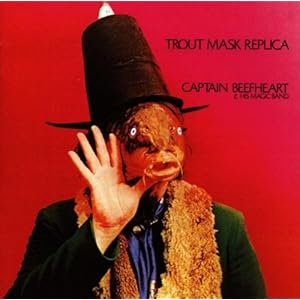
There was something curiously old-fashioned about that "his"; it seemed to evoke old-time acts like Mantovani and his Orchestra. This is strangely appropriate. For all his avant-garde reputation, Beefheart was a showman, and there's a playful theatricality in his music that in another life might have made him a housewives' favourite. You'd have a shock if you put the record on expecting some smooth strings though. I knew the album's reputation, of course - I was an obstreperous child and got that one because it had the most forbidding reputation - but the extraordinary noise that awaited me was something I wasn't prepared for. It took years (and I mean, around 10) for it to click that for all the complexities of time and tone, it was at heart a blues album. That moment of realisation brought everything into focus, and thereafter it seemed incomprehensible that I'd ever found this music forbidding. It never became comfortably familiar though. Like all great music, it remains unpredictable, startling, new.
Saturday, December 18, 2010
Don Van Vliet 1941-2010
Friday, June 26, 2009
Another one bites the dust...
Bloody hell, now Jacko.
I was going to put a video up, but the internet seems to be grinding to a halt at the moment. It must be all the grieving subjects of the king of pop.
Thursday, June 25, 2009
RIP Swells
A world without Swells? Say it ain't so!
Sadly, it is. But it doesn't seem possible he could be gone. RIP, you contrary bugger, you.
Thursday, February 05, 2009
R.I.P. Lux Interior
As a friend remarked, Lux Interior always looked like he'd died about 30 years ago and crawled out of the grave, so it doesn't seem quite right that he's actually gone. The Cramps remain one of the best bands I ever saw live. Damn shame.
Monday, August 18, 2008
Stormy Monday
Well, goddam. I return from a lovely holiday to discover that Ronnie Drew and Isaac Hayes have both died while I was away. Tempting though it is to stick up the theme from Shaft or one of his South Park Songs, here's something slightly less obvious to remember Hayes by:
And here's Ronnie and his band raising some quality hell with the Pogues:
Monday, August 04, 2008
R.I.P. Aleksandr Solzhenitsyn
By coincidence, I'm in the middle of reading The Gulag Archipelago, one of those books everyone's heard of, but few have actually read. It's an astonishing book, that describes events that are hardly imaginable in their horror, and I hope you understand what I mean when I say that if it weren't so readable it would be unreadable. So it gave me an extra jolt this morning to turn on the radio just as the newsreader announced the death of Solzhenitsyn.
I feel like I've chickened out a bit, reading the abridged version rather than the full three volumes, but at the time the abridged version seemed less intimidating, and was also in the bookshop. Now that I'm about a third of the way through, I wish I'd gone straight to the unexpurgated version, so compelling is his prose. It's not just a catalogue of violence though; what shines through the relentless stream of nightmarish scenes is an extraordinary indomitableness of spirit. To read about such things may seem difficult, but it is necessary: because it's important, not just to know what depths humans are capable of sinking to, but to know that there are those who are brave enough to survive them.
Tuesday, June 03, 2008
Bo Diddley Is Jesus
R.I.P. Bo Diddley. One of those guys who, hovering behind a huge number of bands in my record collection as a kid, influenced me before I even knew it.
Sunday, April 27, 2008
R.I.P. Humph

Wednesday, March 19, 2008
Arthur C. Clarke 1917-2008
Anyone who grew up in the late 70s and early 80s will remember "Arthur C. Clarke's Mysterious World", a TV series in which Clarke fronted a series of articles investigating strange phenomena. It certainly made a deep impression on me; I was obsessed with Doctor Who (as were most small boys then) and all thing extraterrestrial, and the remarkable tales I saw presented were a huge meal for my ten-year-old imagination. I even got the big expensive tie-in book, and poured over its pages, filling my head with crystal skulls, mysterious explosions, ancient anomalous technology and alien visitors. It was also the first place I heard the name of Charles Fort, whose words currently head this blog, and whose wickedly playful philosophy has been a great influence on me.
Clarke's best known amongst the wider public, of course, for his novel and screenplay 2001: a space odyssey, and for predicting satellites with geostationary orbits, but he wrote a huge number of books, many of which I read avidly. His short stories always chimed with me most, filled with extraordinary imaginative speculation as to the future, which was nevertheless always perfectly grounded in contemporary science.
What I remember and treasure most from his stories, however, is its essential optimism. Clarke wasn't naive; he was certainly aware that human nature does not evolve as fast as our technological capability. But he always seemed to project the wonder of possibility, and the hope that for all our faults, in the end all things shall be well.
It doesn't strike me that he was the sort of person who'd want to be remembered in solemnity, and so here's something I also remember from TV relating to the great man in an entirely less serious way:
Thursday, January 31, 2008
Beadle: No longer about
You may remember him as that smug git on all those rotten 80s tv shows, but something less well known about Jeremy Beadle is that as organiser of the Bickershaw Festival in 1972 he was resonsible for bringing Captain Beefheart to the UK for the first time. Because of this, I can forgive him for Henry Kelly.
Addendum: The internet throws up some strange connections. Henry Kelly went on from Game for a Laugh to present seminal daytime Euro-quiz Going for Gold, essential viewing for all students and unemployed layabouts in the early 90s, whose cheesy, yet indelibly etched onto my mind, theme song was written by the bloke who went on to score Ridley Scott's Gladiator.
Friday, December 14, 2007
What's next?
Once upon a time composers were artisans, servants like any other. Composing was part of musicianship; all composers performed and most performers composed. Then Beethoven came along and suddenly composers were Artists. Beethoven went deaf and was forced to retire as a performer, and thus was born the Great Composer, the mystic sage who came down from on high bearing the Score, which the musicians then dutifully followed.
This was the end of the Classical style, and the beginning of Classical Music - the canon, the tradition, the myth of the unbroken line inexorably moving forward through history: Beethoven, Wagner, Mahler, Schoenberg, Webern, Stockhausen... at the turn of the 19th and 20th centuries Mahler codified the rituals of concert-giving and going, and the Classical Concert became a quasi-religious ceremony. The composer was a Shaman, exalted and separate.
Stockhausen is dead, and with him dies the Great Composer. We no longer believe the march of that history. Our history is messier, less sure. It seems to me that the music of the future will most likely be collaborative; the roles of composer and performer will merge again, we will all become composers, all performers. There are plenty of talented composers writing fine music (and even more untalented ones writing bad music - and who may judge which is which?), but there are no more Great Composers, and there may never be.
We shouldn't mourn this. This is simply the way things are. Creativity is being democratised, and there is no longer a place for the shaman. Music is not a god to be worshipped. It's not a product to be passively consumed. It is an activity to be participated in, a means for people to come together. There will be new music, and some of it will grow from his ideas, but Stockhausen is part of another time. What's next? We shall find out.
Thursday, December 13, 2007
Stockhausen is dead
But didn't he die a long time ago? What about the people I overheard in Huddersfield in 1996, dismissive and contemptuous of pretty much anything he'd written since the 70s? Wasn't he regarded as someone who'd long since ceased to be worth paying attention to, who'd disappeared down a path of self-indulgent, egomaniacal mysticism? I used to hear such opinions regularly. The he died and no-one wanted to say that anymore.
I was thinking more about that Brian Eno interview, where he suggested that he was more interested in Stockhausen's ideas than his music. Is the actual music so ungrateful? John Humphreys lapped up any suggestion that you wouldn't want to listen to it, of course. Personally I never found his music that hard to listen to. Thorny, certainly. But those people in Huddersfield were berating him for producing music they regarded as too accessible, too easy on the ear, too melodic, not confrontational enough.
So, to the avant-gardists (or at least former avant-gardists; is there actually any such thing as an avant-garde anymore?) he's frozen in amber, a figure from a long time ago, when giants walked the earth. To the anti-modernists he's the bogeyman, the frightening creature under the bed who ruined it for everyone, who can't be buried quickly enough. There's precious little room for Stockhausen himself, underneath all the opinions about him. Either way, there seems to be a consensus between the two poles that he's a figure of the past, whether a past you wish to revive or to bury is up to you to decide.
To the vast majority of people, of course, he means absolutely nothing. Innovation, adventure, risk; these are qualities that find little resonance today in our lowest common denominator Tesco world. Is Stockhausen dead? Did he ever live? The avant-garde is no longer the terrible threat it once was, not something to be railed against, just a curiosity, maybe worth a snigger, then brushed aside. Not relevant. To many people it never was, if they even stopped to think about it, or even became aware of it, however briefly.
Stockhausen is dead, and all we have left is ourselves. And what shall we do with that?
Sunday, December 09, 2007
Karlheinz Stockhausen 1928-2007

I can't, of course. Stockhausen's influence is so profound that entire movements define themselves by opposition to him (or at least their idea of what he stands for, which is generally wrong), so pervasive that you often don't even realise it's there. Half the music in the charts owes something to him, even if its creators don't realise it.
But there's more to him than just an outré name for art-school graduates to drop. Stockhausen's music carries with it ideas about the space created by sound, both literally and figuratively, that have profound consequences for our understanding of our relationship with music, with the people who create and perform it, and those who listen to the results.
What struck me most the first time I heard his music was how approachable it was. His name had such a fearsome reputation, and the texts written by the greybeards who propagated his cult seemed obfuscatory and impenetrably complex and cerebral. But the actual music isn't like that at all. It's visceral and playful, and filled with wonder at the possibilities of sound. To hear the man himself introduce his music was to have all the fog lifted. He used complex methods to produce his scores, but, he insisted, it wasn't at all necessary for the listener to worry about the method. All the listener has to do was hear a sound, then another, and another, and follow these sounds as they grew and changed through time and space. Whether it's the literally visceral approach to the piano he takes in his Klavierstücke (one of which hangs on my wall) or the quiet spirituality of Stimmung, or the grasping of space of Gruppen and Sternklang, his music always seems to me to speak directly and immediately, in a way that isn't always recognised. He was feared as a terrifying, complex and forbidding composer, but I always found the reality simple and instinctive and wonderful.
I encountered him three times, and not once did I pluck up the courage to speak to him (although I'm pleased to report that on two of those occasions he was wearing his famous orange jumper). I remember once in Huddersfield seeing someone go up to him and expound some long, complicated theory as to what had happened to the characters in one of his operas after the end, and whether Mr Stockhausen could confirm whether he was right? Mr Stockhausen replied, bemusedly, that nothing had happened to them, as that was the end of the opera and they were fictional characters.
I wish I had spoken to him. Just to say how much I loved his music; its humanity and its wonderful directness. Stockhausen wasn't a difficult composer, whatever anyone says. In many ways he was as straightforward as anyone could be. It's just difficult to explain ideas as big as his. Far easier to understand them. What I take most of all is a sense of endless, boundless possibility.
Tuesday, October 02, 2007
RIP


Thursday, September 06, 2007
Pavarotti R.I.P.
So farewell then, Fat Lucy. In between all the references to the World Cup, and possibly the odd reference to the fact that he was an actual proper opera singer who sang whole operas, on stage (not something certain other "opera singers" can claim to have done), let us not forget his abiding fondess for elephants.