When I was young I discovered the record section of Birmingham Central Library (something that sadly would be all but impossible now in more than one way, and will become utterly impossible if this government gets its way). I discovered many things within those thing cardboard sleeves, sounds that I’d never heard or imagined could be made. I devoured Nielsen’s symphonies, Stockhausen’s Telemusik and Miles Davies’ Bitches Brew with equal enthusiasm, if not immediate understanding. I pored over the sleeve notes for the Stockhausen. They were all but impenetrable, and if I’d been relying on them to guide me into the music I doubt I’d have made it far. Fortunately I just liked the sounds and didn’t worry about what I was supposed to think about them. It was gratifying years later to hear Stockhausen himself introduce his music. His advice on how to listen to his music mentioned nothing of tone rows or retrograde inversions, but boiled down to: you will hear some sounds. Listen to them and hear what happens to them. It turned out Karlheinz was a lot easier to get my head round than Miles.
Tuesday, May 31, 2011
Sunday, August 03, 2008
Proms: Stockhausen Day
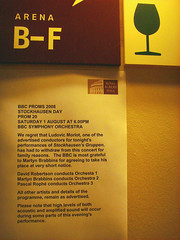
I first heard Gruppen about 10 years ago, when it was performed by the CBSO in Birmingham. Then, as now, the piece was given twice; this works very well, as the piece is so much about the spacial placement of sounds that shuffling about to a different spot for the second performance seems almost a necessity to start to have a proper sense of it. So this is the third time I've heard it.
It doesn't grab me as much this time as before; we're standing in a very crowded arena, with all the really tall people in front of us obscuring any view. Two of the groups have been placed in the arena itself (hence the crowding), but they're at the front end, close to the stage where the third is, so there's very little scope to get right in the middle of the sound field. This seems like poor planning. Wouldn't it have been better to have them at the back, or even construct platforms over some of the stalls? It's not as if they're full, although the turnout's quite respectable (I'm reminded of the adage that there's no hall like the Albert Hall for looking half-empty when it's half-full). That would have left both more space in the arena and more space between the orchestras. As it is, it feels like I'm only really hearing half a performance, only getting a dim sense of the interplay between the groups. And the iconic brass chord that hockets around towards the end doesn't seem to take flight, quite.
There are 24 loops repeating at 24 different speeds (I read later in the programme notes - one occasion where I should have read them before, I think). From the point of view of the listener, there's a swirling, pulsating mass of sound hanging in the air above us, and it's maybe closer to the aural equivalent of looking at a sculpture than listening to a conventional piece of music. I change my mind about it at least three times during its 32 minute course, at first fascinated by its whirling texture, and overwhelmed by the experience of hearing the sounds swoop around in such a large space. Then as it continues it seems to become oppressive, and I wonder if this isn't a perfect demonstration of the megalomania that many wild accuse Stockhausen of, the sense of himself as God. Certainly I feel like I'm a tiny mortal gazing up at an ineffable and indifferent universe. I feel pinned down by one enormous ego, forcing me to accede to his will. Perhaps this is the sound we will hear when the aliens arrive from Sirius to take over our world. By the end, as the loops gradually complete their cycles and the texture thins out, I'm filled with wonder again, as the skies seem to clear.
The solo trumpet of Harmonien, part of the fifth hour of Klang, follows, and it seems like a breeze blowing though the hall after the swirling dense clouds of Cosmic Pulses. It's a very simple piece, essentially a succession of elaborately embellished melodies that seem heartwarming in their straightforwardness.
Finally, an interval! I've heard some wonderful music, but I've been standing up for an hour and a half, and I'm grateful for a chance to sit for a bit. When I go back in I still can't get into the middle (although that tall man who stood in front of me and farted all the way through Cosmic Pulses has managed to get there - honestly, there's no justice), so I settle for a position right by the other orchestra in the arena. At least I'll get a view of something this time. I become aware of a voice droning on behind me. The wanker in the orange shirt (who talked all the way through Cosmic Pulses, by the way - obviously not so enamoured of Stockhausen that he feels the need to listen that hard) has moved too and is still behind me! I'm obviously being punished by the cosmic forces for my doubts earlier on.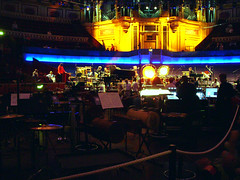
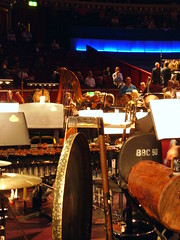
Afterwards, I reflect on how there often seems in Stockhausen's music to be a moment, near the end, when the violent, thorny textures subside, and something more introspective and lyrical comes through, a lyricism that he tries to suppress but can't entirely. If you ignore the received wisdom about his fearsome reputation and just listen, you come to the conclusion that he is in essence a Romantic composer.
It's easy to make fun of this sort of thing, but it works because it's done with sincerity, and it highlights the home-made feel that a lot of Stockhausen seems to have, which gets derided by some but to me is an essential part of his appeal.
That one chord, slowly changing through time, punctuated only by occasional speech, is an extraordinary thing to experience, lying on your back staring up at the ceiling once more. There's a terrible wrench when it finally winds down to its close, and I have to run out as the applause starts to catch the last train home. I feel awake, and don't want the evening to end. That chord gets inside you and resonates, so that long after the performance is over it still seems to be sounding, buzzing inside your skull as you walk home.
Thursday, April 10, 2008
You've spun me round And knocked me off my axis mundi
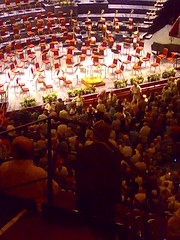
And you know what? There's some pretty darn good stuff in there. Obviously the Stockhausen day will be a highlight for me, but there's also a hefty wad of Messiaen and Carter (and it's not often you get to celebrate the centenary of someone who's not only still alive, but still very active), and a couple of "populist" gigs which I think are both excellent ideas - although not everyone agrees with me.
It's all very well to say "If we build it they will come", but the fact is that kids today have next to no experience of classical music, concert halls are seen as forbidding places, and many people simply won't enter one (a bit like the way quite a lot of people won't watch a programme simply because it's on BBC2 - which is why shows that transfer to BBC1 get such a huge hike in viewing figures). Personally I think that juxtaposing Doctor Who and Turnage is a great idea, not only in terms of getting people inside the hall who might never otherwise go, but putting a message out that it's ok to like both. It's not going to create a brand new audience overnight, but it's a step in the right direction, and puts the whole thing ahead of the usual game for "family" concerts.
The folk day is also exactly in line with what the Proms ought to be doing - a type of music that's intimately linked with so-called classical music, and presented with some of the cultural paraphernalia that surrounds it rather than in isolation like a butterfly in a glass case. I'm looking forward to having a dance round the maypole, so there! And the Ceilidh is a great way to finish it off. If we take it for granted that the Proms is bound to the Albert Hall for the foreseeable future (and I think it is), then for all the place's faults it should be embraced, and stuff like this makes an imaginative use of the space.
Some of the concerts look a bit bizarre to my eye in terms of the wild oscillations between full symphonic works and solo piano pieces, not to mention some strange programme orders (Mahler 5 as an opener??) , but if the Proms are to survive and flourish they have to be open to innovation and experiment, and one of the things about experiments is that they don't always work. The point is, it feels like a fresh breeze is blowing over the season after the increasingly stultifying Kenyon years. There's an eclecticism and a lack of reliance on tired barrel-scraping themes and the like that leaves me feeling uncharacteristically upbeat.
So bring on the daleks, the maypole, the electronica, I say: If it works, great; if it doesn't, at least they tried. Next year they could try putting a big Wicker Man up in Kensington Gardens.
... and everything decays.
Friday, April 04, 2008
Alone again with the dawn coming up

Thursday, January 24, 2008
The Great and Good
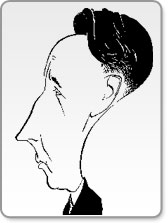
There's a strange thing in classical music, I suppose because it leans on the past more than any other art form, of an insistence when talking about composers talking up their "genius". It's perfectly possible to talk of, say, Dickens as a great novelist while acknowledging his faults (all that sentimental Tiny Tim nonsense, for example), but we like to keep quiet about the second rate pieces Beethoven churned out amongst the jewels (such as the rotten Battle Symphony) . It's as though we're scared that if we admit any weakness in our musical gods, the entire edifice will come crashing down around our ears.
Martinů is a really good (and underrated) composer, and amazingly consistent for someone so prolific, but he's not a Great Composer. I think this is something to do with the fact that he's almost completely uninfluential (there's no "Martinů School" trailing in his wake), but also to do with an attitude, or lack of it, on his part towards his craft. He wrote well crafted, attractive and moving music, but there's never really a sense of him really trying to stamp himself onto history or change the course of his art for anyone but himself. He just tried to write good music.
This makes me stop and think, what do we really mean by a "Great Composer"? The whole idea of the Artist making a Statement begins with Beethoven (of course), which means that Bach, Haydn and Mozart (to pick only the 3 most obvious names) aren't really Great Composers, because the concept didn't exist for them. Significant, influential, great even; but not Great.
A Great Composer doesn't have to be a good composer; in fact I wonder if the two are very compatible, as it's entirely possible for a Great Composer to be a dreadful composer (Berlioz springs to mind, and Wagner - these are my prejudices, of course, you may have your own candidates for bad Great composers). even Beethoven, a Great composer who's generally also a good composer, sails pretty close to the wind - the 5th, 7th and 9th symphonies are exercises in increasing self-importance and bombast, and I maintain that after the astounding opening 30 seconds or so of the ninth, it's downhill pretty much all the way. But in the face of Greatness, quality's a secondary consideration
The line runs out almost exactly 200 years after Ludwig van, with the death of Stravinsky in 1971, and then the demise of Stockhausen at the end of last year; the Great Composer is essentially an idea of the 19th century that lingered through the 20th, and with the decline of so-called- classical music as a vital force rather than a museum, it's an idea whose time has gone. Which is not to say there aren't some great composers out there still, but are there really any Great ones?
Saturday, December 15, 2007

Friday, December 14, 2007
What's next?
Once upon a time composers were artisans, servants like any other. Composing was part of musicianship; all composers performed and most performers composed. Then Beethoven came along and suddenly composers were Artists. Beethoven went deaf and was forced to retire as a performer, and thus was born the Great Composer, the mystic sage who came down from on high bearing the Score, which the musicians then dutifully followed.
This was the end of the Classical style, and the beginning of Classical Music - the canon, the tradition, the myth of the unbroken line inexorably moving forward through history: Beethoven, Wagner, Mahler, Schoenberg, Webern, Stockhausen... at the turn of the 19th and 20th centuries Mahler codified the rituals of concert-giving and going, and the Classical Concert became a quasi-religious ceremony. The composer was a Shaman, exalted and separate.
Stockhausen is dead, and with him dies the Great Composer. We no longer believe the march of that history. Our history is messier, less sure. It seems to me that the music of the future will most likely be collaborative; the roles of composer and performer will merge again, we will all become composers, all performers. There are plenty of talented composers writing fine music (and even more untalented ones writing bad music - and who may judge which is which?), but there are no more Great Composers, and there may never be.
We shouldn't mourn this. This is simply the way things are. Creativity is being democratised, and there is no longer a place for the shaman. Music is not a god to be worshipped. It's not a product to be passively consumed. It is an activity to be participated in, a means for people to come together. There will be new music, and some of it will grow from his ideas, but Stockhausen is part of another time. What's next? We shall find out.
Thursday, December 13, 2007
Stockhausen is dead
But didn't he die a long time ago? What about the people I overheard in Huddersfield in 1996, dismissive and contemptuous of pretty much anything he'd written since the 70s? Wasn't he regarded as someone who'd long since ceased to be worth paying attention to, who'd disappeared down a path of self-indulgent, egomaniacal mysticism? I used to hear such opinions regularly. The he died and no-one wanted to say that anymore.
I was thinking more about that Brian Eno interview, where he suggested that he was more interested in Stockhausen's ideas than his music. Is the actual music so ungrateful? John Humphreys lapped up any suggestion that you wouldn't want to listen to it, of course. Personally I never found his music that hard to listen to. Thorny, certainly. But those people in Huddersfield were berating him for producing music they regarded as too accessible, too easy on the ear, too melodic, not confrontational enough.
So, to the avant-gardists (or at least former avant-gardists; is there actually any such thing as an avant-garde anymore?) he's frozen in amber, a figure from a long time ago, when giants walked the earth. To the anti-modernists he's the bogeyman, the frightening creature under the bed who ruined it for everyone, who can't be buried quickly enough. There's precious little room for Stockhausen himself, underneath all the opinions about him. Either way, there seems to be a consensus between the two poles that he's a figure of the past, whether a past you wish to revive or to bury is up to you to decide.
To the vast majority of people, of course, he means absolutely nothing. Innovation, adventure, risk; these are qualities that find little resonance today in our lowest common denominator Tesco world. Is Stockhausen dead? Did he ever live? The avant-garde is no longer the terrible threat it once was, not something to be railed against, just a curiosity, maybe worth a snigger, then brushed aside. Not relevant. To many people it never was, if they even stopped to think about it, or even became aware of it, however briefly.
Stockhausen is dead, and all we have left is ourselves. And what shall we do with that?
Wednesday, December 12, 2007
Immortality
Is an idea enough to ensure a name survives? So much talk of Stockhausen's ideas; comparatively little of his actual music. And yet it's the music that matters. Isn't it? What are the ideas worth if their worth is not found in their expression? For myself, the ideas were a barrier, not a path. Not the ideas of Stockhausen himself; rather I mean the fog of ideas that other minds smothered him with. The talk of technique, of ways and means, the impression that nothing less or other than a total mathematical understanding of construction could be any help in understanding his music. A path to understanding that instead led to darkness, fear and confusion. And then the revelation of the actual music. The realisation that all this waffle was just that, and clearing that aside left the music itself standing gleaming, not turning the listener away or demanding penance, but welcoming and inviting. No need for analysis or deconstruction, only a willingness to listen. "Don't give me ideas, give me sounds."
Ideas matter. A disciplined, committed approach to one's art is necessary. Because if one does one's job properly and thoroughly, it should be easy for those that listen to the result, if they have the inclination.
Stockhausen was a great font of ideas, and a great philosopher of sound. But we should not let ourselves forget that he was firstly a Great Composer. Perhaps the last one. Is that enough?
Life on Sirius
Tuesday, December 11, 2007
Posterity
A lot of people, including me, have pointed out the influence Stockhausen had beyond the supposedly marginal constituency he occupied. (You can hear Brian Eno discussing this with John Humphreys on Today at The Rambler. Eno is as considered as you'd expect, Humphreys is as ignorant and simplistic as you'd expect.*)
But is that really the most important thing? No Stockhausen, no Radiohead? It's very odd, the way so much of the coverage of his death that tries to express his importance takes this tack. The man who fearlessly pursued his own path, regardless of whether anyone followed him, remembered in terms of commercial success by others.
What about the integrity, the single mindedness, the spirit of exploration, the willingness to pursue an idea?
*By the way, Mr Humphreys, the last time I went to a Stockhausen gig it was sold out. So there.
Monday, December 10, 2007
Arrival
Give up everything, we were on the wrong track.
Begin with yourself:
you are a musician.
You can transform all the vibrations of the world into sounds.
if you firmly believe this and from now on never doubt it,
begin with the simplest exercises.
Become quite still, until you no longer think, want, feel anything
Sense your soul, a little below your chest.
let its radiance slowly permeate your whole body
both upwards and downwards at the same time.
open your head on top in the center, a little towards the back,
and let the current that hovers above you there, like a dense sphere
enter into you.
Let the current slowly fill you from head to foot
and continue flowing.
Quietly take your instrument and play, at first single sounds.
Let the current flow through the whole instrument.
Whatever you want to play, even written
music of any sort, begin only
when you have done what I have recommended.
you will then experience everything on your own.
before you play, you may let your thoughts
run free, you may train the muscles
of your fingers, of your larynx, etc.
But now you know what you think and train for,
and even the thinking and training
will be completely new, completely different from before.
Nothing is as it used to be.
as long as you retain this consciousness,
everything you do will be right and good.
excerpt from Aus den Sieben Tagen, by Karlheinz Stockhausen. © 1970 by Universal Edition.
Sunday, December 09, 2007
Karlheinz Stockhausen 1928-2007

I can't, of course. Stockhausen's influence is so profound that entire movements define themselves by opposition to him (or at least their idea of what he stands for, which is generally wrong), so pervasive that you often don't even realise it's there. Half the music in the charts owes something to him, even if its creators don't realise it.
But there's more to him than just an outré name for art-school graduates to drop. Stockhausen's music carries with it ideas about the space created by sound, both literally and figuratively, that have profound consequences for our understanding of our relationship with music, with the people who create and perform it, and those who listen to the results.
What struck me most the first time I heard his music was how approachable it was. His name had such a fearsome reputation, and the texts written by the greybeards who propagated his cult seemed obfuscatory and impenetrably complex and cerebral. But the actual music isn't like that at all. It's visceral and playful, and filled with wonder at the possibilities of sound. To hear the man himself introduce his music was to have all the fog lifted. He used complex methods to produce his scores, but, he insisted, it wasn't at all necessary for the listener to worry about the method. All the listener has to do was hear a sound, then another, and another, and follow these sounds as they grew and changed through time and space. Whether it's the literally visceral approach to the piano he takes in his Klavierstücke (one of which hangs on my wall) or the quiet spirituality of Stimmung, or the grasping of space of Gruppen and Sternklang, his music always seems to me to speak directly and immediately, in a way that isn't always recognised. He was feared as a terrifying, complex and forbidding composer, but I always found the reality simple and instinctive and wonderful.
I encountered him three times, and not once did I pluck up the courage to speak to him (although I'm pleased to report that on two of those occasions he was wearing his famous orange jumper). I remember once in Huddersfield seeing someone go up to him and expound some long, complicated theory as to what had happened to the characters in one of his operas after the end, and whether Mr Stockhausen could confirm whether he was right? Mr Stockhausen replied, bemusedly, that nothing had happened to them, as that was the end of the opera and they were fictional characters.
I wish I had spoken to him. Just to say how much I loved his music; its humanity and its wonderful directness. Stockhausen wasn't a difficult composer, whatever anyone says. In many ways he was as straightforward as anyone could be. It's just difficult to explain ideas as big as his. Far easier to understand them. What I take most of all is a sense of endless, boundless possibility.
Wednesday, November 28, 2007
What's difficult?
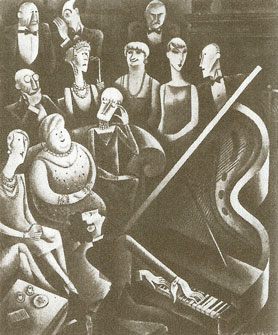
What I found particularly interesting, though, was the response of the audience (or at least those who came because I badgered them). These people (in the main not musically educated) all said they preferred the Sibelius. Now, the Fourth Symphony is a powerful work, one of the greatest symphonies of the twentieth, or any century, but it's also the part of the programme that would be considered a "difficult" piece - essentially because it' s relatively dissonant, emotionally dark and introverted, ending in grey resignation rather than any kind of triumphant peroration (or indeed the opposite, breast-beating despair). And it occurs to me that this is obviously how it should be, not because the Schubert's not a wonderful and great piece (it is, of course it is) but because Sibelius lived in a time closer to our own, and we need to do less work to understand the context he worked in. But the conventional approach to concert programming is entirely based on the premise that anything modern or contemporary is inevitably harder to understand for the non-cognoscenti, and should be approached with caution, buttered up with Beethoven or Brahms.
Is there any other art form where this sort of thinking is considered normal? Can you imagine anyone suggest that you shouldn't even attempt to watch a modern play before you've got to grips with Shakespeare? Or that you should avert your eyes from Picasso or Damien Hirst until you've got the hang of Holbein?
What rot. All my experience tells me that this idea that "uneducated" people need to be coddled in the face of new music is just rubbish. They may not like it, but give them the opportunity to listen and they'll appreciate it - in fact, I suspect the untrained ear may be more open to new sounds than that conditioned and brow-beaten by years of propaganda dripped into it by the education system. We live in an age, after all, where the charts contain music far more abrasive than anything Schoenberg ever wrote, and where the influence of that giant of the post-war musical bogeymen, Stockhausen, can be heard in ways beyond anything you, or he, might have imagined. Isn't it time the classical music establishment woke up to itself and admitted it's got everything the wrong way round, and that this misguidedly timid approach is helping to destroy the art form it's supposed to be enriching?
When a newspaper such as the Observer can print such a closed-minded viewpoint as this review of the Huddersfield Festival by Anthony Holden, there is something deeply rotten at the heart of our relationship with music, an awful combination of intolerance and conservatism that seems to betray an active hatred of music. The point about something like Huddersfield is that it's experimental, it's not going to conform to preconceived ideas, and yes, it will inevitably attract a small audience, and not everything you hear there will work (because it's experimental, remember?) but that's OK, because it's not meant to be mainstream, any more than Stockhausen's works were before they influenced the likes of Warp records' roster. For a major broadsheet paper's music critic to fail to grasp this is an extraordinary failure of the critical process.
It's time we started treating audiences as grown-ups who can listen without prejudice, not as children who need to be protected from the nasty frightening modern composers.
Image (a cartoon from Vanity Fair in 1929) swiped from here.
Monday, November 26, 2007
On the Corner
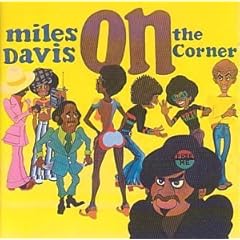
Its origins lie in Miles' realisation in the early '70s that jazz had been largely abandoned by young black kids, who were listening to Sly Stone and James Brown instead. He realised he needed to do something that would connect with them, speak to the kids on the street. So he made a funk album, of course. But being Miles, he couldn't make any old Stone-derived sound. He needed to bring something new to the party. And what he decided was the killer concept, that would bring his sound to the kids on the street was the ideas and processes of Karlheinz Stockhausen. Well, obviously.
I remember when I was a teenager first listening to Miles, and finding things like Bitches Brew bewildering, in a way probably only matched by Trout Mask Replica, another album it took me a long time to get my head round. But I always felt there was something in them, something that was just out of reach, that I needed to keep digging and find. Anything of real worth requires effort, because the effort makes the reward that much sweeter. So when Miles decides that what funk-jazz needs is the influence of the German avant-garde, god dammit, you've just got to go with it, because in the end you'll see he's right.
What Miles specifically takes from Stockhausen is his concept of space. On the Corner is an album that isn't much concerned with harmonic progressions, being on the surface a sequence of one-chord jams (or to be more accurate, cut and paste collages derived from one-chord jams). It's in the placing of the sounds that it gets its power, taking what could almost be described as a pointillist approach, short staccato phrases juxtaposed in varying combinations, never resting, always moving, but also static, creating a real sense of an environment in which we stay for a while. I'm reminded of the way Birtwistle describes many of his works, in terms of a single unchanging object viewed from changing perspectives.
If this sounds dauntingly intellectual, the effect on the ear is visceral and immediate (as is the actual music of Stockhausen and Birtwistle, if you ignore all the talking about it and just listen). Those foam-mouthed jazz-heads need to open up their perspectives and stop worrying about whether this is jazz or not. It's an extraordinary record that even now sounds like something that arrived in our midst from outer space.
Oh, did I mention that it's also damn funky?


