Showing posts with label Birtwistle. Show all posts

Wednesday, April 30, 2008

The Minotaur

Say what you like about the parasitical/elitist/upper class* crowd, they get service. I hardly had to queue at all to pick up my ticket from the Royal Opera House box office for tonight's performance of Harrison Birtwistle's latest show, The Minotaur. A pleasant change from some venues I could mention. The man behind the desk almost smiled, too.

They're obviously not used to folks from the regions in the bar though, as I had to repeat my request for a bottle of Pride several times, my minimally Brummie accent proving virtually indecipherable to the barman. Of course I was in the cheap sets, but i got to feel like a flash rich person with wads of cash to chuck around through the ROH's thoughtfully charging £4 for a bottle (that's about eight quid a pint - nightclub prices if ever I saw them. Maybe this is their way of reaching out to the ordinary punter).

I must make a confession: I'm not really that mad on opera. It's fundamentally a fairly ridiculous medium that seems to attract deranged fanatics who take no interest in any other form of music. So it's a credit to the composer and the production that I was thoroughly engaged in the evening, managing to sit through the 85 minute first half without fidgeting very much a all (just as well, as there's not much room in the cheap seats, certainly stretching's a no-no).

Death's always a problem on stage. It's difficult to feel genuine horror at the sight of some skinny lass writhing around the floor smearing ketchup over her smock. I suppose this is just one of those things you have to put up with, though, and Birtwistle's score and the production are both sensible enough to present something heavily stylised that makes almost no attempt to acknowledge the concept of realism. So when the Minotaur goes on his second killing spree, taking the body tally from one to a dozen in a few minutes, it's presented more as ballet than anything actorly, and is all the better for it.

As I've noted before, Birtwistle seems to be in the process of a strange image-metamorphosis from bogey man to the cuddly face of modernism in the press at the moment, and while it would be stretching it to suggest this is no more work than a night at Madam Butterfly, this is a compelling, clearly orchestrated and emotionally direct score, and hell, yes, lyrical. The narrative proceeds in a linear fashion, and one suspects Birtwistle's in danger of becoming respectable. I particularly liked the cimbalom that popped up fairly regularly, reminding me strangely of Portishead (I guess because they're in my mined this week).

There are lots of startling moments, particularly the Keres who come to feast on the dead left in the beast's wake, and the Oracle who tells Ariadne how to help Theseus escape the labyrinth. The message of the piece - the closeness of humanity and baser nature, and the way we create our demons - isn't one of startling revelation, but it's resonant, and presented subtly without being bashed around the head, and the melancholy of the Minotaur's monologues particularly is very affecting.

All the cast were excellent, but of course special mention must be made of John Tomlinson, whose head was visible as a human ghost inside the bull's head (a particularly good example of the way the design in the show uses simple ideas effectively) and brought the pathos to the role to make us sympathise with the beast. The chorus goading him on to kill come over as school bullies, creating the beast by treating him as one.

Looking round the audience at the interval, it struck me that it didn't look at all like what cliche would suggest an audience at a contemporary opera would look like, which must be a good sign. Although there was present that man who gos to all concerts it seems, and makes sure he leaps in like a demented seal as soon as the orchestra finishes to clap, thus entirely destroying the atmosphere (this was particularly annoying at the interval). No-one thinks you're clever for knowing when it's ended, mate, so give it a rest, eh?

At the curtain call I was startled to see a fat bloke in drag with a pair of comedy plastic breasts strapped on come on stage, it was the oracle. Sometimes it's best to keep the lights down low and keep the magic.

*Delete according to personal prejudice.

I tried to take a picture of the nice sandpit with a bull's head in it at the front of the stage before the show began, but it came out terrible, so I've nicked this picture from MusicalCriticism.com
instead.
Tuesday, April 15, 2008

Tuesday Link-o-rama

Oh, has it come to this? Am I now on that slippery slope to being just another blog with a bunch of links to the words of other, far more intelligent and interesting people than me? I'll try not to make a habit of it. Anyway, in the absence of anything interesting to say coming out of my brain, here are a few things to read:

EMI's planned job cuts have been delayed by some piddling legal process. Damn those pesky Europeans with their crazy ideas that big multinational corporations can't just shit on people as they please.

The Graunaiad is publishing daily extracts from one of the Defeatist's number one heroes, Mark E. Smith. Part one is here and part two is here.

Harrison Birtwistle's new opera The Minotaur premieres tonight. Here are some interviews with the composer, director and protagonist. I'm interested in the way the media seem to have moved from portraying Birtwistle as a terrifying figure to almost the cuddly face of modernism.

Monday, November 26, 2007

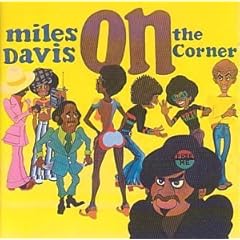
On the Corner

On the Corner is probably just about the most contentious thing Miles Davis ever did, and even now you'll still find plenty of jazz-heads who'll foam at the mouth and brain you if you even mention it, let alone suggest that it's good, or even jazz. I'm reminded of it by the fact that a big box set of the complete sessions has recently come out, and currently sits in the "highest priority" part of my Amazon wish list (hint), and that's reminded me that it's about time I pulled it off the shelf again and had another listen.

Its origins lie in Miles' realisation in the early '70s that jazz had been largely abandoned by young black kids, who were listening to Sly Stone and James Brown instead. He realised he needed to do something that would connect with them, speak to the kids on the street. So he made a funk album, of course. But being Miles, he couldn't make any old Stone-derived sound. He needed to bring something new to the party. And what he decided was the killer concept, that would bring his sound to the kids on the street was the ideas and processes of Karlheinz Stockhausen. Well, obviously.

I remember when I was a teenager first listening to Miles, and finding things like Bitches Brew bewildering, in a way probably only matched by Trout Mask Replica, another album it took me a long time to get my head round. But I always felt there was something in them, something that was just out of reach, that I needed to keep digging and find. Anything of real worth requires effort, because the effort makes the reward that much sweeter. So when Miles decides that what funk-jazz needs is the influence of the German avant-garde, god dammit, you've just got to go with it, because in the end you'll see he's right.

What Miles specifically takes from Stockhausen is his concept of space. On the Corner is an album that isn't much concerned with harmonic progressions, being on the surface a sequence of one-chord jams (or to be more accurate, cut and paste collages derived from one-chord jams). It's in the placing of the sounds that it gets its power, taking what could almost be described as a pointillist approach, short staccato phrases juxtaposed in varying combinations, never resting, always moving, but also static, creating a real sense of an environment in which we stay for a while. I'm reminded of the way Birtwistle describes many of his works, in terms of a single unchanging object viewed from changing perspectives.

If this sounds dauntingly intellectual, the effect on the ear is visceral and immediate (as is the actual music of Stockhausen and Birtwistle, if you ignore all the talking about it and just listen). Those foam-mouthed jazz-heads need to open up their perspectives and stop worrying about whether this is jazz or not. It's an extraordinary record that even now sounds like something that arrived in our midst from outer space.

Oh, did I mention that it's also damn funky?

Wednesday, August 01, 2007

Prom 25: Boulez/Birtwistle (Radio 3/ online)

Pierre Boulez is a composer notorious for reworking his music, sometimes over many decades, and never quite reaching a conclusion (he has commented that works of art are never finished, only abandoned), with the result that his catalogue is full of torsos and "works in progress". Ironic then, that due to the late running of the earlier prom and the vagaries of London's public transport network this late-night offering from the London Sinfonietta and the BBC Singers was already up and running by the time I got home and turned on the radio, so I only heard his recent completion of Dérive 2 as a fragment. I shall certainly be taking advantage of the excellent BBC Radio player to listen to the full work, though, as it was an extraordinary and beautiful work. Boulez is the man fingered by many of those who oppose all avant-garde music since 1900 who ruined it all, and I'll admit I have issues with parts of his aesthetic*, but you'd have to be fairly cloth-eared not to be able to revel in the luxurious sounds he conjures up here. I wonder how the fact that I shall hear the opening of his piece after the close relates to his ideas challenging the idea of a "complete" work?

Coupled with this sensuous, glowing music was another of the bogeymen of contemporary music, Harrison Birtwistle. Again, Birtwistle is a man much misunderstood, as the frequent extreme complexity of his textures belies a thoroughly direct, even blunt, approach. Neruda Madrigals is one of his gentler works, and its more austere sound world, conjuring up thoughts of the Northern landscapes that he inhabits, made an excellent pairing with the Boulez, and made me regret that it was impracticable for me to stay and hear it live. What a shame this sort of thing gets increasingly and timidly relegated to late night slots. One hopes that this is a trend that will not continue when Roger Wright takes over the Proms from Nicholas Kenyon (aka the Doctor out of Star Trek Voyager) next year.

Players and singers were as good as you'd expect, and isn't it good to see in Susanna Mälkki a woman at the forefront of was is still largely a male domain?

* Maybe I'll get round to writing a post about this eventually.