Patterns in a Chromatic Field was the second piece by Morton Feldman I ever heard, and it remains one of my favourites. The first time I encountered it was in Huddersfield in 1996, in a late-night concert straight after the one that featured the first Feldman piece I'd ever heard, For Samuel Beckett.
I was there because I had a piece in contention for the festival's Young Composer Award. (I didn't win, although I did get beyond the workshop stage and get a proper concert performance alongside the piece that did win. Long story.) Feldman was one of the featured composers that year (the first time a dead man had been featured this way in Huddersfield, I believe), so there was quite a lot of his music to hear. Being a provincial boy who'd been to a provincial university, I'd never heard of him before. Hearing For Samuel Beckett was an extraordinary experience. I'd read about him beforehand and so had an idea of what to expect (slow, quiet, goes on a long time), but I really wasn't prepared for how it would feel to sit through something like this. It started off well; Feldman's music has a sound that's immediately attractive. So for the first few minutes it was great. As it progressed though, the sheer apparent stasis of it began to get to me. By about 20 minutes in it began to feel like some form of torture. After that confusion and disorientation began to set in. And then something odd happened. The music seemed to be putting me into a kind of trance like state, not entirely unlike the state of mind you might find yourself in after a low dose of hallucinogens. By about the 50 minute mark when the piece finished, I couldn't decide whether it had gone on far too long or not nearly long enough. We left the hall and walked over to the venue where the late-night gig was happening. This was Patterns in a Chromatic Field, and here everything clicked into place, I experienced that rare sense of revelation that classical music delivers rather more rarely than it promises, and I became the devote of Feldman's music that I remain today.
So Patterns holds a special place in my heart. It's where I "got" Feldman, and it came into my life at a very exciting time when it briefly seemed I might amount to something. It's also a piece for cello, so I also get to have the (probably futile) notion that one day I might play it myself. In my mind it's become a rep piece for cello. I've heard a good four or five recordings of it since then, but last night's performance by Anton Lukoszevieze and Philip Thomas of Apartment House is only the second time I've heard it live.
That's important, because Feldman's is a music that feels significantly different in concert. It's something to do with commitment. Listening to a recording in your own living room, there are always distractions, the possibility of doing something else while the music's playing. Going to a performance requires a higher level of commitment. You're there for an hour and a half of quiet, often superficially uneventful music that demands a level of concentration that's almost superhuman. (This goes for everyone there, whether they're performing or listening.) At the same time, the fact that there's nothing else but you and the music (well, and the rest of the audience), makes it easier. It's just you and this intimidating experience ahead of you, and the only thing that can distract you (apart from the rest of the audience) is whatever thoughts spring into your mind as it struggles to maintain its focus on the moment.
I say superficially because of course there's actually a huge amount going on. You hear a lot of music written under the influence of Feldman, and what most of it fails to grasp is that although tiny motifs and ideas return and reiterate again and again, over and over, there's actually very little repetition in Feldman. Like walking into a dark room, once you've acclimatised yourself you find there's actually a huge amount of detail to appreciate where initially there seemed to be nothing. Patterns is unusual in late Feldman in that it's often quite antsy and fidgety in texture, and has a sense of nervous activity that only periodically dissipates to reveal a more glacial texture. Lukoszevieze and Thomas's performance tends towards the slower end of the range I've heard (they come in at just over 90 minutes), and yet they still mange to convey this jitteriness, a quality that I think often gets lost in the race to play Feldman as slowly as possible. This is quiet and defective and profound music, sure, but there's also humour to be had, another element of Feldman's personality that often gets neglected, and which they convey deliciously here in the the throwaway ending, for instance.
One of the startling things I find listening to this piece on the flesh again after all those years is how much of it has seeped into my own music. Feldman's been a huge influence on me, of course, but it's startling to sit listening to Patterns and real is how much this specific piece has left its mark on my own work. Sometimes this is the result of initial enthusiasm and half-absorbed lessons: you can hear this in Infinite Breathing, where a Feldmanish texture jostles for supremacy with passages in thrall to Ustvolskaya, whose music I discovered around the same time as Feldman's. Later on in Le tombeau de Feldman it's a more deliberate allusion, but it's startling to realise how what I thought at the time was a kind of generalised ersatz-Morty was a half-memory of this particular piece, the main difference being that my figures tend more towards the diatonic than Feldman's (that at least was a deliberate thing).
I sometimes wonder if Feldman, who twenty years ago was a fairly marginal figure, isn't now becoming too pervasive a figure. I certainly worry that it's become cliché to write music under his influence (albeit often without a real understanding of what he's doing and why he uses those textures and strategies), and periodically try to kick the Feldman habit in my own music. Having said that, he's clearly not edged quite so far into respectability that some people won't walk out before he's done. Five did last night. One of them was a woman who heroically and selflessly sneaked out as quietly as she could before she succumbed to a coughing fit. I salute her. The other four confuse me (why on earth stick it out for over an hour and disappear with 20 minutes or less to go?) and annoy me (if you are going to duck out early, couldn't you at least try to leave quietly?). But to come back to this piece, to her it live in that situation where you're stuck in a hall with it, and just as you settle in having made sure you went to the toilet first, you experience a momentary frisson of exhilarating fear as you register what you're committing yourself to, banishes thoughts like that. What's wonderful, what makes it great music, is its capacity to come out and startle you, and (particularly in a well-judged performance like this one) make you feel like music you've been listening to for years is music you've never properly heard before. You thought you had it figured, and then you realise that you've hardly scratched the surface.
Saturday, November 09, 2013
Morty and Me: Appartment House perform Patterns in a Chromatic Field at the Purcell Room
Monday, April 12, 2010
Ensemble Plus Minus, Kings Place
 Or should that be plus-minus ensemble at King's Place? Or +/- @ kingsplace? This sort of typographical quandry is par for the course in the world of Modern Music.
And this gig was definitely Modern Music, with capitals and all. I felt like I'd been transported back to the late 80s. Within seconds of arriving I saw my first Man Dressed In Black.
When I was a nipper, there was a certain set of clichés about Modern Music and the people who went to hear it. Men (always men), almost certainly dressed in black, either bald as a coot or hirsute, possibly of questionable hygiene, never smiling. This is Modern Music. It's Serious. It's Art. NO SMILING. Angular, difficult, hard edged music. Music for Men. Men who smoke and shun deodorant. Men who probably write similar music themselves.
If you believe what you read on the internet (and why wouldn't you?) this sort of thing's yesterday's news. We're no longer scared of music written by non-dead people, we all love each other and even know girls. There were actually some girls there, but they tended not to be talking to the boys, a bit like a school disco. I did see a couple of people smiling, so things haven't remained entirely static since 1989 for these folks.
(I'm uncomfortably aware, by the way, that if you drew a Venn diagram of people who fit into the category I'm talking about, I'd have at least one foot inside it. A lot of these guys are dressed like 80s-90s students, i.e. exactly like I did when I was a student, and sometimes still do. Although I rarely wear all-black these days, it feels weird when I inadvertently do.)
Like Goths and Catholicism, though, the old guard survives, and you'll find them at a gig like this. The particularly fearsome man who sat stiff-backed, hands at the ready to applause the second the Xenakis finished to show he knows when it ends (and is therefore better than the rest of us), paunch nearly covered by grubby shirt and leather jacket, the gentle smell of stale fag smoke wafting gently from his person, was only the most striking example of this Lost World of Modern Music fans (as in fanatics). Gruffly barking "Bravo!" to show he understands and appreciates Difficult Music more than the rest.
Back in the day you'd have gone to a church or a school drama studio to hear this sort of stuff. Fortunately King's Place Hall two has much the same vibe as a drama studio, so there's some continuity there. The presentation is resolutely old-school, too. No talking to the audience or anything like that, just a procession of musicians coming on, playing, and walking off again. This is Difficult Music. If you don't understand it there's no point trying to explain it to you.
I've heard pieces by Xenakis that knocked me out, and others that bored me senseless. Neither of the works that began and ended the first half were at either extreme, though I preferred the piano solo Evryali to the violin and piano piece Dikhthas. Evryali came over like a cross between Ligeti's Piano Etudes and Ustvolskaya's Sonatas without being quite as compelling as either. In between came Rebecca Saunders' Vermilion. Saunders is published by Peters Edition, who despite their signing of the likes of Jonathan Dove in recent years will always be for me the publisher non plus ultra of Difficult Modern Music, printed in Very Big Scores. The scores in this case were surprisingly normal-sized, but it was still definitely the sort of piece where everyone plays from a score. Saunders clearly has a fine ear for texture, and there was much to admire in that respect, but I'm afraid it left me cold, neither seducing nor provoking me. It was there and it was OK, but I didn't feel any sense of its existence as being necessary.
It was the second half I was actually there for. I like Bryn Harrison's music, but there's no getting away from the fact that it's basically a massive rip-off of Morton Feldman. Talent borrows, genius steals, they say, which puts him firmly in the talented camp. If you're going to borrow on this scale though, you may as well do it well, and Harrison (Head of Composition at Huddersfield University) does. I do wish he'd reference something other than other pieces of his in his programme notes though. Unless you're deeply acquainted with his work it's unhelpful and irritating. The lengths he went to to avoid mentioning Feldman were amusing though. Repetitions in Extended Time was commissioned by the Huddersfield Festival.
I find myself wondering though. The Xenakis pieces are, what, 30-40 years old now? Which is old enough that the style has acquired a comfortably quaint, nostalgic patina. Is there some weird thing happening here where composers like that are for people like this what Beethoven and Mahler are for mainstream classical audiences? Something old and familiar, that they feel comfortable with (and therefore almost certainly no longer understand)? And is the Feldmanesque trope now becoming so common (there a a lot of other composers ripping him off, myself included) that it's in danger of going the same way? I'm certain that one day that style will seem just as quaint and cute as Xenakis does now. I'm sure the New Music Men see themselves as keepers of a flame. If there's one thing that's definitely better now than 40 years ago it's that there's no style police telling us what sort of music we can and can't write or listen to, so in a way it's reassuring that they're still about. But maybe they're just as hung up on nostalgia as everyone else. The trouble with writing the music of the future is that it tends to skip the present and go straight to being the music of the past.
Thursday, March 18, 2010
London Sinfonietta play Barry & Ayres, QEH
You'd think that as I'm on the South Bank Centre's mailing list I'd have heard about this gig from them. As it was an email limped into my inbox a few days after the man in Harold Moore's told me about it. He was particularly excited about the prospect of a Gerald Barry premiere; it was the Richard Ayres piece that dragged me along.
It's quite a while since I've been to a proper Sinfonietta-type "contemporary music" gig, so it was reassuring that the crowd seemed to be largely the familiar mix of composers, journos and the nearly-dead. It was also a relief not to have to avoid anyone I've offended over the years. It was the kind of audience full of people who recognised each other, some of whom I recognised, none of whom recognised me. Reassuring but also depressing, because this music ought to be getting a much wider audience than the same old clique.
A lot of this must be down to a failure of advertising. Arts venues generally seem incredibly complacent about their audiences, not really making much effort to reach beyond the audience they already have, and then wondering why they're going down the dumper. It's not really good enough, and the likes of the South Bank really ought to be taking a long hard look at what they do rather than sitting back and feeling smug because they had that Jarvis Cocker doing Meltdown a couple of years ago.
On the other hand, kudos is due for allowing punters to take their drinks into the hall, which I think is an entirely civilised thing to be able to do, and stuff anyone who says different.
But I digress. What of these two fine pieces I heard?
First up was Gerald Barry's Beethoven. This is a setting to music of Ludwig van's famous letter to the Immortal Beloved, in which the great man takes time out from metaphorically bashing us over the head with his cock to go all Emo on us. As Barry says in his programme note, it's a very odd love letter: a combination of declarations of undying love with declarations that it'll never work. If you're feeling sympathetic it's a desperate cry from the heart; if you're not it's some self-flagellating whiny shit.
I can't make up my mind about Barry's music. I like the idea of it,but somehow the reality of it never seems quite as exciting. On the other hand, this particular piece didn't seem too long to me, as a lot of what I've heard of his has. Singer Stephen Richardson negotiated the extremes of his vocal register with wonderful aplomb, and the final section that appropriated the very famous hymn tune that embarrassingly I can't remember what it is now is rather lovely.
I hope the man from Harold Moore liked it. For me though, Richard Ayres' No.42 (In the Alps) was the real deal. Ayres is a comparative rarity in these circles: he has an ability to combine full on, often very silly, humour with moments of genuine profundity, without becoming either superficial or pretentious. He makes it seem entirely reasonable that the band should all come on wearing woolly hats, while conductor Martyn Brabbins is dressed for a good long hike, backpack included.
The use of projected captions (in the manner of a silent movie) is an inspired way to convey the story being depicted in the ensemble, as well as providing some brilliantly timed jokes The female protagonist's raising by very maternal mountain goats raises a chuckle, as does the nicking of bits of Strauss to evoke the Alps (although that's not as funny as the woman next to me thought it was). this also fits in with the silent movie references, as that sort of lifting of well known music is a standard trick of the cinematic accompanist.
Barbara Hannigan (dressed like a post-punk Brunhilde) gives an astonishing performance, in which she's required to impersonate goats, hogs, cicadas and eagles (and probably some other things I've forgotten about), and does so brilliantly. The use of animal noises is a wonderful example of Ayres's way with a joke: it begins as something funny, but evolves into something strange, wonderful and affecting. Likewise Alistair Mackie (fetching in lederhosen) shows that the gag of a hero who can speak only through his bugle can be something much more than slapstick. The tale of unrequited love between these two characters ought to be just silly, but Ayres magically spins something moving out of it.
Two interludes and a postlude reflect on how animals with different heartbeats perceive time. As with so much of this piece, this began as comedy, but by the conclusion was transformed into something altogether more thought-provoking.
It's a terrible shame that the Queen Elizabeth Hall was half-empty. Both these pieces combine immediate appeal with a genuine depth that would repay repeated hearings. Both deserve to, and I'm convinced can find a much wider audience than that tiny in-crowd that turns up to this sort of show. So when are the organisations in question going to make a serious effort to find it?
Saturday, June 06, 2009
Feldman: Crippled Symmetry (Endymion, Kings Place)
It's redundant to dissect a performance of Feldman's music in a way: Not that there isn't great skill and musicianship needed to bring it off, but the music itself places itself so far outside the traditional notion of "performance" that it's very difficult to say anything of the performers beyond the bare facts that they turned up, played the notes, and had the stamina and concentration to get through the hour and a half (in this case) that the piece takes to play.
So at the risk of seeming to damn with faint praise (I don't mean to), I should say straight off that the three members of Endymion who performed "Crippled Symmetry" at Kings Place on Friday night turned up, played the notes and demonstrated the requisite stamina with aplomb. The thing is, this is music that one one level isn't about the performers at all, and yet on another is absolutely about them. The extreme duration, and the demands of playing so softly and slowly (much more tiring than playing fast, busy music) mean that it's all about the physical and mental stamina needed to maintain concentration. And yet the music itself demands the players to abandon the normal ideas of self-expression. Feldman's music lies beyond ideas of expression. It simply is.
This removing of theatrical display or gesture, the creation of what you might call a flat surface, like the canvases of his friend Mark Rothko, with whose work his has much in common, doesn't lead to an uninvolving experience though. The reduction of everything to the minimum actually makes the smallest detail assume immense significance. So it is that the flute's tonal pallor comes to seem sharp and piercing in contrast to its bigger, softer sibling, the bass flute. And the glockenspiel and piano likewise acquire a brighter presence next to their more muted doubles, vibraphone and celesta.
"Crippled Symmetry" is one of the few Feldman works to carry a title other than the names of the instruments it's written for. It's a title that could apply to most all of his work though: the small patterns that almost, but don't quite repeat. The sense of stillness that conceals enormous movement: like a glacier, it appears from moment to moment to be static, but in fact is moving with a power that can cut through mountains.
Feldman's music makes no claim to "meaning" beyond the fact if its existence and the actions that bring it into existence. But that doesn't make it meaningless. It simply makes that meaning something so vast that it can't be expressed in any terms than the sounds that make it. It's something best experienced live rather than on record. In your living room there are too many distractions. This demands, and deserves, your full and undivided attention. That's not easy over such a long span of time. It's music that conveys and demands quiet courage, for both its performers and audience.
Saturday, April 25, 2009
Heiner Goebbels: Songs from Wars I have seen (QEH)
It's an essential part of the contemporary so-called-classical scene that the show you're at will overrun. A good yardstick of the quality of what you've been listening to is therefore how much that irritates you. I found myself not at all bothered by the fact on this occasion, so well done Heiner*.
To be fair, at least part of the overrun was down to the man who walked on and announced "My name is Andrew Burke Chief Executive of the London Sinfonietta" (how remarkable to have a name that suits your job, I thought) and proceeded to beg for money in that way that people desperate for money who don't want you to have the impression they're begging for it do. A lot of talk of wanting to connect with those who buy their tickets on the door (subtext: please book in advance, we've been shitting brick about advance sales), building relationships with their audiences (subtext: we're really worried about how the hell we get people to come to these things) and so on. All couched in friendly, "hey, we love you and we want to connect" language, but going on slightly too long not to come across as a bit desperate. Maybe I'm completely wrong, the London Sinfonietta feels completely recession-proof and has a mailing list as long as your arm, but it sure as hell didn't come across that way.
I have a problem with the London Sinfonietta; they make me slightly suspicious. Partly this is because they're the Establishment: I think of what Morton Feldman said, that the music you hear in London sounds official, like it was written for the London Sinfonietta. And the Establishment can't ever do anything really innovative or different, because innovation and difference challenges the established order. It's hide-bound by its position, by the deadweight of the one-of-each-instrument lineup that fills so much of its repertoire, from which so little interesting comes. Then there are things like those collaboration nights with Warp Records, which seem slightly pointless: is the Sinfonietta desperately chasing after the cool kids, or is it saying that by rearranging electronica for "classical" forces it's conferring a greater artistic legitimacy on it than it otherwise has? Which would seem to imply some level of contempt for the other, cooler music. The classical world is infested with the notion that its music is inherently better than any other kind.**
That said, it would be dumb to dismiss anything they do because of who they are, and tonight's concert of two pieces by Heiner Goebbels is an impressive one that shows that there's still life in this thing if you're clever enough to know where to look. Which Goebbels is. He understands that this genre of ours is essentially dramatic (why else dos it take place on a stage?) and both the pieces here are to some degree overtly theatrical. The use of samples of other records, as well as quotations of other musics performed by the musicians, emphasises this. It's to Goebbels' credit that these elements don't distract - although it's impossible not to have a moment of trying to remember where that drum loop's from - but manage to integrate in a way that earlier stylistic cross-dressers like Schnittke don't really manage, so the flow from tonality to atonality, from baroque to postwar modernism and back comes to seem natural.
Maybe this just where I'm coming from these days, but it's at its most impressive when there's less going on. "Songs of Wars I have seen" underpins Gertrude Stein's words with subtle, elusive sounds that seem to drift in and out of focus, lending a dreamlike quality. The combination of modern instruments with the period ones of the OAE lends another layer: the quieter baroque strings and winds lend an inward quality. Having the narration provided by the musicians rather than actors or singers is a masterstroke. It helps draw the listener in, almost as though we're being read bedtime stories. It manages to be hugely evocative without ever labouring to make a point. And the final moments, when a lone trumpet spins a melody over the ringing of prayer-bowls, coming over like Miles Davis sounding the last post, are magical, intimate and tender.
*I'm being over-familiar there. I don't actually know him or anything.
**Plus they don't play my stuff. Motherfuckers.
Saturday, April 04, 2009
Eliza Carthy, Mick Jagger Centre

No matter, because we're here in the arse end of nowhere to see the splendid Eliza Carthy at the Mick Jagger Centre.
Mick Jagger's from Dartford, you know. He set this arts centre up. you know. They sure as hell don't let you forget who paid for the place. The walls are festooned with murals of Mick's face with its big mouth, and everyone working there wears a T-shirt with Mick's face with its big mouth. Sorry, that's Sir Mick. I'm sure he wouldn't want us to forget that.
Having attempted to negotiate the giant roundabout full of chavs being stalked by the police and arrived late, we find everyone else milling about, There are technical problems. Eventually we get into the hall and settle down for the support, the trickily punctuated mawkin:causley.
They're good. We like them. They play good music well. It's a nicely put together sound. I'd probably have bought their new CD if it had been on sale in the foyer afterwards. But there's something not quite there. I can't quite put my finger on what it was. It's that edge. They're a bit polite and tame. I wish they were a bit rougher and sparky. To be fair, they're not helped by the audience, which is as flat a crowd as I've seen in a while. Somehow I expected the audience at an Eliza Carthy gig to be reasonably young, but I find myself in a position I rarely do these days outside a classical gig: I'm bringing the average age down. Age is no excuse for being as subdued as this, though. "Good evening!" the lead singer says. "Good evening." they mumble back politely. "How are you?" he asks. "mmmwmmmwfffverywellthankyou," is the gist of the murmur that follows. It's like a primary school assembly, only with pensioners. Is this what they mean by second childhood? Maybe it's just what Dartford does to you.
Eliza Carthy does have that thing I can't put my finger on. Ah yes, I remember: presence. There's that extra bit of electricity in the air from the moment she appears, the sort that comes from being experienced and utterly confident at this.
Unfortunately the technical gremlins are still hanging about, and there's a bit of a hiatus just as the band's warming up: microphone problems threaten to put a halt to the set altogether. She handles it well - I'm not sure I'd stay so level-headed in this sort of situation - and manages somehow to give the impression that the gig's still happening when it's clearly not. Eventually they manage to sport things out, but by then there's been some momentum lost and there's a bit of a sag until they get back into the swing of things. That may also be partly because by then I'm feeling a bit hot and stuffy though. It may also be the continuing lack of audience reaction -just a smattering of polite applause between songs. I wouldn't want to have to work this crowd, it's like a morgue. Or a classical concert. It's OK though: by the end the energy's all back again, and we even get an excellent encore about blow jobs to send us out into the night, where the pubs are starting to empty out. We get the fuck out of Dartford.
Thursday, October 09, 2008
Fit for a king?
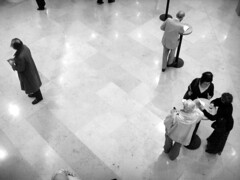
I went there to have a snoop round on Sunday. First impressions of the building are good: it's an impressive space that feels open and not too cluttered. Picking up tickets from the box office needed a bit of queuing, but probably no more than you'd expect from a newly opened venue where things are still settling. I'm not impressed with the catering though: A packet of crisps and a sandwich left little change from a fiver, which wouldn't have been so bad if the sandwich wasn't small, soggy and not very nice, and the crisps a smaller packet than a bog-standard packet of Walkers. If you're going to charge three or four quid for something as basic as two pieces of bread with some filling, you need to come up with something better than this.
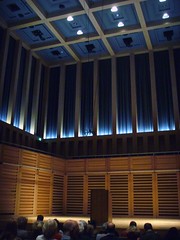 Hall One, the main performance space, is great, not as luxurious a place as the Wigmore Hall which is its most obvious rival, but it's a smart, clean design of a hall.
 The first event we're here for is a lecture by Sir Peter Maxwell Davies, entitled Musica Speculum Mundi? [Music a mirror of the world?]. He strolls onto the platform, and announces that he's been asked to write his speech down and recite it, not the way he'd normally speak in public. This makes it a little hard to get into what he's saying at first, as reading from a script makes his delivery a little stilted, but he warms up and sweeps us along with his talk, which, rather like a lot of his music, begins with a series of scraps of stories which gradually coalesce into a wider narrative. it's intimidating that he quotes form so many source in the original language, whether it be Italian, German, Latin or Greek. It's probably a sign of a generation gap that he can say something along the lines of "Of course, we all remember from school what Sophocles said...", but he's an engaging and intelligent speaker, and we're swept along by his argument, which becomes more and more personal and passionate as he touches on such subjects as his writing his Third Naxos Quartet in response to the invasion of Iraq. His conclusion is that writing a piece of music makes no practical difference to the world - he never imagined Blair, Brown or Bush would listen to his piece - but nevertheless it is immensely important that a composer reflect his world and act as a witness to it.
Max returns to the stage for the next show, a performance of two works for string quartet from the spnm shortlist selected by him and performed by the Brodsky Quartet. I've discussed this elsewhere, but it's a shame the speakers weren't miked up (as Max was for his lecture): we can hear what Max is saying (he's used to speaking in public) but the two composers, who aren't, mumble a bit and a lot of their words are lost beneath various rustlings from the audience. The acoustic is very clear, and hence very unforgiving in this respect, compulsive coughers note.
Another thing: please, please will someone at the spnm think of some compulsory course in programme-note writing for the composers on their shortlist? What we had to read was absolutely rotten and did nothing to enhance our enjoyment of the pieces. I was convinced from reading his note I was going to hate and/or be bored stupid by Oliver Waespi's piece, but was pleasantly surprised to be confronted with a beguiling piece that I'd like to hear again. It's difficult enough to persuade a lot of people to engage with this stuff as it is, and composers do themselves no favours by presenting such unenlightening writing.
Monday, October 06, 2008
Judgmental
I'm branching out into reviewing for the splendid folks at the Londonist. For my first effort I went to hear Beethoven at the Barbican on Friday.
Tuesday, August 05, 2008
Prom 24: Smyth, Rachmaninov et al.

I wish I could say the same about her music, but the fact is that her Concerto for violin and horn, which formed the main part of the first half of yesterday's prom, isn't very good. I'm perhaps being harsh here - there are some lovely moments, particularly in the slow movement and the opening of the finale. But overall it lacked any real sense of purpose, meandering on in a somewhat directionless and verbose manner, before finishing fairly arbitrarily.
On the other hand, there are plenty of crap pieces by male composers of the period that get a regular hearing, so why shouldn't Smyth be allowed out now and then?
I wonder how much the performers had to do with my perception? Richard Watkins is a wonderful horn player, but I don't like Tasmin Little's sound at all - it's very wobbly, with an excessively wide vibrato that somehow reminds me of Edith Evans, and makes me rethink Roger Norrington's viewpoint on the use of vibrato in early 20th century music. The BBC Scottish Symphony Orchestra play well, though.
Talking of crap music by men, the two arrangements by Sir Henry Wood - of Bach's Toccata and Fugue in D minor an Rachmaninov's Prelude in C sharp minor - that began the first and second halves respectively were the sort of orchestral lollipop that was once commonplace, but has largely died out, and thank god, as these muddy, overblown orchestrations did nothing to serve these two very famous keyboard works, both of which I'd far rather hear on their intended instruments than this way.
But that's not to say it's not worth hearing all these things now and then - it's important to have a chance to realise why some things get left behind, and other endure. Rachmaninov's music was dismissed as schmaltz in his day, and critics regularly opined that no-one would want to listen to it in 50 years. Well, they were wrong, and the reason, as made clear by the wonderful performance of the Second Symphony the SSO gave here, is not because audiences have no taste, but simply because this is very powerful, taut and well made music. Tchaikovsky used to be dismissed the same way, and just as he has survived and his reputation has had to be reassessed, perhaps it's time to give Rachmaninov his due too.
Sunday, August 03, 2008
Proms: Stockhausen Day
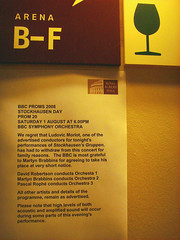
I first heard Gruppen about 10 years ago, when it was performed by the CBSO in Birmingham. Then, as now, the piece was given twice; this works very well, as the piece is so much about the spacial placement of sounds that shuffling about to a different spot for the second performance seems almost a necessity to start to have a proper sense of it. So this is the third time I've heard it.
It doesn't grab me as much this time as before; we're standing in a very crowded arena, with all the really tall people in front of us obscuring any view. Two of the groups have been placed in the arena itself (hence the crowding), but they're at the front end, close to the stage where the third is, so there's very little scope to get right in the middle of the sound field. This seems like poor planning. Wouldn't it have been better to have them at the back, or even construct platforms over some of the stalls? It's not as if they're full, although the turnout's quite respectable (I'm reminded of the adage that there's no hall like the Albert Hall for looking half-empty when it's half-full). That would have left both more space in the arena and more space between the orchestras. As it is, it feels like I'm only really hearing half a performance, only getting a dim sense of the interplay between the groups. And the iconic brass chord that hockets around towards the end doesn't seem to take flight, quite.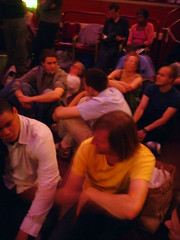
There are 24 loops repeating at 24 different speeds (I read later in the programme notes - one occasion where I should have read them before, I think). From the point of view of the listener, there's a swirling, pulsating mass of sound hanging in the air above us, and it's maybe closer to the aural equivalent of looking at a sculpture than listening to a conventional piece of music. I change my mind about it at least three times during its 32 minute course, at first fascinated by its whirling texture, and overwhelmed by the experience of hearing the sounds swoop around in such a large space. Then as it continues it seems to become oppressive, and I wonder if this isn't a perfect demonstration of the megalomania that many wild accuse Stockhausen of, the sense of himself as God. Certainly I feel like I'm a tiny mortal gazing up at an ineffable and indifferent universe. I feel pinned down by one enormous ego, forcing me to accede to his will. Perhaps this is the sound we will hear when the aliens arrive from Sirius to take over our world. By the end, as the loops gradually complete their cycles and the texture thins out, I'm filled with wonder again, as the skies seem to clear.
The solo trumpet of Harmonien, part of the fifth hour of Klang, follows, and it seems like a breeze blowing though the hall after the swirling dense clouds of Cosmic Pulses. It's a very simple piece, essentially a succession of elaborately embellished melodies that seem heartwarming in their straightforwardness.
Finally, an interval! I've heard some wonderful music, but I've been standing up for an hour and a half, and I'm grateful for a chance to sit for a bit. When I go back in I still can't get into the middle (although that tall man who stood in front of me and farted all the way through Cosmic Pulses has managed to get there - honestly, there's no justice), so I settle for a position right by the other orchestra in the arena. At least I'll get a view of something this time. I become aware of a voice droning on behind me. The wanker in the orange shirt (who talked all the way through Cosmic Pulses, by the way - obviously not so enamoured of Stockhausen that he feels the need to listen that hard) has moved too and is still behind me! I'm obviously being punished by the cosmic forces for my doubts earlier on.
Afterwards, I reflect on how there often seems in Stockhausen's music to be a moment, near the end, when the violent, thorny textures subside, and something more introspective and lyrical comes through, a lyricism that he tries to suppress but can't entirely. If you ignore the received wisdom about his fearsome reputation and just listen, you come to the conclusion that he is in essence a Romantic composer.
It's easy to make fun of this sort of thing, but it works because it's done with sincerity, and it highlights the home-made feel that a lot of Stockhausen seems to have, which gets derided by some but to me is an essential part of his appeal.
That one chord, slowly changing through time, punctuated only by occasional speech, is an extraordinary thing to experience, lying on your back staring up at the ceiling once more. There's a terrible wrench when it finally winds down to its close, and I have to run out as the applause starts to catch the last train home. I feel awake, and don't want the evening to end. That chord gets inside you and resonates, so that long after the performance is over it still seems to be sounding, buzzing inside your skull as you walk home.
Monday, July 28, 2008
Scaledown
John White also twiddles knobs, but as you'd expect from the man who invented Systems Music, played a leading role in the British experimental music movement of the early '70s (that also gave rise to such diverse composers as Howard Skempton and Michael Nyman) and has written over 160 piano sonatas, it's of a different order to the previous turn. It's determinedly lo-fi stuff, a couple fo cheap casio keyboards wired together and forced out of their comfort zones. What makes it fascinating rather than self-indulgent though is White's keen ear for what works, and his sense of humour. He's very serious about what he does, but never po-faced, and will happily title a piece "Significant parachute jumps of 1910", after the fact that the first successful paarchute jump took place in 1911. It's this combination of seriousness of purpose with a sense of the ridiculous that gives his music substance, and it's a priviledge to be able to see this inventive and under-appreciated man peform.
I do have some photos, but they're not great, so here's something different, a little extract from the sound between sets:
Friday, July 25, 2008
Prom 10: BBC Philharmonic / Tortelier (RAH)

Arnold Bax is one of those composers. You know the sort - English, tonal, vaguely post-romantic, championed by a lot of slightly scary obsessive middle-aged men who can't understand why this doesn't get played all the time on the radio instead of all that modern rubbish, and form a society (fan club) to prove their devotion. There's nothing exactly wrong with In memoriam, which receives its first public performance here. It's inoffensive waffle, and slightly less glum than Bax often is. But I was still bored by the end, as I always am by Bax. In a while I'll forget about this piece and start fretting again that he's a compose I ought to listen to more of. But i don't think I'll ever hear anything that'll actually make me want to.
Rachmaninov is surely near the top of anyone's list of composers you ought to think are a load of rubbish but don't. He ought to be irredeemably cheesy, but there's something about him that stops short of that. He's at least as glum as Bax, but people don't seem to comment on that much. His First Piano Concerto isn't played as often as the later ones, and it becomes clear that this is because it's not as good as them. It's okay, all the elements of his sound are there, but at this stage in his career he hadn't quite worked out how to stitch the bits together effectively. Yevgeny Sudbin plays brilliantly (as do the orchestra), and also looks frighteningly young from my perspective in the foothills of middle age. "But he's a child!" I think. He was born in 1980, so he's hardly a prodigy by now. But that seems practically foetal to me.
Vaughan Williams' Fourth Symphony is one of those pieces that always astonishes, not least because it's by Vaughan Williams. When I was young and foolish, I thought old RVW to be a crashing bore (Yawn Williams, I called him. God, I was funny). Then I heard this and the Sixth and realised I was going to have to change my mind. Would this extraordinary, violent and dissonant work get such an enthusiastic reception if it wasn't presented under the name of the patron saint of Classic FM, composer of The Lark Ascending?
Everything's here that hasn't really been about so far in the concert: anger, tension, and also a very sardonic sense of humour. Not a cowpat in sight. It's hot in the hall tonight, very close and sweaty. But that hardly registers when you're gripped by music this powerful.
Tuesday, July 22, 2008
Prom 7: Stuttgart Radio Symphony Orchestra/Roger Norrington (RAH)
 There are fancy cordon bleu dishes, exotic Eastern cooking, and then there are meat and potato dishes. The classical equivalent of meat and potatoes is overture-concerto-symphony, and that's exactly what was served up at tonight's Prom.
The thing is, meat and potatoes may not have much in the way of an exciting reputation,but sometimes you need something straightforward instead of all the fancy stuff, and the fact is that unglamourous as it may seem, a well-cooked side of beef and perfectly roasted tats is a meal that's hard to beat. And, to stretch this tortuous food metaphor a little further (don't worry, I'll drop it in a minute), the chefs of Radio Stuttgart delivered in many ways a perfectly timed roast dinner. Having said that, I have some doubts. But I'll come to those in due course.
Rossini's William Tell Overture is one of those pieces that's so famous I'm not even going to bother linking to Wikipedia about it, so famous that the prospect of hearing it fills me with almost no excitement at all. Luckily, Norrington and his band aren't as jaded as me, and a nimble performance reminded me that heck, this is really fun music. Obviously no-one these days can entirely pout the Lone Ranger out of their mind, and Norrington seemed to acknowledge as much by turning to the audience and winking when that bit started.
Jean-Guihen Queyras was the soloist in Haydn's wonderful C major Cello Concerto, and a very fine performance he gave too, the slimmed down band behind him providing able support, while Norrington hovered behind him, wisely leaving the players largely to it. This was an interpretation that seemed to point out Haydn's debt to Vivaldi, although the cadenza seemed to point forward to Beethoven.
My doubts set in in the second half. Not that the performance of Elgar's First Symphony wasn't in many ways a rewarding experience. But Norrington's advocacy of "authentic" performance practice seems to have hardened into dogma, and where he once seemed iconoclastic he now seems like a fundamentalist. It's true that players in Elgar's day tended to use less vibrato than they would now, and I'm generally all in favour of a more restrained use of it. But it's just not true that they used none at all (we do, after all, have recordings of Elgar himself conducting this work, albeit in the early '30s), and a device they would certainly have used much more liberally than modern orchestras would, which was entirely absent from the Stuttgart players' technique, is portamento. Norrington also shied away from any great rubato too, which, as can be heard in his recordings, Elgar certainly wouldn't have done. There were moments when the lean string sound brought great benefits to the piece, but others where it didn't. To call this style of performing historical/authentic is simply inaccurate, and I found these worries nagging at me throughout, which stopped me enjoying what was, I should emphasise, some very fine playing.
Another thing about Norrington's idea of performance practice involves that perennial bugbear, applause between movements. Now I'm pretty relaxed about this sort of thing on the whole: people clapped between movements in the Haydn, and it was fine as far as I'm concerned. But Norrington goes beyond asserting a right to do this into insisting on it, and in a piece like the Elgar, which is clearly conceived as one large span of music, and even ends its first three movements quietly and anticlimactically this seems to destroy the mood. If it's wrong to stop people applauding, it's equally wrong to stop people having a moment's quiet reflection after the heartfelt slow movement before the finale creeps in. Norrington's a fine, eccentric showman, and he'll undoubtedly handle the dreaded Last Night very well, but in this instance what once seemed a fresh approach seems to have ossified into willfulness.
Monday, July 21, 2008
Folking about: Proms 4&5 (RAH and Kensington Gardens)
 A day devoted to folk music has been sneered at in some quarters, but I think it's absolutely right that the Proms should do this sort of thing, not least because the SCCM* scene could take instruction from the folk scene: a small, minority interest that for many years seemed threatened with extinction at the hands of indifference, a perception that this was a dead or dying genre with nothing to say of any relevance to the modern world, and well-meaning but misguided fundamentalism on the part of some of its most zealous advocates. Sound familiar?
 We sauntered into Kensington Gardens at lunchtime to find the Folk In The Park mini-festival in full swing; scratch choirs and orchestras merrily hacked their way through some choice tunes, if to slightly limited effect to those of us who weren't right at the front (but that's open-air singing for you), while nearer to my eyes and ears some Morris Dancers did their stuff.
  Morris Dancing's had a terrible press over the years, unfairly I think, which I suppose is down to the general public's desensitisation to the point where jumping over each other with bells strapped to your legs and whacking clubs together can't substitute for actually getting your cocks out and waving them about. A shame, because in the right hands (stop it) it's a raucous affair with a healthy lack of reverence for its own traditions. I hadn't realised what a major part of it all was having the musicians hurl abuse at the dancers. The climax to our outdoor sojourn was a short set by Bellowhead (of whom more later).
 The clouds began to cover the sky, so it seemed fortunate that it was time to head over to the Albert Hall for the first concert of the Proms's first Folk Day (the way they went on about it, you'd think folk hadn't existed before Roger Wright decided to bring it to South Ken, but I shall not continue in this measly-mouthed vein, as I come to praise the Folk Day, not to bury it).
The evening concert, meanwhile, featured three acts, two of whom we'd already caught a glimpse of. Bella Hardy had already demonstrated during the afternoon what a beautiful voice she has, and her set here was equally impressive, adding her own fiddling and harp and concertina to the palette to produce a sound that managed to fall entirely within what you might call a purist definition of folk, but never seeming anything other than fresh.
Martin Simpson, meanwhile, represents another aspect of tradition in a set that I wasn't sure I was going to like at first, as after Bella Hardy it seemed to have a whiff of noodling about it. However, he's such a persuasive performer that I soon settled into the more introspective mode, and ended up thoroughly bewitched by his mellifluous guitar style (and was impressed by the way he avoided those awkward pauses you often get while a player re-tunes by making little sketches of music out of his string adjusting, wryly commenting on the unashamed way classical musicians tune up.
Bellowhead are in some respects about as far from traditional or purist as it's possible to get, and yet they escape the trap of crossover hell by the simple fact that no matter how loud they get, no matter how many Latin rhythms or dance beats they throw in, everything they do has its roots very firmly in the folk tradition. There are different ways to extend and revitalise a tradition though, and giving it a good (friendly) kicking can be just as effective a way as tender care.
It's easy to knock this sort of day as tokenism, and I guess the proof of that particular pudding will be in whether further potions are served up in future years. I hope that happens, as this day has scratched the surface of a very deep mine that could be profitably explored for a long time. When you think that a century ago, as Vaughan Williams and Cecil Sharp travelled around the British Isles collecting folk songs, that this was a tradition on the brink of extinction, it's remarkable what a healthy and diverse landscape now exists, and it's a thought worth dwelling on that without Vaughan Williams there might not be Bellowhead. It's fascinating both in its apparent unlikeliness and its potential to spark new connections and evolutions, and this is just the sort of thing the Proms ought to be nurturing.*So-Called Classical Music
Wednesday, May 14, 2008
Prometeo (RFH)

It's a bit different for me perhaps; I've sat through the five hours of Morton Feldman's For Philip Guston*, so a couple of hours is peanuts in comparison. And Bruckner wrote 90-minute pieces in which, in a very profound sense, nothing really happens (and yet everything!). So there's plenty of precedent.
Not everyone can take this sort of thing: there were several people who walked out, some after less than half an hour. But it takes a half-hour or so to acclimatise yourself to this sort of music, and you need the patience to do that if you're going to get something out of it.
The spacial element of Prometeo is of course one of its main selling points. Stockhausen of course experimented with breaking down the traditional relationship between performers and audience in the 60s with Gruppen, and playing Strauss's Alpine Symphony recently, with its army of off-stage brass, reminds me that playing about with these things is nothing new in itself. But Prometeo takes these ideas and runs with them. There are clusters of musicians everywhere, even before you consider the sound field created by numerous speakers distributed all around. This creates a slight tension, as the Royal Festival Hall is clearly designed for the traditional layout of audience all pointing towards a stage, so our sitting position works against what Nono is trying to achieve. But in a strange way this only seems to point up how entrenched we are in our concert-going habits, the very thing Nono wants us to question.
The (excellent) programme contained the texts used in the piece, but this is really better studied later on, as Nono deliberately abstracts the words in his setting so that it's really incomprehensible in any conventional sense. Rather, he exploits the libretto as a source of sounds and timbres for the voices. There didn't seem to be any need to think about the text or the legend of Prometheus except in the most general, abstract way, and this is part of what it's about: it's not about comprehending, it's about the pure experience of listening.
Normally when you hear something involving a combination of instruments and electronics you expect the electric part to be superimposed on the acoustic, but what Nono does is much more subtle than that, and it's a credit to him that you hardly think about the presence of the sound system, so carefully are the two elements integrated; this is use of technology as a subtle enhancement rather than a bludgeoning club. The effect as you hear sounds from their original source drift across the room and transform into complex textures is serenely discorporating.
The actual music itself seems much more eclectic than I'd have expected, ranging from terrifying clusters to the sweetest of perfect fifths, and pretty much everything in between. Occasionally a roar emerges from the orchestras, but largely the music is a great drift.
Nono is classed as one of those nasty modernists we're all supposed to reject these days in favour of Golijov. But what's striking is that this music (as well as being far more immediate than the anti-modernists would have you believe) doesn't sound "modern" at all. It sounds extraordinarily, immensely ancient. We leave the hall at the end, and to return to the bustle of London after this feels like returning from a journey to an unimaginably distant world, perhaps even time. The world seems too fast. Nono gives our thoughts space to breathe. And time.
There's so much more to be said, and yet also nothing. I go about my day as before. But behind it somewhere there's the memory of this other place, and it'll be a while before it's absorbed. it's all a matter of time.
Tim Rutherford-Johnson has a good roundup of reviews of the performances.
*I've sat through the even bigger String Quartet No.2 (over six hours on the Flux Quartet's recording, helpfully available on DVD to avoid those annoying disc changes). But somehow it seems cheating, doing it in the comfort of your own living room.
Tuesday, April 15, 2008
A hard climb
I'm writing a programme note about Richard Strauss's Alpine Symphony for the next KSO concert at the moment, and it's an interesting contrast with the last one I did for Shostakovich 4. This is partly due to the fact that I just don't like Richard Strauss very much.
it's difficult to pin down just what it is that doesn't appeal to me; I can see that it's well written - Strauss is never less than effective with an orchestra - and there's plenty to say about the origins of the piece, what with the connections to Nietszche and Mahler. It's not even his dodgy Nazi links - the more I read about him the more I become convinced that he was naive and blinkered and self-serving rather than actually evil. It's that I can't see anything beneath the (admittedly attractive) surface. So I struggle at those sentences, desperately trying to convey an enthusiasm I don't really feel, talkign about hidden depths I'm not convinced are there.
He's the musical equivalent of a page 3 girl - very well built, but once you've got past the beautifully contoured orchestration, there's nothing to engage the intellect*. Someone once said something to the effect that of the three late-romantic Austro-German composers, Bruckner found God, Mahler searched for God and Strauss wondered what all the fuss was about. And that's the effect his music has on me. It drifts by, beautifully composed and utterly vacuous.
Composing to entertain the audience is a perfectly legitimate strategy, as valid as composing without a care for the audience, and on some level Strauss must be successful, because I certainly seem to be in a minority in my apathy. But as much as I like to look at a well built figure, it's more fun if there's a conversation to be had too.
*I'm not suggesting that all page 3 girls are air heads, of course. I'm sure there are plenty of them with degrees in comparative philosophy or quantum physics.

Thursday, February 07, 2008
Daniel Barenboim plays Beethoven (Royal Festival Hall)
There are so many things I could say about Barenboim's playing. It's unshowy, deeply humane and puts music above shallow showmanship at all times. When at the end of the Appassionata Sonata he works himself into such a frenzy that he pounds the pedals and the floor violently with his feet it comes across as the perfectly natural unleashing of tension and passion that he has held carefully in check up till now. It's a pleasure to hear him play the two op. 49 sonatas, the "easy" ones that even I can (or at least used to be able to) have a stab at. There's no danger of being overwhelmed by sheer technique, as you would in one of the more note-stuffed sonatas, and yet of course you see his brilliant technical abilities all the more, and see it entirely in a musical light. I come away thiunking I'm glad I saw him play these simple (but not simplistic) pieces rather than one of the phenominally difficult warhorses that you can hear any pro playing most weeks.
I could also talk about his lack of pomposity or self-importance, his air of absolute straightforwardness and openness, the wonderful intimacy created by his having audience all around him, rather than being perched in front of us on a stage, unreachable and separate.
But the thing I keep noticing is the handkerchief. He mops his brow with it, then throws it into the piano, then retrieves it again later. There's one point where he does this in the middle of a movement, while only his right hand is occupied with the keyboard, which lends a brief nervousness to my mood. But mostly the handkerchief stays out of sight, only momentarily appearing between sonatas. It's such a mundane thing, but it sticks with me, and somehow seems to stand for what it is about him that makes this such a satisfying evening, filled with insight and humanity.
Wednesday, January 30, 2008
Robyn Hitchcock / Rasputina (Queen ElizabethHall)
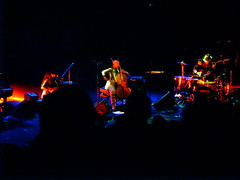
Anyway, the Queen Elizabeth Hall in front of an audience who are mostly waiting for someone else who they've actually heard of to come on is of course a very different proposition to headlining at the Windmill, and Rasputina seemed at first here to be pursuing their more explicitly "chamber" side at first, easy on the pedals and steady on the tempi, less of the banter. Something seems to gel when "Saline the Salt Lake Queen" appears and I think by the end they won over some of the unconverted at least. It was a good performance, although it was never going to be quite as special as standing mere inches from the band in a small room. The two audiences remind me of the two Londons; one intimate, friendly, eager; the other cosmopolitan, standoffish, reserved. They're a great band, as individual in their way as is the headliner, and I hope they'll be back on these shores before very long, and welcomed by an increasing crowd (although a selfish part of me would like that crowd to be small enough to fit in the back of a pub).
I could mention Syd Barrett and Vivian Stanshall and that whole pantheon of English eccentrics and surrealists he belongs to, that stretches back way beyond Dali and his ilk to the real origins of surrealism, Edward Lear and Lewis Carroll. But building up a legend isn't really what he's about. it's mostly quiet, unassuming music that doesn't need to declare its worth, and is all the more affecting for it. There's a simple joy that's easy to hear, much harder to put across effectively, the art that's all the more artful for its apparent artlessness.
Addendum: a man like Robyn H attracts a certain level of punter, among those present was none other than Nick Lowe. And Adam from TV's Adam and Joe. Which is quite exciting. But not as exciting as Nick Lowe. Sorry, Adam.
Tuesday, January 29, 2008
Rasputina (Windmill, Brixton)
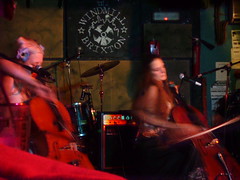
First, though, we have rayOn (eccentric typography preserved here, I've got a soft spot for that sort of thing). They start off lively, but before the first song is over the guitarist's broken a string. They do what has to be done: make a bad pun about their "rocky" start and play a slow number to give him a chance to replace it (although it'd have been more fun to make do with five strings. After all, George Formby managed with four). I like this band. Back in Birmingham we have a grand tradition of fabric-monikered bands (Felt, Denim*) which immediately warms me to them, and they play a fun set. They're not going to set the world alight, but they look a bit long in the tooth to be seriously entertaining thoughts of rock 'n' roll stardom, and you know what? Sometimes being a decent band in the back of a pub is enough.
Rasputina really could be playing somewhere other than the back of a pub (the girl I'm next to and I are both surprised that we're seeing them here rather than the Brixton Academy, and in fact they'll be at the grander surroundings of the QueenElizabeth Hall tomorrow night, supporting Robyn Hitchcock), but I'm very glad they're here, because there's a cosiness in a small venue you'll never get anywhere bigger, and Melora's dry wit goes down well in an intimate setting like this. American bands always seem to do things like banter much better than most British groups, maybe they just have a better tradition of playing to the audience to draw on than we do. Rasputina have an arrestingly individual aesthetic, and all the bucketloads of charisma necessary to bring that to life on stage, Melora and Sarah's voices and playing perfectly attuned, Melora's between song chat is very funny, and the whole thing is ably underpinned by Jonathon's driving drumming. (Incidentally, and utterly irrelevantly, Jonathon is really, really tall. I kind of expected him to look as he does, like Alan Moore might have done if all those years ago he'd decided to research Swamp Thing by going to live on Gumbo in a Louisiana swamp, but I really wasn't prepared for his remarkable distance from the floor.) At one point They launch into a heartfelt tribute to Sir Mixalot, which touches all our hearts.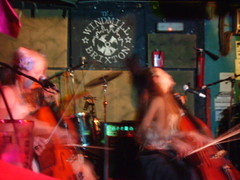
You wait ages for a rocking cello band to come over from America, and then they do do two gigs at once. And even before the second, I'm already hoping it won't be too long before they're back here again. And if it does all come to nothing with the band (heaven forbid) Melora's got a bright alternative future in stand-up.
*Felt and Denim are arguably two manifestations of the same band, which would make this a grand tradition of one.
Sunday, January 27, 2008
Scaledown, King & Queen, 25 January
Good intentions butter no parsnips, I'm told, and having determined after the last time I went to a Scaledown night to get along to another really,really soon, I find myself here, almost exactly a year later. So much later, in fact that one of the acts tonight is making a return visit to the Scaled Down world. Still, I made it eventually, and this year I'm definitely going to get along to another one in less than a year's time.
So anyway, this time we had another varied menu of sounds. It's the sort of evening where you're unlikely to like everything, but you're bound to like something, and so it proved. After the customary turn by hosts Mark Braby and Andy Coules - a unique take on "Smash it Up" by the Damned - we have some entertaining spoken word stuff from saxophonist Mark Norton, of which the funnier poems are the better, not a million miles from John Hegley territory. 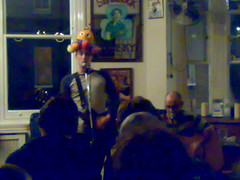

Finally is John Ellis, former guitarist with the Vibrators and the Stranglers, whose pedal and ebow-driven guitar noodling just didn't really do it for me, I'm afraid (and that's mild compared to what my companion said. She really didn't like it). But it doesn't matter, because I heard plenty of stuff I did like, and had a good time. Which is of course what it's all about.
The next Scaledown's on 22nd February, and I'm going to be there, definitely, honest.
I did take pictures of everyone, by the way, it's just they didn't come out very well. It's difficult taking photos in a dark room without a flash.
By the way, the Scaledown boys have moved into the world of recording, and I picked up their first release, a lovely 7" single by a band called Pocket. Get it at the Orchestra Pit.


