As the festival season is upon us, and specifically the Proms are about to start (a lot of meh, a few interesting things this year as far as I'm concerned - I'll get around to that later), here's an historical perspective, as first seen in Classical Music's recent festivals supplement.
Showing posts with label proms. Show all posts
Showing posts with label proms. Show all posts
Monday, July 13, 2009
Festival Fever 1759
Tuesday, August 05, 2008
Prom 24: Smyth, Rachmaninov et al.

I wish I could say the same about her music, but the fact is that her Concerto for violin and horn, which formed the main part of the first half of yesterday's prom, isn't very good. I'm perhaps being harsh here - there are some lovely moments, particularly in the slow movement and the opening of the finale. But overall it lacked any real sense of purpose, meandering on in a somewhat directionless and verbose manner, before finishing fairly arbitrarily.
On the other hand, there are plenty of crap pieces by male composers of the period that get a regular hearing, so why shouldn't Smyth be allowed out now and then?
I wonder how much the performers had to do with my perception? Richard Watkins is a wonderful horn player, but I don't like Tasmin Little's sound at all - it's very wobbly, with an excessively wide vibrato that somehow reminds me of Edith Evans, and makes me rethink Roger Norrington's viewpoint on the use of vibrato in early 20th century music. The BBC Scottish Symphony Orchestra play well, though.
Talking of crap music by men, the two arrangements by Sir Henry Wood - of Bach's Toccata and Fugue in D minor an Rachmaninov's Prelude in C sharp minor - that began the first and second halves respectively were the sort of orchestral lollipop that was once commonplace, but has largely died out, and thank god, as these muddy, overblown orchestrations did nothing to serve these two very famous keyboard works, both of which I'd far rather hear on their intended instruments than this way.
But that's not to say it's not worth hearing all these things now and then - it's important to have a chance to realise why some things get left behind, and other endure. Rachmaninov's music was dismissed as schmaltz in his day, and critics regularly opined that no-one would want to listen to it in 50 years. Well, they were wrong, and the reason, as made clear by the wonderful performance of the Second Symphony the SSO gave here, is not because audiences have no taste, but simply because this is very powerful, taut and well made music. Tchaikovsky used to be dismissed the same way, and just as he has survived and his reputation has had to be reassessed, perhaps it's time to give Rachmaninov his due too.
Sunday, August 03, 2008
Proms: Stockhausen Day
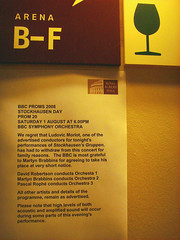
I first heard Gruppen about 10 years ago, when it was performed by the CBSO in Birmingham. Then, as now, the piece was given twice; this works very well, as the piece is so much about the spacial placement of sounds that shuffling about to a different spot for the second performance seems almost a necessity to start to have a proper sense of it. So this is the third time I've heard it.
It doesn't grab me as much this time as before; we're standing in a very crowded arena, with all the really tall people in front of us obscuring any view. Two of the groups have been placed in the arena itself (hence the crowding), but they're at the front end, close to the stage where the third is, so there's very little scope to get right in the middle of the sound field. This seems like poor planning. Wouldn't it have been better to have them at the back, or even construct platforms over some of the stalls? It's not as if they're full, although the turnout's quite respectable (I'm reminded of the adage that there's no hall like the Albert Hall for looking half-empty when it's half-full). That would have left both more space in the arena and more space between the orchestras. As it is, it feels like I'm only really hearing half a performance, only getting a dim sense of the interplay between the groups. And the iconic brass chord that hockets around towards the end doesn't seem to take flight, quite.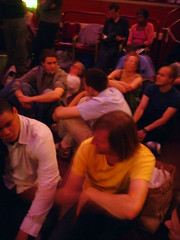
There are 24 loops repeating at 24 different speeds (I read later in the programme notes - one occasion where I should have read them before, I think). From the point of view of the listener, there's a swirling, pulsating mass of sound hanging in the air above us, and it's maybe closer to the aural equivalent of looking at a sculpture than listening to a conventional piece of music. I change my mind about it at least three times during its 32 minute course, at first fascinated by its whirling texture, and overwhelmed by the experience of hearing the sounds swoop around in such a large space. Then as it continues it seems to become oppressive, and I wonder if this isn't a perfect demonstration of the megalomania that many wild accuse Stockhausen of, the sense of himself as God. Certainly I feel like I'm a tiny mortal gazing up at an ineffable and indifferent universe. I feel pinned down by one enormous ego, forcing me to accede to his will. Perhaps this is the sound we will hear when the aliens arrive from Sirius to take over our world. By the end, as the loops gradually complete their cycles and the texture thins out, I'm filled with wonder again, as the skies seem to clear.
The solo trumpet of Harmonien, part of the fifth hour of Klang, follows, and it seems like a breeze blowing though the hall after the swirling dense clouds of Cosmic Pulses. It's a very simple piece, essentially a succession of elaborately embellished melodies that seem heartwarming in their straightforwardness.
Finally, an interval! I've heard some wonderful music, but I've been standing up for an hour and a half, and I'm grateful for a chance to sit for a bit. When I go back in I still can't get into the middle (although that tall man who stood in front of me and farted all the way through Cosmic Pulses has managed to get there - honestly, there's no justice), so I settle for a position right by the other orchestra in the arena. At least I'll get a view of something this time. I become aware of a voice droning on behind me. The wanker in the orange shirt (who talked all the way through Cosmic Pulses, by the way - obviously not so enamoured of Stockhausen that he feels the need to listen that hard) has moved too and is still behind me! I'm obviously being punished by the cosmic forces for my doubts earlier on.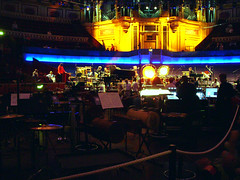
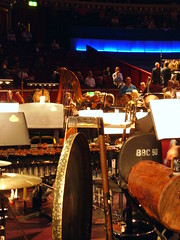
Afterwards, I reflect on how there often seems in Stockhausen's music to be a moment, near the end, when the violent, thorny textures subside, and something more introspective and lyrical comes through, a lyricism that he tries to suppress but can't entirely. If you ignore the received wisdom about his fearsome reputation and just listen, you come to the conclusion that he is in essence a Romantic composer.
It's easy to make fun of this sort of thing, but it works because it's done with sincerity, and it highlights the home-made feel that a lot of Stockhausen seems to have, which gets derided by some but to me is an essential part of his appeal.
That one chord, slowly changing through time, punctuated only by occasional speech, is an extraordinary thing to experience, lying on your back staring up at the ceiling once more. There's a terrible wrench when it finally winds down to its close, and I have to run out as the applause starts to catch the last train home. I feel awake, and don't want the evening to end. That chord gets inside you and resonates, so that long after the performance is over it still seems to be sounding, buzzing inside your skull as you walk home.
Friday, July 25, 2008
Prom 10: BBC Philharmonic / Tortelier (RAH)

Arnold Bax is one of those composers. You know the sort - English, tonal, vaguely post-romantic, championed by a lot of slightly scary obsessive middle-aged men who can't understand why this doesn't get played all the time on the radio instead of all that modern rubbish, and form a society (fan club) to prove their devotion. There's nothing exactly wrong with In memoriam, which receives its first public performance here. It's inoffensive waffle, and slightly less glum than Bax often is. But I was still bored by the end, as I always am by Bax. In a while I'll forget about this piece and start fretting again that he's a compose I ought to listen to more of. But i don't think I'll ever hear anything that'll actually make me want to.
Rachmaninov is surely near the top of anyone's list of composers you ought to think are a load of rubbish but don't. He ought to be irredeemably cheesy, but there's something about him that stops short of that. He's at least as glum as Bax, but people don't seem to comment on that much. His First Piano Concerto isn't played as often as the later ones, and it becomes clear that this is because it's not as good as them. It's okay, all the elements of his sound are there, but at this stage in his career he hadn't quite worked out how to stitch the bits together effectively. Yevgeny Sudbin plays brilliantly (as do the orchestra), and also looks frighteningly young from my perspective in the foothills of middle age. "But he's a child!" I think. He was born in 1980, so he's hardly a prodigy by now. But that seems practically foetal to me.
Vaughan Williams' Fourth Symphony is one of those pieces that always astonishes, not least because it's by Vaughan Williams. When I was young and foolish, I thought old RVW to be a crashing bore (Yawn Williams, I called him. God, I was funny). Then I heard this and the Sixth and realised I was going to have to change my mind. Would this extraordinary, violent and dissonant work get such an enthusiastic reception if it wasn't presented under the name of the patron saint of Classic FM, composer of The Lark Ascending?
Everything's here that hasn't really been about so far in the concert: anger, tension, and also a very sardonic sense of humour. Not a cowpat in sight. It's hot in the hall tonight, very close and sweaty. But that hardly registers when you're gripped by music this powerful.
Tuesday, July 22, 2008
Prom 7: Stuttgart Radio Symphony Orchestra/Roger Norrington (RAH)
 There are fancy cordon bleu dishes, exotic Eastern cooking, and then there are meat and potato dishes. The classical equivalent of meat and potatoes is overture-concerto-symphony, and that's exactly what was served up at tonight's Prom.
The thing is, meat and potatoes may not have much in the way of an exciting reputation,but sometimes you need something straightforward instead of all the fancy stuff, and the fact is that unglamourous as it may seem, a well-cooked side of beef and perfectly roasted tats is a meal that's hard to beat. And, to stretch this tortuous food metaphor a little further (don't worry, I'll drop it in a minute), the chefs of Radio Stuttgart delivered in many ways a perfectly timed roast dinner. Having said that, I have some doubts. But I'll come to those in due course.
Rossini's William Tell Overture is one of those pieces that's so famous I'm not even going to bother linking to Wikipedia about it, so famous that the prospect of hearing it fills me with almost no excitement at all. Luckily, Norrington and his band aren't as jaded as me, and a nimble performance reminded me that heck, this is really fun music. Obviously no-one these days can entirely pout the Lone Ranger out of their mind, and Norrington seemed to acknowledge as much by turning to the audience and winking when that bit started.
Jean-Guihen Queyras was the soloist in Haydn's wonderful C major Cello Concerto, and a very fine performance he gave too, the slimmed down band behind him providing able support, while Norrington hovered behind him, wisely leaving the players largely to it. This was an interpretation that seemed to point out Haydn's debt to Vivaldi, although the cadenza seemed to point forward to Beethoven.
My doubts set in in the second half. Not that the performance of Elgar's First Symphony wasn't in many ways a rewarding experience. But Norrington's advocacy of "authentic" performance practice seems to have hardened into dogma, and where he once seemed iconoclastic he now seems like a fundamentalist. It's true that players in Elgar's day tended to use less vibrato than they would now, and I'm generally all in favour of a more restrained use of it. But it's just not true that they used none at all (we do, after all, have recordings of Elgar himself conducting this work, albeit in the early '30s), and a device they would certainly have used much more liberally than modern orchestras would, which was entirely absent from the Stuttgart players' technique, is portamento. Norrington also shied away from any great rubato too, which, as can be heard in his recordings, Elgar certainly wouldn't have done. There were moments when the lean string sound brought great benefits to the piece, but others where it didn't. To call this style of performing historical/authentic is simply inaccurate, and I found these worries nagging at me throughout, which stopped me enjoying what was, I should emphasise, some very fine playing.
Another thing about Norrington's idea of performance practice involves that perennial bugbear, applause between movements. Now I'm pretty relaxed about this sort of thing on the whole: people clapped between movements in the Haydn, and it was fine as far as I'm concerned. But Norrington goes beyond asserting a right to do this into insisting on it, and in a piece like the Elgar, which is clearly conceived as one large span of music, and even ends its first three movements quietly and anticlimactically this seems to destroy the mood. If it's wrong to stop people applauding, it's equally wrong to stop people having a moment's quiet reflection after the heartfelt slow movement before the finale creeps in. Norrington's a fine, eccentric showman, and he'll undoubtedly handle the dreaded Last Night very well, but in this instance what once seemed a fresh approach seems to have ossified into willfulness.
Monday, July 21, 2008
Folking about: Proms 4&5 (RAH and Kensington Gardens)
 A day devoted to folk music has been sneered at in some quarters, but I think it's absolutely right that the Proms should do this sort of thing, not least because the SCCM* scene could take instruction from the folk scene: a small, minority interest that for many years seemed threatened with extinction at the hands of indifference, a perception that this was a dead or dying genre with nothing to say of any relevance to the modern world, and well-meaning but misguided fundamentalism on the part of some of its most zealous advocates. Sound familiar?
 We sauntered into Kensington Gardens at lunchtime to find the Folk In The Park mini-festival in full swing; scratch choirs and orchestras merrily hacked their way through some choice tunes, if to slightly limited effect to those of us who weren't right at the front (but that's open-air singing for you), while nearer to my eyes and ears some Morris Dancers did their stuff.
  Morris Dancing's had a terrible press over the years, unfairly I think, which I suppose is down to the general public's desensitisation to the point where jumping over each other with bells strapped to your legs and whacking clubs together can't substitute for actually getting your cocks out and waving them about. A shame, because in the right hands (stop it) it's a raucous affair with a healthy lack of reverence for its own traditions. I hadn't realised what a major part of it all was having the musicians hurl abuse at the dancers. The climax to our outdoor sojourn was a short set by Bellowhead (of whom more later).
 The clouds began to cover the sky, so it seemed fortunate that it was time to head over to the Albert Hall for the first concert of the Proms's first Folk Day (the way they went on about it, you'd think folk hadn't existed before Roger Wright decided to bring it to South Ken, but I shall not continue in this measly-mouthed vein, as I come to praise the Folk Day, not to bury it).
This was a bit of a hodge-podge of a concert (rather as the First Night was): We began with an a Capella turn from the excellent young singer Bella Hardy (of whom more later also) which then segue into a performance of Vaughan Williams' English Folk Song Suite by the Royal Northern College of Music's wind band. Being an afternoon concert, and hence rather more al fresco than your normal RAH affair, there was a smattering of applause after the first movement, which obviously utterly confused the lighting technicians, as the stage then went dark, then after a while the lights went up, but on the wrong group, and finally the RNCM were given back enough illumination to continue. They played very well, too.
The other group was the London Sinfonietta, which now lit up a second time to play for the first time: a couple of Percy Grainger arrangements. Grainger's a fascinating figure in the history of the folk revival, and undoubtedly we owe him a great debt, but his arrangements outstay their welcome and come across now as an eccentric curiosity. Then, after another turn from Bella Hardy, they were joined by Monica Bacelli for a performance of Berio's Folk Songs, the work he composed for his sometime wife, the late, great Cathy Berberian.
These are wonderful arrangements, subtle and glowing. They're also completely lost in the cavernous Albert Hall, and especially after the (miked) Hardy, the (unmiked) Bacelli) came across as distant and affected. She's a fine singer, but fell between the stools of not sounding folky enough, yet also sounding less convincing in her theatricality as Berberian would (a problem anyone's going to have in this work). The audience was getting restless, and that didn't really help. So all in all, this first half ended with proper folk:1, art-folk 0.
The second half began with Folkestra, a group of Northeastern young players organised by Katheryn Tickell, who turned out to be largely the flowery-dressed young lasses we'd had standing next to us in the first half. They play beautifully, and have an easy-going air about them that doesn't however distract from the evident care they put into their performance. And they had a clog-dancer, which is always a good thing.
For me, the highlight was the next act: Muzsikás, a quartet of Hungarian fiddlers who played a selection of traditional tunes with an energy and authenticity that was a marvel to behold. The audience began clapping along spontaneously, and I realised that what I really wanted to do was listen to this lot all evening, preferably in some small Eastern European bar. This was something quite startling: folk music, not reconstituted and revived, as English folk of necessity is, but a living tradition, ancient and yet utterly contemporary. They then joined forces with the London Sinfonietta for a performance of Bartók's Romanian Folk Dances, the classical ensemble alternating with the folk one, presenting their own versions of the dances, then coming together for the finale. This was a stunning performance by all involved, an entirely successful coming together of the art and folk strands of the concert. It also confirmed the suspicion I've long held, that contrary to what you might think Bartók's use of folk song is a watering down rather than a spicing up of the original's rough, dissonant harmony.
Which left Katheryn Tickell's "Confluence" rather redundant, as that was clearly intended to do the same thing, adding Folkestra into the mix for the climax of the concert. Unfortunately, having brought everyone onstage there seemed to be no real reason for the work beyond this inter-disciplinary jam, and the whole thing meandered along pleasantly but inconsequentially. It came across like a precis of what had gone before, done for no real reason than because they could.
The evening concert, meanwhile, featured three acts, two of whom we'd already caught a glimpse of. Bella Hardy had already demonstrated during the afternoon what a beautiful voice she has, and her set here was equally impressive, adding her own fiddling and harp and concertina to the palette to produce a sound that managed to fall entirely within what you might call a purist definition of folk, but never seeming anything other than fresh.
The evening concert, meanwhile, featured three acts, two of whom we'd already caught a glimpse of. Bella Hardy had already demonstrated during the afternoon what a beautiful voice she has, and her set here was equally impressive, adding her own fiddling and harp and concertina to the palette to produce a sound that managed to fall entirely within what you might call a purist definition of folk, but never seeming anything other than fresh.
Martin Simpson, meanwhile, represents another aspect of tradition in a set that I wasn't sure I was going to like at first, as after Bella Hardy it seemed to have a whiff of noodling about it. However, he's such a persuasive performer that I soon settled into the more introspective mode, and ended up thoroughly bewitched by his mellifluous guitar style (and was impressed by the way he avoided those awkward pauses you often get while a player re-tunes by making little sketches of music out of his string adjusting, wryly commenting on the unashamed way classical musicians tune up.
Bellowhead are in some respects about as far from traditional or purist as it's possible to get, and yet they escape the trap of crossover hell by the simple fact that no matter how loud they get, no matter how many Latin rhythms or dance beats they throw in, everything they do has its roots very firmly in the folk tradition. There are different ways to extend and revitalise a tradition though, and giving it a good (friendly) kicking can be just as effective a way as tender care.
It's easy to knock this sort of day as tokenism, and I guess the proof of that particular pudding will be in whether further potions are served up in future years. I hope that happens, as this day has scratched the surface of a very deep mine that could be profitably explored for a long time. When you think that a century ago, as Vaughan Williams and Cecil Sharp travelled around the British Isles collecting folk songs, that this was a tradition on the brink of extinction, it's remarkable what a healthy and diverse landscape now exists, and it's a thought worth dwelling on that without Vaughan Williams there might not be Bellowhead. It's fascinating both in its apparent unlikeliness and its potential to spark new connections and evolutions, and this is just the sort of thing the Proms ought to be nurturing.*So-Called Classical Music
Thursday, April 10, 2008
You've spun me round And knocked me off my axis mundi
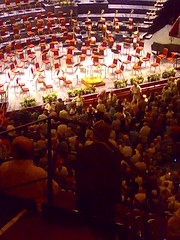
And you know what? There's some pretty darn good stuff in there. Obviously the Stockhausen day will be a highlight for me, but there's also a hefty wad of Messiaen and Carter (and it's not often you get to celebrate the centenary of someone who's not only still alive, but still very active), and a couple of "populist" gigs which I think are both excellent ideas - although not everyone agrees with me.
It's all very well to say "If we build it they will come", but the fact is that kids today have next to no experience of classical music, concert halls are seen as forbidding places, and many people simply won't enter one (a bit like the way quite a lot of people won't watch a programme simply because it's on BBC2 - which is why shows that transfer to BBC1 get such a huge hike in viewing figures). Personally I think that juxtaposing Doctor Who and Turnage is a great idea, not only in terms of getting people inside the hall who might never otherwise go, but putting a message out that it's ok to like both. It's not going to create a brand new audience overnight, but it's a step in the right direction, and puts the whole thing ahead of the usual game for "family" concerts.
The folk day is also exactly in line with what the Proms ought to be doing - a type of music that's intimately linked with so-called classical music, and presented with some of the cultural paraphernalia that surrounds it rather than in isolation like a butterfly in a glass case. I'm looking forward to having a dance round the maypole, so there! And the Ceilidh is a great way to finish it off. If we take it for granted that the Proms is bound to the Albert Hall for the foreseeable future (and I think it is), then for all the place's faults it should be embraced, and stuff like this makes an imaginative use of the space.
Some of the concerts look a bit bizarre to my eye in terms of the wild oscillations between full symphonic works and solo piano pieces, not to mention some strange programme orders (Mahler 5 as an opener??) , but if the Proms are to survive and flourish they have to be open to innovation and experiment, and one of the things about experiments is that they don't always work. The point is, it feels like a fresh breeze is blowing over the season after the increasingly stultifying Kenyon years. There's an eclecticism and a lack of reliance on tired barrel-scraping themes and the like that leaves me feeling uncharacteristically upbeat.
So bring on the daleks, the maypole, the electronica, I say: If it works, great; if it doesn't, at least they tried. Next year they could try putting a big Wicker Man up in Kensington Gardens.
... and everything decays.
Wednesday, March 05, 2008
Politician may not actually know what she's talking about shock
The debate about the speech that Margaret Hodge gave yesterday rumbles on. And proves that for most people, the Last Night of the proms, the entire proms season and the entire range of what we call" Classical Music" are all interchangeable. Now that's what you call an image problem.
Hodge's own online diary, meanwhile, praised the Proms mightily last September. There's bound to be a suspicion that this proves that she' s simply a vacuous media tart who'll say whatever needs to be said to get some attention (I see more than one person has raised the spectre of Zhdanov), but is it just me or do those diary entries talking about operas and the Vienna Phil read like they've been cribbed from some bluffer's guide to classical music-type book? I'm now confused: is she ignorant or hypocritical?
Tuesday, March 04, 2008
Minister in ill-judged comment shock
My heart sinks every time a politician offers an opinion on the Arts, and today's no exception as I read Margaret Hodge's reported comments on the Proms. Whether she's talking about the whole season or just the Last Night is being debated in a surprisingly well mannered discussion on the Grauniad "blogs" ( normally a hotbed of hate and ignorance way off the image of Grauniad readers as woolly liberal mung bean munchers), and of course there are less literate discussions going on, as well as the odd person happy to hitch her remarks to their own Beeb-bashing.
Hodge's words are of course flimflam, that show no knowledge or love of the subject at hand but an addiction to meaningless soundbites (pretty much what you'd expect from this government). It's interesting how quickly Downing Street seems to have intervened to put the can on the story - Hodge was booked to appear on Radio 4's The World At One, but at the last minute "something came up", and so we had to put up with Nicholas Kenyon waffling away.
I'm certainly not going to suggest that there's nothing that needs to be improved about the Proms - there's plenty - but this sort of thing really isn't going to start a sensible or useful debate about that. Rather, it's a sop, the Proms being a lazy shorthand (because of course to most people, the Last Night is the Proms, and indeed all classical music) for a certain type of white middle class idea of "culture". The minister's ill-thought out half-ideas about "inclusivity" and this governments obsession with a "British national identity" is fuelled partly by the prime minister's determination to make us forget that he's Scottish, and partly by a hatred of anything that might emphasise individuality. Hodge's singling out of the Proms is meaningless; it's a lazy, convenient target rather than any cogent analysis of contemporary culture. The only thing more depressing is David "Dave" Cameron's equally fatuous response. Let us not forget that politicians of all hues are rarely genuinely interested in the Arts, and never, ever interested in anything other than the lowest common denominator.

Friday, September 07, 2007
All Prommed Out
Coming out of the Albert Hall the other night, I felt a mixed bunch of things: a certain elation, but also relief and weariness. As much as I've enjoyed pretty much all the concerts I've been to over the summer, there's a slight but inescapable gladness that it's over now, rather like the feeling you might get after a delicious meal where all the portions have been slightly too big. While the Proms are undoubtedly a Good Thing, you can have too much of a Good Thing, and I wonder how those people who turn up night after night for the best part of three months do it. Perhaps this is why the audience seems to disappear rather than decamp to the Barbican, Festival Hall etc; they're simply sated, and need nine months to let their ears refresh before the next marathon. I wonder if it's entirely healthy to binge on music like this. So I'll raise a glass to another year done, and briefly wonder what the regime change will bring next year. I'm not sure what I'll be doing tomorrow night, but I know where I won't be.

Tuesday, September 04, 2007
Prom 68: Vienna Philharmonic Orchestra (RAH)
The Vienna Philharmonic have one hell of a history behind them, and a tradition that stretches way back. This isn't necessarily a good thing: it's only within the last five years that they've abandoned the tradition that women may not play in the orchestra. I recall Mahler's definition of tradition as "sloppy habits". They make a fabulous sound, rich and warm and unlike any other orchestra. But it's also a comfortable and slightly lazy sound. And that doesn't entirely suit Bartók, whose Music for Strings, Percussion and Celesta opens this concert. They play with astonishing virtuosity, and conductor Daniel Barenboim brings out a wealth of detail, but it lacks the edge that's needed. The same can be said of Kodály's Dances from Galánta, which is given a surprisingly soporific performance, which nevertheless manages to whip itself into a lively finale.
They play better in Enescu's Romanian Rhapsody No.1; a shame, because it's a less substantial piece than either Bartók or Kodály. The piece that comes off best in this (for the VPO) unusual programme is, curiously, the most modern: the slowly shifting textures of Ligeti's Atmosphères seem to suit the VPO's lush sound very well, and I find myself wondering if this is because its glacial thought processes resemble those of Bruckner, whose music is part of the orchestra's soul.
Barenboim is an astonishing man, buzzing with energy that belies his 64 years. The VPO are an astonishing band, too, rich in tone and dazzling in virtuosity and style. They play an encore, something by Johann Strauss (I presume). They play it wonderfully. That's both what's great and wrong with them.

Wednesday, August 29, 2007
Prom 59: Tchaikovsky/Prokofiev (RAH)
It seems almost inconceivable that there could be any such thing as a little heard piece by Tchaikovsky, but that was exactly what we had here: his Hamlet Overture, which began the second half of the concert. It's cut from very much the same cloth as his considerably less unheard Romeo and Juliet Overture, which opened the show, and it would be nice to hear it again, if a few concert programmers might want to think beyond the blindingly obvious every now and again.
The main meat in this concert by the LSO and their principal conductor, the hardest working man in show business Valery Gergiev, was two works by a more recent Russian composer, Prokofiev. His Second Piano Concerto is a behemoth of a piece, and finds the composer in full-on enfant terrible mode. You need a big personality to stand up to this piece, and fortunately we had one in the form of the wonderful Alexander Toradze. I've seen him play this and other concertos before, and he's mesmerising to watch; a great bear of a man whose gesticulations as he prepares to attack the keyboard are an extraordinary sight, and who, when he's not playing (not that that happens often in this particular piece) turns round and pays keen attention to what the orchestra are doing. Entertaining as this eccentric stage presence is, it'd be nothing if he didn't have the musical intelligence to back it up, and he certainly does: there's a fierce intelligence to his playing, as well as an emotional depth, and a variety of touch that stretches from the most delicate playing to a full-on assault on the instrument. An extraordinary performer in an extraordinary piece, he receives rapturous applause at the end of this marathon, although strangely he suddenly seems to come over rather shy at this point, and I'm suddenly struck with a sense that he feels unhappy with his performance. I suppose it must be difficult to feel satisfied when your standards are this high.
Prokofiev's Seventh Symphony is at the other end of the spectrum. A product of the end of his life, it's tuneful and lush occasionally to the point of blandness, hardly recognisable as the same composer who wrote the concerto. It's partly a reworking of ballet music, and that's reflected in its simplicity: themes tend to be repeated rather than developed, and sometimes the material seems a bit thinly spread. By the end of his life when he wrote it, Prokofiev was a broken man, both in body and spirit, and what redeems the symphony is the palpable sense of this; beneath its surface sheen of divertimento atmosphere and lush yet oddly pale orchestration there's an overwhelming sadness suffusing it. Prokofiev later wrote an alternative, "upbeat" ending which sounds as tacked on as it is. Gergiev and the LSO eschewed this in favour of the original, which winds down to a wistful, heartbreaking close.

Monday, August 27, 2007
Proms 53 & 54 (RAH)
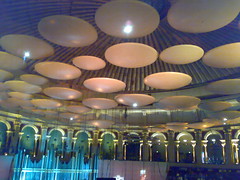
Well, Bruckner's like that, and it took me years to get him. Once I've got something, though, I tend to forget how much work it took to find my way in, so it was a salutary reminder when my companion at Prom 54, at which Bernard Haitink and the Royal Concertgebouw Orchestra performed his Eighth Symphony, came out with this conclusion. Bruckner is hard work, especially when you're stuck in a hall for an hour and a half, and it's a credit to him that although she was left bemused, she was also surprised that it had been that long. My first impressions of Bruckner as a lad were that nothing happened, and it didn't happen for a very long time. My mature impressions are actually pretty much the same, only now I think that this is a Good thing. It seems superfluous to say that the performance was superb, but I shall say so nonetheless, because it was.
It's not often I have the luxury of going to a late-night Prom, so it was especially fortunate that one of the few occasions when circumstances allowed me to stay for the late shift that we should be treated to the wonderful Pierre-Laurent Aimard performing some of Ligeti's wonderful Piano Studies. These works are real gems, mind-bending in their complexity, yet also generous in their approachability, and I can never tire of hearing them, especially in the hands of such a wonderful player as Aimard. Before this, he took on the role of conductor for a romp through Haydn's 102nd Symphony with the Mahler Chamber Orchestra. This juxtaposition emphasised the generosity and humanity of both composers. Next to these, Beethoven, whose 2nd Piano Concerto finished the concert, seemed overbearing, though this may have been down to the fact that we were tiring rapidly by this point. They played it beautifully though, and those parts where Beethoven wasn't intent on showing off were beautiful. These two concerts constituted a marathon, and we struggled to stay awake on the train home, though our exhaustion was tempered with a sense of worlds traversed.
Tuesday, August 21, 2007
Prom 50: Copland/Adams

I remember playing Copland's Billy the Kid Suite at school, and quite enjoying it. With more years' experience, I now realise it's not one of his better pieces. In fact, in all honesty, it's pretty dull, something a slightly scrappy performance by the BBC Symphony Orchestra does nothing to belie.
My companion remarks that Billy the Kid is the sort of piece that gets played to children to make them like classical music. She's right, and it's a shame. What we should be playing The Kids is something like John Adams' Century Rolls, which follows. It takes me a while to get into this, possibly because I'm slightly jaded from the Copland (I find myself wondering if I'm suffering Proms fatigue), but soloist Olli Mustonen and the band win me over. In the slow movement there's hints of Satie and Rachmaninov, while the driving, angular finale has echoes of Nancarrow and even Ligeti. Which is obviously a Good Thing.
The other Adams work in this prom, his new "Doctor Atomic Symphony" derived from his recent opera about Robert Oppenheimer, is, I fear, not on the same level. The ideas are thin, and spread thinly, the whole thing waffles on without really going anywhere, it's bitty and fussy and frequently sounds like second rate John Williams or Ennio Morricone. There are some nice enough moments, but to paraphrase Rossini, too many bad quarter hours. We find ourselves struggling not to fidget, and when the end finally comes after what seems like an interminable age, we clap politely and make our way out without waiting for the inevitable curtain calls.
Saturday, August 18, 2007
Prom 45: Schoenberg, Knussen, Henze, Stravinsky

It's obviously a day for lookalikes, as with her long blonde hair and blue and white dress, violinist Leila Josefowicz reminds me of no-one so much as Alice. Quite appropriate, as it turns out, as Knussen's Violin Concerto (as all his music) is filled with a quicksilver wit that seems to breathe much the same air as Lewis Carroll. I've long admired Knussen as a composer; he's far from prolific, but everything he produces seems so beautifully judged, expertly crafted and heartfelt without ever becoming overwrought.
I've only started really listening to Henze's music recently, so this was a welcome part of the programme. Sebastian im Traum has the same Tippett-ish feel to some of it as I've previously noted (though considerably more tautly argued than that composer's somewhat more diffuse music), and for a brief moment there even seems to be a hint of Elgarian wistfulness there, which leaves me to reflect on how curious it should be that a composer so much in his own tradition should sound so English.
What can be said about The Rite of Spring? Everything and nothing. It's one of the lodestones of the past century, the last piece that everyone agrees about, as someone wiser than me said, and casts a shadow over anyone who wants to write this stuff we inaccurately call classical music. But really, in the face of it, it's better to shut up, as a good performance leaves discussion unnecessary. This was one of those performances, rugged, rough, violent, full of that contradictory sense that this is the birth of Modern Music, and also a monument that defies all who stand before it.
Friday, August 17, 2007
Last Orders

Well, there's a lot of harm, because Sawhney is exactly the sort of intelligent, open-minded person the Proms should be attracting, and if his overriding impression of the season is one of an orgy of jingoism, then it's fair to say there's a major image problem here. It's not just the cringe-worthy sight of socially inadequate persons of questionable personal hygiene dressing up in tails and bawling along like the chinless wonders they are to Rule Britannia while draped in the Union flag, it's not that even someone with a classical background like Sawhney takes that as the image of the entire Proms season. It's that for the vast majority of people, this bunch of idiots represent the entire classical music world. This is the harm - all the talk of elitism, dumbing down, accessibility, artistic integrity, etc etc, is a side show to the real problem. The rot spreads beyond the actual event - look up listings at this time of year and you'll see a plethora of "Last Night of the Proms" events advertised, that strip the model of even the limited integrity it has and plump wholesale for the flags and rampant nationalism. If this is most people's only experience of classical music, no wonder they don't want to experience any more of it.
Tradition? Sloppy habits, as Mahler defined it. All this guff about the sacred tradition of the Last Night is just that, guff. The whole thing dates back no further than Malcolm Sergeant's tenure after the war, and the timing of its introduction tells you all you need to know about why it is as it is, and why it is so purely awful. This sorry sight of a nation in decline, drunk on nostalgia for its imperial past is an affront to all human dignity, and the most poisonous cup from which all classical music drinks. Why else was it such an affront to the Daily Mail and their like to introduce Harrison Birtwistle into the pantomime 10 years ago? Because for a moment they were confronted with the Now, a real Dionysian moment that showed up the moth-eaten pomp and that peculiarly stilted, forced "party" atmosphere so unique to the British in public around it as the shabby rot that it is. The single act that could do more than anything else to restore the reputation of concert-going would be to get rid of it. But that, alas, is only slightly less likely to happen than getting rid of the monarchy. And like that similarly archaic institution, it keeps us retarded, in thrall to an imaginary past and unable to grasp a future. We need to put the Last Night behind us, and face the dawn.
Wednesday, August 15, 2007
Prom 42: Sibelius (RAH)
Sometimes, it's all about context.
Listening to incidental music in a concert setting is in many ways a frustrating experience. In this case we had over a hour's worth of Sibelius' music for The Tempest, and while there was much beautiful music in it, ideas tended to flit by briefly, and overall the whole thing would be better heard with the play around it. As the evening progresses I become aware of a strange background noise which, it gradually dawns on me, is the sound of rain pummeling the Albert Hall's roof - a tempest outside becoming part of the Tempest within. Sometimes you need something like that to transport you to where you need to be, and allow the magic of Shakespeare's island to take you.
Sibelius wrote many songs, and the selection we hear after the interval demonstrate how good he was at it, the miniaturist in him coming to the fore in these exquisite jewels, evoking worlds with a few brushstrokes.
We finish with his Seventh Symphony, a piece whose tragic nobility rarely fails to affect me. Some conductors like to squeeze every drop out of the last bar, to wrench a triumphant peroration from it, but Osmo Vänskä (surely the best living conductor of Sibelius) and the Lahti Symphony Orchestra are better than that, and allow it to do what Sibelius intended - to evaporate, leaving an aching sense of loss and leave-taking hanging in the air.
Sometimes context creeps up on you.

Tuesday, August 14, 2007
Prom 41: Gershwin (BBC4)
What a fascinating, if flawed, experiment this was. The BBC Scottish Symphony Orchestra joined forces with the Marcus Roberts Trio for Gershwin's Rhapsody in Blue, with the trio contributing extensive improvised passages.
As the talking heads before noted, Rhapsody in Blue is itself a clash between jazz and "classical" styles, so on the face of it it's entirely natural to bring a jazz trio into the mix. The problem is that the excellent Roberts and his cohorts play in a post-Coltrane, post-Monk idiom, so what we ended up with was a three-way clash between classicism, pre-war and post-war jazz, with none emerging unscathed. Roberts' solos were wonderful, and when his rhythm section of Roland Guerin and Jason Marsalis kicked in things really took flight, but when they played along with the orchestra in the "composed" bits the result was oddly stilted, the stiffer '20s rhythms jarring against the more fluid post-bop element. I'd love to hear the trio alone improvise on the Rhapsody, as what they gave us tonight was exquisite, but I'm not convinced the middle of a "conventional" reading really works as the place to do it. Having said that, all involved acquitted themselves well, and this was an imaginative piece of programming, so full marks to the Proms for bringing it to us.
Roberts, Guerin and Marsalis gave us an encore, a delicious take on "I Got Rhythm" that had me hungering to hear more of them.
(Sorry, I can't comment on the rest of this show as I was watching Jamie Oliver on the other side, who showed me some excellent ways with courgettes.)
Wednesday, August 01, 2007
Prom 25: Boulez/Birtwistle (Radio 3/ online)
Pierre Boulez is a composer notorious for reworking his music, sometimes over many decades, and never quite reaching a conclusion (he has commented that works of art are never finished, only abandoned), with the result that his catalogue is full of torsos and "works in progress". Ironic then, that due to the late running of the earlier prom and the vagaries of London's public transport network this late-night offering from the London Sinfonietta and the BBC Singers was already up and running by the time I got home and turned on the radio, so I only heard his recent completion of Dérive 2 as a fragment. I shall certainly be taking advantage of the excellent BBC Radio player to listen to the full work, though, as it was an extraordinary and beautiful work. Boulez is the man fingered by many of those who oppose all avant-garde music since 1900 who ruined it all, and I'll admit I have issues with parts of his aesthetic*, but you'd have to be fairly cloth-eared not to be able to revel in the luxurious sounds he conjures up here. I wonder how the fact that I shall hear the opening of his piece after the close relates to his ideas challenging the idea of a "complete" work?
Coupled with this sensuous, glowing music was another of the bogeymen of contemporary music, Harrison Birtwistle. Again, Birtwistle is a man much misunderstood, as the frequent extreme complexity of his textures belies a thoroughly direct, even blunt, approach. Neruda Madrigals is one of his gentler works, and its more austere sound world, conjuring up thoughts of the Northern landscapes that he inhabits, made an excellent pairing with the Boulez, and made me regret that it was impracticable for me to stay and hear it live. What a shame this sort of thing gets increasingly and timidly relegated to late night slots. One hopes that this is a trend that will not continue when Roger Wright takes over the Proms from Nicholas Kenyon (aka the Doctor out of Star Trek Voyager) next year.
Players and singers were as good as you'd expect, and isn't it good to see in Susanna Mälkki a woman at the forefront of was is still largely a male domain?
* Maybe I'll get round to writing a post about this eventually.
Coupled with this sensuous, glowing music was another of the bogeymen of contemporary music, Harrison Birtwistle. Again, Birtwistle is a man much misunderstood, as the frequent extreme complexity of his textures belies a thoroughly direct, even blunt, approach. Neruda Madrigals is one of his gentler works, and its more austere sound world, conjuring up thoughts of the Northern landscapes that he inhabits, made an excellent pairing with the Boulez, and made me regret that it was impracticable for me to stay and hear it live. What a shame this sort of thing gets increasingly and timidly relegated to late night slots. One hopes that this is a trend that will not continue when Roger Wright takes over the Proms from Nicholas Kenyon (aka the Doctor out of Star Trek Voyager) next year.
Players and singers were as good as you'd expect, and isn't it good to see in Susanna Mälkki a woman at the forefront of was is still largely a male domain?
* Maybe I'll get round to writing a post about this eventually.
Prom 24: Sibelius/Britten/Varese/Debussy (RAH)

There is plenty more to be said in this concert, however, and the next is Britten's Piano Concerto. Again, the orchestra dispatches it with aplomb, and soloist Steven Osborne plays beautifully and engagingly, but, as with quite a number of Britten's pieces, I find that my attention keeps wandering, then is dragged back by something arresting, then wanders again.
The second half also features two pieces. Varèse's Ecuatorial features retro-chic electronics in the form of two ondes martenots, to evoke an ancient past. it's a strange and powerful piece, the swooping of the ondes contrasting with the guttural sounds of brass and percussion, as well as the strange alien chanting of the male singers. There's really nothing very much to compare it with, even in Varèse's own output, and it lingers in the mind long after it finishes, an unsettling presence.
Finally, we hear La Mer by Debussy, a performance that evokes foam flecked, salty air.
So, four works, four good performances... and yet I leave feeling slightly dissatisfied. It's something to do with the two major stage shifts, one in each half, that inevitably drain the momentum from a concert (I work on a theory that one should always try and avoid such things, one large move is manageable, more disrupts proceedings too much). It's also to do with the choice of repertoire. These are all pieces I either know and love, or would be more than happy to hear again, yet I am left with a feeling that I don't really know why they were programmed together. Four big-ish pieces leave a lack of a sense of a core, so that the whole is less than the sum of its parts. It's a shame, because each of these performances deserve to be remembered fondly. But they won't be remembered as one concert, which is the difference between good playing and good programming.
Subscribe to:
Posts (Atom)


