
Actually, Classic Fucking Mediocre dissemble, because it's a very old genre - the genre of Fucking Horrible Arrangements Of Recent Pop Hits To Make A Quick Buck. FHAORPHTMAQB has a long and frequently ignoble history, although I have to confess to an entirely unjustifiable fascination with Deep Purple and Malcolm Arnold's seminal* collaboration, Concerto for Group and Orchestra, which is not quite the same thing, admittedly, but is a closely related genre, also being of the phylum "Terrible Things That Happen When the Rock and Classical Worlds meet" (see also: Metallica's gig with the San Francisco Symphony, Philip Glass's rotten orchestral inflations of David Bowie and the Queen Symphony). I don't include the Orchestral Tubular Bells here because it's no worse than the original.
It works the other way around too, of course, and honourable mention here must go to Waldo de Los Rios's fantastically tasteless '70s arrangements of popular classical pieces by Mozart, Dvořák, and others, which, like doughnuts and crack, are irresistible even though they're clearly not good for you.
These chimeras differ from Classic FM concept in one important respect though; they're ill-advised, overblown and gloriously lacking in taste or restraint, which in time lends them a certain charm. Classic FM's album is all about being tasteful, music to put on in the background as you sit round your coffee table with your estate agent friends discussing what car you're driving these days and when mortgage rates might come down. There's a terrible and insidious snobbishness about the whole enterprise: the implication is that, on the one hand, these songs must be tarted up in "classical" clothes in order to be acceptable, and on the other hand that Classic FM's audience isn't really clever enough to listen to proper classical music, and shouldn't get any ideas that they deserve any better than this. The first is the sort of thinking that leads to Paul McCartney's "classical" follies, which only a lunatic could believe can hold a candle to his magnificent work with the Beatles; the second is essentially the same sort of mindset that thinks it's a jolly big shame that the natives are now running their own countries in the former British Empire, and that the working classes no longer doff their caps to the toffs. it betrays an attitude of paternalistic contempt by Classic FM for its listeners: it does nothing for either pop or classical or any other type of music, it creates nothing, refreshes nothing; it just leaches and leaches until the blood is drained from its victim.
When I was a kid, you'd see "Top of the Pops" albums in the bargain bins in Woolworth's and W.H. Smiths, offering the promise of the latest chart smashes all on one disc. When you got it home and slapped it on the record player, what you got was a bunch of cheap knocked off cover versions performed by session musicians. But you couldn't really complain, because they'd never actually said it was the original recordings, so you were stuck with the record and a vague sense of empty despair. This is the legacy of FHAORPHTMAQB, and Classic FM's tawdry product is no better, demeaning everyone and everything its fetid embrace encompasses.
Of course, it's entirely possible that I'm wrong, and that, far from being a cynical piece of opportunistic marketing tat, Songs Without Words (see what they did there?) is a triumph of artistic innovation that provides hitherto unglimpsed insights into the songs featured, and charts new lands in music. In which case, Yay, Go Classic FM.
*seminal: consisting of semen, i.e. a load of wank.
Wednesday, August 20, 2008
Kingdom of the Bland
Thursday, May 15, 2008
Irony in action
 Gordon's famously reduced the strength of their gin after an EU directive defined the minimum strength for gin as 37.5%. What was that about cutting corners and losing your edge again?
Mr Ramsay's very big on quality control. Obviously not that big, though..
Wednesday, May 07, 2008
Young Musician of the Year 2008 (BBC4)
Tuesday, January 22, 2008
Chasing the blues away
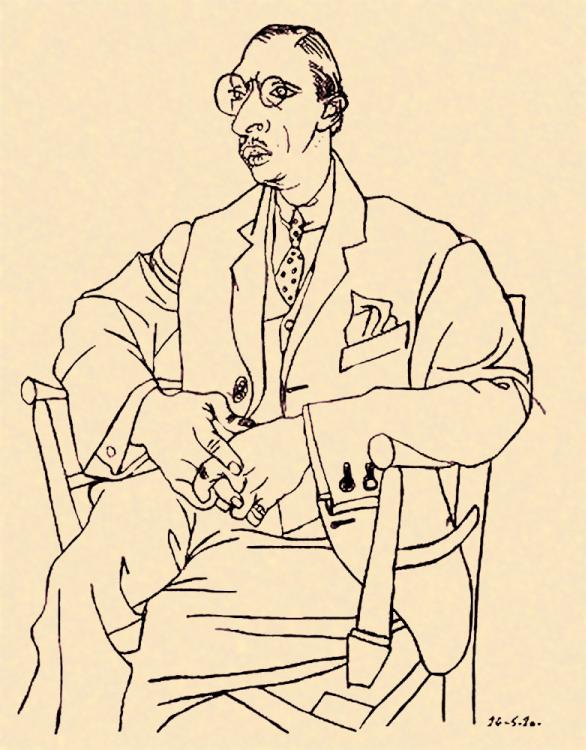
Among the pieces written in response to Henry Prunière's call for contributions to a supplement to the Revue Musicale in 1920 to commemorate Debussy, who had died in 1918, one stuck out: where most of the contributing composers (including Falla, Bartók and Ravel) responded with conventionally threnodic or wistful miniatures, Igor Stravinsky offered a cool, austere chorale, bearing the title: "Fragment des Symphonies pour instruments à vent à la mémoire de Claude Achille Debussy".
The complete work, to which this fragment forms the conclusion, in fact has its origins in sketches Stravinsky had made in 1919, while the opening motif was noted down on March 26th, 1918, just after he had learned of the death of Debussy the day before. Most of these sketches indicate that Stravinsky's original intention was to score this music for strings and harmonium, and it seems that they did not find their final form as wind music until much later on, the unrefusable request for a memorial to Debussy providing the final push Stravinsky needed to realise the work's definitive form. As the pluralisation implies, "Symphonies" is not used to denote anything like a conventional classical symphony, but rather harks back to the word's earlier meaning as a generic term for ensemble music (from the Greek "syn" [together] and "phone" [sound]).
The dedication is at least partly ironic; while Stravinsky and Debussy were friends, their relationship was characterised by a certain friction, attributable on Debussy's part to jealousy at the greater fame Stravinsky had achieved, and on Stravinsky's side to resentment at the older composer's occasionally condescending attitude. Debussy did not approve of the more cosmopolitan style that the Russian had been experimenting with, writing to him in 1915 to say;" Cher Stravinsky, you are a great artist! Be, with all your energy, a great Russian artist! It is a good thing to be from one's country, to be attached to the earth like the humblest peasant!"
Stravinsky, however, was by the time of Debussy's death determined to put as much space as possible between himself and his roots. Any hopes he may have entertained about returning to Russia were destroyed after the Bolshevik Revolution in 1917, after which his modernist style made him persona non grata with the new regime, and it is surely not coincidental that within 2 years he composed Pulcinella, the work which effected a seismic shift in his career, rejecting the Russian folkloristic style that had characterised his greatest successes (not least the Rite of Spring) in favour of the ironic, distanced world of what would become known as neo-classicism. The Symphonies of Winds therefore stands as the last recognisably "Russian" work he produced until the Requiem Canticles some 50 years later - shortly after he visited Russia for the first time since the First World War.
This all goes deeper than mere stylistic turns, though. The structure of the Symphonies, hailed in its early years as something radical, in fact is related very closely to the Russian Orthodox burial service, to the point that one can virtually superimpose the prayers of the service onto the melodic lines that weave their way through the work's short, but intense path. It may be that this work is intended as a burial, not only of Debussy, but also of Stravinsky's own identity as a Russian composer.
Wednesday, January 09, 2008
How Pop Music Works
Oh, Charlie, Charlie, Charlie. Don't you look fashionable in your unbuttoned shirt and Converses? Look at you, grooving to "Tomorrow Never Knows", nodding sagely to Joni Mitchell, telling us how great Imagine and Bohemian Rhapsody and Wyclef Jean are, making it OK to like pop. Well, you know what? I don't need your patronising waffle to justify listening to anything. I don't need you pinning songs down like butterflies.
The thing is, there are some interesting people on this programme, with pertinent things to say about what makes a great pop song. But why do we have to put up with you bringing your relentlessly average thoughts to bear? It's bad enough that you're becoming ubiquitous in the field of classical music on telly, a middle aged, dressed twenty years too young television producer's wet dream of half-arsed ideas of "accessibility" and "relevance". Why do you have to ruin pop as well?
Wednesday, October 17, 2007
We're not gonna Blake it.
The excellent Campaign for the prevention of Joss Stone draws my attention to some very naughty record company minions posting wildly enthusiastic reviews on Amazon for the yet to be released album by sub Il Divo* (if that's possible) blandtastic goons Blake. Go there and redress the balance. Together we can defeat this thing.
(Incidentally, how do clowns like these get away with describing themselves as "opera singers"? They wouldn't last five minutes on stage at Covent Garden.)
* Italian for "The Divs"
Friday, August 17, 2007
Last Orders

Sunday, July 01, 2007
What is this toss?
The literal answer is that this toss is the pilot for a resurrection of ancient telly music quiz Face The Music on BBC4, but the literal answer doesn't really answer the question, what is this toss?
You might be able to find it on the BBC's spanking new i-player, but I really wouldn't recommend it, as it really is shockingly poor and shows just how little anyone in television understands music. John Sergeant, who used to be so authoritative as a political corespondent, has a ponderous, pedantic delivery, his guests all look thoroughly uncomfortable, and the whole thing has an insipid, simpering air that I find utterly repellent. It makes Classic FM look like Hans Keller. Who commissioned this rubbish? If I knew nothing of classical music, I'd think, what a bunch of smarmy tossers. Knowing about it, I find it patronising, unintelligent and embarrassing. Oh, and I still think, what a bunch of smarmy tossers. It sets the cause of classical music back about 50 years.
Thursday, June 14, 2007
Britain's got attention whores
"The budgie man's on the telly!"
(If you've never wandered along the Thames in the vicinity of Tate Modern, you may not be aware that the budgie man is a bloke who stands about with a row of budgies on a pole and a tape player, singing a terrible song about how he's the "bu-budgie man".)
"really? What's he on?"
"I can't tell you, I'm too ashamed of the rubbish I'm watching."
A couple of days after this exchange, I finally wheedle the information out of her: The budgie man appeared (albeit briefly) on Britain's Got Talent. My curiosity piqued, I turn on and am sucked into an hour and a half of what Dante's Inferno might be like if Dante had been BBC1's light entertainment commissioning editor in 1975.
I'm confronted by a gaggle of small children jumping about dressed as purple witches, which puts me in mind of New Order's True Faith video re-imagined by a crack-head.
The judges are Simon Cowell, Amanda Holden and Piers Morgan. They each have a button that they press when they've had enough of whatever act is in front of them, which lights up an enormous red cross. If all three light their crosses, the act must stop and leave the stage in ignominy and shame. Cowell is playing his usual Nasty shtick, while Holden (a brunette these days, presumably in penance for doing the dirty on Les Dennis) almost visibly melts every time a small child appears. Her role is clearly to be good cop to Cowell's bad. Morgan doesn't appear to be able to decide if he's there to be an honest broker between these extremes or to try and out-bastard Cowell. When he attempts to do the latter, the result is hilarious in its ill-judgement. After a small child has run through "Wouldn't it be luverly" (very well, it must be said), he pronounces "No." there is an uncomfortable silence, it's clear the other two think she's a shoe-in. "No... doubt you're going through," he says. This sort of thing might work if Morgan was a polished performer who knew about comic timing, but he clearly isn't. He's clearly just that idiot who used to edit the Mirror before all that unfortunate business with the share tips.
There's a lot of that false expectation stuff in this show, actually - when the time comes to decide who'll go through to the next round, Cowell habitually uses it ("I'm sorry to tell you... you'll have to do it all over again. You're through!"). They used to use this gag on Neighbours all the time when telling kids their exam results and the like. Still, at least Cowell can pace it properly.
Of course, what we watch this sort of thing for isn't anyone with any actual talent, nor the ocean of mediocrity, but the jaw-droppingly awful, and Britain's Got Talent supplies that in spades. It's interesting that the audience is by now primed to boo Simon Cowell whatever he says, despite the fact that most of the time he's extremely fair in his criticisms. The man on the trampoline did get boring after he'd done the same pratfall about 5 times in the first 30 seconds. The middle aged woman dressed as Madonna was rubbish. Sticking spoons to your face isn't enough to make an act.
What continues to amaze, not only in this but all these talent shows, is the incredible ability of people to delude themselves that they can sing/tell jokes/dance/entertain in any way whatsoever. Surely if one of these people was your friend it'd be kinder to tell them quietly that they're rubbish, than to let them demonstrate it on national television? Or just shoot them. It'd be quick.
Monday, May 14, 2007
The Classical Brits, or, Big Mac and Fries.
Do you think I enjoy this? Two and a quarter bloody hours of this? Of course not. But I must do this, because even if it is ultimately futile to make the gesture, a stand must be made. Because this will not do.
Here we begin, with Katheryn Jenkins looking pretty and blonde as she squeezes Holst into a 4/4 meter, with added bongos, male voice choir and a key change so unsubtle it could be in Eurovision. Here's Joshua Bell, who ought to know better, posing his way through Vivaldi in that "exciting", highly charged" fashion previously associated with Vanessa Mae. Why doesn't he stick a wet T-shirt on and be done with it?
Oh look, here comes Sting with his lute. Is there a bigger, smugger twat than Sting? (Well, yes there is, but we'll let that pass for now.) I should be glad he's bringing Dowland to a wider audience, I ought to applaud the fact that he does these songs straight, without the sort of knobby "crossover" bollocks you'd normally get with this sort of enterprise, but when I see his smug face all reason leaves me, and I want to punch him repeatedly in the mouth while shouting "You didn't invent Dowland, you fucking smug twat!" Oh look, he's bunged some close harmony singers in halfway through. Twat.
Ooh, here's Katie Derham presenting the Record of the Year award to Simon Rattle for the Planets, she must be annoyed at losing the presenting gig to Fearne Brittain. Some bunch of actresses calling themselves "All Angels" croon their way through "Nimrod", robbing it of all dignity and subtlety in the process. Still, they're fit, eh? So that's all right, then.
Mrs. Sting pops up to award George Fenton the award for soundtrack for Planet Earth (or was it Blue Planet? No, that was last time). I suppose I should be grateful that John Adams won the contemporary composer award rather than Karl Jenkyns and his dreary new age toss.
And on and on it goes, culminating in the award of Classical Album of the year to Paul McCartney's new "Classical" work, another bit of trite rubbish that soils the genuine legacy of his work with the Beatles. I have a horrible feeling he really believes that this insipid nonsense is better and more worthwhile than "Helter Skelter" or "Penny Lane".
It's not that it's bad as such, it's that it's relentlessly average. I can't report that it was badly presented or that there were any terrible howlers (although it was edited terribly, shoddily), but the whole thing reeks of mediocrity. Music can be exciting, dangerous, provocative, heady, all-embracing. But the Classical Brits, and the industry they celebrate reduce it to muzak. It's not bad because it pushes crossover and TV soundtracks over more serious work. It's bad because it neuters the music, it removes all ambition and reduces it to a cheap bauble. The Classical Brits have the same relation to music as pornography to sex, or MacDonald's to a restaurant. They tell their audience that they should limit their horizons, that they're too stupid to cope with anything more than the scraps they're thrown, that they shouldn't above all make any effort to try and understand. That they don't deserve anything better, and neither should they aspire to anything better.
They diminish us all. This is what will kill music: the insistence that mediocrity is not just acceptable, but desirable.
Now go and listen to someone who understands what music can be.
Wednesday, March 14, 2007
The mind boggles
Also, I was bemused by the list of books we haven't finished. I mean, I'll 'fess up to not finishing Ulysses (although I shall one day, oh yes), but what's so difficult about Vernon God Little? I remember it being an easy read. Are we becoming so dumb? Judging by this story, HMV seems to think we are.
Wednesday, January 24, 2007
Hooray for radio!
Maybe it's the Man-Flu making me even more of a grouch than usual, but isn't TV shit at the moment? The odd repeat (Life On Mars, Charlie Brooker) apart, it's wall to wall unwatchable trash that actually makes me wish Torchwood was still on.*
Thank god for the radio. Already today I've heard some great documentaries about memory, Woman's Hour, and some Beethoven. And I've got a Sibelius concert on Radio 3, a documentary on Herbie Hancock on Radio 2, Chain Reaction on Radio 4 and Lee and Herring on BBC7 to look forward to. And that's not even to mention all the stuff you can listen again" to on the interweb (like yesterday's editions of Ross Noble and Down the Line, for instance). And all sorts of weird and wonderful stuff on Resonance FM, where you really do never know quite what you're going to get (which is a Good Thing, of course). There's a ton of stuff there, so switch off the telly and use your ears.
Talking of radio, I've just heard professional shit-stirring twat Norman Lebrecht advertising his show this weekend on Radio 3, when his subject will be blogs. Read this, and then email him, and make him look like an ignorant fool.
*I must confess to a strange obsession with Deal Or No Deal, though. Especially this week, which has an astoundingly camp twat called Bunney on it, who sings a song about whoever's playing that day before he opens his box.
Tuesday, January 02, 2007
Post festivities
Well, that's that for another year. I find as I get older that I've less and less time for the forced jollity of Christmas, and find myself in the ironic position of really just doing it for the parents, as I guess they once did it just for my sake. It's a week off work, true, but so much time is spent on an endless round of social/family visits that you get no time for yourself, and end up feeling exhausted and enervated from too much crap food, booze and small talk. I also find myself getting more and more annoyed by the whole present thing, the spending of money on things no-one really wants. I used to think getting something that someone had asked for/ had put on a wish list represented a failure of imagination, but I'm increasingly of the opinion that unless you really have a brilliant idea of your own, you shouldn't bother with anything else. I got two books this year that I know I'm never going to read. Not because they're not perfectly decent books, but they're just too damn big, certainly not the kind of thing to be carried on public transport, which is almost the only place I have time to read these days. When I was a student I might have been interested enough to dig my way through Prokofiev's student diaries, but now I can't persuade myself that it matters enough to bother. There seem to be many more important things to occupy my time. Not least actually listening to his music. And while a zipperobe in the shape of the Tardis seemed funny for about 5 minutes, I rapidly found myself reflecting that a) it was going to be a pain in the arse to get home, b) I don't have room for it and c) I don't need it, as I have a proper wardrobe. And at a time when I'm pretty desperately short of money, I can't help but think that the no doubt considerable amount that was spent on what is essentially a joke present could have been more profitably used to get me stuff that I would have got for myself, and kept me a little less in debt.
Anyway, back to work today. We rotate specific duties once a year in my office, and due to the differing space needed by different roles this means I will also have to move desk, where I will be surrounded by the 2 most talkative people in the office. I am now wondering if there's any way I can politely say "Actually, while you find everything your children do fascinating, I don't. I especially don't find them interesting first thing in the morning, when my foremost desire is to drink my coffee and talk as little as possible. I also don't consider the fact that we both own bicycles to be an adequate basis for extended conversation. And I'm not that interested in pictures of rabbits, either. Please shut up."
I think this year I will be mostly wearing headphones. With very loud music coming through them.
Still, mustn't grumble, eh? Happy New Year!
Monday, December 18, 2006
A mild surprise
Torchwood wasn't shit last night. Is this because it was better or because my expectations have dropped that much further? This conundrum can be expressed by the equation a=e(r/e), where a represents appreciation, e represents expectation, and r represents reality. Thus, a high expectation combined with a disappointing reality will lead to a lower satisfaction than something you expect to be a steaming pile of dog shit, which turns out not to be as bad as you thought it'd be. This equation explains why it's possible to gain more enjoyment from an above-par episode of a crap sitcom than a quality period drama adaptation that's as good as, but no better, than you expected.
Unrelated: There's a post by Shane MacGowan on the Guardian blogs today noting the anniversary of the death of Kirsty MacColl. I was listening to some of her songs with Cheerful One on Saturday night. Life's full of little coincidences, not always happy.


