I'm branching out into reviewing for the splendid folks at the Londonist. For my first effort I went to hear Beethoven at the Barbican on Friday.
Showing posts with label classical. Show all posts
Showing posts with label classical. Show all posts
Monday, October 06, 2008
Tuesday, August 26, 2008
Wednesday, August 20, 2008
Kingdom of the Bland
Actually, Classic Fucking Mediocre dissemble, because it's a very old genre - the genre of Fucking Horrible Arrangements Of Recent Pop Hits To Make A Quick Buck. FHAORPHTMAQB has a long and frequently ignoble history, although I have to confess to an entirely unjustifiable fascination with Deep Purple and Malcolm Arnold's seminal* collaboration, Concerto for Group and Orchestra, which is not quite the same thing, admittedly, but is a closely related genre, also being of the phylum "Terrible Things That Happen When the Rock and Classical Worlds meet" (see also: Metallica's gig with the San Francisco Symphony, Philip Glass's rotten orchestral inflations of David Bowie and the Queen Symphony). I don't include the Orchestral Tubular Bells here because it's no worse than the original.
It works the other way around too, of course, and honourable mention here must go to Waldo de Los Rios's fantastically tasteless '70s arrangements of popular classical pieces by Mozart, Dvořák, and others, which, like doughnuts and crack, are irresistible even though they're clearly not good for you.
These chimeras differ from Classic FM concept in one important respect though; they're ill-advised, overblown and gloriously lacking in taste or restraint, which in time lends them a certain charm. Classic FM's album is all about being tasteful, music to put on in the background as you sit round your coffee table with your estate agent friends discussing what car you're driving these days and when mortgage rates might come down. There's a terrible and insidious snobbishness about the whole enterprise: the implication is that, on the one hand, these songs must be tarted up in "classical" clothes in order to be acceptable, and on the other hand that Classic FM's audience isn't really clever enough to listen to proper classical music, and shouldn't get any ideas that they deserve any better than this. The first is the sort of thinking that leads to Paul McCartney's "classical" follies, which only a lunatic could believe can hold a candle to his magnificent work with the Beatles; the second is essentially the same sort of mindset that thinks it's a jolly big shame that the natives are now running their own countries in the former British Empire, and that the working classes no longer doff their caps to the toffs. it betrays an attitude of paternalistic contempt by Classic FM for its listeners: it does nothing for either pop or classical or any other type of music, it creates nothing, refreshes nothing; it just leaches and leaches until the blood is drained from its victim.
When I was a kid, you'd see "Top of the Pops" albums in the bargain bins in Woolworth's and W.H. Smiths, offering the promise of the latest chart smashes all on one disc. When you got it home and slapped it on the record player, what you got was a bunch of cheap knocked off cover versions performed by session musicians. But you couldn't really complain, because they'd never actually said it was the original recordings, so you were stuck with the record and a vague sense of empty despair. This is the legacy of FHAORPHTMAQB, and Classic FM's tawdry product is no better, demeaning everyone and everything its fetid embrace encompasses.
Of course, it's entirely possible that I'm wrong, and that, far from being a cynical piece of opportunistic marketing tat, Songs Without Words (see what they did there?) is a triumph of artistic innovation that provides hitherto unglimpsed insights into the songs featured, and charts new lands in music. In which case, Yay, Go Classic FM.
*seminal: consisting of semen, i.e. a load of wank.
Tuesday, August 19, 2008
Tales From the Back Desk
 Just post-holiday's always a good time to summon up some vague enthusiasm for doing something new, so with that in mind I've started a new project: Tales from the Back Desk. It's a regular (weekly, if I can summon the time and energy) comic about music and musicians, that grows out of the three strips I drew for Classical Music earlier this year. I was hoping they might be enthused enough about those to have such a series in the magazine, but hey, their loss is the internet's gain.
Friday, May 09, 2008
Playing with fire

And just to show it's not only BBC Young Musician that's had a lobotomy, I see the Classical Brits gave Emperor Palpatine an outstanding achievement award, and think the best classical release of the last year was cod-operatic karaoke act Bleak. To which the only sensible response is to laugh like a drain.
Wednesday, May 07, 2008
Young Musician of the Year 2008 (BBC4)
Is this starting to sound familiar? It should, because it's pretty much the same format as every other X-stars-in-Britain-have-talented-operatunity show out there; that stumbling mass of rotten-headed zombie programmes that shuffles unstoppably across the TV schedules, with the sole aim of removing the brains from our skulls.
And that's the point: you can see exactly how we arrived at this sorry abortion of a programme - lots of brainstorming by telly people, lots of guff about how classical music's seen as elitist and we've got to show how these lids are just normal teenagers, not stuck up posh kids (except that they are, because music's been sliding down the priorities of educational policy in the country for years, and only posh kids have parents who can afford to pay for them to have the lessons) - oh, and isn't it lucky one of them's Scottish, because another thing that every coked-up TV executive knows is that Scottish kids are automatically NOT POSH, so let's have lots of focus on him. Make it normal, make it accessible, don't let any hint through that there might be anything special or exceptional about these kids, certainly don't scare anyone off by showing them play an entire piece uninterrupted, get lots of reaction footage of the bods on the jury, much better to have someone tell you how good it is, can't trust the fucking plebs who watch TV to listen and form their own opinion, can you?
So you end up with a programme that fails on every count, because it's too scared to show us the only thing that makes these kids worth our time: their talent as musicians. This is how television likes to deal with classical music; anything, anything but the music itself.
You can see and hear complete performances on the website, I'm sure they would say. And it's true, you can. But why can't you see and hear them on TV? It's not as if the schedules are so stuffed full of content that they can't ever find time to devote hours of transmission time to talking heads spouting inanities about what they loved about the 1970s. I think there's a simpler explanation. I think the people who run TV don't like the music, they resent having to make space for it, they resent its very existence. They know little of it, and care less. All they care about is squeezing the last drop of life from exhausted formats while they wait for the next bandwagon to roll up. I'll bet when they put this programme together they talked a lot about journeys, about personalities, about relevance, about elitism and outreach. I wonder how much they talked about music?
Thursday, April 10, 2008
You've spun me round And knocked me off my axis mundi
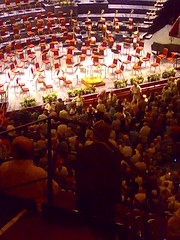
And you know what? There's some pretty darn good stuff in there. Obviously the Stockhausen day will be a highlight for me, but there's also a hefty wad of Messiaen and Carter (and it's not often you get to celebrate the centenary of someone who's not only still alive, but still very active), and a couple of "populist" gigs which I think are both excellent ideas - although not everyone agrees with me.
It's all very well to say "If we build it they will come", but the fact is that kids today have next to no experience of classical music, concert halls are seen as forbidding places, and many people simply won't enter one (a bit like the way quite a lot of people won't watch a programme simply because it's on BBC2 - which is why shows that transfer to BBC1 get such a huge hike in viewing figures). Personally I think that juxtaposing Doctor Who and Turnage is a great idea, not only in terms of getting people inside the hall who might never otherwise go, but putting a message out that it's ok to like both. It's not going to create a brand new audience overnight, but it's a step in the right direction, and puts the whole thing ahead of the usual game for "family" concerts.
The folk day is also exactly in line with what the Proms ought to be doing - a type of music that's intimately linked with so-called classical music, and presented with some of the cultural paraphernalia that surrounds it rather than in isolation like a butterfly in a glass case. I'm looking forward to having a dance round the maypole, so there! And the Ceilidh is a great way to finish it off. If we take it for granted that the Proms is bound to the Albert Hall for the foreseeable future (and I think it is), then for all the place's faults it should be embraced, and stuff like this makes an imaginative use of the space.
Some of the concerts look a bit bizarre to my eye in terms of the wild oscillations between full symphonic works and solo piano pieces, not to mention some strange programme orders (Mahler 5 as an opener??) , but if the Proms are to survive and flourish they have to be open to innovation and experiment, and one of the things about experiments is that they don't always work. The point is, it feels like a fresh breeze is blowing over the season after the increasingly stultifying Kenyon years. There's an eclecticism and a lack of reliance on tired barrel-scraping themes and the like that leaves me feeling uncharacteristically upbeat.
So bring on the daleks, the maypole, the electronica, I say: If it works, great; if it doesn't, at least they tried. Next year they could try putting a big Wicker Man up in Kensington Gardens.
... and everything decays.
Monday, March 10, 2008
Notes & Queries
A trombonist and me in the pub after the concert on Saturday:
"Great programmes notes!"
"Thanks!"
"Not much about music in them, is there?"
"Well, writing about music's a waste of time, really."
And it is.
Well, I should qualify that. There's plenty to be had out of the study of music, for performers and composers. But when you're writing for an audience the rules are different, I think. Maybe once upon a time you could have assumed a certain level of knowledge about how a piece of so-called-classical music works, but the fact is that you can't anymore. I write programme notes for intelligent people who have no musical education. I could witter on about sonata forms or whatever happens to be the bottle tonight's wine is poured into, but for those who know about such things it's unnecessary, and for those who don't it's a confusion. All those descriptions of what happens in the piece you read in most programmes - what's the point? I don't want to be told the plot before I read a book. But it does help to have the scene set, and as a lot of the time we're talking about something that was written in a different age or society, it's good to know the context in which it was created. I usually mention something that happens near the end, so that the audience knows it's nearly done. But really my ideal programme note wouldn't talk about the music at all. Long-winded technical descriptions put the layman off, make it seem an esoteric exercise that you can't begin to understand without a degree. Music should be experienced viscerally.
In the case of Shostakovich's Fourth Symphony, the political context of its creation is vital to understanding the work, but that's true of anything. No composer exists in a vacuum. To put a work in context doesn't diminish its universality (as some try to claim, particularly in the case of Shostakovich). When making a case, one argues from the specific to the general, and knowing how, when and why DDS composed his Fourth can only help in understanding its wider relevance today.
These thoughts are with me regularly as I write, of course, but they also come to mind this morning reading the comments on Pliable's post about the review of Alex Ross's book on Radio 3. It's true that there's not much in the way of discussion of music in the book, but is that its purpose? My impression is that the point of it is to put 20th century composers into a social context, something which has been largely lacking. I find the earlier part of the book more successful in this than the latter - although perhaps that simply reflects the extent to which the post-war composers abdicated social responsibility? It's also true that Ross's story peters out sometime in the early 70s, but perhaps with music since then it is too soon to tell. Certainly, the book isn't as wonderful as it's been made out to be - what could live up to such hype? - but Ross has attempted to put 20th century composers before a general audience, and that's something to be admired and encouraged.
Thursday, January 24, 2008
The Great and Good
There's a strange thing in classical music, I suppose because it leans on the past more than any other art form, of an insistence when talking about composers talking up their "genius". It's perfectly possible to talk of, say, Dickens as a great novelist while acknowledging his faults (all that sentimental Tiny Tim nonsense, for example), but we like to keep quiet about the second rate pieces Beethoven churned out amongst the jewels (such as the rotten Battle Symphony) . It's as though we're scared that if we admit any weakness in our musical gods, the entire edifice will come crashing down around our ears.
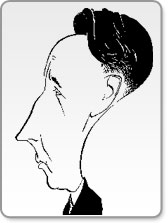
Martinů is a really good (and underrated) composer, and amazingly consistent for someone so prolific, but he's not a Great Composer. I think this is something to do with the fact that he's almost completely uninfluential (there's no "Martinů School" trailing in his wake), but also to do with an attitude, or lack of it, on his part towards his craft. He wrote well crafted, attractive and moving music, but there's never really a sense of him really trying to stamp himself onto history or change the course of his art for anyone but himself. He just tried to write good music.
This makes me stop and think, what do we really mean by a "Great Composer"? The whole idea of the Artist making a Statement begins with Beethoven (of course), which means that Bach, Haydn and Mozart (to pick only the 3 most obvious names) aren't really Great Composers, because the concept didn't exist for them. Significant, influential, great even; but not Great.
A Great Composer doesn't have to be a good composer; in fact I wonder if the two are very compatible, as it's entirely possible for a Great Composer to be a dreadful composer (Berlioz springs to mind, and Wagner - these are my prejudices, of course, you may have your own candidates for bad Great composers). even Beethoven, a Great composer who's generally also a good composer, sails pretty close to the wind - the 5th, 7th and 9th symphonies are exercises in increasing self-importance and bombast, and I maintain that after the astounding opening 30 seconds or so of the ninth, it's downhill pretty much all the way. But in the face of Greatness, quality's a secondary consideration
The line runs out almost exactly 200 years after Ludwig van, with the death of Stravinsky in 1971, and then the demise of Stockhausen at the end of last year; the Great Composer is essentially an idea of the 19th century that lingered through the 20th, and with the decline of so-called- classical music as a vital force rather than a museum, it's an idea whose time has gone. Which is not to say there aren't some great composers out there still, but are there really any Great ones?
Tuesday, January 22, 2008
Chasing the blues away
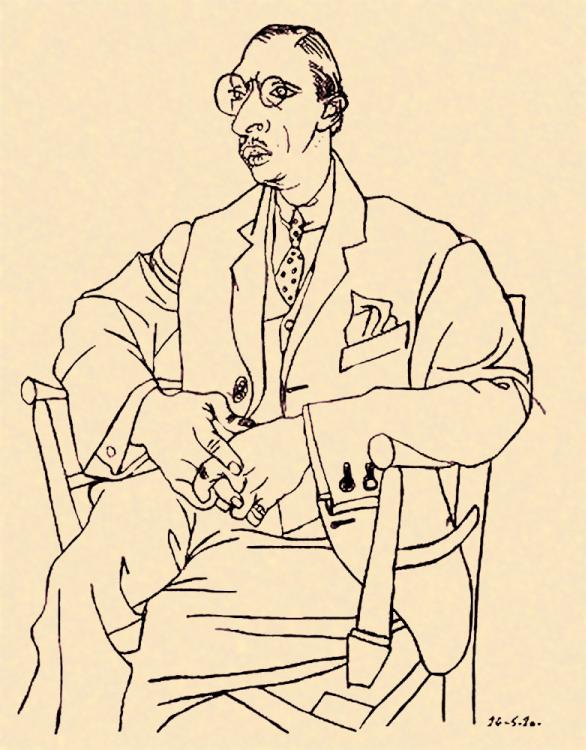
Igor Stravinsky (1882-1971)
Symphonies of Wind Instruments
Among the pieces written in response to Henry Prunière's call for contributions to a supplement to the Revue Musicale in 1920 to commemorate Debussy, who had died in 1918, one stuck out: where most of the contributing composers (including Falla, Bartók and Ravel) responded with conventionally threnodic or wistful miniatures, Igor Stravinsky offered a cool, austere chorale, bearing the title: "Fragment des Symphonies pour instruments à vent à la mémoire de Claude Achille Debussy".
The complete work, to which this fragment forms the conclusion, in fact has its origins in sketches Stravinsky had made in 1919, while the opening motif was noted down on March 26th, 1918, just after he had learned of the death of Debussy the day before. Most of these sketches indicate that Stravinsky's original intention was to score this music for strings and harmonium, and it seems that they did not find their final form as wind music until much later on, the unrefusable request for a memorial to Debussy providing the final push Stravinsky needed to realise the work's definitive form. As the pluralisation implies, "Symphonies" is not used to denote anything like a conventional classical symphony, but rather harks back to the word's earlier meaning as a generic term for ensemble music (from the Greek "syn" [together] and "phone" [sound]).
The dedication is at least partly ironic; while Stravinsky and Debussy were friends, their relationship was characterised by a certain friction, attributable on Debussy's part to jealousy at the greater fame Stravinsky had achieved, and on Stravinsky's side to resentment at the older composer's occasionally condescending attitude. Debussy did not approve of the more cosmopolitan style that the Russian had been experimenting with, writing to him in 1915 to say;" Cher Stravinsky, you are a great artist! Be, with all your energy, a great Russian artist! It is a good thing to be from one's country, to be attached to the earth like the humblest peasant!"
Stravinsky, however, was by the time of Debussy's death determined to put as much space as possible between himself and his roots. Any hopes he may have entertained about returning to Russia were destroyed after the Bolshevik Revolution in 1917, after which his modernist style made him persona non grata with the new regime, and it is surely not coincidental that within 2 years he composed Pulcinella, the work which effected a seismic shift in his career, rejecting the Russian folkloristic style that had characterised his greatest successes (not least the Rite of Spring) in favour of the ironic, distanced world of what would become known as neo-classicism. The Symphonies of Winds therefore stands as the last recognisably "Russian" work he produced until the Requiem Canticles some 50 years later - shortly after he visited Russia for the first time since the First World War.
This all goes deeper than mere stylistic turns, though. The structure of the Symphonies, hailed in its early years as something radical, in fact is related very closely to the Russian Orthodox burial service, to the point that one can virtually superimpose the prayers of the service onto the melodic lines that weave their way through the work's short, but intense path. It may be that this work is intended as a burial, not only of Debussy, but also of Stravinsky's own identity as a Russian composer.
Thursday, November 22, 2007
Abscheid

Monday, October 08, 2007
Know Nono? No?
In the absence of any coherent thing of my own to say (hey, I'm busy), may I point you in the direction of an excellent post about Luigi Nono.
Friday, October 05, 2007
Scenes from the death of classical music #1
"So, do you think we'll be playing Julian Anderson in 100 years?" a violinist friend asked me last night in the break during our rehearsal for the next KSO concert. Well, will we? Does it matter?
The shortest and probably most honest answer is "I don't know". Who can possibly say with certainty what will and won't be heard in a century? Acclaim in your own lifetime is no guarantee of an equal posthumous reputation - just ask Spohr, Clementi, and any number of other dead also-rans. Who can even say with certainty whether the symphony orchestra will still exist as a performing group? (I have my doubts about this.)
Does it matter? One one level, not at all, as I'll be long dead by then. On another level, it matters immensely, as I'm a composer, and no matter what I may say, I'll always have one eye on posterity. At least some of the motivation for creating anything, whether it be art, music, a building, social reform, whatever, is ego-driven: the desire for immortality. At a tangent to this is professional envy - I don't want some other bugger being remembered if I'm not.
I hope he isn't. This isn't anything to do with him or my opinion of his music. Up until comparatively recently it was normal for a composer to be forgotten after his death, because it was normal to have new music. But something happened in the 19th century, starting with Beethoven - the first composer whose work remained in the standard repertoire after his death, and has never left it* - and now new music is seen as at best novelty, at worst something to be actively avoided. There's too much posterity now. We need to remember to forget. Then there will be room for new musics. Otherwise classical music is just an embalmed corpse. Embalmed corpses are of course interesting to study, but they don't make very good conversationalists. I'd rather spend time with the living.
*"Beethoven started the rot", said Britten. Messiaen on the other hand speculated that music went wrong sometime in the 11th or 12th century, roughly when we started to write it down.
Thursday, September 13, 2007
A sell-off by any other name...
The BBC Philharmonic has announced a £20 million sponsorship deal with Salford Council. I believe that having an orchestra to call its own (in riposte to the Hallé's association with Manchester) was a major selling point for Salford Council to become the BBC's new Northern host. The band will retain its name, but this means it has effectively been outsourced. I wonder how long it will be before the other BBC orchestras find themselves the subject of such schemes? As the Beeb is merrily selling off all the means to make television programmes, it seems hard to believe they will continue to fund several orchestras.
Tuesday, September 04, 2007
Prom 68: Vienna Philharmonic Orchestra (RAH)
The Vienna Philharmonic have one hell of a history behind them, and a tradition that stretches way back. This isn't necessarily a good thing: it's only within the last five years that they've abandoned the tradition that women may not play in the orchestra. I recall Mahler's definition of tradition as "sloppy habits". They make a fabulous sound, rich and warm and unlike any other orchestra. But it's also a comfortable and slightly lazy sound. And that doesn't entirely suit Bartók, whose Music for Strings, Percussion and Celesta opens this concert. They play with astonishing virtuosity, and conductor Daniel Barenboim brings out a wealth of detail, but it lacks the edge that's needed. The same can be said of Kodály's Dances from Galánta, which is given a surprisingly soporific performance, which nevertheless manages to whip itself into a lively finale.
They play better in Enescu's Romanian Rhapsody No.1; a shame, because it's a less substantial piece than either Bartók or Kodály. The piece that comes off best in this (for the VPO) unusual programme is, curiously, the most modern: the slowly shifting textures of Ligeti's Atmosphères seem to suit the VPO's lush sound very well, and I find myself wondering if this is because its glacial thought processes resemble those of Bruckner, whose music is part of the orchestra's soul.
Barenboim is an astonishing man, buzzing with energy that belies his 64 years. The VPO are an astonishing band, too, rich in tone and dazzling in virtuosity and style. They play an encore, something by Johann Strauss (I presume). They play it wonderfully. That's both what's great and wrong with them.

Wednesday, August 29, 2007
Prom 59: Tchaikovsky/Prokofiev (RAH)
It seems almost inconceivable that there could be any such thing as a little heard piece by Tchaikovsky, but that was exactly what we had here: his Hamlet Overture, which began the second half of the concert. It's cut from very much the same cloth as his considerably less unheard Romeo and Juliet Overture, which opened the show, and it would be nice to hear it again, if a few concert programmers might want to think beyond the blindingly obvious every now and again.
The main meat in this concert by the LSO and their principal conductor, the hardest working man in show business Valery Gergiev, was two works by a more recent Russian composer, Prokofiev. His Second Piano Concerto is a behemoth of a piece, and finds the composer in full-on enfant terrible mode. You need a big personality to stand up to this piece, and fortunately we had one in the form of the wonderful Alexander Toradze. I've seen him play this and other concertos before, and he's mesmerising to watch; a great bear of a man whose gesticulations as he prepares to attack the keyboard are an extraordinary sight, and who, when he's not playing (not that that happens often in this particular piece) turns round and pays keen attention to what the orchestra are doing. Entertaining as this eccentric stage presence is, it'd be nothing if he didn't have the musical intelligence to back it up, and he certainly does: there's a fierce intelligence to his playing, as well as an emotional depth, and a variety of touch that stretches from the most delicate playing to a full-on assault on the instrument. An extraordinary performer in an extraordinary piece, he receives rapturous applause at the end of this marathon, although strangely he suddenly seems to come over rather shy at this point, and I'm suddenly struck with a sense that he feels unhappy with his performance. I suppose it must be difficult to feel satisfied when your standards are this high.
Prokofiev's Seventh Symphony is at the other end of the spectrum. A product of the end of his life, it's tuneful and lush occasionally to the point of blandness, hardly recognisable as the same composer who wrote the concerto. It's partly a reworking of ballet music, and that's reflected in its simplicity: themes tend to be repeated rather than developed, and sometimes the material seems a bit thinly spread. By the end of his life when he wrote it, Prokofiev was a broken man, both in body and spirit, and what redeems the symphony is the palpable sense of this; beneath its surface sheen of divertimento atmosphere and lush yet oddly pale orchestration there's an overwhelming sadness suffusing it. Prokofiev later wrote an alternative, "upbeat" ending which sounds as tacked on as it is. Gergiev and the LSO eschewed this in favour of the original, which winds down to a wistful, heartbreaking close.

Monday, August 27, 2007
Proms 53 & 54 (RAH)
Well, Bruckner's like that, and it took me years to get him. Once I've got something, though, I tend to forget how much work it took to find my way in, so it was a salutary reminder when my companion at Prom 54, at which Bernard Haitink and the Royal Concertgebouw Orchestra performed his Eighth Symphony, came out with this conclusion. Bruckner is hard work, especially when you're stuck in a hall for an hour and a half, and it's a credit to him that although she was left bemused, she was also surprised that it had been that long. My first impressions of Bruckner as a lad were that nothing happened, and it didn't happen for a very long time. My mature impressions are actually pretty much the same, only now I think that this is a Good thing. It seems superfluous to say that the performance was superb, but I shall say so nonetheless, because it was.
It's not often I have the luxury of going to a late-night Prom, so it was especially fortunate that one of the few occasions when circumstances allowed me to stay for the late shift that we should be treated to the wonderful Pierre-Laurent Aimard performing some of Ligeti's wonderful Piano Studies. These works are real gems, mind-bending in their complexity, yet also generous in their approachability, and I can never tire of hearing them, especially in the hands of such a wonderful player as Aimard. Before this, he took on the role of conductor for a romp through Haydn's 102nd Symphony with the Mahler Chamber Orchestra. This juxtaposition emphasised the generosity and humanity of both composers. Next to these, Beethoven, whose 2nd Piano Concerto finished the concert, seemed overbearing, though this may have been down to the fact that we were tiring rapidly by this point. They played it beautifully though, and those parts where Beethoven wasn't intent on showing off were beautiful. These two concerts constituted a marathon, and we struggled to stay awake on the train home, though our exhaustion was tempered with a sense of worlds traversed.
Tuesday, August 21, 2007
Prom 50: Copland/Adams

I remember playing Copland's Billy the Kid Suite at school, and quite enjoying it. With more years' experience, I now realise it's not one of his better pieces. In fact, in all honesty, it's pretty dull, something a slightly scrappy performance by the BBC Symphony Orchestra does nothing to belie.
My companion remarks that Billy the Kid is the sort of piece that gets played to children to make them like classical music. She's right, and it's a shame. What we should be playing The Kids is something like John Adams' Century Rolls, which follows. It takes me a while to get into this, possibly because I'm slightly jaded from the Copland (I find myself wondering if I'm suffering Proms fatigue), but soloist Olli Mustonen and the band win me over. In the slow movement there's hints of Satie and Rachmaninov, while the driving, angular finale has echoes of Nancarrow and even Ligeti. Which is obviously a Good Thing.
The other Adams work in this prom, his new "Doctor Atomic Symphony" derived from his recent opera about Robert Oppenheimer, is, I fear, not on the same level. The ideas are thin, and spread thinly, the whole thing waffles on without really going anywhere, it's bitty and fussy and frequently sounds like second rate John Williams or Ennio Morricone. There are some nice enough moments, but to paraphrase Rossini, too many bad quarter hours. We find ourselves struggling not to fidget, and when the end finally comes after what seems like an interminable age, we clap politely and make our way out without waiting for the inevitable curtain calls.
Saturday, August 18, 2007
Prom 45: Schoenberg, Knussen, Henze, Stravinsky

It's obviously a day for lookalikes, as with her long blonde hair and blue and white dress, violinist Leila Josefowicz reminds me of no-one so much as Alice. Quite appropriate, as it turns out, as Knussen's Violin Concerto (as all his music) is filled with a quicksilver wit that seems to breathe much the same air as Lewis Carroll. I've long admired Knussen as a composer; he's far from prolific, but everything he produces seems so beautifully judged, expertly crafted and heartfelt without ever becoming overwrought.
I've only started really listening to Henze's music recently, so this was a welcome part of the programme. Sebastian im Traum has the same Tippett-ish feel to some of it as I've previously noted (though considerably more tautly argued than that composer's somewhat more diffuse music), and for a brief moment there even seems to be a hint of Elgarian wistfulness there, which leaves me to reflect on how curious it should be that a composer so much in his own tradition should sound so English.
What can be said about The Rite of Spring? Everything and nothing. It's one of the lodestones of the past century, the last piece that everyone agrees about, as someone wiser than me said, and casts a shadow over anyone who wants to write this stuff we inaccurately call classical music. But really, in the face of it, it's better to shut up, as a good performance leaves discussion unnecessary. This was one of those performances, rugged, rough, violent, full of that contradictory sense that this is the birth of Modern Music, and also a monument that defies all who stand before it.
Friday, August 17, 2007
Last Orders

Well, there's a lot of harm, because Sawhney is exactly the sort of intelligent, open-minded person the Proms should be attracting, and if his overriding impression of the season is one of an orgy of jingoism, then it's fair to say there's a major image problem here. It's not just the cringe-worthy sight of socially inadequate persons of questionable personal hygiene dressing up in tails and bawling along like the chinless wonders they are to Rule Britannia while draped in the Union flag, it's not that even someone with a classical background like Sawhney takes that as the image of the entire Proms season. It's that for the vast majority of people, this bunch of idiots represent the entire classical music world. This is the harm - all the talk of elitism, dumbing down, accessibility, artistic integrity, etc etc, is a side show to the real problem. The rot spreads beyond the actual event - look up listings at this time of year and you'll see a plethora of "Last Night of the Proms" events advertised, that strip the model of even the limited integrity it has and plump wholesale for the flags and rampant nationalism. If this is most people's only experience of classical music, no wonder they don't want to experience any more of it.
Tradition? Sloppy habits, as Mahler defined it. All this guff about the sacred tradition of the Last Night is just that, guff. The whole thing dates back no further than Malcolm Sergeant's tenure after the war, and the timing of its introduction tells you all you need to know about why it is as it is, and why it is so purely awful. This sorry sight of a nation in decline, drunk on nostalgia for its imperial past is an affront to all human dignity, and the most poisonous cup from which all classical music drinks. Why else was it such an affront to the Daily Mail and their like to introduce Harrison Birtwistle into the pantomime 10 years ago? Because for a moment they were confronted with the Now, a real Dionysian moment that showed up the moth-eaten pomp and that peculiarly stilted, forced "party" atmosphere so unique to the British in public around it as the shabby rot that it is. The single act that could do more than anything else to restore the reputation of concert-going would be to get rid of it. But that, alas, is only slightly less likely to happen than getting rid of the monarchy. And like that similarly archaic institution, it keeps us retarded, in thrall to an imaginary past and unable to grasp a future. We need to put the Last Night behind us, and face the dawn.
Subscribe to:
Posts (Atom)


