Showing posts with label Britten. Show all posts

Saturday, March 20, 2010

KSO Programme notes: Dean, Britten, Holst

Brett Dean (b. 1961)
Komarov’s Fall

Australian composer Brett Dean’s short work Komarov’s Fall was written as part of the Berlin Philharmonic’s “Ad Astra” project: Simon Rattle invited four composers to provide “asteroids” to accompany a performance of Holst’s The Planets.


Opinions on the astrological significance of Asteroid 1836 Komarov appear to be lacking. It was discovered in 1971 and named for Vladimir Mikhaylovich Komarov, who has a significant place in extraterrestrial history if not in metaphysics. He was selected for training on the Soviet space programme in 1960, and became the first cosmonaut to go into space twice. This achievement is overshadowed by his other, more dismal claim to fame: on his second trip in 1967 on board the Soyuz 1 craft, he became the first man to die in space.


As he waited to die in his failing spacecraft, his wife spoke to him by radio, as did the Chairman of the Council of Ministers, Aleksei Kosygin, who told that his country was proud of him. Komarov’s reply was inaudible. Rumours persist that he died cursing the designers of the spacecraft and the flight controllers. The Soyuz mission had been hastily assembled and many corners had been cut. Engineers are said to have reported 200 faults to their superiors, but their concerns were overruled. In the wake of the United States’ disastrous Apollo 1 flight, the Soviet authorities were determined to push ahead in the race to be the first nation on the moon and to provide a conspicuous feat to celebrate the anniversary of Lenin’s birth.


In 1969 the last action of Neil Armstrong before he left the moon’s surface was to leave a memorial on the surface. This commemorates Komarov, Yuri Gagarin (who had died in 1968 not in space but in a plane crash) and the crew of the ill-fated Apollo 1 mission.


Against a background inspired by the sounds of recorded telemetry signals, jagged textures reflect Komarov’s increasingly frantic radio messages to the control centre. A brief lyrical passage at the heart evokes his wife’s farewell, before the frenzy is suddenly cut off and there is only the cold silence of space.


Benjamin Britten (1913-1976)
Sinfonia da Requiem
1 Lacrymosa (Andante ben misurato)
2 Dies irae (Allegro con fuoco)
3 Requiem (Andante molto tranquillo)

Britten’s attachment to his parents, and particularly his mother, was intense. Her sudden death in January 1937 came as a great shock, only a few years after his father. Britten was at the time living in a flat in London with his sister. They were both sick with flu and their mother had come to nurse them, only to fall ill herself. Within days she was dead.


This marked the beginning of a turbulent year for Britten. Only a few months later his close friend Peter Burra died in a plane crash. Britten took on the responsibility of sorting out Burra’s things. He was assisted by a mutual friend and casual acquaintance who would soon become closer: the singer Peter Pears. By October, when Pears was on tour in America, Britten was raising the idea of emigrating to further their careers. At the same time he noted in his diary, “The loss of Mum & Pop, instead of lessening, seems to be more & more apparent every day. Scarcely bearable.” In January 1939 they followed Britten’s friend and mentor Auden and crossed the Atlantic to Canada. The plan was only to stay a few weeks, but they remained there for six months before crossing the border to the United States and New York. In the meantime their professional relationship had become an intimate one, which would last until Britten’s death in 1976.


By now war seemed an increasingly inevitable prospect, and they discussed the subject with Aaron Copland, who later recalled that the pair “worried constantly about whether to return to England.” He wrote advising Britten to stay put: “Anyone can shoot a gun – but how many can write music like you?” In any case, the flow of commissions meant that Britten was able to tell his publisher Ralph Hawkes that he was simply too busy to return. It was Hawkes who told him that Japan was commissioning music to mark 2,600 years of the Mikado dynasty. Britten offered the Sinfonia da Requiem, which he dedicted to the memory of his parents. The Japanese government rejected the work. They considered its use of titles from Christian liturgy insulting. The rejection turned out to be a blessing in disguise when the bombing of Pearl Harbour in December 1941 pulled the USA into the Second World War. To be an immigrant providing music for the enemy would have been an unfortunate situation. In 1942 Britten and Pears returned to the UK and were eventually granted conscientious objector status.


The Sinfonia’s three movements play without a break. The titles of the movements do not indicate any specific liturgical meaning, but suggest the tone of each movement. Thus the opening has the character of a lament, followed by “a form of Dance of Death”, and finally a resolution into peace.

Gustav Holst (1874-1934)
The Planets
1 Mars, the Bringer of War
2 Venus, the Bringer of Peace
3 Mercury, the Winged Messenger
4 Jupiter, the Bringer of Jollity
5 Saturn, the Bringer of Old Age
6 Uranus, the Magician
7 Neptune, the Mystic

The origin of The Planets lies in a walking holiday in Spain that Holst took with his close friend Clifford Bax in 1913. They discovered a mutual interest in astrology, and their conversations sparked the idea for a large-scale work exploring the personality traits associated with the planets.


Such interests were not unusual. From Theosophy to Conan Doyle’s advocacy of the existence of fairies and the thriving trade in Necromancy, the supernatural and paranormal were popular throughout society. The frisson of scandal provided by the likes of the occultist Aleister Crowley added spice to the fashion for spiritualism of all hues. The British Empire, built on the science of the Industrial Revolution, created a ready market for mysticism from the East. This was reflected in the art of the era: Holst’s own Choral hymns from the Rig Veda were an early success.


Holst’s interest in mysticism and astrology was more than a passing fad: he continued to cast horoscopes for his friends throughout his life. His attention in The Planets however was focussed less on divination than character. Holst’s subtitles for each planet play fairly loose with strict ideas of astrological significance. It was more important to him to convey a sense of the development of human character than to be tied down by dogma. The overall plan combines a sequence of contrasting pairs with a progression from the physical to the spiritual. The movement that upsets this pattern, Mercury, was also the last to be composed, and Holst seems to have had trouble deciding how it should fit in. In a letter to a friend he recalled that “As far as I can remember I had the scheme of the Planets roughly worked out in my mind by Easter 1914 except Mercury which was added later.”


At the time he composed the suite, Holst was firmly established in his roles as director of music at St. Paul’s Girls’ School in Hammersmith and at Morley College in Waterloo, two posts he retained for the rest of his working life. This settled life was disturbed when war broke out in September 1914. Holst rushed to enlist, but was rejected because of poor eyesight. He was eventually offered a post working for the YMCA in Salonika as part of their educational work with the troops based in the near East. Before he left, Balfour Gardiner, who had championed many of his earlier works, gave him a generous parting gift: a private performance of The Planets by the Queen’s Hall Orchestra, conducted by Adrian Boult. Holst enlisted his pupils as the chorus in “Neptune”, as well as copyists to produce the orchestral parts. The work was performed at the Queen’s Hall in September 1918. Boult conducted partial performances in 1919, omitting Venus and Neptune, but it was not until November 1920 that the complete work was “officially” heard in public for the first time. By then Holst’s Hymn of Jesus, composed immediately after The Planets, had been premiered to great acclaim, and the orchestral work’s official debut had become an Event. Reviews of the early outings of the movements had been mixed (the Times described it as “Elaborately contrived and painful to hear”) but the reception afforded the official premiere verged on the fulsome.


Mars is often taken to signify Holst’s reaction to the outbreak of war in September 1914. What is depicted, however, is a psychological conflict. The warlike temperament is one that turns upon itself, reflected in the theme that continually tries to expand but collapses in on itself, all the time driven by the restless tattoo that underpins virtually the entire movement.


Venus sounds much simpler than Mars, but is in fact filled with a sophisticated subtlety alien to the Bringer of War. Elements of the opening movement are here transformed from negative, unresolved tension into ethereal beauty. In this light, Mercury may be seen as a kind of transformation of Mars, showing how its characteristics may lead to positive and inventive behaviour when tempered by Venusian serenity. This playful and fleet-footed movement may contain an element of self-portrait: Holst’s own star sign was Virgo ruled by Mercury.


Of all the movements, Jupiter has perhaps suffered the most from its popularity. The unfortunate appropriation of its central melody as a patriotic hymn has brought associations of solemnity and piety that really have nothing to do with its true character. It is certainly exhilarating, but partial performances of the suite that use it as a finale miss the point: its energy is of the physical world and therefore transient (Holst’s use of the term “Jollity” rather than “Joy” is significant). This is emphasised by its complement, Saturn. However, the Bringer of Old Age is not the tragic figure some see it as. The steady tread reflects the inevitability of physical decay, and its conclusion the serenity that follows acceptance of this. Only by accepting the passage of time can one hope to transcend it and enter the metaphysical realm of the final two movements.


The first of these, Uranus, the Magician, would appear to be played as comedy. The term “Magician” has inescapable associations with children’s birthday parties, and Uranus comes across as a conjuror rather than the magus we might expect from the portentous opening flourish. Perhaps Holst is poking fun at the pretentions of the occultist movement. The music easily brings to mind a Crowley-like figure grandiosely casting spells. The comedy falls away at the climax, as something altogether more dark and powerful is revealed, and the Magician realises he is dabbling with something rather serious.


Neptune, the Mystic moves into another realm altogether. Its meter and much of its thematic material echo events right back to Mars, but transformed far beyond the concerns of the physical world. The incorporeal aspect is emphasised by an offstage female chorus (for the audience, literally disembodied voices). There is no conclusion of any conventional kind: only the voices, floating into the distance endlessly.

Monday, October 20, 2008

KSO Programme Notes: 20 October 2008

Maurice Ravel (1875-1937)
Daphnis et Chloé: Suite No.2

1. Lever du jour
2. Pantomime
3. Danse générale
The myth of Daphnis and Chloë comes to us through a 2nd century Greek text credited to Longus. The story is fairly typical of pastoral erotica of the period: two children, raised by shepherds on the isle of Lesbos, nurture an unrecognised passion for each other that is brought to the surface through the medium of mutual peril. More notable is its characterisation, which is more extensive than its more plot-driven contemporaries, and puts it closer in style to a modern novel.

The combination of sex, mild adventure and textual innovation therefore made the story naturally attractive to the Russian impresario Serge Diaghilev as a potential subject for the Ballet Russe when they sensationally swept into Paris in 1908. Ravel, the composer earmarked by Diaghilev for the commission, was however more dubious: he disapproved of the racier elements of the story, and this led to arguments with the choreographer Mikhail Fokine, with whom he wrote the scenario for the ballet. An episode in which Chloé is abducted by pirates ended up particularly toned down from the original, and Ravel's final score dispatches it in an alarmingly perfunctory manner.

Beyond these aesthetic disagreements, Ravel found the work immensely difficult, and many of his most famous pieces of this period, such as Ma Mère L’Oye were in fact produced largely as procrastinatory diversions from completing work on Daphnis. The premiere, originally slated for the Ballet Russe's 1910 season, was continually delayed as Ravel fiddled with the score, and it was not heard in public until 1912.

The music that is performed in concert as the Second Suite consists of the finale of the ballet, by which point what little plot there is has been resolved. After a depiction of dawn, one of the very finest pieces of orchestral writing Ravel ever produced, the reunited lovers perform a pantomime in thanks to the gods, an enacting of the myth of Syrinx, who, pursued by the god Pan, came to a river, and, asking for help from the river nymphs, was transformed into a water reed, from which the frustrated god fashioned his eponymous pipes. There then follows a final bacchanal, whose pagan frenzy is intensified by a wild quintuple pulse.

Benjamin Britten (1913-1976)

Variations on a theme of Frank Bridge, Op.10

Introduction and theme - Adagio - March - Romance - Aria Italiana - Bourée Classique - Wiener Walzer - Moto Perpetuo - Funeral March - Chant - Fugue and Finale

When asked, after he had conducted a concert featuring Ravel's music, if such an eminent composer would ever emerge from England, Frank Bridge replied, "You will hear of one: Benji Britten."

The relationship between Britten and Bridge was of crucial importance for the younger composer: it was hearing and being "knocked sideways" by Bridge's Suite The Sea that set the young Britten on the path to becoming a composer himself, and it was his subsequent lessons with Bridge that honed and disciplined his natural talent, instilling in him his mentor's sense of rigour: Bridge insisted that a composer should write not one more note than was absolutely necessary to make his point, and this asceticism would become the backbone of Britten's own style.

So when the commission came to write a work for Boyd Neel's string orchestra to perform at the Salzburg Festival it was natural that Britten should take the opportunity to compose something in tribute to his teacher. The resulting work was heard in 1937, and confirmed Britten's growing reputation as England's brightest musical talent. What was particularly remarkable about the Variations on a theme of Frank Bridge was their European quality: aside from the various parodies of Italian, Austrian and French music, the young composer's style showed an obvious knowledge of such composers as Bartók, Stravinsky and Schoenberg, which set him apart from the insular attitude of much of 1930s Britain, exemplified by the suspicious reviews the work received in British newspapers, in contrast to the more positive reception afforded by the European press.

Perhaps Britten fully intended to provoke his native establishment. Certainly the theme he chose to use - from Bridge's Three Idylls for string quartet - has a wistful, nostalgic quality (of a kind that Bridge himself had long since abandoned in favour of a more abrasive style) that is blown away by its subsequent transformations. The work was intended as more than witty stylistic parody though: As well as their titles, the variations also originally had subtitles, intended to indicate an aspect of his teacher's personality. It was only with difficulty that Bridge himself persuaded Britten to abandon these, unquestionably the right decision; while one might see how the brooding first variation might embody "his integrity", it is difficult to see what the distillation of every waltz cliché in the Wiener Walzer has to do with "his gaiety", and "his sympathy" is an entirely inadequate description of the extraordinary funeral march, whose bitterness is only magnified by the frothy vivaciousness of what precedes it. The extraordinary "Chant" that follows takes the music into another, visionary realm altogether. A devilish fugue takes us to the conclusion, which weaves quotations from other works of Bridge around the main theme. So subtle and so integrated are these that it is only in very recent years that anyone has noticed they are even there.

Manuel de Falla (1876-1946)
El Sombrero de tres picos (The Three-Cornered Hat)

Part 1: Introduction - Afternoon - Dance of the Miller's Wife (Fandango ) - The Grapes
Part 2: The Neighbours' Dance (Seguidillas) - The Miller's Dance (Farruca) - The Corregidor's Dance - Final Dance (Jota)

Diaghilev had all the major composers of Europe in his sights, and so as well as Ravel, it was inevitable that he would approach Manuel de Falla to write something for the Ballet Russe. The subject he had in mind was Nights in the Gardens of Spain, suggested to him by G. Martinez Sierra. However, he happily transferred his enthusiasm to Falla's own suggestion that an adaption of El sombrero de tres picos, an 1875 novel by Pedro Antonio de Alarcón based on an older folk tale: a familiar story of political power abused for the aim of sexual gratification.

Falla had been toying with the idea of adapting the novel for some years, and was keen to set to work. However, the outbreak of war in 1914 meant that it would be nigh on impossible to produce the work, and so Falla, with the blessing of Diaghilev, produced with Sierra a pantomime, El corregidor y la molinera [The Corregidor and the Miller's Wife], which was produced in Madrid in 1917 to great popular success. He then revised this extensively to produce the definitive work which was unveiled under its final title in London in 1919.

If Diaghilev was hoping for a succès de scandale such as he had achieved with Nijinsky's notoriously erotic interpretation of Debussy's Prélude à l'après-midi d'un faune or Stravinsky's The Rite of Spring, he may have been disappointed by the final ballet: Falla was devoutly Catholic and had toned down the plot considerably - the Miller's Wife is much less amenable to the advances of men other than her husband than she is in Alarcón's novel. In other respects, however, it attracted as much controversy as the impresario could have hoped for, with critical reaction divided between those who saw it as a remarkable example of the Spanish national character expressed in a contemporary manner (the opinion of many critics outside Spain) and as an act of modernist desecration of Spain's folk traditions (the opinion of many critics within Spain). To put these reactions in context, Spain during this period was undergoing something of an existential crisis: the battle between those who espoused strident international modernism and those who supported a more insular approach to Spanish culture was, in the wake of decades of political instability, a fierce one.

Synopsis


The set and costume designs for The Three Cornered Hat were as much a draw as the music: Diaghilev had secured the services of Pablo Picasso. For the drop curtain Picasso produced a painting depicting a party of spectators at a bullfight. To give the audience time to admire this, Falla added an introduction. A soprano sings:

Casadita, casadita, cierra trance la puerta; Que aunque el diablo esté dormido a lo mejor se despierta!

[Little house, you must bolt your door; although the Devil sleeps he may wake up!]

The curtain rises on a small village. In the heat of the afternoon the Miller and his wife go about their tasks: drawing water from the well (with a pulley that is obviously in desperate need of oiling), feeding the chickens, and so on. The Miller is an ugly man, but his Wife is much more attractive, indeed has the charm to teach the blackbird to whistle the hour of the day, and attracts the attentions of every passing man. She catches the eye of the Corregidor (the mayor and chief magistrate, whose authority is symbolised by his tricorn), who tries to dance with her. She teases him with a bunch of grapes, obviously a very tasty dish, as in his excitement he loses his balance and falls over.

Part two opens with a dance for the Miller's neighbours: it is St. John's Eve, and the villagers are gathering to drink and dance. The Miller's Wife invites her husband to dance the farruca, a solemn and intense flamenco dance. As he finishes, Fate (as represented by a very famous quotation) knocks at the door, in the form of the police, who are here to arrest the Miller on the orders of the Corregidor. As they haul the Miller off, leaving his wife alone, a warning is sung:

Por la noche canta el cuco. Ad virtiendo a los casados que corran bien los cerrojos que el diablo está desvelado!

[The cuckoo sings in the night. It cautions us to bolt the door, for the Devil is awake!]

Having disposed of the opposition, the Corregidor struts in, dressed in all his official finery to seduce the Miller's wife. Luck is not on his side, however: he falls into the millstream. The Miller's Wife mocks him and threatens him with her husband's blunderbuss; then, suddenly frightened, runs off. The Corregidor removes his sodden clothes to dry, and goes upstairs and falls asleep on the Miller's bed.

The Miller meanwhile has escaped, and returning home to find the Corregidor unclothed in his bed draws the obvious conclusion. Furious, he plots his revenge: he puts on the Corregidor's uniform and sets off to find his wife. When the Corregidor wakes, he finds his clothes missing, so puts on the Miller's clothes. This inevitably leads to a confusion of identity, as his own officials mistake him for the Miller and arrest him. The confusion is exacerbated with the return of the Miller's Wife, who, distraught to find what she takes to be her husband in the grip of the police, sets upon them, and uproar ensues. The Miller returns, and seeing his wife defending the Corregidor, attacks his rival in a jealous rage. The arrival of the St John's Eve procession heralds the final dance, during which the true identities of all are finally revealed, the Miller and his Wife are reconciled, and the Corregidor once again flounders, surrounded and mocked by the whole village.

Friday, October 05, 2007

Scenes from the death of classical music #1

"So, do you think we'll be playing Julian Anderson in 100 years?" a violinist friend asked me last night in the break during our rehearsal for the next KSO concert. Well, will we? Does it matter?

The shortest and probably most honest answer is "I don't know". Who can possibly say with certainty what will and won't be heard in a century? Acclaim in your own lifetime is no guarantee of an equal posthumous reputation - just ask Spohr, Clementi, and any number of other dead also-rans. Who can even say with certainty whether the symphony orchestra will still exist as a performing group? (I have my doubts about this.)

Does it matter? One one level, not at all, as I'll be long dead by then. On another level, it matters immensely, as I'm a composer, and no matter what I may say, I'll always have one eye on posterity. At least some of the motivation for creating anything, whether it be art, music, a building, social reform, whatever, is ego-driven: the desire for immortality. At a tangent to this is professional envy - I don't want some other bugger being remembered if I'm not.

I hope he isn't. This isn't anything to do with him or my opinion of his music. Up until comparatively recently it was normal for a composer to be forgotten after his death, because it was normal to have new music. But something happened in the 19th century, starting with Beethoven - the first composer whose work remained in the standard repertoire after his death, and has never left it* - and now new music is seen as at best novelty, at worst something to be actively avoided. There's too much posterity now. We need to remember to forget. Then there will be room for new musics. Otherwise classical music is just an embalmed corpse. Embalmed corpses are of course interesting to study, but they don't make very good conversationalists. I'd rather spend time with the living.

*"Beethoven started the rot", said Britten. Messiaen on the other hand speculated that music went wrong sometime in the 11th or 12th century, roughly when we started to write it down.

Wednesday, August 01, 2007

Prom 24: Sibelius/Britten/Varese/Debussy (RAH)

A strange one, this. Four pieces, all well played by the BBC Scottish Symphony Orchestra. First up is Sibelius' last major work, Tapiola, which Ilan Volkov took at a fair speed that emphasised the driving wind through the forest rather than the brooding stillness that I find difficult to contemplate without thinking of Sibelius' 30-year compositional silence that followed it. There does seem to be something very monumental and absolute about it that precludes the possibility of anything after. Considering he spent many years attempting to write an eighth symphony, it seems to have a very strong sense of a final word, after which nothing more can be said.
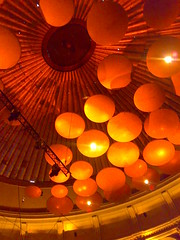
There is plenty more to be said in this concert, however, and the next is Britten's Piano Concerto. Again, the orchestra dispatches it with aplomb, and soloist Steven Osborne plays beautifully and engagingly, but, as with quite a number of Britten's pieces, I find that my attention keeps wandering, then is dragged back by something arresting, then wanders again.

The second half also features two pieces. Varèse's Ecuatorial features retro-chic electronics in the form of two ondes martenots, to evoke an ancient past. it's a strange and powerful piece, the swooping of the ondes contrasting with the guttural sounds of brass and percussion, as well as the strange alien chanting of the male singers. There's really nothing very much to compare it with, even in Varèse's own output, and it lingers in the mind long after it finishes, an unsettling presence.

Finally, we hear La Mer by Debussy, a performance that evokes foam flecked, salty air.

So, four works, four good performances... and yet I leave feeling slightly dissatisfied. It's something to do with the two major stage shifts, one in each half, that inevitably drain the momentum from a concert (I work on a theory that one should always try and avoid such things, one large move is manageable, more disrupts proceedings too much). It's also to do with the choice of repertoire. These are all pieces I either know and love, or would be more than happy to hear again, yet I am left with a feeling that I don't really know why they were programmed together. Four big-ish pieces leave a lack of a sense of a core, so that the whole is less than the sum of its parts. It's a shame, because each of these performances deserve to be remembered fondly. But they won't be remembered as one concert, which is the difference between good playing and good programming.

Saturday, July 28, 2007

Prom 19: Strauss/Britten/Nielsen (RAH)

Richard Strauss' Macbeth is exactly the sort of piece that only gets performed in long concert seasons that feature a Shakespearean theme. There is no other reason to play, or listen to, this dreary tosh.

Next up we were supposed to hear a rare outing for Britten's Our Hunting Fathers, but unfortunately singer Lisa Milne fell ill and no-one else was available who knew the piece well enough to do it at short notice, so instead we hear another vocal work of Britten's, Les Illuminations. Joan Rodgers steps into the breach wonderfully (as apparently she did at Aldeburgh last year, when Milne cried off sick at the last minute from the very same work...), as do the Hallé, and Britten's settings of Rimbaud are wonderful, but it's a bit of a shame to sacrifice something I and probably many others in the ausience have never heard for a piece (albeit a great one) that's far more commonly heard; not to mention the nonsense it makes of the other Prom theme supposedly being represented, the centenary of the birth of Auden.

In the second half we hear the wonderful fourth symphony of Nielsen, a piece I have long loved, in which the Hallé under Mark Elder catch fire to produce possibly the single best performance I've heard so far at this year's Proms.What a shame the hall was half empty. I've never been able to fathom why Nielsen isn't massively popular, but on this showing he simply isn't a box office draw. Well, all those of us who were there experienced something quite magical, and all those of you who weren't missed out. I was transported into another world, and ( a sure sign of a fine performance) couldn't quite believe it was over so soon. One day, I hope, Nielsen will reach his rightful place at the forefront of the average concert-goer's consciousness.

They play an encore, something I'd not normally welcome after such a charged experience, but it's beautifully judged: a new orchestration by Colin Matthews of Debussy's last, long lost piano work, "Les soirs illuminée par l'ardeur du charbon", a delicate and refined couple of minutes that soothes our ears and readies us to return to the dark, wet night of London. We retire to a pub and revel in what we have heard.