Showing posts with label Sibelius. Show all posts

Wednesday, November 28, 2007

What's difficult?

So, we played Sibelius and Schubert last night, and they came off very well (they seemed to like it at Classical Scourge), although it was an exhausting programme, both emotionally (Sibelius) and physically (Schubert).

What I found particularly interesting, though, was the response of the audience (or at least those who came because I badgered them). These people (in the main not musically educated) all said they preferred the Sibelius. Now, the Fourth Symphony is a powerful work, one of the greatest symphonies of the twentieth, or any century, but it's also the part of the programme that would be considered a "difficult" piece - essentially because it' s relatively dissonant, emotionally dark and introverted, ending in grey resignation rather than any kind of triumphant peroration (or indeed the opposite, breast-beating despair). And it occurs to me that this is obviously how it should be, not because the Schubert's not a wonderful and great piece (it is, of course it is) but because Sibelius lived in a time closer to our own, and we need to do less work to understand the context he worked in. But the conventional approach to concert programming is entirely based on the premise that anything modern or contemporary is inevitably harder to understand for the non-cognoscenti, and should be approached with caution, buttered up with Beethoven or Brahms.

Is there any other art form where this sort of thinking is considered normal? Can you imagine anyone suggest that you shouldn't even attempt to watch a modern play before you've got to grips with Shakespeare? Or that you should avert your eyes from Picasso or Damien Hirst until you've got the hang of Holbein?

What rot. All my experience tells me that this idea that "uneducated" people need to be coddled in the face of new music is just rubbish. They may not like it, but give them the opportunity to listen and they'll appreciate it - in fact, I suspect the untrained ear may be more open to new sounds than that conditioned and brow-beaten by years of propaganda dripped into it by the education system. We live in an age, after all, where the charts contain music far more abrasive than anything Schoenberg ever wrote, and where the influence of that giant of the post-war musical bogeymen, Stockhausen, can be heard in ways beyond anything you, or he, might have imagined. Isn't it time the classical music establishment woke up to itself and admitted it's got everything the wrong way round, and that this misguidedly timid approach is helping to destroy the art form it's supposed to be enriching?

When a newspaper such as the Observer can print such a closed-minded viewpoint as this review of the Huddersfield Festival by Anthony Holden, there is something deeply rotten at the heart of our relationship with music, an awful combination of intolerance and conservatism that seems to betray an active hatred of music. The point about something like Huddersfield is that it's experimental, it's not going to conform to preconceived ideas, and yes, it will inevitably attract a small audience, and not everything you hear there will work (because it's experimental, remember?) but that's OK, because it's not meant to be mainstream, any more than Stockhausen's works were before they influenced the likes of Warp records' roster. For a major broadsheet paper's music critic to fail to grasp this is an extraordinary failure of the critical process.

It's time we started treating audiences as grown-ups who can listen without prejudice, not as children who need to be protected from the nasty frightening modern composers.

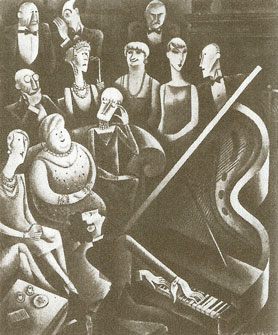
Image (a cartoon from Vanity Fair in 1929) swiped from here.

Tuesday, October 30, 2007

following a line

You'd think that, being a cellist myself, drawing a cellist would be a simple matter. But it's actually incredibly difficult to do something that looks even vaguely convincing. I persuaded two fellow cellists in my orchestra to let me take photos of them for reference at the last rehearsal. The results revealed that the sketches I'd done, which seemed plausible at the time, were way off the mark as to how the boy wraps itself around a large, annoyingly curved object. The players in question were a bit suspicious at first - "This sounds a bit suspicious", they said - but I persuaded them it was all in a good cause, and I'd show them the result. Here's a bit of it - I'll put the whole thing up once it's been published. it was weird, typing that; I still can't quite get used to the idea. After all the worries, about whether the idea was strong enough, about whether i was up to executing it, I'm quite pleased with the end result. I think it has one or two nice subtle touches, and I'm pleased with the page layout I came up with, which is (I hope) easy to read while also being reasonably complex. I've tried to use everything, from the poses of the figures, to the colours, to even the hairstyles, to add layers to the story. Strangely, drawing makes me think afresh about composing, of different ways of putting ideas together, of creating a form that serves rather than dictates the content.

I hope someone finds it funny...

So, one deadline conquered, and another immediately looms. So, thoughts now turn to Schubert, and Sibelius, and the prospect of thinking about bassoons grows closer.

Thursday, September 20, 2007

Silence

John Cage, whose birthday I noted recently, is of course the first name you'd associate with silence, as enshrined in his notorious piece 4'33". But there's another composer whose career is partly defined by silence.

It's 50 years since Sibelius died, and approximately 80 years since he produced any significant work. I can't think of any parallel to this. It seems he worked on an eighth symphony for some years, before burning everything he had written in 1943. Tom Service in today's Guardian suggests that this 30 year silence was simply the only appropriate response Sibelius could make after what he achieved in his final symphonies and Tapiola; he simply could say nothing which would not diminish those achievements.

There's probably some truth in this, although it may be romanticising crippling self-doubt on the part of Sibelius. After he burnt the eighth symphony, he became much happier. Maybe this was because he had reached a point where he felt able to let go of his idea of himself as a composer.

I often think about what makes one a composer*, especially when I'm not actually writing anything. If I at what point do I cease to be a composer? Elisabeth Lutyens used to say "If you're a composer, you bloody well compose", which implies that you're only a composer if you're actually writing. This appeals to me, as I've always felt uncomfortable with the presumption and pretension that seems to go with a declaration of "I am a COMPOSER!". And yet, I'm always conscious, even during those dry, unproductive periods, that I feel that I am, in some way. And this is a disturbing feeling, because if I'm a composer, why am I not composing? Generally, before the suspicion that I'm not a composer anymore takes complete hold, I have an idea, start writing,and become myself again.

But that awesome, oppressive 30 year silence of Sibelius continues to haunt me, and sometimes seems as powerful as anything he wrote. I wonder if that happiness that was noted in him after his immolation was due to a sense of freedom, that he had finally abandoned ambition, had unshackled himself from reputation, had admitted to himself that he was a man who had once been a composer, but no longer was.


*Harrison Birtwistle once gave a talk to an audience of schoolchildren, one of whom asked him, "But how do you become a composer?" Birtwistle replied, "Well, you've got to write music. There's no way round it."

Wednesday, August 15, 2007

Prom 42: Sibelius (RAH)

the choir enters
Sometimes, it's all about context.

Listening to incidental music in a concert setting is in many ways a frustrating experience. In this case we had over a hour's worth of Sibelius' music for The Tempest, and while there was much beautiful music in it, ideas tended to flit by briefly, and overall the whole thing would be better heard with the play around it. As the evening progresses I become aware of a strange background noise which, it gradually dawns on me, is the sound of rain pummeling the Albert Hall's roof - a tempest outside becoming part of the Tempest within. Sometimes you need something like that to transport you to where you need to be, and allow the magic of Shakespeare's island to take you.

Sibelius wrote many songs, and the selection we hear after the interval demonstrate how good he was at it, the miniaturist in him coming to the fore in these exquisite jewels, evoking worlds with a few brushstrokes.

We finish with his Seventh Symphony, a piece whose tragic nobility rarely fails to affect me. Some conductors like to squeeze every drop out of the last bar, to wrench a triumphant peroration from it, but Osmo Vänskä (surely the best living conductor of Sibelius) and the Lahti Symphony Orchestra are better than that, and allow it to do what Sibelius intended - to evaporate, leaving an aching sense of loss and leave-taking hanging in the air.

Sometimes context creeps up on you.

Wednesday, August 01, 2007

Prom 24: Sibelius/Britten/Varese/Debussy (RAH)

A strange one, this. Four pieces, all well played by the BBC Scottish Symphony Orchestra. First up is Sibelius' last major work, Tapiola, which Ilan Volkov took at a fair speed that emphasised the driving wind through the forest rather than the brooding stillness that I find difficult to contemplate without thinking of Sibelius' 30-year compositional silence that followed it. There does seem to be something very monumental and absolute about it that precludes the possibility of anything after. Considering he spent many years attempting to write an eighth symphony, it seems to have a very strong sense of a final word, after which nothing more can be said.

There is plenty more to be said in this concert, however, and the next is Britten's Piano Concerto. Again, the orchestra dispatches it with aplomb, and soloist Steven Osborne plays beautifully and engagingly, but, as with quite a number of Britten's pieces, I find that my attention keeps wandering, then is dragged back by something arresting, then wanders again.

The second half also features two pieces. Varèse's Ecuatorial features retro-chic electronics in the form of two ondes martenots, to evoke an ancient past. it's a strange and powerful piece, the swooping of the ondes contrasting with the guttural sounds of brass and percussion, as well as the strange alien chanting of the male singers. There's really nothing very much to compare it with, even in Varèse's own output, and it lingers in the mind long after it finishes, an unsettling presence.

Finally, we hear La Mer by Debussy, a performance that evokes foam flecked, salty air.

So, four works, four good performances... and yet I leave feeling slightly dissatisfied. It's something to do with the two major stage shifts, one in each half, that inevitably drain the momentum from a concert (I work on a theory that one should always try and avoid such things, one large move is manageable, more disrupts proceedings too much). It's also to do with the choice of repertoire. These are all pieces I either know and love, or would be more than happy to hear again, yet I am left with a feeling that I don't really know why they were programmed together. Four big-ish pieces leave a lack of a sense of a core, so that the whole is less than the sum of its parts. It's a shame, because each of these performances deserve to be remembered fondly. But they won't be remembered as one concert, which is the difference between good playing and good programming.