Oh, you didn't think there was actually going to be a part 12, did you? Pff.
Anyway, poor quality pastiche be damned. I have determined that 2009 will be the year when slightly crazy plans are brought to fruition.
In particular, something to do with environments and participation, and something to do with time. A lot of time.
And something to do with a bunch of 19th century composers behaving badly.
More clues later. Gotta go chase the next deadline now.
Showing posts with label amateur. Show all posts
Showing posts with label amateur. Show all posts
Monday, January 12, 2009
What's next?
Wednesday, September 17, 2008
Till the money runs out
The days pass, and I find myself on the brink of the new season, preparing to take up my cello and start rehearsing once more. After a good long summer break, it's good to feel some enthusiasm building for the coming year.
That's tempered with some trepidation, though. The credit crunch is biting everyone, and the orchestra's no exception. Rising costs, venue hire, the difficulty in persuading people to part with some cash in return for an evening's entertainment are all things that impinge on the activities of an amateur orchestra, and one that receives no subsidies at that. We rely on the subs that players pay, ticket sales and any sponsorship we can attract to keep going, and while it'd be exaggerating to say that we're on the brink of collapse, that fact is that an orchestra's an expensive thing to run; we made a big loss last year and we expect to this year. A lot of imaginative thinking will be needed to find new ways to raise money to keep the band going. (Any other amateur bands having the same worries round here?) >eanwhile hard decisions must be made, programmes changed and belts tightened.
Performing arts organisations must all be looking over their shoulders at the moment, as they're usually prime targets to have their grants cut when the economy starts to nosedive, no matter how well they seem to be doing. There have already been scare stories in the recent past when the Arts Council cut off all support to a number of prominent bodies. It's hard to avoid the conclusion that the time's coming when the best place to be is in an amateur band, working on a small scale and, for all the financial worries, perhaps better placed to ride out the storm than a large pro organisation that depends on public subsidy. One of the points trumpeted about the new Kings Place development is that it's funded entirely by private money, which I suspect is another sign that no-one sensible would want to be relying on public money at a time when there seems to be something in the air against the very idea of it.
On a tangent, there's some interesting (and quite long, don't try printing this out if you want to save trees) reading in this government report on amateur music-making. There's a bit of techno-waffle and stating the bleeding obvious, of course - this is a government document, after all - but I shouldn't be churlish, as it's good to see something vaguely official that propagates the notion that the Arts are something that people do, rather than a product to be passively absorbed. Whether this leads to the conclusion that amateur organisations should be cherished and supported in a way that officialdom doesn't really do at the moment, or that by some twisted logic their presence and popularity should serve as a reason to slash public arts funding remains to be seen.
Wednesday, July 16, 2008
Is your critique really necessary?
This interesting article (which I found via the splendid folks at the Detritus Review) provides much food for thought on the place and aesthetics of criticism. Defeatist Towers is of course on the whole a repository of half-witted ranting and raving rather than proper criticism that actually says clever stuff, like, but I like to believe that it all serves some sort of purpose in exploring ideas and thoughts about music and whatever else I drone on about. I sometimes wonder if there's any real value in what I type here, it being all pretty subjective and often outright ignorant, so it's good to have someone with more brains than me justify the utter lack of critical distance I so often display. And as there's a debate in the air about critics, bloggers and the relationship/divide/overlap of the two, it's always good to have some more ideas chucked in the pot. Call it work in progress.
Tuesday, February 05, 2008
Does Norman Lebrecht exist?
Daniel Wolf links to a prime cut of Norman Lebrecht, full of the factual accuracy that afficionados of Stormin' Norman have come to expect. Daniel expresses surprise that Norm, a professional newspaper columnist, could display such a level of ignorance about a major figure in a field about which he professes to be expert, and, the general disregard hacks have in this country for the truth aside, he's got a point. After all, if that were the case, then given Lebrecht's dismissals of bloggers as a bunch of amateurs who don't get their facts right, that would make him a big fat hypocite, and surely he can't be that? So it goes that as I read the hairy blusterer's attack on Stockhausen with the bluntest of hatchets, the thought occurs to me: Maybe Norman Lebrecht dosn't really exist.
Think about it: there have been cases before of spoof columnists who paraded a ludicrous series of columns before the public, who nevertheless took it seriously; Chris Morris's suicide journalist in the Observer springs to mind. If you were to create a satirical character, a music journalist filled with utter pomposity and egomania, entirely convinced of his own correctness despite his inability to do basic research properly, who assumes a stance of integrity and moral probity even as he trawls through the gutter looking for his next scurrilous bit of gossip, what would you come up with?
So, let others deride his ignorance and self-importance. I say, praise him! Praise the nameless shadow who has created one of the greatest caricatures of our age! Laudibus regina Jocasta in pestilentibus Thebis!
(It is of course possible, though highly unlikely I think, that I'm wrong, and Norm is a real person. If anyone can show me satisfactory evidence that Lebrecht does exist, and is not a fictional entity, I shall buy them a pint, or equivalent drink of their choice. Bet you can't.)
Sunday, December 02, 2007
Late Starters
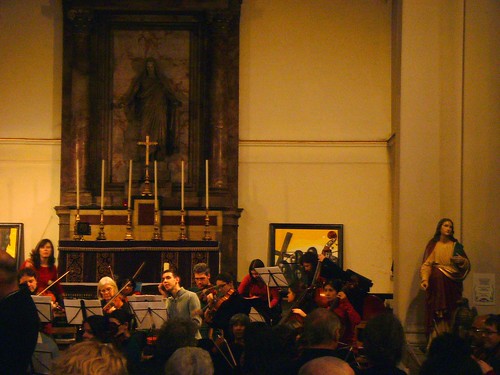
I've been playing the cello for over 30 years now, and composing nearly as long, so I ought to have some sort of handle on how this music lark works by now. But not everyone is as lucky as I was as a kid to have access to the wherewithal to pursue it, and the way music education is going there'll be even fewer in the future, so organisations like the East London Late Starters Orchestra are doing something very valuable. The idea is that people who've never had the opportunity to learn an instrument, or perhaps learned as a child then abandoned it for years, can have the opportunity to pick one up and have a go.
It's not really about the result (although of course all involved want to play the best they can), but about the act of getting up and doing it, I think; some of the players I hear had never touched an instrument until a couple of months ago, and to stand up and perform in public after that short a time takes a huge amount of guts, much more than I have certainly. And it also makes a statement that classical music isn't something obscure or difficult, to be the preserve of a few, but something that anyone can have in their life, if they want it.
There's such a strong vested interest in the music industry from professional bodies, record companies and the like that wants to promote music as a product to be passively consumed. This is so wrong. Music is an activity, something to be participated in, something to do, and it's this idea that really makes projects such as this important, not worrying about the "excellence" that ministers like to talk up (translation: leave it to the professionals, sit back, consume, buy, buy, don't think, BUY) but revelling in the act of creating it. Music's a social force, and that's what I bring away more than anything from this evening. There's little division between performers and audience; there's a unity of community, a joy and pleasure in the gathering together and the sharing of a moment.
Wednesday, November 28, 2007
What's difficult?
What I found particularly interesting, though, was the response of the audience (or at least those who came because I badgered them). These people (in the main not musically educated) all said they preferred the Sibelius. Now, the Fourth Symphony is a powerful work, one of the greatest symphonies of the twentieth, or any century, but it's also the part of the programme that would be considered a "difficult" piece - essentially because it' s relatively dissonant, emotionally dark and introverted, ending in grey resignation rather than any kind of triumphant peroration (or indeed the opposite, breast-beating despair). And it occurs to me that this is obviously how it should be, not because the Schubert's not a wonderful and great piece (it is, of course it is) but because Sibelius lived in a time closer to our own, and we need to do less work to understand the context he worked in. But the conventional approach to concert programming is entirely based on the premise that anything modern or contemporary is inevitably harder to understand for the non-cognoscenti, and should be approached with caution, buttered up with Beethoven or Brahms.
Is there any other art form where this sort of thinking is considered normal? Can you imagine anyone suggest that you shouldn't even attempt to watch a modern play before you've got to grips with Shakespeare? Or that you should avert your eyes from Picasso or Damien Hirst until you've got the hang of Holbein?
What rot. All my experience tells me that this idea that "uneducated" people need to be coddled in the face of new music is just rubbish. They may not like it, but give them the opportunity to listen and they'll appreciate it - in fact, I suspect the untrained ear may be more open to new sounds than that conditioned and brow-beaten by years of propaganda dripped into it by the education system. We live in an age, after all, where the charts contain music far more abrasive than anything Schoenberg ever wrote, and where the influence of that giant of the post-war musical bogeymen, Stockhausen, can be heard in ways beyond anything you, or he, might have imagined. Isn't it time the classical music establishment woke up to itself and admitted it's got everything the wrong way round, and that this misguidedly timid approach is helping to destroy the art form it's supposed to be enriching?
When a newspaper such as the Observer can print such a closed-minded viewpoint as this review of the Huddersfield Festival by Anthony Holden, there is something deeply rotten at the heart of our relationship with music, an awful combination of intolerance and conservatism that seems to betray an active hatred of music. The point about something like Huddersfield is that it's experimental, it's not going to conform to preconceived ideas, and yes, it will inevitably attract a small audience, and not everything you hear there will work (because it's experimental, remember?) but that's OK, because it's not meant to be mainstream, any more than Stockhausen's works were before they influenced the likes of Warp records' roster. For a major broadsheet paper's music critic to fail to grasp this is an extraordinary failure of the critical process.
It's time we started treating audiences as grown-ups who can listen without prejudice, not as children who need to be protected from the nasty frightening modern composers.
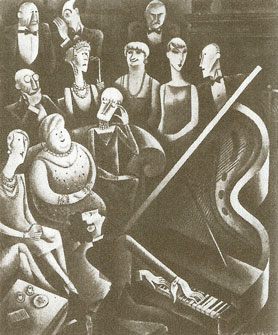
Image (a cartoon from Vanity Fair in 1929) swiped from here.
Friday, November 16, 2007
The art of gestures

All this offers me an opportunity to plug the next Kensington Symphony Orchestra concert on November 27th. It's going to be good, of course it is. Come along if you're around.
Strangely, only a couple of days ago I had a dream about a concert I conducted at university, more years ago than I care to divulge. What could it all mean?
Friday, September 28, 2007
The end is where we start
When I was a lad, I was determined that I was going to be an artist. I had this dream from very early on (since 3 or 4, I think), and later on it crystallised into something more specific: I wanted to draw comics. I spent hours copying the characters in comics like the Beano, Buster and Whizzer & Chips, and later on the Doctor Who comic strips, 2000ad and the Eagle were obsessions for me. I marvelled at the wonderful worlds that appeared in them, remembered the artists' name and watched out for my favourites, studying their styles and resolved that one day my name would be listed in the credit cards of 2000ad (at that time pretty much the only comic that credited its creators).
It didn't work out like that of course; I failed my art 'O' level (there's a bit of me that wishes I had had the paper remarked, I'm sure I failed at least partly because my main project was done in a very unashamedly comic-book style), but it didn't really matter, because by then I'd started writing music, and it made me focus on that, and despite my intention to keep drawing for my own pleasure, I stopped making pictures (although I continued to, and still do, doodle voraciously).
Then a few years ago, through comics fans I met through the web, who decided to stop being passive consumers and produce their own small press comics, I started again. I was very unsure of myself at first, in fact to begin with I wrote scripts for others to draw, but gradually I dared to put pen to paper and draw once more. It was wonderful, and all the better because the motivation wasn't any idea of career or success, but a love of the medium and a delight in producing something of my own that was there (as opposed to a piece of music, which once finished must lie in limbo until someone can be persuaded to perform it). And now I find myself drawing for payment, something I've never achieved as a composer, and wondering if this might lead somewhere. Strange how things turn out.
Wednesday, August 22, 2007
A Wing and a Prayer
Reading this post made me think about some of the ideas I've been having lately about what music and/or composition is actually for. Especially this bit:
"it's a tremendous loss that nowadays most people solely consume music,
rather than try to make music themselves. "
I'm reminded of something Ives said: "Can there be any such thing as bad music?" There's such a huge amount of judgmentalism in music, especially classical music. People who sit around comparing different recordings of the same piece, rather than thinking about the piece itself. Who go to a live performance and compare it to an old recording (always unfavourably, of course). I feel sorry for such people. They are missing the point in a spectacular manner, dwelling in the tombs of their recordings when they could be out with the living.
An old colleague of mine used to say, "Professionalism is the enemy of music." And the more I dwell on this sentiment, the truer it seems. I've nothing against professional performing groups, but it seems very unhealthy that the audience is increasingly regarded as a passive absorber of product. Music should be something you do, not something you consume.
Take a stand. Buy a cheap instrument (you can pick up a ukulele for about 20 quid, and they're very easy to play) and make a noise with it. Sing along to your records. tap out a rhythm on your table. it doesn't matter what it sounds like. It just matters that it's a sound you're making.
Subscribe to:
Posts (Atom)


