This interesting article (which I found via the splendid folks at the Detritus Review) provides much food for thought on the place and aesthetics of criticism. Defeatist Towers is of course on the whole a repository of half-witted ranting and raving rather than proper criticism that actually says clever stuff, like, but I like to believe that it all serves some sort of purpose in exploring ideas and thoughts about music and whatever else I drone on about. I sometimes wonder if there's any real value in what I type here, it being all pretty subjective and often outright ignorant, so it's good to have someone with more brains than me justify the utter lack of critical distance I so often display. And as there's a debate in the air about critics, bloggers and the relationship/divide/overlap of the two, it's always good to have some more ideas chucked in the pot. Call it work in progress.
Wednesday, July 16, 2008
Wednesday, November 28, 2007
What's difficult?
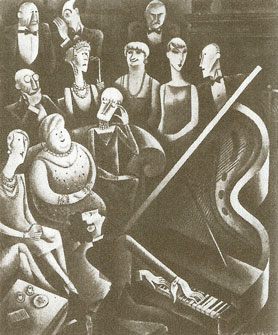
What I found particularly interesting, though, was the response of the audience (or at least those who came because I badgered them). These people (in the main not musically educated) all said they preferred the Sibelius. Now, the Fourth Symphony is a powerful work, one of the greatest symphonies of the twentieth, or any century, but it's also the part of the programme that would be considered a "difficult" piece - essentially because it' s relatively dissonant, emotionally dark and introverted, ending in grey resignation rather than any kind of triumphant peroration (or indeed the opposite, breast-beating despair). And it occurs to me that this is obviously how it should be, not because the Schubert's not a wonderful and great piece (it is, of course it is) but because Sibelius lived in a time closer to our own, and we need to do less work to understand the context he worked in. But the conventional approach to concert programming is entirely based on the premise that anything modern or contemporary is inevitably harder to understand for the non-cognoscenti, and should be approached with caution, buttered up with Beethoven or Brahms.
Is there any other art form where this sort of thinking is considered normal? Can you imagine anyone suggest that you shouldn't even attempt to watch a modern play before you've got to grips with Shakespeare? Or that you should avert your eyes from Picasso or Damien Hirst until you've got the hang of Holbein?
What rot. All my experience tells me that this idea that "uneducated" people need to be coddled in the face of new music is just rubbish. They may not like it, but give them the opportunity to listen and they'll appreciate it - in fact, I suspect the untrained ear may be more open to new sounds than that conditioned and brow-beaten by years of propaganda dripped into it by the education system. We live in an age, after all, where the charts contain music far more abrasive than anything Schoenberg ever wrote, and where the influence of that giant of the post-war musical bogeymen, Stockhausen, can be heard in ways beyond anything you, or he, might have imagined. Isn't it time the classical music establishment woke up to itself and admitted it's got everything the wrong way round, and that this misguidedly timid approach is helping to destroy the art form it's supposed to be enriching?
When a newspaper such as the Observer can print such a closed-minded viewpoint as this review of the Huddersfield Festival by Anthony Holden, there is something deeply rotten at the heart of our relationship with music, an awful combination of intolerance and conservatism that seems to betray an active hatred of music. The point about something like Huddersfield is that it's experimental, it's not going to conform to preconceived ideas, and yes, it will inevitably attract a small audience, and not everything you hear there will work (because it's experimental, remember?) but that's OK, because it's not meant to be mainstream, any more than Stockhausen's works were before they influenced the likes of Warp records' roster. For a major broadsheet paper's music critic to fail to grasp this is an extraordinary failure of the critical process.
It's time we started treating audiences as grown-ups who can listen without prejudice, not as children who need to be protected from the nasty frightening modern composers.
Image (a cartoon from Vanity Fair in 1929) swiped from here.
Friday, September 28, 2007
The end is where we start
When I was a lad, I was determined that I was going to be an artist. I had this dream from very early on (since 3 or 4, I think), and later on it crystallised into something more specific: I wanted to draw comics. I spent hours copying the characters in comics like the Beano, Buster and Whizzer & Chips, and later on the Doctor Who comic strips, 2000ad and the Eagle were obsessions for me. I marvelled at the wonderful worlds that appeared in them, remembered the artists' name and watched out for my favourites, studying their styles and resolved that one day my name would be listed in the credit cards of 2000ad (at that time pretty much the only comic that credited its creators).
It didn't work out like that of course; I failed my art 'O' level (there's a bit of me that wishes I had had the paper remarked, I'm sure I failed at least partly because my main project was done in a very unashamedly comic-book style), but it didn't really matter, because by then I'd started writing music, and it made me focus on that, and despite my intention to keep drawing for my own pleasure, I stopped making pictures (although I continued to, and still do, doodle voraciously).
Then a few years ago, through comics fans I met through the web, who decided to stop being passive consumers and produce their own small press comics, I started again. I was very unsure of myself at first, in fact to begin with I wrote scripts for others to draw, but gradually I dared to put pen to paper and draw once more. It was wonderful, and all the better because the motivation wasn't any idea of career or success, but a love of the medium and a delight in producing something of my own that was there (as opposed to a piece of music, which once finished must lie in limbo until someone can be persuaded to perform it). And now I find myself drawing for payment, something I've never achieved as a composer, and wondering if this might lead somewhere. Strange how things turn out.
Wednesday, August 22, 2007
A Wing and a Prayer
Reading this post made me think about some of the ideas I've been having lately about what music and/or composition is actually for. Especially this bit:
I'm reminded of something Ives said: "Can there be any such thing as bad music?" There's such a huge amount of judgmentalism in music, especially classical music. People who sit around comparing different recordings of the same piece, rather than thinking about the piece itself. Who go to a live performance and compare it to an old recording (always unfavourably, of course). I feel sorry for such people. They are missing the point in a spectacular manner, dwelling in the tombs of their recordings when they could be out with the living.


