
This time, the Keplers present Johnston's first and last quartets, together with one from the middle of the sequence. The Fifth Quartet opens the disc, and is quite simply one of the most astonishing pieces of music I've heard in a very long time. It's a set of variations on the Appalachian song "Lonesome Valley," and in this respect is a natural successor to the Fourth Quartet (included on the previous release), which is a set of variations on "Amazing Grace." Whereas that quartet expanded the harmonic language to include harmonies derived from the seventh partial, the slightly "flat" seventh that lies just outside the normal scope of conventional Western harmony, this one goes further, deriving its sound world from the distinctly more alien intervals to be found at the 11th and 13th limits. The effect is ambiguous and unsettling to ears used only to the "major-minor" standard Western harmony. The "Lonesome Valley" of the song's title is the"Valley of the Shadow of Death", and the quartet is not merely a clever exercise in weird harmony; it's a profound and disquieting mediation on death that resonates in the mind long after it's over. The piece dates from the 1970s, but feels like something from the distant future, while at the same time speaking with an ancient voice.
Johnston's tenth and most likely final quartet (although still very much with us, he's in frail health and hasn't composed for some years now) belongs to a later style, which might be described as revisionist. Here he explicitly draws on old models such as Haydn, not as pastiche, but as a way of exploring how Western music might have developed had we not locked down our tuning system to a twelve note scale sometime around 1600. This quartet dates from 1995, but paradoxically feels like the work of someone younger. it's an energetic, smart and witty piece, ebullient and extrovert where the fifth is inward and contemplative. The last movement acts as a kind of précis of the history of music, beginning in quasi-medieval mode. It eventually turns out that the movement is another set of variations on a famous tune - a tune so famous, in fact, that's it's a high risk strategy to use it, as in lesser hands the point where its identity is revealed could be a moment of appalling kitsch. In the event, it's a wonderful coup de théâtre that will leave all but the most curmudgeonly listener with an enormous grin on their face.
The final work on the disc is Johnston's First Quartet, the only one of the cycle not written in JI, and perhaps something of a period piece in its post-Webern serial style, typical of its 50s origins. The experience of learning to pitch the exotic intervals in the later quartets has clearly paid off though, because the Kepler's performance brings a luminous quality that makes the piece (another set of variations, though of a much less obvious sort) seem much more voluptuous and much less "difficult" than this sort of music is commonly characterised as being.
If the earlier disc of the second, third, fourth and ninth quartets was a revelation, this set of three is no less so, and confirms that Johnston's is one of the finest and richest quartet cycles of the 20th century. It's to be fervently hoped that the Kepler Quartet manage to raise the funds to complete the cycle (including the so-far unperformed Seventh Quartet, one of the most complex and adventurous things Johnston has written). In the meantime, anyone who cares about music and what it's capable of should immerse themselves in these extraordinary works. All three of these quartets are stunning, but for me it's the Fifth which is the standout, a genuinely overwhelming experience not quite like anything else you've heard.
Friday, February 11, 2011
Ben Johnston: String Quartets 1, 5 and 10 (Kepler Quartet; New World Records)
Saturday, April 25, 2009
Heiner Goebbels: Songs from Wars I have seen (QEH)
It's an essential part of the contemporary so-called-classical scene that the show you're at will overrun. A good yardstick of the quality of what you've been listening to is therefore how much that irritates you. I found myself not at all bothered by the fact on this occasion, so well done Heiner*.
To be fair, at least part of the overrun was down to the man who walked on and announced "My name is Andrew Burke Chief Executive of the London Sinfonietta" (how remarkable to have a name that suits your job, I thought) and proceeded to beg for money in that way that people desperate for money who don't want you to have the impression they're begging for it do. A lot of talk of wanting to connect with those who buy their tickets on the door (subtext: please book in advance, we've been shitting brick about advance sales), building relationships with their audiences (subtext: we're really worried about how the hell we get people to come to these things) and so on. All couched in friendly, "hey, we love you and we want to connect" language, but going on slightly too long not to come across as a bit desperate. Maybe I'm completely wrong, the London Sinfonietta feels completely recession-proof and has a mailing list as long as your arm, but it sure as hell didn't come across that way.
I have a problem with the London Sinfonietta; they make me slightly suspicious. Partly this is because they're the Establishment: I think of what Morton Feldman said, that the music you hear in London sounds official, like it was written for the London Sinfonietta. And the Establishment can't ever do anything really innovative or different, because innovation and difference challenges the established order. It's hide-bound by its position, by the deadweight of the one-of-each-instrument lineup that fills so much of its repertoire, from which so little interesting comes. Then there are things like those collaboration nights with Warp Records, which seem slightly pointless: is the Sinfonietta desperately chasing after the cool kids, or is it saying that by rearranging electronica for "classical" forces it's conferring a greater artistic legitimacy on it than it otherwise has? Which would seem to imply some level of contempt for the other, cooler music. The classical world is infested with the notion that its music is inherently better than any other kind.**
That said, it would be dumb to dismiss anything they do because of who they are, and tonight's concert of two pieces by Heiner Goebbels is an impressive one that shows that there's still life in this thing if you're clever enough to know where to look. Which Goebbels is. He understands that this genre of ours is essentially dramatic (why else dos it take place on a stage?) and both the pieces here are to some degree overtly theatrical. The use of samples of other records, as well as quotations of other musics performed by the musicians, emphasises this. It's to Goebbels' credit that these elements don't distract - although it's impossible not to have a moment of trying to remember where that drum loop's from - but manage to integrate in a way that earlier stylistic cross-dressers like Schnittke don't really manage, so the flow from tonality to atonality, from baroque to postwar modernism and back comes to seem natural.
Maybe this just where I'm coming from these days, but it's at its most impressive when there's less going on. "Songs of Wars I have seen" underpins Gertrude Stein's words with subtle, elusive sounds that seem to drift in and out of focus, lending a dreamlike quality. The combination of modern instruments with the period ones of the OAE lends another layer: the quieter baroque strings and winds lend an inward quality. Having the narration provided by the musicians rather than actors or singers is a masterstroke. It helps draw the listener in, almost as though we're being read bedtime stories. It manages to be hugely evocative without ever labouring to make a point. And the final moments, when a lone trumpet spins a melody over the ringing of prayer-bowls, coming over like Miles Davis sounding the last post, are magical, intimate and tender.
*I'm being over-familiar there. I don't actually know him or anything.
**Plus they don't play my stuff. Motherfuckers.
Thursday, October 09, 2008
Fit for a king?
I went there to have a snoop round on Sunday. First impressions of the building are good: it's an impressive space that feels open and not too cluttered. Picking up tickets from the box office needed a bit of queuing, but probably no more than you'd expect from a newly opened venue where things are still settling. I'm not impressed with the catering though: A packet of crisps and a sandwich left little change from a fiver, which wouldn't have been so bad if the sandwich wasn't small, soggy and not very nice, and the crisps a smaller packet than a bog-standard packet of Walkers. If you're going to charge three or four quid for something as basic as two pieces of bread with some filling, you need to come up with something better than this.
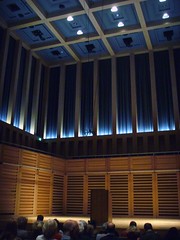 Hall One, the main performance space, is great, not as luxurious a place as the Wigmore Hall which is its most obvious rival, but it's a smart, clean design of a hall.
 The first event we're here for is a lecture by Sir Peter Maxwell Davies, entitled Musica Speculum Mundi? [Music a mirror of the world?]. He strolls onto the platform, and announces that he's been asked to write his speech down and recite it, not the way he'd normally speak in public. This makes it a little hard to get into what he's saying at first, as reading from a script makes his delivery a little stilted, but he warms up and sweeps us along with his talk, which, rather like a lot of his music, begins with a series of scraps of stories which gradually coalesce into a wider narrative. it's intimidating that he quotes form so many source in the original language, whether it be Italian, German, Latin or Greek. It's probably a sign of a generation gap that he can say something along the lines of "Of course, we all remember from school what Sophocles said...", but he's an engaging and intelligent speaker, and we're swept along by his argument, which becomes more and more personal and passionate as he touches on such subjects as his writing his Third Naxos Quartet in response to the invasion of Iraq. His conclusion is that writing a piece of music makes no practical difference to the world - he never imagined Blair, Brown or Bush would listen to his piece - but nevertheless it is immensely important that a composer reflect his world and act as a witness to it.
Max returns to the stage for the next show, a performance of two works for string quartet from the spnm shortlist selected by him and performed by the Brodsky Quartet. I've discussed this elsewhere, but it's a shame the speakers weren't miked up (as Max was for his lecture): we can hear what Max is saying (he's used to speaking in public) but the two composers, who aren't, mumble a bit and a lot of their words are lost beneath various rustlings from the audience. The acoustic is very clear, and hence very unforgiving in this respect, compulsive coughers note.
Another thing: please, please will someone at the spnm think of some compulsory course in programme-note writing for the composers on their shortlist? What we had to read was absolutely rotten and did nothing to enhance our enjoyment of the pieces. I was convinced from reading his note I was going to hate and/or be bored stupid by Oliver Waespi's piece, but was pleasantly surprised to be confronted with a beguiling piece that I'd like to hear again. It's difficult enough to persuade a lot of people to engage with this stuff as it is, and composers do themselves no favours by presenting such unenlightening writing.
Tuesday, October 07, 2008
New adventures in sound

Monday, October 06, 2008
Judgmental
I'm branching out into reviewing for the splendid folks at the Londonist. For my first effort I went to hear Beethoven at the Barbican on Friday.


