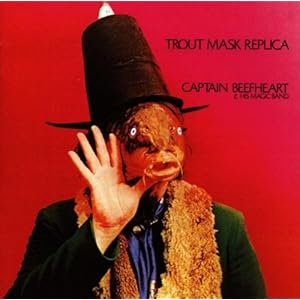
There was something curiously old-fashioned about that "his"; it seemed to evoke old-time acts like Mantovani and his Orchestra. This is strangely appropriate. For all his avant-garde reputation, Beefheart was a showman, and there's a playful theatricality in his music that in another life might have made him a housewives' favourite. You'd have a shock if you put the record on expecting some smooth strings though. I knew the album's reputation, of course - I was an obstreperous child and got that one because it had the most forbidding reputation - but the extraordinary noise that awaited me was something I wasn't prepared for. It took years (and I mean, around 10) for it to click that for all the complexities of time and tone, it was at heart a blues album. That moment of realisation brought everything into focus, and thereafter it seemed incomprehensible that I'd ever found this music forbidding. It never became comfortably familiar though. Like all great music, it remains unpredictable, startling, new.
Saturday, December 18, 2010
Don Van Vliet 1941-2010
Tuesday, December 14, 2010
Cage Against the Machine
I suspect the the attempt by Cage Against the Machine to take John Cage's notorious 4'33" to the Christmas No.1 spot is doomed to failure. There doesn't seem to be quite the focussed support for a single anti-X Factor purchase this year as there was with Rage Against the Machine last year. Anyway, Cowell's a canny enough operator to know that even such projects ultimately fuel his own machine, keeping the brand in the public eye. All publicity is good publicity, and the high-trousered one wins (and the rest of us lose) whatever happens, as long as we're not ignoring him.
Having said that, it's bound to be a noble failure, that gives a wider circulation to some of Cage's ideas. Some people seem concerned that the CATM project is "overexposing" Cage's notorious work (although I wonder if there isn't an element of hating it when our friends become successful). Meanwhile over at the Quietus, David Stubbs worries that people aren't taking the piece seriously enough. (There's an interesting discussion about about the question of humour in the comments.) He's partly right of course: 4' 33" isn't a joke. Cage insisted to the end of his life that it was his most important achievement, and that he thought about it before beginning work on every other piece he wrote. But at the same time Cage was certainly alive to the absurdity of the situation that performing 4'33" puts an audience in, and would have considered laughter as valid a response as any. The idea is important and robust enough to survive those who mock it.
Will CATM spark an interest in Cage's other work, so over-shadowed by his most notorious piece? Well, it's unlikely. But it equally seems wrong-headed to complain that it risks making Cage a cult. For one thing, he is already. For another, Cage knew the power of popular culture, and was happy to appear on a TV gameshow for instance. 4'33" was originally conceived as a protest against Muzak, so it seems fitting to employ it as a protest against the souless sausage machine Cowell operates. I suspect he'd have been delighted by the project.
Sceptics like to question how Cage can be said to have "composed" this piece at all, but its form is one of the most intriguing things about it. In its original form, it appropriates all the trappings of a conventional piece. It's divided into three movements, and that's not a joke: Cage's intention was that it should observe exactly all the conventions of classical performance, except of course for the production of any deliberate sound. The boundary between performance and the spaces between and around performance become blurred and uncertain. it's tempting to see this as a deliberate satire on the anxiety that modern concert etiquette inspires in people: the questions of how you know when the piece is finished and when you're "supposed" to clap. The CATM version, with its celebs getting together for charity and its remixes, actually seems to me to be a rather more faithful approach in this respect than the smirking of the BBC Symphony Orchestra that Stubbs mentions in his article.
A lot of those conventions - including the diktat that the audience should be silent - are essentially a product of the recorded music era. It would be silly to applaud a solo on a record in your own home after all. 4'33" reflects a fundamental shift: the audience has become divorced from the performer, and 4'33" formalises this by making the listener rather than the musician the focus, while also opposing it: as the work consists of ambient noise, the audience is as much a performer as anyone on stage.
CATM seems to understand and enage with Cage's idea in a way that "serious" musicians often seem incapable of doing. And four an a half minutes of "dead air"* turning up on the Radio 1 chart show would represent a genuine challenge to all contemporary convention, perhaps more so than David Tudor's premiere. After all, we now live in a world where silence* is becoming almost impossible to find. Background music has invaded music, and every shop, restaurant, pub and public space (even tube stations, increasingly) is overlaid with a patina of sound, there to protect us from our fear of being forced to be aware of ourselves. It's there not to be listened to, but to be ignored. The opposite of music.
This is the most elegant and important point 4'33" has to make. What is music? It's what happens when you pay attention.
Now go buy! Oh, and listen to some of Cage's other music too, because it's great.
(By the way, if you want a good starting point to explore 4'33" and how it fits into Cage's career I highly recommend Kyle Gann's excellent book No Such Thing As Silence.)
*Yes, yes, I know.
** The Classical Music World has few questions as burning as this, and it wonders why it's seen as irrelevant and detached from real life.
Tuesday, November 09, 2010
Saturday, October 02, 2010
Friday, August 13, 2010
Forty

In which I celebrate my impending mid-life crisis by considering the first forty tones of the harmonic series. This entailed using the 37th partial, which I've not only never used and don't really have much idea what it sounds like, but also had to work out exactly what the notation signified (a lowering of pitch by about 23.24 cents, since you ask). I'm rather more excited about having worked this out than I ought to be.
(Just Intonation notation guide here.)
Saturday, August 07, 2010
Canyon
Woo! We're back! Well, maybe. I've got a few ideas and I may blog about them as they develop. In the meantime here's a bit of actual music I made.
Canyon by petemaskreplica
Wednesday, May 12, 2010
KSO Programme notes 10/05/2010: Schubert & Bruckner
Franz Schubert (1797-1828)
Symphony No. 8 in B Minor, D.759 (Unfinished)
1. Allegro moderato
2. Andante con moto
There are in fact five fragmentary symphonies by Schubert, but only one that proudly proclaims its incompleteness. What marks this Unfinished Symphony out from the others is that two of its movements exist in a performable state. The other unfinished symphonies (and the third movement of this one) exist only as fragments and sketches.
The torso was not performed until 1865, over 40 years after its semi-composition. Schubert gave the manuscript of the two completed movements and the beginnings of a third to a friend shortly before his death, and the symphony did not come to light again until the early 1860s. By then the myth of Schubert the neglected genius, fuelled by Robert Schumann's advocacy from the 1830s onwards, was fully established. The much delayed première added to this myth. The “Unfinished” Symphony seemed a reflection of Schubert's fate: Poor Schubert, the untutored genius who produced music as naturally and effortlessly as a bird, doomed to neglect and a young death before he was able to complete his destiny.
Schubert's position in Vienna was not so much that of a neglected composer as an undiscovered one. He was well known as a composer of songs and dance music and had a number of works published. The music for which he is best remembered now was largely unpublished and unperformed during his lifetime not because of a lack of interest, but because he was a young composer at the start of his career who was still hustling for a position in the Viennese artistic scene. Had he lived into the 1830s he would have benefited hugely from the support of both Robert Schumann and Franz Liszt. It is worth remembering that had Beethoven died at the same age as Schubert he would be remembered as a far less significant composer, if at all.
Austria in the early nineteenth century was in many ways at the forefront of European civilisation. Steam boats and hot air balloons were two modern transports that could be experienced in Vienna as early as 1820. Yet there were as yet no sewers and disease was rife. The deathrate in Veinna had declined in the early 19th century but rose again sharply in the 1820s and 30s. Schubert's frequent concern with death in his work was not simply a personal obsession but a reflection of the conditions around him. To us 31 is a shockingly early age to die. To Schubert's contemporaries it was not.
On top of this, the society he lived in was a restricted one. Social occasions such as dances and the soirées where Schubert's songs and chamber music were heard were the closest it was possible to come to personal expression. As the art form least easily interpreted as political, music flourished as a form of covert communication of the hopes and desires of the Viennese. Fantasy, whether in the form of Schubert's “Fantasias” or less salubrious forms of entertainment, was the order of the day. This reflected not only the need for diversion but the desire to be freed from the shackles that bound society.
Schubert was such a prolific composer that it is hard to imagine that he could have suffered writer's block. However, the early 1820s appears to be such a period. This slackening of productivity came between his first great public success, the première of his setting of Goethe's poem Der Erlkönig, and his final illness. It seems that Schubert knew that he had to produce something extraordinary to achieve his ambition of recognition as an equal of Beethoven, but was unable to achieve this until the point at which he realised that time was running out. His earlier successes had been music for domestic, amateur performance. The next step was to produce large-scale instrumental music for public performance. This was no mean feat to achieve. Professional music making was an idea still in its infancy. There were no professional orchestras outside theatres, and no purpose built concert hall in Vienna until the 1830s. The fact that, unlike Beethoven, Schubert was not a virtuoso performer made gaining wider recognition still harder. When he finally organised a public concert of his own music less than a year before his death, it was overshadowed by Paganini's first appearance in Vienna three days later.
This symphony is therefore only one of many incomplete works from this period of Schubert's life. Why he failed to complete it is open to speculation. It seems likely that his poor health was a factor. He spent the latter months of the year in a sanatorium being treated for syphilis, the infection that would eventually kill him in 1828. It may also simply be that without an immediate prospect of performance there was no reason to continue work on it. He may have been stumped as to how to continue. This was after all a radical leap from his earlier symphonies. The fact that between May 1818 and August 1821 he had begun and abandoned 10 symphonic movements suggests a certain insecurity about this new direction. He would eventually bring his ambitions to fulfilment with the “Great” C major Symphony a few years later, but the “unfinished” represents a real breakthrough. Its two completed movements display an astonishingly original conception of what symphonic music can be, quite different to the Beethovenian model that was the norm at the time. In many ways its expansive paragraphs and obsessive repetitions and reiterations anticipate the symphonies of another composer who would find fame in Vienna: Anton Bruckner.
Anton Bruckner (1824-1896)
Symphony No.9 in D Minor (Unfinished)
1. Feierlich, misterioso (Solemn, mysterious)
2. Scherzo: Bewegt, lebhaft (With movement, lively)
3. Adagio: Langsam, feierlich (Slow, solemn)
Few composers have been quite so divisive and quite so misunderstood as Bruckner. To his contemporaries he was either a simpleton or an astoundingly gifted improviser, a creator of revolutionary, futuristic music or of symphonic monstrosities comically in thrall to the cult of Wagner. After his death his music was co-opted by reactionary forces in Austrian politics as a symbol of a lost Germanic Utopia, a trend that would lead eventually to the linking of Bruckner, along with his idol Wagner, to the Nazis. The published versions of his symphonies were denounced as the distortion by Liberal Jews of the master's true, and new, “untainted” editions revealed the “pure” Bruckner. Bruckner has never fully recovered from this association, which partly explains why his music remains contentious over a century after his death. Since the war a new Bruckner has emerged: the attempt by pre-war scholars to create definitive versions of the symphonies has been replaced by a new idea, that the multiple versions of certain works constitute valid alternative realisations of the same musical ideas. Thus Bruckner comes to foreshadow contemporary ideas of the artwork that is never complete but in constant flux, epitomised by Pierre Boulez's ever-evolving “Works in Progress”. To some Bruckner is a mystic, channelling profound spiritual messages; to others he is an incontinent (and possibly incompetent) bore. The music meanwhile remains, evading any easy explanation.
He cut a strange figure in late nineteenth century Vienna. He spoke with a thick upper-Austrian accent and dialect, which made him seem like a county bumpkin to Viennese sophisticates. So numerous are the stories about his eccentric behaviour and strange obsessions that it is difficult to establish which if any of them are true. The manias that gripped him, his obsession with counting and his compulsive reworking of his earlier music have been cited as evidence of mental illness (he had some kind of mental breakdown in 1867), or of an overwhelming sense of his own inadequacy as a composer. It is quite possible that today he would be diagnosed with some form of Asperger's Syndrome. Moreover his devout Catholicism was suspicious to some in a country where tensions between Catholics and Protestants often ran high. Anti-Catholic sentiments certainly contributed to some of the opposition to his music, and the stoking of the idea of a rivalry between him and the other prominent composer of symphonies of the time, Johannes Brahms.
Bruckner was conscious of the example of Beethoven’s Ninth Symphony, and in some respects his own is modelled on it. It was intended to be a summation of his compositional life, and this sense of a final confession is heightened by its dedication to “beloved God.” He began work on it in 1887, but progress was slow. He had sent the score of his recently completed Eighth Symphony to a sympathetic conductor, Hermann Levi, who had performed his Seventh Symphony to great success. Levi rejected the Eigth, and a devastated Bruckner embarked on a wholesale reworking of it. He also revised his first four symphonies (some of them several times). The result of this was that by 1894 only the first three movements of the new symphony were ready. His last years were marked by a sharp decline in health, but he continued to work on the finale. In any event, the surviving sketches suggest that he was very close to completing the composition of the movement. The next stage would be to flesh out the structure with details of counterpoint and orchestration. It is ironic that death prevented Bruckner from completing his final declaration of faith in the promise of resurrection and the life to come.
The opening has an elemental force, as though we are witnessing Creation itself. Having brought a world into existence though, Bruckner proceeds by the end of the movement to bring it crashing down again, as though to demonstrate that all human endeavour must come to dust.
There then follows one of the most extraordinary, bizarre movements that Bruckner ever wrote. It is filled with ambiguous harmonies and unsettling switches of mood, containing extremes of violence and fleeting, spectral shadows.
The slow movement's second principle theme is a quotation of the “Miserere” from Bruckner's own Mass in D minor of 1864. This provides a clue to its character: it is as thought the composer here falls to the ground and prays for mercy as he faces death. Allusions to the slow movements of the seventh and eighth symphonies, which both have explicit death-related themes, also suggest that this is intended as a final confession and plea for God's grace. Bruckner himself described it as his “farewell to life.” And then...
“Art is never finished, only abandoned” (Leonardo da Vinci)
Nobody worries very much about the fact that the Venus de Milo has no arms. As we all have a mental image of what a whole body looks like, the absence of appendages on the statue matters little. We may not know the precise details of her original posture, but the mind can fill in the gap satisfactorily from what the eye sees.
Incomplete symphonies pose a different problem. Music exists only in performance, so if a composer leaves behind only sketches for a composition (as with Schubert’s four other unfinished symphonies) it cannot be directly experienced without the intervention of another hand to elaborate or complete what is there.
We do not know how Schubert's symphony might have ended. Bruckner on the other hand left substantial sketches for a finale. Unfortunately many of the pages were stolen in the wake of his death by devotees seeking mementos. It seems likely that Bruckner had completed the structure in his head, if not on paper: his doctor reported that he had heard Bruckner play the finale through on the piano. Performing versions have been constructed from the surviving sketches which give a glimpse of what Bruckner had in mind, although this can only be a provisional impression of an emerging work. He planned nothing less than a summation of all music, climaxing with the combining of themes from all four movements and concluding with a “song of praise to the Dear Lord.” In the event of his dying before he completed the movement he suggested that his setting of the Te Deum might function as a substitute finale. This is rarely observed in performance, but the idea of a Te Deum gives us a clue as to the nature of what Bruckner intended as his conclusion, possibly more than emotionally: the surviving sketches show that he intended to use motifs from that work.
Unlike an arm, a missing movement is unique. Any generic principle we may have in our head about how the last movement of a symphony proceeds is of little help in understanding what the finished work might be like. The argument has been made for both these works that they are somehow complete in themselves, but this is wishful thinking. Certainly neither Schubert nor Bruckner would have considered their fragment to be finished work. Attempts to complete both symphonies have been made. The elaboration of an incomplete work is something that is only sporadically accepted. Bruckner's finale is controversial, yet the completions of Mozart's Requiem or Elgar's Third Symphony enjoy wider acceptance.
The German term for works such as these, Unvollendete [“Unperfected”], carries a greater charge than the more pragmatic English term “Unfinished.” It implies a distinction between a finished (i.e. performable) work and an ideal, which is unrealisable except by the composer himself. Perhaps the best way to consider all this is as an unintended extension of the idea of Bruckner's numerous revisions as separate, equally valid realisations of the same symphony: So the Ninth may conclude with a choral song of praise; or with an elaboration of the sketches for the finale, as a completed, albeit Unvollendete structure; or with a silence to be filled by our imagination.
Tuesday, April 20, 2010
Syntonic Progression

Notational notes here. This is just a little progression, based on the difference between a Just and a Pythagorean major third, which then gets a little twist to push it up to the end.
Mrs Replica looks askance at her husband many evenings, and not for the usual reasons: he seems to spend an awful lot of time writing out fractions. She's used to his little ways, but even so.
It's a sobering experience, trying to work into a new and partly unfamiliar way of working. If I'd stuck to the old ways I could probably be rattling through churning out sketches for the next piece. As it is I'm slowly assembling fragments, trying to figure out what the sounds are called and how to tell the players, which is essentially what a notated score does. Moments of progress are interrupted by moments of realisation that I've got one tiny thing wrong and have to refashion everything as a result. You could see this as a pain in the arse, a lot of extra work and just making things difficult for myself. I prefer to think of the increased groundwork as a way of getting to know the DNA of the piece. These fractions after all represent the basic notes from which everything else will be built. The music's in there, it's just a matter of unearthing it.
Monday, April 12, 2010
Ensemble Plus Minus, Kings Place
 Or should that be plus-minus ensemble at King's Place? Or +/- @ kingsplace? This sort of typographical quandry is par for the course in the world of Modern Music.
And this gig was definitely Modern Music, with capitals and all. I felt like I'd been transported back to the late 80s. Within seconds of arriving I saw my first Man Dressed In Black.
When I was a nipper, there was a certain set of clichés about Modern Music and the people who went to hear it. Men (always men), almost certainly dressed in black, either bald as a coot or hirsute, possibly of questionable hygiene, never smiling. This is Modern Music. It's Serious. It's Art. NO SMILING. Angular, difficult, hard edged music. Music for Men. Men who smoke and shun deodorant. Men who probably write similar music themselves.
If you believe what you read on the internet (and why wouldn't you?) this sort of thing's yesterday's news. We're no longer scared of music written by non-dead people, we all love each other and even know girls. There were actually some girls there, but they tended not to be talking to the boys, a bit like a school disco. I did see a couple of people smiling, so things haven't remained entirely static since 1989 for these folks.
(I'm uncomfortably aware, by the way, that if you drew a Venn diagram of people who fit into the category I'm talking about, I'd have at least one foot inside it. A lot of these guys are dressed like 80s-90s students, i.e. exactly like I did when I was a student, and sometimes still do. Although I rarely wear all-black these days, it feels weird when I inadvertently do.)
Like Goths and Catholicism, though, the old guard survives, and you'll find them at a gig like this. The particularly fearsome man who sat stiff-backed, hands at the ready to applause the second the Xenakis finished to show he knows when it ends (and is therefore better than the rest of us), paunch nearly covered by grubby shirt and leather jacket, the gentle smell of stale fag smoke wafting gently from his person, was only the most striking example of this Lost World of Modern Music fans (as in fanatics). Gruffly barking "Bravo!" to show he understands and appreciates Difficult Music more than the rest.
Back in the day you'd have gone to a church or a school drama studio to hear this sort of stuff. Fortunately King's Place Hall two has much the same vibe as a drama studio, so there's some continuity there. The presentation is resolutely old-school, too. No talking to the audience or anything like that, just a procession of musicians coming on, playing, and walking off again. This is Difficult Music. If you don't understand it there's no point trying to explain it to you.
I've heard pieces by Xenakis that knocked me out, and others that bored me senseless. Neither of the works that began and ended the first half were at either extreme, though I preferred the piano solo Evryali to the violin and piano piece Dikhthas. Evryali came over like a cross between Ligeti's Piano Etudes and Ustvolskaya's Sonatas without being quite as compelling as either. In between came Rebecca Saunders' Vermilion. Saunders is published by Peters Edition, who despite their signing of the likes of Jonathan Dove in recent years will always be for me the publisher non plus ultra of Difficult Modern Music, printed in Very Big Scores. The scores in this case were surprisingly normal-sized, but it was still definitely the sort of piece where everyone plays from a score. Saunders clearly has a fine ear for texture, and there was much to admire in that respect, but I'm afraid it left me cold, neither seducing nor provoking me. It was there and it was OK, but I didn't feel any sense of its existence as being necessary.
It was the second half I was actually there for. I like Bryn Harrison's music, but there's no getting away from the fact that it's basically a massive rip-off of Morton Feldman. Talent borrows, genius steals, they say, which puts him firmly in the talented camp. If you're going to borrow on this scale though, you may as well do it well, and Harrison (Head of Composition at Huddersfield University) does. I do wish he'd reference something other than other pieces of his in his programme notes though. Unless you're deeply acquainted with his work it's unhelpful and irritating. The lengths he went to to avoid mentioning Feldman were amusing though. Repetitions in Extended Time was commissioned by the Huddersfield Festival.
I find myself wondering though. The Xenakis pieces are, what, 30-40 years old now? Which is old enough that the style has acquired a comfortably quaint, nostalgic patina. Is there some weird thing happening here where composers like that are for people like this what Beethoven and Mahler are for mainstream classical audiences? Something old and familiar, that they feel comfortable with (and therefore almost certainly no longer understand)? And is the Feldmanesque trope now becoming so common (there a a lot of other composers ripping him off, myself included) that it's in danger of going the same way? I'm certain that one day that style will seem just as quaint and cute as Xenakis does now. I'm sure the New Music Men see themselves as keepers of a flame. If there's one thing that's definitely better now than 40 years ago it's that there's no style police telling us what sort of music we can and can't write or listen to, so in a way it's reassuring that they're still about. But maybe they're just as hung up on nostalgia as everyone else. The trouble with writing the music of the future is that it tends to skip the present and go straight to being the music of the past.
Thursday, April 01, 2010

Wednesday, March 31, 2010


Tuesday, March 30, 2010
A Wild Rumpus
Blimey, who'd have thought you'd get this sort of thing in Wigmore Street? The Jerusalem Quartet found themselves at the centre of a political protest yesterday as they played Mozart and Ravel at the Wigmore Hall. The ruckus was such that the BBC pulled the live broadcast and played a record instead. You can find viewpoints of the protest from both sides of the fence here and here. My chums at Classical Music report that the Wigmore's head honcho says:
"I want to make the point very strongly that we can’t possibly condone any kind of disturbance to an artistic event. Wigmore Hall is a totally non-political organisation, and by disrupting performances the protesters completely take away the whole meaning of an artistic event, which is something that transcends politics."
Let's think about that for a second: "an artistic event... is something that transcends politics."
Can the Arts really shut themselves off from politics? Certainly the Great and Good are happy to lobby for funding when there's a general election in the air. It's a bit difficult to claim that the Jerusalem Quartet stand apart from politics when their biography points out their proud serving in the Israeli military. They are promoted as ambassadors for Israel, and so I'm not sure anyone can reasonably complain if people who oppose that country's policies want to protest at their event.
I'm not standing up for the protesters' views here. I don't know enough to be able to offer an informed opinion on that. But I do think the right to protest is a valuable and important one that's under attack in this country at the moment, and I applaud anyone who stands up for their right to demonstrate in a non-violent fashion. I also have to admire the quartet for having the balls to complete their programme in the face of the protest.
Art encompasses (or at least can encompass) a larger world than political squabbles, but it's at best naive, at worst disingenuous to say that it's too high to concern itself with such everyday concerns. Music certainly has been called into the service of some very dubious acts in history. It's important for artists and musicians to engage with the world around them. The Wigmore Incident (should we call it Wigmoregate perhaps?) demonstrates that you can't shut out the world. Art has to confront if it is to have any meaning beyond a bit of entertainment for the middles classes. At the very least the Wigmore Hall audience must have been considerably more engaged in the moment than some people lead me to believe is often the case.
Want to hear this exciting event for yourself? You can't: the concert was supposed to be broadcast live on Radio 3 but got pulled when the disruption occurred. The quartet later recorded patches so when it's repeated all you'll hear is the music, which seems a tad of a Stalinist approach to the historical record by the Beeb.

Monday, March 29, 2010

Sunday, March 28, 2010
Metamorphosis 27

I can't believe March is nearly over already. It feels like I've hardly got going. I'm determined to complete a page for every day this month, but it does feel like I'm running out of steam at the moment. I have the beginnings of a large scale, fully worked out piece on the drawing board, so after March 31 I'll stop for a bit, take a step back and breathe, and give myself a bit of mental space to think about that a bit more.
I recently got hold of a microphone, so another thing I'd like to do is maybe try and record a few of these little sketches. This involves getting my playing back up to scratch though, so a fair bit of work needed to get that done.
Saturday, March 27, 2010

Friday, March 26, 2010

Thursday, March 25, 2010

Wednesday, March 24, 2010
Metamorphosis 23
 Kind of carrying on from yesterday. I became intrigued by how the "strange" intervals started to suggest more conventional ones.