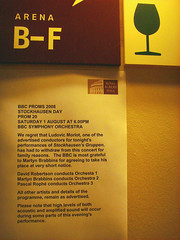
 My feet are killing me. Three hours is a long time to stand up. One thing Stockhausen isn't into is the ten-minute modern piece that sits embarrasedly on the edges of a lot of orchestral concerts. If I was ten years younger I'd have gone to the film screenings and discussions that formed the first part of the Proms Stockhausen day, but I' m getting on and have domestic concerns like getting the shopping done and recovering from the sort of hangover I never used to get after a night playing ukulele in a pub, so I skip all that and go straight to the first concert of the day.
I first heard Gruppen about 10 years ago, when it was performed by the CBSO in Birmingham. Then, as now, the piece was given twice; this works very well, as the piece is so much about the spacial placement of sounds that shuffling about to a different spot for the second performance seems almost a necessity to start to have a proper sense of it. So this is the third time I've heard it.
It doesn't grab me as much this time as before; we're standing in a very crowded arena, with all the really tall people in front of us obscuring any view. Two of the groups have been placed in the arena itself (hence the crowding), but they're at the front end, close to the stage where the third is, so there's very little scope to get right in the middle of the sound field. This seems like poor planning. Wouldn't it have been better to have them at the back, or even construct platforms over some of the stalls? It's not as if they're full, although the turnout's quite respectable (I'm reminded of the adage that there's no hall like the Albert Hall for looking half-empty when it's half-full). That would have left both more space in the arena and more space between the orchestras. As it is, it feels like I'm only really hearing half a performance, only getting a dim sense of the interplay between the groups. And the iconic brass chord that hockets around towards the end doesn't seem to take flight, quite.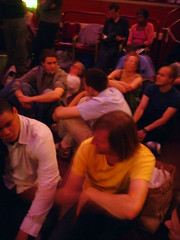 There's some shuffling as the players leave the stage (and arena), and I'm briefly distracted by a man in an orange T-shirt (which I think of as a sure sign of a wanker) telling his girlfriend how this is what it's all about, all pop music is crap, the Beatles are crap . The next piece is purely electronic - Cosmic Pulses, the 13th Hour of Klang, the cycle Stockhausen was working on when he died last year. it's always a slightly odd experience, sitting in a concert hall listening to disembodies sounds, but then again Stockhausen's so wildly ambitious in what he does that what seems awkward in lesser talents seems perfectly proper here. The hall is in almost total darkness, and the pinpricks of light coming through the dome make it feel like we're looking up at the night sky searching for UFOs, appropriately, as it turns out.
There are 24 loops repeating at 24 different speeds (I read later in the programme notes - one occasion where I should have read them before, I think). From the point of view of the listener, there's a swirling, pulsating mass of sound hanging in the air above us, and it's maybe closer to the aural equivalent of looking at a sculpture than listening to a conventional piece of music. I change my mind about it at least three times during its 32 minute course, at first fascinated by its whirling texture, and overwhelmed by the experience of hearing the sounds swoop around in such a large space. Then as it continues it seems to become oppressive, and I wonder if this isn't a perfect demonstration of the megalomania that many wild accuse Stockhausen of, the sense of himself as God. Certainly I feel like I'm a tiny mortal gazing up at an ineffable and indifferent universe. I feel pinned down by one enormous ego, forcing me to accede to his will. Perhaps this is the sound we will hear when the aliens arrive from Sirius to take over our world. By the end, as the loops gradually complete their cycles and the texture thins out, I'm filled with wonder again, as the skies seem to clear.
The solo trumpet of Harmonien, part of the fifth hour of Klang, follows, and it seems like a breeze blowing though the hall after the swirling dense clouds of Cosmic Pulses. It's a very simple piece, essentially a succession of elaborately embellished melodies that seem heartwarming in their straightforwardness.
Finally, an interval! I've heard some wonderful music, but I've been standing up for an hour and a half, and I'm grateful for a chance to sit for a bit. When I go back in I still can't get into the middle (although that tall man who stood in front of me and farted all the way through Cosmic Pulses has managed to get there - honestly, there's no justice), so I settle for a position right by the other orchestra in the arena. At least I'll get a view of something this time. I become aware of a voice droning on behind me. The wanker in the orange shirt (who talked all the way through Cosmic Pulses, by the way - obviously not so enamoured of Stockhausen that he feels the need to listen that hard) has moved too and is still behind me! I'm obviously being punished by the cosmic forces for my doubts earlier on.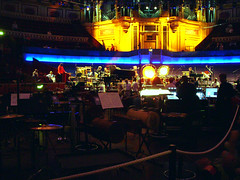 Kontakte seems like a glimpse into another world. I've seen old black and white film of this sort of thing in the 50s, a couple of men surrounded by percussion bashing away in the heart of a tape maelstrom, and here it is, brought forward into the living colour 21st century. It is dated in only the way as yesterday's vision of tomorrow can be. This isn't necessarily a bad thing - I love old sci-fi movies, and this has something of the same innocence about it, an excitedness in Creating the Future that remains inspiring rather than laughable because, well, a lot of the future (your present) was created here. The taped sounds' movement through space is of course less sophisticated than a recent work like Cosmic Pulses, but this was created, after all, at a time when computers barely existed, let alone anything that was available to a musician to play with. It seems somehow to have passed through being dated and become in its way timeless.
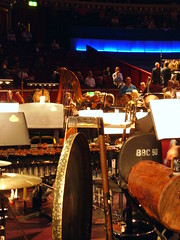 Gruppen's much better the second time round - whether this is because it's played better or just because I'm in a better position I couldn't say, but it suddenly seems to come into focus, and the drama of the interaction of the three groups seems more apparent. Although the percussion section's maybe not the ideal place to be right by if you want to hear anything else when they're in full swing.
Afterwards, I reflect on how there often seems in Stockhausen's music to be a moment, near the end, when the violent, thorny textures subside, and something more introspective and lyrical comes through, a lyricism that he tries to suppress but can't entirely. If you ignore the received wisdom about his fearsome reputation and just listen, you come to the conclusion that he is in essence a Romantic composer. It's been a long evening, but I can't miss the opportunity to hear Stimmung live. It's a piece like no other, by Stockhausen or anyone else (although LaMonte Young would probably disagree with me on that). I'm annoyed by the Radio 3 woman who comes on and subjects us to one of those slightly inane introductions you get on the radio. I don't want to hear this drivelling bollocks, I want to hear the fucking music, thank you. Fortunately it doesn't last long, and the performance begins. The stage is set up according to Stockhausen's strict instructions, the singers entering silently one by one (only one person didn't get the hint in the announcement that the long silence at the start is integral to the piece and tried to clap them on) and sitting in a circle on cushions on a rug in "earth colours" (beige) round one of those globe lights that was so popular in the late 60s.
It's easy to make fun of this sort of thing, but it works because it's done with sincerity, and it highlights the home-made feel that a lot of Stockhausen seems to have, which gets derided by some but to me is an essential part of his appeal.
That one chord, slowly changing through time, punctuated only by occasional speech, is an extraordinary thing to experience, lying on your back staring up at the ceiling once more. There's a terrible wrench when it finally winds down to its close, and I have to run out as the applause starts to catch the last train home. I feel awake, and don't want the evening to end. That chord gets inside you and resonates, so that long after the performance is over it still seems to be sounding, buzzing inside your skull as you walk home.
Sunday, August 03, 2008
Proms: Stockhausen Day
Wednesday, July 30, 2008
The centre cannot hold
Some interesting and thought provoking stuff in this article, which I found via Molly Sheridan.
I was particularly taken by this:
Nobody in Winnipeg's classical community was upset last year when the Winnipeg
Symphony Orchestra played a new concerto for turntable and orchestra written by
Nicole Lizée, who plays keyboards for the Montreal band Besnard Lakes. I think
that's because the WSO and Lizée (who studied composition at McGill University)
were seen to be absorbing a dynamic bit of pop culture into the body of
classical music.
That's not so different from what Bartok did when he
imported elements of Hungarian folk music into his works for classical
performers. In both cases, something was pulled from the margin into the centre,
and the centre became stronger.
It occurred to me that this is actually phrased the wrong way round: it assumes that So-Called-Classical-Music is the mainstream. But surely it's the DJ who's at the centre of contemporary culture, and the orchestra that's at the margins?
Dvořák once thought that Black American music, in the form of spirituals, would be the future of composition. He was right, but not in the way he thought. He assumed that the melodic and harmonic principles of the spiritual would be absorbed into the traditional structures of European art music (the symphony and so on) and renew them. In fact, what happened was that the melodic and harmonic principles of European art music were imported into an entirely new structural aesthetic to create Jazz. I wonder if something similar might be happening here.
Monday, July 28, 2008
Scaledown
John White also twiddles knobs, but as you'd expect from the man who invented Systems Music, played a leading role in the British experimental music movement of the early '70s (that also gave rise to such diverse composers as Howard Skempton and Michael Nyman) and has written over 160 piano sonatas, it's of a different order to the previous turn. It's determinedly lo-fi stuff, a couple fo cheap casio keyboards wired together and forced out of their comfort zones. What makes it fascinating rather than self-indulgent though is White's keen ear for what works, and his sense of humour. He's very serious about what he does, but never po-faced, and will happily title a piece "Significant parachute jumps of 1910", after the fact that the first successful paarchute jump took place in 1911. It's this combination of seriousness of purpose with a sense of the ridiculous that gives his music substance, and it's a priviledge to be able to see this inventive and under-appreciated man peform.
I do have some photos, but they're not great, so here's something different, a little extract from the sound between sets:
Friday, July 25, 2008
Veneer
 It's very easy, if you're white and middle-class like me, to assume that we live in a more tolerant world than the one of, say, 30 years ago. That prejudices once taken for granted are now equally taken for granted as unacceptable. And yet if you stop and listen, it's amazing how quickly you'll hear casual, unthinking prejudice raise its voice in the most adamantly liberal quarters. I count myself lucky to have friends who face this at first-hand, because it gives me a second-hand view, which is better than ignorance. Whether it's the funny voices of those funny foreign people with their funny foreign names and extra melanin, or the utter lack of awareness of the issues involved in day-to-day getting about if you're disabled, or the assumptions people make about people whose chromosomes developed rather differently to most of us, or those who fuck their own sex, don't assume that because we don't have advertising like the picture above (memorably featured in the film of Daniel Clowes' Ghost World) we're necessarily better than we once were. Just not quite as gob-smackingly awful, all of the time.
Other people have fought battles to bring us even the tiny step forward we've come, and one such man was Julius Eastman, whose remarkable music I've been listening to and will write about soon.
I'm just as bad as anyone else, of course, it's just that I have people in the immediate vicinity who keep me aware of the awful thoughts that lurk within. Everyone's a little bit racist, after all.
Cue music...
Prom 10: BBC Philharmonic / Tortelier (RAH)
 Another dish of meat and potatoes? I must watch it, I'll get fat(ter).
Arnold Bax is one of those composers. You know the sort - English, tonal, vaguely post-romantic, championed by a lot of slightly scary obsessive middle-aged men who can't understand why this doesn't get played all the time on the radio instead of all that modern rubbish, and form a society (fan club) to prove their devotion. There's nothing exactly wrong with In memoriam, which receives its first public performance here. It's inoffensive waffle, and slightly less glum than Bax often is. But I was still bored by the end, as I always am by Bax. In a while I'll forget about this piece and start fretting again that he's a compose I ought to listen to more of. But i don't think I'll ever hear anything that'll actually make me want to.
Rachmaninov is surely near the top of anyone's list of composers you ought to think are a load of rubbish but don't. He ought to be irredeemably cheesy, but there's something about him that stops short of that. He's at least as glum as Bax, but people don't seem to comment on that much. His First Piano Concerto isn't played as often as the later ones, and it becomes clear that this is because it's not as good as them. It's okay, all the elements of his sound are there, but at this stage in his career he hadn't quite worked out how to stitch the bits together effectively. Yevgeny Sudbin plays brilliantly (as do the orchestra), and also looks frighteningly young from my perspective in the foothills of middle age. "But he's a child!" I think. He was born in 1980, so he's hardly a prodigy by now. But that seems practically foetal to me.
Vaughan Williams' Fourth Symphony is one of those pieces that always astonishes, not least because it's by Vaughan Williams. When I was young and foolish, I thought old RVW to be a crashing bore (Yawn Williams, I called him. God, I was funny). Then I heard this and the Sixth and realised I was going to have to change my mind. Would this extraordinary, violent and dissonant work get such an enthusiastic reception if it wasn't presented under the name of the patron saint of Classic FM, composer of The Lark Ascending?
Everything's here that hasn't really been about so far in the concert: anger, tension, and also a very sardonic sense of humour. Not a cowpat in sight. It's hot in the hall tonight, very close and sweaty. But that hardly registers when you're gripped by music this powerful.
Thursday, July 24, 2008
Simplicity is a complex business
Obviously, living in this Google-Age of interweb ionformation overload, nowadays I've got the attention span of a goldfish, and not a particularly bright one at that. But I would like to draw your attention to this excellent post by Kyle Gann, which says a lot of very intelligent and insightful things that I agree with but don't posess the writing ability to express as beautifully as like wot he does, and is so good that I read right to the end, despite it being more than two paragraphs long.
Tuesday, July 22, 2008
Prom 7: Stuttgart Radio Symphony Orchestra/Roger Norrington (RAH)
 There are fancy cordon bleu dishes, exotic Eastern cooking, and then there are meat and potato dishes. The classical equivalent of meat and potatoes is overture-concerto-symphony, and that's exactly what was served up at tonight's Prom.
The thing is, meat and potatoes may not have much in the way of an exciting reputation,but sometimes you need something straightforward instead of all the fancy stuff, and the fact is that unglamourous as it may seem, a well-cooked side of beef and perfectly roasted tats is a meal that's hard to beat. And, to stretch this tortuous food metaphor a little further (don't worry, I'll drop it in a minute), the chefs of Radio Stuttgart delivered in many ways a perfectly timed roast dinner. Having said that, I have some doubts. But I'll come to those in due course.
Rossini's William Tell Overture is one of those pieces that's so famous I'm not even going to bother linking to Wikipedia about it, so famous that the prospect of hearing it fills me with almost no excitement at all. Luckily, Norrington and his band aren't as jaded as me, and a nimble performance reminded me that heck, this is really fun music. Obviously no-one these days can entirely pout the Lone Ranger out of their mind, and Norrington seemed to acknowledge as much by turning to the audience and winking when that bit started.
Jean-Guihen Queyras was the soloist in Haydn's wonderful C major Cello Concerto, and a very fine performance he gave too, the slimmed down band behind him providing able support, while Norrington hovered behind him, wisely leaving the players largely to it. This was an interpretation that seemed to point out Haydn's debt to Vivaldi, although the cadenza seemed to point forward to Beethoven.
My doubts set in in the second half. Not that the performance of Elgar's First Symphony wasn't in many ways a rewarding experience. But Norrington's advocacy of "authentic" performance practice seems to have hardened into dogma, and where he once seemed iconoclastic he now seems like a fundamentalist. It's true that players in Elgar's day tended to use less vibrato than they would now, and I'm generally all in favour of a more restrained use of it. But it's just not true that they used none at all (we do, after all, have recordings of Elgar himself conducting this work, albeit in the early '30s), and a device they would certainly have used much more liberally than modern orchestras would, which was entirely absent from the Stuttgart players' technique, is portamento. Norrington also shied away from any great rubato too, which, as can be heard in his recordings, Elgar certainly wouldn't have done. There were moments when the lean string sound brought great benefits to the piece, but others where it didn't. To call this style of performing historical/authentic is simply inaccurate, and I found these worries nagging at me throughout, which stopped me enjoying what was, I should emphasise, some very fine playing.
Another thing about Norrington's idea of performance practice involves that perennial bugbear, applause between movements. Now I'm pretty relaxed about this sort of thing on the whole: people clapped between movements in the Haydn, and it was fine as far as I'm concerned. But Norrington goes beyond asserting a right to do this into insisting on it, and in a piece like the Elgar, which is clearly conceived as one large span of music, and even ends its first three movements quietly and anticlimactically this seems to destroy the mood. If it's wrong to stop people applauding, it's equally wrong to stop people having a moment's quiet reflection after the heartfelt slow movement before the finale creeps in. Norrington's a fine, eccentric showman, and he'll undoubtedly handle the dreaded Last Night very well, but in this instance what once seemed a fresh approach seems to have ossified into willfulness.
Monday, July 21, 2008
Folking about: Proms 4&5 (RAH and Kensington Gardens)
 A day devoted to folk music has been sneered at in some quarters, but I think it's absolutely right that the Proms should do this sort of thing, not least because the SCCM* scene could take instruction from the folk scene: a small, minority interest that for many years seemed threatened with extinction at the hands of indifference, a perception that this was a dead or dying genre with nothing to say of any relevance to the modern world, and well-meaning but misguided fundamentalism on the part of some of its most zealous advocates. Sound familiar?
 We sauntered into Kensington Gardens at lunchtime to find the Folk In The Park mini-festival in full swing; scratch choirs and orchestras merrily hacked their way through some choice tunes, if to slightly limited effect to those of us who weren't right at the front (but that's open-air singing for you), while nearer to my eyes and ears some Morris Dancers did their stuff.
  Morris Dancing's had a terrible press over the years, unfairly I think, which I suppose is down to the general public's desensitisation to the point where jumping over each other with bells strapped to your legs and whacking clubs together can't substitute for actually getting your cocks out and waving them about. A shame, because in the right hands (stop it) it's a raucous affair with a healthy lack of reverence for its own traditions. I hadn't realised what a major part of it all was having the musicians hurl abuse at the dancers. The climax to our outdoor sojourn was a short set by Bellowhead (of whom more later).
 The clouds began to cover the sky, so it seemed fortunate that it was time to head over to the Albert Hall for the first concert of the Proms's first Folk Day (the way they went on about it, you'd think folk hadn't existed before Roger Wright decided to bring it to South Ken, but I shall not continue in this measly-mouthed vein, as I come to praise the Folk Day, not to bury it).
The evening concert, meanwhile, featured three acts, two of whom we'd already caught a glimpse of. Bella Hardy had already demonstrated during the afternoon what a beautiful voice she has, and her set here was equally impressive, adding her own fiddling and harp and concertina to the palette to produce a sound that managed to fall entirely within what you might call a purist definition of folk, but never seeming anything other than fresh.
Martin Simpson, meanwhile, represents another aspect of tradition in a set that I wasn't sure I was going to like at first, as after Bella Hardy it seemed to have a whiff of noodling about it. However, he's such a persuasive performer that I soon settled into the more introspective mode, and ended up thoroughly bewitched by his mellifluous guitar style (and was impressed by the way he avoided those awkward pauses you often get while a player re-tunes by making little sketches of music out of his string adjusting, wryly commenting on the unashamed way classical musicians tune up.
Bellowhead are in some respects about as far from traditional or purist as it's possible to get, and yet they escape the trap of crossover hell by the simple fact that no matter how loud they get, no matter how many Latin rhythms or dance beats they throw in, everything they do has its roots very firmly in the folk tradition. There are different ways to extend and revitalise a tradition though, and giving it a good (friendly) kicking can be just as effective a way as tender care.
It's easy to knock this sort of day as tokenism, and I guess the proof of that particular pudding will be in whether further potions are served up in future years. I hope that happens, as this day has scratched the surface of a very deep mine that could be profitably explored for a long time. When you think that a century ago, as Vaughan Williams and Cecil Sharp travelled around the British Isles collecting folk songs, that this was a tradition on the brink of extinction, it's remarkable what a healthy and diverse landscape now exists, and it's a thought worth dwelling on that without Vaughan Williams there might not be Bellowhead. It's fascinating both in its apparent unlikeliness and its potential to spark new connections and evolutions, and this is just the sort of thing the Proms ought to be nurturing.*So-Called Classical Music
Friday, July 18, 2008
each moment gone as it comes
There's an undeniably manic-depressive element to composing (or any creation): ideas, and the energy to work on them, do not flow constantly, but splutter, sometimes disappear to the extent that one is ready to declare them extinct, then suddenly flood forth without warning, to such an extent that one struggles to catch them, and must surreptitiously scribble while keeping paperwork handy to preserve the illusion that one is getting on with the uninteresting things that are nevertheless what justify the wage that keeps the bills paid and the food stocked. Notebooks become like buckets, filled with as much of the deluge as the clumsy pen skittering across the page can manage, in hope that these fragments may provide some nourishment when the drought returns. Fecundity ought to be something to be celebrated, revelled in, but it becomes another source of anxiety: what happens if this doesn't last?
This is the root of it: to get down the ideas, as many of them as quickly as possible, while they still come. While they do come it feels as though this is the only way it could be; and the same is true when they disappear and will not come, no matter how much one may long for it.
Too much or too little; dissatisfaction; achievement. And the hope that what has been achieved will serve us through the lean times.
And what then? The hope that it begins again. And so we continue.
Thursday, July 17, 2008
My precioussss!
 Just when you thought we'd seen off this sort of thing, I see on Coolfer that the record companies are up to it again.
I can see why the EU is concerned about artists' income, but it really isn't about starving singers, it's about big corporate companies clinging onto their cash cows.
95 years? 95?? Just how long do you need to recoup an investment? Forever, I'm sure they think.
I'm not at all convinced by the get-out clause, either. It reminds me of the sort of contractual thing that DC used to screw Alan Moore.
If the record companies put half as much effort into nurturing new talent as they do in clinging onto their old warhorses, the music industry would be in a hell of a rosy state.
Wednesday, July 16, 2008
Is your critique really necessary?
This interesting article (which I found via the splendid folks at the Detritus Review) provides much food for thought on the place and aesthetics of criticism. Defeatist Towers is of course on the whole a repository of half-witted ranting and raving rather than proper criticism that actually says clever stuff, like, but I like to believe that it all serves some sort of purpose in exploring ideas and thoughts about music and whatever else I drone on about. I sometimes wonder if there's any real value in what I type here, it being all pretty subjective and often outright ignorant, so it's good to have someone with more brains than me justify the utter lack of critical distance I so often display. And as there's a debate in the air about critics, bloggers and the relationship/divide/overlap of the two, it's always good to have some more ideas chucked in the pot. Call it work in progress.
Friday, July 11, 2008
Judas
They've just finished the second song, and the crowd seem restless. There's a lot of slow clapping going on. They carry on, anyway. The sound's raw, loud, kind of sloppy. But it's exciting and immediate too. At least that's how it sounds to me. I'm not hearing it like those unhappy people in the audience, a sinking in that we're not in Kansas anymore. I know I'm not in Kansas anymore, I wasn't even born when we left.
There's some enthusiastic cheering as they reach the end of song 3. So it's not a given that what they're doing is alienating. Some people like it.
It really is loud, though. I want to turn the volume down on my earphones (an option not available to the people in the hall), but I'm going to stick it out, because there's a thrill in it, a sense that I'm transgressing something, even though it's only in my own mind (and whatever tinny hiss is escaping my headphones and reaching those at the desks next to me).
The slow hand-clapping starts off, and he tails off his introduction to the next song... the audience falls silent, and he continues. The cat-calls resume, and are starting to grow. There's a definite air of menace. I can only hear, of course, but it sounds fair to say the audience is divided.
Well, that one seemed to push them a bit far. The guitarist's tuning, and the jeering is growing. The singer is mumbling into his mike, speaking nonsense as far as I can tell. Eventually the claps subside as people realise he's talking and they can't hear what he's saying: "...mblmblmblmblmblif you only wouldn't clap so hard." There's a smatter of applause at this, so I guess he still has his supporters, they haven't all turned against him.
The thing is, you can't really tell what the audience is doing during the songs, because it really is fucken loud.
The guitarist is tuning again now, and the atmosphere really does sound like it's getting ugly. The piano starts off, and this song' different to the rest; where there's been a lot of exuberance before, now there's palpable menace, the hostility in the audience reflected back at them. "Something is happening, and you don't know what it is..."
They finish, there's more heckling, the audience laughs. One man shouts out. He's just saying what he thinks, he doesn't know he's just become part of a myth.
The singer's exasperated. "I don't believe you!". Then he realises the literal meaning of what he's just said. "You're a liar!"
Then, to the band:
"Play it fucking loud!"
How does it feel?
Thrilling.
(There's some clapping at the end. A few stuck it out, then. Animated discussion. The national anthem comes across the tannoy. Then the tape cuts out.)
(Seems someone's always upset about something, aren't they?)
(Now go here.)
Wednesday, July 09, 2008
Eight Songs for a Mad King
 A heated debate on the Grauniad blogs in response to an article by Joe Queenan on why all modern SCCM* is rubbish (of course I put my tuppenceworth in) takes me back to when I was 11 or 12 and encountered my first bit of real, proper, honest-to-god modern music: Peter Maxwell Davies' Eight Songs for a Mad King.
It was an LP in school, performed by the excitingly named Fires of London, conducted by the composer and with a chap called Julius Eastman singing (well, vocalising, anyway) and it was one of the most extraordinary things I had ever heard. I started off laughing, then being delighted at the extraordinary sounds that were coming out of the speakers, then finally captivated and shocked by the realisation that what I'd first taken for comedy was in fact searing horror.
I grew up in a house where music abounded, but I'd heard nothing like this: my parents' favourite composers were Mozart and Haydn, and the other sounds I heard were my brothers' and sister's rock and pop records. This was something entirely new: it was wild, crazy, untameable stuff, and it felt as though I'd lived a life in black and white** and suddenly been catapulted into the most garish technicolour imaginable.
I (and several of my friends) became obsessed with the piece; I ordered in the score from my local music shop and marvelled at it - it seemed to function as much as a work of art in itself as a set of instructions for which notes to play when. We harboured the idea that we might try and get hold of the parts, construct the giant cages in which the players sit, and perform it. We never did of course. I wish we had, though. It would almost certainly have been a terrible performance, but it would have been a hell of an exciting thing to do.
It's that feeling of intense excitement, that I'd discovered a new world and could never think of things in quite the same way ever again, that set me off on the road to this disreputable role we call "composer", and it's the feeling I still look for even now, which is why I still listen to new music and refuse to sink into comfortable middle-aged predictability. It's also why, when I want to explain what contemporary SCCM is and how magical it can be, I think of that record first.
*So-Called Classical Music
*Well, orange and brown; I grew up in the 70s, after all.
Friday, July 04, 2008
What we call the beginning is often the end
And then there are those pieces that are indisputably unfinished. I think in particular of Bruckner's Ninth Symphony, which I've been listening to and thinking about a lot recently. And in particular the realisation of the finale, a controversial project.
Where his finished symphonies offer one sense of an incomplete project in their multiple workings of the same material, the surviving sketches for this movement offer another side: the work that can only be experienced as work in progress.
This is where facts, traditions and romanticism collide: the tradition has grown up that the three complete movements are in themselves complete, and therefore it's unnecessary to attempt to complete the fourth. But it's certain that Bruckner didn't think this: on his deathbed, realising he wouldn't live to finish the symphony, he suggested that his Te Deum be used as a substitute finale. So whatever else he may have thought, he definitely didn't consider it as a three-movement piece.
In was amazed when I discovered that there was a playable version of the finale: I grew up, like most people, thinking that nothing existed of it beyond a few scraps, and yet it turns out that there's enough there to show that Bruckner had the design fully formed in his mind, and was probably only weeks from completing a draft score.
It's remarkable how hostile some people seem to be to the idea of this reconstruction. Of course it's to some extent speculative, as it has to be to provide a satisfying listen (you can't listen to an unfinished piece of music and really get much from the fragments in the way you can look at an unfinished painting), but isn't it better to have an idea of what the composer intended rather than cling to a delusion?
Gottfried von Einem, by the way, wrote a piece called "Bruckner Dialogue", which uses the chorale from the finale of the ninth, which seems another alternative. It's certainly far from what Bruckner would have intended, but it does acknowledge the truth that there is an enormous vacuum in the wake of the slow movement. It seems to me better to recognise, and not deny, this absence.
The finished and the incomplete are two extreme ends of a spectrum, and there's a lot of space in between, a strange and forbidding place that nevertheless can offer great rewards to those brave enough to explore it.
Wednesday, July 02, 2008
The end is where we start from
When is something finished?
I crawl through my manuscript, typing it slowly and painstakingly onto my PC, changing notations here, making cuts there, elsewhere inserting or rewriting passages. When I've got to the final bar I'll go back again and may well see other points ripe for change. And then I may do it again.
But at what point will I decide that enough's enough? It's a question that every composer has to face. One of the composers who taught me told me that his rule of thumb is that a piece will have to be draughted about six times before it's ready. If you're lucky you might get it done by the third or fourth.
Art is never finished, only abandoned, as one artist said; some take this to extremes - Pierre Boulez designates pretty much his entire oeuvre as "work in progress", which seems a bit extreme to me. When I worked for a music publisher, often were the times that a piece seemed doomed forever to stay in revision hell - one (very fine) composer in particular had enormous trouble with the concept of letting go, and continued to tweak and tweak at scores for years after their premieres. It's one thing to rewrite music that doesn't work as well as it might, but endless tiny alterations seem top me to be a symptom of neurosis, which I guess stems from the awful pressure on composers to produce "Masterpieces" - that strange quirk of the so-called classical music world where it seems unacceptable to admit that a piece may be a great work while still containing weaknesses.
I think of Bruckner as well, re-writing his symphonies (sometimes on his own initiative, sometimes at the behest of well-meaning but misguided supporters) to such an extent that different versions stand as entirely different works that just happen to use the same material. There's a parallel to be drawn here with Boulez and his re-writes - the piece as an ever-evolving entity, that cannot be definitively fixed. This goes against the dogma of the score as Bible that underpins all SCCM since the late 19th century, the same dogma that sparks the kind of neurosis mentioned above, and perhaps, as infuriating to librarians and cataloguers as it is, it represents a way out of the straitjacket of the score, and the Masterpiece.
Access all areas*
 The Internet Music Score Library Project is back online.
Monday, June 30, 2008
to make an end is to make a beginning
 There's a tricky point I reach in the process of writing a new piece, which is the point at which I draw a double bar line and have for the first time a complete contiguous score in front of me. it's difficult because it feels like I've completed something, whereas I've actually only reached a staging post, and from now on I've got o keep this fact in and and not succumb to the temptation to be lazy and skip all the refining.
Fortunately my composing habits help me here, as although I produce the final score on computer, I still do all the working out on paper, so what I have is actually a rather untidy hand-written manuscript that I'm now transcribing onto my PC, and as I do this I can look again at everything and make adjustments as seems necessary.
Notation programs are in many ways brilliant, in a way you can only appreciate if you've ever had to write out parts for a half-hour orchestral piece by hand, then photocopy them to make up the numbers needed for a full string section, and then tape the damn pages together, which is how I had to do it when I persuaded my schools' symphony orchestra to perform a symphony I'd written some 20 years ago. That level of drudgery is almost physically, painfully dull, and I'm very glad I now live in a world where I can just type up the score and press a button to produce a set of parts (and these days even get them copied as nicely saddle stitched booklets).
It's not quite that simple, of course, and here's one of the dangers of the technology; a lot of young composers assume that Sibelius (or whatever program they're using) will magically do everything to produce a decent set of parts. It doesn't, of course; it does do an awful lot towards it, but I've seen a lot of badly produce parts whose inadequacies stem pretty much entirely from the fact that the composer didn't bother to go through the parts and check them and tweak them. Some of this is down to inexperience (I'm always amazed how little awareness composers seem to have of what's needed in performance materials, it seems obvious to me that it's a fundamental thing to learn, preferably at first hand, which is why I don't think you can be a composer without being at s0me level a performer), but a lot of it comes down to the laziness that having beautiful-looking typesetting at the click of a mouse can engender.
At the other end, the miracle of cutting and pasting makes instant changes so easy that it's very easy to fiddle endlessly without much thought, so that huge swathes of music end up being repeated verbatim without ever really being imagined.
This is why I don't work on computer until fairly late on in the process; While the speed and ease of computers cuts a lot of work out of the preparation of a score, it can also take effort out of the composition of it, which is the one place where you shouldn't take short cuts. I need to write each note down, because somehow it doesn't feel like it's really there if I haven't. Morton Feldman said something once about having a need, a desire to copy his music out, and I think you need that if you're going to take writing music seriously; if you're not prepared to write it out how can you expect others to play or listen to it?
The manuscript is a page from the sketches for the finale of Bruckner's Ninth Symphony, which raises all sorts of questions about when a piece of music is or isn't finished. More tomorrow...
Wednesday, June 25, 2008
Composing is a political act


Tuesday, June 24, 2008
KSO Programme Notes: 24 June 2008
Bedřich Smetana (1824-1884)
Vltava
Czech nationalism was a sentiment borne more on hope than experience in the 19th century. The country then known as Bohemia was a province of the Austro-Hungarian Empire, and it would not emerge with any autonomy until the creation of Czechoslovakia in the wake of the First World War: true independence had to wait until the Czech republic disconnected itself from Slovakia in the aftermath of the collapse of the Soviet Union at the end of the last century.
So music was one of the few areas that offered any palpable outlet for patriotic expression, and Smetana, as the leading Czech composer of his day, found himself at the head of a movement, and his music emulated as the basis for a Czech school of composition. The cycle of six tone poems called Má Vlast [My Homeland] that he composed between 1872 and 1879 represent a self-conscious attempt to encapsulate the essence of Bohemia in music.
The original title of the cycle was the more demonstrative Vlast; the later addition of the pronoun perhaps suggests an unease with the idea of being a spokesman for the nationalist cause at a time when he was the subject of increasing hostility from critics. The project must also have taken on a great personal significance as the composition of the first part, Vyšehrad, coincided with the sudden loss of Smetana's hearing. For a composer this was serious enough, but the deafness itself was a symptom of undiagnosed syphilis, which would eventually kill him. Má Vlast therefore represents a remarkable fusion of the political and the personal.
Vltava is the second part of the cycle. It depicts the flow of the eponymous river from its source in the Šumava Mountains to Prague and beyond. On the way it passes a hunting party and a village wedding, and sprites dance on its moonlit waters before the current builds as the river reaches the St. John rapids, then flows broadly through Prague, past Vyšehrad Castle and disappears into the distance where it will flow into the Elba.
Nikolai Myaskovsky (1881-1950)
Symphony No.21 in F sharp minor, op.51
Posterity is a harsh mistress, as is seen in the case of Myaskovksy, a classmate of Prokofiev and pupil in Rimsky-Korsakov's composition class, who built himself a reputation as the finest symphonist in the Soviet Union before a young upstart called Shostakovich came along and stole his thunder. His 27 symphonies constitute one of the most extensive sequences since the classical era of Haydn and Mozart, and together form the backbone of his career.
After a time in the armed forces, he took a post at the Moscow Conservatory and became a leading light in the promotion of contemporary music in the 1920s, and later became a member of the Organising Committee of the Composers' Union. An introvert by nature, he showed little interest in politica and an overwhelming absorbtion in his work, but this was not enough to keep him from criticism, and he was periodically attacked for what the authorities saw as the excessive individualism and pessimism of his music, and in 1948, along with Shostakovich and Prokofiev, found himself one of the main targets of the infamous Zhdanov decree attacking "formalist" music. His style is, however, less abrasive than either of those two composers, and is more obviously in the Russian romantic tradition of Tchaikovsky and Rimsky-Korsakov.
His 21st symphony was composed in 1940 concurrently with his 20th, and dedicated to the Chicago Symphony Orchestra and their principal conductor Frederick Stock, who had asked Myaskovsky to compose something for them in 1938. Their performance of it on December 26 1940 was billed as a world première, but in fact the first performance had been given on 16 November by the USSR State Symphony Orchestra under Aleksandr Gauk.
The symphony is cast in a single movement, and although there are passages of livelier temprament, the predominant mood is withdrawn, epitomised by the clarinet solo which opens it, and the quiet string chords which bring it to a close. It is a testament to the inconsistencies of Soviet Arts policy that this introverted and melancholic symphony by a composer who had been condemned for these qualities was awarded a Stalin Prize in 1941.
Antonín Dvořák (1841-1904)
Symphony No.6 in D major, op.60
1. Allegro non tanto
2. Adagio
3. Scherzo: Furiant: Presto
4. Finale: Allegro con spirito
If Smetana effectively created the Czech musical character, it was Dvořák who took it to the world. By the end of the 1870s he was, thanks to the patronage of Brahms, establishing himself internationally as a composer, and in 1879 he achieved the distinction of having his third Slavonic Rhapsody performed by the Vienna Philharmonic conducted by Hans Richter. The performance was a great success, and as a result Dvořák found himself in the position of promising his next symphony to the orchestra. So in 1880 he set to work, completing the new work by October for a projected performance in December.
The orchestra, however, had other ideas: rumbles of discontent were heard at the prospect of playing new Czech music two years in a row; to present overtly Czech music in the capital of the Austro-Hungarian empire, of which Bohemia was a subject, was potentially an unwise political act. In the end the first performance of the symphony was given in March 1881 by the Prague Philharmonic under Adolf Čech. Richter himself finally conducted the symphony of which he was the dedicatee in London the following year.
Ironically, the work that the Viennese musicians had objected to on the grounds of its ethnicity has a distinctly Germanic tang to it; Dvořák went out of his way to write something that related to the traditions of musical Vienna. Not least of these is a clear indebtedness to his mentor Brahms, and in particular his second symphony (also in D major), which was then still a recent work. Dvořák also peppers the score with reference to Beethoven's symphonies, which were highly regarded in Vienna (not necessarily the case when that composer was alive), in what seems a ploy to present himself as an heir to those traditions.
That notwithstanding, this symphony, the first of his to be published (which is why for many years it was known as his first), sees Dvořák's style fully formed, the thick scoring of his earlier symphonies now replaced by the colourful, translucent sound that characterises his mature output. The first movement's allusions to the musical world of Brahms, Beethoven and Schubert only serve to highlight the confidence Dvořák has in his own voice, which is never swamped by his illustrious forbears.
The second movement takes for its principal theme a tune from an early string quartet that dates back to 1862, around the same time as the youthful Dvořák composed his first symphony, The Bells of Zlonice. As is his way, the movement proceeds less through contrasts than ruminations on and tangents to the main theme in a thoroughly relaxed and generous manner which finds time to make reference to the slow movement of Beethoven's Ninth Symphony.
Having doffed his cap to Vienna, the third movement is entirely and unashamedly Czech in character, taking the form of a furiant, a dance notable for its forceful cross-rhythms, that takes the folk ideas he had thoroughly explored in such works as the Slavonic Dances and propels them into an entirely new plane of thought. The opening of the finale that follows evokes the equivalent movement of Brahms' second, before launching off on its own expansive course, finally culminating in an outrageously lively dash for the finish.
Inobservant
Take a look at Anthony Holden's review from this week's Observer. Skip the bit about Strauss - Mr Holden doesn't like to stray too far from the opera house, so his reviews are usually about operas, especially expensive ones with big names in them. But occasionally he remembers that there are other classical music genres, and manages to get himself to one of those concert hall places. This week he's managed to navigate his way to Snape Maltings in Aldeburgh (probably relatively easy, as it was established by Britten, who of course was primarily a composer of operas). He's also aware of the current artistic director of the Aldeburgh Festival, Thomas Ades (presumably because he's seen his name about the Royal Opera House advertising one of those high-profile opera commissions that stop Mr Ades writing something more interesting), although the sub who prepared the copy doesn't seem to realise that Ades doesn't feature in this concert. But the excellent French pianist Pierre-Laurent Aimard, who's due to replace Mr Ades as thge Aldeburgh Festival'sartistic director next year, does.
Consider this:
"taste-free modern slices of Schoenberg, Kurtag, Webern and Charles Ives amid some nourishing Haydn and Mozart."
Taste-free? I've heard the above composers accused of many things in my time, but blandness certainly isn't one of them. How anyone can think such things of The Unanswered Question, or Webern's Five Movements, is beyond me. And "modern"? Kurtág's still living and breathing, sure, but of the rest the most recently animate is Ives, and he died in 1954 (that's 54 years ago, Mr Holden). Those four composers represent a remarkably wide spectrum of twentieth century musical trends, and it seems unfair to brush them aside in this manner.
Mr Holden also seems confused at the difference between conducting and directing from the keyboard. He describes Aimard's conducting of Haydn's Symphony No.22 as "sprightly", and specifically states that "All went well until Aimard attempted to conduct from the keyboard." And yet his conclusion is that it's
"Just as well, perhaps, that Aimard has disavowed any ambition to give up the piano for conducting."Huh? You just said his conducting was good! It was his directing from the keyboard in the concerto that went wrong, you said. So not only is that little dig at the end nasty and petty, it's also factually wrong.
So there you go - three paragraphs which say next to nothing about the music, and are a set-up for a punchline that doesn't work.
If someone's got a narrow viewpoint, I can put up with it (well, just about, as long as you don't ask me to talk to them for any length of time). But if you're going to be a narrow-minded music critic, you'd better write with a Swiftian level of wit and be prepared to back your opinion up rather than just casually dismiss the past century of music. Maybe if you didn't gorge your palate with late-romantic opera you'd have taste buds clear enough to appreciate other flavours.
Wednesday, June 18, 2008
Computer Love
The earliest known recording of computer generated music has been unearthed.
(Intriguingly, the 1950s computer shows a healthy disdain for the puny human concept of the tempered scale, as you'll hear every time it hits the dominant.)
Careful! We know where this sort of thing leads:
Wednesday, June 11, 2008
Big Ideas: Don't get any
Some time ago Radiohead held a competition for remixes of "Nude" from "In Rainbows". This is one of the entries. Be patient, it kicks off at about 1'10". It's not samples, it's actual equpiment playing live, as James Houston explains on the YouTube page:
Sinclair ZX Spectrum - Guitars (rhythm & lead)
Epson LX-81 Dot Matrix Printer - Drums
HP Scanjet 3c - Bass Guitar
Hard Drive array - Act as a collection of bad speakers - Vocals & FX
Utterly brilliant.
Friday, June 06, 2008
Friday link-o-rama
 It's time for one of those posts you do when you can't think of anything interesting to say!
Tuesday, June 03, 2008
Bo Diddley Is Jesus
R.I.P. Bo Diddley. One of those guys who, hovering behind a huge number of bands in my record collection as a kid, influenced me before I even knew it.
Monday, June 02, 2008
Happy Birthday!
Many happy returns to Cheerful One.
I'd sing "Happy Birthday", but as Warner-Chappell claims that the song is in copyright, I can't afford to. You can read more about the arguments over who owns the world's most popular song here and here.
Sunday, June 01, 2008

Saturday, May 24, 2008
RVW: Let's Get It On
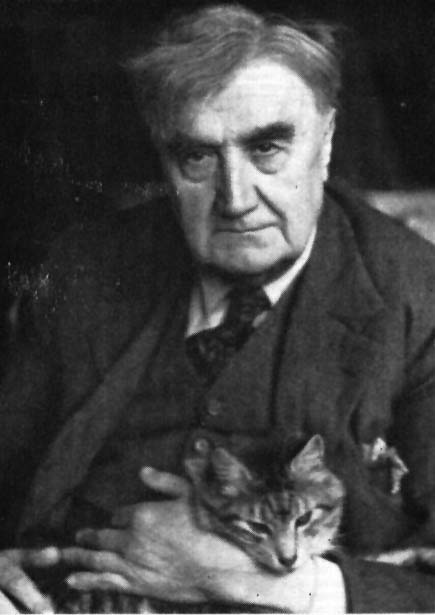 The Passions of Vaughan Williams was an entertaining, if slight, documentary last night that took as its thesis that all that stuff we thought was about cows and country meadows was actually about shagging and fighting. It featured a lot of old ladies talking about sex, which is always an instructive experience.
I'd say more, but I'm trapped in relocation hell at the moment and really should get on with the packing. Normal service will be resumed shortly.
It's repeated tonight at 7.00 on BBC4, or you can blahblah iPlayer. And while I'm at it here's an interview with the man himself.
Obviously I'll be deeply possessed with Euro-fever by then. Assuming I'm not trapped under a collapsed tower of boxes.
RVW would have felt right at home in the world of blogging, as this photo of him with a cat demonstrates.
Wednesday, May 21, 2008
A life in boxes
I am surrounded by stuff.
Packing is an activity that inevitably leads to a certain amount of introspection; it's like a ritual, sifting through the lives once led in preparation for the life to come. Those books, CDs, pieces of random paper that bring to mind times you'd half-forgotten, smiles and rueful wonderings about what might have been, if only. But there's no if only in life, only what was, is and shall be.
So the difficult decision becomes, what stays and what goes? There are of course things that retain their immediate usefulness or potency, and those that can be happily discarded (CDs that will never again be played, books that will never be re-read). But there's also a slew of things that fall between; things that you can't entirely justify keeping on any practical level, but bring warm feelings of nostalgia. How do you decide about these?
I try to be reasonably callous about it; I believe in looking forward, not becoming mired in things past. But at the same time, that past is what made me, and I need to keep something to remind me of where I've been. Judging the line between these is a difficult one.
Mostly, though, at the moment I feel overwhelmed. When you've been in the same place for over seven years, you don't notice the accumulation of things, and it's only when you come to put it in boxes that you realise how much you are defined, and weighed down, by possessions.
There's a piece of me that wants to stand up, walk out and leave all the things. That knows I only need what I carry within me, really, and that everything else is detritus. But I can't let go of it all. I'm possessed by objects, and it's a worrying feeling. But we cannot entirely escape the detritus we have produced, and must accept responsibility for it.
Tuesday, May 20, 2008
Near and far

I ride a new way, aiming for the same destination. It's amazing how little deviation it takes to make the familiar seem like unexplored territory. I whistle a happy tune, with obscene lyrics rewritten as I ride. I reflect on how good it feels to be alone, out of the city, disconnected from the daily grind. At one point I almost look at the time, but think better of it. Why spoil the wonderful freedom from the temporal whip? I think of how strange it is that we strive to isolate ourselves from the wilderness, and then construct an artificial one. Of how fragile our existence is. Of how wonderful it is that this freedom is there for the taking, even in the city, if you take the time to find it.
Then I stop thinking, and look at the world.
Thursday, May 15, 2008
Irony in action
 Gordon's famously reduced the strength of their gin after an EU directive defined the minimum strength for gin as 37.5%. What was that about cutting corners and losing your edge again?
Mr Ramsay's very big on quality control. Obviously not that big, though..
Wednesday, May 14, 2008
Prometeo (RFH)
 Time's a funny thing; or the perception of it. Prometeo runs for over two hours, two hours in which not very much happens. And yet, in another sense, an awful lot happens, because by the end of it you're in a different space to the one you started out in.
It's a bit different for me perhaps; I've sat through the five hours of Morton Feldman's For Philip Guston*, so a couple of hours is peanuts in comparison. And Bruckner wrote 90-minute pieces in which, in a very profound sense, nothing really happens (and yet everything!). So there's plenty of precedent.
Not everyone can take this sort of thing: there were several people who walked out, some after less than half an hour. But it takes a half-hour or so to acclimatise yourself to this sort of music, and you need the patience to do that if you're going to get something out of it.
The spacial element of Prometeo is of course one of its main selling points. Stockhausen of course experimented with breaking down the traditional relationship between performers and audience in the 60s with Gruppen, and playing Strauss's Alpine Symphony recently, with its army of off-stage brass, reminds me that playing about with these things is nothing new in itself. But Prometeo takes these ideas and runs with them. There are clusters of musicians everywhere, even before you consider the sound field created by numerous speakers distributed all around. This creates a slight tension, as the Royal Festival Hall is clearly designed for the traditional layout of audience all pointing towards a stage, so our sitting position works against what Nono is trying to achieve. But in a strange way this only seems to point up how entrenched we are in our concert-going habits, the very thing Nono wants us to question.
The (excellent) programme contained the texts used in the piece, but this is really better studied later on, as Nono deliberately abstracts the words in his setting so that it's really incomprehensible in any conventional sense. Rather, he exploits the libretto as a source of sounds and timbres for the voices. There didn't seem to be any need to think about the text or the legend of Prometheus except in the most general, abstract way, and this is part of what it's about: it's not about comprehending, it's about the pure experience of listening.
Normally when you hear something involving a combination of instruments and electronics you expect the electric part to be superimposed on the acoustic, but what Nono does is much more subtle than that, and it's a credit to him that you hardly think about the presence of the sound system, so carefully are the two elements integrated; this is use of technology as a subtle enhancement rather than a bludgeoning club. The effect as you hear sounds from their original source drift across the room and transform into complex textures is serenely discorporating.
The actual music itself seems much more eclectic than I'd have expected, ranging from terrifying clusters to the sweetest of perfect fifths, and pretty much everything in between. Occasionally a roar emerges from the orchestras, but largely the music is a great drift.
Nono is classed as one of those nasty modernists we're all supposed to reject these days in favour of Golijov. But what's striking is that this music (as well as being far more immediate than the anti-modernists would have you believe) doesn't sound "modern" at all. It sounds extraordinarily, immensely ancient. We leave the hall at the end, and to return to the bustle of London after this feels like returning from a journey to an unimaginably distant world, perhaps even time. The world seems too fast. Nono gives our thoughts space to breathe. And time.
There's so much more to be said, and yet also nothing. I go about my day as before. But behind it somewhere there's the memory of this other place, and it'll be a while before it's absorbed. it's all a matter of time.
Tim Rutherford-Johnson has a good roundup of reviews of the performances.
*I've sat through the even bigger String Quartet No.2 (over six hours on the Flux Quartet's recording, helpfully available on DVD to avoid those annoying disc changes). But somehow it seems cheating, doing it in the comfort of your own living room.
Friday, May 09, 2008
Playing with fire
 A big weekend looms: tomorrow night I'll be off to the South Bank to hear Luigi Nono's Prometeo, about which I shall doubtless have more to say later. I'll be rehearsing on Sunday for the KSO concert on Monday, so annoyingly I won't get to see the Bowmans at the Borderline, but you should if you can.
Wednesday, May 07, 2008
Young Musician of the Year 2008 (BBC4)
 I missed last night's string programme (general consensus: the guitarist was streets ahead of the others, and the violinist shouldn't have even been there) but I did see the wind finalists paraded before me and the 3 other people who watch BBC4 on Monday. I'm sure the Scottish flautist who won ("He's so camp!" squealed one of the other contestants, and I'm sure he'll thank her for that when he's lying in some street late at night having his head kicked in) fully deserved his place in the grand final, but it's difficult to be sure, because one of the defining features of this programme was that you didn't get to hear very much music at all. Instead you got treated to lots of shots of the players walking about, going on Facebook (they do little else, at least that's the impression the programme gives; well, as every coked-up London TV executive knows, that's what da kidz do, innit bro?), hugging each other endlessly in the wake of auditions and recitals, thinking about what shoes to wear, lots of voice overs about how nervous they are but also how excited to have got this far... I looked at my watch at one point and realised it was halfway through the programme and not one of the four contenders had performed anything. Not long after that I realised none of them would, beyond a few seconds.
Saturday, May 03, 2008
Thursday, May 01, 2008
"Writing about music is like dancing about architecture"

- Talk about historical context
- Put in something unusual or entertaining about composer or piece, the more trivial the better.
- Don't use any technical musical terms.
- Don't write descriptions of the music, except in the most general terms
- It's acceptable to mention something specific near the end of the piece, so the listener will know they're near the end.
- Entertain the reader.
- If at all possible don't mention the actual music at all.




