No time to post right now, due to personal circumstances. back soon.
Wednesday, October 29, 2008
Monday, October 20, 2008
KSO Programme Notes: 20 October 2008
Maurice Ravel (1875-1937)
Daphnis et Chloé: Suite No.2
The combination of sex, mild adventure and textual innovation therefore made the story naturally attractive to the Russian impresario Serge Diaghilev as a potential subject for the Ballet Russe when they sensationally swept into Paris in 1908. Ravel, the composer earmarked by Diaghilev for the commission, was however more dubious: he disapproved of the racier elements of the story, and this led to arguments with the choreographer Mikhail Fokine, with whom he wrote the scenario for the ballet. An episode in which Chloé is abducted by pirates ended up particularly toned down from the original, and Ravel's final score dispatches it in an alarmingly perfunctory manner.
Beyond these aesthetic disagreements, Ravel found the work immensely difficult, and many of his most famous pieces of this period, such as Ma Mère L’Oye were in fact produced largely as procrastinatory diversions from completing work on Daphnis. The premiere, originally slated for the Ballet Russe's 1910 season, was continually delayed as Ravel fiddled with the score, and it was not heard in public until 1912.
The music that is performed in concert as the Second Suite consists of the finale of the ballet, by which point what little plot there is has been resolved. After a depiction of dawn, one of the very finest pieces of orchestral writing Ravel ever produced, the reunited lovers perform a pantomime in thanks to the gods, an enacting of the myth of Syrinx, who, pursued by the god Pan, came to a river, and, asking for help from the river nymphs, was transformed into a water reed, from which the frustrated god fashioned his eponymous pipes. There then follows a final bacchanal, whose pagan frenzy is intensified by a wild quintuple pulse.
Variations on a theme of Frank Bridge, Op.10
When asked, after he had conducted a concert featuring Ravel's music, if such an eminent composer would ever emerge from England, Frank Bridge replied, "You will hear of one: Benji Britten."
The relationship between Britten and Bridge was of crucial importance for the younger composer: it was hearing and being "knocked sideways" by Bridge's Suite The Sea that set the young Britten on the path to becoming a composer himself, and it was his subsequent lessons with Bridge that honed and disciplined his natural talent, instilling in him his mentor's sense of rigour: Bridge insisted that a composer should write not one more note than was absolutely necessary to make his point, and this asceticism would become the backbone of Britten's own style.
So when the commission came to write a work for Boyd Neel's string orchestra to perform at the Salzburg Festival it was natural that Britten should take the opportunity to compose something in tribute to his teacher. The resulting work was heard in 1937, and confirmed Britten's growing reputation as England's brightest musical talent. What was particularly remarkable about the Variations on a theme of Frank Bridge was their European quality: aside from the various parodies of Italian, Austrian and French music, the young composer's style showed an obvious knowledge of such composers as Bartók, Stravinsky and Schoenberg, which set him apart from the insular attitude of much of 1930s Britain, exemplified by the suspicious reviews the work received in British newspapers, in contrast to the more positive reception afforded by the European press.
Perhaps Britten fully intended to provoke his native establishment. Certainly the theme he chose to use - from Bridge's Three Idylls for string quartet - has a wistful, nostalgic quality (of a kind that Bridge himself had long since abandoned in favour of a more abrasive style) that is blown away by its subsequent transformations. The work was intended as more than witty stylistic parody though: As well as their titles, the variations also originally had subtitles, intended to indicate an aspect of his teacher's personality. It was only with difficulty that Bridge himself persuaded Britten to abandon these, unquestionably the right decision; while one might see how the brooding first variation might embody "his integrity", it is difficult to see what the distillation of every waltz cliché in the Wiener Walzer has to do with "his gaiety", and "his sympathy" is an entirely inadequate description of the extraordinary funeral march, whose bitterness is only magnified by the frothy vivaciousness of what precedes it. The extraordinary "Chant" that follows takes the music into another, visionary realm altogether. A devilish fugue takes us to the conclusion, which weaves quotations from other works of Bridge around the main theme. So subtle and so integrated are these that it is only in very recent years that anyone has noticed they are even there.
Manuel de Falla (1876-1946)
El Sombrero de tres picos (The Three-Cornered Hat)
Part 1: Introduction - Afternoon - Dance of the Miller's Wife (Fandango ) - The Grapes
Part 2: The Neighbours' Dance (Seguidillas) - The Miller's Dance (Farruca) - The Corregidor's Dance - Final Dance (Jota)
Diaghilev had all the major composers of Europe in his sights, and so as well as Ravel, it was inevitable that he would approach Manuel de Falla to write something for the Ballet Russe. The subject he had in mind was Nights in the Gardens of Spain, suggested to him by G. Martinez Sierra. However, he happily transferred his enthusiasm to Falla's own suggestion that an adaption of El sombrero de tres picos, an 1875 novel by Pedro Antonio de Alarcón based on an older folk tale: a familiar story of political power abused for the aim of sexual gratification.
Falla had been toying with the idea of adapting the novel for some years, and was keen to set to work. However, the outbreak of war in 1914 meant that it would be nigh on impossible to produce the work, and so Falla, with the blessing of Diaghilev, produced with Sierra a pantomime, El corregidor y la molinera [The Corregidor and the Miller's Wife], which was produced in Madrid in 1917 to great popular success. He then revised this extensively to produce the definitive work which was unveiled under its final title in London in 1919.
If Diaghilev was hoping for a succès de scandale such as he had achieved with Nijinsky's notoriously erotic interpretation of Debussy's Prélude à l'après-midi d'un faune or Stravinsky's The Rite of Spring, he may have been disappointed by the final ballet: Falla was devoutly Catholic and had toned down the plot considerably - the Miller's Wife is much less amenable to the advances of men other than her husband than she is in Alarcón's novel. In other respects, however, it attracted as much controversy as the impresario could have hoped for, with critical reaction divided between those who saw it as a remarkable example of the Spanish national character expressed in a contemporary manner (the opinion of many critics outside Spain) and as an act of modernist desecration of Spain's folk traditions (the opinion of many critics within Spain). To put these reactions in context, Spain during this period was undergoing something of an existential crisis: the battle between those who espoused strident international modernism and those who supported a more insular approach to Spanish culture was, in the wake of decades of political instability, a fierce one.
Synopsis
The set and costume designs for The Three Cornered Hat were as much a draw as the music: Diaghilev had secured the services of Pablo Picasso. For the drop curtain Picasso produced a painting depicting a party of spectators at a bullfight. To give the audience time to admire this, Falla added an introduction. A soprano sings:
Casadita, casadita, cierra trance la puerta; Que aunque el diablo esté dormido a lo mejor se despierta!
[Little house, you must bolt your door; although the Devil sleeps he may wake up!]
The curtain rises on a small village. In the heat of the afternoon the Miller and his wife go about their tasks: drawing water from the well (with a pulley that is obviously in desperate need of oiling), feeding the chickens, and so on. The Miller is an ugly man, but his Wife is much more attractive, indeed has the charm to teach the blackbird to whistle the hour of the day, and attracts the attentions of every passing man. She catches the eye of the Corregidor (the mayor and chief magistrate, whose authority is symbolised by his tricorn), who tries to dance with her. She teases him with a bunch of grapes, obviously a very tasty dish, as in his excitement he loses his balance and falls over.
Part two opens with a dance for the Miller's neighbours: it is St. John's Eve, and the villagers are gathering to drink and dance. The Miller's Wife invites her husband to dance the farruca, a solemn and intense flamenco dance. As he finishes, Fate (as represented by a very famous quotation) knocks at the door, in the form of the police, who are here to arrest the Miller on the orders of the Corregidor. As they haul the Miller off, leaving his wife alone, a warning is sung:
Por la noche canta el cuco. Ad virtiendo a los casados que corran bien los cerrojos que el diablo está desvelado!
[The cuckoo sings in the night. It cautions us to bolt the door, for the Devil is awake!]
Having disposed of the opposition, the Corregidor struts in, dressed in all his official finery to seduce the Miller's wife. Luck is not on his side, however: he falls into the millstream. The Miller's Wife mocks him and threatens him with her husband's blunderbuss; then, suddenly frightened, runs off. The Corregidor removes his sodden clothes to dry, and goes upstairs and falls asleep on the Miller's bed.
The Miller meanwhile has escaped, and returning home to find the Corregidor unclothed in his bed draws the obvious conclusion. Furious, he plots his revenge: he puts on the Corregidor's uniform and sets off to find his wife. When the Corregidor wakes, he finds his clothes missing, so puts on the Miller's clothes. This inevitably leads to a confusion of identity, as his own officials mistake him for the Miller and arrest him. The confusion is exacerbated with the return of the Miller's Wife, who, distraught to find what she takes to be her husband in the grip of the police, sets upon them, and uproar ensues. The Miller returns, and seeing his wife defending the Corregidor, attacks his rival in a jealous rage. The arrival of the St John's Eve procession heralds the final dance, during which the true identities of all are finally revealed, the Miller and his Wife are reconciled, and the Corregidor once again flounders, surrounded and mocked by the whole village.

Thursday, October 16, 2008
Delta
 I don't believe in fate, or synchronicity, or whatever you want to call it. But sometimes you have to wonder.
Christopher Small suddenly seems to be everywhere. I'd never read a word of his before last week, when one of those chains of link following that you do sometimes led me to his book Music, Society, Education. Reading it, I had the sensation of both elation and crushing disappointment, that someone had articulated thoughts and ideas that I've been half-having for years, much better and more cogently than I have, and 30 years earlier. And suddenly I seem to see references to this book, that I'd never heard of (why hadn't I heard of it?) and its author, here and there and everywhere. There's that sudden relief in knowing you're not alone, and that sudden disconcerting realisation that you're not alone. And all this is coming to the surface even as I write a whole series of pieces that touch on a lot of these ideas about performance, tradition, the whole question of what the Western European musical culture is, and what it needs to do to stop its slide into utter obsolescence. Or if it can do anything.
I don't believe in fate, or synchronicity, or whatever you want to call it. But sometimes you have to wonder. Sometimes things seem to pop up at an alarmingly prescient moment.
(By the way, is classical music dead? some people ask. The pedantic, correct answer, of course is that it died in 1827.)
Tuesday, October 14, 2008
More thoughts on Haydn
 I'm entering the final stage of my trek through Haydn's symphonies, in the early 80's now, and the landmarks are starting to seem familiar as those works that are better known - the big, public works for Paris and London after the years of splendid isolation at Esterhazy - loom into view.
It's a source of continuing amazement to me that there's such a wealth of imagination throughout these works, hardly a hint of routine. If these later symphonies, composed for very different circumstances than the earlier ones, seem less obviously questing in the search for innovation, that's not a reflection of any dimming of inspiration, rather perhaps the sign of a composer with absolute mastery of his medium writing for an audience less committed, and hence perhaps less open to overt experimentation, than the prince for whom he composed and performed every day for so many years. It's one of the things I admire moist about Haydn: his ability to write something that can engage on both a casual and deeper level - none of the schism between art and entertainment that we worry about so much these days here. And yet surprises abound; I think of the opening of the Symphony No.73, which sounds like nothing so much as an anticipation of minimalism. And where does the extraordinary moment in Symphony No.85 originate, when the raging fire of the Farewell Symphony suddenly erupts into the surrounding grandeur?
It always surprises me that not more interest is shown in things like this: Ian MacDonald's exhaustive unraveling of the web of self-quotation in Shostakovich is all too readily derided by academia (mainly because he was seen as not having the right credentials, not being a paid-up member of their club). The greybeards pore over every detail of a composer's life and technique, but can't abide the thought that elements from life might intrude on theory. Why did Haydn feel the need to insert the memory of something written over a decade previously here? It was highly unlikely that many, if anyone, would recognise the reference. What private thoughts determined this strange, disturbing intrusion?
Sunday, October 12, 2008

Thursday, October 09, 2008
Fit for a king?
 London's latest arts centre is open. The fashionably apostropheless Kings Place opened for business last week with a festival of "100 concerts in 5 days". It's to be the new home for the London Sinfonietta and the Orchestra of the Age of Enlightenment, as well as featuring two galleries and providing office space for the Grauniad.
Intriguingly, it's been paid for entirely with private money, and some are holding it up as a model for the future of arts funding. Whether this model can stand up now that the economy is heading down a 30's style drain remains to be seen (and whether such a project would get off the ground now is an interesting question) - and of course its two new musical residents are both recipients of public money, so things aren't quite as clear-cut as some would have you believe.
I went there to have a snoop round on Sunday. First impressions of the building are good: it's an impressive space that feels open and not too cluttered. Picking up tickets from the box office needed a bit of queuing, but probably no more than you'd expect from a newly opened venue where things are still settling. I'm not impressed with the catering though: A packet of crisps and a sandwich left little change from a fiver, which wouldn't have been so bad if the sandwich wasn't small, soggy and not very nice, and the crisps a smaller packet than a bog-standard packet of Walkers. If you're going to charge three or four quid for something as basic as two pieces of bread with some filling, you need to come up with something better than this.
On a more positive note, toilet facilities seem very good, there was none of that frustrating traipsing up and down stairs to find the bogs that you get at the South Bank, for example. These may sound like trivial matters when we're supposed to be here for the Art, but if you want to build a reputation then things like catering and toilets make a difference. Us dedicated artsy folk don't want our communion with the higher spheres of human endeavour disturbed by a discomforting bladder-emptying experience.
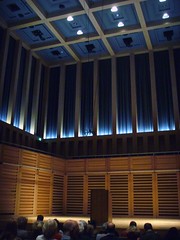 Hall One, the main performance space, is great, not as luxurious a place as the Wigmore Hall which is its most obvious rival, but it's a smart, clean design of a hall.
 The first event we're here for is a lecture by Sir Peter Maxwell Davies, entitled Musica Speculum Mundi? [Music a mirror of the world?]. He strolls onto the platform, and announces that he's been asked to write his speech down and recite it, not the way he'd normally speak in public. This makes it a little hard to get into what he's saying at first, as reading from a script makes his delivery a little stilted, but he warms up and sweeps us along with his talk, which, rather like a lot of his music, begins with a series of scraps of stories which gradually coalesce into a wider narrative. it's intimidating that he quotes form so many source in the original language, whether it be Italian, German, Latin or Greek. It's probably a sign of a generation gap that he can say something along the lines of "Of course, we all remember from school what Sophocles said...", but he's an engaging and intelligent speaker, and we're swept along by his argument, which becomes more and more personal and passionate as he touches on such subjects as his writing his Third Naxos Quartet in response to the invasion of Iraq. His conclusion is that writing a piece of music makes no practical difference to the world - he never imagined Blair, Brown or Bush would listen to his piece - but nevertheless it is immensely important that a composer reflect his world and act as a witness to it.
Max returns to the stage for the next show, a performance of two works for string quartet from the spnm shortlist selected by him and performed by the Brodsky Quartet. I've discussed this elsewhere, but it's a shame the speakers weren't miked up (as Max was for his lecture): we can hear what Max is saying (he's used to speaking in public) but the two composers, who aren't, mumble a bit and a lot of their words are lost beneath various rustlings from the audience. The acoustic is very clear, and hence very unforgiving in this respect, compulsive coughers note.
Another thing: please, please will someone at the spnm think of some compulsory course in programme-note writing for the composers on their shortlist? What we had to read was absolutely rotten and did nothing to enhance our enjoyment of the pieces. I was convinced from reading his note I was going to hate and/or be bored stupid by Oliver Waespi's piece, but was pleasantly surprised to be confronted with a beguiling piece that I'd like to hear again. It's difficult enough to persuade a lot of people to engage with this stuff as it is, and composers do themselves no favours by presenting such unenlightening writing.
Wednesday, October 08, 2008

Tuesday, October 07, 2008
New adventures in sound
 I went to have a look at Kings Place on Sunday. I'll post something about it later, but in the meantime here's my review of the concert I saw.
Monday, October 06, 2008
Judgmental
I'm branching out into reviewing for the splendid folks at the Londonist. For my first effort I went to hear Beethoven at the Barbican on Friday.
Wednesday, October 01, 2008
Survival strategies for the average composer (5)
[1].JPG) 5: Stay away from composers
5: Stay away from composers
It is a truth universally acknowledged that the one thing a composer hates above all else, more than war, oppression, racism, Hitler, the Daily Mail, music critics, anything, is another composer.
That's not why I'm advising the average composer to stay away from other composers though, although that would go some way to avoiding a certain amount of bruising and bloodletting (if not seething, festering jealousy and resentment).
I don't mean you should never speak to another composer - you've got to learn something, for starters, and I'd not have got much out of the composers who taught me if I'd sat there mute, or refused to turn up to the tutorial. And I've enjoyed social congress with other note scribblers on many occasions, almost never ending in physical recriminations (it helps if you manage to get enough drink inside you to remove the ability to land a punch, of course).
No, what I'm thinking of is the sort of occasion you can see quite regularly in any place where scccm is being performed (perhaps, here in London - actually, almost certainly, here in London - a mini-festival organised by the London Sinfonietta or the SPNM). The performances come and go through the day, people drift in and out of the concert hall, gravitating towards the bar, usually, and little clusters of conversation can be seen. And here's the thing: it's nearly all composers talking to other composers. If you go along to one of these things, it's actually quite difficult to meet anyone who isn't a composer. Sometimes you might get the feeling that the entire concert scene in London is really just an excuse for a lot of composer networking opportunities.
Now, if making a career's your thing, blah blah, networking's one of those things you do, sure. But composers (mostly) aren't going to play your damn music. Unless you're writing stuff for yourself to perform (and that's a subject I'll return to), you need musicians. Friendly ones, who know you and will be willing to put up with your ill-thought-out notation and ignorance of what their instrument can do, and will gently, kindly tell you how to change it to make it better. Musicians are quite easy to meet - just go to the nearest pub after the gig. If you make friends with them, they'll be only to happy to offer advice, and it's not that big a step from there to persuading them to run through something you've written. So stop talking theory with all the composers and start talking practice with the players.
There are moments that defy explanation
John Lydon. Advertising butter.
I can't think of anything to add.
Tuesday, September 30, 2008
Survival strategies for the average composer (4)
4: Don't write for the Arditti Quartet Let me make this clear right from the off: I've got no beef with the Arditti Quartet. They're an astonishing ensemble, who've brought some extraordinary music to life, and they and their contribution to so-called contemporary classical music (SCCCM) can't really be over-estimated. They reach heights of virtuosity that few if any other groups can, and when Stockhausen needed a quartet that could manage to keep time while flying about in four different helicopters, there was only one quartet to go to. I admire and respect Irvine Arditti and his cohorts immensely, and they are undoubtedly a Good Thing.
But even the Ardittis only work to a 24-hour day, some of which they have to sleep through, and there's a finite number of pieces they can look at.
When I go to composer workshops and the like, something that often strikes me is that many young composers seem to be unaware of this, and have written a piece that is, frankly, unplayable by anyone who isn't the Arditti Quartet. The Arditti's success seems to have encouraged a belief that nothing is unplayable, and that therefore everything should be made that much harder. It's like one of those Westerns when the local gunslinger has to put up with a succession of challenges of young bucks eager to prove they have a faster draw than him - the ultimate badge of composing respectability would be to write a piece that the Arditti Quartet couldn't play.
There are several reasons why this is a Bad Thing, not least because music is a social force for bringing people together in a spirit of exploration and cooperation, and to reduce it to a complexity pissing contest is a woeful waste of everybody's time. But here are the main points to bear in mind:
- While the Ardittis do devote a saintly amount of their time to looking at scores of young composers, they're getting music written for them by all the most prominent composers around, so stop and think: are they really going to spend time scrabbling round your parts rather than Jonathan Harvey's?
- Just because the Ardittis can play anything, it doesn't mean that anything is writable. Sometimes a piece is unplayable not because it's fearlessly testing the boundaries of instrumental technique, but because it's just badly written.
- If you spend your time writing for a performance by the Arditti Quartet, you're missing out on the possibility of performances by other quartets, who may not have Irvine Arditti leading them but are nevertheless very good. Write for the musicians who are actually going to play your music. If you make friends with Irvine Arditti and he asks you to write him something really, really difficult, then you can pull out your bag of near-impossibilities.
- With regard to the point above, if you hadn't considered the fact that at some point your best bet will be to ask someone other than Irvine Arditti to play your piece, you really need to rethink your priorities. Now.
Sunday, September 28, 2008

Thursday, September 25, 2008
Survival strategies for the average composer (3)
Great things are afoot at Defeatist Towers, but it's important not to let real life get in the way of procrastination, so here is the third in what remains for the moment a regular series.
3. It's not your fault... but you still have to deal with it.
Bobbins's comment on strategy no.2 raises some points that regularly come up if you're in the business of what we are pleased to call Contemporary Music, and just like a drunk in the pub, no matter how friendly the initial approach, when they appear you know in your heart that things are bound to turn nasty eventually.
But, like the lairy pisshead waiting outside the pub at 11 o'clock to deck you for looking at his pint or spilling his bird, there's no avoiding it, so we may as well pile in. There is, ahem, a debate continuing about what's happened in SCCM* since the turn of the last century, whether it's a valid development, whether it has any future or will ever attract a large audience, whether classical music is dead**, and whether the perpetrators should be dragged outside and given a damn good kicking by hoards of indignant Classic FM listeners.
Arnold Schoenberg, knocking up a few volleys in between alienating the masses
Now there are many arguments and counter-arguments here: Who abandoned whom first, composers or audiences (answer: audiences, as it happens, during the 19th century), whether it's allowable to write music not based on the tonal system (answer: of course it's "allowed", I'll write whatever the hell I like, thank you very much), and so on and so forth. As with the drunk man we met in the pub at the start of this post, an awful lot of this fractiousness is down to some misunderstandings, but that doesn't make the outcome any less violent. Except that it's down to a lot of misunderstandings that happened years ago, long before you and I were around.
The practical upshot of this is that as soon as you're outed as a composer, and just after the inevitable question is asked "Do you write modern music?", you'll be expected to be on the defensive about what your interrogator perceives as a century of atrocities that were perpetrated out of personal malice for them.*** The honest answer is that a) it was like that when you got here, b) yes, there is a lot of bad modern music about, but there's a lot of bad old music as well, it's just that we've had time to forget about that, c) not all modern music sounds the same, d) there's nothing inherently wrong, as it happens, in writing music with a limited audience, e) Hey, Schoenberg's really not that bad, have a listen to this great Hilary Hahn CD of the Violin Concerto! and f) actually this whole argument is at least 20 years out of date anyway, if you took the trouble to pay any attention to current trends. Unfortunately, such arguments will fall on deaf ears. Sorry, but as far as the world's concerned, everything's ruined, and it's all your fault, you composing bastard.
*SCCM: So-Called Classical Music.
**Classical music actually died in about 1827, of course.
*** I remember an occasion as a boy when a piece I wrote for a school music competition making limited use of serial techniques was denounced by my housemaster (yes, it was that kind of school) as "a sick joke". I argued back in a very cogent fashion, explaining the history of Schoenbergian technique and the long establishment and academic respectability of such methods, and was I think very restrained in that I never once used the phrase "you narrow-minded wanker". Or even anything worse.
Wednesday, September 24, 2008
Fight!

Jessica Duchen provides a handy roundup of the opening salvos of the London orchestras' new seasons today. But what's this?
So Stravinsky and Vaughan Williams emerge as flavours of the month, which is an interesting combination since Stravinsky could probably have eaten Vaughan Williams for breakfast, given half a chance.
I'm not convinced. A Google Fight would appear to back Jessica up, but given that Vaughan Williams was very tall and hefty (over 6', I think), and Stravinsky was a measly 5'3", surely Ralph would whup Igor's ass?
Tuesday, September 23, 2008
Survival strategies for the average composer (2)
 Judging by the swelling stats for yesterday, this is is obviously a topic that has gripped the imagination of literally some people. So let's not hang about! Strategy number two awaits.
2. Accept your insignificance
Yesterday I discussed the unavoidable fact that the normal thing for a composer to do is stop composing, which means that if you're still doing it past college, you must be some kind of weirdo. But what drives those of us who do to do the thing we do?
There's a fallacy that's common in SCCM: that because, say, Beethoven's late quartets weren't immediately understood or accepted by his contemporaries, and as they're clearly a work of genius, then anything that's not immediately understood or accepted by one's contemporaries must therefore be a clear work of genius. It hardly seems worth pointing out that this is false logic, but so many composers still seem to fall into the trap that I suppose I must.
This isn't something that's limited to the Average Composer, by the way: it's a nonsense that infects the entire business from top to bottom. Closely related is the delusion that because you're writing SCCM, what you produce is therefore more significant than whatever happens to be in the charts or on the front of the music press. As the logical conclusion to this line of thought is to declare that Paul McCartney's Liverpool Oratorio is a more significant piece of music than Penny Lane, I fell no need to dissect this one further for now.
The reason I mentioned Beethoven was that this stuff is largely his fault: before him composers were admired and revered, but it was after Beethoven that the composer as Artist took a hold, and it was only a step from there to the morass of self-importance that the Classical Music business finds itself mired in now. Even now, some 200 years later, composers are expected, indeed encouraged, to measure themselves against a deaf German from the early 19th century.
Now, I'm not saying that you're not as culturally significant as Beethoven; but let's face it, as composers have been trying, and mostly failing, to live up to his example ever since, it's pretty unlikely. Most of the top composers now, whatever they may like to think, are nowhere near that level, and probably neither are you. And the fact that nobody's ever heard of you (and come to think of it, pretty much nobody outside the tiny, tiny clique surrounding them has heard of the top composers either), does not mean that you're a misunderstood genius. It just means no-one's ever heard of you. Accept this, stop worrying about your place in posterity, and you'll be a big step on the way to happiness.
Now, I'm not saying that you're not as culturally significant as Beethoven; but let's face it, as composers have been trying, and mostly failing, to live up to his example ever since, it's pretty unlikely. Most of the top composers now, whatever they may like to think, are nowhere near that level, and probably neither are you. And the fact that nobody's ever heard of you (and come to think of it, pretty much nobody outside the tiny, tiny clique surrounding them has heard of the top composers either), does not mean that you're a misunderstood genius. It just means no-one's ever heard of you. Accept this, stop worrying about your place in posterity, and you'll be a big step on the way to happiness.
Monday, September 22, 2008

Survival strategies for the average composer (1)
Average, a. 1. Estimated by average; i.e. by equally distributing the aggregate
inequalities of a series among all the individuals of which the series is
composed.
2. Equal to what would be the result of taking an average; medium, ordinary; of the usual or prevalent standard. Most composers, if we are honest (and few of us are) are average. This isn't necessarily a qualitative judgement - although that comes into it. What I mean is that most of us are neither in the shining stratosphere of success, from which a few names look down beatifically while the rest of us stare sullenly back with a barely concealed jealous rage, nor in that sad category of people who persist in pursuing the muse despite ample evidence that they have no talent whatsoever for it, on whom the rest of us look down with a mixture of disdain, smugness and relief. Most of us bumble along, turning out pieces as and when we can squeeze them between the demands of a day job and the need to get the groceries in, occasionally getting a performance and filling with optimism that this time, our big break is coming, before sinking back into our routines as the recognition fails to erupt, and we carry on with the next piece, slightly crestfallen, but soon once more hopeful that what we write holds some significance beyond ourselves, and will be recognised eventually, and preferably before we fulfil the essential condition of being a composer and die.Of course, as Morton Feldman pointed out, being a composer is inherently abnormal, as the normal thing for a composer to do is give up, probably soon after he or she leaves university or college and realises the full extent of the world's indifference to SCCM*. But given that you've failed to fall at that hurdle, and are bobbing by, neither sinking nor swimming, what you need to do is take on board certain facts. Hence this, the first in a series of posts designed to enlighten and educate, and make the average composer's life if not better then at least slightly more tolerable. And following from the sage words of Mr Feldman, let's proceed:1: Admit it, you're weirdYou are though, aren't you? If you had any sense you'd have quit this composing lark years ago. Unfortunately, you somehow managed to leave the education system without having the idea that anyone might be interested in anything you have to say knocked out of you, and if you're still scribbling now, it's probably too late for you. Admitting to yourself that what you do is weird is the first, and possibly most important step to take if you're going to cope with being a composer in the 21st century. You can expect the world to tolerate what you do, but by and large, you can't expect it to show any interest in it. Occasionally someone will appear to express something greater than apathy, but it'll very rarely lead anywhere, so don't get your hopes up.*SCCM: So-called classical music
Wednesday, September 17, 2008
Till the money runs out
The days pass, and I find myself on the brink of the new season, preparing to take up my cello and start rehearsing once more. After a good long summer break, it's good to feel some enthusiasm building for the coming year.
That's tempered with some trepidation, though. The credit crunch is biting everyone, and the orchestra's no exception. Rising costs, venue hire, the difficulty in persuading people to part with some cash in return for an evening's entertainment are all things that impinge on the activities of an amateur orchestra, and one that receives no subsidies at that. We rely on the subs that players pay, ticket sales and any sponsorship we can attract to keep going, and while it'd be exaggerating to say that we're on the brink of collapse, that fact is that an orchestra's an expensive thing to run; we made a big loss last year and we expect to this year. A lot of imaginative thinking will be needed to find new ways to raise money to keep the band going. (Any other amateur bands having the same worries round here?) >eanwhile hard decisions must be made, programmes changed and belts tightened.
Performing arts organisations must all be looking over their shoulders at the moment, as they're usually prime targets to have their grants cut when the economy starts to nosedive, no matter how well they seem to be doing. There have already been scare stories in the recent past when the Arts Council cut off all support to a number of prominent bodies. It's hard to avoid the conclusion that the time's coming when the best place to be is in an amateur band, working on a small scale and, for all the financial worries, perhaps better placed to ride out the storm than a large pro organisation that depends on public subsidy. One of the points trumpeted about the new Kings Place development is that it's funded entirely by private money, which I suspect is another sign that no-one sensible would want to be relying on public money at a time when there seems to be something in the air against the very idea of it.
On a tangent, there's some interesting (and quite long, don't try printing this out if you want to save trees) reading in this government report on amateur music-making. There's a bit of techno-waffle and stating the bleeding obvious, of course - this is a government document, after all - but I shouldn't be churlish, as it's good to see something vaguely official that propagates the notion that the Arts are something that people do, rather than a product to be passively absorbed. Whether this leads to the conclusion that amateur organisations should be cherished and supported in a way that officialdom doesn't really do at the moment, or that by some twisted logic their presence and popularity should serve as a reason to slash public arts funding remains to be seen.
Subscribe to:
Posts (Atom)




