Patterns in a Chromatic Field was the second piece by Morton Feldman I ever heard, and it remains one of my favourites. The first time I encountered it was in Huddersfield in 1996, in a late-night concert straight after the one that featured the first Feldman piece I'd ever heard, For Samuel Beckett.
I was there because I had a piece in contention for the festival's Young Composer Award. (I didn't win, although I did get beyond the workshop stage and get a proper concert performance alongside the piece that did win. Long story.) Feldman was one of the featured composers that year (the first time a dead man had been featured this way in Huddersfield, I believe), so there was quite a lot of his music to hear. Being a provincial boy who'd been to a provincial university, I'd never heard of him before. Hearing For Samuel Beckett was an extraordinary experience. I'd read about him beforehand and so had an idea of what to expect (slow, quiet, goes on a long time), but I really wasn't prepared for how it would feel to sit through something like this. It started off well; Feldman's music has a sound that's immediately attractive. So for the first few minutes it was great. As it progressed though, the sheer apparent stasis of it began to get to me. By about 20 minutes in it began to feel like some form of torture. After that confusion and disorientation began to set in. And then something odd happened. The music seemed to be putting me into a kind of trance like state, not entirely unlike the state of mind you might find yourself in after a low dose of hallucinogens. By about the 50 minute mark when the piece finished, I couldn't decide whether it had gone on far too long or not nearly long enough. We left the hall and walked over to the venue where the late-night gig was happening. This was Patterns in a Chromatic Field, and here everything clicked into place, I experienced that rare sense of revelation that classical music delivers rather more rarely than it promises, and I became the devote of Feldman's music that I remain today.
So Patterns holds a special place in my heart. It's where I "got" Feldman, and it came into my life at a very exciting time when it briefly seemed I might amount to something. It's also a piece for cello, so I also get to have the (probably futile) notion that one day I might play it myself. In my mind it's become a rep piece for cello. I've heard a good four or five recordings of it since then, but last night's performance by Anton Lukoszevieze and Philip Thomas of Apartment House is only the second time I've heard it live.
That's important, because Feldman's is a music that feels significantly different in concert. It's something to do with commitment. Listening to a recording in your own living room, there are always distractions, the possibility of doing something else while the music's playing. Going to a performance requires a higher level of commitment. You're there for an hour and a half of quiet, often superficially uneventful music that demands a level of concentration that's almost superhuman. (This goes for everyone there, whether they're performing or listening.) At the same time, the fact that there's nothing else but you and the music (well, and the rest of the audience), makes it easier. It's just you and this intimidating experience ahead of you, and the only thing that can distract you (apart from the rest of the audience) is whatever thoughts spring into your mind as it struggles to maintain its focus on the moment.
I say superficially because of course there's actually a huge amount going on. You hear a lot of music written under the influence of Feldman, and what most of it fails to grasp is that although tiny motifs and ideas return and reiterate again and again, over and over, there's actually very little repetition in Feldman. Like walking into a dark room, once you've acclimatised yourself you find there's actually a huge amount of detail to appreciate where initially there seemed to be nothing. Patterns is unusual in late Feldman in that it's often quite antsy and fidgety in texture, and has a sense of nervous activity that only periodically dissipates to reveal a more glacial texture. Lukoszevieze and Thomas's performance tends towards the slower end of the range I've heard (they come in at just over 90 minutes), and yet they still mange to convey this jitteriness, a quality that I think often gets lost in the race to play Feldman as slowly as possible. This is quiet and defective and profound music, sure, but there's also humour to be had, another element of Feldman's personality that often gets neglected, and which they convey deliciously here in the the throwaway ending, for instance.
One of the startling things I find listening to this piece on the flesh again after all those years is how much of it has seeped into my own music. Feldman's been a huge influence on me, of course, but it's startling to sit listening to Patterns and real is how much this specific piece has left its mark on my own work. Sometimes this is the result of initial enthusiasm and half-absorbed lessons: you can hear this in Infinite Breathing, where a Feldmanish texture jostles for supremacy with passages in thrall to Ustvolskaya, whose music I discovered around the same time as Feldman's. Later on in Le tombeau de Feldman it's a more deliberate allusion, but it's startling to realise how what I thought at the time was a kind of generalised ersatz-Morty was a half-memory of this particular piece, the main difference being that my figures tend more towards the diatonic than Feldman's (that at least was a deliberate thing).
I sometimes wonder if Feldman, who twenty years ago was a fairly marginal figure, isn't now becoming too pervasive a figure. I certainly worry that it's become cliché to write music under his influence (albeit often without a real understanding of what he's doing and why he uses those textures and strategies), and periodically try to kick the Feldman habit in my own music. Having said that, he's clearly not edged quite so far into respectability that some people won't walk out before he's done. Five did last night. One of them was a woman who heroically and selflessly sneaked out as quietly as she could before she succumbed to a coughing fit. I salute her. The other four confuse me (why on earth stick it out for over an hour and disappear with 20 minutes or less to go?) and annoy me (if you are going to duck out early, couldn't you at least try to leave quietly?). But to come back to this piece, to her it live in that situation where you're stuck in a hall with it, and just as you settle in having made sure you went to the toilet first, you experience a momentary frisson of exhilarating fear as you register what you're committing yourself to, banishes thoughts like that. What's wonderful, what makes it great music, is its capacity to come out and startle you, and (particularly in a well-judged performance like this one) make you feel like music you've been listening to for years is music you've never properly heard before. You thought you had it figured, and then you realise that you've hardly scratched the surface.
Saturday, November 09, 2013
Morty and Me: Appartment House perform Patterns in a Chromatic Field at the Purcell Room
Monday, August 12, 2013
On competitions
Clarinettist and Twitter pal Heather Roche recently wrote an interesting post about composing competitions. She asked a number of questions of composers about the whole business of entering competitions. As I spent ages wibbling on in the comments in reply, I may as well recycle that into a post here.
I have very mixed feelings about competitions generally, which are a lot to do with the notion (drummed into me as a teenager by a cherished teacher) that the very idea of a competition is utterly opposed to what music should be about, and of course nothing whatsoever to do with the fact that I never win the damn things. Nevertheless, I've entered a number of them over the years. This is partly as it's just one of those things you do, but it's also because I suffer from anxiety, and it sometimes seems like a way of getting my scores out into the world in a way that keeps things at arm's length, in some way, and makes it feel less like ACTUAL PEOPLE are JUDGING my music. As I've got older and lost most of my enthusiasm for the idea of career-building, these occasions have become fewer. Strangely, last month I put in for five or six competitions/calls. This was simply because I happened to see a lot that seemed like they might be interesting for one reason or another, or happened to be asking for pieces written for a lineup I'd already written for, or just seemed to fit in one way or another with an idea I already had at the back of my mind. So far I've had three outright rejections, one promising but noncommittal response, and deafening silence from the rest (probably because the deadlines are not reached or only just gone).
So with that in mind, and apologies for the length of this reply (I'm struggling to stay awake through this, god knows you just be losing the will to live), here are some answers to Heather's questions:
"what about a call for works makes you want to submit a work?"
Generally, an opportunity that fits in with whatever my interests are at the time, or fits a piece I've already written or have half written or have in mind, or features musicians who I think might be sympathetic to what I'm trying to do, or just sounds like it might be interesting.
"What makes you hesitate? What makes you run away screaming?"
Deadline! It amazing how often I find out about something about two weeks before the deadline. Maybe that's just me though. These days I'm less inclined to submit unless I can do so online; frankly it costs money that I don't have to print scores. I'm not so keen on the idea of writing for an obscure instrumentation (unless it's a really interesting one), as it's a lot of time to spend on something that may not have any use beyond the specific competition; remember, I never win these damn things. Fees (see below); I know a lot of groups, festivals etc. are short of money. But so am I!
"How can festivals or ensembles encourage you to submit?"
I've done the "turn up at a rehearsal, do a workshop, get a recording" thing, and while it's not entirely without its merits, these days what I really want to do is work with people who are interested in what I'm doing and might be interested in more than a one-night stand. So I guess anything that sounds like I won't just be rep fodder would attract my attention more.
"Under what conditions might you think it acceptable to pay a fee to enter a competition?"
Generally, never. I have entered competitions where a fee was payable in the past. I look back at those as money I might as well have burned.
"What kind of prize would you expect or like to see offered in both situations in which you have paid and those in which you haven’t?"
All I really want from these things is a performance, the opportunity to work with some sympathetic musicians who'll take the music and the aesthetic seriously and be helpful of technicalities and forgiving of my misjudgments, and ideally a connection with some musicians who I might want to work more with (and vice versa of course).
"Having described the situation at the Witten festival, does that sound like something you would be interested in, or advise your students to submit pieces for?"
Yes it does, and I did! But as I say, I never win these damn things, and so must add that to my ever expanding collection of rejection emails. C'est la vie. I console myself with the satisfaction of having gotten a working piece written in only a couple of weeks; I actually think it's one of my favourite things I've written for a while, so I hope it'll get a chance somewhere else.
Wednesday, May 08, 2013
For Steve
There are plenty of people who knew Steve Martland better than I, and could tell you better stories than I. My principal encounter with him was in 2001, when my string piece "Infinite Breathing" was chosen by him for a SPNM workshop and concert. So I got to experience the generosity and big-heartedness of the man first-hand. Between the workshop and the concert we went for a meal and we had a fantastic conversation, which I can't really relate here because it largely consisted of things that would be libellous if i wrote them down. Very funny, though. When I bumped into him afterwards at other events, he remembered who I was. This may not sound like much, but believe me that's a rare thing in this business. Steve was a man who cared about people above all.
I can't quite believe he's dead. No-one else can, from the people I've spoken to. It's particularly sad because I gather that after a long period of creative stasis he was feeling re-energised: the commissions were coming in again, he was full of ideas and the hunger to realise them, and things seemed generally to be coming together for him. It's a sad thing to consider what he might yet have had to give in music. It's a greater loss to the world though, no longer to have the man himself in it.
This is a tiny thing I did today as a memorial. It seems dreadfully inadequate, but I couldn't not make the attempt. I hope it's not sentimental, at least. Steve wasn't a sentimental man, just a passionately caring one.

Monday, March 18, 2013
Notes before a Final (5): Kaija Saariaho
One of the things I constantly find myself saying when I take part in discussions about future repertoire for the orchestra I play in is to emphasise the need to put in music by people who aren't dead. Everything I've played and planned to play thus far in this competition was written in the past century, and can be described as contemporary in the sense that it was written by people who were alive within living memory (my parents' if not mine). However, it's still all written by dead people (and reasonably long-dead people at that - the most recently breathing composer, Lutosławksi, dies over 20 years ago). It therefore seemed a matter of urgency to include something by someone still alive. As with the Falla, I found what I needed by trawling through Spotify and other online sources for recordings.
Kaija Saariaho scores double points for being not only a non-dead composer, but also a non-male one. She's white and European, but two out of four ain't bad, I figure.
Sept Papillons (Seven Butterflies) is a work for cello solo. This seemed to create a nice symmetry: I begin with just me, introduce a piano for the two 1914 pieces, and finish alone again (no singing this time though). I'm playing the sixth papillon. It's an extraordinary piece, that seems to exist on the edge of silence. It's full of tapping, high ethereal noises and harmonics, and has a sense of weightlessness abut it. After the richness of tone that the Falla demands, this is something's else entirely: silvery, glittering and brittle. At the end it just seems to evaporate. It connects to the Webern's gossamer textures, just as the Falla and Partch seem to connect by their more earthly moods.
Having moved from loss and despair through to consolation and peace, this seems to me to take things somewhere else, more ethereal and otherworldly. It's absolutely not a rousing climax, it's not designed to bring the crowd to their feet, but that's not what I'm aiming for. I figure that's what's expected in this sort of event, and what's expected seems to me to the least interesting thing you could do. I hope that rather, this sequence will provide something nourishing for the soul.
Notes before a Final (4): Manuel de Falla
This is in a sense a set of two halves. The first two pieces are ones I've been familiar with and wanted to play for a while. The last two are fairly new to me (as a player, at least) and I've learned them specially for this gig.
Having set up a trajectory with Partch and Webern - in which Partch prepares for and amplifies the emotional world of Webern - I wanted what followed also to throw a light on Webern, but this time through contrast. After the devastated mood of those two pieces, I wanted something comforting, without being too sentimental. I had a Mendelssohn Song without Words in mind, but this was a little too long for the context (especially as I'd decided I'd need a fourth piece to round things off). Cue a lot of random looking up of cellists on Spotify.
Eventually I alighted on the Popular Spanish Suite by Manuel de Falla (which is a transcription of some of his Popular Spanish Songs), and in particular "Nana".
Falla is one of the most famous of Spanish composers (both in his nationality and his style), but perhaps surprisingly the Spanish Popular Songs are a rare example in his output of his using preexisting folk tunes. "Nana" is a lullaby, and had all the qualities I was after: it has that sense of consolation, but isn't sentimental, and has that aspect of noble melancholia that comes to my mind when I think of flamenco (the songs are all full of flamenco influences). It's also quite simply a very beautiful melody.
It's an unexpected juxtaposition with the Webern, and I hope an effective one. Curiously, it only dawned on me later that this and Webern's Three Little Pieces were written in the same year, 1914. Falla died one year after Webern, too. I chose this piece purely on the basis of its sound, and yet these connections and resonances seem to arise between the pieces.
A lullaby could be a good way to end a sequence, but I wanted something else, something to effect a further transformation. This is where the final piece in the set comes in.
Sunday, March 17, 2013
Notes before a final (3): Anton Webern
When you look at a score by Webern, the really obvious thing you notice is there really aren't many notes there. You might think this makes it easy to play. You'd be wrong about that.
When I mentioned to a friend that I was going to be playing Webern's Three Little Pieces as part of my set for the Office Musician Final, her reaction was something along the lines of, "All the rep for cello you've got, and you're doing that?"
There are lot of preconceptions about Webern. It's cold. It's difficult. It's unrewarding to play. All thse things are bollocks. Webern's music is some of the most emotional there is. He was deeply traumatised by the death of his mother in 1906, when he was 22. He never really got over it, and pretty much his entire output after then is, I think, consumed with grief at his loss. It's grief quietly expressed. Not chest-beating, extroivert grief, but internalised, a weight held deep inside that never leaves. It's highly condensed: a fleeting gesture or even a single note carries the sort of weight that in conventional music would be carried by a long melody or a cascade of notes. This is what makes it so difficult to perform: you have to reach deep inside yourself and put so much into so little. The other thing that people find difficult to appreciate is that it needs great accuracy. There are complex rhythms and tempo changes that aren't necessarily directly evident to the listener, but it matters to get those silences and those placements of single notes just so. I think the point is that as a musician, you need to be filled with that level of intense concentration to put the music across to the listener. I cn honestly say that rehearsing this music has been incredibly rewarding, and my admiration for it has only increased. It's all very well to play somethign fast and showy with lots of notes and scrambling about, but to play a single note just right - now that's real virtuosity, and far harder to bring off.
There's a affinity between Webern's inconsolable grief and that of the protagonist in "The Long-Departed Lover" which I hope will come across whn they're heard one after the other. This is what I hope to achieve in a good programme: that the pieces all fit together and illuminate each other in some way. I hope that the contrast of the Falla piece that follows the Webern will also shine a new light on it. If a few people come out of it feling better disposed to Webern than they were before, I'll feel like I've achieved something.
Friday, March 15, 2013
Notes before a final (2): Harry Partch
I can't recall precisely when I first heard of Harry Partch. I have a vague memory that I was aware of the name when I was a student*, but if he was mentioned in British academia at all then, it was as a freakish footnote. I knew he was a hobo, that he invented a 43-tone scale sand some weird instruments. He was an eccentric, marginal figure, not someone to be seriously considered or studied. Certainly his infamous scale would have been presented as some kind of crazy folly, and the logic and impetus behind its creation not considered anything worth study (and anyway, getting hold of recordings of the music was next to impossible in that pre-intenet era. I may have been aware of the term "Just Intonation", but I didn't really have any conception of what it actually was until years later.
Something I never learned to do very well was to play the piano. I started playing the cello at 6 but didn't have a keyboard lesson until I was 17, when my mother (who'd decided not to force it on me as my elder siblings had nearly all hated it) figured I probably needed some keyboard skills for the A level I was studying. At times this lack has irritated or frustrated me over the years, but latterly I've come to realise it was a blessing, as it kept me from becoming too trapped in the 7 white and five black bars covering the window of the cell called equal temperament. Although I didn't have the understanding to fully appreciate the significance at the time, I was always aware that the way I tuned my cello, in perfect fifths, didn't quite fit with a piano. (I knew I needed to tune my A string slightly sharp to stop the C string sounding really flat.) This is what got me interested in the notes "between the notes". I was fascinated by the quarter-tone music written by Ives and Lutosławski, and captivated by the "out-of-tune" intervals of the harmonic series. It seemed strange to me that they were called out of tune; surely they, as natural phenomena, were correct, and the scale on the piano must be wrong? But I didn't have the language to describe and understand such things properly, other than the quarter-tones which were what amounted to microtonality as far as my education was concerned. (It's astonishing to think that back then even quarter-tones were regarded by a lot of teachers and musicians as intervals too small to be perceived. The degree to which received wisdom can smother your thoughts is extraordinary.)
So for years I had this vague idea in my head of Partch as this funny weird guy. Then I heard his music, and perhaps as importantly read his book Genesis of a Music in which he explains in detail the theory and practice of his compositions. That was a major explosion in the middle of my preconceptions, the consequences of which I'm still getting to grips with.
So Harry's an important figure for me, who revealed truths I'd only half-glimpsed before. Nowadays it's easy to get hold of recordings of his music - you can find the recordings he made of some of his Li Po settings on Spotify - and it's even possible to get hold of some scores. I forked out the whatever-outrageous-cost-of-a-photocopy Schott charge for the Li Po settings, partly because I thought they were wonderful of course, but also because I liked the self-sufficiency they stand for - just Harry, with his voice and his adapted viola, making his revolution all alone. There's a strength and also a melancholy to this single-player set-up, and Li Po's poems also carry some of this sense of isolation and loneliness.
*Thinking about it, I suspect it was in connection with Tom Waits, and specifically "Bone Machine", that I probably first heard about him.
Wednesday, March 13, 2013
Notes before a final (1): Balancing Act
Creating a programme for a concert isn't just a matter of chucking together a bunch of stuff you'd like to play, whatever some people think. My original plan for the first round of the competition was to pair Feldman's Durations II with Debussy's Cello Sonata; I thought it would make an intriguing pairing, the Feldman both acing as a kind of warm-up for me and the pianist before we launched into the various difficulties of the Debussy, but also acting as a foil: there's the contrast between Feldman's slow, flat surfaces and Debussy's busier, jump-cut style, but also a shared interest in texture and colour. The Debussy got cut because the time I had got cut, down from 15 minutes to 10. Lutosławski's Grave is a piece which, like the Debussy, I've been laying privately for years, so I had under my fingers (at least enough that getting it up to scratch seemed feasible), and in its changes of mood and varied texture has a certain affinity with Debussy, and hence I figured would provide a similar fit with the Feldman (which I was determined to keep in the mix).
The Lutosławski's quite an overtly virtuosic piece, very dramatic and full of gesture (very much unlike the Feldman). The obvious thing to do for the finale would be something similarly flashy. Doing the obvious just isn't me though. From the moment I dared to start thinking I might make it to the final I knew I wanted to do some kind of sequence that would create a certain mood, and progression of mood. The one piece I knew I wanted to play from the off was Webern's Three Little Pieces for Cello and Piano (I'll talk about this piece, and the others, in more detail in further posts). The other thing I was keen to include was one of Harry Partch's Li Po settings, and it occurred to me that one of them in particular would make a great prelude to the Webern, and really help the intense emotion of that to come through. "The Long-Departed Lover" is, as you'd guess from the title, in part about loss, as is the Webern; pretty much his entire output as a composer is coloured by the trauma he suffered when his mother died. Following that, I wanted something very calm and soothing, even comforting. This was the hardest piece of the jigsaw to find; not just the right tone, but the right length to fit in the limited time I had. In the end, I added two pieces to follow Webern: one to comfort, and another to bring a transformative, fantastical end to the set.
After my set in the semi-final, I was asked, "do you do any more... mainstream pieces?" I guess the answer is, "not this time!". Mainstream doesn't seem a very interesting place to be to me. It only occurred to me after I'd settled on the music I wanted to play that only one of the composers I'm playing through the whole competition isn't dead (bad), and that the piece most people would recognise as "Difficult Modern Music", the Webern, is the oldest piece I'm playing, by the composer who died longest ago. I find that quite a satisfying thought.
Retuning to the stage
Here's me playing Feldman's Durations II and Lutosławski's Grave at the Office Musician of the Year semi-final, my first public performance as a soloist for about 25 years:
It's strange to listen back to it now. At the time I thought it went really well, and others told me they did too. But recordings are an unforgiving thing, and listening to this in the cold light of day, without the excitement of being present at or involved in a performance makes me start to hear everything that's wrong with it: the notes I didn't quite pitch right, the moments where the rhythm's a bit off, the failure to pull the bow quite straight or put the finger down quite firmly enough that just skews things slightly away from what I wanted. This is partly inevitable, that small slips become magnified by a recording, and things that are barely noticed as they fly by in performance can be heard and re-heard. I's like to think it's also down to the fact that I've been working a lot harder at playing than I have for years, and am becoming more exacting of myself and more aware of what I need to improve.
In the end (post recording self-criticism aside), the semi went well, I thought. Having spent years living in fear of the idea of standing up* in front of people and playing as a soloist, it seemed to come remarkable easily. My wife said she was surprised at the degree to which I performed, not something she would have previously associated with me. This was something I and my accompanist Jon had worked on quite a bit since the masterclass - trying to make sure we injected a certain theatricality to proceedings (it's not called performing for nothing, you know). We even planned our entrance, bow etc. In the event our brilliantly planned choreography came to nothing, as the event was really rather more informal than that. We came out of the audience, as there wasn't an easy route from "off-stage" to "on-stage." I hope I managed to look vaguely like I looked like I knew what I was about, anyway. I said a few impromptu things about the two pieces which I think managed not to be total waffle, and then we played. It helped that Jon's a great musician and a good rehearser. Most of our rehearsing ha to be squeezed into our lunch break, so time's at a premium, and making efficient use of it vital. It was a massive boost to confidence walking on to the stage to know we'd really thoroughly prepared ourselves and had nailed all those tricky corners. One of my old teachers once told me you need to allow for a performance being around a quarter to a third less good than the best you're capable of. The great feeling was being confident we were good enough to drop that bit of quality and still be OK.
Interestingly, the main criticism I had from the judge was that we could have given more space to the Feldman. I actually agree with this, but as we'd been given only 10 minutes (and as you can tell from the recording above we were already pushing the boundaries of that) we had to take a particular approach that was a bit faster than I'd have naturally done. Having said that, I think it's always a good idea to question received wisdom, and the idea that a piece like that should be done as slowly as possible is one such thing.
There were eight of us in the semi, and five went through to the final. It's a strong line-up, but I think I may actually be in with a chance. Of course, I'm scuppering that chance with a programme that's pretty much the exact opposite of a crowd-pleasing fireworks display. I think having got there, there are two ways I can go: one is to do something to show off, and the other is to decide I don't care about the winning and just do something I really want to do. Too much of my life is given to compromise as it is, so I'm going with the latter option.
* Not literally. This is cello playing, after all.
Thursday, February 14, 2013
Over the edge
So, what have I been doing since the last time I declared I was reactivating this place and then didn't?
Well, teetering on the edge of a nervous breakdown for one, but that's another story.
I wrote a fucking amazing piece for orchestra. The conductor was scared of it though, so I had to write a less scary one. In two days. TWO DAYS! I'm brilliant, I am.
I went to some gigs and listened to some music. Maybe I'll tell you about that sometime, maybe I won't.
I mucked about with some other people's music.
I did a bit of my own.
I started recording versions of songs from Beck's Song Reader.
I entered a competition for amateur musicians.
Gulp.
Yes, I am going to perform my cello all on my own-some (OK with a pianist). The last time I did this was in 1989 and it was a disaster. I have suffered crippling anxiety about it ever since.
But in the last few years, I've been doing a lot of recording of my own stuff - mostly drones with cello, processed cello sounds, that sort of thing. I realised what I should have realised about 20 years ago really, that it's fundamentally a waste of time and energy trying to foist your music on other performers who are on the whole at best indifferent and at worst condescending or actively hostile. You know - classical musicians. (There are of course one or two noble exceptions to this.)
So I was making this music all by myself, without any need to rely on pothers, and it felt good. I played some of it to my friend Rhodri, and his reaction was, "this is really good. You should get yourself a gig at Cafe Oto or something."
Well, he's right of course. It's all very well sitting in your front room recording stuff and fiddling about with it, but music's a performing thing, yes? It's intriguing to think how this stuff might be done live - it would have to be executed in a different way to the way I go about constructing a recording of course, but having to adapt to that could spark off some new and interesting avenues. But the thought of getting up in front of people and performing as the centre of their attention was just terrifying. This was something I needed to address. It's closed off all sorts of opportunities for my for two decades.
I'd heard of Music in Offices before, and in fact I know a couple of people who've entered their Office Musician of the Year competition. One even won it! And the other reached the final. No pressure there, then. So when some people turned up at a rehearsal of my orchestra before Christmas touting it, it planted a seed in my mind. Perhaps this was what I needed? Something to force me to stand up and play in front of other people. I spoke to one of my friends who'd done it before. She told me she'd entered it for pretty much the same reasons I was thinking about it, and it had done her a huge amount of good; boosted her confidence in her own abilities and opened up all sorts of opportunities to play that she'd never even conceived before. I um-ed and ah-ed about it for a few weeks, then bit the bullet and sent in the application form jut before the deadline at the end of November.
The heats stage is at the end of February. But on Monday night my accompanist and I went along to a masterclass that MiO had organised for the participants. It seemed a good idea to have a dry run where it didn't matter too much if I fucked up. The two musicians taking the class, Joel Garthwaite and Maite Aguirre were both lovely and positive and had plenty of wise advice.
And you know what? I didn't fuck up. In fact I was OK. Not perfect, but OK. It's a couple of weeks to the heats, so there's time to sort out the rough edges. Suddenly it occurs to me I might have to start practising the stuff I planned for the final, because there's a possibility I might get there and actually have to play it.
Wednesday, December 21, 2011
Some records that I liked this year
They're not all new this year, but they were new to me.
Cornershop: And the Double-O Groove of
Birtwistle: Night's Black Bird
Björk: Biophilia
Kate Bush: 50 Words for Snow
Bill Callahan: Apocalypse
Eliza Carthy: Neptune
The Fall: Ersatz GB
Fovea Hex: Here Is Where We Used To Sing
PJ Harvey: Let England Shake
Katy B: On a Mission
Khyam Allami: Resonance/Dissonance
Julaba Kunda: Traders
Hilary Hahn: Ives Violin Sonatas
Jonny Kearney & Lucy Farrell: Kite
Katzenjammer: Le Pop & A Kiss Before You Go
Laura Marling: A Creature I Don't Know
Ben Johnston: String Quartets 1, 5 & 10
Misty Dixon: Iced to Mode
Mötorhead: The Wörld is Yours
Eliane Radigue: L'île re-sonante
Rasputina: Great American Gingerbread & How We Quit the Forest (reissue)
Roshi featuring Pars Radio: Mehregan
Spieres and Boden: The Works
The Fierce and the Dead: If It Carries On Like This We are Moving to Morecombe
Trio Scordatura: Dubh
Sun-Ra: Strange Strings
The Unthanks: Last & The Somngs of Robert Wyatt and Antony and the Johnsons
Tom Waits: Bad As Me
Abigail Washburn: City of Refuge
Danger Mouse and Daniele Luppi: Rome
Little Roy: Battle for Seattle
Jane Weaver Septième Soeur: The Watchbird Alluminate
The Webb Sisters: Savages
Friday, June 24, 2011
Essays before a composition (4)
The complete consort dancing together by petemaskreplica
The last time I wrote a piece for a symphony orchestra was in 2005: a small piece with a long title to celebrate Kensington Symphony Orchestra's 50th season. The last time I wrote for orchestra before that was in 2001, a work which got a play through in rehearsal but has never been publicly performed. When you're 20 years old and filled with energy and idealism you think nothing of churning out enormous pieces of music without a thought for who's going to play them, but as I get older it seems a waste of time and energy to slave over an orchestral score with no prospect of it being heard. It's so easy now and so satisfying to produce something large scale in my own living room, and immediately get it uploaded and out there; why sweat over something as arcane as an orchestra when I'll probably never hear the result?
As a result of this ideas stew in my brain for years. I've had the idea for the piece I'm about to begin work on for a long time. In fact, when I wrote The complete consort I had it in mind that it might be in part a preparatory sketch for the bigger work I wanted to write but couldn't at that time justify spending time on.
Over time ideas get half buried, maybe rethought for more realistic projects. Meanwhile new influences continually change my ideas of how to make music, and what sort of music to make. These new ideas and strategies sink into those half-buried seeds and mutate them. You'd think having had the germ of a piece fermenting in my mind for the best part of a decade would make it easy to produce when the chance finally comes. In fact it's hard: I and my music have changed in so many ways I couldn't have foreseen that the idea itself has begun to change, and many of the aspects that I thought were most fixed turn out now not to fit in with how I currently do things. It's not impossible that I'll raid the older music for elements I can use in the new piece, but it seems unlikely that it'll be as straightforward a relationship as I once thought it would be. Music's always on the move; any particular piece that's set down in a definable form is only a snapshot of a moment that's already gone.
Saturday, June 18, 2011
Thursday, June 02, 2011
Essays before a composition (3)
They chase, they chase their quarry, or the idea of it. Look at them, wildly swinging their nets, each lunge met with empty air. And still they hunt. And meanwhile I sit here, chasing an imagined sound, pen skittering across the page trying to capture my quarry, my conception, even as it recedes ever before me and behind me, each moment gone before it happens...
Wednesday, June 01, 2011
Essays before a composition (2)
One of the problems for a composer trying to write a programme note is that the experience of listening to a piece of music is almost the precise opposite of the experience of writing it. When you compose, you begin with an idea, a concept of what impression you want the piece to give. The process of producing the music is then a process of unpacking this idea, expanding it and rolling it out into a time span. The listener does this process more or less backwards: over the time span, he or she absorbs the notes, the textures and so on and (if the composer’s done the job well) at the end will have a concept of the work in the mind (which may bear a greater or lesser similarity to the concept the composer had in the fist place). Moreover, what concerns and interests a composer in the act of writing isn’t necessarily what concerns the listener. The composer is concerned with processes: how do I put things together so a to realise this idea of sound? Of course, once he’s worked this out he feels very excited and pleased, and wants to tell people how he did it. But that’s exactly what a listener doesn’t need or want to know. Roberto Gerhard wrote, “Understanding comes first; knowledge second.” There’s a fundamental mistake that’s made all the time in the classical music world: people who like classical music know a lot about it, gos the reasoning, so if you tell people a lot about it they’ll like it. In fact what happens is that if you bombard people with technical detail they start to think that unless they know about it they can’t possibly like or even begin to listen to it. If people like a piece they may well find out more about it, and they may get into the nitty gritty of theory and technique, but that’s for later. Programme notes in which the composer drones on about the clever technical devices he used to write the piece are therefore the biggest turn off imaginable, and such notes often lose the audience’s sympathy before they’ve heard a note.
Tuesday, May 31, 2011
Essays before a composition (1)
When I was young I discovered the record section of Birmingham Central Library (something that sadly would be all but impossible now in more than one way, and will become utterly impossible if this government gets its way). I discovered many things within those thing cardboard sleeves, sounds that I’d never heard or imagined could be made. I devoured Nielsen’s symphonies, Stockhausen’s Telemusik and Miles Davies’ Bitches Brew with equal enthusiasm, if not immediate understanding. I pored over the sleeve notes for the Stockhausen. They were all but impenetrable, and if I’d been relying on them to guide me into the music I doubt I’d have made it far. Fortunately I just liked the sounds and didn’t worry about what I was supposed to think about them. It was gratifying years later to hear Stockhausen himself introduce his music. His advice on how to listen to his music mentioned nothing of tone rows or retrograde inversions, but boiled down to: you will hear some sounds. Listen to them and hear what happens to them. It turned out Karlheinz was a lot easier to get my head round than Miles.
Essays before a composition (preamble)
I'm about to start work on a reasonably big piece. I tend to steer clear of big pieces these days; it's all very well churning out page after page of music for an enormous body of musicians like an orchestra regardless when you're 20, but now it doesn't seem worth the effort unless there's a realistic chance of a performance. I'd rather work on the small scale, move fast, move on, have stuff ready that someone might actually pick up. Small forces make it easier to make a stab at originality, too; I think larger groups by their nature are more of the establishment and tend to drive out different ways of thinking.
But once the prospect of an actual performance raises its head all my worthy self-justification goes out of the window and I get childishly excited at the thought of having all those instruments to play with.
I'll have to write a programme note, of course. I was thinking about this at the weekend when I went to see the London Sinfonietta's "Pavilions" concert at the Queen Elizabeth Hall, a curious mixture of music, not really a programme, more just a bunch of pieces that got played on the same night. I liked about half of it, which I think is a decent strike rate (dear professional composer in their 40s with a teaching post and a decent stretch as a composer: by now you really ought to be able to work out how long your piece is. A couple of minutes out is understandable, but nearly double the advertised length just pisses people off, especially when it doesn't justify the length).
Anyway, I got to talking to my friends in the interval, and I mentioned that I thought on the whole that composers shouldn't be allowed to write notes for their own music, something demonstrated by at least two of the composers represented at the concert. They tend to forget that what's interesting for a composer in what he's written isn't necessarily the same as what a listener wants to know. It was pointed out to me that I'll be breaking my own rule next year and writing my own note for my piece. I said I might write a programme note about why composers shouldn't write programme notes. "I'll remind you about that next year!" said E.
So over the coming months I'm going to scribble random thoughts and stick them up here. Don't expect any continuity or even sense between the posts. It'll essentially be a series of random thoughts that I put down to try and help me get my head around the ideas I'm tackling with this piece, how I might try and explain them in a programme note, whether I should. I'm hoping tat something might emerge magically out of this. It might just turn out to be a disjointed sequence of uninteresting waffle though. So sorry if that's what happens.
Friday, February 11, 2011
Ben Johnston: String Quartets 1, 5 and 10 (Kepler Quartet; New World Records)

This time, the Keplers present Johnston's first and last quartets, together with one from the middle of the sequence. The Fifth Quartet opens the disc, and is quite simply one of the most astonishing pieces of music I've heard in a very long time. It's a set of variations on the Appalachian song "Lonesome Valley," and in this respect is a natural successor to the Fourth Quartet (included on the previous release), which is a set of variations on "Amazing Grace." Whereas that quartet expanded the harmonic language to include harmonies derived from the seventh partial, the slightly "flat" seventh that lies just outside the normal scope of conventional Western harmony, this one goes further, deriving its sound world from the distinctly more alien intervals to be found at the 11th and 13th limits. The effect is ambiguous and unsettling to ears used only to the "major-minor" standard Western harmony. The "Lonesome Valley" of the song's title is the"Valley of the Shadow of Death", and the quartet is not merely a clever exercise in weird harmony; it's a profound and disquieting mediation on death that resonates in the mind long after it's over. The piece dates from the 1970s, but feels like something from the distant future, while at the same time speaking with an ancient voice.
Johnston's tenth and most likely final quartet (although still very much with us, he's in frail health and hasn't composed for some years now) belongs to a later style, which might be described as revisionist. Here he explicitly draws on old models such as Haydn, not as pastiche, but as a way of exploring how Western music might have developed had we not locked down our tuning system to a twelve note scale sometime around 1600. This quartet dates from 1995, but paradoxically feels like the work of someone younger. it's an energetic, smart and witty piece, ebullient and extrovert where the fifth is inward and contemplative. The last movement acts as a kind of précis of the history of music, beginning in quasi-medieval mode. It eventually turns out that the movement is another set of variations on a famous tune - a tune so famous, in fact, that's it's a high risk strategy to use it, as in lesser hands the point where its identity is revealed could be a moment of appalling kitsch. In the event, it's a wonderful coup de théâtre that will leave all but the most curmudgeonly listener with an enormous grin on their face.
The final work on the disc is Johnston's First Quartet, the only one of the cycle not written in JI, and perhaps something of a period piece in its post-Webern serial style, typical of its 50s origins. The experience of learning to pitch the exotic intervals in the later quartets has clearly paid off though, because the Kepler's performance brings a luminous quality that makes the piece (another set of variations, though of a much less obvious sort) seem much more voluptuous and much less "difficult" than this sort of music is commonly characterised as being.
If the earlier disc of the second, third, fourth and ninth quartets was a revelation, this set of three is no less so, and confirms that Johnston's is one of the finest and richest quartet cycles of the 20th century. It's to be fervently hoped that the Kepler Quartet manage to raise the funds to complete the cycle (including the so-far unperformed Seventh Quartet, one of the most complex and adventurous things Johnston has written). In the meantime, anyone who cares about music and what it's capable of should immerse themselves in these extraordinary works. All three of these quartets are stunning, but for me it's the Fifth which is the standout, a genuinely overwhelming experience not quite like anything else you've heard.
Saturday, January 01, 2011

Saturday, December 18, 2010
Don Van Vliet 1941-2010

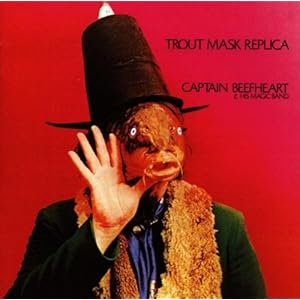
There was something curiously old-fashioned about that "his"; it seemed to evoke old-time acts like Mantovani and his Orchestra. This is strangely appropriate. For all his avant-garde reputation, Beefheart was a showman, and there's a playful theatricality in his music that in another life might have made him a housewives' favourite. You'd have a shock if you put the record on expecting some smooth strings though. I knew the album's reputation, of course - I was an obstreperous child and got that one because it had the most forbidding reputation - but the extraordinary noise that awaited me was something I wasn't prepared for. It took years (and I mean, around 10) for it to click that for all the complexities of time and tone, it was at heart a blues album. That moment of realisation brought everything into focus, and thereafter it seemed incomprehensible that I'd ever found this music forbidding. It never became comfortably familiar though. Like all great music, it remains unpredictable, startling, new.