I've signed up for Slow Club, an 8-week experiment in living life more slowly. Every week we have a task to perform. My first was to walk a walk I do regularly, but slowly. The following are notes I took on Thursday as I walked to the sandwich shop at lunchtime. Don't expect any startling insights...
Thursday, 12.38
Rush out of office. Remember - slow walk! Pause in corridor. Rattle of air conditioning unit. Somewhere a chair scrapes. Floorboard creaks as I move on. Wave to Jon as I walk out to stairwell.
High-pitched note - from building site over road? Small squares of sunlight dapple the road below. A drill somewhere.
Spots of light on stairwell from spotlights. Become conscious of my own footsteps, slow and irregular as I take notes - as I pause when I jot words down.
As I pass the First Floor, lift door slides shut. Out of the window: stone arch, two workmen on a crane over the road, 2 more inside above them. Doors open and close all up and down. Sudden distant shriek of people talking as they go past outside.
12.44
Outside. Chilly. Other people walking down the road past me, all going the same direction as me.
Two men through window in an office - one hunched over computer with tie over his shoulder, the other leans back in his chair, apparently napping.
Workman leans on corner. Below, past railing on basement window on corner - window boxes with small evergreen trees and ivy.
I feel the need to speed up as I approach the workman, lest I be looked at funny. I resist it.
A Volvo parks as I pause on the corner to write. Piles of planks on the corner pavement. Cars parked all along. Bike. Robert comes the other way, I say hello. Girl on phone follows, also the other way. A crocodile of kids behind me. Man with BBC pass approaches, concentrating on his phone (texting?) rather than what's ahead. He looks up in time to see me and not walk into me.
Cab on corner by pub with suitcases in open boot. Coming up to main road now, more people walking up and down.
12.50
Two men sat outside pub smoking. One has hat and (I presume) photo reactive glasses (not sunglasses?). Cross road. Gut on a bike with sunglasses (white frames) looks at me funny as he passes. Cross road. Cross of St George painted on lorry.
Pace of different people interests me. Cashpoint. Rejected! Bah!
Want to speed up, get back so I can check bank balance. Resist.
12.54
Speed up a bit to get across road before traffic kills me (I'd already started crossing before it went). People on phones everywhere. Man on phone - first person I've seen smiling.
12.56
Walking back
12.58
Cracks in pavement. People on phones - notice more people talking to each other. The people in company smile more. Two men stand on opposite corner having conversation. Woman leans on railing smoking and looking at phone.
Walk back down other side of road. Bike I passed last time has a horn on it. Jogger. "Thieves, beware" warns a sign on a post. Am overtaken by Lyr walking back to the office.
Another bike, tied to a lamppost, strange I didn't really register it on the way out (was it there?). It has a rear-view mirror attached to handlebar - hangs below it, I wonder how effective it is.
Leafy designs on cornices above doors. People now coming against me. Round window by side door to office.
I realise I came halfway round block same way back - wonder if I should have come back other way. See more people on way back, going upstairs. Have to pay attention! Walk slowly upstairs, feel my leg muscles tense and release, feel my weight going down into the floor/stair. Back in the corridor under the rattling aircon. One of lights in corridor isn't on.
13.08
Back in office - taken half hour on walk that'd normally take less than 10 minutes. Conscious of the cold in my fingers and nose.
Saturday, January 23, 2010
Notes on a Slow Walk


Thursday, January 21, 2010

Wednesday, January 20, 2010

Tuesday, January 19, 2010

Monday, January 18, 2010

Sunday, January 17, 2010
PopStar to Opera Star
You know as soon as you see Alan Titchmarsh that you're not in for anything nasty. The housewives' favourite isn't going to preside over the sort of laughing at the mentally ill and desperate that Simon Cowell fronts in the early episodes of the X-Factor, is he? And so it proves in ITV's latest attempt to get some decent viewing figures by cobbling together spare parts from other TV shows like a cathode ray Frankenstein. You have to admire Mylene Kalss's professionalism, too. She stands next to Alan as he does his bumblingly affable schtick, and then delivers her lines with a steely determination. There's barely a hint of the pounding fear that must underlie every waking moment when you've rescued your career by wearing a bikini in the jungle and are absolutely, fiercely resolute that you are going to hang on to the spotlight this time, oh yes.
The judges on PopStar to Opera Star are a bizarre combination. One wonders what drugs the production staff were on when they chose them. I assumed before I switched on that Lawrence Llewellyn-Bowen must have been chosen because he's a bit frilly and poncey - y'know, like classical music? - but it turns out he's on because he's a DJ on Classic FM these days, presumably because he's a bit frilly and poncey - y'know, like classical music? Meat Loaf, of course, is famous for his operatic records. Operatic in the sense of wildly ridiculous and over the top, that is. Which is the point at which you begin to realise exactly how opera fits into the scheme here.
The other two judges are also the coaches for the celebs, which is disappointing, because it means no-one's ever going to be anything other than nice to the contestants. This is surely going to be a strain when they get to Alex James, who is surely the undisputed king of Being Shit At Classical Music On Telly. They are Kathryn Jenkins and Animal from the Muppets. Ironically, Animal is the only person here who's actually been in an opera. That's not half as ironic as the presence of Katherine Jenkins, though - a woman famous for singing everything the same on a programme whose whole point is supposed to be about singing things differently to normal. There
The format follows the pattern we all know from Strictly X-Maestro Academy. Each celeb in turn is shown "in training", then emerges onto the set to bawl out a popular aria, every warble the subject of frenzied cheering form the (allegedly) live audience. There's no insight into how "operatic" singing differs from "pop" singing, or of why the celebs should want to do it (other than being paid to appear in an 8-week TV series, which is steady work for a couple of months, isn't it?). "I only know my song from the Stella ad!" exclaims Kym Marsh, to the hilarity of some canned laughter. Of course, most people only know that song from the Stella ad, but we'll let that pass, eh?
Animal and the Jenkster are never gong to be nasty to their pupils on live telly, not even Alex James, but you'd hope one of the other two might offer a more jaded counterbalance to their gushing. But no. Meat Loaf appears to be channelling John Barrowman, while Lawrence Fop, appears at first as though he might do a Craig Revel-Horwood, but as soon as he opens his mouth it becomes clear nothing's going to upset the applecart. You'd hope that at least a mild frisson would develop when Kym and Mylene have to share a stage, but even they manage to put on a half decent pretence of liking each other.
There's a decent idea for a TV show struggling to get out of all this. Well, there might have been, but it's been strangled at birth. There's no insight into how classical singing differs from pop singing, no indication why either might be worth attempting (oh, how I'd love to see a programme where Kitty J was made to try and sing in a "pop" style, or indeed to inject any sense of insight or understanding into anything she sings, ever). The complete absence of any criticism means that there's nothing to be learned. It's not really anything to do with opera, either. But I suppose "PopStar to PopStar Singing In A More Wobbly Voice" wouldn't have been such a catchy title.
Some will probably say that this is dumbing down classical music or opera. Well, duh. There's not really much point in fretting over that though. The classical music business sold itself down the river a long time ago, and really only has itself to blame that it's become the musical equivalent of a posh bubble bath. Anyway, this is ITV. We didn't come here to be educated. But you might at least hope to be entertained. You'd be disappointed.
ITV's absolute fear of doing anything that might be dangerous, or risky, or innovative, means that all the tropes they've stolen from other shows are neutered. There isn't even any danger that the celebs might look a bit shit, not even Alex James, the King of Being Shit At Classical Music On Telly. I know this because I saw his bit on YouTube this Morning. We actually switched off halfway through Kym Marsh's introduction, unable to take another seven contestants when we could be doing, well, almost anything else. I was hoping it'd be a bit of trashy fun, but it was just dull. That's what you've done, ITV: you've made a programme so dull I couldn't keep watching long enough to see Alex James being Shit at Classical Music On Telly. And that is surely the nadir of dull.
Saturday, January 16, 2010

Friday, January 15, 2010

Wednesday, January 13, 2010

Sunday, January 10, 2010

Friday, January 08, 2010

Thursday, January 07, 2010
Dream

Seriously, this happened: a couple of nights ago I had a dream consisting of harmonies based on the 13th partial of the harmonic series. What I've written down isn't that - that's hard to describe. In a way it was really just the single 13/8 pitch at the start of this page, but somehow there was a multitude of other sounds shimmering round it. It wasn't a visual dream, but it had a huge sense of space. What can it all mean?
I could just sit and play that first interval for ages. It's a strange one, it takes some listening because it lies even further outside the harmony I was brought up with than the 11th partial (which does bear a passing resemblance to "quarter tones" in equal temperament).
Wednesday, January 06, 2010
Scordatura

One of the things about Just Intonation on a cello is the fact that the strings are tuned in perfect fifths, which means that if you take C as your 1/1, the A string's actually too sharp. So here I detuned the A string by 80/81. I did this by stopping an E on the D string (tuned to make a just sixth with the G string) and then tuning the A down so it made a perfect 4/3 with that.

Monday, January 04, 2010

Sunday, January 03, 2010

Friday, January 01, 2010

Just Intonation Notation

For an explanation of Just Intonation and what all these ratios are, go here.
Ben Johnston's notation system for Just Intonation aims to produce something that looks similar enough to conventional notation that the average musician can get their head round it without going too batshit insane.
The basic notation is the C major scale. The notated triad C-E-G, F-A-C and G-B-D all represent just major triads, in ratio 4:5:6 (e.g. if C is 1/1 [=4/4], then E is 5/4 and G is 3/2 [=6/4])
One consequence of this is that the interval D-A isn't a perfect fifth, it's actually 40/27. This arises because of the syntonic comma, the difference between a just-tuned major third and a Pythagorean major third (i.e. one derived through the so-called "cycle of fifths"). This small interval is a ratio of 81/80, and that's notated by a + or a - (line a above)
(Another consequence of this is that if you tune to "A", as is standard practice, the open strings of a cello are therfore not A, D, G, C but A, D-, G-, C-. I experimented for a while with a version of this notation in which a key signature of one sharp indicates that the uninflected notes of the G major scale are the 4-5-6 triads instead of the C major scale. This meant that for a cello the open strings would be notated as naturals (although a violin's E string would have to be E+). I decided this was potentially too confusing and I've now reverted to Johnston's original plan.)
b) sharps and flats raise or lower a note by the ration 25/24, which is the difference between a just major and minor third (5/4 and 6/5)
c) the 7 and upside-down-7 signs raise or lower by 36/35, which is the difference between a just minor ninth (9/5) and the "flat" seventh partial in the harmonic series (in C major, Bb7)
d) the up and down arrow raises or lowers by 33/32, which is the difference between a perfect fourth and the "sharp" fourth that is the eleventh partial (in C, F^)
e) the "13" and upside-down "13" raise or lower by 65/64, which is, you guessed it, the difference between a minor 6th and the "sharp" minor 6th of the 13th partial (Ab13).
You can go on ad infinitum, adding a new inflection for every prime number, but that's quite enough to be going on with. f), g) and h) show a few examples of how these accidentals may be combined to form compound signs, except the +/- of 81/80, which is always separate and always closest to the note.
Thursday, December 31, 2009
We're all retro now

Everyone and his dog seems to be drawing up lists of their favourite/ the best (pretty much interchangeable terms in fact) records of the past 10 years . I hesitate to do it too, because most of them are fairly uninteresting. But what the hell, opinions are like arseholes, and we all seem to like displaying them on the web, so here's a random selection of recordings I've picked up since 2000 that have touched me in some way. Not all of them originate from the past decade. Some were reissued, some are ancient things that I just didn't come across before. I make no claims to this being a list of the best or most innovative or fashionable or zeitgeisty or whatever you think a record ought to be. They're just things that came by at the right time and made some sort of impact on me. Being the right thing at the right time is what makes a great record. The fragmentation of public taste, the explosion of media that's happened lately means that big "event" records that mean a great deal to a sizable proportion of the population are becoming rarer. We all have to find our own milestones now. Some of us have always worked that way.
John Luther Adams: The Light That Fills the World
Beethoven in the Temperaments
Six Degrees of Tonality
Björk: Medúlla
The Bowmans: Far From Home / The Bowmans
Sam Brown: Ukulele and Voice
Bruckner: Symphony No.9 with reconstructed finale (Sinfonieorchester Aachen, cond. Marcus Bosch)
Kate Bush: Aerial
R. Crumb's Heroes of Blues, Jazz and Country
Smog: A River Ain't too Much to Love
Eliza Carthy: Dreams of Breathing Underwater
Tounami Diabaté: The Mandé Variations
Bob Dylan: Love and Theft
Julius Eastman: Unjust Malaise
The Fall: The Unutterable
The Feelies: Crazy Rhythms
Morton Feldman: String Quartet No.2 (Flux Quartet)
Fleet Foxes
Flight of the Conchords
PJ Harvey: White Chalk
Grinderman
Schoenberg: Violin Concerto (Hilary Hahn)
Glenn Gould: The Solitude Trilogy
The Imagined Village
Ben Johnston: String Quartets No.s 2, 3, 4 and 9
Elizabeth Maconchy: Complete String Quartets
Lubica Marić: Byzantine Concerto etc.
The Mules: Save Your Face
Joanna Newsom: The Milk-Eyed Mender
Harry Partch: The Wayward / 17 Lyrics of Li-Po
Radiohead: Kid A
Rasputina: Frustration Plantation
Zeitkratzer: Metal Machine Music
Kronos Quartet: Floodplain
Bella Hardy: Night Visiting
Viktor Ullmann: Symphonies/ Piano Sonatas
Vialka: Plus vite que la musique
Tom Waits: Real Gone
Scott Walker: The Drift
M Ward: Transfiguration of Vincent
Brian Wilson: Smile
Amy Winehouse: Back to Black
Cantigas de Santa Maria
Kathryn Williams & Neill MacColl: Two
Enough with the back-glances. Happy New Year, everyone, maybe time to push things forward in 2010.
Friday, December 04, 2009
KSO Programme notes: McCabe, Janáček, Shostakovich
Leoš Janáček (1854-1928)
Taras Bulba
1. The Death of Andrei
2. The Death of Ostap
3. The Prophecy and Death of Taras Bulba
Nikolai Gogol’s novel Taras Bulba tells the story of a Ukrainian Cossack and his two sons. Ostep is the more adventurous and true to the Cossack nature of the two, while Andrey is a romantic. They set out to join the war against the Poles who have occupied the western Ukraine. They besiege Dubno Castle. Andrey falls in love with a Polish girl, and renounces his heritage to help her and the besieged Poles. Taras discovers his son’s betrayal and executes him. Ostep, meanwhile, is captured during battle and tortured by the Poles. Taras attempts to disguise himself to reach the prison to see his son, but his ruse fails, and he witnesses Ostep’s execution from the crowd. Finally, Taras is caught in battle, tortured and burned to death by his captors. Even as he dies, Taras calls on his men to continue the fight, and predicts that a great Tsar will come to rule the world.
Leoš Janáček read the novel in 1905 and made extensive notes. At a time when the Czechs were still ruled by the Austro-Hungarian Empire, Taras Bulba’s tale of a nation’s struggle to free itself from oppression struck a chord. However, it was not until 1915 that he began work on his orchestral work based on Gogol’s tale. The First World War was raging, and the Czech nationalist movement was gathering pace, inspired by Russia’s offensive against Austria-Hungary at Galicia. By the time he completed Taras Bulba in 1918, the war had left the empire exhausted. Later that same year the creation of the state of Czecho-Slovakia brought an end to 200 years of Austro-Hungarian rule.
Trying to map the plot of Gogol’s novel onto Janáček’s music in any more than a vague way is problematic. Janáček’s memory of a story he had read a decade earlier would seem to be less than crystal clear. His own note on the work, written in one long, breathless sentence for the Prague première, perhaps reveals that the spirit that is more important than the detail:
“Not because he beat to death his own son for betraying the nation – Part I (the Battle of Dubno);
not because of the martyr’s death of his second son – Part II (the Warsaw torments);
but ‘because the fires, the tortures that could destroy the force of the Russian people are not to be found on earth’ – for these words that fall into the fiery sparks and flames of the stake at which the sufferings of the famous Cossack ataman Taras Bulba finally ended – Part III and conclusion, did I compose this rhapsody in 1915-16 based on a tale written by N.V. Gogol. Leoš Janáček.”
John McCabe (b. 1939)
Symphony “Labyrinth”
Underneath Edge Hill in Liverpool lies an extensive network of underground passages. The Williamson Tunnels were excavated between 1805 and 1840 at the behest of Joseph Williamson, an eccentric entrepreneur. Quite why he built them is not known for sure. Rumours spread at the time that they were intended to shelter a religious sect that believed that the end of the world was imminent. But it is quite possible that they represent nothing more sinister than a rich philanthropist’s desire to provide honest work for unemployed men returning from the Napoleonic Wars. Williamson himself declared that his workers “all received a weekly wage and were thus enabled to enjoy the blessing of charity without the attendant curse of stifled self respect.”
In the 1830s, Williamson’s path crossed both figuratively and literally with George Stephenson: the great engineer bored his own tunnel through the area to carry trains to and from the new railway station at Lime Street. Over a century later, the young John McCabe’s imagination would be fired by the thought of Williamson’s labyrinth as he rode the trains. Occasionally he would catch a glimpse of a bird in flight in a small patch of sky seen through a ventilation shaft in the tunnel.
That childhood memory provided the impetus when he came to compose a work for the Royal Liverpool Philharmonic Orchestra to perform in celebration of his home town’s 800th anniversary in 2007. “Labyrinth” is John McCabe’s seventh symphony, and like Sibelius’s seventh is cast in a single movement. It has no programme, although McCabe concedes that the bird glimpsed from a train can be heard in the piccolo that begins the symphony, while the sinewy lines that soon emerge in the cellos and basses perhaps suggest the darkness of the abandoned caves beneath Edge Hill. From this darkness, the symphony strives towards light, a struggle that reflects the turbulence of Liverpool’s history. A gradual, constant acceleration leads to a driving climax, which then evaporates, leaving the opening idea subtly transformed, as though we are now in the clouds with the bird we glimpsed at the outset.
Dmitri Shostakovich (1906-1975)
Symphony no.5 in D minor, op.47
1: Moderato
2: Allegretto
3: Largo
4: Allegro non troppo
The singer Galina Vishnevskaya recalls a pointedly ambiguous statement made by Shostakovich in one of the many public submissions he had to make to the state during his life: “Our Party has so closely followed the growth of all musical life in our country. I have been aware of that close attention throughout my creative life.”
Shostakovich was particularly aware of that close attention in 1937. Since the attacks on his opera “Lady Macbeth of Mtsensk” and his ballet “The Limpid Stream” in Pravda the previous year he had found himself transformed overnight from the Soviet Union’s foremost composer to a non-person. The Great Terror that Stalin inflicted on Russia was at its height. Arrests and disappearances reached a vertiginous level. Stalin declared that 10 per cent of the population was subversive. The only way the police could make enough arrests to match this figure (which, coming from the leader himself, must be correct) was to detain people more or less at random. Like many others, Shostakovich kept a packed suitcase by the door, ready for the knock in the night signalling the arrival of the secret police to take him away. T be seen in public without a smile was to court arrest. Solzhenitsyn summed up the times: “Black Marias by night, demonstrations by day.”
Shostakovich completed his Fourth Symphony in May 1936 in the wake of these attacks. A performance was planned, but it became clear that the consequences of playing such a work could be severe for all concerned. After some strained rehearsals, Shostakovich withdrew the symphony, claiming dissatisfaction with it. The extraordinary, dissonant and dissident work would not be heard until 1961.
The only work available to him was film and theatre music. This may have worked to his advantage: Stalin was a keen film buff, and his awareness of Shostakovich prior to the Lady Macbeth controversy would have been as a film rather than a concert composer. Loyalty was next to impossible to demonstrate when the leader’s whims made citizens into enemies of the state overnight. Usefulness was another quality entirely, and Shostakovich’s film work made him look useful. This may be how he avoided the gulag: it also gave the party and Stalin an opportunity to be publicly merciful.
From the tone of the Pravda articles, Shostakovich knew that at the least he was expected to make his musical language simpler and more obviously tonal. What is remarkable about the Fifth is not, however, the compromise in style. The melodies are less angular and the harmony more straightforward than the Fourth Symphony, true, but it wilfully ignores the demands of the party in one very important respect: the Fifth is an explicitly and overwhelmingly tragic work.
Its famous and verbose subtitle, “A Soviet Artist’s Practical Creative Reply to Just Criticism,” was not Shostakovich’s invention. A journalist previewing the première in January 1938 coined it. The composer happily went along with the idea: it offered a very useful shield. He gave interviews in which he made vague pronouncements that the new symphony concerned “the making of a man.” The première in January 1938 was a huge success: it received a standing ovation nearly as long as the entire symphony. A long debate ensued, during which some astonishing logical somersaults were performed by party officials in order to explain why the symphony was in fact a straightforward, optimistic piece of Soviet Realist art. A “Hamlet” theory quickly became popular, which cast Shostakovich in the role of Shakespeare’s Dane. Thus the tragic element could be explained away as a superficial precursor to Soviet enlightenment. Shostakovich was rehabilitated – although he still kept the suitcase by the door, just in case.
The first movement’s opening gesture contains the seeds of almost everything that follows. It settles into an uncertain, shell-shocked mood, into which grotesquery gradually intrudes. A parody of the kind of four-square march beloved of totalitarian regimes throughout the world breaks out, before a climactic cry of anguish. This subsides into a deadpan passage in which a horn attempts to follow a flute into the stratosphere, before disappearing into an uneasy mist.
The second movement is a clodhopping affair brimming with irony. It attempts to display some finesse in its dance, but is never very far from a banana skin.
If the first half of the symphony is characterised by irony and distance, the third movement provides the emotional heart of the symphony. It was this intense, deeply tragic music that moved its first audience to tears. The effect of such deeply and genuinely emotional music on an audience that was effectively forbidden to have genuine emotion must have been overwhelming.
The finale continues to be the subject of controversy. For many years the official explanation was accepted without question in the West: that the “Hamlet-like” tragic (and therefore individualist and superficial) themes are overcome by the profound joy and triumph of the collective Soviet will. But one only has to listen to realise that the “triumph” is imposed. Any sign of genuine emotion is trampled by bullying brass. In a brief moment of hope, an undulating motif in the harp alludes to Shostakovich’s setting of Pushkin’s Poem “Rebirth.” But the “new and brighter day” promised does not dawn. Instead a darkly menacing restatement of the movement’s opening theme builds to a witheringly ironic conclusion: A crude, banal fanfare is upstaged by its own accompaniment of a single note hammered out 251 times, as Vishnevskaya describes it, “like nails being pounded into one’s brain.”
The conductor Boris Khaikin recalled a conversation he had with Shostakovich after the symphony’s premiere. The composer remarked, “I finished the Fifth Symphony in the major and fortissimo… It would be interesting to know what would have been said if I finished it pianissimo and in the minor?”
Thursday, November 26, 2009

Monday, November 02, 2009
KSO Programme notes: Debussy, Ullmann, Stravinsky
Claude Debusy (1862-1918)
Ibéria
1. Par les rues et par les chemins (In the streets and byways)
2. Les Parfumes de la nuit (Perfumes of the night)
3. Le matin d'un jour de fête (The morning of a festival day)
When Debussy composed Ibéria, the central part of his orchestral triptych Images (and the first to be written), he was at a turning point in his life. The notoriety that characterised his early successes had become international fame with the first productions of his opera Pelléas et Mélisande in 1902. The cult of “Debussyism” reached its peak, and scandal was replaced by expectation.
As is often the case, success was to be swiftly followed by a backlash. Those who had championed his earlier work found his new music staid in comparison. Those who had always considered his style to be a threat to the very foundations of all musical orthodoxy found more grist to their mill.
Shortly after he completed Ibéria in December 1909, Debussy exhibited the first symptoms of the cancer that would eventually kill him. In June 1912 his transformation from enfant terrible to yesterday’s man was brought home forcefully to him when he sat at the piano with the young Igor Stravinsky and played through the piano score of The Rite of Spring.
Some say that Images betrays a falling off of inspiration. This is unfair. Ibéria, in particular, shows off Debussy’s masterly and original way with an orchestra to the full, including what is for him an unusually unrestrained percussion section. Debussy had a strong mystical streak, which came from his involvement with the Symbolist movement. One of the aims of the Symbolists was to create art so evocative that it actually becomes the thing it depicts. In his attempt to achieve this, Debussy jettisoned traditional ideas of musical structure and form. A letter he wrote to a friend reveals something of what he aimed at: “You can’t imagine how naturally the transition works between ‘Parfums de la nuit’ and ‘Le matin d’un jour de fête’. It sounds as though it’s improvised.”
Viktor Ullmann (1898-1944)
Symphony No.2 in D major (“Theresienstadt Sketchbook”)
(Reconstructed from the Piano Sonata No.7 by Bernhard Wulff)
1. Allegro
2. Alla marcia, ben misurato
3. Adagio, ma non tanto
4. Scherzo: Allegretto grazioso
5. Variations and Fugue on a Hebrew Folksong
Terezín (Theresienstadt), about an hour's drive from Prague, was built in 1780, as a garrison town. The Austro-Hungarian Emperor Franz Joseph II wanted to ensure that the borders of the Czech territory he had conquered would not be overrun by German hoards from the north. In the event, the town was never used for its intended purpose. Instead it found an effective alternative role as a high security prison. When the German invasion finally came in 1940, Terezín reached its final form as a concentration camp. At its height, the ghetto was home to over 60,000 Jews. The town had been designed to house a population of 5,000. Food was scarce and disease rife.
This was not so different from any other concentration camp. But Terezín was distinguished by one extraordinary fact: its cultural life, which flourished. The plan was to dispel rumours of death camps by promoting Terezín as a cultural beacon. To this end, many Jewish intellectuals were sent there. Artistic activity and the performance of otherwise banned musical and theatrical works was at first tolerated, and later actively encouraged. The results, paraded to visiting representatives of the Red Cross and filmed for a propaganda film, were held up as proof that the Czech Jews were living an idyllic life, separate from the “native” Ayrians (who had been encouraged to immigrate by the Nazis).
Terezín was host to many talented composers, but Viktor Ullmann was perhaps foremost. A former pupil of Schoenberg, he had in the years preceding the war forged his own style, building on but completely distinct from his teacher’s. When war broke out and the Nazis occupied Czechoslovakia Ullmann found himself transformed overnight from an internationally renowned composer into a nonentity. His music was barred from performance and he was forbidden to appear in public. In 1942 he was sent to Terezín. For the next two years he was heavily involved in the musical life there, not only as a composer and pianist, but also as a critic. His surviving (by no means always kind) reviews of the musical productions there are one of the most important sources of information about artistic life in the ghetto.
That a vivacious artistic culture should thrive in a concentration camp seems scarcely believable. In an essay written towards the end of his time there, Ullmann reflected on the morality of art in captivity. “Theresienstadt was and is for me a school of structure. Before, when one did not feel the force and weight of existence because of comfort, this magic of civilisation, it was easy to create beautiful form. Here, where one must daily overcome the substance of life, where everything goes against the Muses: here is the masterclass... I must stress that I have bloomed in my musical work at Theresienstadt, without inhibition, and that in no way did we merely sit down and weep by the rivers of Babylon that our will for culture was inadequate to our will to live. And I am convinced that all those who have struggled to wrest Form from Art and Life will say that I was right.”
The symphony you hear tonight is a reconstruction: it has a dual existence as Ullmann’s seventh piano sonata. By the time he wrote it in August 1944, dedicating it to his children, such luxuries as manuscript paper were a distant memory. He wrote piecemeal on whatever paper came to hand. The manuscript is a fragmentary piano score, with notes for orchestration. It is unclear to what degree it was intended as a piano work or a short score for an orchestral work. Quite possibly Ullmann abandoned his initial ideas for orchestration simply because the resources were not available. Perhaps they reflect a hope for a day when he might be free again and able to write for a symphony orchestra once more.
The music contains many quotations, partly autobiographical, and partly coded messages to his fellow inmates. Mahler’s Song of a Wayfarer, Wagner’s Tristan and Isolde, and Richard von Heuberger’s operetta The Opera Ball are all quoted, as is Ullmann’s own opera The Emperor of Atlantis, also written for performance in Terezín. The latter is the source of an unusual feature of the symphony: the presence in the orchestra of a harpsichord, which also appears in the opera.
The “Hebrew folksong”that forms the basis of the Finale is in fact a Zionist song by Yehuda Sharett. It sets a poem by the Russian Jewish poet Rachel, in which the she imagines herself as her biblical namesake. Ullmann’s variations draw attention to its resemblance to the Slovak national anthem (also banned by the Nazis) and the Hussite hymn “Ye Who Are God’ s Warriors”. The famous chorale “Now thank we all our God” and the four-note motto derived from Bach’s name. Such Germanic Protestant music may seem incongruous in a Jewish ghetto, but it should be remembered that many of the prisoners would have previously considered themselves secular and German. Bach’s music especially was cherished as an important, and comforting part of their own culture.
Liberation came to Terezín in early 1945, too late for Ullmann: On October 16th 1944, having been persuaded by his friends to leave his manuscripts in their care, he was put on a transport train to Auschwitz. On arrival he was sent directly to the gas chambers. For all the darkness surrounding its creation, however, the lasting impression left by the music is one of great courage and determination. The music itself, and the fact of its survival, is a remarkable testament to the tenacious spirit of Ullmann and his fellow prisoners. Its diversity of influences and materials represents a plea for tolerance that is still all too pertinent today.
Igor Stavinsky (1882-1971)
Petrushka (1911 version)
Scene 1: The Shrove-tide fair
Scene 2: Petrushka’s cell
Scene 3: The Moor’s cell
Scene 4: The Shrove-tide fair (towards evening)
The Russian puppet-show Petrushka was a familiar fixture at the fairs of Stravinsky’s childhood. It was these he had in mind when he sketched an idea for a piece for piano and orchestra in 1910, in between his ballet The Firebird, and the next production he was due to write for Diaghilev’s Ballets Russes, The Rite of Spring.
Like many ancient national traditions, the show is a nineteenth century import. Petrushka himself is Russia's version of Mr Punch. The plot is essentially the same: the protagonist has a succession of confrontations with authority figures, all of whom he whacks with a large stick. Eventually he is tried and executed for murder, and goes to Hell. Diaghilev was taken by the music, and the idea of a production based around the carnivals, and asked Stravinsky to rework it as a ballet.
Anyone familiar with Stravinsky’s music will probably now be scratching their head, as the above plot bears very little resemblance to anything in the ballet. In fact, Stravinsky voiced the concern early on that librettist Alexandre Benois’s scenario for Petrushka contained very little Petrushka. What Benois (12 years older than Stravinsky) remembered most vividly from the carnivals of his youth were the Harlequinades – plays based on characters from the Italian Commedia dell’Arte. Thus Petrushka, the Moor and the Ballerina are in character closer to Pierrot, Harlequin and Columbine than what Stravinsky remembered from his youth. The closest Petrushka comes to his traditional demeanour is in the second scene in his cell (which derives from Stravinsky’s initial sketches) and in the closing pages where Petrushka’s ghost appears – which may raise the question, is the final apparition a ghost, or the real Petrushka? This is only one element of a disturbing undercurrent of the ballet: puppets behave like people; people behave like puppets; and the audience, which finds itself viewing events from the perspective of both as well as its own, may wonder where it fits into the scheme of things.
The combination of Stravinsky’s music, the exotic setting of the Russian carnivals and the flamboyant production values of the Ballets Russes added up to an instant hit. Not everyone was pleased with the result: many Russian critics condemned Stravinsky for his stylistic experiments and appropriation of folk materials. They saw it as a debasement of the legacy of Rimsky-Korsakov. This is a curious reaction given that Stravinsky’s veneration of his teacher is written in every note, sometimes to a plagiaristic degree.
When Stravinsky emigrated to America in the 1940s, he rewrote and rescored a number of his early works, principally to be able to copyright them under US law, but in some cases the changes were quite radical. The latter incarnation of Petrushka is largely unchanged in its music, but the orchestration is radically altered: by slimming down his forces, Stravinsky gave the work a new and lucrative life as a concert work. However, when he came to re-record the ballet towards the end of his life, he performed Petrushka in its original garb: more extravagant and theatrical than its leaner, concert-hall oriented revision.
Synopsis
The curtain opens on the eve of the St. Petersburg Shrovetide fair, sometime in the 1830s. – we hear the cries of the sideshow barkers drumming up audiences and street songs sung by drunken revellers. A barrel organist accompanies himself on the cornet (a rather rude song about the actress Sandra Bernhardt that Stravinsky had heard on a barrel organ while staying in Beaulieu on the French Riviera) while a dancer joins in. At the other side of the stage, another dancer performs to a music-box.
Two drummers appear in front of a little theatre and attract the crowd’s attention. The Charlatan, an old conjuror, appears from behind the curtain. He plays his flute, and the curtain rises to reveal three puppets: Petrushka, the Ballerina and the Moor. The Charlatan brings them to life by touching them with his flute, and they dance.
Petrushka is thrown into his cell and the door is locked behind him. The puppets have been filled with human emotions by the Charlatan’s magic, and Petrushka most of all. He curses the Charlatan for imprisoning him, and suffers at the knowledge of his own ugliness. The Ballerina enters, and he attempts to woo her. But she is terrified and runs away. He flings himself at the wall in frustration.
In contrast, the Moor is vain and stupid. The Ballerina finds him attractive, however, and uses every trick in her book to seduce him. Just as she succeeds, Petrushka bursts in, mad with jealousy. The Moor throws him out.
Ouutside, it is now evening, and the carnival is in full swing. The wet-nurses dance. A peasant with a bear enters, and the crowd scatters. A merchant enters, with two girls on his arm. He throws bank-notes into the crowd as the girls dance to an accordion. The coachmen dance, joined by the wet-nurses. A group of mummers burst in, and their leader, dressed as the Devil, provokes the crowd into dancing with him.
The revels are interrupted by a commotion. Petrushka runs out of the theatre pursued by the Moor, who pulls out his sabre and strikes Petrushka down. The crowd falls silent in horror.
The Charlatan arrives. He picks up Petrushka and shakes him. Seeing that the corpse is only a puppet, the crowd disperse. As the Charlatan pulls the body back to the theatre, he looks up and sees Petrushka’s ghost, threatening and mocking him and everyone he has fooled.
Saturday, October 31, 2009
New beginnings, old concerns

One week ago I got married. One of the little projects we attached to this great endeavour was to make a little booklet full of things we like and things we do. One of them was this little piece for cello. I put the sketch from my moleskine in the book because it looked nice. Looking nice isn't necessarily conducive to being able to read a score though, so this is a tidied up and Sibeliused version. I used an inkpen font for the setting, because as Kyle Gann's pointed out before, somehow it makes the score look more suggestive, less prescriptive. That's not the only experiment going on here. Now the biggest project of all is complete, we've got ideas for lots of new ones, of which this is a tentative stp towards one. More of these little cello pieces to come...
(a note on those funny accidentals: + raises by 81/80, ^ raises by 33/32, 7 lowers by 35/36, # raises by 25/24. G is 1/1. If you don't understand any of that, go here.)
Saturday, September 12, 2009
Beatles for Sale
I was going to write something about the Beatles, but I decided to draw a comic instead.
Thursday, September 03, 2009

Thursday, August 13, 2009
New Definitions: Classical Music
 Happy birthday to me!
To celebrate, and in the vain hope of kick-starting this blog into something like action, I've been thinking about definitions.
We all like to define things, don't we? And it's even more fun when we can have good fight about it. A spate of letters recently in Private Eye has debated the rights and wrongs of Classic FM's playlist, and whether the music from ET is classical or not. Classic FM seems to take the view that if it's got an orchestra or a wobbly cod-operatic voice on it, it's classical. Others disagree.
It's a perennial argument. Once upon a time, "Classical Music" meant simply music written between about 1760 and 1830, a particular style as exemplified by Haydn, Mozart and Beethoven. But the advent of the twentieth century and the invenion of recording, pop music and marketing means that now anything written from the 12th century to today might be called classical, if only we could agree what that means. According to recent reports, classical music is apprently something soothing to distract you from the recession. This implies that Bacharach is classical, but Beethoven isn't. Hmm. tricky, isn't it?
Kyle Gann has also been in on the argument recently, offering a definition given him by Robert Ashley -under 5 minutes is pop, over 5 minutes is classical - and I can see the attraction of that. It's simple, it sidesteps all those thorny issues of whether a particular genre might be inherently classical or not-classical, and it pisses off a few people in the process who probably deserve to be pissed off.
My definition is even simpler, though, and it sidesteps all those tricky borderline issues, such as whether Blue Monday by New Order is clasical, but True Faith isn't. And it's this:
Classical Music is music written by dead people.
So: Beethoven, Bach, Josquin, Stockhausen: Classical. As is Frank Zappa, who's an excellent example, as he was treated with disdain and contempt by the classical music establishment until he died, whereupon he became OK and can now be found cropping up in classical concerts, and is represented by a classical publisher. And Michael Jackson is the latest inductee to the classical canon. Of course.
Britney, Take That, Thomas Ades, Björk and me, however, are Not Classical. We're just breathing too much.
The Beatles, meanwhile, count as crossover, I guess.
So there you go: if they're dead, it's classical. Much simpler. Glad we cleared that one up.
There are probably a few naive people out there who think it doesn't matter, and that the only important question about a piece of music is whether it's any good or not, but of course we pay no heed to such people.
Monday, July 13, 2009
Festival Fever 1759
As the festival season is upon us, and specifically the Proms are about to start (a lot of meh, a few interesting things this year as far as I'm concerned - I'll get around to that later), here's an historical perspective, as first seen in Classical Music's recent festivals supplement.
Monday, June 29, 2009
Friday, June 26, 2009
Another one bites the dust...
Bloody hell, now Jacko.
I was going to put a video up, but the internet seems to be grinding to a halt at the moment. It must be all the grieving subjects of the king of pop.
Thursday, June 25, 2009
RIP Swells
A world without Swells? Say it ain't so!
Sadly, it is. But it doesn't seem possible he could be gone. RIP, you contrary bugger, you.
Wednesday, June 24, 2009
Programme Notes: Elgar, Strauss, Brahms
Here are my notes for last night's KSO concert. It's all about the facial hair. I had something about Strauss's moustache in the first draft, but my editor made me cut it out. "You're just doing that to amuse yourself," she said. Well, it's a fair cop.
Edward Elgar (1857-1934)
Froissart – Concert Overture, Op.19
Elgar’s public image – the tweed suit, the extravagant moustache, the very image of the establishment country gent – was assiduously cultivated. He did this so successfully that the most popular idea of him today is still the gruff patriot, churning out tunes to wave flags by. The reality was rather different. To be born a Catholic in the provinces was the mark of an outsider in Victorian England. It took years of struggle and disappointment before he achieved his status as England’s foremost composer.
Froissart is an early work. It was commissioned by the Worcester Festival, but actually composed in London. Elgar had moved there with his new wife Alice in 1889 hoping to make his mark, but he struggled to make an impact. He had to commute back to Malvern to earn money teaching the violin, and the arrival of his first child put further strain on his finances. At one stage he was forced to pawn Alice’s pearls. Disillusioned, he retreated to Malvern in 1891, and would not return to London for a decade. Despite these misfortunes surrounding its composition, he retained affection for the piece in later years.
The overture is named for the medieval French writer Jean Froissart. Froissart worked as a merchant and a clerk before he became the court poet and historian to Philippa of Hainault, the consort of Edward III. His Chronicles, written as he travelled round England, Scotland, Wales, France, Flanders and Spain, are one of the most important contemporary records of the period leading up to the Hundred Years’ War.
Froissart’s value as a reliable historian is disputed, but what appealed to Victorian England was his depiction of the values of chivalry. Rather than any specific event, Elgar evokes the spirit of dashing nobility. The score is prefaced with a quotation from Keats that sums up the Romantic enthusiasm for this ideal: “When Chivalry lifted up her lance on high.”
Richard Strauss (1864-1949)
Horn Concerto No.2 in E flat
1. Allegro – Andante con moto
2. Rondo (Allegro molto)
In 1945 an old man walked down the stairs of his country retreat with his hands up and surrendered to the American soldiers who had entered with the words, “I am Richard Strauss, the composer of Rosenkavalier and Salome.” He cut a very different figure to the young turk who had scandalised early 20th century audiences with dissonant operas on such scandalous subjects as Salome. The First World War swept aside the certainties of nineteenth-century Europe, and almost overnight the former leading modernist found himself out of step with the times. As the younger generation scandalised Viennese ears with such horrors as atonality and jazz, Strauss assumed the mantle of Establishment: conservative, safe and above all respectable.
It was rather unfortunate that over the next twenty years the Establishment took a turn for the worse as Hitler came to power. Probably more through naivety than anything else, Strauss decided that he could stand apart from politics. Not everyone agreed with this stance. The nature and morality of Strauss’s relationship with the Nazis continues to provoke heated debate even today. The works of his last years are marked by a conspicuous sense of retreat from a world that had left him far behind.
Strauss wrote his first concerto for horn as a young man for his father to perform (the elder Strauss declared it too difficult), and his second, part of the remarkable fecundity of his last years, was written as a tribute to his memory. He only intended it to be performed once, and that is reflected in its absolute straightforwardness of mood. Barely a hint of the war that raged as he wrote it in 1942 is to be heard. Beyond the occasional moment that hints of darker things, the concerto exists largely in a Mozartean utopia, the hunting calls that abound perhaps an echo of an imagined past when life was more chivalrous, less complicated.
Johannes Brahms (1833-1897)
Symphony No.3 in F, Op.90
1. Allegro con brio
2. Andante
3. Poco allegretto
4. Allegro
Like Elgar, Brahms hid a complex personality behind a construct of gruffness, sturdy suits and facial hair. He was immensely self-conscious about his place in musical history, and went to great lengths to make sure that as little as possible of his life became public knowledge. But the crusty image of “Herr Doktor Brahms” belies a life born in grinding poverty. His teenage years were spent playing piano in brothels to make ends meet, where he was subject to abuse of all kinds. He was irrevocably scarred by his early experiences. He felt deeply lonely, yet incapable of allowing himself any great intimacy. He was notorious for his caustic wit and an exasperating combination of misanthropy and self-pity. “I have no friends!” he would often exclaim in later life (to his friends).
By the time he came to write his third symphony, the blue-eyed, handsome youth had long since disappeared beneath the façade. He was held up as the figurehead of the conservative opposition to the revolutionary music of Wagner and his followers. This was not a position he sought or welcomed, despite his reservations about the Wagnerian cult. He remarked acidly on more than one occasion that he understood Wagner’s music far better than any of his most rabid acolytes. But as the pre-eminent composer of symphonies and chamber music in a world dominated by Wagner’s ideas of the “Total Art Work”, he felt himself to be the last of a line.
In 1883 Brahms was about to celebrate his 50th birthday. He was, after Wagner’s death early that year, indisputably the foremost composer in Germanic culture. Not that his mind was entirely focussed on his artistic reputation. He was in the grip of one of his perennial infatuations, in this case a young singer called Hermine Spies. An outpouring of vocal music followed. His decision to take his summer holiday in Wiesbaden rather than his customary destination of Bad Ischl may not have been unconnected with the fact that she was there during that summer. What if anything went on is a matter for conjecture: this is one of those episodes that Brahms was more successful in removing from record. But in a light and airy country house in sight of the Rhine, as luxurious, he claimed, “as if I were trying to imitate Wagner”, he began his third symphony.
Brahms more than almost any other composer resists interpretation, but there are clues as to the influence of extra-musical thoughts. The opening three chords derive from a cipher. His friend and early champion, the violinist Joseph Joachim, had a motto: the notes F-A-E, standing for “Frei aber einsam” [free but lonely]. Brahms rejoined with F-A-F, meaning “Frei aber Froh” [free but happy]. This arresting opening plunges us deep into the current of the Rhine – almost literally, as the main theme is adapted from the Rhenish Symphony of another of Brahms’ friends from his youth, Robert Schumann.
These associations ran deep for Brahms. Both Joachim and Schumann had provided crucial support early in his career. There were less happy memories too. He had fallen out with Joachim three years earlier over the latter’s divorce, and it is perhaps significant that Brahms’s first attempt at a rapprochement would be to ask Joachim to conduct the Berlin premiere of the Third Symphony. Schumann loomed large in Brahms’s life beyond his role as mentor. As the elder composer succumbed to madness and died in an asylum, Brahms fell head over heels in love with his wife, the great pianist Clara Schumann. Whether these feelings were consummated is still a subject of speculation, but she was undoubtedly the great love of his life. The presence of these motifs in the symphony suggest that thoughts of his past must have been present, and to be thinking of his lost friends and lost loves while he was pursuing the young contralto must have been a source of much soul-searching. The overall mood of the opening movement is heroic, but it is heroism undermined by instability: the rhythms and harmonies are in constant flux.
The middle two movements are more subdued and introverted. The second begins restfully enough, but there is a melancholic undertow. The third movement’s exquisitely yearning main theme made it an instant hit at early performances. In those days when no one worried about whether or not to clap between movements, it was often encored.
The finale begins quietly and tensely before erupting. Elements of the previous movements are woven into the design, which seems to be striving towards a heroic conclusion. Brahms often takes a moment in his finales to reflect before he races for an affirmative ending. But on this occasion things take an unexpected turn. The ensuing valediction nods towards Wagner, and reveals the opening theme’s true nature. It would be an unthinkable way to conclude such monumental music had Brahms not done it and made it seem so right.
Wednesday, June 17, 2009
In C on the South Bank, 14 June 2009
World Busk Day 2009 from John Hackett on Vimeo.
Thanks again to everyone who helped make it happen. Show your appreciation here.
Sunday, June 14, 2009
The Ramshackle Orchestra for Musequality

We arrived on the South Bank shortly after 11.00. We scouted about a bit and eventually decided to pitch ourselves under a tree just near where that big purple E4 cow is at the moment. While we waited for the others to arrive, Em and I entertained ourselves, if no-one else, with our ukes and our singing. We learned that Innocent When You Dream, while a lovely song, is a bit maudlin to attract money. Downtown and Five Foot Two, Eyes of Blue work much better in this regard. Even if you struggle to remember the words.
By the time the rest of our band started to arrive at about 11.30, the walkway was considerably busier, and if we'd showed up then instead of 20 minutes earlier we'd have struggled to find a place to set up amidst the other buskers, balloon modellers, pavement artists and talking plant pots that now surrounded us. Undaunted, we set up, and ploughed into In C.
It's an amazing experience, playing this music. All the difficulties of playing the patterns that I'd found practising earlier in the week seemed to melt away, and the web of cross rhythms that rapidly built up as utterly absorbing (I hope it was half as fascinating to listen to!). It's immensely satisfying to play. It's something to do with the autonomy. What you play, and how, and when, is up to you, and it's thrilling to find all sorts of unexpected combinations emerging as a result of your decisions. You get into the groove, and play around, reacting to what the other musicians are doing, they reacting to you in turn. Kudos to Nick who hammered out repeated Cs on a toy glockenspiel that looked like a relic from East Berlin before the wall came down. That gave us something to hang onto, when all the cross rhythms threatened to overwhelm.
In C is in one sense mis-named: it's not in the key of C major in any conventional sense. There's no progression of harmony as you'd find in a tonal work. Although the harmonies do evolve as it progresses, it's got little to do with traditional functional harmony. It's about texture and pure sound. And this is where the title has its true meaning. That C major triad, and the play around it, is something you inhabit.
It was a blast. Thanks to everyone who played, held out hats, listened and gave money. The whole 45 minutes or so was filmed, so I hope to add YouTube links soon!
Donate here.
Friday, June 12, 2009
A mute point
"it is more expensive," said the man in the shop as I contemplated the £7 rubber practice mute or the £25 (shiny!) metal one. "But - I play violin, and I find with the rubber one the sound's quite fuzzy. with the metal one you get more clarity of tone."
Easy decision, then. I bought the rubber one. Sounds much more interesting.
Monday, June 08, 2009
Minor delays
God bless London Transport. Having offered Musequality pitches at Southwark tube station for Sunday (which we eagerly snapped up), they turned round and announced that that part of the Jubilee Line will be closed (again) then. So we're now looking for somewhere to do In C again.
It'll all be worth it in the end.
If you want to join in, email me: petemaskreplica[at]gmail[dot]com
Donate!
Sunday, June 07, 2009
Strata
Sometimes an idea just needs the right context.
I've been thinking about Terry Riley's In C for a while now. It's a seminal piece, of course - it helped kick-start a huge sea change in musical style, the effects of which are still evident today. But the thing about it that's been lingering in my mind isn't a question of style or compositional technique - it's its social significance.
This is where it departs from so-called classical music most importantly, I think. The way you approach it as a musician is quite different to how you'd approach, say, a symphony by Brahms or Mahler. For one thing, it doesn't ask for any specific scoring. Whatever instruments are available play. There's therefore no hierarchy . Everyone plays the same notes, in whatever register suits their on instrument (or voice). Immediately Riley has removed a social structure. There are no issues of being first or second fiddle, no "extras" who get paid differently, no joking about the competence of certain instruments, because they're playing the same as you. Everyone comes to the table as an equal.
Connected this is the responsibility that every player carries. It's not simply a matter of counting the bars rest until the conductor brings you in. There's no conductor at all, in fact (although there may be someone pounding out repeated Cs to help everyone keep time). How the piece goes depends on what you do, in a way more fundamental than in traditional orchestral music. If you don't do what you're old to do in a symphony then you're wrong. There's no "wrong" as such in In C. But that's not to say it doesn't matter what you play. It matters a great deal - it's just that you have to decide for yourself how you play, when you play, and must consider carefully the consequences of what you play on everyone else.
Donate here.
Saturday, June 06, 2009
Feldman: Crippled Symmetry (Endymion, Kings Place)
It's redundant to dissect a performance of Feldman's music in a way: Not that there isn't great skill and musicianship needed to bring it off, but the music itself places itself so far outside the traditional notion of "performance" that it's very difficult to say anything of the performers beyond the bare facts that they turned up, played the notes, and had the stamina and concentration to get through the hour and a half (in this case) that the piece takes to play.
So at the risk of seeming to damn with faint praise (I don't mean to), I should say straight off that the three members of Endymion who performed "Crippled Symmetry" at Kings Place on Friday night turned up, played the notes and demonstrated the requisite stamina with aplomb. The thing is, this is music that one one level isn't about the performers at all, and yet on another is absolutely about them. The extreme duration, and the demands of playing so softly and slowly (much more tiring than playing fast, busy music) mean that it's all about the physical and mental stamina needed to maintain concentration. And yet the music itself demands the players to abandon the normal ideas of self-expression. Feldman's music lies beyond ideas of expression. It simply is.
This removing of theatrical display or gesture, the creation of what you might call a flat surface, like the canvases of his friend Mark Rothko, with whose work his has much in common, doesn't lead to an uninvolving experience though. The reduction of everything to the minimum actually makes the smallest detail assume immense significance. So it is that the flute's tonal pallor comes to seem sharp and piercing in contrast to its bigger, softer sibling, the bass flute. And the glockenspiel and piano likewise acquire a brighter presence next to their more muted doubles, vibraphone and celesta.
"Crippled Symmetry" is one of the few Feldman works to carry a title other than the names of the instruments it's written for. It's a title that could apply to most all of his work though: the small patterns that almost, but don't quite repeat. The sense of stillness that conceals enormous movement: like a glacier, it appears from moment to moment to be static, but in fact is moving with a power that can cut through mountains.
Feldman's music makes no claim to "meaning" beyond the fact if its existence and the actions that bring it into existence. But that doesn't make it meaningless. It simply makes that meaning something so vast that it can't be expressed in any terms than the sounds that make it. It's something best experienced live rather than on record. In your living room there are too many distractions. This demands, and deserves, your full and undivided attention. That's not easy over such a long span of time. It's music that conveys and demands quiet courage, for both its performers and audience.
Thursday, June 04, 2009
A Minimal donation to charity
Musequality is a charity that deserves your support. Go and read about them.
then go and read about the World Busk they're organising between the 8th and 14th june.
Then go to my Just Giving page and sponsor me for the exciting thing I'm doing to help raise money: On Sunday 14th June at about 11.45 I and a crack team of, er, people I know will be busking through Terry Riley's In C.
I shall write about this more later when I've got time. For now, go on, donate!
(If you'd like to join in the band, email me: petemaskreplica [at] gmail [dot] com. I've still got a few spaces left.)
Sunday, May 31, 2009
Haydn
For any number or combination of players. Everyone works through the sequence at their own pace, moving on to the next bar when they feel they have explored the previous one fully. The notes may be played in any register at any speed. Repeat each bar/grouping as many times as seems right. When each player reaches the final D they hold it until everyone is there, then all crescendo and finish.
Two variants are below. They use exactly the same sequence of notes (derived from the keys of Haydn's symphonies). Both variants may be performed simultaneously. Other variants may be devised and played with or without others. The "chords" in Variant 2 are not intended necessarily to be sounded together, though they may be, in part or in full, as the performers please.

Thursday, May 21, 2009
Rambling on my mind
I've got a very long, rambling post about Mahler sitting in my drafts folder yet. I keep looking at it and wondering how to make it more coherent. Or even if I should post it up. it's kind of personal. Oh well, we'll see. Look, a cat!

Sunday, May 17, 2009
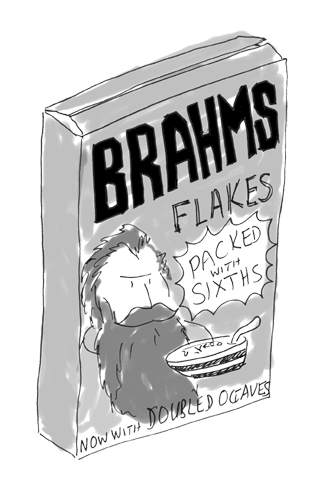
Schoenberg, Marquis of Granby
Schoenberg, Marquis of Granby
Originally uploaded by petemaskreplica.

Who knew?
Saturday, May 16, 2009
Sprouts
I'll get back to Mahler in a minute. It's a tricky subject, it'll take a while. But it rarely if ever stands still round here, and I must now think hard about what to writ about the next KSO gig. It's always tricky making that start. It's a matter of finding that thing that brings it all into focus. It might be a quote, it might be one of those random sudden moments of clarity where you suddenly see what it's all about.
Elgar, Strauss (ugh), Brahms.
I have decided that this time, it's all about facial hair.
Wednesday, May 13, 2009
Programme notes: Mahler Symphony No.9
Here's the note I wrote for KSO's concert on Monday. I'll probably have more to say about Mahler later.
Gustav Mahler (1860-1911)
Symphony No.9
1. Andante comodo
2. Im Tempo eines gemächlichen Ländlers (Etwas täppisch und sehr derb) (In the speed of a leisurely Ländler [folk-dance] (somewhat clumsy and very crude)
3. Rondo – Burleske
4. Adagio
“…So in the first place it is completely untrue that any affaires have brought me down. I have not been brought down at all. I am leaving of my own accord because I wish to have complete independence… after ten years of hard work I have decided to leave a post which has remained mine to keep, right up to the moment of my final decision; of that I can assure you most decidedly.”
Not the words of a disgraced cabinet minister fending off accusations of misconduct, but part of an interview that Gustav Mahler gave to the Neues Wiener Tagblatt in June 1907, following his resignation from the Vienna State Opera. Disquiet about the way the House was managed had been growing over several years. Direktor Mahler became the focus of a campaign that made uncomfortable accusations about the artistic direction of the House, as well as its financial management. Many asked why Mahler was drawing an exorbitant salary from an opera house that was going to rack and ruin while hawking his own compositions on long foreign tours.
Then as now, a superstar conductor who seemed less than wholeheartedly committed to his prominent, well-paid job was sure to provoke resentment. But the complaints were the result of more than artistic or economic concerns. Anti-Semitism was rife throughout Vienna and Europe at the turn of the twentieth century. Mahler was acutely aware of this. He had had to deny his own roots and convert to Catholicism in order to obtain the post in Vienna. He once commented, “I am thrice homeless, as a native of Bohemia in Austria, as an Austrian amongst Germans, as a Jew throughout the world. Always an intruder, never welcomed.”
Having jumped before he was pushed, Mahler wasted no time: even before his resignation was officially accepted, newspapers announced that he had been appointed to conduct at the Metropolitan Opera in New York. No wonder he felt able to be so bullish in his public comments about his departure from Vienna. But his fortunes were about to take a turn for the worse. In July 1907 Mahler’s elder daughter Maria-Anna contracted diphtheria and died suddenly, aged five. A few days later his doctor diagnosed a disease of the cardiovascular valves and ordered him to limit his physical activity. The condition was not deadly; Mahler’s doctor almost certainly exaggerated the gravity of the situation, in order to persuade his workaholic patient to limit his routines. Nevertheless, these two blows hot on the heels of the plotting in Vienna left Mahler devastated.
The trauma of all this is reflected in the vast triptych of works he composed between 1907 and his own death in 1911: the song-symphony Das Lied von der Erde [The Song of the Earth], the ninth symphony and the unfinished tenth.
It is ironic that the piece we hear tonight was his last completed work: A common superstition of the time was that following Beethoven’s epic final symphony, and Bruckner’s death weeks from completing his, nine symphonies represented some kind of limit. To go beyond this number was to search after knowledge forbidden to mortals. Mahler, a man of his time, was not immune to such thoughts, and shied away from numbering Das Lied von der Erde as his ninth symphony – which, it is clear from his letters, is what he considered it to be. He then began what we know as his Symphony No.9, consoling himself that as it was really his tenth, he had circumnavigated the issue. Tempting fate rarely ends well.
The symphony’s design is unusual: two vast, largely slow movements, between which come two shorter interludes. The main theme, heard after a stuttering, unsure opening, is filled with an insatiable longing, always stretching out for a resolution, never quite finding it. It carries on almost directly from the closing bars of Das Lied von der Erde’s ‘Abschied’ [Farewell], to the extent that it almost seems like an instrumental commentary on the vocal work. Over and over the music reaches for joy and triumph, and over and over it is battered into numbness. Towards the end of the movement a solo violin transforms the main theme into an ironic quotation of Johann Strauss’s waltz Freut euch des Lebens! [“Rejoice in Life!”]
If the opening represents crisis, the subsequent movements may stand for the classic pattern of reaction to grief: denial, anger, resignation and acceptance. The second movement is based on the traditional Austrian country waltz, the Ländler. This had always been a symbol for Mahler of the joys of life, of simple revelry and love of nature, but here it becomes something else: the joy has gone, and what is left is an empty and shallow distraction.
The subtitle “Burleske” suggests more distraction. But in contrast to the disconnected Ländler, this extraordinary outburst throws the listener into a seething mass of activity. Having left Vienna for New York, Mahler had quickly fallen out with the management of the Metropolitan Opera, and left for the New York Philharmonic, which he also fell out with. It is tempting to see a reflection of this professional turbulence and hyperactivity here. The music strains and splinters at the edges in a complex mass of sound that teeters on the edge of chaos. For a brief moment the clouds roll back and a glimpse of hope emerges. But it is a mirage, and eventually the restraints are broken and the movement races out of control to its car-crash conclusion.
The distractions cannot continue, and the finale returns to the world of the opening movement, at once lushly beautiful and filled with anguish. The main theme’s allusion to “Abide With Me” may or may not be intentional, but the reference is entirely appropriate. The vision from the Burleske returns, now merely a memory. Later there is one more quotation, from the fourth of his Kindertotenlieder [Songs on the Death of Children], ‘Oft denk’isch, sie sind nur ausgegangen’ [Often I think they’ve just gone out]:
“Wir holen sie auf jenen Höh’nIm Sonnenschein! Der Tag ist schön auf jenen Höh’n!”[We’ll go and fetch them up on the hillsIn the sunshine! It’s a beautiful day up on the hills!].
Friday, May 08, 2009
Old Fart at Play
I resent the caution that comes with age.
When you're young you're reckless. You don't think about the consequences of your actions. You don't wonder if the idea's any good — it doesn't even occur to you that an idea you've had might not be. You just plow on, what the hell. If everything goes to shit, oh well — the next idea's here already, and this one's brilliant.
As you grow older, you question your ideas. I've heard it said that you get fewer, but I don't think this is so: I think it's more that you accept each one less uncritically, you question, and fewer get past that initial thought and make it to something realised. This isn't necessarily bad, of course. It's got something to do with wisdom, the experience that enables you to dismiss the idea that isn't going to go anywhere. You learn to conserve energy, because you don't have so much. You think of the boundless energy you had when you were young, and stupid, and thoughtless, and profligate in your thoughts, and wish you had that energy now, now that you've got the wisdom to expend it on valuable activities more than frivolous ones.
There's more to it than that, though. Sometimes I start to think, is this wisdom stopping me doing this? Or the complacency that received wisdom generates? Or is it fear? Growing older you learn the tricks, you negotiate the traps better, you avoid the failures. But failure's not always such a bad thing is it? Sometimes the mistakes are more valuable than the assured, competent execution, because they shake you out of your viewpoint. Sometimes they can give you that sudden realisation that there's another way to do things, that you hadn't thought of before. That's what keeps music, or any art, alive.
Of course sometimes mistakes are just shit and you're wasting your time, but you've got to take the risk.
That's what I resent about the caution. It stops you fucking up, but it can also stop the interesting fucking up that real proper actual art comes from. It's easy to learn, harder to un-learn.


