World Busk Day 2009 from John Hackett on Vimeo.
Thanks again to everyone who helped make it happen. Show your appreciation here.
World Busk Day 2009 from John Hackett on Vimeo.

We arrived on the South Bank shortly after 11.00. We scouted about a bit and eventually decided to pitch ourselves under a tree just near where that big purple E4 cow is at the moment. While we waited for the others to arrive, Em and I entertained ourselves, if no-one else, with our ukes and our singing. We learned that Innocent When You Dream, while a lovely song, is a bit maudlin to attract money. Downtown and Five Foot Two, Eyes of Blue work much better in this regard. Even if you struggle to remember the words.
By the time the rest of our band started to arrive at about 11.30, the walkway was considerably busier, and if we'd showed up then instead of 20 minutes earlier we'd have struggled to find a place to set up amidst the other buskers, balloon modellers, pavement artists and talking plant pots that now surrounded us. Undaunted, we set up, and ploughed into In C.
It's an amazing experience, playing this music. All the difficulties of playing the patterns that I'd found practising earlier in the week seemed to melt away, and the web of cross rhythms that rapidly built up as utterly absorbing (I hope it was half as fascinating to listen to!). It's immensely satisfying to play. It's something to do with the autonomy. What you play, and how, and when, is up to you, and it's thrilling to find all sorts of unexpected combinations emerging as a result of your decisions. You get into the groove, and play around, reacting to what the other musicians are doing, they reacting to you in turn. Kudos to Nick who hammered out repeated Cs on a toy glockenspiel that looked like a relic from East Berlin before the wall came down. That gave us something to hang onto, when all the cross rhythms threatened to overwhelm.
In C is in one sense mis-named: it's not in the key of C major in any conventional sense. There's no progression of harmony as you'd find in a tonal work. Although the harmonies do evolve as it progresses, it's got little to do with traditional functional harmony. It's about texture and pure sound. And this is where the title has its true meaning. That C major triad, and the play around it, is something you inhabit.
It was a blast. Thanks to everyone who played, held out hats, listened and gave money. The whole 45 minutes or so was filmed, so I hope to add YouTube links soon!
Donate here.
"it is more expensive," said the man in the shop as I contemplated the £7 rubber practice mute or the £25 (shiny!) metal one. "But - I play violin, and I find with the rubber one the sound's quite fuzzy. with the metal one you get more clarity of tone."
Easy decision, then. I bought the rubber one. Sounds much more interesting.
God bless London Transport. Having offered Musequality pitches at Southwark tube station for Sunday (which we eagerly snapped up), they turned round and announced that that part of the Jubilee Line will be closed (again) then. So we're now looking for somewhere to do In C again.
It'll all be worth it in the end.
If you want to join in, email me: petemaskreplica[at]gmail[dot]com
Donate!
Sometimes an idea just needs the right context.
I've been thinking about Terry Riley's In C for a while now. It's a seminal piece, of course - it helped kick-start a huge sea change in musical style, the effects of which are still evident today. But the thing about it that's been lingering in my mind isn't a question of style or compositional technique - it's its social significance.
This is where it departs from so-called classical music most importantly, I think. The way you approach it as a musician is quite different to how you'd approach, say, a symphony by Brahms or Mahler. For one thing, it doesn't ask for any specific scoring. Whatever instruments are available play. There's therefore no hierarchy . Everyone plays the same notes, in whatever register suits their on instrument (or voice). Immediately Riley has removed a social structure. There are no issues of being first or second fiddle, no "extras" who get paid differently, no joking about the competence of certain instruments, because they're playing the same as you. Everyone comes to the table as an equal.
Connected this is the responsibility that every player carries. It's not simply a matter of counting the bars rest until the conductor brings you in. There's no conductor at all, in fact (although there may be someone pounding out repeated Cs to help everyone keep time). How the piece goes depends on what you do, in a way more fundamental than in traditional orchestral music. If you don't do what you're old to do in a symphony then you're wrong. There's no "wrong" as such in In C. But that's not to say it doesn't matter what you play. It matters a great deal - it's just that you have to decide for yourself how you play, when you play, and must consider carefully the consequences of what you play on everyone else.
Donate here.
It's redundant to dissect a performance of Feldman's music in a way: Not that there isn't great skill and musicianship needed to bring it off, but the music itself places itself so far outside the traditional notion of "performance" that it's very difficult to say anything of the performers beyond the bare facts that they turned up, played the notes, and had the stamina and concentration to get through the hour and a half (in this case) that the piece takes to play.
So at the risk of seeming to damn with faint praise (I don't mean to), I should say straight off that the three members of Endymion who performed "Crippled Symmetry" at Kings Place on Friday night turned up, played the notes and demonstrated the requisite stamina with aplomb. The thing is, this is music that one one level isn't about the performers at all, and yet on another is absolutely about them. The extreme duration, and the demands of playing so softly and slowly (much more tiring than playing fast, busy music) mean that it's all about the physical and mental stamina needed to maintain concentration. And yet the music itself demands the players to abandon the normal ideas of self-expression. Feldman's music lies beyond ideas of expression. It simply is.
This removing of theatrical display or gesture, the creation of what you might call a flat surface, like the canvases of his friend Mark Rothko, with whose work his has much in common, doesn't lead to an uninvolving experience though. The reduction of everything to the minimum actually makes the smallest detail assume immense significance. So it is that the flute's tonal pallor comes to seem sharp and piercing in contrast to its bigger, softer sibling, the bass flute. And the glockenspiel and piano likewise acquire a brighter presence next to their more muted doubles, vibraphone and celesta.
"Crippled Symmetry" is one of the few Feldman works to carry a title other than the names of the instruments it's written for. It's a title that could apply to most all of his work though: the small patterns that almost, but don't quite repeat. The sense of stillness that conceals enormous movement: like a glacier, it appears from moment to moment to be static, but in fact is moving with a power that can cut through mountains.
Feldman's music makes no claim to "meaning" beyond the fact if its existence and the actions that bring it into existence. But that doesn't make it meaningless. It simply makes that meaning something so vast that it can't be expressed in any terms than the sounds that make it. It's something best experienced live rather than on record. In your living room there are too many distractions. This demands, and deserves, your full and undivided attention. That's not easy over such a long span of time. It's music that conveys and demands quiet courage, for both its performers and audience.
Musequality is a charity that deserves your support. Go and read about them.
then go and read about the World Busk they're organising between the 8th and 14th june.
Then go to my Just Giving page and sponsor me for the exciting thing I'm doing to help raise money: On Sunday 14th June at about 11.45 I and a crack team of, er, people I know will be busking through Terry Riley's In C.
I shall write about this more later when I've got time. For now, go on, donate!
(If you'd like to join in the band, email me: petemaskreplica [at] gmail [dot] com. I've still got a few spaces left.)
For any number or combination of players. Everyone works through the sequence at their own pace, moving on to the next bar when they feel they have explored the previous one fully. The notes may be played in any register at any speed. Repeat each bar/grouping as many times as seems right. When each player reaches the final D they hold it until everyone is there, then all crescendo and finish.
Two variants are below. They use exactly the same sequence of notes (derived from the keys of Haydn's symphonies). Both variants may be performed simultaneously. Other variants may be devised and played with or without others. The "chords" in Variant 2 are not intended necessarily to be sounded together, though they may be, in part or in full, as the performers please.

I've got a very long, rambling post about Mahler sitting in my drafts folder yet. I keep looking at it and wondering how to make it more coherent. Or even if I should post it up. it's kind of personal. Oh well, we'll see. Look, a cat!
Schoenberg, Marquis of Granby
Originally uploaded by petemaskreplica.
Who knew?
I'll get back to Mahler in a minute. It's a tricky subject, it'll take a while. But it rarely if ever stands still round here, and I must now think hard about what to writ about the next KSO gig. It's always tricky making that start. It's a matter of finding that thing that brings it all into focus. It might be a quote, it might be one of those random sudden moments of clarity where you suddenly see what it's all about.
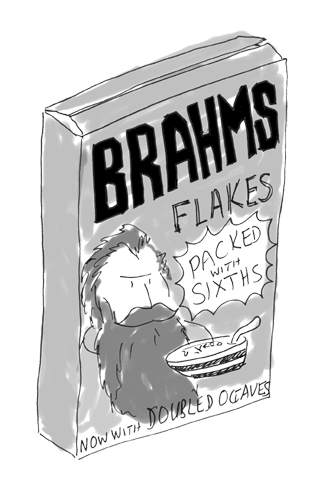
Elgar, Strauss (ugh), Brahms.
I have decided that this time, it's all about facial hair.
Here's the note I wrote for KSO's concert on Monday. I'll probably have more to say about Mahler later.
Gustav Mahler (1860-1911)
Symphony No.9
1. Andante comodo
2. Im Tempo eines gemächlichen Ländlers (Etwas täppisch und sehr derb) (In the speed of a leisurely Ländler [folk-dance] (somewhat clumsy and very crude)
3. Rondo – Burleske
4. Adagio
“…So in the first place it is completely untrue that any affaires have brought me down. I have not been brought down at all. I am leaving of my own accord because I wish to have complete independence… after ten years of hard work I have decided to leave a post which has remained mine to keep, right up to the moment of my final decision; of that I can assure you most decidedly.”
Not the words of a disgraced cabinet minister fending off accusations of misconduct, but part of an interview that Gustav Mahler gave to the Neues Wiener Tagblatt in June 1907, following his resignation from the Vienna State Opera. Disquiet about the way the House was managed had been growing over several years. Direktor Mahler became the focus of a campaign that made uncomfortable accusations about the artistic direction of the House, as well as its financial management. Many asked why Mahler was drawing an exorbitant salary from an opera house that was going to rack and ruin while hawking his own compositions on long foreign tours.
Then as now, a superstar conductor who seemed less than wholeheartedly committed to his prominent, well-paid job was sure to provoke resentment. But the complaints were the result of more than artistic or economic concerns. Anti-Semitism was rife throughout Vienna and Europe at the turn of the twentieth century. Mahler was acutely aware of this. He had had to deny his own roots and convert to Catholicism in order to obtain the post in Vienna. He once commented, “I am thrice homeless, as a native of Bohemia in Austria, as an Austrian amongst Germans, as a Jew throughout the world. Always an intruder, never welcomed.”
Having jumped before he was pushed, Mahler wasted no time: even before his resignation was officially accepted, newspapers announced that he had been appointed to conduct at the Metropolitan Opera in New York. No wonder he felt able to be so bullish in his public comments about his departure from Vienna. But his fortunes were about to take a turn for the worse. In July 1907 Mahler’s elder daughter Maria-Anna contracted diphtheria and died suddenly, aged five. A few days later his doctor diagnosed a disease of the cardiovascular valves and ordered him to limit his physical activity. The condition was not deadly; Mahler’s doctor almost certainly exaggerated the gravity of the situation, in order to persuade his workaholic patient to limit his routines. Nevertheless, these two blows hot on the heels of the plotting in Vienna left Mahler devastated.
The trauma of all this is reflected in the vast triptych of works he composed between 1907 and his own death in 1911: the song-symphony Das Lied von der Erde [The Song of the Earth], the ninth symphony and the unfinished tenth.
It is ironic that the piece we hear tonight was his last completed work: A common superstition of the time was that following Beethoven’s epic final symphony, and Bruckner’s death weeks from completing his, nine symphonies represented some kind of limit. To go beyond this number was to search after knowledge forbidden to mortals. Mahler, a man of his time, was not immune to such thoughts, and shied away from numbering Das Lied von der Erde as his ninth symphony – which, it is clear from his letters, is what he considered it to be. He then began what we know as his Symphony No.9, consoling himself that as it was really his tenth, he had circumnavigated the issue. Tempting fate rarely ends well.
The symphony’s design is unusual: two vast, largely slow movements, between which come two shorter interludes. The main theme, heard after a stuttering, unsure opening, is filled with an insatiable longing, always stretching out for a resolution, never quite finding it. It carries on almost directly from the closing bars of Das Lied von der Erde’s ‘Abschied’ [Farewell], to the extent that it almost seems like an instrumental commentary on the vocal work. Over and over the music reaches for joy and triumph, and over and over it is battered into numbness. Towards the end of the movement a solo violin transforms the main theme into an ironic quotation of Johann Strauss’s waltz Freut euch des Lebens! [“Rejoice in Life!”]
If the opening represents crisis, the subsequent movements may stand for the classic pattern of reaction to grief: denial, anger, resignation and acceptance. The second movement is based on the traditional Austrian country waltz, the Ländler. This had always been a symbol for Mahler of the joys of life, of simple revelry and love of nature, but here it becomes something else: the joy has gone, and what is left is an empty and shallow distraction.
The subtitle “Burleske” suggests more distraction. But in contrast to the disconnected Ländler, this extraordinary outburst throws the listener into a seething mass of activity. Having left Vienna for New York, Mahler had quickly fallen out with the management of the Metropolitan Opera, and left for the New York Philharmonic, which he also fell out with. It is tempting to see a reflection of this professional turbulence and hyperactivity here. The music strains and splinters at the edges in a complex mass of sound that teeters on the edge of chaos. For a brief moment the clouds roll back and a glimpse of hope emerges. But it is a mirage, and eventually the restraints are broken and the movement races out of control to its car-crash conclusion.
The distractions cannot continue, and the finale returns to the world of the opening movement, at once lushly beautiful and filled with anguish. The main theme’s allusion to “Abide With Me” may or may not be intentional, but the reference is entirely appropriate. The vision from the Burleske returns, now merely a memory. Later there is one more quotation, from the fourth of his Kindertotenlieder [Songs on the Death of Children], ‘Oft denk’isch, sie sind nur ausgegangen’ [Often I think they’ve just gone out]:
“Wir holen sie auf jenen Höh’nIm Sonnenschein! Der Tag ist schön auf jenen Höh’n!”[We’ll go and fetch them up on the hillsIn the sunshine! It’s a beautiful day up on the hills!].
I resent the caution that comes with age.
When you're young you're reckless. You don't think about the consequences of your actions. You don't wonder if the idea's any good — it doesn't even occur to you that an idea you've had might not be. You just plow on, what the hell. If everything goes to shit, oh well — the next idea's here already, and this one's brilliant.
As you grow older, you question your ideas. I've heard it said that you get fewer, but I don't think this is so: I think it's more that you accept each one less uncritically, you question, and fewer get past that initial thought and make it to something realised. This isn't necessarily bad, of course. It's got something to do with wisdom, the experience that enables you to dismiss the idea that isn't going to go anywhere. You learn to conserve energy, because you don't have so much. You think of the boundless energy you had when you were young, and stupid, and thoughtless, and profligate in your thoughts, and wish you had that energy now, now that you've got the wisdom to expend it on valuable activities more than frivolous ones.
There's more to it than that, though. Sometimes I start to think, is this wisdom stopping me doing this? Or the complacency that received wisdom generates? Or is it fear? Growing older you learn the tricks, you negotiate the traps better, you avoid the failures. But failure's not always such a bad thing is it? Sometimes the mistakes are more valuable than the assured, competent execution, because they shake you out of your viewpoint. Sometimes they can give you that sudden realisation that there's another way to do things, that you hadn't thought of before. That's what keeps music, or any art, alive.
Of course sometimes mistakes are just shit and you're wasting your time, but you've got to take the risk.
That's what I resent about the caution. It stops you fucking up, but it can also stop the interesting fucking up that real proper actual art comes from. It's easy to learn, harder to un-learn.
It's an essential part of the contemporary so-called-classical scene that the show you're at will overrun. A good yardstick of the quality of what you've been listening to is therefore how much that irritates you. I found myself not at all bothered by the fact on this occasion, so well done Heiner*.
To be fair, at least part of the overrun was down to the man who walked on and announced "My name is Andrew Burke Chief Executive of the London Sinfonietta" (how remarkable to have a name that suits your job, I thought) and proceeded to beg for money in that way that people desperate for money who don't want you to have the impression they're begging for it do. A lot of talk of wanting to connect with those who buy their tickets on the door (subtext: please book in advance, we've been shitting brick about advance sales), building relationships with their audiences (subtext: we're really worried about how the hell we get people to come to these things) and so on. All couched in friendly, "hey, we love you and we want to connect" language, but going on slightly too long not to come across as a bit desperate. Maybe I'm completely wrong, the London Sinfonietta feels completely recession-proof and has a mailing list as long as your arm, but it sure as hell didn't come across that way.
I have a problem with the London Sinfonietta; they make me slightly suspicious. Partly this is because they're the Establishment: I think of what Morton Feldman said, that the music you hear in London sounds official, like it was written for the London Sinfonietta. And the Establishment can't ever do anything really innovative or different, because innovation and difference challenges the established order. It's hide-bound by its position, by the deadweight of the one-of-each-instrument lineup that fills so much of its repertoire, from which so little interesting comes. Then there are things like those collaboration nights with Warp Records, which seem slightly pointless: is the Sinfonietta desperately chasing after the cool kids, or is it saying that by rearranging electronica for "classical" forces it's conferring a greater artistic legitimacy on it than it otherwise has? Which would seem to imply some level of contempt for the other, cooler music. The classical world is infested with the notion that its music is inherently better than any other kind.**
That said, it would be dumb to dismiss anything they do because of who they are, and tonight's concert of two pieces by Heiner Goebbels is an impressive one that shows that there's still life in this thing if you're clever enough to know where to look. Which Goebbels is. He understands that this genre of ours is essentially dramatic (why else dos it take place on a stage?) and both the pieces here are to some degree overtly theatrical. The use of samples of other records, as well as quotations of other musics performed by the musicians, emphasises this. It's to Goebbels' credit that these elements don't distract - although it's impossible not to have a moment of trying to remember where that drum loop's from - but manage to integrate in a way that earlier stylistic cross-dressers like Schnittke don't really manage, so the flow from tonality to atonality, from baroque to postwar modernism and back comes to seem natural.
Maybe this just where I'm coming from these days, but it's at its most impressive when there's less going on. "Songs of Wars I have seen" underpins Gertrude Stein's words with subtle, elusive sounds that seem to drift in and out of focus, lending a dreamlike quality. The combination of modern instruments with the period ones of the OAE lends another layer: the quieter baroque strings and winds lend an inward quality. Having the narration provided by the musicians rather than actors or singers is a masterstroke. It helps draw the listener in, almost as though we're being read bedtime stories. It manages to be hugely evocative without ever labouring to make a point. And the final moments, when a lone trumpet spins a melody over the ringing of prayer-bowls, coming over like Miles Davis sounding the last post, are magical, intimate and tender.
*I'm being over-familiar there. I don't actually know him or anything.
**Plus they don't play my stuff. Motherfuckers.
Hell, I swore I wouldn't do this, but I ended up crawling back onto Twatter again. If you're one of the 3 people (apart from my parents, I should imagine) who've never heard of it, it's kind of like blogging for people too lazy to write a whole paragraph. It's clearly vile and narcissistic, but equally clearly an easy way to massage my monstrously huge ego.
Every day we get nearer to the logical conclusion of the interweb networking madness, where everyone in the world simply hits a button every few minutes to make the message "LOOK AT ME! LOOK AT ME! I'M ON THE INTERNET! LOOK AT ME!" appear on www.ihavenothingtosaybutthat'snotgoingtostopme.com. If I had any sense I'd set the damn thing up myself, wait for the inevitable rush, and then sell it to Murdoch or whoever for a fucking fortune, just as the Guardian picks up on it (which is always a sure-fire sign that something is over).
Still, it beats doing anything constructive.

No matter, because we're here in the arse end of nowhere to see the splendid Eliza Carthy at the Mick Jagger Centre.
Mick Jagger's from Dartford, you know. He set this arts centre up. you know. They sure as hell don't let you forget who paid for the place. The walls are festooned with murals of Mick's face with its big mouth, and everyone working there wears a T-shirt with Mick's face with its big mouth. Sorry, that's Sir Mick. I'm sure he wouldn't want us to forget that.
Having attempted to negotiate the giant roundabout full of chavs being stalked by the police and arrived late, we find everyone else milling about, There are technical problems. Eventually we get into the hall and settle down for the support, the trickily punctuated mawkin:causley.
They're good. We like them. They play good music well. It's a nicely put together sound. I'd probably have bought their new CD if it had been on sale in the foyer afterwards. But there's something not quite there. I can't quite put my finger on what it was. It's that edge. They're a bit polite and tame. I wish they were a bit rougher and sparky. To be fair, they're not helped by the audience, which is as flat a crowd as I've seen in a while. Somehow I expected the audience at an Eliza Carthy gig to be reasonably young, but I find myself in a position I rarely do these days outside a classical gig: I'm bringing the average age down. Age is no excuse for being as subdued as this, though. "Good evening!" the lead singer says. "Good evening." they mumble back politely. "How are you?" he asks. "mmmwmmmwfffverywellthankyou," is the gist of the murmur that follows. It's like a primary school assembly, only with pensioners. Is this what they mean by second childhood? Maybe it's just what Dartford does to you.
Eliza Carthy does have that thing I can't put my finger on. Ah yes, I remember: presence. There's that extra bit of electricity in the air from the moment she appears, the sort that comes from being experienced and utterly confident at this.
Unfortunately the technical gremlins are still hanging about, and there's a bit of a hiatus just as the band's warming up: microphone problems threaten to put a halt to the set altogether. She handles it well - I'm not sure I'd stay so level-headed in this sort of situation - and manages somehow to give the impression that the gig's still happening when it's clearly not. Eventually they manage to sport things out, but by then there's been some momentum lost and there's a bit of a sag until they get back into the swing of things. That may also be partly because by then I'm feeling a bit hot and stuffy though. It may also be the continuing lack of audience reaction -just a smattering of polite applause between songs. I wouldn't want to have to work this crowd, it's like a morgue. Or a classical concert. It's OK though: by the end the energy's all back again, and we even get an excellent encore about blow jobs to send us out into the night, where the pubs are starting to empty out. We get the fuck out of Dartford.
Once upon a time, Man and Wolf came to an accommodation: Man provided food and shelter, and in return Wolf became dog and provided companionship and protection. Over time Man realised that he could manipulate dog to become all kinds of useful shapes.
Eventually the uses themselves disappeared, but the shapes remained. Nobody could remember why that particular dog was that particular shape and had those particular features emphasised, only that it was good and desirable that it should be so.
So the dogs kept being bred into more and more unlikely shapes, until eventually they ended up wonderful to behold, but completely impractical, and so far removed from their wolvish origins that they were incapable of surviving without Man to provide food and shelter.
Then one day Man decided to stop feeding dog and kicked him out, and he died a slow, painful death from starvation and neglect.
And that's pretty much the story of (so-called) classical music.
Why don't young people listen to classical music?
Well, why should they?
The thing about Post-its is that they come in different colours:

After I did this one, I started wondering to myself: is the mood determined b the colour or the colour by the mood? So here's the same image on yellow. Does it make a difference?

 A slow day, a doodle, a vague desire to do something a bit loose... who needs staves anyway?
I've got a soft spot for collective nouns. Apparently they were all made up by some vicar in the nineteenth century or something, but so what. I like the random yet strangely appropriate feel of things like a pride of lions or a murder of crows. But what of the world of musicians, I hear you ask?* Well, I@m glad you asked.** because I've been wondering about that too. Here's a few possibilities:
An oversubscription of flutes
a mallard of oboes
an intonation of trumpets
a flatulence of trombones
an accelleration of percussionists
a payment of harps
a hubris of first violins
a neurosis of second violins
an oppression of violas
an indulgence of cellos
Any more? I've been concentrating on orchestral sections, but there must be some good ideas out there for drummers too, at least.
* I know you didn't. So what?
** see above.
Spring has sprung, it seems. Out for a walk at lunchtime in the West End, the sky is brilliant blue and there seems to be that indefinable sense of everyone being a little bit happier. I walk down Berwick Street, pick up a bit of veg. "Cheers mate," I say to the vegetable man in that Mockney way I've learned over a decade in the capital. I try hard not to look over the shoulder of the girl standing at the bottom of the street drawing the sex shop opposite, because I'm on a mission, and have to be back at the office in 40 minutes. I swing across towards the London Graphics centre to pick up a few drawing implements, when suddenly I'm confronted with the sight of an enormous dildo on top of the Palace Theatre:
A few steps further reveals the truth: it's just a giant stiletto heel advertising the new musical version of Priscilla, Queen of the Desert.
Just another normal day, then. I move on, pausing only briefly to reflect on the fact that it didn't seem terribly bizarre to have a giant dildo on top of the Palace Theatre. As I walk back to the office, I pass the girl, still intently sketching the sex shop at the corner of Walker's Court. Once, when I was a child, this place was the Soho sex industry. Now it's just another back street full of porn and what we then called marital aids. But it still retains that whiff of scandal, even amid the gentrification that seeps into it. I consider the walkers, and where they may now be. Then continue back to the office, pausing only to linger and gaze at other temptations offered for sale
Michael Torke (b. 1961)
Bright Blue Music
One of the characteristics of much music composed in the last 30 years or so is a new sense that the bitter arguments about musical style that have characterised the history of music in the 20th century are now an historical irrelevance. A composer need no longer feel weighed down by dogma, and can employ whatever techniques and styles he feels suit whatever it is he wants to write. This is an attitude that the grandfather of modern American music, Charles Ives, would have approved of: he once wrote, “Why tonality as such should be thrown out for good I can’t see. Why it should always be present I can’t see. It depends, it seems to me…on what one is trying to do, and on the state of the mind, the time of day or other accidents of life.”
This brings us to Michael Torke and Bright Blue Music, a piece filled with startlingly straightforward harmonies. He came to public attention early, with two pieces – Ecstatic Orange and The Yellow Pages – written while he was still a student at Yale. These were the first two parts of his series of pieces collectively known as Color Music, and the reader will need no further prompting from a programme note to deduce that Bright Blue Music also belongs to this sequence.
Torke gives two reasons for his strategy. One is that by using the simplest, most obvious harmonies he is freed to concentrate on other things: “Once this decision was made and put in the back of my mind, an unexpected freedom of expression followed. With the simplest means, my musical emotions and impulses were free to guide me. Working was exuberant: I would leave my outdoor studio and the trees and bushes seemed to dance, and the sky seemed a bright blue.
“That bright blue color contributed towards the piece's title, but in conjunction with another personal association. The key of D major, the key of this piece (from which there is no true modulation) has been the color blue for me since I was five years old.” The result is a ten-minute burst of uninhibited exuberance and joy, or as the Chicago Tribune’s critic John van Rhein puts it, “like John Adams getting stoned and listening to Der Rosenkavalier.”
Charles Ives (1874-1954)
Decoration Day
When the young Charles Ives scoffed at John the village stonemason’s off-key singing in church, his father corrected him: “Look into his face and hear the music of the ages. Don’t pay too much attention to the sounds. If you do, you may miss the music.” George Ives was an inveterate experimenter who encouraged his son to open his ears to sounds outside the scope of conventional music theory. Ives recalled his memories of his father leading the singing at camp-meeting services that were a feature of the revivalist Christianity prevalent in New England at that time: “Father…would always encourage the people to sing their own way. Most of them knew the words and music (their version) by heart and sang it that way. If they threw the poet or composer around a bit, so much the better for the poetry and the music. There was power and exaltation in these great conclaves of sound from humanity.” The clusters of sound and wayward harmonies and rhythms that fill his music reflect these childhood memories.
Decoration Day is the second of four pieces that together are known as the Holidays Symphony. Ives wrote on one of the sketches, “Symphony, but not called Sym.”, and on another occasion remarked, “These movements may be played as separate pieces. These pieces may be lumped together as a symphony.” The holiday that it portrays commemorates those who died during the Civil War of 1861-65. As with much of Ives’ music, it has its roots in earlier works: in this case an organ piece of his own based on the hymn tune “Adeste Fidelis” (better known nowadays as “Oh Come All Ye Faithful”), and the Second Regiment Connecticut National Guard March by David Wallis Reeves. A number of other popular and hymn tunes of the time can also be heard by the attentive ear.
The villagers gather and the parade forms and marches to the graveyard, where the graves are decorated and hymns sung. Then all march back to the village to the strains of the Second Regiment, below which can barely be discerned the sombre thoughts of the soldiers. Finally, “in the silence the shadow of the early morning flower-song rises over the town, and the sunset behind West Mountain breathes its benediction upon the day.”
George Gershwin (1898-1937)
An American in Paris
“George Gershwin is the only songwriter I know who became a composer,” noted Irving Berlin in 1961. Crossover is a discredited concept now, but Gershwin stands almost alone in having achieved a genuine cross-fertilisation of different genres.
He drew rather less complimentary reactions from most of the American classical establishment. “Nauseous claptrap” was the verdict of the New York Telegram on An American in Paris at its premiere in December 1928. Hardly less dismissive was the Evening Post, whose critic declared, “For those not too deeply concerned with any apparently outmoded niceties of art, it was an amusing occasion… To conceive of a symphonic audience listening to it with any degree of pleasure or patience twenty years from now, when whoopee is no longer even a word, is another matter.”
He found a more receptive audience in Europe: when he toured his Piano Concerto there earlier the same year, Ravel, when asked what he would like as a birthday present, declared that he wanted to meet Gershwin. The ensuing meeting, where Gershwin asked Ravel for composition lessons (as he was wont to do to almost every major composer he met, so self-conscious was he about his lack of formal training), resulted in Ravel’s observation, “why be a second-rate Ravel when you are a first-rate Gershwin?”
It was during this European visit that Gershwin bought a number of car horns in Paris. The results of his experiments with them can be heard at the outset of An American in Paris. Described as a “Tone Poem” on the manuscript, it presents a lively sequence of events, from the opening street scene to the grand romance of the slow central section. Freed from the formal constraints imposed by traditional orchestral genres, the piece proceeds in a rhapsodical, almost stream-of-consciousness manner that perhaps, along with such touches as the car horns, puts him closer in spirit to Ives than is generally recognised. One more European who recognised his significance was Arnold Schoenberg, who wrote after Gershwin’s untimely death: “I know he is an artist and a composer; he expressed musical ideas; and they were new – as is the way in which he expressed them.”
Aaron Copland (1900-1990)
Symphony No.3
Molto moderato - with simple expression
Allegro molto
Andantino quasi allegretto
Molto deliberato - Allegro risoluto
From Ives’s use of hymn tunes and marches, through Gershwin’s ambition to take jazz and Tin Pan Alley to the concert hall, to Torke’s appropriation of rock dynamics, American composers seem to be consistently concerned with how music for mass consumption and more academically-minded sounds might relate to each other. This is not something that is so common in Europe, where until very recently there has been an unspoken consensus that, the odd essay comparing the Beatles and Schubert aside, the two shall never meet.
Aaron Copland brings all these cultural issues into sharp relief. A Jewish New Yorker like his contemporary Gershwin, he studied in Paris with the most influential European teacher of the first half of the twentieth century, Nadia Boulanger. This elicited suspicion from many back in America: a composer steeped in old-world traditions composing modernist music. But he attracted as much disdain from the European elite when he turned his attention to writing deliberately populist works like El Salón México, a clever and deceptively simple piece that convinced most of the avant-gardists who might have been his allies that he had irredeemably debased himself.
This is more a reflection of differing political and social concerns on either side of the Atlantic than anything else. While depression in the 1930s made Europe a place of gathering storms as Nazism and Fascism rose up, in the United States a relatively optimistic air was building thanks to Franklin D. Roosevelt and the New Deal, and this sense of rebuilding the nation was reflected in the arts generally. It is surely not coincidental that as Copland perfected his “American” sound in the early 40s with his ballets Billy The Kid, Rodeo and Appalachian Spring, Rodgers and Hammerstein were doing much the same with Oklahoma, which premièred in 1943.
This resurgent sense of national pride went hand in hand with a renewed interest in the grandest musical forms, and the symphony became a fashionable medium for an American composer to express himself in; the 1930s saw a slew of grand orchestral declarations. When it became known that Copland was engaged in writing a symphony the expectation was for something epic. He himself would later wryly admit that he “certainly was reaching for the grand gesture.” Work began on the symphony in 1944 and continued for two years.
The grandest gesture in what is Copland’s largest orchestral work is probably his most famous music: the Fanfare for the Common Man, which heralds the finale. In fact the fanfare existed before the symphony, written to a commission for the Cincinnati Symphony in 1942. It is sometimes suggested that the fanfare is bolted on to the symphony, but this is unfair: Copland had it in mind as the symphony’s climax very early on. The extraordinary fame that it has achieved since gives us a warped perspective on it. At the time it would have seemed to Copland that it was just an occasional piece that would soon be forgotten, but too good an idea not to use in a new context.
The fanfare’s contours are reflected in the whole work, from the grand opening, which gives that sense of wide open spaces that Copland had perfected in the ballets he had written in the early 40s. Anyone familiar with Appalachian Spring will recognise the dancing rhythms and pastoral interludes that characterise the second movement. The third movement reflects some of the concerns of the opening, beginning with a brooding version of a theme heard on trombone in the first movement, before gradually speeding up to a central climax so dramatic that the listener could be forgiven for thinking that it marks the start of the finale. But things die down again, and when the finale does follow on directly, it begins tentatively in the flutes before the full brilliance of the fanfare breaks out. From here the music takes flight before reaching a conclusion whose grandeur and significance was summed up by Leonard Bernstein: “The Symphony has become an American monument, like the Washington Monument or the Lincoln Memorial or something.”
Crikey. If you're here, you're almost certainly here via the estimable Mr Campbell. Thanks for stopping by.
Sorry, it's a bit quiet here at the moment. Would it be terribly whoreish to point you in the direction of this, and also this?
Yup, thought so.
Well, damn. I come back from Glasgow with exciting tales of the Proclaimers, but I see the EU is on the verge of extending sound copyright to an eye-watering 95 years. I've discussed why this is a bad thing before, and will doubtless do so again, but fortunately rather than read my half-arsed rambling and ranting you can go and find out from the Rambler why this is a Bad Thing. To which I shall append my usual aesthetic argument that dialogue with the recent past is a vital part of the development of any art, and enormously long copyright terms hinder that. Think of J.S. Bach rewriting Vivaldi, or young Mozart rejigging J.C. Bach. Both acts of what we would now consider copyright infringement, but both essential to the development of each composer.
As a friend remarked, Lux Interior always looked like he'd died about 30 years ago and crawled out of the grave, so it doesn't seem quite right that he's actually gone. The Cramps remain one of the best bands I ever saw live. Damn shame.
Revellers
Originally uploaded by petemaskreplica.
Rarely does a collapse of the transport system feel so welcome. That travel alert sitting in my inbox this morning telling me that there were no trains at all was the sweetest news I'd had in a while. So much so that instead of going straight back to bed, we jump up, rush into the garden and build a splendid effigy.
Later we walk up to the woods and are astounded by the sight that greets us. It's as though Abbey Wood has tuned into a Breughel painting: people everywhere, adults and children alike, running and laughing and sliding down the hill, many on sledges (where have they been for the past eighteen years?) or snowboards or just binbags. No hostility, no depression, no recession, just a whole load of people who live nearby all enjoying themselves. Politicians go on the radio every day and tell us what's wrong with society, all the laws and restrictions they need to impose on us to put it right, to keep us in our place. And it turns out it's all unnecessary. All it really needs is a few inches of snow.
It won't last, of course, it never does - in fact as we head home again the tears and arguments are starting again as reluctant children are dragged home - but for a moment this afternoon we all forgot the fear that drives our lives and lived.
The sight that really amazes, and really shouldn't is this: children, loads of them, outside, playing. How did that become such a rare sight? I wonder how many of them have never really been allowed out to play like this before. I hope when the snow melts they still play.
 The thing is this: I like Rothko. I really like him. Well, his paintings, I mean. It's wonderful to be able to see these enormous, imposing canvases laid out like this, to be able to stand in front of them and let myself be drawn into those huge expanses of space, that seem so blank and flat and forbidding at first, then, as your eyes adjust, reveal ll kinds of shade, and turn out to be filled with eventfulness, dark reflections of whole other worlds.
What I don't like is being surrounded by hoards of people. Of course it's inevitable, especially when you don't get round to going until the last day of the exhibition, and sure the crowds are nothing compared to the Monet show a few years back. But I really don't need to be surrounded by ghastly, vacuous people, plugged into i-Pods rented at great expense to tell them what someone else thinks about the paintings, talking about them, spouting that pseudo-religious bullshit that surrounds Rothko and cheapens him with every word uttered. I don't want any of that stuff. I don't want anything, physical or emotional or conceptual, to get between me and the canvas. I just want to be there, face to face with that thing that requires no words of explanation, that just is.
Gabriel Fauré (1845-1924)
Pelléas et Mélisande, Op.80
1. Prélude
2. Fileuse
3. Sicilienne
4. Mort de Mélisande
Maurice Maeterlinck's symbolist play Pelléas et Mélisande has been a source of inspiration for a number of composers: in the wake of Debussy's opera, Schoenberg, Sibelius and Cyril Scott all composed works on the subject. Before any of these eminent modernists turned their attentions to the subject, however, Gabriel Fauré's score composed for the first performance of the play in English in London in 1898 gained the distinction of being the first music inspired by the drama to be heard in public.
Fauré was overworked at the time and so entrusted his pupil Charles Koechlin with the orchestration of the music. Fauré himself subsequently revised three movements for a larger orchestra in 1901, and the addition in 1909 of the famous Sicilienne completed the four movement suite that we hear tonight.
The circumstances of the work may seem unlikely, but Fauré made several attempts to establish himself in London. However, he never managed to impress the English as much as did his titled contemporary Dr Edvard Grieg. Indeed, the reception of his music was decidedly lukewarm: "It is scarcely satisfactory, being wanting alike in charm and in dramatic power… its continued absence of tangible form, not to speak of its actual ugliness at many points, is such as to disturb rather than assist the illusion of the scene," wrote the Times.
Such sniffy judgements were not uncommon for a composer who was and often still is dismissed as a purveyor of lightweight salon songs. But this is to misunderstand how his music works. Those looking for lurid expressions of breast-beating despair in the death of Mélisande, for instance, will be disappointed. Fauré's music eschews melodrama, and prefers to make its point in more undemonstrative, subtly shaded ways. Its exquisitely attractive surface should not blind the listener to its great subtlety and originality, an art that conceals itself. Often seen as a marginal figure of the late nineteenth century, Fauré really deserves to take his place as a farsighted figure of the early twentieth century, whose influence, through such composers as his contemporary Satie and his favourite pupil Ravel, has persisted through a significant strand of the past century; rarely if ever drawing attention to itself, but there nevertheless.
Ludwig van Beethoven (1770-1827)
Violin Concerto in D major, Op.61
1. Allegro ma non troppo
2. Larghetto
3. Rondo. Allegro
Franz Clement, the dedicatee and first performer of Beethoven's Violin Concerto, is a man recalled by some with horror. At the concert in December 1806 when he gave the first performance, rather than play the whole concerto through in one go he performed the first movement in the first half of the concert and the remaining two in the second half. In between he interspersed a number of other pieces, including a set of variations of his own composing, played on one string with the violin held upside down, before continuing with the remaining two movements of Beethoven's piece.
A little perspective is required. Those who complain po-facedly about this sullying of the concerto's artistry would do well to remember the dedication to Clement that Beethoven scrawled on the manuscript, which consists mainly of a tortuous pun on the violinist's "clemency". Beethoven clearly saw no contradiction between the expression of divine ideas and a cheap joke, and there is no reason why we should be troubled by such things.
That Clement performed the concerto at sight with no rehearsal may be true or may be a tale put about to bolster his reputation as a technical master, but Beethoven certainly finished the concerto very late. Again, though, this was not such an unusual situation as it appears to us. Late into the nineteenth century, virtuosi such as Liszt were accustomed to rolling into whichever town was next on their tour itinerary and only then organising concert dates and assembling the necessary local musicians to form an orchestra. Spontaneity was the order of the day, and if we like to believe we treat this music with more reverence we might also consider what we have lost in the process.
Although now one of his most loved pieces, the Violin Concerto remained relatively unknown until Joseph Joachim took it into his repertoire in the latter part of the nineteenth century. Until then it was more likely to be heard on a very different instrument: as a violin concerto was not an enormously sellable genre, Beethoven rewrote the solo part for piano.
The concerto is unusual for Beethoven in its overall feeling of sublime calm, which is not to say that there is not plenty of drama to be had in the vast opening movement, which is filled with incident and surprises. The second movement is so filled with rapturous stillness that it takes a sudden and violent interjection to dispel the mood and prepare for the energetic finale, whose joyfulness and cheeky touches (including the soloist's only two plucked notes in the entire piece) remind us that humour and profundity can make perfectly happy bedfellows.
Jean Sibelius (1865-1957)
Symphony No.3 in C major, Op.52
1. Allegro moderato
2. Andantino con moto, quasi allegretto
3. Moderato - Allegro ma non tanto
The early years of the twentieth century were a busy time for Sibelius. After years of struggle he was finally establishing his name as a composer, and conductors such as Toscanini and Henry Wood were performing his works. The English were taking to his music particularly, and so it was natural that he should be invited to visit the country by another prominent (though now half-forgotten) musician, Granville Bantock, who conducted the British première of Sibelius's First Symphony in March 1905 during the composer's stay.
England's appeal to Sibelius may not have been entirely unconnected with Bantock's generous hospitality, so lavish that Sibelius declared that he "never made the acquaintance of English coinage." While such attentions were understandably welcome and helped smooth the way for the Royal Philharmonic Society's proposal that he should bring his planned third symphony to England in 1907, there is a dark undercurrent: Sibelius had a drink problem, and such unconstrained bonhomie cannot have helped matters. His new publisher Robert Lienau's desire for more new works was an unwelcome pressure, and drove him further into the bottle. Progress on the new symphony was therefore slow, and the Society had to wait until February 1908 for its première. Bantock conducted, and Sibelius expressed his gratitude by dedicating the symphony to him. A pattern had been set, and Sibelius's subsequent career would be characterised by increasing self-doubt, struggles with alcoholism and consequent procrastination.
The Third Symphony represents a new maturity in Sibelius's style. Gone is the romanticism of the first two symphonies. In its place is a new, pared down sound, restrained in its emotions and textures. The moderately-sized orchestra that Sibelius uses could not be more in contrast to prevailing fashions in 1908 – Mahler had recently produced his Eighth Symphony, the "Symphony of a Thousand" whose extravagantly large forces were much more in tune with mainstream tastes. It is interesting to note that one of the few other composers defying fashion at this time was Schoenberg, whose Chamber Symphony is similarly a reaction against the overblown excesses of late Romantic music. Within a decade, the First World War would put an end to large orchestras (not least through the wholesale slaughter of thousands of young men who might otherwise have taken up the profession) and stripped-down neoclassicism would become the trend. Sibelius's music stands apart from these trends though. He is not interested in the ironic recycling of archaic clichés, but taking the principles of symphonic thought as the starting point for something entirely new. When Sibelius and Mahler met, around the time that the Third Symphony was being composed, their differences were encapsulated in Sibelius's declared fascination with the possibilities of creating symphonies bound together by intricate relationships between all the musical ideas and motifs, and Mahler's insistence that "the symphony must be like the world: it must embrace everything!" He did not see that Sibelius's approach could create the sense of an entire world just as effectively as his own, more diffuse structures.
The Third Symphony is in only three movements: The first movement's quietly vigorous opening opens out into bright cold sunlight, tempered by Nordic melancholy. Then a withdrawn, will o' the wisp of an intermezzo precedes a finale that starts fleet-footedly before mutating into a noble conclusion. It is often said that the way Sibelius constructs his music is by taking scraps and building up themes from them. This is precisely how the last movement of this symphony works – but it is in fact the only movement in all Sibelius's symphonies where this happens.
...screeched the headlines at me as I fought my way down the Euston Road, swatting free-paper-hawkers left and right.
Eight babies? Eight?! How on earth can you be unaware that you're carrying octuplets? I don;t have a womb myself, but I can't help thinking that if I did I'd notice if it was that crowded. Did the mother just think she was constipated for nine months? Or was she so busy gorging on burgers and Mars bars that it didn't occur to her that there might be another reason for the sudden and dramatic weight gain?
Closer inspection reveals that the woman in question was perfectly awarer condition, and in fact that seven of the arrivals were expected. Only the eighth (sentimentally named "H" by the doctors) was a surprise. Suddenly it all seems much more reasonable. I suppose if you're a hard-pressed gynaecologist you might easily give up counting after the fourth or fifth body shows up on the ultrasound.
Still, eight babies. Are they very small? Or is the mother some kind of Titan? As no mention is mad of her extraordinary volume I can only assume she is now the proud matriarch of a tribe of Tom Thumbs, who will grow up to wear dolls' clothes and fear cats more than most children.
One person who will have been very happy at the news is her bank manager,who must be rubbing his hands with delight at the prospect of the interest she'll pay on the kind of overdraft you need to finance raising octuplets. Perhaps we'll salute her in years to come as the person who singlehandedly unblocked the international flow of currency.
Oh, you didn't think there was actually going to be a part 12, did you? Pff.
Anyway, poor quality pastiche be damned. I have determined that 2009 will be the year when slightly crazy plans are brought to fruition.
In particular, something to do with environments and participation, and something to do with time. A lot of time.
And something to do with a bunch of 19th century composers behaving badly.
More clues later. Gotta go chase the next deadline now.
Mr Cage had made a lot of sense at the time, but the next day it didn't seem like I could get a handle on, or even remember, any of it - it was as though the guy had said nothing at all. The mushroom omelette was great, but it was repeating on me. And there'd been enough repetition in this case. It was time to cut to the chase. There was this guy I'd heard whispers about, Greg, they called him the Pontiff. Seems he'd gotten everything written down. That had to be the break I needed. I knew I was getting close to my man, close enough to smell, and it didn't smell pretty. Just one more step and I'd be there. That last twelfth step. Yup, I'd find the answer there alright...
I woke on the floor. What happened?
The musician. Strange, everything he said seemed from a script. It was repeating my suspicions It knew the story well, the rest not at all. 15 or 20 to get the full picture, it seemed.
It wasn't so exciting third time, but he assured me it was the urtext, so I accepted and moved on.
I came to in a heap on the floor, and not an attractive one. What happened?
The musician happened. It had been a weird night, he had plenty to say, almost as much as he'd had to drink, which was almost as much as me. Kinda strange though, everything he said seemed right but false, as though he was reading from a script. It was when he started repeating himself that my suspicions were raised. It was like he knew part of the story well, pretty well, and the rest not at all. I'd need to talk to 30 or 40 of the guys to get the full picture, it seemed.
I had to move forward, but I couldn't help feeling I needed to speak to him again, maybe with a little less lubrication this time.
I came to in a heap on the floor, and not a pretty one. What the hell happened?
Oh yeah, the musician. It had been a weird night, he had plenty to say, almost as much as he'd had to drink, which was almost as much as me. Kinda strange though, everything he said seemed right but false, as though he was reading from a script. It was when he started repeating himself that my suspicions were raised. It was like he knew part of the story well, really well, and the rest not at all. I'd need to talk to 60 or 70 of the guys to get the full picture, it seemed.
I had to move forward, but I couldn't help feeling I needed to speak to him again, maybe with a little less lubrication this time.
Time was running out. Every corner I turned seemed to hide a whole bunch of questions. Who was this dame? Who was she seeing? Was there anyone left who'd known her, not just heard about her? Why were there so many bodies in this case? I'd need a whole new year to figure this one out. Hey...
The guy opposite me was a weaselly looking man, beard, glasses, kinda fusty. He looked like the kind of man who'd sell out his own grandmother for a chance to sell out his own grandfather. Everything he said sounded strange, kinda bored and confident, the kind of confidence that's a con more often than not.
"Of course, no-one knew her like I did, it was my job to make sure everyone else knew her right, " he drawled. "Wanna buy some pictures of her?" The pictures looked kinda old, but the price tag on them was right up to date.
"Yes, I understood her, alright, and it was my job to make sure everyone understood just a little less than me - nothing worse than letting just anyone in on the act. I made sure everyone knew about all her old lovers - the Abbé, the Kaiser, the Rebel, the Joker, the Choirmaster - oh, yes, she had plenty, I can tell you..."
Yeah, plenty of names coming of his tongue, but thy were all old hat, all long gone. I needed to know who she was seeing now, who might have had a reason to stop her seeing someone else.
"Now? Good God, man, she was never seeing anyone now. There were only ever the old lovers. What do you think I am - some kind of gossip columnist? Only the old ones are worth talking about. Oh, sure, I know there are some young bucks who like to say they know her - but they don't, I tell you! Only I do! Only through old photographs, all those faces from long ago..."
He was starting to ramble. I slapped him hard across the face. He fell to his knees and thanked me, asked me to do it again. But I didn't have time. I had to get to the bottom of it all. There were a hell of a lot of bodies piling up in this case, and I was starting to wonder if the dame knew anyone who wasn't dead.
I got into the Professor's study. Don't ask me how, gotta have a few trade secrets in this business. Let's just say that there aren't too many locked doors when you look at them.
Joint was a mess. Someone had been here before me. In fact, it looked like a lot of people had been here before me. For a guy who couldn't get the time of day the Professor seemed to be at the top of a hell of a lot of visiting lists. Didn't look like many of them had stopped for tea, mind. Just a quick drop-by, overturn the place and get out. Guess they had their own agendas.
There were a lot of papers, all over the floor. Lot of sums. Lot of numbers. Well, a few numbers over and over again. 13 wasn't one you saw anywhere.
The Frenchman sat opposite me. His face was half hidden in shadow, but even the half I could see looked like a face to be careful of taking your eyes away from for too long. He smiled and joked, but I could tell he wasn't too much of a giggler.
"Classical Music? Yes, I knew her," he drawled, in a voice as smooth as a silk stocking and twice as dangerous round your neck. "She was - how you say?- quite a dame, yes." I tried to moderate her behaviour, but she had a tendency to run away to... get in touch with people, non?"
"So you didn't like the way she acted with other guys, huh?" I asked. The guy had a charm, sure, but you wouldn't want to get on the wrong side of him, I could tell. Maybe you'd find yourself stuck in the Bastille with the kind of kiss-off that brought the house down.
"Pfff, it's not my concern what she does with... other classes. I know she did the right thing when she was with me, that's all. I made sure she kept up to date, dressed her well... what more could she ask for?"
"Maybe to be shown a little slack every now and then?"
"Ah, I have always been open minded, no matter what... some people may say."
"What about the German, were you open minded enough for him?"
"Oh, I doubt anyone would be. I hardly spoke to him in recent times. We fell out since our days when we plotted to bring the Professor's plans to fruition."
The Professor. I'd heard of the guy, not that people liked to talk about him. Some said he was responsible for the whole mess. Nobody'd ever caught him in the act, but they said you could see his fingerprints all over if you looked. I wondered aloud if I should speak to him.
"Speak to him?" The Frenchman's face cracked into a smile, and a laugh I didn't like the sound of. "Mon Ami, you won't find that easy to achieve."
"Why not?" I was getting a bad feeling.
The Frenchman sat back with a grin across his face like a cat that's inherited the whole damn dairy. "Why, haven't you heard? He's dead."
I pulled on my mac and pulled my hat down low to keep the rain off my face. It was a dirty night, cold and wet, and plenty of folks would be glad to be indoors, but in my line of work you go where the action is, when it is.
There was this guy, the German. Lot of folks had his number, they said, a lot of suspicion pointing his way. He wasn't the kind of guy who liked to do things anyone else's way, kinda the dominating type, if you know what I mean - I'd heard pretty strange things about his domestic, too. Kind of man who keeps more than one woman at home is going to be careless with the rest of them they said. And he was into crazy stuff too, weird group action and saying he was from outer space. I wasn't convinced - a bit of kinky doesn't make you a killer, and just because he liked to have the dame in unusual positions didn't mean he'd offed her, just that he had a different appreciation of her.
I was too late, anyhow - the German was already dead himself. Looked like heart trouble, but you never know - guy like that makes a lot of enemies, and some of them are smart, smart enough to make foul play look like happenstance. I was going to have to check that out, but not now. I had to get to the bottom of the case. I decided to grill the German's accomplice - the Frenchman. I pounded the sidewalk again, wondering if I was going to find a killer or a victim. Damn this rain.
or, Who Killed Classical Music? An exciting Christmas thriller in 12 parts (or fewer, depending how quickly I get bored).
Part 1
Classical Music was dead. Sure, she'd left a good-looking corpse - she was one hell of a dame in her time, and if you didn't look too close she could still turn your eye, and hell, some people were still trying to turn hers. Jeez, some people. If you've got an automobile with no wheels and no engine, it don't matter if it's a Rolls - it's still a jalopy, and it ain't right to take it out for a ride.
Question was, who'd done the deed? Sure, there were some people who wanted her dead, but most folks, if you asked them, were surprised she hadn't bitten the dust years ago, if they even knew who she was. Or cared.
Just because most didn't though, didn't mean that the ones who did hadn't come up with a whole heap of suspects. This was one investigation that wouldn't be wrapped up before the bars opened.
 Speaking of things that go bump in the night (sort of)... the long-awaited new Back Desk is now online!
Not sure how that happened. Actually, I'm entirely sure how that happened. A combination of extreme business and personal stuff (none of your business, sorry) that's left no time or inclination to blog.
I've got a few ideas for things to post here, and I wondered for quite a while if it might not be better to wrap up here and start afresh. But I figure the raison d'être of this ol' house has always been pretty vague, and I wouldn't want to inconvenience the 10 or so people who stop by here, so Notations will begin again soon, with a chilling Seasonal Tale.
Shit, I'm blogging about blogging, which puts me down with some of the scum of the world. On the other hand, I have managed and shall continue to resist the temptation to start posting pictures of the cat, so be grateful for that, at least.