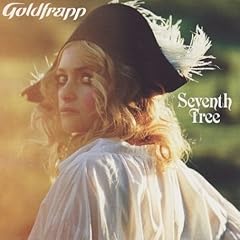
The best thing (at the moment, anyway) for me, though, is the lyrics. Although by that I don't mean what you think I do.
Take the first track, "Clowns". Reading the lyric booklet in my nice posh special edition blah blah, I see the opening line is "Only clowns would play with those balloons." Only that's not what I hear. What I hear is more like "Only cloeooayeedohmmmaooooo." My theory is that Alison's approached the lyric writing via the method of doing some nice sounding vocalising, and then scribbling down something that it could plausibly be. And this is a Very Good Thing.
Because that's pretty much how I hear lyrics anyhow. I've never been very good at remembering, or even hearing, words beyond the odd pertinent line, even Dylan. Where some people sit about trying to deduce the inner meaning of "Subterranean Homesick Blues", I just enjoy the sounds of the words. I don't really care what they mean, or even if they mean anything. What matters is the feel conveyed by them, and that's got little to do with syntax. This is demonstrated perfectly by the greatest lyric ever penned in the history of rock and pop: "Awop-bop-a-loo-mop alop-bam-boom!"
Friday, February 29, 2008
Words written in the wind and the running water
Ships that pass in the night*
Just as the tube doors close at Oxford Circus, a gangling figure crashes through them and swerves past my cello straight into the last untaken seat, it's Bobby Gillespie. I wonder if anyone else recognises him? I resist the temptation to ask him "Are you Bobby Gillespie?". Because that would make me a wanker. Although somewhere in the back of my mind a scenario presents itself that he'll be getting of at my stop, we'll start chatting and the epic collaboration between us will be born. He gets off at Notting Hill Gate. Probably just as well.
*I say night. Obviously it was the morning. But it was underground, where it may as well be night.
Thursday, February 28, 2008
reissue, repackage
 There must be a re-branding mania at large - this week we commuters down the Lee Valley have been continually reminded that we are no longer on a "One" service, but in the brave new world of "National Express".
Wednesday, February 27, 2008
Walls come tumbling down (or not)

Monday, February 25, 2008
Neckwear for second childhood
 It's a good and necessary thing to have goals, and it occurs to me that I'm sorely in need of an objective or two at the moment.
I wonder if adulthood isn't a matter of putting away childish things, but more of an opportunity to accrue the childish things you couldn't get hold of because you were only a child.
Now, I must make the momentous decision: which scarf should I make? The original model, the replacement that came along a few series later when the first one had had one too many bits shot off by daleks and the like (which I guess is the one I really remember, as it coincides with my getting old enough to become really obsessed with the show) or the burgundy one from Tom's last season, which came in with the shirt with question marks on the collar that I associate with the beginning of the slide into 80s awfulness?
Thursday, February 21, 2008
The extraordinary continuing non-shitness of Torchwood

I hope Scott and Charlene are hanging their heads in shame, that their rebellious shenanigans drove poor old Jim to this.
Wednesday, February 20, 2008
It ain't what you do, it's the way that you do it
Interesting post over at Kyle Gann's blog touching upon issues of notation.
Now you may think this sort of thing is pure composer-nerd territory, but think about it for a minute: a "classical" composer is in a strange position in that he or she is dependent on others to realise his work; all the great ideas in the world are worth nothing if you can't figure out an effective way to communicate them to the performer so he or she can attempt to convey them to the audience (which you hope will consist of a least a few more people than you and your mates).
I sometimes wonder if all the exciting notation software we have available to us these days isn't stopping composers from really thinking about how they write things down. On the other hand, fancy clever notation can be a smokescreen to mask the lack of substance in a piece; there's a terrible danger that the means become the ends.
It's a long, thin, high tightrope to walk: Kyle's got a point about professional musicians' aversion to anything that makes them have to stop and think, but at the same time it's important for the composer to put his instructions across as clearly as possible. Morton Feldman's a great example of a composer who writes his music out in a fashion that often sems to defy logic; but his idiosyncratic presentation does convey an important idea about the music and how one should approach it, in a way that a more superficially straightforward approach wouldn't. I guess the bottom line is, if you're going to write something in an unorthadox way, that's fine, but make sure you know why you're writing it like that. And the same goes if you're writing it just how your teacher told you to.
Sunday, February 17, 2008
Culture - to go!
This article by Armando Iannucci in the Observer today is thought-provoking stuff, one of the best bits of journalism he's written. Of course kids won't just stumble upon "culture" without being introduced to it, but when a government starts declaring quotas for arts in school I get suspicious, not least because (apart from the question of where these 5 hours are going to fit in and what can be usefully achieved in that time anyway) there's a bit of me that wonders if this sort of thing isn't a substitute for proper education rather than an impetus to it. What kids need to be introduced to is the idea that there are things in the world that require effort, and that they are worth that effort. I can't see how what they're suggesting will achieve this. Plonking a child in front of an orchestra isn't enough.
Thursday, February 14, 2008
Happy Valentine's Day!

A heartwarming tale of romance, stolen moments and utter idiocy for the most romantic day of the year. As seen in Classical Music's guide to music summer schools, out now. Play nicely and take precautions, kids.
Wednesday, February 13, 2008
The Image Game
 Some time ago I found myself in the strange position of being offered money to draw comics, not something I ever thought would happen. The first fruits of that job are in the public eye now, and as the Classical Music Competitions supplement has now been out for a bit, I thought I'd post the strip I drew for it. The second one, for the Summer Shools supplement is just out, and the third, for the Music Festivals one is due in May. Well worth getting if you have any kind of interest in those subjects, and the strips look lovely on the page.
It's an odd feeling, seeing something I drew in print on nice glossy paper in a magazine, a strange mixture of excitement and terror, but one I could get used to, I think.
I might put up the second one tomorrow, it'd be appropriate given the date, ha-ha.
Tuesday, February 12, 2008
Lost Girls
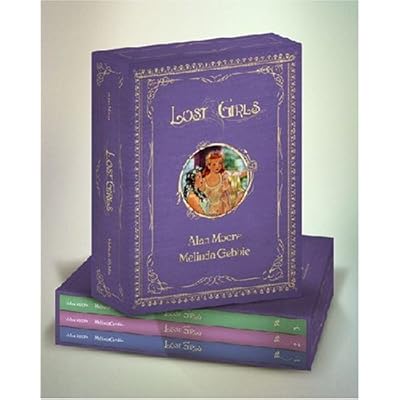
Lost Girls is Moore's self-declared attempt to produce intelligent porn, and there's no doubt that it's hardcore - pretty much every page contains explicit sex, quite a bit of it illegal (and the rest oughtta be! I thangyew). The scenario presents us with three famous fictional women from fantasy novels - Alice (of Wonderland), Wendy (of Never Never Land) and Dorothy (of Oz), who meet in a hotel in Europoe on the eve of the First World war, and proceed to tell each other their stories while engaging in all manner of congress*. Thus the three tales from which the characters originate are recast as Freudian metaphors for sexual awakening. Moore is certainly not the first to consider these works of children's literature in this way, but to be quite so, um, uncensored about it is, er, a novelty.
This is by a country mile the most controversial thing Moore's ever put his name to, but it's a serious, thought-provoking book that argues passionately for freedom of thought and expression - only madmen and magistrates can't distinguish between fantasy and the real world, he states - and makes clear in its closing pages that there are real obscenities in the world that make a mockery of our uncomfortable reaction to sexual fantasy.
Whether it really works as pornography, however, is open to question. For all the organs shown in action, Lost Girls is a cerebral work, concerned with how society polices our thoughts and actions, with how we define the limits to what we consider acceptable or immoral, with the sexual undertow that exists within all human endeavour. It's hard to imagine it'll be very useful to anyone who just wants a quick one off the wrist.
Here's an interview with affable Al on Lost Girls:
Part One
Part Two
And here's the great man himself speaking on the subject in moving image form:
*For the musos out there, there's a thoroughly entertaining and improbable threesome that takes place during the first performance of The Rite of Spring, all the rest of the audience presumably too busy being horrified by the action on stage to notice the three women shagging in the stalls.
Thursday, February 07, 2008
Daniel Barenboim plays Beethoven (Royal Festival Hall)
There are so many things I could say about Barenboim's playing. It's unshowy, deeply humane and puts music above shallow showmanship at all times. When at the end of the Appassionata Sonata he works himself into such a frenzy that he pounds the pedals and the floor violently with his feet it comes across as the perfectly natural unleashing of tension and passion that he has held carefully in check up till now. It's a pleasure to hear him play the two op. 49 sonatas, the "easy" ones that even I can (or at least used to be able to) have a stab at. There's no danger of being overwhelmed by sheer technique, as you would in one of the more note-stuffed sonatas, and yet of course you see his brilliant technical abilities all the more, and see it entirely in a musical light. I come away thiunking I'm glad I saw him play these simple (but not simplistic) pieces rather than one of the phenominally difficult warhorses that you can hear any pro playing most weeks.
I could also talk about his lack of pomposity or self-importance, his air of absolute straightforwardness and openness, the wonderful intimacy created by his having audience all around him, rather than being perched in front of us on a stage, unreachable and separate.
But the thing I keep noticing is the handkerchief. He mops his brow with it, then throws it into the piano, then retrieves it again later. There's one point where he does this in the middle of a movement, while only his right hand is occupied with the keyboard, which lends a brief nervousness to my mood. But mostly the handkerchief stays out of sight, only momentarily appearing between sonatas. It's such a mundane thing, but it sticks with me, and somehow seems to stand for what it is about him that makes this such a satisfying evening, filled with insight and humanity.
Tuesday, February 05, 2008
Does Norman Lebrecht exist?
Daniel Wolf links to a prime cut of Norman Lebrecht, full of the factual accuracy that afficionados of Stormin' Norman have come to expect. Daniel expresses surprise that Norm, a professional newspaper columnist, could display such a level of ignorance about a major figure in a field about which he professes to be expert, and, the general disregard hacks have in this country for the truth aside, he's got a point. After all, if that were the case, then given Lebrecht's dismissals of bloggers as a bunch of amateurs who don't get their facts right, that would make him a big fat hypocite, and surely he can't be that? So it goes that as I read the hairy blusterer's attack on Stockhausen with the bluntest of hatchets, the thought occurs to me: Maybe Norman Lebrecht dosn't really exist.
Think about it: there have been cases before of spoof columnists who paraded a ludicrous series of columns before the public, who nevertheless took it seriously; Chris Morris's suicide journalist in the Observer springs to mind. If you were to create a satirical character, a music journalist filled with utter pomposity and egomania, entirely convinced of his own correctness despite his inability to do basic research properly, who assumes a stance of integrity and moral probity even as he trawls through the gutter looking for his next scurrilous bit of gossip, what would you come up with?
So, let others deride his ignorance and self-importance. I say, praise him! Praise the nameless shadow who has created one of the greatest caricatures of our age! Laudibus regina Jocasta in pestilentibus Thebis!
(It is of course possible, though highly unlikely I think, that I'm wrong, and Norm is a real person. If anyone can show me satisfactory evidence that Lebrecht does exist, and is not a fictional entity, I shall buy them a pint, or equivalent drink of their choice. Bet you can't.)
Thursday, January 31, 2008
Beadle: No longer about
You may remember him as that smug git on all those rotten 80s tv shows, but something less well known about Jeremy Beadle is that as organiser of the Bickershaw Festival in 1972 he was resonsible for bringing Captain Beefheart to the UK for the first time. Because of this, I can forgive him for Henry Kelly.
Addendum: The internet throws up some strange connections. Henry Kelly went on from Game for a Laugh to present seminal daytime Euro-quiz Going for Gold, essential viewing for all students and unemployed layabouts in the early 90s, whose cheesy, yet indelibly etched onto my mind, theme song was written by the bloke who went on to score Ridley Scott's Gladiator.
Here's Johnny
 Johnny Hicklenton drew some of the most distinctive, visceral, and plain old bizarre art you could hope to have seen in the pages of 2000ad in the late 80s and early 90s. At a time when the entire industry seemed to be in the grip of Bisley clones churning out brown painted art, he stood out as someone doing something utterly unlike anything else around, and there's still really no-one quite like him.
  Fortunately Johnny's too much of a fighter to sit back and accept this, and one of the ways he's fightiong back against this horrible disease is by working with Animal Monday to make a film about his condition, "Here's Johnny", the first screening of which I attended last night at the Science Museum's Dana Centre. It's a powerful piece that pulls no punches in letting you know what the (often uncomforatbly personal) effects of multiple sclerosis are, not just physically but pstychologically. This coukld make for uncomfortable viewing, but it transcends the awfulnes of its subject matter simply by the fact that Johnny's such an irrepressible, tenacious and funny man. It's being screened at Sight and Sound in Austen next month, whether or not it gets a cinema release remains to be seen, but as channel 4 have part-funded its making it'll doubtless be coming to a tv screen soon, and you really should keep an eye out for it and make sure you see it, because it's a provocative and thoughtful piece of film-making, the sort of thing you used to see all the time on Channel 4 before they gave themselves over to Wife Swap and Big Brother.
 Wednesday, January 30, 2008
Robyn Hitchcock / Rasputina (Queen ElizabethHall)
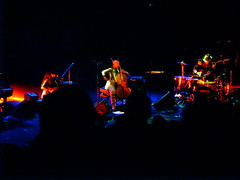
Anyway, the Queen Elizabeth Hall in front of an audience who are mostly waiting for someone else who they've actually heard of to come on is of course a very different proposition to headlining at the Windmill, and Rasputina seemed at first here to be pursuing their more explicitly "chamber" side at first, easy on the pedals and steady on the tempi, less of the banter. Something seems to gel when "Saline the Salt Lake Queen" appears and I think by the end they won over some of the unconverted at least. It was a good performance, although it was never going to be quite as special as standing mere inches from the band in a small room. The two audiences remind me of the two Londons; one intimate, friendly, eager; the other cosmopolitan, standoffish, reserved. They're a great band, as individual in their way as is the headliner, and I hope they'll be back on these shores before very long, and welcomed by an increasing crowd (although a selfish part of me would like that crowd to be small enough to fit in the back of a pub).
I could mention Syd Barrett and Vivian Stanshall and that whole pantheon of English eccentrics and surrealists he belongs to, that stretches back way beyond Dali and his ilk to the real origins of surrealism, Edward Lear and Lewis Carroll. But building up a legend isn't really what he's about. it's mostly quiet, unassuming music that doesn't need to declare its worth, and is all the more affecting for it. There's a simple joy that's easy to hear, much harder to put across effectively, the art that's all the more artful for its apparent artlessness.
Addendum: a man like Robyn H attracts a certain level of punter, among those present was none other than Nick Lowe. And Adam from TV's Adam and Joe. Which is quite exciting. But not as exciting as Nick Lowe. Sorry, Adam.
Tuesday, January 29, 2008
Between thought and expression

Rasputina (Windmill, Brixton)

First, though, we have rayOn (eccentric typography preserved here, I've got a soft spot for that sort of thing). They start off lively, but before the first song is over the guitarist's broken a string. They do what has to be done: make a bad pun about their "rocky" start and play a slow number to give him a chance to replace it (although it'd have been more fun to make do with five strings. After all, George Formby managed with four). I like this band. Back in Birmingham we have a grand tradition of fabric-monikered bands (Felt, Denim*) which immediately warms me to them, and they play a fun set. They're not going to set the world alight, but they look a bit long in the tooth to be seriously entertaining thoughts of rock 'n' roll stardom, and you know what? Sometimes being a decent band in the back of a pub is enough.
Rasputina really could be playing somewhere other than the back of a pub (the girl I'm next to and I are both surprised that we're seeing them here rather than the Brixton Academy, and in fact they'll be at the grander surroundings of the QueenElizabeth Hall tomorrow night, supporting Robyn Hitchcock), but I'm very glad they're here, because there's a cosiness in a small venue you'll never get anywhere bigger, and Melora's dry wit goes down well in an intimate setting like this. American bands always seem to do things like banter much better than most British groups, maybe they just have a better tradition of playing to the audience to draw on than we do. Rasputina have an arrestingly individual aesthetic, and all the bucketloads of charisma necessary to bring that to life on stage, Melora and Sarah's voices and playing perfectly attuned, Melora's between song chat is very funny, and the whole thing is ably underpinned by Jonathon's driving drumming. (Incidentally, and utterly irrelevantly, Jonathon is really, really tall. I kind of expected him to look as he does, like Alan Moore might have done if all those years ago he'd decided to research Swamp Thing by going to live on Gumbo in a Louisiana swamp, but I really wasn't prepared for his remarkable distance from the floor.) At one point They launch into a heartfelt tribute to Sir Mixalot, which touches all our hearts.
You wait ages for a rocking cello band to come over from America, and then they do do two gigs at once. And even before the second, I'm already hoping it won't be too long before they're back here again. And if it does all come to nothing with the band (heaven forbid) Melora's got a bright alternative future in stand-up.
*Felt and Denim are arguably two manifestations of the same band, which would make this a grand tradition of one.
Sunday, January 27, 2008
Scaledown, King & Queen, 25 January
Good intentions butter no parsnips, I'm told, and having determined after the last time I went to a Scaledown night to get along to another really,really soon, I find myself here, almost exactly a year later. So much later, in fact that one of the acts tonight is making a return visit to the Scaled Down world. Still, I made it eventually, and this year I'm definitely going to get along to another one in less than a year's time.
So anyway, this time we had another varied menu of sounds. It's the sort of evening where you're unlikely to like everything, but you're bound to like something, and so it proved. After the customary turn by hosts Mark Braby and Andy Coules - a unique take on "Smash it Up" by the Damned - we have some entertaining spoken word stuff from saxophonist Mark Norton, of which the funnier poems are the better, not a million miles from John Hegley territory. 

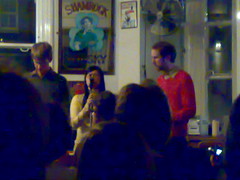
Finally is John Ellis, former guitarist with the Vibrators and the Stranglers, whose pedal and ebow-driven guitar noodling just didn't really do it for me, I'm afraid (and that's mild compared to what my companion said. She really didn't like it). But it doesn't matter, because I heard plenty of stuff I did like, and had a good time. Which is of course what it's all about.
The next Scaledown's on 22nd February, and I'm going to be there, definitely, honest.
I did take pictures of everyone, by the way, it's just they didn't come out very well. It's difficult taking photos in a dark room without a flash.
By the way, the Scaledown boys have moved into the world of recording, and I picked up their first release, a lovely 7" single by a band called Pocket. Get it at the Orchestra Pit.
Friday, January 25, 2008
Och aye!

To A Mouse.
Wee, sleekit, cowrin, tim'rous beastie,
Thou need na start awa sae hasty


