
Monday, April 30, 2007
Sunday, April 29, 2007
Bill Callahan
 It's the dancing you remember.
Bill Callahan has been making music for many years now, generally under the name of Smog (or, in an act of obfuscation typical of the man, as (smog)). He's much admired by those who know his work, but there aren't that many of them. However, the massive attention that's been paid to his current beau Joanna Newsom means that inevitably some more light is shining on his corner at the moment, and maybe his time is finally coming. There's been a change in the Callahan method, bringing a new album released under his own name, which features songs presenting a demeanour that might be described as cheerful. Fortunately this doesn't seem to have compromised the quality of his work, so we take ourselves to the Queen Elizabeth Hall to hear how this newly lighter mood transfers to the stage.
Last time I saw him he was on his own with his guitar, and although this time he's brought a band with him, all the songs at their core retain that aesthetic. Although he's linked with the "lo-fi" movement, that label doesn't really do him justice. His sound might broadly be described as "countrified Velvet underground", but he seems to draw from a deeper and older well, the same feel you get when you listen to old scratchy blues records from before the war, of something rooted in an ancient past. He's not one for stage banter, his quiet demeanour contrasting incongruously with an audience that applauds the opening bars of most of the songs in the way you might expect at a Barry Manilow concert (incidentally, this audience seemed to spend an awful lot of time standing up and going to the bar, although maybe it just seems more obvious because it's a seated venue with the bar outside the hall?). He stands upright and rigid, strumming his guitar and intoning his lyrics, deadpan and impassive. Which makes it all the more strange, his penchant for suddenly twitching, his legs writing and kicking occasionally, rather in the manner of a slow-motion Elvis as impersonated by Max Wall. The music is hypnotic, soulful, occasionally terrifying in its intensity, and seems utterly at odds with these curious movements. And yet afterwards, on long reflection on what I've seen and heard, it comes to seem absolutely right, the man's movements as singular as his music.
He doesn't say much to us, although at one point he does announce, "I feel good tonight". And it seems a simple, honest thing to say, that at the same time suggests something more profound, merely alluded to.
Saturday, April 28, 2007
Mstislav Rostropovich 1927-2007
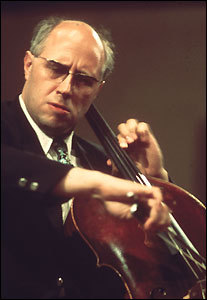
Of course, it's very easy when someone has just died to paint them in saintly colours, and it would be dishonest to deny that he was far from flawless as a man. And I have to say I thought he was an awful conductor. But he opened up worlds for me as a child, and I don't see that anyone could hear a few bars of his performances of the Beethoven cello sonatas without being struck by the sense of being in the presence of a great, generous and very human spirit.
Monday, April 23, 2007

Sunday, April 22, 2007
Things I saw this week when I did not have a camera to hand
A black swan.
A heron pause on the bank of a river before taking flight.
A horse underneath a motorway.
My uncle's remains lowered into the ground.
A baby's smile.
The sun on the water.
Tuesday, April 17, 2007
Basquiat Strings with Seb Rochford

Davis studied with Miles Davis alumnus Dave Holland, and the album's very much in that sort of vein (there's even a version of "In a Silent Way". It's also rather slinky in its rhythms, in a way that brings Piazzolla to mind. If you've heard any of the other bands in F-IRE (Polar Bear, Acoustic Ladyland, etc) and enjoyed them, you should enjoy this, so stop dawdling and buy it.
Two Wheels Good

Monday, April 09, 2007
Xanadu falling

The unusual situation of a gloriously sunny bank holiday is a good excuse to cycle along the Thames pathway from Abbey Wood to Greenwich. Of all the things in London, the river is the one that most consistently makes me glad I live here, and the route takes us right alongside the water for most of the journey.
We round the Greenwich peninsula, and circle the Millennium Dome. I thought at the time, and still do, that the building itself is an impressive looking structure, hamstrung by a lack of purpose. The problem with it always was that they built it and then wondered what to put in it, precisely the wrong way round to go about it. So it ended up filled with tawdry, empty baubles, and now sits forlorn, empty and surrounded by decay, a beacon of broken promises and disappointment, an apposite monument to Blair's government. I reflect on Tony Blair, the man who was so desperate to be liked by everybody, and who ended up being liked by nobody much at all.
Friday, April 06, 2007
Friday, March 30, 2007
What use is a book without pictures and conversations?
I am very much looking forward to the next few days. This is for several reasons. One is the prospect of some time off work, and some rest. Another is the prospect of having some time getting out and about in some fresh air in good company. Another is the fact that I have got the new book by Bryan Talbot, Alice in Sunderland, which from what I've read so far will be a thoroughly absorbing holiday read. And I shall be going to see him give a talk about it next week, which should be fascinating, if his similar talk about The Tale of One Bad Rat (soon to be republished, I'm told) that I saw a couple of years ago is anything to go by. I'm also getting quite excited at the prospect of the return of Doctor Who. Yes, I am a geek. So what?
I'm also looking forward to some time away from certain annoyances, such as the person who's barely paused to draw breath since I got into the office this morning. Sheesh, can't some people shut up for 5 minutes?

Wednesday, March 28, 2007
Absences
There seems to be a chill in the air, a general ennui, disillusion and withdrawal. Where does this come from (apart from here)? Am I just imagining this, spurred on by a few coincidences and my own unproductivity to a hyperbolic conclusion? Maybe now that the days are stretching into the evening and the sun strains to bring in the spring people have simply realised that there are other things to do. Or perhaps it's simply a fallow moment before new buds appear. As I stumble over clumsy attempts to shake off my creative torpor I'm reminded of this poem:
Lambs that learn to walk in snow
When their bleating clouds the air
Meet a vast unwelcome, know
Nothing but a sunless glare.
Newly stumbling to and fro
All they find, outside the fold,
Is a wretched width of cold.
As they wait beside the ewe,
Her fleeces wetly caked, there lies
Hidden round them, waiting too,
Earth's immeasureable surprise.
They could not grasp it if they knew,
What so soon will wake and grow
Utterly unlike the snow.
Sunday, March 25, 2007
The trouble with Thomas Ades
(While I was waiting for my friend to arrive I sketched a few of the people arriving at the hall, some of which are dotted about this post.)
BCMG, Arditti Quartet, Pokrovsky Ensemble/Ades
LSO St. Luke's, 25 March
 This concert was part of a wider retrospective of Thomas Ades' music (the accent you see on his name is an affectation that I'm not going to dignify by using). I can't help but wonder at the reasoning of structuring such an event around a still young composer whose output numbers barely 35 works. Surely there are other composers with a more substantial body of work that deserves the exposure?
Still, I do have a guarded liking for some of Ades' music, so it seemed interesting to go along to this concert and hear several pieces together.
The opening work, a song cycle Ades wrote at 18, was a disappointment.
 "Five Eliot Landscapes" sets poems of T.S. Eliot in a style that might be described as "generic non-scary modernist". If I had to imagine how a teenager would set Eliot (not hard to do, as I did it myself) this is pretty much exactly what I'd expect - self-consciously "high art", with a few striking ideas amongst a morass of dreary note-spinning. I've always thought one of the problems with setting poetry is that you come up with a brilliant idea for one or two lines, and then have the inconvenience of having to set the rest of the poem too, and this was how these songs came across. All perfectly well executed (although I found myself distracted by the frequent extreme hand-crossing in the piano part - played by the composer - which seemed to have no real reason behind it) but ultimately unmemorable.
The Chamber Symphony, composed shortly afterwards, is a completely different matter. Here is a work that stakes its territory with precocious confidence, a jazz-tinged undercurrent fuelling an exuberant and vital piece. it does flag after a while (Ades seems happier writing fast music) but picks up admirably before ending in a slyly off-hand manner.
Living Toys is cut from very similar cloth, although written 3 years later. Again there are many exuberant moments, although I couldn't help but feel that it lacked the freshness of the Chamber Symphony. There's a lot of music here that com
 es across as the sort of thing a young man might write having just heard Ligeti, especially in the prominent horn part that plays considerably on natural "out of tune" harmonics. There's also an ill-advised reference to "2001: a Space Odyssey", bound to fail because the harmonics and glissandi Ades presents, effective though they are in their own right, can never evoke the death of H.A.L. as well as the distorted singing of "Daisy Daisy" in the film.
"Arcadiana" was written a year later, and is a very self-conscious affair that uses quotations from and allusions to other composers to no great effect. There's a deconstruction of "Nimrod" from Elgar's Enigma Variations that has n
 othing to say about the Elgar and hence comes across as pretty but pointless. Occasionally striking ideas surface, but are never around long enough to make an impression. One gets the impression of a composer losing his nerve, and settling for writing acceptable "official" music rather than risk failure in the pursuit of something greater. I've been listening to the complete quartets of Elizabeth Maconchy, a composer whose astringent but approachable language might put her in the same category as Ades, but her works are altogether more substantial and hewn from tougher stuff than this rather limp affair.
(Why isn't there a major retrospective of Maconchy going on, in her centenary year? Her neglect is criminal, compared to the adulation that Ades routinely receives for a far lesser achievement.)

There's no doubt that Ades is a talented composer, but it's hard to see a coherent personality in his music. Maybe this will emerge in the coming years, but it feels too soon to be holding grandiose surveys of his work. Of course, the impetus behind this is, I suspect, more down to lazy programming and the influence of a certain coterie in classical music that Ades has slotted in with very effectively. He needs to take some risks, otherwise I fear he's doomed to be a composer of effective but uncompelling pastiche, polite music for polite people that upsets no-one and harms no-one. Music should never be harmless. There's nothing wrong with overt influences, of course, but I'm not convinced Ades owns his, in the way that Stravinsky does, who always sounds like no-one but himself, even when he's appropriating a style in as extreme a fashion as he does to Mozart in "The Rake's Progress".
Talking ofStravinsky, his "Les Noces" completed the concert. Stravinsky also borrowed from numerous styles liberally, but never sounds like anyone but himself. And how wonderful to hear the singing of the Pokrovsky Ensemble, whose raw, strident folk singing style energised this wonderful piece in a way that preened conservatoire voices never could.
There was another concert after this one, featuring works by Conlon Nancarrow, that I'd like to have stayed for, but I was disoriented enough by the clocks going forward without staying out til past midnight. Shame. Still, I can always dig out my CDs of his Studies for Player-piano.
Friday, March 23, 2007
Top heavy

I don't mean commuters on folding bikes with little Noddy-wheels, although let's face it that does make you look a bit of a twonk,* but young men on little bikes that make them look like clowns. I see this a lot round my way,** and it puzzles me. Do they not realise they look like twats carting their adult bodies around on a child's wheels? Or am I just an old fart who doesn't get it because I'm not Down with Da Kidz?
* Bromptons are the cycling equivalent of Macs, they seem to induce a similar air of smugness in their owners that makes you want to punch them. Hard.
**My way being somewhere near Chav Central, which may explain something.
Wednesday, March 21, 2007
Deconstructive criticism

Feldman's later music is notorious for its extreme length, and his second string quartet must be one of the lengthiest pieces ever written, clocking up at some 5-6 hours (yes, hours). Understandably, it's rarely performed in its entirety, due to the immense stamina it requires.*
Anyway, the story goes that a young quartet decided to take up the challenge, and having prepared themselves, they played this behemoth through for the composer. Feldman sat quietly through the performance for the full six-odd hours it took to perform it. On finishing, the quartet looked, tired but filled with a sense of achievement, to the composer for his opinion. Feldman stood up and announced:
"That was fucking rubbish."
* I believe the Kronos Quartet, for whom it was written, never performed it in full, although in recent years a couple of recordings have appeared, notably an excellent one by the Flux Quartet on DVD, meaning you can listen to it without having to get up and change the disc. If you've got the guts to sit through it, it's well worth your time.
I suspect the quote is inaccurate, mainly because it's highly unlikely that an eminent American composer would use the word "rubbish". It is, however, entirely probable he'd have used the word "fucking".
Friday, March 16, 2007
Send in the clowns

The thing is, the charities that benefit from it are all Good Things and worthy of support. I just can't help thinking, why can't we just, you know, give the money? Then we'd be both helping those who need it, and sparing ourselves hours of light entertainment hell.
Anyway, to prove I'm not a heartless curmudgeon (even though I clearly am), I shall suggest that you buy this book, all the profits of which go to Comic Relief.
Thursday, March 15, 2007
Interrupted
I find it difficult to get to the end of a record at the moment. This is one of the problems with listening to CDs at work: The nature of my job means that I may be sat at my desk for ages, or I may find myself frequently having to get up and go somewhere else. This means I constantly have to pause whatever I'm listening to, and I find that after a number of interruptions I've lost the thread of the album and it seems pointless to continue with it. So another on goes in the drive and the process begins again.
When I was young I got it into my head that once a record was on the turntable (as it was in those days) it could not be interrupted; the passage of the music took precedence over me, and if I had to leave the room for any reason, the record kept playing and I just had to miss whatever happened until I got back. There's an impracticality at work there that I rather like. and I'd often find that on returning to the room, the act of coming in halfway through something made me hear it afresh, so I'd often notice something I hadn't before, just from the removal of the context.
Maybe I should do that again. What's preferable, to miss a large chunk of the middle, and possibly the end, or never to find out what happens in the end? Things are happening all over all the time outside our presence, after all. Life is in some ways a continuous coming in on something halfway through. And the one thing we all have in common is that none of us will ever find out how it ends.
Wednesday, March 14, 2007
The mind boggles

Also, I was bemused by the list of books we haven't finished. I mean, I'll 'fess up to not finishing Ulysses (although I shall one day, oh yes), but what's so difficult about Vernon God Little? I remember it being an easy read. Are we becoming so dumb? Judging by this story, HMV seems to think we are.
Tuesday, March 13, 2007
Lunch with the Doctor
SSL20254
Originally uploaded by petemaskreplica.

I'm not normally one to get excited about celebs, but my fanboy nerves did tingle a bit when I saw David Tennant filming an interview of some sort today.
Friday, March 09, 2007
Activity vs. Achievement
Some weeks you don't seem to get anything done, yet when you look back you can't quite work out why, as nothing seems to have left an impression on your memory. Is it because you've been too busy? Or are you being lazy? Is this a block, or just a natural fallow period? Are you drying up, or do you just need a holiday? Are you fed up with your job, or just your immediate circumstances? Was the week really that featureless, or is it just that it seems so after such a good weekend when you glimpsed a freedom you've been missing?
Maybe it's for the best to have a quiet evening pottering, washing, cleaning. Then a day of activity to follow. The thing is not to work or not to work - it's to achieve a balance between the two. Inactivity isn't necessarily unproductive, any more than business is necessarily constructive.
Subscribe to:
Posts (Atom)


