I'd say more, but I'm trapped in relocation hell at the moment and really should get on with the packing. Normal service will be resumed shortly.
It's repeated tonight at 7.00 on BBC4, or you can blahblah iPlayer. And while I'm at it here's an interview with the man himself.
Obviously I'll be deeply possessed with Euro-fever by then. Assuming I'm not trapped under a collapsed tower of boxes.
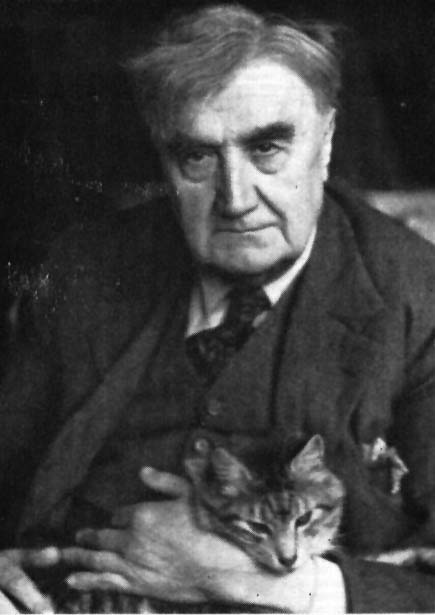
RVW would have felt right at home in the world of blogging, as this photo of him with a cat demonstrates.
Saturday, May 24, 2008
RVW: Let's Get It On
Wednesday, May 21, 2008
A life in boxes
I am surrounded by stuff.
Packing is an activity that inevitably leads to a certain amount of introspection; it's like a ritual, sifting through the lives once led in preparation for the life to come. Those books, CDs, pieces of random paper that bring to mind times you'd half-forgotten, smiles and rueful wonderings about what might have been, if only. But there's no if only in life, only what was, is and shall be.
So the difficult decision becomes, what stays and what goes? There are of course things that retain their immediate usefulness or potency, and those that can be happily discarded (CDs that will never again be played, books that will never be re-read). But there's also a slew of things that fall between; things that you can't entirely justify keeping on any practical level, but bring warm feelings of nostalgia. How do you decide about these?
I try to be reasonably callous about it; I believe in looking forward, not becoming mired in things past. But at the same time, that past is what made me, and I need to keep something to remind me of where I've been. Judging the line between these is a difficult one.
Mostly, though, at the moment I feel overwhelmed. When you've been in the same place for over seven years, you don't notice the accumulation of things, and it's only when you come to put it in boxes that you realise how much you are defined, and weighed down, by possessions.
There's a piece of me that wants to stand up, walk out and leave all the things. That knows I only need what I carry within me, really, and that everything else is detritus. But I can't let go of it all. I'm possessed by objects, and it's a worrying feeling. But we cannot entirely escape the detritus we have produced, and must accept responsibility for it.
Tuesday, May 20, 2008
Near and far

I ride a new way, aiming for the same destination. It's amazing how little deviation it takes to make the familiar seem like unexplored territory. I whistle a happy tune, with obscene lyrics rewritten as I ride. I reflect on how good it feels to be alone, out of the city, disconnected from the daily grind. At one point I almost look at the time, but think better of it. Why spoil the wonderful freedom from the temporal whip? I think of how strange it is that we strive to isolate ourselves from the wilderness, and then construct an artificial one. Of how fragile our existence is. Of how wonderful it is that this freedom is there for the taking, even in the city, if you take the time to find it.
Then I stop thinking, and look at the world.
Thursday, May 15, 2008
Irony in action
 Gordon's famously reduced the strength of their gin after an EU directive defined the minimum strength for gin as 37.5%. What was that about cutting corners and losing your edge again?
Mr Ramsay's very big on quality control. Obviously not that big, though..
Wednesday, May 14, 2008
Prometeo (RFH)

It's a bit different for me perhaps; I've sat through the five hours of Morton Feldman's For Philip Guston*, so a couple of hours is peanuts in comparison. And Bruckner wrote 90-minute pieces in which, in a very profound sense, nothing really happens (and yet everything!). So there's plenty of precedent.
Not everyone can take this sort of thing: there were several people who walked out, some after less than half an hour. But it takes a half-hour or so to acclimatise yourself to this sort of music, and you need the patience to do that if you're going to get something out of it.
The spacial element of Prometeo is of course one of its main selling points. Stockhausen of course experimented with breaking down the traditional relationship between performers and audience in the 60s with Gruppen, and playing Strauss's Alpine Symphony recently, with its army of off-stage brass, reminds me that playing about with these things is nothing new in itself. But Prometeo takes these ideas and runs with them. There are clusters of musicians everywhere, even before you consider the sound field created by numerous speakers distributed all around. This creates a slight tension, as the Royal Festival Hall is clearly designed for the traditional layout of audience all pointing towards a stage, so our sitting position works against what Nono is trying to achieve. But in a strange way this only seems to point up how entrenched we are in our concert-going habits, the very thing Nono wants us to question.
The (excellent) programme contained the texts used in the piece, but this is really better studied later on, as Nono deliberately abstracts the words in his setting so that it's really incomprehensible in any conventional sense. Rather, he exploits the libretto as a source of sounds and timbres for the voices. There didn't seem to be any need to think about the text or the legend of Prometheus except in the most general, abstract way, and this is part of what it's about: it's not about comprehending, it's about the pure experience of listening.
Normally when you hear something involving a combination of instruments and electronics you expect the electric part to be superimposed on the acoustic, but what Nono does is much more subtle than that, and it's a credit to him that you hardly think about the presence of the sound system, so carefully are the two elements integrated; this is use of technology as a subtle enhancement rather than a bludgeoning club. The effect as you hear sounds from their original source drift across the room and transform into complex textures is serenely discorporating.
The actual music itself seems much more eclectic than I'd have expected, ranging from terrifying clusters to the sweetest of perfect fifths, and pretty much everything in between. Occasionally a roar emerges from the orchestras, but largely the music is a great drift.
Nono is classed as one of those nasty modernists we're all supposed to reject these days in favour of Golijov. But what's striking is that this music (as well as being far more immediate than the anti-modernists would have you believe) doesn't sound "modern" at all. It sounds extraordinarily, immensely ancient. We leave the hall at the end, and to return to the bustle of London after this feels like returning from a journey to an unimaginably distant world, perhaps even time. The world seems too fast. Nono gives our thoughts space to breathe. And time.
There's so much more to be said, and yet also nothing. I go about my day as before. But behind it somewhere there's the memory of this other place, and it'll be a while before it's absorbed. it's all a matter of time.
Tim Rutherford-Johnson has a good roundup of reviews of the performances.
*I've sat through the even bigger String Quartet No.2 (over six hours on the Flux Quartet's recording, helpfully available on DVD to avoid those annoying disc changes). But somehow it seems cheating, doing it in the comfort of your own living room.
Friday, May 09, 2008
Playing with fire

Wednesday, May 07, 2008
Young Musician of the Year 2008 (BBC4)
Saturday, May 03, 2008
Thursday, May 01, 2008
"Writing about music is like dancing about architecture"

- Talk about historical context
- Put in something unusual or entertaining about composer or piece, the more trivial the better.
- Don't use any technical musical terms.
- Don't write descriptions of the music, except in the most general terms
- It's acceptable to mention something specific near the end of the piece, so the listener will know they're near the end.
- Entertain the reader.
- If at all possible don't mention the actual music at all.
Wednesday, April 30, 2008
The Minotaur
 Say what you like about the parasitical/elitist/upper class* crowd, they get service. I hardly had to queue at all to pick up my ticket from the Royal Opera House box office for tonight's performance of Harrison Birtwistle's latest show, The Minotaur. A pleasant change from some venues I could mention. The man behind the desk almost smiled, too.
They're obviously not used to folks from the regions in the bar though, as I had to repeat my request for a bottle of Pride several times, my minimally Brummie accent proving virtually indecipherable to the barman. Of course I was in the cheap sets, but i got to feel like a flash rich person with wads of cash to chuck around through the ROH's thoughtfully charging £4 for a bottle (that's about eight quid a pint - nightclub prices if ever I saw them. Maybe this is their way of reaching out to the ordinary punter).
I must make a confession: I'm not really that mad on opera. It's fundamentally a fairly ridiculous medium that seems to attract deranged fanatics who take no interest in any other form of music. So it's a credit to the composer and the production that I was thoroughly engaged in the evening, managing to sit through the 85 minute first half without fidgeting very much a all (just as well, as there's not much room in the cheap seats, certainly stretching's a no-no).
Death's always a problem on stage. It's difficult to feel genuine horror at the sight of some skinny lass writhing around the floor smearing ketchup over her smock. I suppose this is just one of those things you have to put up with, though, and Birtwistle's score and the production are both sensible enough to present something heavily stylised that makes almost no attempt to acknowledge the concept of realism. So when the Minotaur goes on his second killing spree, taking the body tally from one to a dozen in a few minutes, it's presented more as ballet than anything actorly, and is all the better for it.
As I've noted before, Birtwistle seems to be in the process of a strange image-metamorphosis from bogey man to the cuddly face of modernism in the press at the moment, and while it would be stretching it to suggest this is no more work than a night at Madam Butterfly, this is a compelling, clearly orchestrated and emotionally direct score, and hell, yes, lyrical. The narrative proceeds in a linear fashion, and one suspects Birtwistle's in danger of becoming respectable. I particularly liked the cimbalom that popped up fairly regularly, reminding me strangely of Portishead (I guess because they're in my mined this week).
There are lots of startling moments, particularly the Keres who come to feast on the dead left in the beast's wake, and the Oracle who tells Ariadne how to help Theseus escape the labyrinth. The message of the piece - the closeness of humanity and baser nature, and the way we create our demons - isn't one of startling revelation, but it's resonant, and presented subtly without being bashed around the head, and the melancholy of the Minotaur's monologues particularly is very affecting.
All the cast were excellent, but of course special mention must be made of John Tomlinson, whose head was visible as a human ghost inside the bull's head (a particularly good example of the way the design in the show uses simple ideas effectively) and brought the pathos to the role to make us sympathise with the beast. The chorus goading him on to kill come over as school bullies, creating the beast by treating him as one.
Looking round the audience at the interval, it struck me that it didn't look at all like what cliche would suggest an audience at a contemporary opera would look like, which must be a good sign. Although there was present that man who gos to all concerts it seems, and makes sure he leaps in like a demented seal as soon as the orchestra finishes to clap, thus entirely destroying the atmosphere (this was particularly annoying at the interval). No-one thinks you're clever for knowing when it's ended, mate, so give it a rest, eh?
At the curtain call I was startled to see a fat bloke in drag with a pair of comedy plastic breasts strapped on come on stage, it was the oracle. Sometimes it's best to keep the lights down low and keep the magic.
I tried to take a picture of the nice sandpit with a bull's head in it at the front of the stage before the show began, but it came out terrible, so I've nicked this picture from MusicalCriticism.com instead.
Tuesday, April 29, 2008
Portishead: Third

Parr-zed (as you call them if you actually come from Portishead) are also pretty much The Fall's polar opposite in terms of their style, too, but there's a connection in the way they've managed to revitalise their sound while remaining recognisably themselves - "always the same, always different".
What's remarkable about this album is the juxtaposition of two entirely different textures: most of the music is harsh and stark, underpinned by brutally minimalist beats, and this is thrown into sharp relief by Beth Gibbons's fragile, pleading vocals. The effect isn't too far removed from Scott Walker's latter-day stuff, and it's interesting that this album is getting a lot of positive mention where Tilt was received with bafflement by many when it came out. Maybe this is a sign of how we've moved on.
The other music that comes top my mind as I listen to this album is that of Galina Ustvolskaya - there's a similar feel of supplications to an indifferent God, humanity somewhere deep in the midst of a vast, uncaring machine of a universe.
This isn't easy listening - there'll be few dinner parties with this on in the background, as Portishead's first album was unfairly condemned to - but it's powerful stuff, that reveals itself more and more with each listen. And it takes a very special kind of confidence to be able to produce this stark, oppressive sound, and then throw a ukulele into the middle of it, as happens on "Deep Water".
Monday, April 28, 2008
The Fall: Imperial Wax Solvent
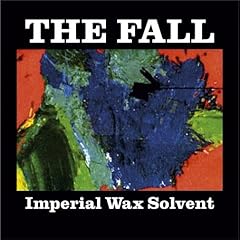
There are, apparently, still some people who remain wilfully blind to the genius of The Fall, and I suppose at this stage it's too late for them; I can only pity them and the drab lives they must lead.
Because there is not one band who has managed what Smith and his many cohorts have achieved: to sustain a career in this strange beast we call rock and roll for three decades that maintains an extraordinarily high quality level (I maintain they've never released a bad album: sure, there are Fall albums that are less good than the others, but their slightest effort is still several rungs above almost anyone else) and still retains its full creative force and originality.
Having established recent incarnations of The Fall as the Ur-garage band, Smith on this album seems to be playing with that sounds, pulling it apart and reconstructing it from the inside out. So what we get are a lot of startling jump cuts between textures and tempi, which seem to bring The Fall's latent Beefheart influence to the fore. now Beefheart's not someone you can emulate unless you're very sure of yourself, and of course The Fall manage to let that sound come out without ever once sounding like anything other than the Fall, which of course is the essence of their genius.
It's compelling, genuinely adult music ("I'm a 50-year old man, and I like it!" exclaims Smith) ; a big thick juicy steak of a record, in comparison to the thin gruel so many bands serve up. And it's great to dance to, too. The Fall come from the land of Northern Soul, remember; they understand the value of dancing.
Sunday, April 27, 2008
R.I.P. Humph

Friday, April 25, 2008
slipping past
slipping past
Originally uploaded by petemaskreplica.

The days pass. I'm not dead or anything, just busy with other things.
There are two courses of action when you hit the weekend with a stinking cold:
i) eat plenty of fruit and veg to get your vitamins and have an early night.
ii) fill yourself with booze and comfort food.
Guess which plan I'm going with?
Wednesday, April 23, 2008
written on the wind and the running waters

 Anyway, more interesting things are in the air, namely that the third and final cartoon I drew for Rhinegold is in the shops now, in the Festivals supplement to the current issue of Classical Music, so rush out and buy that, and then write letters to them saying how great I am and that I should have a regular strip in there.
Tuesday, April 15, 2008
A hard climb
I'm writing a programme note about Richard Strauss's Alpine Symphony for the next KSO concert at the moment, and it's an interesting contrast with the last one I did for Shostakovich 4. This is partly due to the fact that I just don't like Richard Strauss very much.
it's difficult to pin down just what it is that doesn't appeal to me; I can see that it's well written - Strauss is never less than effective with an orchestra - and there's plenty to say about the origins of the piece, what with the connections to Nietszche and Mahler. It's not even his dodgy Nazi links - the more I read about him the more I become convinced that he was naive and blinkered and self-serving rather than actually evil. It's that I can't see anything beneath the (admittedly attractive) surface. So I struggle at those sentences, desperately trying to convey an enthusiasm I don't really feel, talkign about hidden depths I'm not convinced are there.
He's the musical equivalent of a page 3 girl - very well built, but once you've got past the beautifully contoured orchestration, there's nothing to engage the intellect*. Someone once said something to the effect that of the three late-romantic Austro-German composers, Bruckner found God, Mahler searched for God and Strauss wondered what all the fuss was about. And that's the effect his music has on me. It drifts by, beautifully composed and utterly vacuous.
Composing to entertain the audience is a perfectly legitimate strategy, as valid as composing without a care for the audience, and on some level Strauss must be successful, because I certainly seem to be in a minority in my apathy. But as much as I like to look at a well built figure, it's more fun if there's a conversation to be had too.
*I'm not suggesting that all page 3 girls are air heads, of course. I'm sure there are plenty of them with degrees in comparative philosophy or quantum physics.

Tuesday Link-o-rama
Oh, has it come to this? Am I now on that slippery slope to being just another blog with a bunch of links to the words of other, far more intelligent and interesting people than me? I'll try not to make a habit of it. Anyway, in the absence of anything interesting to say coming out of my brain, here are a few things to read:
EMI's planned job cuts have been delayed by some piddling legal process. Damn those pesky Europeans with their crazy ideas that big multinational corporations can't just shit on people as they please.
The Graunaiad is publishing daily extracts from one of the Defeatist's number one heroes, Mark E. Smith. Part one is here and part two is here.
Harrison Birtwistle's new opera The Minotaur premieres tonight. Here are some interviews with the composer, director and protagonist. I'm interested in the way the media seem to have moved from portraying Birtwistle as a terrifying figure to almost the cuddly face of modernism.
Monday, April 14, 2008
And the painted ponies go up and down
During that time the firm supported Boosey & Hawkes’ management in executing
a transformation from a traditional classical music publisher into a 21st
century music rights group. It has outsourced a number of non-core activities
such as printing and distribution and developed a series of new revenue streams.
In particular it has developed a strong presence in the market for music in
advertising and film, where revenues are currently growing at approximately 30%
per annum.
Here's Daniel Wolf on the changing relationship between composer and publisher. My own experience dealing with all levels of music publishing suggests to me that an outfit such as Frog Peak can be a very effective way for composers to pool resources, while self-publishing composers vary in their effectiveness, from someone like Christopher Fox, who runs a very effective cottage industry, to the Stockhausen verlag, which, surprisingly for the imprint of a composer who was so much at the forefront of technology, doesn't even take credit cards. Meanwhile, the big old publishing houses seem to expend more effort in restricting access to their music than promoting it.
Mothman about the house
 I thoroughly enjoy reading Ben Clark's Magic Beans Comics. And so should you.


