Spring has sprung, it seems. Out for a walk at lunchtime in the West End, the sky is brilliant blue and there seems to be that indefinable sense of everyone being a little bit happier. I walk down Berwick Street, pick up a bit of veg. "Cheers mate," I say to the vegetable man in that Mockney way I've learned over a decade in the capital. I try hard not to look over the shoulder of the girl standing at the bottom of the street drawing the sex shop opposite, because I'm on a mission, and have to be back at the office in 40 minutes. I swing across towards the London Graphics centre to pick up a few drawing implements, when suddenly I'm confronted with the sight of an enormous dildo on top of the Palace Theatre:
A few steps further reveals the truth: it's just a giant stiletto heel advertising the new musical version of Priscilla, Queen of the Desert.
Just another normal day, then. I move on, pausing only briefly to reflect on the fact that it didn't seem terribly bizarre to have a giant dildo on top of the Palace Theatre. As I walk back to the office, I pass the girl, still intently sketching the sex shop at the corner of Walker's Court. Once, when I was a child, this place was the Soho sex industry. Now it's just another back street full of porn and what we then called marital aids. But it still retains that whiff of scandal, even amid the gentrification that seeps into it. I consider the walkers, and where they may now be. Then continue back to the office, pausing only to linger and gaze at other temptations offered for sale
Thursday, March 19, 2009
Capital Moments
Saturday, March 07, 2009
Programme notes: 7 March 2009
Michael Torke (b. 1961)
Bright Blue Music
One of the characteristics of much music composed in the last 30 years or so is a new sense that the bitter arguments about musical style that have characterised the history of music in the 20th century are now an historical irrelevance. A composer need no longer feel weighed down by dogma, and can employ whatever techniques and styles he feels suit whatever it is he wants to write. This is an attitude that the grandfather of modern American music, Charles Ives, would have approved of: he once wrote, “Why tonality as such should be thrown out for good I can’t see. Why it should always be present I can’t see. It depends, it seems to me…on what one is trying to do, and on the state of the mind, the time of day or other accidents of life.”
This brings us to Michael Torke and Bright Blue Music, a piece filled with startlingly straightforward harmonies. He came to public attention early, with two pieces – Ecstatic Orange and The Yellow Pages – written while he was still a student at Yale. These were the first two parts of his series of pieces collectively known as Color Music, and the reader will need no further prompting from a programme note to deduce that Bright Blue Music also belongs to this sequence.
Torke gives two reasons for his strategy. One is that by using the simplest, most obvious harmonies he is freed to concentrate on other things: “Once this decision was made and put in the back of my mind, an unexpected freedom of expression followed. With the simplest means, my musical emotions and impulses were free to guide me. Working was exuberant: I would leave my outdoor studio and the trees and bushes seemed to dance, and the sky seemed a bright blue.
“That bright blue color contributed towards the piece's title, but in conjunction with another personal association. The key of D major, the key of this piece (from which there is no true modulation) has been the color blue for me since I was five years old.” The result is a ten-minute burst of uninhibited exuberance and joy, or as the Chicago Tribune’s critic John van Rhein puts it, “like John Adams getting stoned and listening to Der Rosenkavalier.”
Charles Ives (1874-1954)
Decoration Day
When the young Charles Ives scoffed at John the village stonemason’s off-key singing in church, his father corrected him: “Look into his face and hear the music of the ages. Don’t pay too much attention to the sounds. If you do, you may miss the music.” George Ives was an inveterate experimenter who encouraged his son to open his ears to sounds outside the scope of conventional music theory. Ives recalled his memories of his father leading the singing at camp-meeting services that were a feature of the revivalist Christianity prevalent in New England at that time: “Father…would always encourage the people to sing their own way. Most of them knew the words and music (their version) by heart and sang it that way. If they threw the poet or composer around a bit, so much the better for the poetry and the music. There was power and exaltation in these great conclaves of sound from humanity.” The clusters of sound and wayward harmonies and rhythms that fill his music reflect these childhood memories.
Decoration Day is the second of four pieces that together are known as the Holidays Symphony. Ives wrote on one of the sketches, “Symphony, but not called Sym.”, and on another occasion remarked, “These movements may be played as separate pieces. These pieces may be lumped together as a symphony.” The holiday that it portrays commemorates those who died during the Civil War of 1861-65. As with much of Ives’ music, it has its roots in earlier works: in this case an organ piece of his own based on the hymn tune “Adeste Fidelis” (better known nowadays as “Oh Come All Ye Faithful”), and the Second Regiment Connecticut National Guard March by David Wallis Reeves. A number of other popular and hymn tunes of the time can also be heard by the attentive ear.
The villagers gather and the parade forms and marches to the graveyard, where the graves are decorated and hymns sung. Then all march back to the village to the strains of the Second Regiment, below which can barely be discerned the sombre thoughts of the soldiers. Finally, “in the silence the shadow of the early morning flower-song rises over the town, and the sunset behind West Mountain breathes its benediction upon the day.”
George Gershwin (1898-1937)
An American in Paris
“George Gershwin is the only songwriter I know who became a composer,” noted Irving Berlin in 1961. Crossover is a discredited concept now, but Gershwin stands almost alone in having achieved a genuine cross-fertilisation of different genres.
He drew rather less complimentary reactions from most of the American classical establishment. “Nauseous claptrap” was the verdict of the New York Telegram on An American in Paris at its premiere in December 1928. Hardly less dismissive was the Evening Post, whose critic declared, “For those not too deeply concerned with any apparently outmoded niceties of art, it was an amusing occasion… To conceive of a symphonic audience listening to it with any degree of pleasure or patience twenty years from now, when whoopee is no longer even a word, is another matter.”
He found a more receptive audience in Europe: when he toured his Piano Concerto there earlier the same year, Ravel, when asked what he would like as a birthday present, declared that he wanted to meet Gershwin. The ensuing meeting, where Gershwin asked Ravel for composition lessons (as he was wont to do to almost every major composer he met, so self-conscious was he about his lack of formal training), resulted in Ravel’s observation, “why be a second-rate Ravel when you are a first-rate Gershwin?”
It was during this European visit that Gershwin bought a number of car horns in Paris. The results of his experiments with them can be heard at the outset of An American in Paris. Described as a “Tone Poem” on the manuscript, it presents a lively sequence of events, from the opening street scene to the grand romance of the slow central section. Freed from the formal constraints imposed by traditional orchestral genres, the piece proceeds in a rhapsodical, almost stream-of-consciousness manner that perhaps, along with such touches as the car horns, puts him closer in spirit to Ives than is generally recognised. One more European who recognised his significance was Arnold Schoenberg, who wrote after Gershwin’s untimely death: “I know he is an artist and a composer; he expressed musical ideas; and they were new – as is the way in which he expressed them.”
Aaron Copland (1900-1990)
Symphony No.3
Molto moderato - with simple expression
Allegro molto
Andantino quasi allegretto
Molto deliberato - Allegro risoluto
From Ives’s use of hymn tunes and marches, through Gershwin’s ambition to take jazz and Tin Pan Alley to the concert hall, to Torke’s appropriation of rock dynamics, American composers seem to be consistently concerned with how music for mass consumption and more academically-minded sounds might relate to each other. This is not something that is so common in Europe, where until very recently there has been an unspoken consensus that, the odd essay comparing the Beatles and Schubert aside, the two shall never meet.
Aaron Copland brings all these cultural issues into sharp relief. A Jewish New Yorker like his contemporary Gershwin, he studied in Paris with the most influential European teacher of the first half of the twentieth century, Nadia Boulanger. This elicited suspicion from many back in America: a composer steeped in old-world traditions composing modernist music. But he attracted as much disdain from the European elite when he turned his attention to writing deliberately populist works like El Salón México, a clever and deceptively simple piece that convinced most of the avant-gardists who might have been his allies that he had irredeemably debased himself.
This is more a reflection of differing political and social concerns on either side of the Atlantic than anything else. While depression in the 1930s made Europe a place of gathering storms as Nazism and Fascism rose up, in the United States a relatively optimistic air was building thanks to Franklin D. Roosevelt and the New Deal, and this sense of rebuilding the nation was reflected in the arts generally. It is surely not coincidental that as Copland perfected his “American” sound in the early 40s with his ballets Billy The Kid, Rodeo and Appalachian Spring, Rodgers and Hammerstein were doing much the same with Oklahoma, which premièred in 1943.
This resurgent sense of national pride went hand in hand with a renewed interest in the grandest musical forms, and the symphony became a fashionable medium for an American composer to express himself in; the 1930s saw a slew of grand orchestral declarations. When it became known that Copland was engaged in writing a symphony the expectation was for something epic. He himself would later wryly admit that he “certainly was reaching for the grand gesture.” Work began on the symphony in 1944 and continued for two years.
The grandest gesture in what is Copland’s largest orchestral work is probably his most famous music: the Fanfare for the Common Man, which heralds the finale. In fact the fanfare existed before the symphony, written to a commission for the Cincinnati Symphony in 1942. It is sometimes suggested that the fanfare is bolted on to the symphony, but this is unfair: Copland had it in mind as the symphony’s climax very early on. The extraordinary fame that it has achieved since gives us a warped perspective on it. At the time it would have seemed to Copland that it was just an occasional piece that would soon be forgotten, but too good an idea not to use in a new context.
The fanfare’s contours are reflected in the whole work, from the grand opening, which gives that sense of wide open spaces that Copland had perfected in the ballets he had written in the early 40s. Anyone familiar with Appalachian Spring will recognise the dancing rhythms and pastoral interludes that characterise the second movement. The third movement reflects some of the concerns of the opening, beginning with a brooding version of a theme heard on trombone in the first movement, before gradually speeding up to a central climax so dramatic that the listener could be forgiven for thinking that it marks the start of the finale. But things die down again, and when the finale does follow on directly, it begins tentatively in the flutes before the full brilliance of the fanfare breaks out. From here the music takes flight before reaching a conclusion whose grandeur and significance was summed up by Leonard Bernstein: “The Symphony has become an American monument, like the Washington Monument or the Lincoln Memorial or something.”
Friday, March 06, 2009
Look ma, I'm shameless
Crikey. If you're here, you're almost certainly here via the estimable Mr Campbell. Thanks for stopping by.
Sorry, it's a bit quiet here at the moment. Would it be terribly whoreish to point you in the direction of this, and also this?
Yup, thought so.
Monday, February 16, 2009
The ties that bind
Well, damn. I come back from Glasgow with exciting tales of the Proclaimers, but I see the EU is on the verge of extending sound copyright to an eye-watering 95 years. I've discussed why this is a bad thing before, and will doubtless do so again, but fortunately rather than read my half-arsed rambling and ranting you can go and find out from the Rambler why this is a Bad Thing. To which I shall append my usual aesthetic argument that dialogue with the recent past is a vital part of the development of any art, and enormously long copyright terms hinder that. Think of J.S. Bach rewriting Vivaldi, or young Mozart rejigging J.C. Bach. Both acts of what we would now consider copyright infringement, but both essential to the development of each composer.
Thursday, February 05, 2009
R.I.P. Lux Interior
As a friend remarked, Lux Interior always looked like he'd died about 30 years ago and crawled out of the grave, so it doesn't seem quite right that he's actually gone. The Cramps remain one of the best bands I ever saw live. Damn shame.
Monday, February 02, 2009
Steal softly thru snow
Revellers
Originally uploaded by petemaskreplica.

Rarely does a collapse of the transport system feel so welcome. That travel alert sitting in my inbox this morning telling me that there were no trains at all was the sweetest news I'd had in a while. So much so that instead of going straight back to bed, we jump up, rush into the garden and build a splendid effigy.
Later we walk up to the woods and are astounded by the sight that greets us. It's as though Abbey Wood has tuned into a Breughel painting: people everywhere, adults and children alike, running and laughing and sliding down the hill, many on sledges (where have they been for the past eighteen years?) or snowboards or just binbags. No hostility, no depression, no recession, just a whole load of people who live nearby all enjoying themselves. Politicians go on the radio every day and tell us what's wrong with society, all the laws and restrictions they need to impose on us to put it right, to keep us in our place. And it turns out it's all unnecessary. All it really needs is a few inches of snow.
It won't last, of course, it never does - in fact as we head home again the tears and arguments are starting again as reluctant children are dragged home - but for a moment this afternoon we all forgot the fear that drives our lives and lived.
The sight that really amazes, and really shouldn't is this: children, loads of them, outside, playing. How did that become such a rare sight? I wonder how many of them have never really been allowed out to play like this before. I hope when the snow melts they still play.
Sunday, February 01, 2009
Rothko
 The thing is this: I like Rothko. I really like him. Well, his paintings, I mean. It's wonderful to be able to see these enormous, imposing canvases laid out like this, to be able to stand in front of them and let myself be drawn into those huge expanses of space, that seem so blank and flat and forbidding at first, then, as your eyes adjust, reveal ll kinds of shade, and turn out to be filled with eventfulness, dark reflections of whole other worlds.
What I don't like is being surrounded by hoards of people. Of course it's inevitable, especially when you don't get round to going until the last day of the exhibition, and sure the crowds are nothing compared to the Monet show a few years back. But I really don't need to be surrounded by ghastly, vacuous people, plugged into i-Pods rented at great expense to tell them what someone else thinks about the paintings, talking about them, spouting that pseudo-religious bullshit that surrounds Rothko and cheapens him with every word uttered. I don't want any of that stuff. I don't want anything, physical or emotional or conceptual, to get between me and the canvas. I just want to be there, face to face with that thing that requires no words of explanation, that just is.
Thursday, January 29, 2009
KSO Programme notes: 28 January 2009
Gabriel Fauré (1845-1924)
Pelléas et Mélisande, Op.80
1. Prélude
2. Fileuse
3. Sicilienne
4. Mort de Mélisande
Maurice Maeterlinck's symbolist play Pelléas et Mélisande has been a source of inspiration for a number of composers: in the wake of Debussy's opera, Schoenberg, Sibelius and Cyril Scott all composed works on the subject. Before any of these eminent modernists turned their attentions to the subject, however, Gabriel Fauré's score composed for the first performance of the play in English in London in 1898 gained the distinction of being the first music inspired by the drama to be heard in public.
Fauré was overworked at the time and so entrusted his pupil Charles Koechlin with the orchestration of the music. Fauré himself subsequently revised three movements for a larger orchestra in 1901, and the addition in 1909 of the famous Sicilienne completed the four movement suite that we hear tonight.
The circumstances of the work may seem unlikely, but Fauré made several attempts to establish himself in London. However, he never managed to impress the English as much as did his titled contemporary Dr Edvard Grieg. Indeed, the reception of his music was decidedly lukewarm: "It is scarcely satisfactory, being wanting alike in charm and in dramatic power… its continued absence of tangible form, not to speak of its actual ugliness at many points, is such as to disturb rather than assist the illusion of the scene," wrote the Times.
Such sniffy judgements were not uncommon for a composer who was and often still is dismissed as a purveyor of lightweight salon songs. But this is to misunderstand how his music works. Those looking for lurid expressions of breast-beating despair in the death of Mélisande, for instance, will be disappointed. Fauré's music eschews melodrama, and prefers to make its point in more undemonstrative, subtly shaded ways. Its exquisitely attractive surface should not blind the listener to its great subtlety and originality, an art that conceals itself. Often seen as a marginal figure of the late nineteenth century, Fauré really deserves to take his place as a farsighted figure of the early twentieth century, whose influence, through such composers as his contemporary Satie and his favourite pupil Ravel, has persisted through a significant strand of the past century; rarely if ever drawing attention to itself, but there nevertheless.
Ludwig van Beethoven (1770-1827)
Violin Concerto in D major, Op.61
1. Allegro ma non troppo
2. Larghetto
3. Rondo. Allegro
Franz Clement, the dedicatee and first performer of Beethoven's Violin Concerto, is a man recalled by some with horror. At the concert in December 1806 when he gave the first performance, rather than play the whole concerto through in one go he performed the first movement in the first half of the concert and the remaining two in the second half. In between he interspersed a number of other pieces, including a set of variations of his own composing, played on one string with the violin held upside down, before continuing with the remaining two movements of Beethoven's piece.
A little perspective is required. Those who complain po-facedly about this sullying of the concerto's artistry would do well to remember the dedication to Clement that Beethoven scrawled on the manuscript, which consists mainly of a tortuous pun on the violinist's "clemency". Beethoven clearly saw no contradiction between the expression of divine ideas and a cheap joke, and there is no reason why we should be troubled by such things.
That Clement performed the concerto at sight with no rehearsal may be true or may be a tale put about to bolster his reputation as a technical master, but Beethoven certainly finished the concerto very late. Again, though, this was not such an unusual situation as it appears to us. Late into the nineteenth century, virtuosi such as Liszt were accustomed to rolling into whichever town was next on their tour itinerary and only then organising concert dates and assembling the necessary local musicians to form an orchestra. Spontaneity was the order of the day, and if we like to believe we treat this music with more reverence we might also consider what we have lost in the process.
Although now one of his most loved pieces, the Violin Concerto remained relatively unknown until Joseph Joachim took it into his repertoire in the latter part of the nineteenth century. Until then it was more likely to be heard on a very different instrument: as a violin concerto was not an enormously sellable genre, Beethoven rewrote the solo part for piano.
The concerto is unusual for Beethoven in its overall feeling of sublime calm, which is not to say that there is not plenty of drama to be had in the vast opening movement, which is filled with incident and surprises. The second movement is so filled with rapturous stillness that it takes a sudden and violent interjection to dispel the mood and prepare for the energetic finale, whose joyfulness and cheeky touches (including the soloist's only two plucked notes in the entire piece) remind us that humour and profundity can make perfectly happy bedfellows.
Jean Sibelius (1865-1957)
Symphony No.3 in C major, Op.52
1. Allegro moderato
2. Andantino con moto, quasi allegretto
3. Moderato - Allegro ma non tanto
The early years of the twentieth century were a busy time for Sibelius. After years of struggle he was finally establishing his name as a composer, and conductors such as Toscanini and Henry Wood were performing his works. The English were taking to his music particularly, and so it was natural that he should be invited to visit the country by another prominent (though now half-forgotten) musician, Granville Bantock, who conducted the British première of Sibelius's First Symphony in March 1905 during the composer's stay.
England's appeal to Sibelius may not have been entirely unconnected with Bantock's generous hospitality, so lavish that Sibelius declared that he "never made the acquaintance of English coinage." While such attentions were understandably welcome and helped smooth the way for the Royal Philharmonic Society's proposal that he should bring his planned third symphony to England in 1907, there is a dark undercurrent: Sibelius had a drink problem, and such unconstrained bonhomie cannot have helped matters. His new publisher Robert Lienau's desire for more new works was an unwelcome pressure, and drove him further into the bottle. Progress on the new symphony was therefore slow, and the Society had to wait until February 1908 for its première. Bantock conducted, and Sibelius expressed his gratitude by dedicating the symphony to him. A pattern had been set, and Sibelius's subsequent career would be characterised by increasing self-doubt, struggles with alcoholism and consequent procrastination.
The Third Symphony represents a new maturity in Sibelius's style. Gone is the romanticism of the first two symphonies. In its place is a new, pared down sound, restrained in its emotions and textures. The moderately-sized orchestra that Sibelius uses could not be more in contrast to prevailing fashions in 1908 – Mahler had recently produced his Eighth Symphony, the "Symphony of a Thousand" whose extravagantly large forces were much more in tune with mainstream tastes. It is interesting to note that one of the few other composers defying fashion at this time was Schoenberg, whose Chamber Symphony is similarly a reaction against the overblown excesses of late Romantic music. Within a decade, the First World War would put an end to large orchestras (not least through the wholesale slaughter of thousands of young men who might otherwise have taken up the profession) and stripped-down neoclassicism would become the trend. Sibelius's music stands apart from these trends though. He is not interested in the ironic recycling of archaic clichés, but taking the principles of symphonic thought as the starting point for something entirely new. When Sibelius and Mahler met, around the time that the Third Symphony was being composed, their differences were encapsulated in Sibelius's declared fascination with the possibilities of creating symphonies bound together by intricate relationships between all the musical ideas and motifs, and Mahler's insistence that "the symphony must be like the world: it must embrace everything!" He did not see that Sibelius's approach could create the sense of an entire world just as effectively as his own, more diffuse structures.
The Third Symphony is in only three movements: The first movement's quietly vigorous opening opens out into bright cold sunlight, tempered by Nordic melancholy. Then a withdrawn, will o' the wisp of an intermezzo precedes a finale that starts fleet-footedly before mutating into a noble conclusion. It is often said that the way Sibelius constructs his music is by taking scraps and building up themes from them. This is precisely how the last movement of this symphony works – but it is in fact the only movement in all Sibelius's symphonies where this happens.
Tuesday, January 27, 2009
"Mother's 8-Baby Delivery Surprise"
...screeched the headlines at me as I fought my way down the Euston Road, swatting free-paper-hawkers left and right.
Eight babies? Eight?! How on earth can you be unaware that you're carrying octuplets? I don;t have a womb myself, but I can't help thinking that if I did I'd notice if it was that crowded. Did the mother just think she was constipated for nine months? Or was she so busy gorging on burgers and Mars bars that it didn't occur to her that there might be another reason for the sudden and dramatic weight gain?
Closer inspection reveals that the woman in question was perfectly awarer condition, and in fact that seven of the arrivals were expected. Only the eighth (sentimentally named "H" by the doctors) was a surprise. Suddenly it all seems much more reasonable. I suppose if you're a hard-pressed gynaecologist you might easily give up counting after the fourth or fifth body shows up on the ultrasound.
Still, eight babies. Are they very small? Or is the mother some kind of Titan? As no mention is mad of her extraordinary volume I can only assume she is now the proud matriarch of a tribe of Tom Thumbs, who will grow up to wear dolls' clothes and fear cats more than most children.
One person who will have been very happy at the news is her bank manager,who must be rubbing his hands with delight at the prospect of the interest she'll pay on the kind of overdraft you need to finance raising octuplets. Perhaps we'll salute her in years to come as the person who singlehandedly unblocked the international flow of currency.
Thursday, January 15, 2009
Monday, January 12, 2009
What's next?
Oh, you didn't think there was actually going to be a part 12, did you? Pff.
Anyway, poor quality pastiche be damned. I have determined that 2009 will be the year when slightly crazy plans are brought to fruition.
In particular, something to do with environments and participation, and something to do with time. A lot of time.
And something to do with a bunch of 19th century composers behaving badly.
More clues later. Gotta go chase the next deadline now.
Monday, January 05, 2009
Farewell My Cadence (11)
Mr Cage had made a lot of sense at the time, but the next day it didn't seem like I could get a handle on, or even remember, any of it - it was as though the guy had said nothing at all. The mushroom omelette was great, but it was repeating on me. And there'd been enough repetition in this case. It was time to cut to the chase. There was this guy I'd heard whispers about, Greg, they called him the Pontiff. Seems he'd gotten everything written down. That had to be the break I needed. I knew I was getting close to my man, close enough to smell, and it didn't smell pretty. Just one more step and I'd be there. That last twelfth step. Yup, I'd find the answer there alright...
Saturday, January 03, 2009
farewell My Cadence (9)
I woke on the floor. What happened?
The musician. Strange, everything he said seemed from a script. It was repeating my suspicions It knew the story well, the rest not at all. 15 or 20 to get the full picture, it seemed.
It wasn't so exciting third time, but he assured me it was the urtext, so I accepted and moved on.
Friday, January 02, 2009
Farewell My Cadence (8)
I came to in a heap on the floor, and not an attractive one. What happened?
The musician happened. It had been a weird night, he had plenty to say, almost as much as he'd had to drink, which was almost as much as me. Kinda strange though, everything he said seemed right but false, as though he was reading from a script. It was when he started repeating himself that my suspicions were raised. It was like he knew part of the story well, pretty well, and the rest not at all. I'd need to talk to 30 or 40 of the guys to get the full picture, it seemed.
I had to move forward, but I couldn't help feeling I needed to speak to him again, maybe with a little less lubrication this time.
Thursday, January 01, 2009
Farewell My Cadence (7)
I came to in a heap on the floor, and not a pretty one. What the hell happened?
Oh yeah, the musician. It had been a weird night, he had plenty to say, almost as much as he'd had to drink, which was almost as much as me. Kinda strange though, everything he said seemed right but false, as though he was reading from a script. It was when he started repeating himself that my suspicions were raised. It was like he knew part of the story well, really well, and the rest not at all. I'd need to talk to 60 or 70 of the guys to get the full picture, it seemed.
I had to move forward, but I couldn't help feeling I needed to speak to him again, maybe with a little less lubrication this time.
Wednesday, December 31, 2008
Farewell My Cadence (6)
Time was running out. Every corner I turned seemed to hide a whole bunch of questions. Who was this dame? Who was she seeing? Was there anyone left who'd known her, not just heard about her? Why were there so many bodies in this case? I'd need a whole new year to figure this one out. Hey...
Farewell My Cadence (5)
The guy opposite me was a weaselly looking man, beard, glasses, kinda fusty. He looked like the kind of man who'd sell out his own grandmother for a chance to sell out his own grandfather. Everything he said sounded strange, kinda bored and confident, the kind of confidence that's a con more often than not.
"Of course, no-one knew her like I did, it was my job to make sure everyone else knew her right, " he drawled. "Wanna buy some pictures of her?" The pictures looked kinda old, but the price tag on them was right up to date.
"Yes, I understood her, alright, and it was my job to make sure everyone understood just a little less than me - nothing worse than letting just anyone in on the act. I made sure everyone knew about all her old lovers - the Abbé, the Kaiser, the Rebel, the Joker, the Choirmaster - oh, yes, she had plenty, I can tell you..."
Yeah, plenty of names coming of his tongue, but thy were all old hat, all long gone. I needed to know who she was seeing now, who might have had a reason to stop her seeing someone else.
"Now? Good God, man, she was never seeing anyone now. There were only ever the old lovers. What do you think I am - some kind of gossip columnist? Only the old ones are worth talking about. Oh, sure, I know there are some young bucks who like to say they know her - but they don't, I tell you! Only I do! Only through old photographs, all those faces from long ago..."
He was starting to ramble. I slapped him hard across the face. He fell to his knees and thanked me, asked me to do it again. But I didn't have time. I had to get to the bottom of it all. There were a hell of a lot of bodies piling up in this case, and I was starting to wonder if the dame knew anyone who wasn't dead.
Monday, December 29, 2008
Farewell My Cadence (4)
I got into the Professor's study. Don't ask me how, gotta have a few trade secrets in this business. Let's just say that there aren't too many locked doors when you look at them.
Joint was a mess. Someone had been here before me. In fact, it looked like a lot of people had been here before me. For a guy who couldn't get the time of day the Professor seemed to be at the top of a hell of a lot of visiting lists. Didn't look like many of them had stopped for tea, mind. Just a quick drop-by, overturn the place and get out. Guess they had their own agendas.
There were a lot of papers, all over the floor. Lot of sums. Lot of numbers. Well, a few numbers over and over again. 13 wasn't one you saw anywhere.
2-11-4-9-6-7-8-5-10-3-12-1
1-2-11-4-7-6-9-8-5-10-3-12
12-3-8-5-10-7-4-9-6-11-2-1
XXXXX
???14???23??
!!!
Sunday, December 28, 2008
Farewell My Cadence (3)
The Frenchman sat opposite me. His face was half hidden in shadow, but even the half I could see looked like a face to be careful of taking your eyes away from for too long. He smiled and joked, but I could tell he wasn't too much of a giggler.
"Classical Music? Yes, I knew her," he drawled, in a voice as smooth as a silk stocking and twice as dangerous round your neck. "She was - how you say?- quite a dame, yes." I tried to moderate her behaviour, but she had a tendency to run away to... get in touch with people, non?"
"So you didn't like the way she acted with other guys, huh?" I asked. The guy had a charm, sure, but you wouldn't want to get on the wrong side of him, I could tell. Maybe you'd find yourself stuck in the Bastille with the kind of kiss-off that brought the house down.
"Pfff, it's not my concern what she does with... other classes. I know she did the right thing when she was with me, that's all. I made sure she kept up to date, dressed her well... what more could she ask for?"
"Maybe to be shown a little slack every now and then?"
"Ah, I have always been open minded, no matter what... some people may say."
"What about the German, were you open minded enough for him?"
"Oh, I doubt anyone would be. I hardly spoke to him in recent times. We fell out since our days when we plotted to bring the Professor's plans to fruition."
The Professor. I'd heard of the guy, not that people liked to talk about him. Some said he was responsible for the whole mess. Nobody'd ever caught him in the act, but they said you could see his fingerprints all over if you looked. I wondered aloud if I should speak to him.
"Speak to him?" The Frenchman's face cracked into a smile, and a laugh I didn't like the sound of. "Mon Ami, you won't find that easy to achieve."
"Why not?" I was getting a bad feeling.
The Frenchman sat back with a grin across his face like a cat that's inherited the whole damn dairy. "Why, haven't you heard? He's dead."
Saturday, December 27, 2008
Farewell My Cadence (2)
I pulled on my mac and pulled my hat down low to keep the rain off my face. It was a dirty night, cold and wet, and plenty of folks would be glad to be indoors, but in my line of work you go where the action is, when it is.
There was this guy, the German. Lot of folks had his number, they said, a lot of suspicion pointing his way. He wasn't the kind of guy who liked to do things anyone else's way, kinda the dominating type, if you know what I mean - I'd heard pretty strange things about his domestic, too. Kind of man who keeps more than one woman at home is going to be careless with the rest of them they said. And he was into crazy stuff too, weird group action and saying he was from outer space. I wasn't convinced - a bit of kinky doesn't make you a killer, and just because he liked to have the dame in unusual positions didn't mean he'd offed her, just that he had a different appreciation of her.
I was too late, anyhow - the German was already dead himself. Looked like heart trouble, but you never know - guy like that makes a lot of enemies, and some of them are smart, smart enough to make foul play look like happenstance. I was going to have to check that out, but not now. I had to get to the bottom of the case. I decided to grill the German's accomplice - the Frenchman. I pounded the sidewalk again, wondering if I was going to find a killer or a victim. Damn this rain.
Friday, December 26, 2008
Farewell My Cadence
or, Who Killed Classical Music? An exciting Christmas thriller in 12 parts (or fewer, depending how quickly I get bored).
Part 1
Classical Music was dead. Sure, she'd left a good-looking corpse - she was one hell of a dame in her time, and if you didn't look too close she could still turn your eye, and hell, some people were still trying to turn hers. Jeez, some people. If you've got an automobile with no wheels and no engine, it don't matter if it's a Rolls - it's still a jalopy, and it ain't right to take it out for a ride.
Question was, who'd done the deed? Sure, there were some people who wanted her dead, but most folks, if you asked them, were surprised she hadn't bitten the dust years ago, if they even knew who she was. Or cared.
Just because most didn't though, didn't mean that the ones who did hadn't come up with a whole heap of suspects. This was one investigation that wouldn't be wrapped up before the bars opened.
Tuesday, December 23, 2008

Wednesday, December 17, 2008
Tales from the Back Desk: Brahms and Liszt at night
 Speaking of things that go bump in the night (sort of)... the long-awaited new Back Desk is now online!
Look ma, I'm on hiatus
Not sure how that happened. Actually, I'm entirely sure how that happened. A combination of extreme business and personal stuff (none of your business, sorry) that's left no time or inclination to blog.
I've got a few ideas for things to post here, and I wondered for quite a while if it might not be better to wrap up here and start afresh. But I figure the raison d'être of this ol' house has always been pretty vague, and I wouldn't want to inconvenience the 10 or so people who stop by here, so Notations will begin again soon, with a chilling Seasonal Tale.
Shit, I'm blogging about blogging, which puts me down with some of the scum of the world. On the other hand, I have managed and shall continue to resist the temptation to start posting pictures of the cat, so be grateful for that, at least.
Tuesday, November 25, 2008
KSO Programme notes: 25 November 2008
Roberto Gerhard (1896-1970)
Concerto for Orchestra
Reader, beware: Roberto Gerhard once said, “My favourite listener is the one who does not read explanatory programme-notes… Understanding comes first, knowledge second,” and asserted: “I stand by the sound of my music. It is the sound that must make sense.”
He was born of Swiss-German and French-Alsatian parents in Catalonia. Inevitably this gave him an internationalist outlook, but nevertheless he felt his identity as a Catalan strongly. After studying with Schoenberg, he worked during the 1930s as a consultant to the Arts Ministry of the Catalan government, which acted as an autonomous body within Spain from 1932. Here, he was responsible for raising Catalonia’s artistic profile considerably, not only with his own scores but his work promoting others. This culminated in his bringing the International Society of Contemporary Music’s annual festival to Barcelona in 1936, during which Berg’s Violin Concerto had its world première.
In 1936 civil war erupted in Spain, and when in 1939 Franco’s troops captured Barcelona, a centre of Republican resistance, Gerhard was forced into exile. He ended up in Cambridge, where he adopted the Hispanic form of his name (he was christened Robert) and produced music for theatre, radio and television. From his earlier romantic style, concerned with the use of Catalan folk music, in his later years he cultivated a more modernist music, partly derived from his teacher Schoenberg, but with a sensitivity for colour that produces a sound far removed from the expressionist angst of pre-war Vienna: the folk music he studied so carefully in his youth lay beneath the surface, continuing to influence his sound-world.
His sensitivity to the nuances of sound was sharpened by his experience as one of the pioneers of electronic music: his music for the RSC’s 1955 production of King Lear was the first electronic score for the stage in Britain, and a few years later he was one of the first composers to work at the BBC’s newly-established Radiophonic Workshop, the cradle of some of the most radical experimentation ever to appear in mainstream culture, such as the extraordinary piece of electronica that nearly 50 years later still holds television audiences in thrall: the theme to Doctor Who.
As his colleagues gave voice to the TARDIS, Gerhard was re-establishing himself as a composer of concert music, and it was a commission for the 1965 Cheltenham Festival that resulted in the Concerto for Orchestra. In fact, the BBC Symphony Orchestra gave the first performance in Boston in April 1965 by permission of the Festival Authority. The British première followed in Cheltenham a few months later. It ruffled a few feathers, far removed as its sense of drama was from the cosy familiarity of the typical “Cheltenham symphony.”
By this time Gerhard was seriously ill: he had had heart trouble for some years which was by then becoming acute, and would cause his death in 1970. There is however no hint of fragility in the Concerto, which from its opening explosion of notes is a work filled with vigour. Gerhard overcame his aversion to explanatory notes to provide a preface to the published score, in which he described his approach to what remains an unusual genre in orchestral music: “Ensemble playing, the distinguishing feature of the concerto for orchestra, in fact here takes the place of the virtuoso soloist in the traditional concerto.” So the emphasis is less on individual display (although Gerhard certainly provides plenty of challenges for the players) than showing off the orchestra as a collective.
If there is a solo element in this piece, it is time itself: the music is constantly moving between different perceptions of time, expressed in three contrasting ways. The first, exemplified by the very opening, is characterised by busy, dense textures which create a sense of an infinitely expanded tonality. Then there are passages of what Gerhard describes as “almost static yet pulsating constellation-like patterns”, where tone gives way to a myriad array of sounds produced through unorthodox playing techniques, from tapping and rustling sounds in the strings which sound like an abstraction of flamenco music, to the unearthly harmonics of bowed cymbals. Finally, there are moments where time seems to stand still, and we experience “the magic sense of uneventfulness.” These kaleidoscopic changes of texture that abound in the Concerto, in which busy, scurrying passages dissolve into radiantly static textures have a dreamlike quality that the listener might experience as a sonic parallel to the images of another prominent 20th century Catalan, Salvador Dalí.
Pytor Ilyich Tchaikovsky (1840-1893)
Manfred Symphony Op.58
- Lento lugubre - Moderato con animo
Manfred wanders in the Alps. Wearied by the fateful questions of life, tormented by the burning anguish of helplessness and by the memory of his criminal past, he feels cruel tortures to the soul. Manfred penetrates deeply into the secrets of magic and communicates imperiously with the mighty powers of hell, but neither these, nor anyone in the world can give him the oblivion which is the single thing he vainly seeks and begs for. A recollection of the lost Astarte, whom he once loved passionately, devours and gnaws at his heart and there is neither limit nor end to the boundless suffering of Manfred. - Vivace con spirito
The Alpine fairy appears to Manfred in the rainbow from the spray of the waterfall. - Andante con moto
Pastoral - picture of the simple, poor, free life of the mountain dwellers. - Allegro con fuoco
Underground devils of Ahriman. Infernal orgy. The appearance of Manfred amid the Bacchanal. Summoning and appearance of the shade of Astarte. He is forgiven. Death of Manfred.
In the winter of 1867-8 Tchaikovsky came into the orbit of the nationalist composer Mily Balakirev. The influence was profound: the domineering Balakirev suggested and acted as midwife to Tchaikovsky’s Romeo and Juliet. At the same time, in the wake of Berlioz’s second visit to Russia, the influential critic Vladimir Stasov suggested to Balakirev the idea of a symphony in the same vein as Berlioz’s Harold in Italy on another Byron work: Manfred. Balakirev was not keen, and offered Stasov’s suggested programme to Berlioz himself, who declined due to failing health. In the early 1870s Balakirev, suffering financial ruin and mental collapse, withdrew from musical life in Russia and the project seemed dead.
A decade later, Tchaikovsky, preparing the score of his revision of Romeo and Juliet in 1880, sent a letter to Balakirev via his publisher Bessel. “I want you to know that I have not forgotten who was responsible for this score's appearance in the world, that I vividly recall the friendly sympathy you showed me at the time, which I hope even now is not completely extinguished,” he wrote.
The publisher was evidently not in the habit of forwarding correspondence promptly, as it was over a year before Balakirev replied. “Your kind letter and dedication to me prove you have not completely struck me out of your heart's memory”, he responded. He went on to demand that Tchaikovsky come and visit him in St Petersburg, announced that he had a programme for a symphony that he thought would suit Tchaikovsky admirably, and finished with a post script pointing out an error in the published score of Francesca da Rimini: “On p.92 the horns have been omitted, and the result's terrible.”
As it happened, Tchaikovsky was looking for a new project, and so he agreed to take on the job. Having got his claws in again, Balakirev quickly sent the details of the project to Tchaikovsky: a plan for a symphony based on Byron's dramatic poem Manfred. “I had originally offered the subject to Berlioz,” he wrote, somewhat disingenuously. “You would be able to tackle this subject brilliantly – provided, of course, you make an effort... don't hurry to finish at all costs.”
Tchaikovsky's waspish reply suggests he was already regretting renewing his acquaintance: “it leaves me completely cold... To please you I might, perhaps – to use your expression – make an effort... but such composing in no way attracts me.”
And there the matter rested for two years. Then something happened: following a meeting in 1884 Balakirev sent him Stasov's original programme, this time accompanied with extensive notes on what key schemes to employ and a list of pieces that might serve as models for each movement. Balakirev may not have been interested in composing a Manfred Symphony himself, but was evidently determined that whoever did the task should do it his way.
The two men had been discussing religion. Tchaikovsky had recently read Tolstoy's Confession, an account of his faith which was outlawed but circulating nevertheless. Tchaikovsky's interest in religion was largely aesthetic, but Balakirev had moved from being a free-thinker to a devout, if rather eccentric brand of Christianity under the influence of a soothsayer. Tchaikovsky had outgrown any need of Balakirev as a teacher, but he was filled with a need for certainty in the face of overwhelming self-doubt and guilt at his homosexuality, so perhaps felt he had something to learn from Balakirev the mystic.
Tchaikovsky took a copy of Byron's poem to Switzerland and reading it would have become aware of the subtext that is clear in Byron but absent from Stasov’s programme: that Manfred’s love for Astarte is almost certainly incestuous. A tortured soul wracked with guilt at forbidden passion chimed with Tchaikovsky, and it was this conflation of Manfred's feelings with his own that finally provided the incentive to compose.
He found progress difficult, but by August 1885 he declared “this will perhaps be the best of my symphonic compositions.” By the time of the première in March 1886, he was qualifying that “because of its difficulty, impracticability and complexity it is doomed to failure and to be ignored,” and by 1888 he declared that “it is an abominable piece, and that I loathe it deeply, with the one exception of the first movement.” This reflects the deep association he made between Manfred and his own troubles. It is perhaps significant that where Byron’s Manfred dies refusing to submit to higher powers, Tchaikovsky’s hero is granted absolution and dies peacefully, an act of forgiveness the composer was unable to grant himself.
Wednesday, November 19, 2008
The things that concern
It has been a time of eventfulness and profound and worrying thoughts of late, which need not concern us here. What I ave always wondered though is:
What exactly are "gorblimey trousers"?
Wednesday, October 29, 2008
Monday, October 20, 2008
KSO Programme Notes: 20 October 2008
Maurice Ravel (1875-1937)
Daphnis et Chloé: Suite No.2
The combination of sex, mild adventure and textual innovation therefore made the story naturally attractive to the Russian impresario Serge Diaghilev as a potential subject for the Ballet Russe when they sensationally swept into Paris in 1908. Ravel, the composer earmarked by Diaghilev for the commission, was however more dubious: he disapproved of the racier elements of the story, and this led to arguments with the choreographer Mikhail Fokine, with whom he wrote the scenario for the ballet. An episode in which Chloé is abducted by pirates ended up particularly toned down from the original, and Ravel's final score dispatches it in an alarmingly perfunctory manner.
Beyond these aesthetic disagreements, Ravel found the work immensely difficult, and many of his most famous pieces of this period, such as Ma Mère L’Oye were in fact produced largely as procrastinatory diversions from completing work on Daphnis. The premiere, originally slated for the Ballet Russe's 1910 season, was continually delayed as Ravel fiddled with the score, and it was not heard in public until 1912.
The music that is performed in concert as the Second Suite consists of the finale of the ballet, by which point what little plot there is has been resolved. After a depiction of dawn, one of the very finest pieces of orchestral writing Ravel ever produced, the reunited lovers perform a pantomime in thanks to the gods, an enacting of the myth of Syrinx, who, pursued by the god Pan, came to a river, and, asking for help from the river nymphs, was transformed into a water reed, from which the frustrated god fashioned his eponymous pipes. There then follows a final bacchanal, whose pagan frenzy is intensified by a wild quintuple pulse.
Variations on a theme of Frank Bridge, Op.10
When asked, after he had conducted a concert featuring Ravel's music, if such an eminent composer would ever emerge from England, Frank Bridge replied, "You will hear of one: Benji Britten."
The relationship between Britten and Bridge was of crucial importance for the younger composer: it was hearing and being "knocked sideways" by Bridge's Suite The Sea that set the young Britten on the path to becoming a composer himself, and it was his subsequent lessons with Bridge that honed and disciplined his natural talent, instilling in him his mentor's sense of rigour: Bridge insisted that a composer should write not one more note than was absolutely necessary to make his point, and this asceticism would become the backbone of Britten's own style.
So when the commission came to write a work for Boyd Neel's string orchestra to perform at the Salzburg Festival it was natural that Britten should take the opportunity to compose something in tribute to his teacher. The resulting work was heard in 1937, and confirmed Britten's growing reputation as England's brightest musical talent. What was particularly remarkable about the Variations on a theme of Frank Bridge was their European quality: aside from the various parodies of Italian, Austrian and French music, the young composer's style showed an obvious knowledge of such composers as Bartók, Stravinsky and Schoenberg, which set him apart from the insular attitude of much of 1930s Britain, exemplified by the suspicious reviews the work received in British newspapers, in contrast to the more positive reception afforded by the European press.
Perhaps Britten fully intended to provoke his native establishment. Certainly the theme he chose to use - from Bridge's Three Idylls for string quartet - has a wistful, nostalgic quality (of a kind that Bridge himself had long since abandoned in favour of a more abrasive style) that is blown away by its subsequent transformations. The work was intended as more than witty stylistic parody though: As well as their titles, the variations also originally had subtitles, intended to indicate an aspect of his teacher's personality. It was only with difficulty that Bridge himself persuaded Britten to abandon these, unquestionably the right decision; while one might see how the brooding first variation might embody "his integrity", it is difficult to see what the distillation of every waltz cliché in the Wiener Walzer has to do with "his gaiety", and "his sympathy" is an entirely inadequate description of the extraordinary funeral march, whose bitterness is only magnified by the frothy vivaciousness of what precedes it. The extraordinary "Chant" that follows takes the music into another, visionary realm altogether. A devilish fugue takes us to the conclusion, which weaves quotations from other works of Bridge around the main theme. So subtle and so integrated are these that it is only in very recent years that anyone has noticed they are even there.
Manuel de Falla (1876-1946)
El Sombrero de tres picos (The Three-Cornered Hat)
Part 1: Introduction - Afternoon - Dance of the Miller's Wife (Fandango ) - The Grapes
Part 2: The Neighbours' Dance (Seguidillas) - The Miller's Dance (Farruca) - The Corregidor's Dance - Final Dance (Jota)
Diaghilev had all the major composers of Europe in his sights, and so as well as Ravel, it was inevitable that he would approach Manuel de Falla to write something for the Ballet Russe. The subject he had in mind was Nights in the Gardens of Spain, suggested to him by G. Martinez Sierra. However, he happily transferred his enthusiasm to Falla's own suggestion that an adaption of El sombrero de tres picos, an 1875 novel by Pedro Antonio de Alarcón based on an older folk tale: a familiar story of political power abused for the aim of sexual gratification.
Falla had been toying with the idea of adapting the novel for some years, and was keen to set to work. However, the outbreak of war in 1914 meant that it would be nigh on impossible to produce the work, and so Falla, with the blessing of Diaghilev, produced with Sierra a pantomime, El corregidor y la molinera [The Corregidor and the Miller's Wife], which was produced in Madrid in 1917 to great popular success. He then revised this extensively to produce the definitive work which was unveiled under its final title in London in 1919.
If Diaghilev was hoping for a succès de scandale such as he had achieved with Nijinsky's notoriously erotic interpretation of Debussy's Prélude à l'après-midi d'un faune or Stravinsky's The Rite of Spring, he may have been disappointed by the final ballet: Falla was devoutly Catholic and had toned down the plot considerably - the Miller's Wife is much less amenable to the advances of men other than her husband than she is in Alarcón's novel. In other respects, however, it attracted as much controversy as the impresario could have hoped for, with critical reaction divided between those who saw it as a remarkable example of the Spanish national character expressed in a contemporary manner (the opinion of many critics outside Spain) and as an act of modernist desecration of Spain's folk traditions (the opinion of many critics within Spain). To put these reactions in context, Spain during this period was undergoing something of an existential crisis: the battle between those who espoused strident international modernism and those who supported a more insular approach to Spanish culture was, in the wake of decades of political instability, a fierce one.
Synopsis
The set and costume designs for The Three Cornered Hat were as much a draw as the music: Diaghilev had secured the services of Pablo Picasso. For the drop curtain Picasso produced a painting depicting a party of spectators at a bullfight. To give the audience time to admire this, Falla added an introduction. A soprano sings:
Casadita, casadita, cierra trance la puerta; Que aunque el diablo esté dormido a lo mejor se despierta!
[Little house, you must bolt your door; although the Devil sleeps he may wake up!]
The curtain rises on a small village. In the heat of the afternoon the Miller and his wife go about their tasks: drawing water from the well (with a pulley that is obviously in desperate need of oiling), feeding the chickens, and so on. The Miller is an ugly man, but his Wife is much more attractive, indeed has the charm to teach the blackbird to whistle the hour of the day, and attracts the attentions of every passing man. She catches the eye of the Corregidor (the mayor and chief magistrate, whose authority is symbolised by his tricorn), who tries to dance with her. She teases him with a bunch of grapes, obviously a very tasty dish, as in his excitement he loses his balance and falls over.
Part two opens with a dance for the Miller's neighbours: it is St. John's Eve, and the villagers are gathering to drink and dance. The Miller's Wife invites her husband to dance the farruca, a solemn and intense flamenco dance. As he finishes, Fate (as represented by a very famous quotation) knocks at the door, in the form of the police, who are here to arrest the Miller on the orders of the Corregidor. As they haul the Miller off, leaving his wife alone, a warning is sung:
Por la noche canta el cuco. Ad virtiendo a los casados que corran bien los cerrojos que el diablo está desvelado!
[The cuckoo sings in the night. It cautions us to bolt the door, for the Devil is awake!]
Having disposed of the opposition, the Corregidor struts in, dressed in all his official finery to seduce the Miller's wife. Luck is not on his side, however: he falls into the millstream. The Miller's Wife mocks him and threatens him with her husband's blunderbuss; then, suddenly frightened, runs off. The Corregidor removes his sodden clothes to dry, and goes upstairs and falls asleep on the Miller's bed.
The Miller meanwhile has escaped, and returning home to find the Corregidor unclothed in his bed draws the obvious conclusion. Furious, he plots his revenge: he puts on the Corregidor's uniform and sets off to find his wife. When the Corregidor wakes, he finds his clothes missing, so puts on the Miller's clothes. This inevitably leads to a confusion of identity, as his own officials mistake him for the Miller and arrest him. The confusion is exacerbated with the return of the Miller's Wife, who, distraught to find what she takes to be her husband in the grip of the police, sets upon them, and uproar ensues. The Miller returns, and seeing his wife defending the Corregidor, attacks his rival in a jealous rage. The arrival of the St John's Eve procession heralds the final dance, during which the true identities of all are finally revealed, the Miller and his Wife are reconciled, and the Corregidor once again flounders, surrounded and mocked by the whole village.

Thursday, October 16, 2008
Delta

Christopher Small suddenly seems to be everywhere. I'd never read a word of his before last week, when one of those chains of link following that you do sometimes led me to his book Music, Society, Education. Reading it, I had the sensation of both elation and crushing disappointment, that someone had articulated thoughts and ideas that I've been half-having for years, much better and more cogently than I have, and 30 years earlier. And suddenly I seem to see references to this book, that I'd never heard of (why hadn't I heard of it?) and its author, here and there and everywhere. There's that sudden relief in knowing you're not alone, and that sudden disconcerting realisation that you're not alone. And all this is coming to the surface even as I write a whole series of pieces that touch on a lot of these ideas about performance, tradition, the whole question of what the Western European musical culture is, and what it needs to do to stop its slide into utter obsolescence. Or if it can do anything.
I don't believe in fate, or synchronicity, or whatever you want to call it. But sometimes you have to wonder. Sometimes things seem to pop up at an alarmingly prescient moment.
(By the way, is classical music dead? some people ask. The pedantic, correct answer, of course is that it died in 1827.)
Tuesday, October 14, 2008
More thoughts on Haydn
 I'm entering the final stage of my trek through Haydn's symphonies, in the early 80's now, and the landmarks are starting to seem familiar as those works that are better known - the big, public works for Paris and London after the years of splendid isolation at Esterhazy - loom into view.
Sunday, October 12, 2008

Thursday, October 09, 2008
Fit for a king?
I went there to have a snoop round on Sunday. First impressions of the building are good: it's an impressive space that feels open and not too cluttered. Picking up tickets from the box office needed a bit of queuing, but probably no more than you'd expect from a newly opened venue where things are still settling. I'm not impressed with the catering though: A packet of crisps and a sandwich left little change from a fiver, which wouldn't have been so bad if the sandwich wasn't small, soggy and not very nice, and the crisps a smaller packet than a bog-standard packet of Walkers. If you're going to charge three or four quid for something as basic as two pieces of bread with some filling, you need to come up with something better than this.
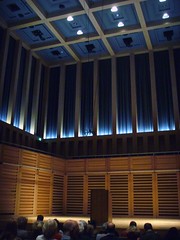 Hall One, the main performance space, is great, not as luxurious a place as the Wigmore Hall which is its most obvious rival, but it's a smart, clean design of a hall.
 The first event we're here for is a lecture by Sir Peter Maxwell Davies, entitled Musica Speculum Mundi? [Music a mirror of the world?]. He strolls onto the platform, and announces that he's been asked to write his speech down and recite it, not the way he'd normally speak in public. This makes it a little hard to get into what he's saying at first, as reading from a script makes his delivery a little stilted, but he warms up and sweeps us along with his talk, which, rather like a lot of his music, begins with a series of scraps of stories which gradually coalesce into a wider narrative. it's intimidating that he quotes form so many source in the original language, whether it be Italian, German, Latin or Greek. It's probably a sign of a generation gap that he can say something along the lines of "Of course, we all remember from school what Sophocles said...", but he's an engaging and intelligent speaker, and we're swept along by his argument, which becomes more and more personal and passionate as he touches on such subjects as his writing his Third Naxos Quartet in response to the invasion of Iraq. His conclusion is that writing a piece of music makes no practical difference to the world - he never imagined Blair, Brown or Bush would listen to his piece - but nevertheless it is immensely important that a composer reflect his world and act as a witness to it.
Max returns to the stage for the next show, a performance of two works for string quartet from the spnm shortlist selected by him and performed by the Brodsky Quartet. I've discussed this elsewhere, but it's a shame the speakers weren't miked up (as Max was for his lecture): we can hear what Max is saying (he's used to speaking in public) but the two composers, who aren't, mumble a bit and a lot of their words are lost beneath various rustlings from the audience. The acoustic is very clear, and hence very unforgiving in this respect, compulsive coughers note.
Another thing: please, please will someone at the spnm think of some compulsory course in programme-note writing for the composers on their shortlist? What we had to read was absolutely rotten and did nothing to enhance our enjoyment of the pieces. I was convinced from reading his note I was going to hate and/or be bored stupid by Oliver Waespi's piece, but was pleasantly surprised to be confronted with a beguiling piece that I'd like to hear again. It's difficult enough to persuade a lot of people to engage with this stuff as it is, and composers do themselves no favours by presenting such unenlightening writing.
Wednesday, October 08, 2008

Tuesday, October 07, 2008
New adventures in sound

Monday, October 06, 2008
Judgmental
I'm branching out into reviewing for the splendid folks at the Londonist. For my first effort I went to hear Beethoven at the Barbican on Friday.
Wednesday, October 01, 2008
Survival strategies for the average composer (5)
[1].JPG) 5: Stay away from composers
5: Stay away from composers
Now, if making a career's your thing, blah blah, networking's one of those things you do, sure. But composers (mostly) aren't going to play your damn music. Unless you're writing stuff for yourself to perform (and that's a subject I'll return to), you need musicians. Friendly ones, who know you and will be willing to put up with your ill-thought-out notation and ignorance of what their instrument can do, and will gently, kindly tell you how to change it to make it better. Musicians are quite easy to meet - just go to the nearest pub after the gig. If you make friends with them, they'll be only to happy to offer advice, and it's not that big a step from there to persuading them to run through something you've written. So stop talking theory with all the composers and start talking practice with the players.
There are moments that defy explanation
John Lydon. Advertising butter.
I can't think of anything to add.


