There is plenty more to be said in this concert, however, and the next is Britten's Piano Concerto. Again, the orchestra dispatches it with aplomb, and soloist Steven Osborne plays beautifully and engagingly, but, as with quite a number of Britten's pieces, I find that my attention keeps wandering, then is dragged back by something arresting, then wanders again.
The second half also features two pieces. Varèse's Ecuatorial features retro-chic electronics in the form of two ondes martenots, to evoke an ancient past. it's a strange and powerful piece, the swooping of the ondes contrasting with the guttural sounds of brass and percussion, as well as the strange alien chanting of the male singers. There's really nothing very much to compare it with, even in Varèse's own output, and it lingers in the mind long after it finishes, an unsettling presence.
Finally, we hear La Mer by Debussy, a performance that evokes foam flecked, salty air.
So, four works, four good performances... and yet I leave feeling slightly dissatisfied. It's something to do with the two major stage shifts, one in each half, that inevitably drain the momentum from a concert (I work on a theory that one should always try and avoid such things, one large move is manageable, more disrupts proceedings too much). It's also to do with the choice of repertoire. These are all pieces I either know and love, or would be more than happy to hear again, yet I am left with a feeling that I don't really know why they were programmed together. Four big-ish pieces leave a lack of a sense of a core, so that the whole is less than the sum of its parts. It's a shame, because each of these performances deserve to be remembered fondly. But they won't be remembered as one concert, which is the difference between good playing and good programming.
Wednesday, August 01, 2007
Prom 24: Sibelius/Britten/Varese/Debussy (RAH)
Saturday, July 28, 2007
Prom 19: Strauss/Britten/Nielsen (RAH)
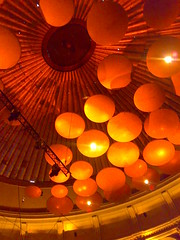
Next up we were supposed to hear a rare outing for Britten's Our Hunting Fathers, but unfortunately singer Lisa Milne fell ill and no-one else was available who knew the piece well enough to do it at short notice, so instead we hear another vocal work of Britten's, Les Illuminations. Joan Rodgers steps into the breach wonderfully (as apparently she did at Aldeburgh last year, when Milne cried off sick at the last minute from the very same work...), as do the Hallé, and Britten's settings of Rimbaud are wonderful, but it's a bit of a shame to sacrifice something I and probably many others in the ausience have never heard for a piece (albeit a great one) that's far more commonly heard; not to mention the nonsense it makes of the other Prom theme supposedly being represented, the centenary of the birth of Auden.
In the second half we hear the wonderful fourth symphony of Nielsen, a piece I have long loved, in which the Hallé under Mark Elder catch fire to produce possibly the single best performance I've heard so far at this year's Proms.What a shame the hall was half empty. I've never been able to fathom why Nielsen isn't massively popular, but on this showing he simply isn't a box office draw. Well, all those of us who were there experienced something quite magical, and all those of you who weren't missed out. I was transported into another world, and ( a sure sign of a fine performance) couldn't quite believe it was over so soon. One day, I hope, Nielsen will reach his rightful place at the forefront of the average concert-goer's consciousness.
They play an encore, something I'd not normally welcome after such a charged experience, but it's beautifully judged: a new orchestration by Colin Matthews of Debussy's last, long lost piano work, "Les soirs illuminée par l'ardeur du charbon", a delicate and refined couple of minutes that soothes our ears and readies us to return to the dark, wet night of London. We retire to a pub and revel in what we have heard.
Friday, July 27, 2007
The vinyl word
In between all this highfalutin Promming, I've been very much enjoying this series of articles in the Guardian by Joe Queenan looking at the origins of pop songs, full of the kind of inconsequential trivia that I find fascinating.
Prom 18: Delius/Tippett/Vaughan Williams (RAH)
Ah, Delius, the syphilitic old fascist. There are those who go into raptures about his music, but I'm afraid I'm not one of them. " A Song of Summer" meandered along in a turn of the century, sub-Debussy sort of way, all very lush and ripe but lacking in much substance. A nagging thought kept knocking in my skull that I'd heard it somewhere before, which coalesced into a realisation that what it really reminded me of was "By the Sleepy Lagoon" without the tune. So, Delius: a poor man's Eric Coates.
I mentioned Tippett yesterday in comparison to Henze, and, serendipitously, here is his Triple Concerto. Tippett's an idiosyncratic composer, to put it mildly; depending on whether you're in the mood for him he can seem luxuriantly rhapsodic or rambling; there are many gestures that sound appealingly knotty when you're feeling sympathetic, and clumsy when you're not. And then he floors you with something of such breathtaking beauty that you have to forgive him. But in a time when so many composers are turning out expertly crafted, glowingly orchestrated and timidly empty scores, Tippett stands against the cult of fetishistic surface perfection and insists on music as a social force that can attempt to say something.
And so to Vaughan Williams' Fifth Symphony. It's such a shame that such transcendentally beautiful music as this gets dismissed as "cowpat music", and it makes me wonder what it is about the English that makes them unable to believe that one of their own might produce something worthy to stand alongside the greats, which this symphony undoubtedly does, in my view. It's elegant pastoral skin conceals an underlying muscular system that is as steely as the tumultuous fourth and sixth symphonies that stand either side of it. And in Andrew Davies you couldn't hope for a better guide through this music. In fact the experience reminds me just how good the BBC Symphony Orchestra were when he was their principal conductor, before he left and they fell into a dreadful slump (I recall a performance they gave a few years ago at the Proms under Jukka-Pekka Saraste of Lutoslawski's Concerto for Orchestra that I still remember as the worst performance I have ever heard a professional orchestra give). They have turned the corner, and Jiri Belohlavek has certainly raised their game, but they still have more work to do to return to their former heights. They played wonderfully tonight, and they should always play this well.
Thursday, July 26, 2007
Henze
There are some things that just seem to pass you by, and Hans Werner Henze has been one of them. I've long been aware of his existence, of course, and his position as one of the few significant composers to emerge from Germany since the war, as well as one not afraid to confront his homeland's past, but somehow his actual music has failed sink into my consciousness. So coming across a score of his Seventh Symphony while engaged in cataloguing the oversized score shelves in the library where I work* seemed to be a sign that I should have a listen, and I now wish I'd paid attention earlier. It's something of a shock to come across something so recent (he wrote it in 1983-4) that engages so directly and seriously, and without any ironic distancing, with the European symphonic tradition that stems from Haydn and Beethoven. All the more remarkable coming from a German composer, who must I suppose feel the weight of such a history even more than most of the rest of us. It's an immediately engaging piece, that's nevertheless clearly a weighty, meaty beast. If you like the sort of eclectic, not-quite-tonal style of such composers as Tippett (whose politics also find an echo in Henze), this is well worth a listen, and I shall certainly be hunting down more of his music.
One thing though: the CD cover is a truly horrible design. I know the sort of person most likely to buy a Henze CD probably isn't going to be put off or attracted by the cover, but really, couldn't they have made the effort?
* A startling number of these scores seem to come from the same two or three publishers, and be composed by people born within a few years of each other. A monument to a certain era in 20th century music...
Tuesday, July 24, 2007
Prom 14: The Seasons (RAH)
Is there a better composer than Haydn?
I have long harboured the suspicion that most, if not all, of music, or indeed of anything is either underrated or overrated, almost nothing being rated generally at its exact worth. Haydn is clearly underrated, as sadly was attested by a half empty Royal Albert Hall for this performance of his oratorio The Seasons. This is a work that lies very much in the shadow of The Creation, not least because Haydn himself was less than happy with the circumstances of its genesis, complaining that the libretto was inadequate, and ultimately that the effort of writing it had worn him out (he composed little after its completion in 1802). I have to confess I know it hardly at all compared to its more famous companion, so Roger Norrington's appearance at the Proms seemed a good opportunity to redress the balance.
Now, it's true to say that it's not as great as The Creation, but then again, to paraphrase Joseph Heller, what is? In fact I wonder if, in a way, it counts as a more remarkable achievement and testament to Haydn's genius that he produced something so good from such unpromising materials. If it's true that he resorts to word-painting more here than before, the fact is that what he paints is far more interesting than the words that he illustrates. The raucous natural horns and growling trombones of the Handel and Haydn Society of Boston's period band depicting the hunt in "Autumn" were only one highlight among many in this performance that reminded one that for all the cosy image of "Papa Haydn", he was much closer to his sometime pupil Beethoven than is often acknowledged. And Haydn has a natural humane warmth that the younger composer often struggled to produce. The triteness of the words becomes irrelevant when you're faced with such spirituality, such craft, such inventiveness as the 70-year-old composer shows here. Genius is a word that gets (mis)used so often nowadays that it hardly means anything anymore; but Haydn is one of a very small number of artists who genuinely deserves the description. It pains me deeply that he's thought of as staid, or boring, or shallow, because he's none of these things, as a careful listen to almost anything he wrote will reveal. He may not have the glamour of dying young and having a play written implying he was murdered by another composer, but I can't think of anyone else who sustained such a level of originality, inventiveness and sheer quality over such a long and prolific career. And yes, dammit, profundity too.If you can't hear the deep, heartfelt emotion and spirituality in his music, then you're simply not listening.
Is there a better composer than Haydn? Well, no.
Monday, July 23, 2007
Damo Suzuki/ Vialka
How do I describe Vialka? If I tell you they're a duo, he on guitar, she on drums, both on vocals, you'll probably think "ah, White Stripes", but they're nothing like that, although they share a certain aesthetic that might be described as primitivist (although not primitive). Maybe if Jack and Meg had grown up listening to Magma instead of Led Zeppelin they might have turned out something like this, although it's impossible to imagine Vialka ever writing a song for a Coke ad. If I tell you their music spans genres from Eastern European folk through punk, jazz and Beefheartesque avant-blues, with the odd bit of reggae thrown in, you might imagine some sort of polystylist sound; but they never really sound like anything other than themselves. If I tell you that Marylise Frecheville wears a fantastically unconvincing blond wig and occasionally jumps out from behind her drum kit to dance in the audience while Eric Boros remains in half-shadow on the stage, encouraging us all to clap, you might have the idea that they're a "wacky" band; but there's a forceful sense of purpose behind what they do that is utterly compelling and has no trace of novelty (which doesn't preclude a wry humour coming through). The only category I feel the need to put them in (although they describe themselves as "nomadic turbo-folk") is "good music". They're one of the most distinctive and engrossing acts I've seen recently, and I commend them to you.
Having left the stage at the Spitz, Vialka come back, as this evening they, augmented by a flautist, are acting as Damo Suzuki's band for his latest appearance in London. It's a different atmosphere tonight to the last time I saw him; It's Sunday night, the audience is a sitting one rather than a dancing one, and there's the small matter of the curfew. So tonight's show is perhaps a more cerebral affair than that November night, which pushes towards a more reflective mood. What's remarkable about Damo's performances is the way that the musicians he plays with seem to absorb entirely into his vision, without ever losing their own voices, so that here we hear the sound of Vialka subtly altered to become something that is clearly of a piece with his previous performances, yet also unique. And next time, it'll be different again, an unpredictable, unrepeatable event with Damo at its centre, acting as the focus that draws it all together. What you can't fail to take away from any of his performances is a sense of the sheer generosity of his spirit.


Friday, July 20, 2007
The Deller Quartet and friends

Thursday, July 19, 2007
Proms 6&7 (Radio 3)
I dashed home after Ives and caught the first Late-Night Prom on Radio 3 (I might have stayed, but I'd never have got home). This was notable as it had made the news bulletins the previous day, featuring as it did the first modern performance of a Mass by Alessandro Striggio, a composer at the court of the Medicis, in which the choir divides into 40, and later 60, parts. If you know your early music this will sound familiar, as it was this mass, as well as a motet in 40 parts by Striggo, that inspired the Duke of Norfolk to ask aloud if there was an English composer who could match this feat, to which the answer was yes - Thomas Tallis stepped up to the challenge and composed his own 40-part motet, Spem in alium. All three of these works were performed here, and there's no denying that the sheer gloss of sound in so many independent voices sounding together is overwhelming. It should also be noted that Tallis comes out on top as the better composer (to these ears, at least), but the Striggio works were very much worth hearing, and the final Agnus Dei of the mass, where the choir divides into 60, was an extraordinary and special moment, a shimmering, gossamer texture that wafted the scent of the divine even into this embittered atheist's soul.
Last night's concert was equally special, the combined forces of the London Philharmonic Orchestra and the Orchestre national de France coming together under the baton of Kurt Masur (celebrating his 80th birthday) to perform Tchaikovsky's Serenade for Strings and Bruckner's Symphony No.7. Tchaikovsky has such a reputation as a Russian misreablist that it's refreshing to hear a piece like this, all light and joy. At the risk of sounding like a Classic FM DJ, this really is music to soothe the soul. Bruckner is a composer I've taken a long time to appreciate - as a shallow youth I dismissed him as long-winded and dull, but I've come to realise how wrong I was, and that he's a unique composer of almost transcendental qualities, whose occupation of space-time chimes strongly with Tallis and Striggio's clouds of sound.
Tuesday, July 17, 2007
Prom 5: Hayden/Bernstein/Ives (Royal Albert Hall)
Is there a longer stretch of urban road in the world without a bin than Kensington Gore? that's how it feels, anyway. Eventually I find one skulking by the Royal College of Art like a Dalek left behind after the invasion was aborted. Such things that a new Proms season brings to mind.
They like to make a big deal of the fact that you can get into the proms for a fiver, but that's somewhat negated by the extortionate bar prices - £3.90 for a 335ml bottle of beer! Arrive early and go to the pub, is my advice.
The old routine comes back quickly once I'm in the hall, many of those strange faces that have become familiar over the years are present - that ageing hippy who sadly seems no longer to have his "Proms 78" t-shirt, that man who looks, frankly, like a paedophile... The announcement telling us to turn off our phones. I am so paranoid about this that I check my phone, despite knowing full well that its battery is flat and it's currently dead as a doornail.
it's not particularly full tonight, but it's not an unrespectable crowd - pretty good for a concert with no conventional warhorse, I guess.
First up is tonight's premiere - Substratum by Sam Hayden (who, I discovered at the weekend, is a relation by marriage. Small world). I seem to recall that a few years ago Sam talked a lot about politics and the composer's role in society. Tonight's programme note talks about "exploring the fundamental and essential characteristics of its material through highly formalist means". One should never put too much store by programme notes - I remain convinced that Stockhausen wouldn't have half such a fearsome reputation if it weren't for the well-meaning but obfuscating waffle that's been written about him - but one does wonder if there's a danger of him being dragged down into the mire of the establishment. The piece itself is OK (it's refreshing to hear a new piece these days that's so apologetically "modern"), but lacks a certain spark for me. Maybe it needs to be listened to a few times, something that if you're played on Radio 3 you have the advantage over most new works in that this is quite easily done.
Anyhow, whatever my reservations, it's certainly a better experience than hearting the next piece in the programme, Bernstein's Second Symphony, the Age of Anxiety. This uneasy blend of pastiches of Rachmaninov, Copland, Shostakovich and Bartok, to name a few, is a seemingly endless parade of cliches, drenched in pretentious portentousness. I wanted to wish it well, really I did, but it was tedious almost beyond endurance, and it was a wonder that I made it to the end. Who'd have though that the flamboyant, extravagant, voraciously bisexual raving egotist Bernstein could come up with something so dull? I suppose this is what happens when you chase respectability. Sam Hayden take note.
Thank god, then, for Charles Ives, who was certainly never troubled by notions of respectability. I last heard his Fourth Symphony a few years ago at the Proms, performed by the City of Birmingham Symphony Orchestra. This performance didn't quite scale the heights of that one - in particular it lacked the clarity that the CBSO brought to the riotous second movement - but this is a piece that sweeps all before it. It is an assertive, unapologetic and thoroughly necessary work that exists on a higher plane than what went before it, and in its closing bars you hear a glimpse of infinity. There are many works that it is interesting to hear, and a few that are a pleasure, but to hear this symphony is a privilege.
Monday, July 16, 2007
Prom 4: Berio/Rossini (Radio3)
Now that the new taste fascists have taken Modernism as their whipping boy, I worry that there will be a comprehensive purge of large swathes of musical history between roughly 1910 and 1980. Now of course there's an awful lot of modernist rubbish that deserves to be forgotten, but there's a lot of rubbish in any era that deserves to be forgotten, and it would be a terrible shame if some very fine composers were to be buried purely due to their use of a style that is now outdated. Berio is one such composer, and his Sinfonia, which forms the first half of tonight's prom, is a case in point, a highpoint of Modernist music (and indeed Post-Modernist) whose glowing textures and warm wit speak of a humanity that current received wisdom would deny could be present in this sort of music, as well as a determination to say something that is certainly becoming rarer. I wonder how much one could get out of it if one did not get the various references and quotations that it contains (in particular the extensive "commentary" on the scherzo of Mahler's Second Symphony), whether it's enough to hear the surreal clash of the tonal and non-tonal. But this isn't something I can answer, although it seems Berio takes for granted in this a certain level of musical knowledge that you simply couldn't assume these days if you were aiming at anything beyond a vanishingly small group of people. Will this, rather than any stylistic fashion, be the death of this piece? I can only hope not, because it's a wonderful experience, and it's ably performed here by the Swingle Singers and the Chorus and Orchestra of the Academy of Santa Cecilia, Rome under conductor Antonio Pappano.
The second half was an Italian classic from an earlier age, Rossini's Stabat Mater. This is one of those pieces I never enjoy as much as I think I'm going to, and so proved the case here, although the players did a very fine job and there were many lovely things on the way.
Friday, July 13, 2007
First Night of the Proms (BBC2)
I don't mind Charles Hazlewood, I've met him and he's a nice bloke. So I can put down his slightly patronising irritatingness on telly events such as this to the autocue and the patronising, irritating script it's delivering him. His guests in the box are Gillian Moore, late of the London Sinfonietta and now of the South bank, and Philip Sheppard, cellist and composer. Both are intelligent, knowledgeable people, and yet in the context of a television event neither has anything interesting to say. I put this down to the inherently asinine nature of television.
The BBC Symphony Orchestra despatches Walton's "Portsmouth point" with efficiency. It's good to hear them on much better form than a couple of years ago, when their performance under Jukka-Pekka Saraste of Lutoslawski's Concerto for Orchestra was possibly the worst performance I have ever heard a professional orchestra give.
Elgar's Cello Concerto is a tricky beast. It's skewed by the influence of Jacqueline du Pre, who created the self-indulgent template that most cellists have copied since for their interpretation. Elgar is all about passionate emotion held in check, and Paul Watkins doesn't quite manage to escape the gushing influence of du Pre, although he gives a pretty fine account. I'm more disturbed by the appalling mix in the TV sound, which pushes the soloist to the top in a ludicrous and utterly unrealistic (and unmusical) manner. Halfway through I switch to Radio 3 to compare. but of course telly is showing with a delay of half an hour and Radio is already onto the interval talk. This misbalancing has the effect of robbing the final moments of all the subtlety and poignancy they should have, that I'm sure Mr Watkins gave them if you were in the hall. The audience clap wildly. Charles Hazlewood gushes. But that's what he's paid to do, of course.
Here's Nicholas Kenyon to gush a bit more. Nicholas Kenyon has run the Proms for the past decade, and has taken it from John Drummond's daring to a cosy safeness that has gone from feeling like a reconciliation to an unimaginative bland consensus.
Charlie wants to know what Nick's favourite moment is in the time he's been running it. Nick waffles on in a generalising way that says nothing. Well, no-one's ever going to say anything thoughtful or intelligent on telly, are they? Only self-congratulatory mush. Blah blah themes and anniversaries [the laziest programming devices]. Blah blah international visitors. Youth Orchestras. Christ, this is turning into something like a speech at a political party conference. Being a bit of a nerd, I can't quite get over the fact that Nick looks quite a lot like the Doctor out of Star Trek: Voyager.
Charles now talks to Paul Watkins, and an intelligent discussion threatens to break out. Here we have two intelligent musicians discussing an important piece, and it's wonderful. it's over too soon, of course, but then we have a nice little film profiling Jiri Belohlavek, who isn't given enough screen time, as he clearly has lots of interesting things to say. But overall I must give thumbs up to BBC 2 for this bit of the interval.
Now the talking heads return, and it's back to bland nonsense. Oh well. That's TV for you.
Actually, I'm being unfair. They're saying some interesting stuff about Beethoven here. But they're talking against the clock, and a conversation that should last hours is over in minutes.
Personally, I've always thought that Beethoven's 9th Symphony's opening 30 seconds are brilliant, and then it's all downhill from there. Belohlavek takes a very steady speed in the first movement, putting himself closer to Klemperer than Norrington in the speed stakes. But in sacrificing the urgency of the faster speed, he doesn't quite achieve the gravity necessary to make the slower speed work.
The second movement's more successful, with an understated quality that brings out the dance element of the music.
I was worried that the solo singers not coming on stage until this point would distract, but fortunately this proves not to be the case, and after a brief respite the orchestra moves into the slow movement, a difficult one to bring off. There's a balance between repose and movement to be struck, and thy don't quite bring that off, although there are many moments to savour.
the finale bursts in-ish. It seems curiously lacking in electricity, and the cello/bass recitatives are rather lumpen and slow for my tastes. And when the "Ode to Joy" theme emerges, it sounds curiously sleepy, which I suppose is a valid interpretation, but it seems to lack the innocence that I want to hear at that point. Maybe that's something impossible to achieve after all these years.
Once the singers come in, of course, it's all about joy and humanity coming together, and critical comment is redundant, because how can you not respond to such a sentiment? It is music that stands beyond any reasonable comment.
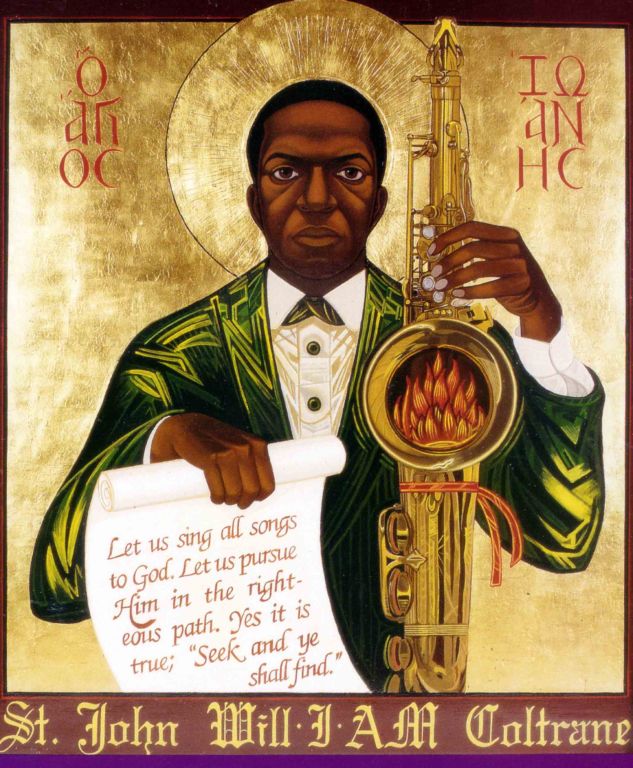
Church of Trane
Wednesday, July 11, 2007
A heart for any fate

Freedom is on two wheels. As the days pass distances seem less, unconquerable Everests become gentle inclines. Irritants remain, of course, but suddenly seem to matter less, because within a few hours you'll be free again, playing chess with the traffic, and then gliding past water, wind in your hair, glad to be able to forego the rat's underground existence and instead enjoy the thrill of movement, the life of it.
Remember those online petitions the government was making such a fuss of encouraging recently? Did you feel cynical, like me, dismiss thm as a cheap publicity stunt that would be filed away and forgotten? Well, sometimes they work!
Tuesday, July 10, 2007
The Mules

Ed Seed is really too skinny to be anything other than in a band. He drums and sings, a combination with a noble lineage (we'll forget about Phil Collins). The Mules also consists of guitar, bass, violin and squelchy moog-type keyboards. If Madness had come from the Weimar Republic they might have sounded like this. They're sharp, but also agreeably slapdash, skittering around Ed's tight drumming. They're rather wonderful, and so is their album. You could buy it online, but it would be better if you went to a gig and bought it off them there. They're playing every Monday at the Big Chill House until the end of August. Entry is free. Go and hear them.
Sunday, July 08, 2007
Rasputina: Oh Perilous World

Chances are, if you're in the U.K. you won't have heard Rasputina, although you may have heard a track of theirs that appeared in Buffy the Vampire Slayer. When I try to describe them to anyone, I struggle beyond "goth-pop cello band", which does them a great disservice, suggesting both a limited genre palette and a novelty element, neither of which is remotely true. Rather I should say that Rasputina mainstay Melora Creager has an idiosyncratic and singular vision, which she has pursued and refined through the course of five albums (plus an excellent solo mini-album last year).
Their last album, 2004's Frustration Plantation marked a breakthrough for these ears, with an expanded palette and refined songwriting producing Rasputina's most rounded work to date. Oh Perilous World builds on that fine album's sound world, as well as Melora's solo outing Perplexions last year. Many of the lyrics this time have been constructed using "found" sources, but the result seems to be pretty much the same as ever, namely oblique, mordant and witty. Rasputina offer a skewed, abstract take on the world around us that seems simultaneously to be entirely of its time and yet independent of any discernible trend. And in these days of identikit indie posers, that's something to be thankful for.
Wednesday, July 04, 2007
I am famous!

I may be overestimating what constitutes fame. Nevertheless, I feel very chuffed to see a photo of mine appear in top capital blog The Londonist!
Monday, July 02, 2007
Thanks for the ether
So, that is that. You can no longer light up in public without the full force of the law coming down on you like Two Ton Tony Tubbs and banging you up and throwing away the key. Or something.
I feel very uncomfortable about this. Let me lay my stall out: I smoked for many years until I gave up for the last time about 2 years ago. The last place I am likely to tempted to indulge was the pub. This means I will, as certainly as I can say, never smoke again. I will return from the pub not smelling of stale smoke. In terms of my own personal well-being, this ban is all to my benefit.
And yet... on Saturday I stood on platform 1 of London Bridge Station, looking at a large sign that informed me that as of July 1, smoking on this platform, or anywhere in this station (and all stations) would be AGAINST THE LAW.
Smoking is a vile habit, and if you smoke you ought to stop, really you should. But it's your choice to. Who benefits from this draconian law? Who is harmed if someone smokes on a platform, in the open air, other than the smoker?
I will doubtless find a smoke free pub a more comfortable place to sit. But I can't applaud a piece of legislation on the grounds that it suits me personally. That seems an attitude brimming with sanctimonious selfishness.
Most people I know don't smoke these days. But there are still some. Am I to cast them from my presence until they forego the perilous weed?
What happened to tolerance? What happened to taking responsibility for oneself? This law is attacking both these things. This comes from the same mindset that is slowly chipping away at our civil liberties, turning us into a nation of suspects.
Sunday, July 01, 2007
What is this toss?
The literal answer is that this toss is the pilot for a resurrection of ancient telly music quiz Face The Music on BBC4, but the literal answer doesn't really answer the question, what is this toss?
You might be able to find it on the BBC's spanking new i-player, but I really wouldn't recommend it, as it really is shockingly poor and shows just how little anyone in television understands music. John Sergeant, who used to be so authoritative as a political corespondent, has a ponderous, pedantic delivery, his guests all look thoroughly uncomfortable, and the whole thing has an insipid, simpering air that I find utterly repellent. It makes Classic FM look like Hans Keller. Who commissioned this rubbish? If I knew nothing of classical music, I'd think, what a bunch of smarmy tossers. Knowing about it, I find it patronising, unintelligent and embarrassing. Oh, and I still think, what a bunch of smarmy tossers. It sets the cause of classical music back about 50 years.
Saturday, June 30, 2007
Da-da-da-dum, da-da-da-dum....
Maybe it's a sign of stress or impending madness (it's been one of those weeks), maybe Rusty Davies has me in the grip of some kind of mind control voodoo, or maybe it's all true and the Master really is in the process of enslaving us all, but over the past week I've kept finding myself tapping out that rhythm. When I was a small lad, Doctor Who was my passion and obsession. It broke my heart to see its decline during the 80s, and I was overjoyed when it came back and made such a success of itself. It's not perfect (the Doctor needs to stop saying sorry and STOP SHOUTING, for a start), but it's still the best thing on telly by miles. Bar a mid-season wobble (that disappointing Dalek story) this has been the best series yet of the reconstituted Who, and I can only hope, as I wait to find out just how he'll get out of this one, and anticipate a return to the unwatchable any-of-big-brother's-x-factor-grease-idol-will-do type rubbish that will undoubtedly swamp the schedules from hereon, that all those rumours that the BBC might actually be stupid enough to cancel it when RTD & co move on (after series 4, allegedly) are the utter nonsense that they must surely be.
da-da-da-dum, da-da-da-dum...
Friday, June 22, 2007
A word from our sponsor
While I'm in plugging mode, if you're in London on Tuesday why not pop along to Kensington Symphony Orchestra's last concert before the summer? There's some Dvorak, the London premiere of a piece by the excellent John Woolrich, and Sibelius's 5th Symphony, which if you grew up in the 80s you'll recognise as the main riff from "Since Yesterday" by Strawberry Switchblade.
Tickets are 12 quid (£9 concessions), and it promises to be an excellent evening.
It all starts at 7.30pm, Tuesday June 26th, at St. John's, Smith Square.
Meaty beaty big and bouncy
I've had an email from Mark out of Meat for a Dark Day, a band from Sheffield of whom regular readers will be aware, telling me about their forthcoming single, which is out on July 2nd.
Now any band that puts stuff out on 7" vinyl in this day and age will always find a place in my heart, and luckily the music's good too, so I can be nice and truthful at the same time. "Vanity Unfair" is a thumping slab of prime garage boogie with a nice line in caustic observation. If it were a person it'd be that louche-looking individual at the other end of the bar eyeing up your girlfriend. The B side, "3 Mallards", couldn't be more different, a folk tinged wisp of a song that lingers in the head. It's a fine single, and you should put your order in for a copy immediately.
Monday, June 18, 2007
Between Roky and a hard place
Roky Erickson is playing in the Royal Festival Hall right now. It's the first time he's played in this country, and frankly it's a miracle that it's happening. I should be there. I should be coming home later to write one of those drunken, gushing, rambling posts about how great he was, how wonderful it was to see him functional and rocking. But I'm not. I'm stuck here with a disgusting cold, barely able to speak and feeling wretched. It sucks, like a big fat sucky thing.
Friday, June 15, 2007
Relative Dimension
 There's a certain breed of gay man who sends women of a certain age all of a quiver in a last-ditch hormonal frenzy, and the exemple de nos jours is part time TARDIS occupant, chum of Emperor Palpatine and all-round hunk o' cheese John Barrowman.
Thursday, June 14, 2007
Britain's got attention whores
"The budgie man's on the telly!"
(If you've never wandered along the Thames in the vicinity of Tate Modern, you may not be aware that the budgie man is a bloke who stands about with a row of budgies on a pole and a tape player, singing a terrible song about how he's the "bu-budgie man".)
"really? What's he on?"
"I can't tell you, I'm too ashamed of the rubbish I'm watching."
A couple of days after this exchange, I finally wheedle the information out of her: The budgie man appeared (albeit briefly) on Britain's Got Talent. My curiosity piqued, I turn on and am sucked into an hour and a half of what Dante's Inferno might be like if Dante had been BBC1's light entertainment commissioning editor in 1975.
I'm confronted by a gaggle of small children jumping about dressed as purple witches, which puts me in mind of New Order's True Faith video re-imagined by a crack-head.
The judges are Simon Cowell, Amanda Holden and Piers Morgan. They each have a button that they press when they've had enough of whatever act is in front of them, which lights up an enormous red cross. If all three light their crosses, the act must stop and leave the stage in ignominy and shame. Cowell is playing his usual Nasty shtick, while Holden (a brunette these days, presumably in penance for doing the dirty on Les Dennis) almost visibly melts every time a small child appears. Her role is clearly to be good cop to Cowell's bad. Morgan doesn't appear to be able to decide if he's there to be an honest broker between these extremes or to try and out-bastard Cowell. When he attempts to do the latter, the result is hilarious in its ill-judgement. After a small child has run through "Wouldn't it be luverly" (very well, it must be said), he pronounces "No." there is an uncomfortable silence, it's clear the other two think she's a shoe-in. "No... doubt you're going through," he says. This sort of thing might work if Morgan was a polished performer who knew about comic timing, but he clearly isn't. He's clearly just that idiot who used to edit the Mirror before all that unfortunate business with the share tips.
There's a lot of that false expectation stuff in this show, actually - when the time comes to decide who'll go through to the next round, Cowell habitually uses it ("I'm sorry to tell you... you'll have to do it all over again. You're through!"). They used to use this gag on Neighbours all the time when telling kids their exam results and the like. Still, at least Cowell can pace it properly.
Of course, what we watch this sort of thing for isn't anyone with any actual talent, nor the ocean of mediocrity, but the jaw-droppingly awful, and Britain's Got Talent supplies that in spades. It's interesting that the audience is by now primed to boo Simon Cowell whatever he says, despite the fact that most of the time he's extremely fair in his criticisms. The man on the trampoline did get boring after he'd done the same pratfall about 5 times in the first 30 seconds. The middle aged woman dressed as Madonna was rubbish. Sticking spoons to your face isn't enough to make an act.
What continues to amaze, not only in this but all these talent shows, is the incredible ability of people to delude themselves that they can sing/tell jokes/dance/entertain in any way whatsoever. Surely if one of these people was your friend it'd be kinder to tell them quietly that they're rubbish, than to let them demonstrate it on national television? Or just shoot them. It'd be quick.
Tuesday, June 12, 2007
What are we here for?
 When I started this, I had no real idea where it was going or what it was really intended to achieve, and as time goes by I feel increasingly that I don't really want to reach a definitive answer to those questions. But it occurred to me the other day, as I looked through a few old entries here and they sparked new ideas that might break the deadlock that's stalled a cherished project for a long time, that at least partly what this is is a place for ideas with no home. It's not exactly pieces - they're frequently too brief and unpolished for that - but I can't think of it as exactly sketches either, as that implies (to me, anyway) that they're intended as preparations for some greater plan (and I've written plenty of sketches at least as substantial as anything I've posted here that haven't appeared here as they're specifically intended as work towards a specific goal) . As it is, they sit here, awaiting their moment when light shines on them and their purpose becomes clear.
Thursday, June 07, 2007
Sound Vs. Noise (5)
Something I find myself returning to in various guises is the horrible all-pervading noise that surrounds us. I would like to draw your attention to this article, which discusses an increasingly common manifestation of this.
Tuesday, June 05, 2007
Daemon Days
It's time for another one of these spurious internet personality tests. This one's a tie-in with the imminent film adaptations of Philip Pullman's Dark Materials books. Mine's a gibbon, apparently. A funky one, I hope. What do you think?
Tuesday, May 29, 2007


Friday, May 25, 2007
Why this is hell, nor am I out of it
I just joined Facebook, thus dragging myself a little further into the hideous mire of online networking, the fashionable alternative to having real friends. By a strange coincidence, having heard John Humphries sneering about "Face Back" (sic) on the radio this morning, I checked my mail to discover I'd been added as a friend on the place. I wavered, then typed in my name and created an account, partly out of that horribly British sense of social embarrassment that demands I say yes to things for risk of offending, but also partly to annoy John Humphries.
Tuesday, May 22, 2007


I am Berlioz
I don't even like Berlioz. I am disturbed.

You scored as Hector Berlioz.
Which classical composer are you? created with QuizFarm.com |


Monday, May 14, 2007
The Classical Brits, or, Big Mac and Fries.
Do you think I enjoy this? Two and a quarter bloody hours of this? Of course not. But I must do this, because even if it is ultimately futile to make the gesture, a stand must be made. Because this will not do.
Here we begin, with Katheryn Jenkins looking pretty and blonde as she squeezes Holst into a 4/4 meter, with added bongos, male voice choir and a key change so unsubtle it could be in Eurovision. Here's Joshua Bell, who ought to know better, posing his way through Vivaldi in that "exciting", highly charged" fashion previously associated with Vanessa Mae. Why doesn't he stick a wet T-shirt on and be done with it?
Oh look, here comes Sting with his lute. Is there a bigger, smugger twat than Sting? (Well, yes there is, but we'll let that pass for now.) I should be glad he's bringing Dowland to a wider audience, I ought to applaud the fact that he does these songs straight, without the sort of knobby "crossover" bollocks you'd normally get with this sort of enterprise, but when I see his smug face all reason leaves me, and I want to punch him repeatedly in the mouth while shouting "You didn't invent Dowland, you fucking smug twat!" Oh look, he's bunged some close harmony singers in halfway through. Twat.
Ooh, here's Katie Derham presenting the Record of the Year award to Simon Rattle for the Planets, she must be annoyed at losing the presenting gig to Fearne Brittain. Some bunch of actresses calling themselves "All Angels" croon their way through "Nimrod", robbing it of all dignity and subtlety in the process. Still, they're fit, eh? So that's all right, then.
Mrs. Sting pops up to award George Fenton the award for soundtrack for Planet Earth (or was it Blue Planet? No, that was last time). I suppose I should be grateful that John Adams won the contemporary composer award rather than Karl Jenkyns and his dreary new age toss.
And on and on it goes, culminating in the award of Classical Album of the year to Paul McCartney's new "Classical" work, another bit of trite rubbish that soils the genuine legacy of his work with the Beatles. I have a horrible feeling he really believes that this insipid nonsense is better and more worthwhile than "Helter Skelter" or "Penny Lane".
It's not that it's bad as such, it's that it's relentlessly average. I can't report that it was badly presented or that there were any terrible howlers (although it was edited terribly, shoddily), but the whole thing reeks of mediocrity. Music can be exciting, dangerous, provocative, heady, all-embracing. But the Classical Brits, and the industry they celebrate reduce it to muzak. It's not bad because it pushes crossover and TV soundtracks over more serious work. It's bad because it neuters the music, it removes all ambition and reduces it to a cheap bauble. The Classical Brits have the same relation to music as pornography to sex, or MacDonald's to a restaurant. They tell their audience that they should limit their horizons, that they're too stupid to cope with anything more than the scraps they're thrown, that they shouldn't above all make any effort to try and understand. That they don't deserve anything better, and neither should they aspire to anything better.
They diminish us all. This is what will kill music: the insistence that mediocrity is not just acceptable, but desirable.
Now go and listen to someone who understands what music can be.
Friday, May 11, 2007
Idiot Joy Showland
Ever heard the opinion voiced that stupid people shouldn't breed? Well, apparently that's no longer a problem, judging by this poster I saw on the tube today.
Wednesday, May 09, 2007
Low

 There are many bands who wish they were the Fall, and Meat for a Dark Day are another one. Impressive facial hair, though.
Death Vessel turns out to be one man (although we weren't entirely sure about this, and I can only state this definitively having looked at his website). Our first thought is "Hey look! It's Neil from the Young Ones!" but he wins us round with some very impressive guitar picking and a distinctive, androgynous voice. The material maybe doesn't always match the performance, but nevertheless, this is someone worth keeping an eye on. Although I maintain that "Death Vulture" would be a better name.
People say Low are slow, and miserable. Only slow in the way an iceberg is. There's a driving power in their music that belies their steady tempi, and while they don't address the audience much at first, when they do there's a wry, dry humour that puts the miserablist tag into perspective. They're certainly not the sort of band you're likely to wave your hands in the air (like you just don't care) to, but they're a compelling live presence, and not too removed from rock 'n' roll theatrics to make us wait for encores that they clearly are going to play.

Tuesday, May 08, 2007
Sound vs. Noise (4)
Regular readers will be aware of the constant stream of verbal diarrhea that plagues my working hours. Just because I haven't mentioned it recently, don't imagine that it's gone. Oh no. A long weekend is of course a very pleasant and welcome thing, but it leads to a heavier heart when you have to haul yourself out of bed on Tuesday morning to go to work, and even the prospect of a 4 day week can't quite lift the spirits. The mood is as grey and dark as the sky, and the babbling that assaults the ear seems to ricochet around the skull. Meanwhile, the seconds, minutes, hours slip away, and stifle the ideas and thoughts that are, or might be. The clouds stretch across the whole sky, imposing and oppressing, and the light feebly scratches through.
Monday, May 07, 2007

Friday, May 04, 2007
Earworms
One of the collateral delights of cycling through London is the music that appears unbidden in the mind. This week I've found tunes from Bill Callahan's new album popping into my head, as well as bits of The Rite of Spring and Carmen. Both these are understandable - I've been listening to the album a lot, and KSO is currently rehearsing the Stravinsky and Bizet (in arrangement by Shchedrin) and for our next concert. This evening, though, I suddenly found "Mack the Knife" running through my mind. Why should Kurt Weill suddenly pop into my head this way? Once these things get into your consciousness, they linger. I briefly wonder if the appearance of these old tunes will interfere with my own composing - a pre-existing idea in the head must make it harder to think of an original one, I conjecture - but I decide not to worry and enjoy the moment. It is a holiday weekend coming up, after all.

Thursday, May 03, 2007
Something you don't see every day...

Tuesday, May 01, 2007

Monday, April 30, 2007

Sunday, April 29, 2007
Bill Callahan
 It's the dancing you remember.
Bill Callahan has been making music for many years now, generally under the name of Smog (or, in an act of obfuscation typical of the man, as (smog)). He's much admired by those who know his work, but there aren't that many of them. However, the massive attention that's been paid to his current beau Joanna Newsom means that inevitably some more light is shining on his corner at the moment, and maybe his time is finally coming. There's been a change in the Callahan method, bringing a new album released under his own name, which features songs presenting a demeanour that might be described as cheerful. Fortunately this doesn't seem to have compromised the quality of his work, so we take ourselves to the Queen Elizabeth Hall to hear how this newly lighter mood transfers to the stage.
Last time I saw him he was on his own with his guitar, and although this time he's brought a band with him, all the songs at their core retain that aesthetic. Although he's linked with the "lo-fi" movement, that label doesn't really do him justice. His sound might broadly be described as "countrified Velvet underground", but he seems to draw from a deeper and older well, the same feel you get when you listen to old scratchy blues records from before the war, of something rooted in an ancient past. He's not one for stage banter, his quiet demeanour contrasting incongruously with an audience that applauds the opening bars of most of the songs in the way you might expect at a Barry Manilow concert (incidentally, this audience seemed to spend an awful lot of time standing up and going to the bar, although maybe it just seems more obvious because it's a seated venue with the bar outside the hall?). He stands upright and rigid, strumming his guitar and intoning his lyrics, deadpan and impassive. Which makes it all the more strange, his penchant for suddenly twitching, his legs writing and kicking occasionally, rather in the manner of a slow-motion Elvis as impersonated by Max Wall. The music is hypnotic, soulful, occasionally terrifying in its intensity, and seems utterly at odds with these curious movements. And yet afterwards, on long reflection on what I've seen and heard, it comes to seem absolutely right, the man's movements as singular as his music.
He doesn't say much to us, although at one point he does announce, "I feel good tonight". And it seems a simple, honest thing to say, that at the same time suggests something more profound, merely alluded to.
Saturday, April 28, 2007
Mstislav Rostropovich 1927-2007
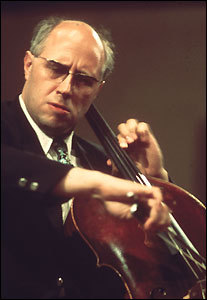
Of course, it's very easy when someone has just died to paint them in saintly colours, and it would be dishonest to deny that he was far from flawless as a man. And I have to say I thought he was an awful conductor. But he opened up worlds for me as a child, and I don't see that anyone could hear a few bars of his performances of the Beethoven cello sonatas without being struck by the sense of being in the presence of a great, generous and very human spirit.
Monday, April 23, 2007

Sunday, April 22, 2007
Things I saw this week when I did not have a camera to hand
A black swan.
A heron pause on the bank of a river before taking flight.
A horse underneath a motorway.
My uncle's remains lowered into the ground.
A baby's smile.
The sun on the water.
Tuesday, April 17, 2007
Basquiat Strings with Seb Rochford

Davis studied with Miles Davis alumnus Dave Holland, and the album's very much in that sort of vein (there's even a version of "In a Silent Way". It's also rather slinky in its rhythms, in a way that brings Piazzolla to mind. If you've heard any of the other bands in F-IRE (Polar Bear, Acoustic Ladyland, etc) and enjoyed them, you should enjoy this, so stop dawdling and buy it.
Two Wheels Good

Monday, April 09, 2007
Xanadu falling

The unusual situation of a gloriously sunny bank holiday is a good excuse to cycle along the Thames pathway from Abbey Wood to Greenwich. Of all the things in London, the river is the one that most consistently makes me glad I live here, and the route takes us right alongside the water for most of the journey.
We round the Greenwich peninsula, and circle the Millennium Dome. I thought at the time, and still do, that the building itself is an impressive looking structure, hamstrung by a lack of purpose. The problem with it always was that they built it and then wondered what to put in it, precisely the wrong way round to go about it. So it ended up filled with tawdry, empty baubles, and now sits forlorn, empty and surrounded by decay, a beacon of broken promises and disappointment, an apposite monument to Blair's government. I reflect on Tony Blair, the man who was so desperate to be liked by everybody, and who ended up being liked by nobody much at all.
Friday, April 06, 2007
Friday, March 30, 2007
What use is a book without pictures and conversations?
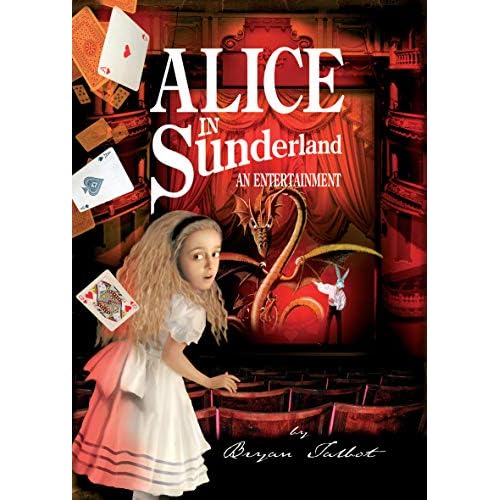
I am very much looking forward to the next few days. This is for several reasons. One is the prospect of some time off work, and some rest. Another is the prospect of having some time getting out and about in some fresh air in good company. Another is the fact that I have got the new book by Bryan Talbot, Alice in Sunderland, which from what I've read so far will be a thoroughly absorbing holiday read. And I shall be going to see him give a talk about it next week, which should be fascinating, if his similar talk about The Tale of One Bad Rat (soon to be republished, I'm told) that I saw a couple of years ago is anything to go by. I'm also getting quite excited at the prospect of the return of Doctor Who. Yes, I am a geek. So what?
I'm also looking forward to some time away from certain annoyances, such as the person who's barely paused to draw breath since I got into the office this morning. Sheesh, can't some people shut up for 5 minutes?
Wednesday, March 28, 2007
Absences
There seems to be a chill in the air, a general ennui, disillusion and withdrawal. Where does this come from (apart from here)? Am I just imagining this, spurred on by a few coincidences and my own unproductivity to a hyperbolic conclusion? Maybe now that the days are stretching into the evening and the sun strains to bring in the spring people have simply realised that there are other things to do. Or perhaps it's simply a fallow moment before new buds appear. As I stumble over clumsy attempts to shake off my creative torpor I'm reminded of this poem:
Lambs that learn to walk in snow
When their bleating clouds the air
Meet a vast unwelcome, know
Nothing but a sunless glare.
Newly stumbling to and fro
All they find, outside the fold,
Is a wretched width of cold.
As they wait beside the ewe,
Her fleeces wetly caked, there lies
Hidden round them, waiting too,
Earth's immeasureable surprise.
They could not grasp it if they knew,
What so soon will wake and grow
Utterly unlike the snow.
Sunday, March 25, 2007
The trouble with Thomas Ades
(While I was waiting for my friend to arrive I sketched a few of the people arriving at the hall, some of which are dotted about this post.)
 This concert was part of a wider retrospective of Thomas Ades' music (the accent you see on his name is an affectation that I'm not going to dignify by using). I can't help but wonder at the reasoning of structuring such an event around a still young composer whose output numbers barely 35 works. Surely there are other composers with a more substantial body of work that deserves the exposure?
Still, I do have a guarded liking for some of Ades' music, so it seemed interesting to go along to this concert and hear several pieces together.
The opening work, a song cycle Ades wrote at 18, was a disappointment.
 "Five Eliot Landscapes" sets poems of T.S. Eliot in a style that might be described as "generic non-scary modernist". If I had to imagine how a teenager would set Eliot (not hard to do, as I did it myself) this is pretty much exactly what I'd expect - self-consciously "high art", with a few striking ideas amongst a morass of dreary note-spinning. I've always thought one of the problems with setting poetry is that you come up with a brilliant idea for one or two lines, and then have the inconvenience of having to set the rest of the poem too, and this was how these songs came across. All perfectly well executed (although I found myself distracted by the frequent extreme hand-crossing in the piano part - played by the composer - which seemed to have no real reason behind it) but ultimately unmemorable.
The Chamber Symphony, composed shortly afterwards, is a completely different matter. Here is a work that stakes its territory with precocious confidence, a jazz-tinged undercurrent fuelling an exuberant and vital piece. it does flag after a while (Ades seems happier writing fast music) but picks up admirably before ending in a slyly off-hand manner.
Living Toys is cut from very similar cloth, although written 3 years later. Again there are many exuberant moments, although I couldn't help but feel that it lacked the freshness of the Chamber Symphony. There's a lot of music here that com
 es across as the sort of thing a young man might write having just heard Ligeti, especially in the prominent horn part that plays considerably on natural "out of tune" harmonics. There's also an ill-advised reference to "2001: a Space Odyssey", bound to fail because the harmonics and glissandi Ades presents, effective though they are in their own right, can never evoke the death of H.A.L. as well as the distorted singing of "Daisy Daisy" in the film.
"Arcadiana" was written a year later, and is a very self-conscious affair that uses quotations from and allusions to other composers to no great effect. There's a deconstruction of "Nimrod" from Elgar's Enigma Variations that has n
 othing to say about the Elgar and hence comes across as pretty but pointless. Occasionally striking ideas surface, but are never around long enough to make an impression. One gets the impression of a composer losing his nerve, and settling for writing acceptable "official" music rather than risk failure in the pursuit of something greater. I've been listening to the complete quartets of Elizabeth Maconchy, a composer whose astringent but approachable language might put her in the same category as Ades, but her works are altogether more substantial and hewn from tougher stuff than this rather limp affair.
(Why isn't there a major retrospective of Maconchy going on, in her centenary year? Her neglect is criminal, compared to the adulation that Ades routinely receives for a far lesser achievement.)

There's no doubt that Ades is a talented composer, but it's hard to see a coherent personality in his music. Maybe this will emerge in the coming years, but it feels too soon to be holding grandiose surveys of his work. Of course, the impetus behind this is, I suspect, more down to lazy programming and the influence of a certain coterie in classical music that Ades has slotted in with very effectively. He needs to take some risks, otherwise I fear he's doomed to be a composer of effective but uncompelling pastiche, polite music for polite people that upsets no-one and harms no-one. Music should never be harmless. There's nothing wrong with overt influences, of course, but I'm not convinced Ades owns his, in the way that Stravinsky does, who always sounds like no-one but himself, even when he's appropriating a style in as extreme a fashion as he does to Mozart in "The Rake's Progress".
Talking ofStravinsky, his "Les Noces" completed the concert. Stravinsky also borrowed from numerous styles liberally, but never sounds like anyone but himself. And how wonderful to hear the singing of the Pokrovsky Ensemble, whose raw, strident folk singing style energised this wonderful piece in a way that preened conservatoire voices never could.
There was another concert after this one, featuring works by Conlon Nancarrow, that I'd like to have stayed for, but I was disoriented enough by the clocks going forward without staying out til past midnight. Shame. Still, I can always dig out my CDs of his Studies for Player-piano.
Friday, March 23, 2007
Top heavy

I don't mean commuters on folding bikes with little Noddy-wheels, although let's face it that does make you look a bit of a twonk,* but young men on little bikes that make them look like clowns. I see this a lot round my way,** and it puzzles me. Do they not realise they look like twats carting their adult bodies around on a child's wheels? Or am I just an old fart who doesn't get it because I'm not Down with Da Kidz?
* Bromptons are the cycling equivalent of Macs, they seem to induce a similar air of smugness in their owners that makes you want to punch them. Hard.
**My way being somewhere near Chav Central, which may explain something.