Well, did you have a Happy Christmas? I did: thanks to the relentless plugging of my Amazon wish list to all and sundry I ended up with a bunch of presents I actually wanted, we managed to slim down the commitments and travelling so that it actually feels like we've had a holiday, and now I'm looking forward to a cosy New Year's Eve with a shepherd's pie and a bottle of fizzy booze.
So now's the time of year when we all make up big lists of what we liked in 2007, isn't it? Top Tens, all that. Well, I thought about doing that, but you know what? I'm not going to. I've written about most of the things I've liked (and not liked) here at some point over the year, so if you're really interested in what I think you can spend a while browsing through the last 12 months' posts.
And anyway, why make lists? Of course, being a boy I spent a fair portion of my youth drawing up lists in the semi-autistic way that boys do; top ten records, TV programmes, films, books, gigs, and so on. But now it all seems so pointless and arbitrary. Why try to make value judgements between, say, Radiohead and Bill Callahan? How can I choose which goes higher up my book list, Ulysses or Strontium Dog Case Files Volume 3? Can I say that Vialka were a better gig than PJ Harvey? Did I enjoy either more than the other? And isn't whether I liked something just about the least interesting thing I can say about it anyway? And haven't there been way too many rhetorical questions in this paragraph?
So, no lists here*. Because it's all worthwhile. The good things (such as those mentioned above) and the bad things too, because the jewels stand out all the better for the shit thy float in. Because what I may say is my favourite today may change tomorrow. Because lists attempt to set in stone something that is, and should be, fluid. Because a butterfly is more beautiful fluttering than pinned to a board. And experience changes every moment.
And may I wish you a happy new year, and more of it in 2008, whatever it may be.
* I did briefly consider doing a list of the best lists I've read. But that would be too much smart-arse wankery, even for me.
Monday, December 31, 2007
List fatigue
Tuesday, December 18, 2007
The hibernation period
 It's that time of year again, when things wind down and we prepare for the traditional season of over-consumption (albeit under the shadow of looming deadlines and commitments, as ever). Have a Merry Christmas, thank you for reading (there are definitely some of you out there) and see you the other side of the holiday.
Monday, December 17, 2007
Removing the safety net
Alex Ross (whose excellent book The Rest Is Noise I'm reading at the moment) calculates that today is the centenary of atonality. This of course is something you can argue about until the cows come home, and is probably a bit arbitrary, but I like the idea as today is also Beethoven's birthday, and happenstance always appeals to me.
Beethoven these days is rather less controversial than he once was, but atonality still has a power to annoy, which pleases me greatly, as those who get annoyed are on the whole small-minded people who deserve to be annoyed.
Atonality has a special significance for me, as it was those school exercises in listening to and repeating an atonal melody, and later writing one (which I found quite easy to do, despite its being trailed as a more difficult exercise than the similar tasks we were given with tonal melodies) that really first put the idea in my head that composing wasn't necessarily just practised by dead people, but was something I might have a go at myself.
Schoenberg didn't actually like the word, preferring to talk about pantonality. It's a significant distinction, as it makes it about extending and enriching something rather than removing it, which is what you can hear happening in Schoenberg's music leading to his break with key signatures. It was something that was in the air (Schoenberg wasn't the only composer moving in this direction), but he was the first to stand up and say what he was doing (and more importantly the first that anyone took any notice of). It wasn't the action that was radical, so much as speaking its name.
Sunday, December 16, 2007

Saturday, December 15, 2007

Friday, December 14, 2007
What's next?
Once upon a time composers were artisans, servants like any other. Composing was part of musicianship; all composers performed and most performers composed. Then Beethoven came along and suddenly composers were Artists. Beethoven went deaf and was forced to retire as a performer, and thus was born the Great Composer, the mystic sage who came down from on high bearing the Score, which the musicians then dutifully followed.
This was the end of the Classical style, and the beginning of Classical Music - the canon, the tradition, the myth of the unbroken line inexorably moving forward through history: Beethoven, Wagner, Mahler, Schoenberg, Webern, Stockhausen... at the turn of the 19th and 20th centuries Mahler codified the rituals of concert-giving and going, and the Classical Concert became a quasi-religious ceremony. The composer was a Shaman, exalted and separate.
Stockhausen is dead, and with him dies the Great Composer. We no longer believe the march of that history. Our history is messier, less sure. It seems to me that the music of the future will most likely be collaborative; the roles of composer and performer will merge again, we will all become composers, all performers. There are plenty of talented composers writing fine music (and even more untalented ones writing bad music - and who may judge which is which?), but there are no more Great Composers, and there may never be.
We shouldn't mourn this. This is simply the way things are. Creativity is being democratised, and there is no longer a place for the shaman. Music is not a god to be worshipped. It's not a product to be passively consumed. It is an activity to be participated in, a means for people to come together. There will be new music, and some of it will grow from his ideas, but Stockhausen is part of another time. What's next? We shall find out.
Thursday, December 13, 2007
Stockhausen is dead
But didn't he die a long time ago? What about the people I overheard in Huddersfield in 1996, dismissive and contemptuous of pretty much anything he'd written since the 70s? Wasn't he regarded as someone who'd long since ceased to be worth paying attention to, who'd disappeared down a path of self-indulgent, egomaniacal mysticism? I used to hear such opinions regularly. The he died and no-one wanted to say that anymore.
I was thinking more about that Brian Eno interview, where he suggested that he was more interested in Stockhausen's ideas than his music. Is the actual music so ungrateful? John Humphreys lapped up any suggestion that you wouldn't want to listen to it, of course. Personally I never found his music that hard to listen to. Thorny, certainly. But those people in Huddersfield were berating him for producing music they regarded as too accessible, too easy on the ear, too melodic, not confrontational enough.
So, to the avant-gardists (or at least former avant-gardists; is there actually any such thing as an avant-garde anymore?) he's frozen in amber, a figure from a long time ago, when giants walked the earth. To the anti-modernists he's the bogeyman, the frightening creature under the bed who ruined it for everyone, who can't be buried quickly enough. There's precious little room for Stockhausen himself, underneath all the opinions about him. Either way, there seems to be a consensus between the two poles that he's a figure of the past, whether a past you wish to revive or to bury is up to you to decide.
To the vast majority of people, of course, he means absolutely nothing. Innovation, adventure, risk; these are qualities that find little resonance today in our lowest common denominator Tesco world. Is Stockhausen dead? Did he ever live? The avant-garde is no longer the terrible threat it once was, not something to be railed against, just a curiosity, maybe worth a snigger, then brushed aside. Not relevant. To many people it never was, if they even stopped to think about it, or even became aware of it, however briefly.
Stockhausen is dead, and all we have left is ourselves. And what shall we do with that?
Wednesday, December 12, 2007
Immortality
Is an idea enough to ensure a name survives? So much talk of Stockhausen's ideas; comparatively little of his actual music. And yet it's the music that matters. Isn't it? What are the ideas worth if their worth is not found in their expression? For myself, the ideas were a barrier, not a path. Not the ideas of Stockhausen himself; rather I mean the fog of ideas that other minds smothered him with. The talk of technique, of ways and means, the impression that nothing less or other than a total mathematical understanding of construction could be any help in understanding his music. A path to understanding that instead led to darkness, fear and confusion. And then the revelation of the actual music. The realisation that all this waffle was just that, and clearing that aside left the music itself standing gleaming, not turning the listener away or demanding penance, but welcoming and inviting. No need for analysis or deconstruction, only a willingness to listen. "Don't give me ideas, give me sounds."
Ideas matter. A disciplined, committed approach to one's art is necessary. Because if one does one's job properly and thoroughly, it should be easy for those that listen to the result, if they have the inclination.
Stockhausen was a great font of ideas, and a great philosopher of sound. But we should not let ourselves forget that he was firstly a Great Composer. Perhaps the last one. Is that enough?
Life on Sirius
Tuesday, December 11, 2007
Posterity
A lot of people, including me, have pointed out the influence Stockhausen had beyond the supposedly marginal constituency he occupied. (You can hear Brian Eno discussing this with John Humphreys on Today at The Rambler. Eno is as considered as you'd expect, Humphreys is as ignorant and simplistic as you'd expect.*)
But is that really the most important thing? No Stockhausen, no Radiohead? It's very odd, the way so much of the coverage of his death that tries to express his importance takes this tack. The man who fearlessly pursued his own path, regardless of whether anyone followed him, remembered in terms of commercial success by others.
What about the integrity, the single mindedness, the spirit of exploration, the willingness to pursue an idea?
*By the way, Mr Humphreys, the last time I went to a Stockhausen gig it was sold out. So there.
Monday, December 10, 2007
Arrival
Give up everything, we were on the wrong track.
Begin with yourself:
you are a musician.
You can transform all the vibrations of the world into sounds.
if you firmly believe this and from now on never doubt it,
begin with the simplest exercises.
Become quite still, until you no longer think, want, feel anything
Sense your soul, a little below your chest.
let its radiance slowly permeate your whole body
both upwards and downwards at the same time.
open your head on top in the center, a little towards the back,
and let the current that hovers above you there, like a dense sphere
enter into you.
Let the current slowly fill you from head to foot
and continue flowing.
Quietly take your instrument and play, at first single sounds.
Let the current flow through the whole instrument.
Whatever you want to play, even written
music of any sort, begin only
when you have done what I have recommended.
you will then experience everything on your own.
before you play, you may let your thoughts
run free, you may train the muscles
of your fingers, of your larynx, etc.
But now you know what you think and train for,
and even the thinking and training
will be completely new, completely different from before.
Nothing is as it used to be.
as long as you retain this consciousness,
everything you do will be right and good.
excerpt from Aus den Sieben Tagen, by Karlheinz Stockhausen. © 1970 by Universal Edition.
Sunday, December 09, 2007
Idiots attack other idiots
The Observer today features an attack by director Tony Palmer on the BBC after he received a rejection letter demonstrating some quite spectacularly slack-jawed meejaspeak drivel. This sort of thing should rightly be lambasted, but before the Observer gets on its high horse it might like to double check such things as what a symphony is, which isn't The Lark Ascending, or indeed the Fantasia on Greensleeves. The fact that the same paper goes on to feature this witless tribute to Stockhausen, which seems to think his greatest contribution to music was "realising that Wagner was rock 'n' roll", in a section featuring a large photo of Simon Cowell on the front, says quite a lot about the Observer's cultural priorities.
Karlheinz Stockhausen 1928-2007

I can't, of course. Stockhausen's influence is so profound that entire movements define themselves by opposition to him (or at least their idea of what he stands for, which is generally wrong), so pervasive that you often don't even realise it's there. Half the music in the charts owes something to him, even if its creators don't realise it.
But there's more to him than just an outré name for art-school graduates to drop. Stockhausen's music carries with it ideas about the space created by sound, both literally and figuratively, that have profound consequences for our understanding of our relationship with music, with the people who create and perform it, and those who listen to the results.
What struck me most the first time I heard his music was how approachable it was. His name had such a fearsome reputation, and the texts written by the greybeards who propagated his cult seemed obfuscatory and impenetrably complex and cerebral. But the actual music isn't like that at all. It's visceral and playful, and filled with wonder at the possibilities of sound. To hear the man himself introduce his music was to have all the fog lifted. He used complex methods to produce his scores, but, he insisted, it wasn't at all necessary for the listener to worry about the method. All the listener has to do was hear a sound, then another, and another, and follow these sounds as they grew and changed through time and space. Whether it's the literally visceral approach to the piano he takes in his Klavierstücke (one of which hangs on my wall) or the quiet spirituality of Stimmung, or the grasping of space of Gruppen and Sternklang, his music always seems to me to speak directly and immediately, in a way that isn't always recognised. He was feared as a terrifying, complex and forbidding composer, but I always found the reality simple and instinctive and wonderful.
I encountered him three times, and not once did I pluck up the courage to speak to him (although I'm pleased to report that on two of those occasions he was wearing his famous orange jumper). I remember once in Huddersfield seeing someone go up to him and expound some long, complicated theory as to what had happened to the characters in one of his operas after the end, and whether Mr Stockhausen could confirm whether he was right? Mr Stockhausen replied, bemusedly, that nothing had happened to them, as that was the end of the opera and they were fictional characters.
I wish I had spoken to him. Just to say how much I loved his music; its humanity and its wonderful directness. Stockhausen wasn't a difficult composer, whatever anyone says. In many ways he was as straightforward as anyone could be. It's just difficult to explain ideas as big as his. Far easier to understand them. What I take most of all is a sense of endless, boundless possibility.
Friday, December 07, 2007
Tabula Rasa

Thursday, December 06, 2007
Sound vs. Noise 6: I do not whistle a happy tune

Whistling is to me very nearly as annoying as the tinny scratching of someone else's personal stereo gouging at my eardrum. That comes simply from a person being a thoughtless twat - I suspect most of the i-Podded different drummers crowded onto the morning tube have somehow managed to convince themselves that they're not playing their music that loud and no-one else can hear it - but to whistle requires a conscious decision to foist your sound on others.
Many years ago, in another job, in another city, there was someone at work (isn't there always?) who was in the habit of whistling. he whistled in that especially irritating old man's style, which was inevitable, I suppose, given that he was an old man. Now I am in a different job in a different city, but still there is someone at work. Although he is younger than my previous irritant.
Apart from the inherent high-pitched annoyance of the tone of it, the whistler is nearly always notable for the paucity of his repertoire, sometimes not even getting to the end of a single tune, but repeating the same four or five-note phrase over and over, like a concussed budgie. The addition of monotony only furthers the pain.
Of course, being English, I'm far too repressed to jump up, make a grab for the offender's throat and throttle him wildly, while shouting "SHUTUPSHUTUPSHUTUP!" I'm so inhibited I probably wouldn't even do it if he weren't my boss.
So I do what I must - I retreat into my headphones and hope whatever I put in the CD drive of the PC can be turned up loud enough to drown the tweeting awfulness of it all. Of course, I can d this, because it's not that loud, and no-one can hear any leakage from my headphones, can they? And so the cycle goes; man hands on misery to man.
Wednesday, December 05, 2007
Record company in good idea shock

Sunday, December 02, 2007
Late Starters
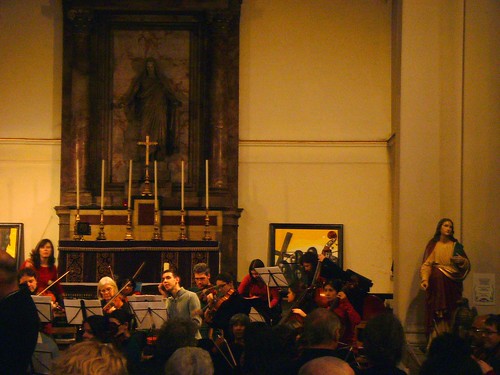
I've been playing the cello for over 30 years now, and composing nearly as long, so I ought to have some sort of handle on how this music lark works by now. But not everyone is as lucky as I was as a kid to have access to the wherewithal to pursue it, and the way music education is going there'll be even fewer in the future, so organisations like the East London Late Starters Orchestra are doing something very valuable. The idea is that people who've never had the opportunity to learn an instrument, or perhaps learned as a child then abandoned it for years, can have the opportunity to pick one up and have a go.
It's not really about the result (although of course all involved want to play the best they can), but about the act of getting up and doing it, I think; some of the players I hear had never touched an instrument until a couple of months ago, and to stand up and perform in public after that short a time takes a huge amount of guts, much more than I have certainly. And it also makes a statement that classical music isn't something obscure or difficult, to be the preserve of a few, but something that anyone can have in their life, if they want it.
There's such a strong vested interest in the music industry from professional bodies, record companies and the like that wants to promote music as a product to be passively consumed. This is so wrong. Music is an activity, something to be participated in, something to do, and it's this idea that really makes projects such as this important, not worrying about the "excellence" that ministers like to talk up (translation: leave it to the professionals, sit back, consume, buy, buy, don't think, BUY) but revelling in the act of creating it. Music's a social force, and that's what I bring away more than anything from this evening. There's little division between performers and audience; there's a unity of community, a joy and pleasure in the gathering together and the sharing of a moment.
Friday, November 30, 2007

Thursday, November 29, 2007
Black Dossier

Black Dossier is the latest episode in Alan Moore and Kevin O'Neill's magnificent League of Extraordinary Gentlemen (try to put the rubbish film out of your mind). It's not Volume 3 proper; rather it's the "short intermission" promised at the end of Volume 2, which through the plot device of the eponymous dossier explores the background of the League, both in Mina Murray's group and earlier incarnations.
What this entails is a collection of spoofs and pastiches of all kinds of literature, from lost Shakespeare plays through Bertie Wooster vs. Cthuhlu and the New Adventures of Fanny Hill to a migraine-inducing Kerouac homage. The strips that link these (all documents in the Dossier, which our heroes read through the course of the book) are set in a post-WW2 world derived from 1984, Dan Dare and Ian Fleming. There are, as in the previous books, hundreds of allusions to all sorts of fictional worlds and characters, some obvious (a suave yet sadistic secret agent called "Jimmy"; the character who turns up towards the end to save our heroes, whom I can't describe, because it'd ruin an absolutely brilliant and funny reveal), others obscure. This is par for the course, of course, but what's remarkable about the Black Dossier is that where the first two volumes were clever, beautifully constructed romps, this raises the whole idea of the series above the level of a brilliant conceit to something much more substantial, relating it to the ideas on magic and creativity Moore has increasingly been concerned with in recent years, particularly in Promethea. The final sequence is presented in 3-D (you get the glasses with the book), and is both a very funny and affectionate spoof on a lot of the elements of '50s 3-D movies, and a magical conclusion (both literally and metaphorically) which makes very effective and imaginative use of what could easily have been just a gimmick.
This is the final book of Moore's to be published under Wildstorm's ABC banner; he has been vocally unhappy since DC bought the company, and volume 3 of the League, and all his future comics work, will be published by Top Shelf Comics. This book is also unavailable in the U.K., allegedly due to copyright restrictions - although I would have thought the get-out clauses of transformative parody would apply (there seems to have been no issue with the previous books containing allusions to H.G. Wells' work, which remains copyright in Europe), so perhaps this is indeed DC spiting the great bearded one. Anyway, there are ways and means around this, and it's well worth getting hold of a copy, because it certainly left a big stupid grin on my face. I mean - 3D!
Wednesday, November 28, 2007
What's difficult?
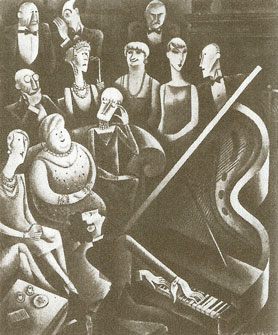
What I found particularly interesting, though, was the response of the audience (or at least those who came because I badgered them). These people (in the main not musically educated) all said they preferred the Sibelius. Now, the Fourth Symphony is a powerful work, one of the greatest symphonies of the twentieth, or any century, but it's also the part of the programme that would be considered a "difficult" piece - essentially because it' s relatively dissonant, emotionally dark and introverted, ending in grey resignation rather than any kind of triumphant peroration (or indeed the opposite, breast-beating despair). And it occurs to me that this is obviously how it should be, not because the Schubert's not a wonderful and great piece (it is, of course it is) but because Sibelius lived in a time closer to our own, and we need to do less work to understand the context he worked in. But the conventional approach to concert programming is entirely based on the premise that anything modern or contemporary is inevitably harder to understand for the non-cognoscenti, and should be approached with caution, buttered up with Beethoven or Brahms.
Is there any other art form where this sort of thinking is considered normal? Can you imagine anyone suggest that you shouldn't even attempt to watch a modern play before you've got to grips with Shakespeare? Or that you should avert your eyes from Picasso or Damien Hirst until you've got the hang of Holbein?
What rot. All my experience tells me that this idea that "uneducated" people need to be coddled in the face of new music is just rubbish. They may not like it, but give them the opportunity to listen and they'll appreciate it - in fact, I suspect the untrained ear may be more open to new sounds than that conditioned and brow-beaten by years of propaganda dripped into it by the education system. We live in an age, after all, where the charts contain music far more abrasive than anything Schoenberg ever wrote, and where the influence of that giant of the post-war musical bogeymen, Stockhausen, can be heard in ways beyond anything you, or he, might have imagined. Isn't it time the classical music establishment woke up to itself and admitted it's got everything the wrong way round, and that this misguidedly timid approach is helping to destroy the art form it's supposed to be enriching?
When a newspaper such as the Observer can print such a closed-minded viewpoint as this review of the Huddersfield Festival by Anthony Holden, there is something deeply rotten at the heart of our relationship with music, an awful combination of intolerance and conservatism that seems to betray an active hatred of music. The point about something like Huddersfield is that it's experimental, it's not going to conform to preconceived ideas, and yes, it will inevitably attract a small audience, and not everything you hear there will work (because it's experimental, remember?) but that's OK, because it's not meant to be mainstream, any more than Stockhausen's works were before they influenced the likes of Warp records' roster. For a major broadsheet paper's music critic to fail to grasp this is an extraordinary failure of the critical process.
It's time we started treating audiences as grown-ups who can listen without prejudice, not as children who need to be protected from the nasty frightening modern composers.
Image (a cartoon from Vanity Fair in 1929) swiped from here.
Monday, November 26, 2007
On the Corner
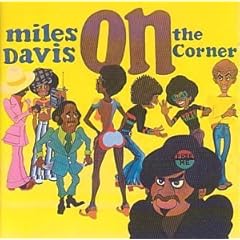
Its origins lie in Miles' realisation in the early '70s that jazz had been largely abandoned by young black kids, who were listening to Sly Stone and James Brown instead. He realised he needed to do something that would connect with them, speak to the kids on the street. So he made a funk album, of course. But being Miles, he couldn't make any old Stone-derived sound. He needed to bring something new to the party. And what he decided was the killer concept, that would bring his sound to the kids on the street was the ideas and processes of Karlheinz Stockhausen. Well, obviously.
I remember when I was a teenager first listening to Miles, and finding things like Bitches Brew bewildering, in a way probably only matched by Trout Mask Replica, another album it took me a long time to get my head round. But I always felt there was something in them, something that was just out of reach, that I needed to keep digging and find. Anything of real worth requires effort, because the effort makes the reward that much sweeter. So when Miles decides that what funk-jazz needs is the influence of the German avant-garde, god dammit, you've just got to go with it, because in the end you'll see he's right.
What Miles specifically takes from Stockhausen is his concept of space. On the Corner is an album that isn't much concerned with harmonic progressions, being on the surface a sequence of one-chord jams (or to be more accurate, cut and paste collages derived from one-chord jams). It's in the placing of the sounds that it gets its power, taking what could almost be described as a pointillist approach, short staccato phrases juxtaposed in varying combinations, never resting, always moving, but also static, creating a real sense of an environment in which we stay for a while. I'm reminded of the way Birtwistle describes many of his works, in terms of a single unchanging object viewed from changing perspectives.
If this sounds dauntingly intellectual, the effect on the ear is visceral and immediate (as is the actual music of Stockhausen and Birtwistle, if you ignore all the talking about it and just listen). Those foam-mouthed jazz-heads need to open up their perspectives and stop worrying about whether this is jazz or not. It's an extraordinary record that even now sounds like something that arrived in our midst from outer space.
Oh, did I mention that it's also damn funky?


