I thought Morton Feldman was long gone, but you can't keep a good man down, it seems - I see he's now running Ireland, although I suspect he may be ruing the day he took the job at the moment. I'm sure he's taking the long view of it all, though.


Bedřich Smetana (1824-1884)
Vltava
Czech nationalism was a sentiment borne more on hope than experience in the 19th century. The country then known as Bohemia was a province of the Austro-Hungarian Empire, and it would not emerge with any autonomy until the creation of Czechoslovakia in the wake of the First World War: true independence had to wait until the Czech republic disconnected itself from Slovakia in the aftermath of the collapse of the Soviet Union at the end of the last century.
So music was one of the few areas that offered any palpable outlet for patriotic expression, and Smetana, as the leading Czech composer of his day, found himself at the head of a movement, and his music emulated as the basis for a Czech school of composition. The cycle of six tone poems called Má Vlast [My Homeland] that he composed between 1872 and 1879 represent a self-conscious attempt to encapsulate the essence of Bohemia in music.
The original title of the cycle was the more demonstrative Vlast; the later addition of the pronoun perhaps suggests an unease with the idea of being a spokesman for the nationalist cause at a time when he was the subject of increasing hostility from critics. The project must also have taken on a great personal significance as the composition of the first part, Vyšehrad, coincided with the sudden loss of Smetana's hearing. For a composer this was serious enough, but the deafness itself was a symptom of undiagnosed syphilis, which would eventually kill him. Má Vlast therefore represents a remarkable fusion of the political and the personal.
Vltava is the second part of the cycle. It depicts the flow of the eponymous river from its source in the Šumava Mountains to Prague and beyond. On the way it passes a hunting party and a village wedding, and sprites dance on its moonlit waters before the current builds as the river reaches the St. John rapids, then flows broadly through Prague, past Vyšehrad Castle and disappears into the distance where it will flow into the Elba.
Nikolai Myaskovsky (1881-1950)
Symphony No.21 in F sharp minor, op.51
Posterity is a harsh mistress, as is seen in the case of Myaskovksy, a classmate of Prokofiev and pupil in Rimsky-Korsakov's composition class, who built himself a reputation as the finest symphonist in the Soviet Union before a young upstart called Shostakovich came along and stole his thunder. His 27 symphonies constitute one of the most extensive sequences since the classical era of Haydn and Mozart, and together form the backbone of his career.
After a time in the armed forces, he took a post at the Moscow Conservatory and became a leading light in the promotion of contemporary music in the 1920s, and later became a member of the Organising Committee of the Composers' Union. An introvert by nature, he showed little interest in politica and an overwhelming absorbtion in his work, but this was not enough to keep him from criticism, and he was periodically attacked for what the authorities saw as the excessive individualism and pessimism of his music, and in 1948, along with Shostakovich and Prokofiev, found himself one of the main targets of the infamous Zhdanov decree attacking "formalist" music. His style is, however, less abrasive than either of those two composers, and is more obviously in the Russian romantic tradition of Tchaikovsky and Rimsky-Korsakov.
His 21st symphony was composed in 1940 concurrently with his 20th, and dedicated to the Chicago Symphony Orchestra and their principal conductor Frederick Stock, who had asked Myaskovsky to compose something for them in 1938. Their performance of it on December 26 1940 was billed as a world première, but in fact the first performance had been given on 16 November by the USSR State Symphony Orchestra under Aleksandr Gauk.
The symphony is cast in a single movement, and although there are passages of livelier temprament, the predominant mood is withdrawn, epitomised by the clarinet solo which opens it, and the quiet string chords which bring it to a close. It is a testament to the inconsistencies of Soviet Arts policy that this introverted and melancholic symphony by a composer who had been condemned for these qualities was awarded a Stalin Prize in 1941.
Antonín Dvořák (1841-1904)
Symphony No.6 in D major, op.60
1. Allegro non tanto
2. Adagio
3. Scherzo: Furiant: Presto
4. Finale: Allegro con spirito
If Smetana effectively created the Czech musical character, it was Dvořák who took it to the world. By the end of the 1870s he was, thanks to the patronage of Brahms, establishing himself internationally as a composer, and in 1879 he achieved the distinction of having his third Slavonic Rhapsody performed by the Vienna Philharmonic conducted by Hans Richter. The performance was a great success, and as a result Dvořák found himself in the position of promising his next symphony to the orchestra. So in 1880 he set to work, completing the new work by October for a projected performance in December.
The orchestra, however, had other ideas: rumbles of discontent were heard at the prospect of playing new Czech music two years in a row; to present overtly Czech music in the capital of the Austro-Hungarian empire, of which Bohemia was a subject, was potentially an unwise political act. In the end the first performance of the symphony was given in March 1881 by the Prague Philharmonic under Adolf Čech. Richter himself finally conducted the symphony of which he was the dedicatee in London the following year.
Ironically, the work that the Viennese musicians had objected to on the grounds of its ethnicity has a distinctly Germanic tang to it; Dvořák went out of his way to write something that related to the traditions of musical Vienna. Not least of these is a clear indebtedness to his mentor Brahms, and in particular his second symphony (also in D major), which was then still a recent work. Dvořák also peppers the score with reference to Beethoven's symphonies, which were highly regarded in Vienna (not necessarily the case when that composer was alive), in what seems a ploy to present himself as an heir to those traditions.
That notwithstanding, this symphony, the first of his to be published (which is why for many years it was known as his first), sees Dvořák's style fully formed, the thick scoring of his earlier symphonies now replaced by the colourful, translucent sound that characterises his mature output. The first movement's allusions to the musical world of Brahms, Beethoven and Schubert only serve to highlight the confidence Dvořák has in his own voice, which is never swamped by his illustrious forbears.
The second movement takes for its principal theme a tune from an early string quartet that dates back to 1862, around the same time as the youthful Dvořák composed his first symphony, The Bells of Zlonice. As is his way, the movement proceeds less through contrasts than ruminations on and tangents to the main theme in a thoroughly relaxed and generous manner which finds time to make reference to the slow movement of Beethoven's Ninth Symphony.
Having doffed his cap to Vienna, the third movement is entirely and unashamedly Czech in character, taking the form of a furiant, a dance notable for its forceful cross-rhythms, that takes the folk ideas he had thoroughly explored in such works as the Slavonic Dances and propels them into an entirely new plane of thought. The opening of the finale that follows evokes the equivalent movement of Brahms' second, before launching off on its own expansive course, finally culminating in an outrageously lively dash for the finish.
Take a look at Anthony Holden's review from this week's Observer. Skip the bit about Strauss - Mr Holden doesn't like to stray too far from the opera house, so his reviews are usually about operas, especially expensive ones with big names in them. But occasionally he remembers that there are other classical music genres, and manages to get himself to one of those concert hall places. This week he's managed to navigate his way to Snape Maltings in Aldeburgh (probably relatively easy, as it was established by Britten, who of course was primarily a composer of operas). He's also aware of the current artistic director of the Aldeburgh Festival, Thomas Ades (presumably because he's seen his name about the Royal Opera House advertising one of those high-profile opera commissions that stop Mr Ades writing something more interesting), although the sub who prepared the copy doesn't seem to realise that Ades doesn't feature in this concert. But the excellent French pianist Pierre-Laurent Aimard, who's due to replace Mr Ades as thge Aldeburgh Festival'sartistic director next year, does.
Consider this:
"taste-free modern slices of Schoenberg, Kurtag, Webern and Charles Ives amid some nourishing Haydn and Mozart."
"Just as well, perhaps, that Aimard has disavowed any ambition to give up the piano for conducting."Huh? You just said his conducting was good! It was his directing from the keyboard in the concerto that went wrong, you said. So not only is that little dig at the end nasty and petty, it's also factually wrong.
The earliest known recording of computer generated music has been unearthed.
(Intriguingly, the 1950s computer shows a healthy disdain for the puny human concept of the tempered scale, as you'll hear every time it hits the dominant.)
Careful! We know where this sort of thing leads:
Some time ago Radiohead held a competition for remixes of "Nude" from "In Rainbows". This is one of the entries. Be patient, it kicks off at about 1'10". It's not samples, it's actual equpiment playing live, as James Houston explains on the YouTube page:
Sinclair ZX Spectrum - Guitars (rhythm & lead)
Epson LX-81 Dot Matrix Printer - Drums
HP Scanjet 3c - Bass Guitar
Hard Drive array - Act as a collection of bad speakers - Vocals & FX
Utterly brilliant.
R.I.P. Bo Diddley. One of those guys who, hovering behind a huge number of bands in my record collection as a kid, influenced me before I even knew it.
Many happy returns to Cheerful One.
I'd sing "Happy Birthday", but as Warner-Chappell claims that the song is in copyright, I can't afford to. You can read more about the arguments over who owns the world's most popular song here and here.
I'd say more, but I'm trapped in relocation hell at the moment and really should get on with the packing. Normal service will be resumed shortly.
It's repeated tonight at 7.00 on BBC4, or you can blahblah iPlayer. And while I'm at it here's an interview with the man himself.
Obviously I'll be deeply possessed with Euro-fever by then. Assuming I'm not trapped under a collapsed tower of boxes.
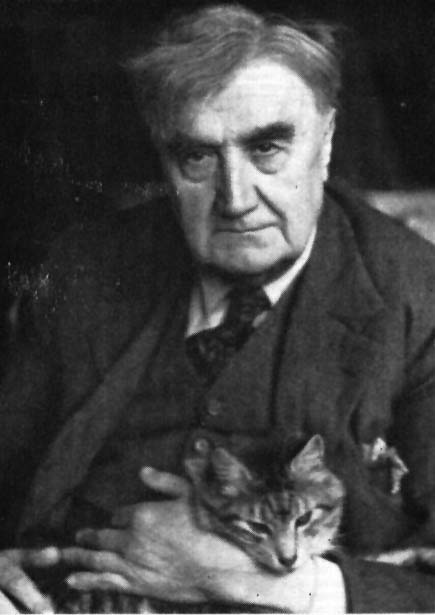
RVW would have felt right at home in the world of blogging, as this photo of him with a cat demonstrates.
I am surrounded by stuff.
Packing is an activity that inevitably leads to a certain amount of introspection; it's like a ritual, sifting through the lives once led in preparation for the life to come. Those books, CDs, pieces of random paper that bring to mind times you'd half-forgotten, smiles and rueful wonderings about what might have been, if only. But there's no if only in life, only what was, is and shall be.
So the difficult decision becomes, what stays and what goes? There are of course things that retain their immediate usefulness or potency, and those that can be happily discarded (CDs that will never again be played, books that will never be re-read). But there's also a slew of things that fall between; things that you can't entirely justify keeping on any practical level, but bring warm feelings of nostalgia. How do you decide about these?
I try to be reasonably callous about it; I believe in looking forward, not becoming mired in things past. But at the same time, that past is what made me, and I need to keep something to remind me of where I've been. Judging the line between these is a difficult one.
Mostly, though, at the moment I feel overwhelmed. When you've been in the same place for over seven years, you don't notice the accumulation of things, and it's only when you come to put it in boxes that you realise how much you are defined, and weighed down, by possessions.
There's a piece of me that wants to stand up, walk out and leave all the things. That knows I only need what I carry within me, really, and that everything else is detritus. But I can't let go of it all. I'm possessed by objects, and it's a worrying feeling. But we cannot entirely escape the detritus we have produced, and must accept responsibility for it.
I ride a new way, aiming for the same destination. It's amazing how little deviation it takes to make the familiar seem like unexplored territory. I whistle a happy tune, with obscene lyrics rewritten as I ride. I reflect on how good it feels to be alone, out of the city, disconnected from the daily grind. At one point I almost look at the time, but think better of it. Why spoil the wonderful freedom from the temporal whip? I think of how strange it is that we strive to isolate ourselves from the wilderness, and then construct an artificial one. Of how fragile our existence is. Of how wonderful it is that this freedom is there for the taking, even in the city, if you take the time to find it.
Then I stop thinking, and look at the world.
 Gordon's famously reduced the strength of their gin after an EU directive defined the minimum strength for gin as 37.5%. What was that about cutting corners and losing your edge again?
Mr Ramsay's very big on quality control. Obviously not that big, though..

It's a bit different for me perhaps; I've sat through the five hours of Morton Feldman's For Philip Guston*, so a couple of hours is peanuts in comparison. And Bruckner wrote 90-minute pieces in which, in a very profound sense, nothing really happens (and yet everything!). So there's plenty of precedent.
Not everyone can take this sort of thing: there were several people who walked out, some after less than half an hour. But it takes a half-hour or so to acclimatise yourself to this sort of music, and you need the patience to do that if you're going to get something out of it.
The spacial element of Prometeo is of course one of its main selling points. Stockhausen of course experimented with breaking down the traditional relationship between performers and audience in the 60s with Gruppen, and playing Strauss's Alpine Symphony recently, with its army of off-stage brass, reminds me that playing about with these things is nothing new in itself. But Prometeo takes these ideas and runs with them. There are clusters of musicians everywhere, even before you consider the sound field created by numerous speakers distributed all around. This creates a slight tension, as the Royal Festival Hall is clearly designed for the traditional layout of audience all pointing towards a stage, so our sitting position works against what Nono is trying to achieve. But in a strange way this only seems to point up how entrenched we are in our concert-going habits, the very thing Nono wants us to question.
The (excellent) programme contained the texts used in the piece, but this is really better studied later on, as Nono deliberately abstracts the words in his setting so that it's really incomprehensible in any conventional sense. Rather, he exploits the libretto as a source of sounds and timbres for the voices. There didn't seem to be any need to think about the text or the legend of Prometheus except in the most general, abstract way, and this is part of what it's about: it's not about comprehending, it's about the pure experience of listening.
Normally when you hear something involving a combination of instruments and electronics you expect the electric part to be superimposed on the acoustic, but what Nono does is much more subtle than that, and it's a credit to him that you hardly think about the presence of the sound system, so carefully are the two elements integrated; this is use of technology as a subtle enhancement rather than a bludgeoning club. The effect as you hear sounds from their original source drift across the room and transform into complex textures is serenely discorporating.
The actual music itself seems much more eclectic than I'd have expected, ranging from terrifying clusters to the sweetest of perfect fifths, and pretty much everything in between. Occasionally a roar emerges from the orchestras, but largely the music is a great drift.
Nono is classed as one of those nasty modernists we're all supposed to reject these days in favour of Golijov. But what's striking is that this music (as well as being far more immediate than the anti-modernists would have you believe) doesn't sound "modern" at all. It sounds extraordinarily, immensely ancient. We leave the hall at the end, and to return to the bustle of London after this feels like returning from a journey to an unimaginably distant world, perhaps even time. The world seems too fast. Nono gives our thoughts space to breathe. And time.
There's so much more to be said, and yet also nothing. I go about my day as before. But behind it somewhere there's the memory of this other place, and it'll be a while before it's absorbed. it's all a matter of time.
Tim Rutherford-Johnson has a good roundup of reviews of the performances.
*I've sat through the even bigger String Quartet No.2 (over six hours on the Flux Quartet's recording, helpfully available on DVD to avoid those annoying disc changes). But somehow it seems cheating, doing it in the comfort of your own living room.

 Say what you like about the parasitical/elitist/upper class* crowd, they get service. I hardly had to queue at all to pick up my ticket from the Royal Opera House box office for tonight's performance of Harrison Birtwistle's latest show, The Minotaur. A pleasant change from some venues I could mention. The man behind the desk almost smiled, too.
Parr-zed (as you call them if you actually come from Portishead) are also pretty much The Fall's polar opposite in terms of their style, too, but there's a connection in the way they've managed to revitalise their sound while remaining recognisably themselves - "always the same, always different".
What's remarkable about this album is the juxtaposition of two entirely different textures: most of the music is harsh and stark, underpinned by brutally minimalist beats, and this is thrown into sharp relief by Beth Gibbons's fragile, pleading vocals. The effect isn't too far removed from Scott Walker's latter-day stuff, and it's interesting that this album is getting a lot of positive mention where Tilt was received with bafflement by many when it came out. Maybe this is a sign of how we've moved on.
The other music that comes top my mind as I listen to this album is that of Galina Ustvolskaya - there's a similar feel of supplications to an indifferent God, humanity somewhere deep in the midst of a vast, uncaring machine of a universe.
This isn't easy listening - there'll be few dinner parties with this on in the background, as Portishead's first album was unfairly condemned to - but it's powerful stuff, that reveals itself more and more with each listen. And it takes a very special kind of confidence to be able to produce this stark, oppressive sound, and then throw a ukulele into the middle of it, as happens on "Deep Water".
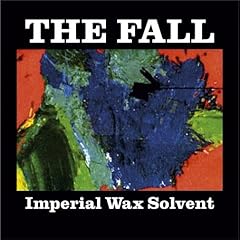
There are, apparently, still some people who remain wilfully blind to the genius of The Fall, and I suppose at this stage it's too late for them; I can only pity them and the drab lives they must lead.
Because there is not one band who has managed what Smith and his many cohorts have achieved: to sustain a career in this strange beast we call rock and roll for three decades that maintains an extraordinarily high quality level (I maintain they've never released a bad album: sure, there are Fall albums that are less good than the others, but their slightest effort is still several rungs above almost anyone else) and still retains its full creative force and originality.
Having established recent incarnations of The Fall as the Ur-garage band, Smith on this album seems to be playing with that sounds, pulling it apart and reconstructing it from the inside out. So what we get are a lot of startling jump cuts between textures and tempi, which seem to bring The Fall's latent Beefheart influence to the fore. now Beefheart's not someone you can emulate unless you're very sure of yourself, and of course The Fall manage to let that sound come out without ever once sounding like anything other than the Fall, which of course is the essence of their genius.
It's compelling, genuinely adult music ("I'm a 50-year old man, and I like it!" exclaims Smith) ; a big thick juicy steak of a record, in comparison to the thin gruel so many bands serve up. And it's great to dance to, too. The Fall come from the land of Northern Soul, remember; they understand the value of dancing.

slipping past
Originally uploaded by petemaskreplica.
The days pass. I'm not dead or anything, just busy with other things.
There are two courses of action when you hit the weekend with a stinking cold:
i) eat plenty of fruit and veg to get your vitamins and have an early night.
ii) fill yourself with booze and comfort food.
Guess which plan I'm going with?

 Anyway, more interesting things are in the air, namely that the third and final cartoon I drew for Rhinegold is in the shops now, in the Festivals supplement to the current issue of Classical Music, so rush out and buy that, and then write letters to them saying how great I am and that I should have a regular strip in there.
I'm writing a programme note about Richard Strauss's Alpine Symphony for the next KSO concert at the moment, and it's an interesting contrast with the last one I did for Shostakovich 4. This is partly due to the fact that I just don't like Richard Strauss very much.
it's difficult to pin down just what it is that doesn't appeal to me; I can see that it's well written - Strauss is never less than effective with an orchestra - and there's plenty to say about the origins of the piece, what with the connections to Nietszche and Mahler. It's not even his dodgy Nazi links - the more I read about him the more I become convinced that he was naive and blinkered and self-serving rather than actually evil. It's that I can't see anything beneath the (admittedly attractive) surface. So I struggle at those sentences, desperately trying to convey an enthusiasm I don't really feel, talkign about hidden depths I'm not convinced are there.
He's the musical equivalent of a page 3 girl - very well built, but once you've got past the beautifully contoured orchestration, there's nothing to engage the intellect*. Someone once said something to the effect that of the three late-romantic Austro-German composers, Bruckner found God, Mahler searched for God and Strauss wondered what all the fuss was about. And that's the effect his music has on me. It drifts by, beautifully composed and utterly vacuous.
Composing to entertain the audience is a perfectly legitimate strategy, as valid as composing without a care for the audience, and on some level Strauss must be successful, because I certainly seem to be in a minority in my apathy. But as much as I like to look at a well built figure, it's more fun if there's a conversation to be had too.
*I'm not suggesting that all page 3 girls are air heads, of course. I'm sure there are plenty of them with degrees in comparative philosophy or quantum physics.
Oh, has it come to this? Am I now on that slippery slope to being just another blog with a bunch of links to the words of other, far more intelligent and interesting people than me? I'll try not to make a habit of it. Anyway, in the absence of anything interesting to say coming out of my brain, here are a few things to read:
EMI's planned job cuts have been delayed by some piddling legal process. Damn those pesky Europeans with their crazy ideas that big multinational corporations can't just shit on people as they please.
The Graunaiad is publishing daily extracts from one of the Defeatist's number one heroes, Mark E. Smith. Part one is here and part two is here.
Harrison Birtwistle's new opera The Minotaur premieres tonight. Here are some interviews with the composer, director and protagonist. I'm interested in the way the media seem to have moved from portraying Birtwistle as a terrifying figure to almost the cuddly face of modernism.
During that time the firm supported Boosey & Hawkes’ management in executing
a transformation from a traditional classical music publisher into a 21st
century music rights group. It has outsourced a number of non-core activities
such as printing and distribution and developed a series of new revenue streams.
In particular it has developed a strong presence in the market for music in
advertising and film, where revenues are currently growing at approximately 30%
per annum.
 I thoroughly enjoy reading Ben Clark's Magic Beans Comics. And so should you.
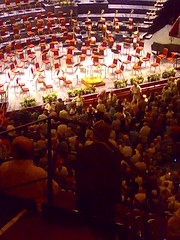
And you know what? There's some pretty darn good stuff in there. Obviously the Stockhausen day will be a highlight for me, but there's also a hefty wad of Messiaen and Carter (and it's not often you get to celebrate the centenary of someone who's not only still alive, but still very active), and a couple of "populist" gigs which I think are both excellent ideas - although not everyone agrees with me.
It's all very well to say "If we build it they will come", but the fact is that kids today have next to no experience of classical music, concert halls are seen as forbidding places, and many people simply won't enter one (a bit like the way quite a lot of people won't watch a programme simply because it's on BBC2 - which is why shows that transfer to BBC1 get such a huge hike in viewing figures). Personally I think that juxtaposing Doctor Who and Turnage is a great idea, not only in terms of getting people inside the hall who might never otherwise go, but putting a message out that it's ok to like both. It's not going to create a brand new audience overnight, but it's a step in the right direction, and puts the whole thing ahead of the usual game for "family" concerts.
The folk day is also exactly in line with what the Proms ought to be doing - a type of music that's intimately linked with so-called classical music, and presented with some of the cultural paraphernalia that surrounds it rather than in isolation like a butterfly in a glass case. I'm looking forward to having a dance round the maypole, so there! And the Ceilidh is a great way to finish it off. If we take it for granted that the Proms is bound to the Albert Hall for the foreseeable future (and I think it is), then for all the place's faults it should be embraced, and stuff like this makes an imaginative use of the space.
Some of the concerts look a bit bizarre to my eye in terms of the wild oscillations between full symphonic works and solo piano pieces, not to mention some strange programme orders (Mahler 5 as an opener??) , but if the Proms are to survive and flourish they have to be open to innovation and experiment, and one of the things about experiments is that they don't always work. The point is, it feels like a fresh breeze is blowing over the season after the increasingly stultifying Kenyon years. There's an eclecticism and a lack of reliance on tired barrel-scraping themes and the like that leaves me feeling uncharacteristically upbeat.
So bring on the daleks, the maypole, the electronica, I say: If it works, great; if it doesn't, at least they tried. Next year they could try putting a big Wicker Man up in Kensington Gardens.
... and everything decays.

I've never texted the wrong person by mistake myself*, but I suppose it must be easy-ish to do. I occasionally get a random message, or sometimes am treated to a long voicemail message consisting of the sound of half heard muffled voices through the phone owner's pocket.Am in Lon tmw so could meet you at waterloo after my meeting around 5? All well my end. Speak tmw Tx
 Lou Reed's Metal Machine Music, one of the more remarkable albums of the seventies, has always had a special place in my heart. It's, in essence, an hour of feedback, and is often voted somewhere near the top of lists of the worst albums ever made. When I was a sullen pretentious teenager this clearly made it a cause to be championed in my own contrary way. Hell, Ian Curtis had once said it was his favourite album, and it was, y'know, really loud.
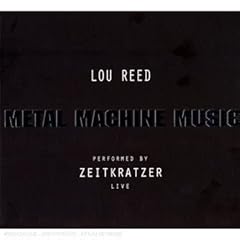 What got me thinking about it again was the remarkable CD by the German ensemble Zeitkratzer, who perform a painstakingly transcribed arrangement for acoustic instruments (joined in the latter stages by Reed himself on guitar). So what better way to follow this up by digging out the original for a comparison? And what better time to do this than a Thursday lunchtime?
Little time for blogging at the moment, as you may have noticed from the few and inconsequential posts lately. Well, I'm afraid you'll have to get used to that, because inane witterings about Doctor Who is about as good as it's likely to get in the immediate future. This is not in itself a bad thing, as it's at least partly down to the exciting thing that I'm now working on, of which I shall not speak, as talking about these things seems to have a tendency to kill them off in my mind. Maybe once you've expressed the thought behind it the need for the piece evaporates. Better to explain in retrospect, if at all. I will say there's an element of thinking about rhythm involved, in a different way to what I've done lately. All these months I've been worrying about my drained pool of ideas, wondering if I need to take a long hard look at things and reassess what I'm doing, and it turns out what I really needed was a few days off. There's a lesson for us all there.
Anyway, Doctor Who. I'm getting quite excited about that.
I know I'm probably too old to be excited by this sort of thing. but I am, so there.
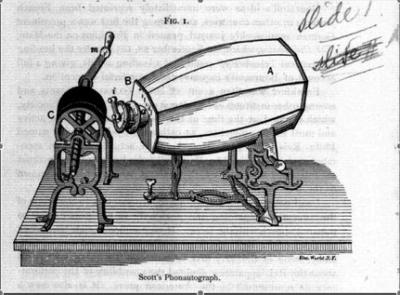
There's something extraordinary and wonderful about this. This voice, the name of whose owner was apparently not considered important enough to be recorded, preserved on nothing more substantial than soot on paper, all that remains of someone from a distant past, untouchable but made tantalisingly close by this tiny fragment. Something about the fragility of existence and the tenaciousness with which we cling to it.
Anyone who grew up in the late 70s and early 80s will remember "Arthur C. Clarke's Mysterious World", a TV series in which Clarke fronted a series of articles investigating strange phenomena. It certainly made a deep impression on me; I was obsessed with Doctor Who (as were most small boys then) and all thing extraterrestrial, and the remarkable tales I saw presented were a huge meal for my ten-year-old imagination. I even got the big expensive tie-in book, and poured over its pages, filling my head with crystal skulls, mysterious explosions, ancient anomalous technology and alien visitors. It was also the first place I heard the name of Charles Fort, whose words currently head this blog, and whose wickedly playful philosophy has been a great influence on me.
Clarke's best known amongst the wider public, of course, for his novel and screenplay 2001: a space odyssey, and for predicting satellites with geostationary orbits, but he wrote a huge number of books, many of which I read avidly. His short stories always chimed with me most, filled with extraordinary imaginative speculation as to the future, which was nevertheless always perfectly grounded in contemporary science.
What I remember and treasure most from his stories, however, is its essential optimism. Clarke wasn't naive; he was certainly aware that human nature does not evolve as fast as our technological capability. But he always seemed to project the wonder of possibility, and the hope that for all our faults, in the end all things shall be well.
It doesn't strike me that he was the sort of person who'd want to be remembered in solemnity, and so here's something I also remember from TV relating to the great man in an entirely less serious way:
High point of the day: Remembering I'm only working three days this week.
Low point of the day: Realising that today is in fact Tuesday, not Wednesday.

'Fingerprints, somehow, are far less contentious,' he said. 'We have
children giving their fingerprints when they are borrowing books from a
library.'
What. The. Fuck?? Does this really happen?
Does this really happen?
AC Grayling eloquently dispatches the pernicious "nothing to hide, nothing to fear" argument today in the Guardian.
At a time when the Chinese government is trampling all over the rights (and bodies) of the Tibetans, we need to look to our own back yards and see what's happening here before we find ourselves at the mercy of rulers with no regard for our right to live our own lives.
Set the controls for the heart of the Sun
Originally uploaded by petemaskreplica.
A mention on the radio draws my attention to The Times pontificating about the need for conductors in the wake of an interview with Nigel Kennedy (are we back to calling him Nigel now? A couple of years ago he declared he wanted to be known as "Kennedy", presumably in imitation of Morrissey, Madonna, God, and other single-monikered celebs). It's an interesting question.
My own band probably wouldn't get through an extended piece unscathed, but we're operating on a different level to, say, the LSO, who I daresay could quite easily get to the end of a symphony without it falling apart. (Whether the performance would be worth hearing is another matter.) Plus KSO's purpose is in part educational, to broaden the knowledge and appreciation of music for both the players and our audience, which means that our conductor is working in part as a teacher as much as a baton waver.
Conductorless orchestras do exist; from what I gather the main difference is that because the approach to the music has to be decided amongst the band rather than being imposed by a single coordinator, it takes longer to rehearse. I suspect this is why stickless bands are unlikely to have much of a future beyond the relatively small forces involved in pre-(and indeed quite a lot of post-)19th century music, simply because the arguments between 30 people are going to be resolved much quicker than between 80. So, the argument in favour of conductors is essentially efficiency: it's more efficient to have one person in charge of rehearsing and shaping a piece than a group of people discussing it. And of course a pair of ears outside the band is useful, to make sure everyone's balancing well.
(Nigel) Kennedy's someone I've got a lot of time for - it's easy to forget that beneath the eccentricity/twattery lies a very fine musician - but I think he's over-stating the case. As the Times article points out, he's struggled to find anyone he can work with since Klaus Tennstedt.
(Incidentally, I'm disturbed by the comment on Radio 4's Front Row last night that (Nigel)'s (conductorless) new recording of the Beethoven Violin Concerto is slower than his old one with Tennstedt, which was so slow it's a wonder it's not still going on. Maybe he's hoping to make a breakthrough in physics by playing so slowly that time actually starts going backwards.)
The question of whether a single view of a piece or a collectively agreed one is better is a question worth pondering. Of course this does all tie in with the very idea of "interpretation", which is to a greater or lesser degree an excuse to justify playing the same old stuff over and over rather than finding something new for our ears, which goes to the heart of what the classical music industry's all about.
There are conductors who do bring something special to the table, but in truth they're rare birds. Mark Elder's a good example of someone who's worked with one band over many years (the Hallé) and has the kind of relationship with them now where he presumably knows them well enough to work with them rather than at them. Then there are the superstar jetsetters like Gergiev. And of course the huge numbers of journeymen who frankly do bugger all. The trouble is, there's a culture of insisting in so-called classical music that everything is the peak, the absolute elite, when the fact is there's a hell of a lot of the mediocre.
Could you put on a Mahler symphony without a conductor? I don't know. It'd be interesting finding out, though.
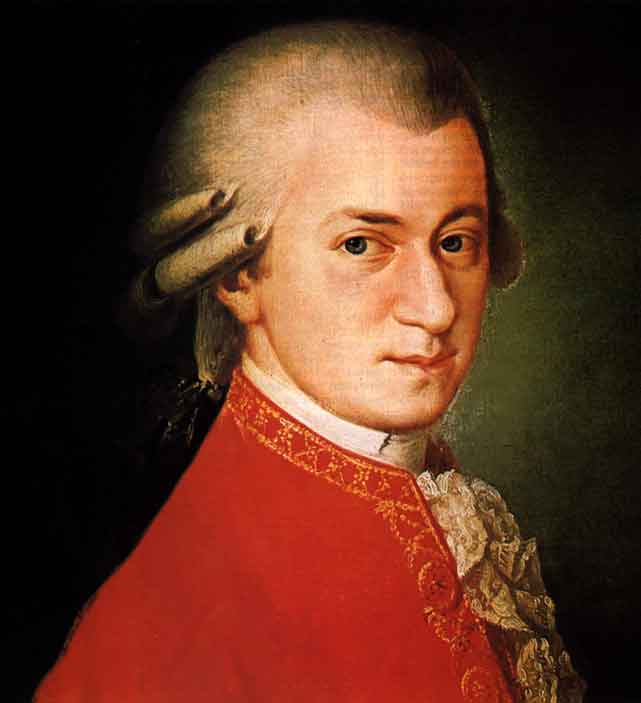 Steph Waller believes she is the reincarnation of Mozart. She gives talks "in character" (and costume) to schoolkids about him, along with her partner Lynette Erwin, who claims to be the reincarnation of the first singer to play the role of Susanna (and alleged tryster with the composer) Anna Storace. Personally I think if I'd been subjected to this as a child I may have been too traumatised ever to listen to Mozart again, but maybe that's just me.
A trombonist and me in the pub after the concert on Saturday:
"Great programmes notes!"
"Thanks!"
"Not much about music in them, is there?"
"Well, writing about music's a waste of time, really."
And it is.
Well, I should qualify that. There's plenty to be had out of the study of music, for performers and composers. But when you're writing for an audience the rules are different, I think. Maybe once upon a time you could have assumed a certain level of knowledge about how a piece of so-called-classical music works, but the fact is that you can't anymore. I write programme notes for intelligent people who have no musical education. I could witter on about sonata forms or whatever happens to be the bottle tonight's wine is poured into, but for those who know about such things it's unnecessary, and for those who don't it's a confusion. All those descriptions of what happens in the piece you read in most programmes - what's the point? I don't want to be told the plot before I read a book. But it does help to have the scene set, and as a lot of the time we're talking about something that was written in a different age or society, it's good to know the context in which it was created. I usually mention something that happens near the end, so that the audience knows it's nearly done. But really my ideal programme note wouldn't talk about the music at all. Long-winded technical descriptions put the layman off, make it seem an esoteric exercise that you can't begin to understand without a degree. Music should be experienced viscerally.
In the case of Shostakovich's Fourth Symphony, the political context of its creation is vital to understanding the work, but that's true of anything. No composer exists in a vacuum. To put a work in context doesn't diminish its universality (as some try to claim, particularly in the case of Shostakovich). When making a case, one argues from the specific to the general, and knowing how, when and why DDS composed his Fourth can only help in understanding its wider relevance today.
These thoughts are with me regularly as I write, of course, but they also come to mind this morning reading the comments on Pliable's post about the review of Alex Ross's book on Radio 3. It's true that there's not much in the way of discussion of music in the book, but is that its purpose? My impression is that the point of it is to put 20th century composers into a social context, something which has been largely lacking. I find the earlier part of the book more successful in this than the latter - although perhaps that simply reflects the extent to which the post-war composers abdicated social responsibility? It's also true that Ross's story peters out sometime in the early 70s, but perhaps with music since then it is too soon to tell. Certainly, the book isn't as wonderful as it's been made out to be - what could live up to such hype? - but Ross has attempted to put 20th century composers before a general audience, and that's something to be admired and encouraged.
We are a product of our environment. But our environment is also in part a product of us. I'm an untidy person. I create the mess that surrounds me. And yet, when I get around to tidying it up, I become aware of how much the mess around me creates untidiness in my mind, that turns a creatively non-sequential mindset slowly into an impenetrable thicket, so cluttered with detritus that I can no longer fight my way to the important matters buried within. And this process creates a feedback loop, so that the thicket of thought builds up a dam against action, the mess in the physical world builds and thus feeds the mess in the imaginative world, until something breaks and insists this will not do. And once the clutter begins to disappear somehow the mind begins to clear also, and one begins to think again of productive thought rather than the tiny, time-strapped whirring that dominates all too often.
There's nothing wrong with this cycle; it's a rhythm, and life needs a rhythm, sometimes simple, sometimes complex, and the simple rhythm must build to complexity and the complexity must in its turn give way to simplicity. It's just a shame that the moment of Nothing that acts as the agent of this change too often arouses out of imposition (of illness, say), rather than being allowed to emerge of its own will. Or is the illness simply a manifestation of this need occasionally to stop?
The debate about the speech that Margaret Hodge gave yesterday rumbles on. And proves that for most people, the Last Night of the proms, the entire proms season and the entire range of what we call" Classical Music" are all interchangeable. Now that's what you call an image problem.
Hodge's own online diary, meanwhile, praised the Proms mightily last September. There's bound to be a suspicion that this proves that she' s simply a vacuous media tart who'll say whatever needs to be said to get some attention (I see more than one person has raised the spectre of Zhdanov), but is it just me or do those diary entries talking about operas and the Vienna Phil read like they've been cribbed from some bluffer's guide to classical music-type book? I'm now confused: is she ignorant or hypocritical?
My heart sinks every time a politician offers an opinion on the Arts, and today's no exception as I read Margaret Hodge's reported comments on the Proms. Whether she's talking about the whole season or just the Last Night is being debated in a surprisingly well mannered discussion on the Grauniad "blogs" ( normally a hotbed of hate and ignorance way off the image of Grauniad readers as woolly liberal mung bean munchers), and of course there are less literate discussions going on, as well as the odd person happy to hitch her remarks to their own Beeb-bashing.
Hodge's words are of course flimflam, that show no knowledge or love of the subject at hand but an addiction to meaningless soundbites (pretty much what you'd expect from this government). It's interesting how quickly Downing Street seems to have intervened to put the can on the story - Hodge was booked to appear on Radio 4's The World At One, but at the last minute "something came up", and so we had to put up with Nicholas Kenyon waffling away.
I'm certainly not going to suggest that there's nothing that needs to be improved about the Proms - there's plenty - but this sort of thing really isn't going to start a sensible or useful debate about that. Rather, it's a sop, the Proms being a lazy shorthand (because of course to most people, the Last Night is the Proms, and indeed all classical music) for a certain type of white middle class idea of "culture". The minister's ill-thought out half-ideas about "inclusivity" and this governments obsession with a "British national identity" is fuelled partly by the prime minister's determination to make us forget that he's Scottish, and partly by a hatred of anything that might emphasise individuality. Hodge's singling out of the Proms is meaningless; it's a lazy, convenient target rather than any cogent analysis of contemporary culture. The only thing more depressing is David "Dave" Cameron's equally fatuous response. Let us not forget that politicians of all hues are rarely genuinely interested in the Arts, and never, ever interested in anything other than the lowest common denominator.
 You can never take anything for granted in this world, and to prove it, the European Union is looking at extending sound copyright terms, against the conclusions of the Gowers Review. Read more here, and sign the petition. Copyright is an important way of protecting the livelihoods of creative artists, but for cultural activity to thrive, it's also important that works be allowed to pass into the public domain, so that we can use the achievements of the past to build the future sound.
Photo taken from Racefan's Picassa album.