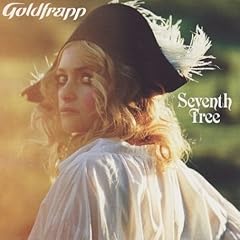
The best thing (at the moment, anyway) for me, though, is the lyrics. Although by that I don't mean what you think I do.
Take the first track, "Clowns". Reading the lyric booklet in my nice posh special edition blah blah, I see the opening line is "Only clowns would play with those balloons." Only that's not what I hear. What I hear is more like "Only cloeooayeedohmmmaooooo." My theory is that Alison's approached the lyric writing via the method of doing some nice sounding vocalising, and then scribbling down something that it could plausibly be. And this is a Very Good Thing.
Because that's pretty much how I hear lyrics anyhow. I've never been very good at remembering, or even hearing, words beyond the odd pertinent line, even Dylan. Where some people sit about trying to deduce the inner meaning of "Subterranean Homesick Blues", I just enjoy the sounds of the words. I don't really care what they mean, or even if they mean anything. What matters is the feel conveyed by them, and that's got little to do with syntax. This is demonstrated perfectly by the greatest lyric ever penned in the history of rock and pop: "Awop-bop-a-loo-mop alop-bam-boom!"
Friday, February 29, 2008
Words written in the wind and the running water
Ships that pass in the night*
Just as the tube doors close at Oxford Circus, a gangling figure crashes through them and swerves past my cello straight into the last untaken seat, it's Bobby Gillespie. I wonder if anyone else recognises him? I resist the temptation to ask him "Are you Bobby Gillespie?". Because that would make me a wanker. Although somewhere in the back of my mind a scenario presents itself that he'll be getting of at my stop, we'll start chatting and the epic collaboration between us will be born. He gets off at Notting Hill Gate. Probably just as well.
*I say night. Obviously it was the morning. But it was underground, where it may as well be night.
Thursday, February 28, 2008
reissue, repackage

 There must be a re-branding mania at large - this week we commuters down the Lee Valley have been continually reminded that we are no longer on a "One" service, but in the brave new world of "National Express".
Wednesday, February 27, 2008
Walls come tumbling down (or not)

Monday, February 25, 2008
Neckwear for second childhood
 It's a good and necessary thing to have goals, and it occurs to me that I'm sorely in need of an objective or two at the moment.
I wonder if adulthood isn't a matter of putting away childish things, but more of an opportunity to accrue the childish things you couldn't get hold of because you were only a child.
Now, I must make the momentous decision: which scarf should I make? The original model, the replacement that came along a few series later when the first one had had one too many bits shot off by daleks and the like (which I guess is the one I really remember, as it coincides with my getting old enough to become really obsessed with the show) or the burgundy one from Tom's last season, which came in with the shirt with question marks on the collar that I associate with the beginning of the slide into 80s awfulness?
Thursday, February 21, 2008
The extraordinary continuing non-shitness of Torchwood

I hope Scott and Charlene are hanging their heads in shame, that their rebellious shenanigans drove poor old Jim to this.
Wednesday, February 20, 2008
It ain't what you do, it's the way that you do it
Interesting post over at Kyle Gann's blog touching upon issues of notation.
Now you may think this sort of thing is pure composer-nerd territory, but think about it for a minute: a "classical" composer is in a strange position in that he or she is dependent on others to realise his work; all the great ideas in the world are worth nothing if you can't figure out an effective way to communicate them to the performer so he or she can attempt to convey them to the audience (which you hope will consist of a least a few more people than you and your mates).
I sometimes wonder if all the exciting notation software we have available to us these days isn't stopping composers from really thinking about how they write things down. On the other hand, fancy clever notation can be a smokescreen to mask the lack of substance in a piece; there's a terrible danger that the means become the ends.
It's a long, thin, high tightrope to walk: Kyle's got a point about professional musicians' aversion to anything that makes them have to stop and think, but at the same time it's important for the composer to put his instructions across as clearly as possible. Morton Feldman's a great example of a composer who writes his music out in a fashion that often sems to defy logic; but his idiosyncratic presentation does convey an important idea about the music and how one should approach it, in a way that a more superficially straightforward approach wouldn't. I guess the bottom line is, if you're going to write something in an unorthadox way, that's fine, but make sure you know why you're writing it like that. And the same goes if you're writing it just how your teacher told you to.
Sunday, February 17, 2008
Culture - to go!
This article by Armando Iannucci in the Observer today is thought-provoking stuff, one of the best bits of journalism he's written. Of course kids won't just stumble upon "culture" without being introduced to it, but when a government starts declaring quotas for arts in school I get suspicious, not least because (apart from the question of where these 5 hours are going to fit in and what can be usefully achieved in that time anyway) there's a bit of me that wonders if this sort of thing isn't a substitute for proper education rather than an impetus to it. What kids need to be introduced to is the idea that there are things in the world that require effort, and that they are worth that effort. I can't see how what they're suggesting will achieve this. Plonking a child in front of an orchestra isn't enough.
Thursday, February 14, 2008
Happy Valentine's Day!

A heartwarming tale of romance, stolen moments and utter idiocy for the most romantic day of the year. As seen in Classical Music's guide to music summer schools, out now. Play nicely and take precautions, kids.
Wednesday, February 13, 2008
The Image Game
 Some time ago I found myself in the strange position of being offered money to draw comics, not something I ever thought would happen. The first fruits of that job are in the public eye now, and as the Classical Music Competitions supplement has now been out for a bit, I thought I'd post the strip I drew for it. The second one, for the Summer Shools supplement is just out, and the third, for the Music Festivals one is due in May. Well worth getting if you have any kind of interest in those subjects, and the strips look lovely on the page.
It's an odd feeling, seeing something I drew in print on nice glossy paper in a magazine, a strange mixture of excitement and terror, but one I could get used to, I think.
I might put up the second one tomorrow, it'd be appropriate given the date, ha-ha.
Tuesday, February 12, 2008
Lost Girls
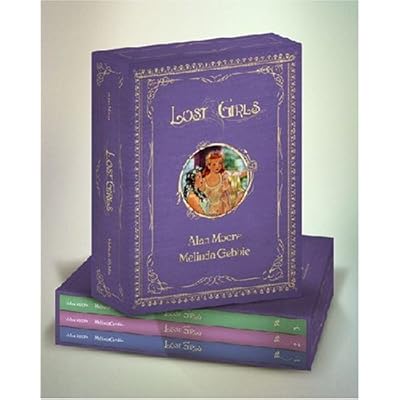
Lost Girls is Moore's self-declared attempt to produce intelligent porn, and there's no doubt that it's hardcore - pretty much every page contains explicit sex, quite a bit of it illegal (and the rest oughtta be! I thangyew). The scenario presents us with three famous fictional women from fantasy novels - Alice (of Wonderland), Wendy (of Never Never Land) and Dorothy (of Oz), who meet in a hotel in Europoe on the eve of the First World war, and proceed to tell each other their stories while engaging in all manner of congress*. Thus the three tales from which the characters originate are recast as Freudian metaphors for sexual awakening. Moore is certainly not the first to consider these works of children's literature in this way, but to be quite so, um, uncensored about it is, er, a novelty.
This is by a country mile the most controversial thing Moore's ever put his name to, but it's a serious, thought-provoking book that argues passionately for freedom of thought and expression - only madmen and magistrates can't distinguish between fantasy and the real world, he states - and makes clear in its closing pages that there are real obscenities in the world that make a mockery of our uncomfortable reaction to sexual fantasy.
Whether it really works as pornography, however, is open to question. For all the organs shown in action, Lost Girls is a cerebral work, concerned with how society polices our thoughts and actions, with how we define the limits to what we consider acceptable or immoral, with the sexual undertow that exists within all human endeavour. It's hard to imagine it'll be very useful to anyone who just wants a quick one off the wrist.
Here's an interview with affable Al on Lost Girls:
Part One
Part Two
And here's the great man himself speaking on the subject in moving image form:
*For the musos out there, there's a thoroughly entertaining and improbable threesome that takes place during the first performance of The Rite of Spring, all the rest of the audience presumably too busy being horrified by the action on stage to notice the three women shagging in the stalls.
Thursday, February 07, 2008
Daniel Barenboim plays Beethoven (Royal Festival Hall)
There are so many things I could say about Barenboim's playing. It's unshowy, deeply humane and puts music above shallow showmanship at all times. When at the end of the Appassionata Sonata he works himself into such a frenzy that he pounds the pedals and the floor violently with his feet it comes across as the perfectly natural unleashing of tension and passion that he has held carefully in check up till now. It's a pleasure to hear him play the two op. 49 sonatas, the "easy" ones that even I can (or at least used to be able to) have a stab at. There's no danger of being overwhelmed by sheer technique, as you would in one of the more note-stuffed sonatas, and yet of course you see his brilliant technical abilities all the more, and see it entirely in a musical light. I come away thiunking I'm glad I saw him play these simple (but not simplistic) pieces rather than one of the phenominally difficult warhorses that you can hear any pro playing most weeks.
I could also talk about his lack of pomposity or self-importance, his air of absolute straightforwardness and openness, the wonderful intimacy created by his having audience all around him, rather than being perched in front of us on a stage, unreachable and separate.
But the thing I keep noticing is the handkerchief. He mops his brow with it, then throws it into the piano, then retrieves it again later. There's one point where he does this in the middle of a movement, while only his right hand is occupied with the keyboard, which lends a brief nervousness to my mood. But mostly the handkerchief stays out of sight, only momentarily appearing between sonatas. It's such a mundane thing, but it sticks with me, and somehow seems to stand for what it is about him that makes this such a satisfying evening, filled with insight and humanity.
Tuesday, February 05, 2008
Does Norman Lebrecht exist?
Daniel Wolf links to a prime cut of Norman Lebrecht, full of the factual accuracy that afficionados of Stormin' Norman have come to expect. Daniel expresses surprise that Norm, a professional newspaper columnist, could display such a level of ignorance about a major figure in a field about which he professes to be expert, and, the general disregard hacks have in this country for the truth aside, he's got a point. After all, if that were the case, then given Lebrecht's dismissals of bloggers as a bunch of amateurs who don't get their facts right, that would make him a big fat hypocite, and surely he can't be that? So it goes that as I read the hairy blusterer's attack on Stockhausen with the bluntest of hatchets, the thought occurs to me: Maybe Norman Lebrecht dosn't really exist.
Think about it: there have been cases before of spoof columnists who paraded a ludicrous series of columns before the public, who nevertheless took it seriously; Chris Morris's suicide journalist in the Observer springs to mind. If you were to create a satirical character, a music journalist filled with utter pomposity and egomania, entirely convinced of his own correctness despite his inability to do basic research properly, who assumes a stance of integrity and moral probity even as he trawls through the gutter looking for his next scurrilous bit of gossip, what would you come up with?
So, let others deride his ignorance and self-importance. I say, praise him! Praise the nameless shadow who has created one of the greatest caricatures of our age! Laudibus regina Jocasta in pestilentibus Thebis!
(It is of course possible, though highly unlikely I think, that I'm wrong, and Norm is a real person. If anyone can show me satisfactory evidence that Lebrecht does exist, and is not a fictional entity, I shall buy them a pint, or equivalent drink of their choice. Bet you can't.)
Thursday, January 31, 2008
Beadle: No longer about
You may remember him as that smug git on all those rotten 80s tv shows, but something less well known about Jeremy Beadle is that as organiser of the Bickershaw Festival in 1972 he was resonsible for bringing Captain Beefheart to the UK for the first time. Because of this, I can forgive him for Henry Kelly.
Addendum: The internet throws up some strange connections. Henry Kelly went on from Game for a Laugh to present seminal daytime Euro-quiz Going for Gold, essential viewing for all students and unemployed layabouts in the early 90s, whose cheesy, yet indelibly etched onto my mind, theme song was written by the bloke who went on to score Ridley Scott's Gladiator.
Here's Johnny
 Johnny Hicklenton drew some of the most distinctive, visceral, and plain old bizarre art you could hope to have seen in the pages of 2000ad in the late 80s and early 90s. At a time when the entire industry seemed to be in the grip of Bisley clones churning out brown painted art, he stood out as someone doing something utterly unlike anything else around, and there's still really no-one quite like him.
  Fortunately Johnny's too much of a fighter to sit back and accept this, and one of the ways he's fightiong back against this horrible disease is by working with Animal Monday to make a film about his condition, "Here's Johnny", the first screening of which I attended last night at the Science Museum's Dana Centre. It's a powerful piece that pulls no punches in letting you know what the (often uncomforatbly personal) effects of multiple sclerosis are, not just physically but pstychologically. This coukld make for uncomfortable viewing, but it transcends the awfulnes of its subject matter simply by the fact that Johnny's such an irrepressible, tenacious and funny man. It's being screened at Sight and Sound in Austen next month, whether or not it gets a cinema release remains to be seen, but as channel 4 have part-funded its making it'll doubtless be coming to a tv screen soon, and you really should keep an eye out for it and make sure you see it, because it's a provocative and thoughtful piece of film-making, the sort of thing you used to see all the time on Channel 4 before they gave themselves over to Wife Swap and Big Brother.
 Wednesday, January 30, 2008
Robyn Hitchcock / Rasputina (Queen ElizabethHall)
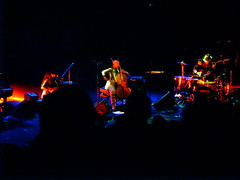
Anyway, the Queen Elizabeth Hall in front of an audience who are mostly waiting for someone else who they've actually heard of to come on is of course a very different proposition to headlining at the Windmill, and Rasputina seemed at first here to be pursuing their more explicitly "chamber" side at first, easy on the pedals and steady on the tempi, less of the banter. Something seems to gel when "Saline the Salt Lake Queen" appears and I think by the end they won over some of the unconverted at least. It was a good performance, although it was never going to be quite as special as standing mere inches from the band in a small room. The two audiences remind me of the two Londons; one intimate, friendly, eager; the other cosmopolitan, standoffish, reserved. They're a great band, as individual in their way as is the headliner, and I hope they'll be back on these shores before very long, and welcomed by an increasing crowd (although a selfish part of me would like that crowd to be small enough to fit in the back of a pub).
I could mention Syd Barrett and Vivian Stanshall and that whole pantheon of English eccentrics and surrealists he belongs to, that stretches back way beyond Dali and his ilk to the real origins of surrealism, Edward Lear and Lewis Carroll. But building up a legend isn't really what he's about. it's mostly quiet, unassuming music that doesn't need to declare its worth, and is all the more affecting for it. There's a simple joy that's easy to hear, much harder to put across effectively, the art that's all the more artful for its apparent artlessness.
Addendum: a man like Robyn H attracts a certain level of punter, among those present was none other than Nick Lowe. And Adam from TV's Adam and Joe. Which is quite exciting. But not as exciting as Nick Lowe. Sorry, Adam.
Tuesday, January 29, 2008
Between thought and expression

Rasputina (Windmill, Brixton)

First, though, we have rayOn (eccentric typography preserved here, I've got a soft spot for that sort of thing). They start off lively, but before the first song is over the guitarist's broken a string. They do what has to be done: make a bad pun about their "rocky" start and play a slow number to give him a chance to replace it (although it'd have been more fun to make do with five strings. After all, George Formby managed with four). I like this band. Back in Birmingham we have a grand tradition of fabric-monikered bands (Felt, Denim*) which immediately warms me to them, and they play a fun set. They're not going to set the world alight, but they look a bit long in the tooth to be seriously entertaining thoughts of rock 'n' roll stardom, and you know what? Sometimes being a decent band in the back of a pub is enough.
Rasputina really could be playing somewhere other than the back of a pub (the girl I'm next to and I are both surprised that we're seeing them here rather than the Brixton Academy, and in fact they'll be at the grander surroundings of the QueenElizabeth Hall tomorrow night, supporting Robyn Hitchcock), but I'm very glad they're here, because there's a cosiness in a small venue you'll never get anywhere bigger, and Melora's dry wit goes down well in an intimate setting like this. American bands always seem to do things like banter much better than most British groups, maybe they just have a better tradition of playing to the audience to draw on than we do. Rasputina have an arrestingly individual aesthetic, and all the bucketloads of charisma necessary to bring that to life on stage, Melora and Sarah's voices and playing perfectly attuned, Melora's between song chat is very funny, and the whole thing is ably underpinned by Jonathon's driving drumming. (Incidentally, and utterly irrelevantly, Jonathon is really, really tall. I kind of expected him to look as he does, like Alan Moore might have done if all those years ago he'd decided to research Swamp Thing by going to live on Gumbo in a Louisiana swamp, but I really wasn't prepared for his remarkable distance from the floor.) At one point They launch into a heartfelt tribute to Sir Mixalot, which touches all our hearts.
You wait ages for a rocking cello band to come over from America, and then they do do two gigs at once. And even before the second, I'm already hoping it won't be too long before they're back here again. And if it does all come to nothing with the band (heaven forbid) Melora's got a bright alternative future in stand-up.
*Felt and Denim are arguably two manifestations of the same band, which would make this a grand tradition of one.
Sunday, January 27, 2008
Scaledown, King & Queen, 25 January
Good intentions butter no parsnips, I'm told, and having determined after the last time I went to a Scaledown night to get along to another really,really soon, I find myself here, almost exactly a year later. So much later, in fact that one of the acts tonight is making a return visit to the Scaled Down world. Still, I made it eventually, and this year I'm definitely going to get along to another one in less than a year's time.
So anyway, this time we had another varied menu of sounds. It's the sort of evening where you're unlikely to like everything, but you're bound to like something, and so it proved. After the customary turn by hosts Mark Braby and Andy Coules - a unique take on "Smash it Up" by the Damned - we have some entertaining spoken word stuff from saxophonist Mark Norton, of which the funnier poems are the better, not a million miles from John Hegley territory. 

Finally is John Ellis, former guitarist with the Vibrators and the Stranglers, whose pedal and ebow-driven guitar noodling just didn't really do it for me, I'm afraid (and that's mild compared to what my companion said. She really didn't like it). But it doesn't matter, because I heard plenty of stuff I did like, and had a good time. Which is of course what it's all about.
The next Scaledown's on 22nd February, and I'm going to be there, definitely, honest.
I did take pictures of everyone, by the way, it's just they didn't come out very well. It's difficult taking photos in a dark room without a flash.
By the way, the Scaledown boys have moved into the world of recording, and I picked up their first release, a lovely 7" single by a band called Pocket. Get it at the Orchestra Pit.
Friday, January 25, 2008
Och aye!

To A Mouse.
Wee, sleekit, cowrin, tim'rous beastie,
Thou need na start awa sae hasty
Thursday, January 24, 2008
The Great and Good
There's a strange thing in classical music, I suppose because it leans on the past more than any other art form, of an insistence when talking about composers talking up their "genius". It's perfectly possible to talk of, say, Dickens as a great novelist while acknowledging his faults (all that sentimental Tiny Tim nonsense, for example), but we like to keep quiet about the second rate pieces Beethoven churned out amongst the jewels (such as the rotten Battle Symphony) . It's as though we're scared that if we admit any weakness in our musical gods, the entire edifice will come crashing down around our ears.
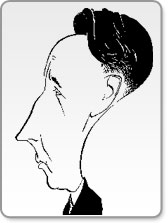
Martinů is a really good (and underrated) composer, and amazingly consistent for someone so prolific, but he's not a Great Composer. I think this is something to do with the fact that he's almost completely uninfluential (there's no "Martinů School" trailing in his wake), but also to do with an attitude, or lack of it, on his part towards his craft. He wrote well crafted, attractive and moving music, but there's never really a sense of him really trying to stamp himself onto history or change the course of his art for anyone but himself. He just tried to write good music.
This makes me stop and think, what do we really mean by a "Great Composer"? The whole idea of the Artist making a Statement begins with Beethoven (of course), which means that Bach, Haydn and Mozart (to pick only the 3 most obvious names) aren't really Great Composers, because the concept didn't exist for them. Significant, influential, great even; but not Great.
A Great Composer doesn't have to be a good composer; in fact I wonder if the two are very compatible, as it's entirely possible for a Great Composer to be a dreadful composer (Berlioz springs to mind, and Wagner - these are my prejudices, of course, you may have your own candidates for bad Great composers). even Beethoven, a Great composer who's generally also a good composer, sails pretty close to the wind - the 5th, 7th and 9th symphonies are exercises in increasing self-importance and bombast, and I maintain that after the astounding opening 30 seconds or so of the ninth, it's downhill pretty much all the way. But in the face of Greatness, quality's a secondary consideration
The line runs out almost exactly 200 years after Ludwig van, with the death of Stravinsky in 1971, and then the demise of Stockhausen at the end of last year; the Great Composer is essentially an idea of the 19th century that lingered through the 20th, and with the decline of so-called- classical music as a vital force rather than a museum, it's an idea whose time has gone. Which is not to say there aren't some great composers out there still, but are there really any Great ones?
Wednesday, January 23, 2008
Blind vision
Well, the concert went very well yesterday. (This bloke was a bit sniffy about it, but what does he know? He's just some bloke on the internet, and we all know what their opinions are worth.) Cadogan Hall proved to be a very convivial venue, and we'll definitely be returning there. Unlike the Queen Elizabeth Hall, unfortunately. We've played there regularly over the years, and hoped to do so this month too, but after much dogged pursuit of a date, we were told that we couldn't be guaranteed a date due to all the other things in store for January, and finally that KSO doesn't fit in with the South Bank's artistic vision, although they might consider at some point putting on some sort of festival of amateur music making, in which case we might be lucky enough to be invited to take part. Pretty much told to bugger off and stop bothering them, really.
Now, I could argue against the idea that an organisation like KSO has no part in the artistic vision of somewhere like the SBC, but if they feel they've already ticked their boxes for classical/orchestral/amateur performance without us, that's their loss. But the fact is that of the 31 days in January 2008, 21 are dark at the QEH, and you have to wonder what kind of artistic vision sees itself as so important that it's better to have a publicly-funded venue empty than to have a respected amateur band like KSO in it. This is not vision, it's an obscenity, and someone needs to start asking what the hell is going on. This Grauniad article from 2006 profiling artistic director Jude Kelly (one of a large number of plum arts jobs she's landed) gives a worrying picture of how she thinks, all bland meaningless buzzwords and platitudes unencumbered by any concrete ideas, and from what I gather talking to various people involved in performing arts at all sorts of levels, there seems to be a feeling that while she is very insistent about what doesn't fit in with her "vision", no-one seems to be able to say exactly what, in any definite terms, that vision is.
If you go to the SBC website and click on "Venue hire" (right at the bottom, not very obvious), you see this:
As well as being a world-class arts venue, Southbank Centre has a variety of auditoria, rooms and spaces that can be hired for a wide range of events, including conferences, AGMs, product launches, graduation ceremonies, receptions, dinners and weddings.
Nothing about concerts or anything like that, you'll notice.
Dark nights and wedding receptions. Is this the bold artistic vision driving the South Bank Centre?
Tuesday, January 22, 2008
Chasing the blues away
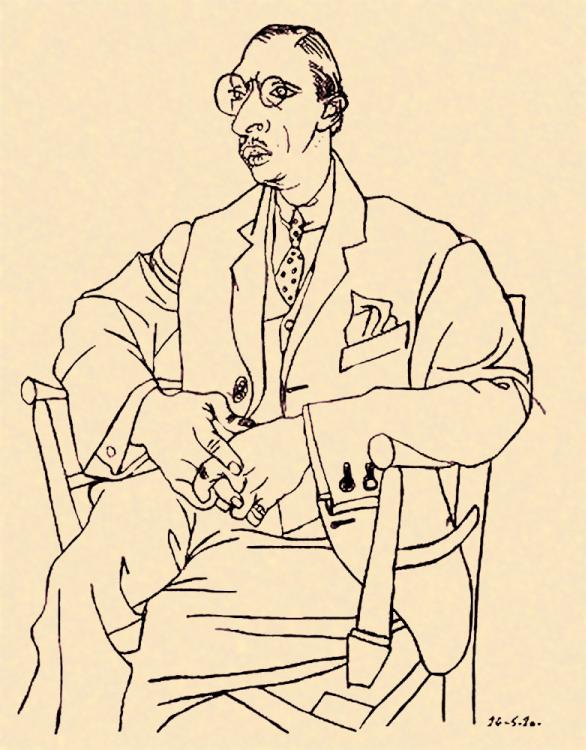
Among the pieces written in response to Henry Prunière's call for contributions to a supplement to the Revue Musicale in 1920 to commemorate Debussy, who had died in 1918, one stuck out: where most of the contributing composers (including Falla, Bartók and Ravel) responded with conventionally threnodic or wistful miniatures, Igor Stravinsky offered a cool, austere chorale, bearing the title: "Fragment des Symphonies pour instruments à vent à la mémoire de Claude Achille Debussy".
The complete work, to which this fragment forms the conclusion, in fact has its origins in sketches Stravinsky had made in 1919, while the opening motif was noted down on March 26th, 1918, just after he had learned of the death of Debussy the day before. Most of these sketches indicate that Stravinsky's original intention was to score this music for strings and harmonium, and it seems that they did not find their final form as wind music until much later on, the unrefusable request for a memorial to Debussy providing the final push Stravinsky needed to realise the work's definitive form. As the pluralisation implies, "Symphonies" is not used to denote anything like a conventional classical symphony, but rather harks back to the word's earlier meaning as a generic term for ensemble music (from the Greek "syn" [together] and "phone" [sound]).
The dedication is at least partly ironic; while Stravinsky and Debussy were friends, their relationship was characterised by a certain friction, attributable on Debussy's part to jealousy at the greater fame Stravinsky had achieved, and on Stravinsky's side to resentment at the older composer's occasionally condescending attitude. Debussy did not approve of the more cosmopolitan style that the Russian had been experimenting with, writing to him in 1915 to say;" Cher Stravinsky, you are a great artist! Be, with all your energy, a great Russian artist! It is a good thing to be from one's country, to be attached to the earth like the humblest peasant!"
Stravinsky, however, was by the time of Debussy's death determined to put as much space as possible between himself and his roots. Any hopes he may have entertained about returning to Russia were destroyed after the Bolshevik Revolution in 1917, after which his modernist style made him persona non grata with the new regime, and it is surely not coincidental that within 2 years he composed Pulcinella, the work which effected a seismic shift in his career, rejecting the Russian folkloristic style that had characterised his greatest successes (not least the Rite of Spring) in favour of the ironic, distanced world of what would become known as neo-classicism. The Symphonies of Winds therefore stands as the last recognisably "Russian" work he produced until the Requiem Canticles some 50 years later - shortly after he visited Russia for the first time since the First World War.
This all goes deeper than mere stylistic turns, though. The structure of the Symphonies, hailed in its early years as something radical, in fact is related very closely to the Russian Orthodox burial service, to the point that one can virtually superimpose the prayers of the service onto the melodic lines that weave their way through the work's short, but intense path. It may be that this work is intended as a burial, not only of Debussy, but also of Stravinsky's own identity as a Russian composer.
Thursday, January 17, 2008
Torchwood in "not shit" shock
It's amazing what incredibly low expectations can do.
By the end of the first series of Torchwood (that's series. Seasons are something they have in America) I'd passed through some kind of cosmic irony barrier and was starting to enjoy it for just how unremittingly awful and laughable the whole charade had become. So series 2 was never going to have to do very much to improve in my eyes, and pie-eyed sucker that I am, I decided to give it another chance.
And good lordy, it turned out to be rather enjoyable. Mainly I think because they've decided to ditch the teen-angst vibe and get funny. there were many good gags in the first episode, not a few of which seemed aimed at the weaknesses of the first series. The whole thing's still ridiculous, and paper-thin, but it now has a healthy sense of its own daftness, and is infinitely more watchable because of it. it also helps that the team now actually appear to be operating as a team, and to have some kind of affection for each other and be vaguely likeable as characters. And that Captain Jack now appears to be more or less the same character as he is in Doctor Who. Having Spike out of Buffy as a guest star (out-gaying John Barrowman, which is quite some feat) helped as well. Although the relentless attempting by everyone to get into everyone else's knickers is gong to get very tired very quickly. But all in all, it was quite good fun.
Of course, the first episode of the first series was quite good fun, and look how that turned out, so there's still plenty of time for everything to go tits up. Still, next week we have the prospect of the lovely Freema Agyeman and Jim out of Neighbours to look forward to, so fingers crossed they manage to keep it up (fnarrrr!).
Wednesday, January 16, 2008
Faceoff
So, I deleted* my Facebook account. Not just because Facebook is evil, but that's certainly an element. It's also because I'm bored of it, and because I find the "gated community" element disturbing, the curious mixture of shut-off clique and utter contempt for its users' privacy.
Of course, it's not the only evil thing in the world. Hell, MySpaz is owned by Rupert Murdoch, and I haven't felt the need to disappear from that, maybe because I can see that there's a useful purpose to that in keeping up with the kind of small-scale bands I like to keep an eye on. Facebook at best seems only to do something I'm perfectly capable of doing myself - keeping up with friends - and at worst a substitute for it. And of course since it rocketed in popularity it's become a haven for bored office workers to arse about. I think I decided it was over when I started to get fictional characters adding me as a friend. that's usually a good sign.
*I say "delete". Actually, I only "deactivated" it, because it's not at all obvious that it's possible to delete it. Which sums up the sort of totalitarian control Facebook exerts over your personal information.
Tuesday, January 15, 2008

Monday, January 14, 2008
Hooray for Radiohead!

So many hearty cheers for the lovely people at Radiohead's online shop, who were very kind and helpful and have sent me a replacement box which now sits enticingly by the hi-fi, waiting for me to get the vinyl out and give it a spin. Good, heavy vinyl too, none of your flimsy rubbish. It was great today to hear the album on CD, the better-than-the-download sound quality makes it glow.And the CD of extra songs is great as well. All in all it's a very beautiful object, definitely worth the 40 quid, and you won't be disappointed if you order one yourself while they still have some left.
I've written before about the possible impact the "honesty box" release of In Rainbows might have on the record industry, and it's wonderful to see them leading the way through the innovative method of being nice to their customers beyond what's strictly necessary. I'm a very happy bunny, for once.
Wednesday, January 09, 2008
How Pop Music Works
Oh, Charlie, Charlie, Charlie. Don't you look fashionable in your unbuttoned shirt and Converses? Look at you, grooving to "Tomorrow Never Knows", nodding sagely to Joni Mitchell, telling us how great Imagine and Bohemian Rhapsody and Wyclef Jean are, making it OK to like pop. Well, you know what? I don't need your patronising waffle to justify listening to anything. I don't need you pinning songs down like butterflies.
The thing is, there are some interesting people on this programme, with pertinent things to say about what makes a great pop song. But why do we have to put up with you bringing your relentlessly average thoughts to bear? It's bad enough that you're becoming ubiquitous in the field of classical music on telly, a middle aged, dressed twenty years too young television producer's wet dream of half-arsed ideas of "accessibility" and "relevance". Why do you have to ruin pop as well?
Bastards
The very excellent Supergrass are playing a "secret" gig at Barfly in Camden this evening, showcasing songs from their new album. Unfortunately I'm not going because the bloody bastard underground's up the spout. Bastards.
The internal post at work has lost my Radiohead discbox. They're bastards too. Bastards bastards bastards.
Oh well, back to the drawing board, then.
Monday, January 07, 2008
I'm Not There

There can't be anyone alive who's been so mythologised as Dylan, to the point where he hardly seems like a real person. For years he's fought against his own legend - I remain convinced that all those notoriously, um, wayward performances and records from the 70s until the 90s represent him trying to destroy Bob the Legend. Then, when he realised that being a shambles only reinforced the myth, he resigned himself to his status, and decided not to worry about it, after which we got the wonderful trilogy of albums of the past few years, the delightful Theme Time Radio Hour, and Chronicles, all of which showcase a Bob apparently more at ease with himself than he's seemed for years.
So what we get in this film isn't any kind of conventional biography. Instead there are 7 different characters, all standing in for various aspects and periods of Dylan's career and persona: a young black kid trying to fake his way through the blues, a young Rimbaud obsessive called, er, Arthur Rimbaud; an earnest young Woody Guthrie-a-like; the iconic super-hip sharp talker of the mid-60s (played by a woman); an actor with a failing marriage; a born-again preacher; and a country hobo who turns out to be more than he seems.
None of these personae presents any accurate depiction of events; this is clearest in the "60s" Bob, where events documented on film are presented in versions that play up to the mythology of what happened. Cate Blanchett's astonishing turn as "Jude Quinn" is the only one of the seven Dylans that is pitched as an impersonation of him; these are intended as archetypes that resonate with one or more perceptions of Dylan and his work. Even Blanchett's performance is more myth than reality, and comes across as the one attempt to "do Bob" more because Dylan's 60's image is one that rock stars ever since have appropriated in an attempt to seem sharp.
If you try and fit the film to the life too closely you'll end up frustrated. I'm reminded to some extent of Burrough's later work such as The Place of Dead Roads, where one character plays out his story in multiple times and dimensions. I suppose in a way one of the major themes of this film is the impossibility of nailing down who Dylan is or what he represents. At the end of the film, as Richard Gere rides off on a train, strumming one of his younger selves' guitar, perhaps a nod to Dylan's recent work, where he's become for real the great bluesman he started of pretending to be, we finally see Dylan himself, in a piece of footage from a live concert. He doesn't sing, he just blows his harmonica and strums his guitar, inscrutable and unreachable, and strangely peaceful. It's a moment that, like a lot of this film, lingers in the mind long after the credits have rolled. Maybe it shows what Dylan himself has always insisted: whatever roles and significances we may try and pin to him, he's really just a song and dance man.
Whether it's a help or a hindrance to know a great deal about Dylan before you watch this film I'm not sure. It'd be interesting to hear the views of someone who knew next to nothing about him
Friday, January 04, 2008
To travel hopefully is a better thing than to arrive
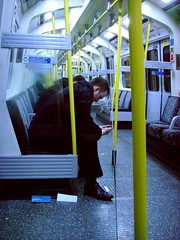
I spend my tube journeys reading Will Self's Psychogeography, which chimes with my own feelings about travelling round on my bike: the sense of place that you don't get underground, rushing about at the commuters' pace. The other London, hidden beneath roads and rails, on towpaths and riverbanks.
Monday, December 31, 2007
List fatigue
Well, did you have a Happy Christmas? I did: thanks to the relentless plugging of my Amazon wish list to all and sundry I ended up with a bunch of presents I actually wanted, we managed to slim down the commitments and travelling so that it actually feels like we've had a holiday, and now I'm looking forward to a cosy New Year's Eve with a shepherd's pie and a bottle of fizzy booze.
So now's the time of year when we all make up big lists of what we liked in 2007, isn't it? Top Tens, all that. Well, I thought about doing that, but you know what? I'm not going to. I've written about most of the things I've liked (and not liked) here at some point over the year, so if you're really interested in what I think you can spend a while browsing through the last 12 months' posts.
And anyway, why make lists? Of course, being a boy I spent a fair portion of my youth drawing up lists in the semi-autistic way that boys do; top ten records, TV programmes, films, books, gigs, and so on. But now it all seems so pointless and arbitrary. Why try to make value judgements between, say, Radiohead and Bill Callahan? How can I choose which goes higher up my book list, Ulysses or Strontium Dog Case Files Volume 3? Can I say that Vialka were a better gig than PJ Harvey? Did I enjoy either more than the other? And isn't whether I liked something just about the least interesting thing I can say about it anyway? And haven't there been way too many rhetorical questions in this paragraph?
So, no lists here*. Because it's all worthwhile. The good things (such as those mentioned above) and the bad things too, because the jewels stand out all the better for the shit thy float in. Because what I may say is my favourite today may change tomorrow. Because lists attempt to set in stone something that is, and should be, fluid. Because a butterfly is more beautiful fluttering than pinned to a board. And experience changes every moment.
And may I wish you a happy new year, and more of it in 2008, whatever it may be.
* I did briefly consider doing a list of the best lists I've read. But that would be too much smart-arse wankery, even for me.
Tuesday, December 18, 2007
The hibernation period
 It's that time of year again, when things wind down and we prepare for the traditional season of over-consumption (albeit under the shadow of looming deadlines and commitments, as ever). Have a Merry Christmas, thank you for reading (there are definitely some of you out there) and see you the other side of the holiday.
Monday, December 17, 2007
Removing the safety net
Alex Ross (whose excellent book The Rest Is Noise I'm reading at the moment) calculates that today is the centenary of atonality. This of course is something you can argue about until the cows come home, and is probably a bit arbitrary, but I like the idea as today is also Beethoven's birthday, and happenstance always appeals to me.
Beethoven these days is rather less controversial than he once was, but atonality still has a power to annoy, which pleases me greatly, as those who get annoyed are on the whole small-minded people who deserve to be annoyed.
Atonality has a special significance for me, as it was those school exercises in listening to and repeating an atonal melody, and later writing one (which I found quite easy to do, despite its being trailed as a more difficult exercise than the similar tasks we were given with tonal melodies) that really first put the idea in my head that composing wasn't necessarily just practised by dead people, but was something I might have a go at myself.
Schoenberg didn't actually like the word, preferring to talk about pantonality. It's a significant distinction, as it makes it about extending and enriching something rather than removing it, which is what you can hear happening in Schoenberg's music leading to his break with key signatures. It was something that was in the air (Schoenberg wasn't the only composer moving in this direction), but he was the first to stand up and say what he was doing (and more importantly the first that anyone took any notice of). It wasn't the action that was radical, so much as speaking its name.
Sunday, December 16, 2007

Saturday, December 15, 2007

Friday, December 14, 2007
What's next?
Once upon a time composers were artisans, servants like any other. Composing was part of musicianship; all composers performed and most performers composed. Then Beethoven came along and suddenly composers were Artists. Beethoven went deaf and was forced to retire as a performer, and thus was born the Great Composer, the mystic sage who came down from on high bearing the Score, which the musicians then dutifully followed.
This was the end of the Classical style, and the beginning of Classical Music - the canon, the tradition, the myth of the unbroken line inexorably moving forward through history: Beethoven, Wagner, Mahler, Schoenberg, Webern, Stockhausen... at the turn of the 19th and 20th centuries Mahler codified the rituals of concert-giving and going, and the Classical Concert became a quasi-religious ceremony. The composer was a Shaman, exalted and separate.
Stockhausen is dead, and with him dies the Great Composer. We no longer believe the march of that history. Our history is messier, less sure. It seems to me that the music of the future will most likely be collaborative; the roles of composer and performer will merge again, we will all become composers, all performers. There are plenty of talented composers writing fine music (and even more untalented ones writing bad music - and who may judge which is which?), but there are no more Great Composers, and there may never be.
We shouldn't mourn this. This is simply the way things are. Creativity is being democratised, and there is no longer a place for the shaman. Music is not a god to be worshipped. It's not a product to be passively consumed. It is an activity to be participated in, a means for people to come together. There will be new music, and some of it will grow from his ideas, but Stockhausen is part of another time. What's next? We shall find out.
Thursday, December 13, 2007
Stockhausen is dead
But didn't he die a long time ago? What about the people I overheard in Huddersfield in 1996, dismissive and contemptuous of pretty much anything he'd written since the 70s? Wasn't he regarded as someone who'd long since ceased to be worth paying attention to, who'd disappeared down a path of self-indulgent, egomaniacal mysticism? I used to hear such opinions regularly. The he died and no-one wanted to say that anymore.
I was thinking more about that Brian Eno interview, where he suggested that he was more interested in Stockhausen's ideas than his music. Is the actual music so ungrateful? John Humphreys lapped up any suggestion that you wouldn't want to listen to it, of course. Personally I never found his music that hard to listen to. Thorny, certainly. But those people in Huddersfield were berating him for producing music they regarded as too accessible, too easy on the ear, too melodic, not confrontational enough.
So, to the avant-gardists (or at least former avant-gardists; is there actually any such thing as an avant-garde anymore?) he's frozen in amber, a figure from a long time ago, when giants walked the earth. To the anti-modernists he's the bogeyman, the frightening creature under the bed who ruined it for everyone, who can't be buried quickly enough. There's precious little room for Stockhausen himself, underneath all the opinions about him. Either way, there seems to be a consensus between the two poles that he's a figure of the past, whether a past you wish to revive or to bury is up to you to decide.
To the vast majority of people, of course, he means absolutely nothing. Innovation, adventure, risk; these are qualities that find little resonance today in our lowest common denominator Tesco world. Is Stockhausen dead? Did he ever live? The avant-garde is no longer the terrible threat it once was, not something to be railed against, just a curiosity, maybe worth a snigger, then brushed aside. Not relevant. To many people it never was, if they even stopped to think about it, or even became aware of it, however briefly.
Stockhausen is dead, and all we have left is ourselves. And what shall we do with that?
Wednesday, December 12, 2007
Immortality
Is an idea enough to ensure a name survives? So much talk of Stockhausen's ideas; comparatively little of his actual music. And yet it's the music that matters. Isn't it? What are the ideas worth if their worth is not found in their expression? For myself, the ideas were a barrier, not a path. Not the ideas of Stockhausen himself; rather I mean the fog of ideas that other minds smothered him with. The talk of technique, of ways and means, the impression that nothing less or other than a total mathematical understanding of construction could be any help in understanding his music. A path to understanding that instead led to darkness, fear and confusion. And then the revelation of the actual music. The realisation that all this waffle was just that, and clearing that aside left the music itself standing gleaming, not turning the listener away or demanding penance, but welcoming and inviting. No need for analysis or deconstruction, only a willingness to listen. "Don't give me ideas, give me sounds."
Ideas matter. A disciplined, committed approach to one's art is necessary. Because if one does one's job properly and thoroughly, it should be easy for those that listen to the result, if they have the inclination.
Stockhausen was a great font of ideas, and a great philosopher of sound. But we should not let ourselves forget that he was firstly a Great Composer. Perhaps the last one. Is that enough?
Life on Sirius
Tuesday, December 11, 2007
Posterity
A lot of people, including me, have pointed out the influence Stockhausen had beyond the supposedly marginal constituency he occupied. (You can hear Brian Eno discussing this with John Humphreys on Today at The Rambler. Eno is as considered as you'd expect, Humphreys is as ignorant and simplistic as you'd expect.*)
But is that really the most important thing? No Stockhausen, no Radiohead? It's very odd, the way so much of the coverage of his death that tries to express his importance takes this tack. The man who fearlessly pursued his own path, regardless of whether anyone followed him, remembered in terms of commercial success by others.
What about the integrity, the single mindedness, the spirit of exploration, the willingness to pursue an idea?
*By the way, Mr Humphreys, the last time I went to a Stockhausen gig it was sold out. So there.
Monday, December 10, 2007
Arrival
Give up everything, we were on the wrong track.
Begin with yourself:
you are a musician.
You can transform all the vibrations of the world into sounds.
if you firmly believe this and from now on never doubt it,
begin with the simplest exercises.
Become quite still, until you no longer think, want, feel anything
Sense your soul, a little below your chest.
let its radiance slowly permeate your whole body
both upwards and downwards at the same time.
open your head on top in the center, a little towards the back,
and let the current that hovers above you there, like a dense sphere
enter into you.
Let the current slowly fill you from head to foot
and continue flowing.
Quietly take your instrument and play, at first single sounds.
Let the current flow through the whole instrument.
Whatever you want to play, even written
music of any sort, begin only
when you have done what I have recommended.
you will then experience everything on your own.
before you play, you may let your thoughts
run free, you may train the muscles
of your fingers, of your larynx, etc.
But now you know what you think and train for,
and even the thinking and training
will be completely new, completely different from before.
Nothing is as it used to be.
as long as you retain this consciousness,
everything you do will be right and good.
excerpt from Aus den Sieben Tagen, by Karlheinz Stockhausen. © 1970 by Universal Edition.
Sunday, December 09, 2007
Idiots attack other idiots
The Observer today features an attack by director Tony Palmer on the BBC after he received a rejection letter demonstrating some quite spectacularly slack-jawed meejaspeak drivel. This sort of thing should rightly be lambasted, but before the Observer gets on its high horse it might like to double check such things as what a symphony is, which isn't The Lark Ascending, or indeed the Fantasia on Greensleeves. The fact that the same paper goes on to feature this witless tribute to Stockhausen, which seems to think his greatest contribution to music was "realising that Wagner was rock 'n' roll", in a section featuring a large photo of Simon Cowell on the front, says quite a lot about the Observer's cultural priorities.
Karlheinz Stockhausen 1928-2007

I can't, of course. Stockhausen's influence is so profound that entire movements define themselves by opposition to him (or at least their idea of what he stands for, which is generally wrong), so pervasive that you often don't even realise it's there. Half the music in the charts owes something to him, even if its creators don't realise it.
But there's more to him than just an outré name for art-school graduates to drop. Stockhausen's music carries with it ideas about the space created by sound, both literally and figuratively, that have profound consequences for our understanding of our relationship with music, with the people who create and perform it, and those who listen to the results.
What struck me most the first time I heard his music was how approachable it was. His name had such a fearsome reputation, and the texts written by the greybeards who propagated his cult seemed obfuscatory and impenetrably complex and cerebral. But the actual music isn't like that at all. It's visceral and playful, and filled with wonder at the possibilities of sound. To hear the man himself introduce his music was to have all the fog lifted. He used complex methods to produce his scores, but, he insisted, it wasn't at all necessary for the listener to worry about the method. All the listener has to do was hear a sound, then another, and another, and follow these sounds as they grew and changed through time and space. Whether it's the literally visceral approach to the piano he takes in his Klavierstücke (one of which hangs on my wall) or the quiet spirituality of Stimmung, or the grasping of space of Gruppen and Sternklang, his music always seems to me to speak directly and immediately, in a way that isn't always recognised. He was feared as a terrifying, complex and forbidding composer, but I always found the reality simple and instinctive and wonderful.
I encountered him three times, and not once did I pluck up the courage to speak to him (although I'm pleased to report that on two of those occasions he was wearing his famous orange jumper). I remember once in Huddersfield seeing someone go up to him and expound some long, complicated theory as to what had happened to the characters in one of his operas after the end, and whether Mr Stockhausen could confirm whether he was right? Mr Stockhausen replied, bemusedly, that nothing had happened to them, as that was the end of the opera and they were fictional characters.
I wish I had spoken to him. Just to say how much I loved his music; its humanity and its wonderful directness. Stockhausen wasn't a difficult composer, whatever anyone says. In many ways he was as straightforward as anyone could be. It's just difficult to explain ideas as big as his. Far easier to understand them. What I take most of all is a sense of endless, boundless possibility.
Friday, December 07, 2007
Tabula Rasa

Thursday, December 06, 2007
Sound vs. Noise 6: I do not whistle a happy tune

Whistling is to me very nearly as annoying as the tinny scratching of someone else's personal stereo gouging at my eardrum. That comes simply from a person being a thoughtless twat - I suspect most of the i-Podded different drummers crowded onto the morning tube have somehow managed to convince themselves that they're not playing their music that loud and no-one else can hear it - but to whistle requires a conscious decision to foist your sound on others.
Many years ago, in another job, in another city, there was someone at work (isn't there always?) who was in the habit of whistling. he whistled in that especially irritating old man's style, which was inevitable, I suppose, given that he was an old man. Now I am in a different job in a different city, but still there is someone at work. Although he is younger than my previous irritant.
Apart from the inherent high-pitched annoyance of the tone of it, the whistler is nearly always notable for the paucity of his repertoire, sometimes not even getting to the end of a single tune, but repeating the same four or five-note phrase over and over, like a concussed budgie. The addition of monotony only furthers the pain.
Of course, being English, I'm far too repressed to jump up, make a grab for the offender's throat and throttle him wildly, while shouting "SHUTUPSHUTUPSHUTUP!" I'm so inhibited I probably wouldn't even do it if he weren't my boss.
So I do what I must - I retreat into my headphones and hope whatever I put in the CD drive of the PC can be turned up loud enough to drown the tweeting awfulness of it all. Of course, I can d this, because it's not that loud, and no-one can hear any leakage from my headphones, can they? And so the cycle goes; man hands on misery to man.
Wednesday, December 05, 2007
Record company in good idea shock

Sunday, December 02, 2007
Late Starters
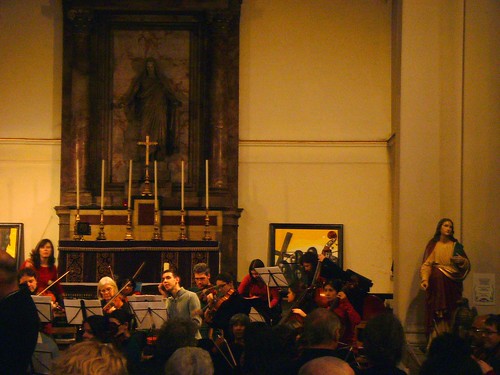
I've been playing the cello for over 30 years now, and composing nearly as long, so I ought to have some sort of handle on how this music lark works by now. But not everyone is as lucky as I was as a kid to have access to the wherewithal to pursue it, and the way music education is going there'll be even fewer in the future, so organisations like the East London Late Starters Orchestra are doing something very valuable. The idea is that people who've never had the opportunity to learn an instrument, or perhaps learned as a child then abandoned it for years, can have the opportunity to pick one up and have a go.
It's not really about the result (although of course all involved want to play the best they can), but about the act of getting up and doing it, I think; some of the players I hear had never touched an instrument until a couple of months ago, and to stand up and perform in public after that short a time takes a huge amount of guts, much more than I have certainly. And it also makes a statement that classical music isn't something obscure or difficult, to be the preserve of a few, but something that anyone can have in their life, if they want it.
There's such a strong vested interest in the music industry from professional bodies, record companies and the like that wants to promote music as a product to be passively consumed. This is so wrong. Music is an activity, something to be participated in, something to do, and it's this idea that really makes projects such as this important, not worrying about the "excellence" that ministers like to talk up (translation: leave it to the professionals, sit back, consume, buy, buy, don't think, BUY) but revelling in the act of creating it. Music's a social force, and that's what I bring away more than anything from this evening. There's little division between performers and audience; there's a unity of community, a joy and pleasure in the gathering together and the sharing of a moment.


