Monday, July 21, 2008

Folking about: Proms 4&5 (RAH and Kensington Gardens)

A day devoted to folk music has been sneered at in some quarters, but I think it's absolutely right that the Proms should do this sort of thing, not least because the SCCM* scene could take instruction from the folk scene: a small, minority interest that for many years seemed threatened with extinction at the hands of indifference, a perception that this was a dead or dying genre with nothing to say of any relevance to the modern world, and well-meaning but misguided fundamentalism on the part of some of its most zealous advocates. Sound familiar?

We sauntered into Kensington Gardens at lunchtime to find the Folk In The Park mini-festival in full swing; scratch choirs and orchestras merrily hacked their way through some choice tunes, if to slightly limited effect to those of us who weren't right at the front (but that's open-air singing for you), while nearer to my eyes and ears some Morris Dancers did their stuff. Morris Dancing's had a terrible press over the years, unfairly I think, which I suppose is down to the general public's desensitisation to the point where jumping over each other with bells strapped to your legs and whacking clubs together can't substitute for actually getting your cocks out and waving them about. A shame, because in the right hands (stop it) it's a raucous affair with a healthy lack of reverence for its own traditions. I hadn't realised what a major part of it all was having the musicians hurl abuse at the dancers. The climax to our outdoor sojourn was a short set by Bellowhead (of whom more later).

The clouds began to cover the sky, so it seemed fortunate that it was time to head over to the Albert Hall for the first concert of the Proms's first Folk Day (the way they went on about it, you'd think folk hadn't existed before Roger Wright decided to bring it to South Ken, but I shall not continue in this measly-mouthed vein, as I come to praise the Folk Day, not to bury it).

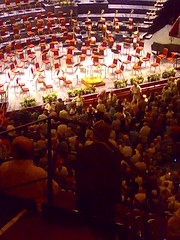
This was a bit of a hodge-podge of a concert (rather as the First Night was): We began with an a Capella turn from the excellent young singer Bella Hardy (of whom more later also) which then segue into a performance of Vaughan Williams' English Folk Song Suite by the Royal Northern College of Music's wind band. Being an afternoon concert, and hence rather more al fresco than your normal RAH affair, there was a smattering of applause after the first movement, which obviously utterly confused the lighting technicians, as the stage then went dark, then after a while the lights went up, but on the wrong group, and finally the RNCM were given back enough illumination to continue. They played very well, too.

The other group was the London Sinfonietta, which now lit up a second time to play for the first time: a couple of Percy Grainger arrangements. Grainger's a fascinating figure in the history of the folk revival, and undoubtedly we owe him a great debt, but his arrangements outstay their welcome and come across now as an eccentric curiosity. Then, after another turn from Bella Hardy, they were joined by Monica Bacelli for a performance of Berio's Folk Songs, the work he composed for his sometime wife, the late, great Cathy Berberian.

These are wonderful arrangements, subtle and glowing. They're also completely lost in the cavernous Albert Hall, and especially after the (miked) Hardy, the (unmiked) Bacelli) came across as distant and affected. She's a fine singer, but fell between the stools of not sounding folky enough, yet also sounding less convincing in her theatricality as Berberian would (a problem anyone's going to have in this work). The audience was getting restless, and that didn't really help. So all in all, this first half ended with proper folk:1, art-folk 0.

The second half began with Folkestra, a group of Northeastern young players organised by Katheryn Tickell, who turned out to be largely the flowery-dressed young lasses we'd had standing next to us in the first half. They play beautifully, and have an easy-going air about them that doesn't however distract from the evident care they put into their performance. And they had a clog-dancer, which is always a good thing.

For me, the highlight was the next act: Muzsikás, a quartet of Hungarian fiddlers who played a selection of traditional tunes with an energy and authenticity that was a marvel to behold. The audience began clapping along spontaneously, and I realised that what I really wanted to do was listen to this lot all evening, preferably in some small Eastern European bar. This was something quite startling: folk music, not reconstituted and revived, as English folk of necessity is, but a living tradition, ancient and yet utterly contemporary. They then joined forces with the London Sinfonietta for a performance of Bartók's Romanian Folk Dances, the classical ensemble alternating with the folk one, presenting their own versions of the dances, then coming together for the finale. This was a stunning performance by all involved, an entirely successful coming together of the art and folk strands of the concert. It also confirmed the suspicion I've long held, that contrary to what you might think Bartók's use of folk song is a watering down rather than a spicing up of the original's rough, dissonant harmony.

Which left Katheryn Tickell's "Confluence" rather redundant, as that was clearly intended to do the same thing, adding Folkestra into the mix for the climax of the concert. Unfortunately, having brought everyone onstage there seemed to be no real reason for the work beyond this inter-disciplinary jam, and the whole thing meandered along pleasantly but inconsequentially. It came across like a precis of what had gone before, done for no real reason than because they could.

The evening concert, meanwhile, featured three acts, two of whom we'd already caught a glimpse of. Bella Hardy had already demonstrated during the afternoon what a beautiful voice she has, and her set here was equally impressive, adding her own fiddling and harp and concertina to the palette to produce a sound that managed to fall entirely within what you might call a purist definition of folk, but never seeming anything other than fresh.

Martin Simpson, meanwhile, represents another aspect of tradition in a set that I wasn't sure I was going to like at first, as after Bella Hardy it seemed to have a whiff of noodling about it. However, he's such a persuasive performer that I soon settled into the more introspective mode, and ended up thoroughly bewitched by his mellifluous guitar style (and was impressed by the way he avoided those awkward pauses you often get while a player re-tunes by making little sketches of music out of his string adjusting, wryly commenting on the unashamed way classical musicians tune up.

Bellowhead are in some respects about as far from traditional or purist as it's possible to get, and yet they escape the trap of crossover hell by the simple fact that no matter how loud they get, no matter how many Latin rhythms or dance beats they throw in, everything they do has its roots very firmly in the folk tradition. There are different ways to extend and revitalise a tradition though, and giving it a good (friendly) kicking can be just as effective a way as tender care.

It's easy to knock this sort of day as tokenism, and I guess the proof of that particular pudding will be in whether further potions are served up in future years. I hope that happens, as this day has scratched the surface of a very deep mine that could be profitably explored for a long time. When you think that a century ago, as Vaughan Williams and Cecil Sharp travelled around the British Isles collecting folk songs, that this was a tradition on the brink of extinction, it's remarkable what a healthy and diverse landscape now exists, and it's a thought worth dwelling on that without Vaughan Williams there might not be Bellowhead. It's fascinating both in its apparent unlikeliness and its potential to spark new connections and evolutions, and this is just the sort of thing the Proms ought to be nurturing.

*So-Called Classical Music
Friday, July 18, 2008

each moment gone as it comes

There's an undeniably manic-depressive element to composing (or any creation): ideas, and the energy to work on them, do not flow constantly, but splutter, sometimes disappear to the extent that one is ready to declare them extinct, then suddenly flood forth without warning, to such an extent that one struggles to catch them, and must surreptitiously scribble while keeping paperwork handy to preserve the illusion that one is getting on with the uninteresting things that are nevertheless what justify the wage that keeps the bills paid and the food stocked. Notebooks become like buckets, filled with as much of the deluge as the clumsy pen skittering across the page can manage, in hope that these fragments may provide some nourishment when the drought returns. Fecundity ought to be something to be celebrated, revelled in, but it becomes another source of anxiety: what happens if this doesn't last?

This is the root of it: to get down the ideas, as many of them as quickly as possible, while they still come. While they do come it feels as though this is the only way it could be; and the same is true when they disappear and will not come, no matter how much one may long for it.

Too much or too little; dissatisfaction; achievement. And the hope that what has been achieved will serve us through the lean times.

And what then? The hope that it begins again. And so we continue.

Thursday, July 17, 2008

My precioussss!

Just when you thought we'd seen off this sort of thing, I see on Coolfer that the record companies are up to it again.

I can see why the EU is concerned about artists' income, but it really isn't about starving singers, it's about big corporate companies clinging onto their cash cows.

95 years? 95?? Just how long do you need to recoup an investment? Forever, I'm sure they think.

I'm not at all convinced by the get-out clause, either. It reminds me of the sort of contractual thing that DC used to screw Alan Moore.

If the record companies put half as much effort into nurturing new talent as they do in clinging onto their old warhorses, the music industry would be in a hell of a rosy state.

Wednesday, July 16, 2008

Is your critique really necessary?

This interesting article (which I found via the splendid folks at the Detritus Review) provides much food for thought on the place and aesthetics of criticism. Defeatist Towers is of course on the whole a repository of half-witted ranting and raving rather than proper criticism that actually says clever stuff, like, but I like to believe that it all serves some sort of purpose in exploring ideas and thoughts about music and whatever else I drone on about. I sometimes wonder if there's any real value in what I type here, it being all pretty subjective and often outright ignorant, so it's good to have someone with more brains than me justify the utter lack of critical distance I so often display. And as there's a debate in the air about critics, bloggers and the relationship/divide/overlap of the two, it's always good to have some more ideas chucked in the pot. Call it work in progress.

Friday, July 11, 2008

Judas

They've just finished the second song, and the crowd seem restless. There's a lot of slow clapping going on. They carry on, anyway. The sound's raw, loud, kind of sloppy. But it's exciting and immediate too. At least that's how it sounds to me. I'm not hearing it like those unhappy people in the audience, a sinking in that we're not in Kansas anymore. I know I'm not in Kansas anymore, I wasn't even born when we left.

There's some enthusiastic cheering as they reach the end of song 3. So it's not a given that what they're doing is alienating. Some people like it.

It really is loud, though. I want to turn the volume down on my earphones (an option not available to the people in the hall), but I'm going to stick it out, because there's a thrill in it, a sense that I'm transgressing something, even though it's only in my own mind (and whatever tinny hiss is escaping my headphones and reaching those at the desks next to me).

The slow hand-clapping starts off, and he tails off his introduction to the next song... the audience falls silent, and he continues. The cat-calls resume, and are starting to grow. There's a definite air of menace. I can only hear, of course, but it sounds fair to say the audience is divided.

Well, that one seemed to push them a bit far. The guitarist's tuning, and the jeering is growing. The singer is mumbling into his mike, speaking nonsense as far as I can tell. Eventually the claps subside as people realise he's talking and they can't hear what he's saying: "...mblmblmblmblmblif you only wouldn't clap so hard." There's a smatter of applause at this, so I guess he still has his supporters, they haven't all turned against him.

The thing is, you can't really tell what the audience is doing during the songs, because it really is fucken loud.

The guitarist is tuning again now, and the atmosphere really does sound like it's getting ugly. The piano starts off, and this song' different to the rest; where there's been a lot of exuberance before, now there's palpable menace, the hostility in the audience reflected back at them. "Something is happening, and you don't know what it is..."

They finish, there's more heckling, the audience laughs. One man shouts out. He's just saying what he thinks, he doesn't know he's just become part of a myth.

The singer's exasperated. "I don't believe you!". Then he realises the literal meaning of what he's just said. "You're a liar!"

Then, to the band:

"Play it fucking loud!"

How does it feel?

Thrilling.

(There's some clapping at the end. A few stuck it out, then. Animated discussion. The national anthem comes across the tannoy. Then the tape cuts out.)

(Seems someone's always upset about something, aren't they?)

(Now go here.)

Wednesday, July 09, 2008

Eight Songs for a Mad King

A heated debate on the Grauniad blogs in response to an article by Joe Queenan on why all modern SCCM* is rubbish (of course I put my tuppenceworth in) takes me back to when I was 11 or 12 and encountered my first bit of real, proper, honest-to-god modern music: Peter Maxwell Davies' Eight Songs for a Mad King.

It was an LP in school, performed by the excitingly named Fires of London, conducted by the composer and with a chap called Julius Eastman singing (well, vocalising, anyway) and it was one of the most extraordinary things I had ever heard. I started off laughing, then being delighted at the extraordinary sounds that were coming out of the speakers, then finally captivated and shocked by the realisation that what I'd first taken for comedy was in fact searing horror.

I grew up in a house where music abounded, but I'd heard nothing like this: my parents' favourite composers were Mozart and Haydn, and the other sounds I heard were my brothers' and sister's rock and pop records. This was something entirely new: it was wild, crazy, untameable stuff, and it felt as though I'd lived a life in black and white** and suddenly been catapulted into the most garish technicolour imaginable.

I (and several of my friends) became obsessed with the piece; I ordered in the score from my local music shop and marvelled at it - it seemed to function as much as a work of art in itself as a set of instructions for which notes to play when. We harboured the idea that we might try and get hold of the parts, construct the giant cages in which the players sit, and perform it. We never did of course. I wish we had, though. It would almost certainly have been a terrible performance, but it would have been a hell of an exciting thing to do.

It's that feeling of intense excitement, that I'd discovered a new world and could never think of things in quite the same way ever again, that set me off on the road to this disreputable role we call "composer", and it's the feeling I still look for even now, which is why I still listen to new music and refuse to sink into comfortable middle-aged predictability. It's also why, when I want to explain what contemporary SCCM is and how magical it can be, I think of that record first.


*So-Called Classical Music

*Well, orange and brown; I grew up in the 70s, after all.

Friday, July 04, 2008

What we call the beginning is often the end

And then there are those pieces that are indisputably unfinished. I think in particular of Bruckner's Ninth Symphony, which I've been listening to and thinking about a lot recently. And in particular the realisation of the finale, a controversial project.

Where his finished symphonies offer one sense of an incomplete project in their multiple workings of the same material, the surviving sketches for this movement offer another side: the work that can only be experienced as work in progress.

This is where facts, traditions and romanticism collide: the tradition has grown up that the three complete movements are in themselves complete, and therefore it's unnecessary to attempt to complete the fourth. But it's certain that Bruckner didn't think this: on his deathbed, realising he wouldn't live to finish the symphony, he suggested that his Te Deum be used as a substitute finale. So whatever else he may have thought, he definitely didn't consider it as a three-movement piece.

In was amazed when I discovered that there was a playable version of the finale: I grew up, like most people, thinking that nothing existed of it beyond a few scraps, and yet it turns out that there's enough there to show that Bruckner had the design fully formed in his mind, and was probably only weeks from completing a draft score.

It's remarkable how hostile some people seem to be to the idea of this reconstruction. Of course it's to some extent speculative, as it has to be to provide a satisfying listen (you can't listen to an unfinished piece of music and really get much from the fragments in the way you can look at an unfinished painting), but isn't it better to have an idea of what the composer intended rather than cling to a delusion?

Gottfried von Einem, by the way, wrote a piece called "Bruckner Dialogue", which uses the chorale from the finale of the ninth, which seems another alternative. It's certainly far from what Bruckner would have intended, but it does acknowledge the truth that there is an enormous vacuum in the wake of the slow movement. It seems to me better to recognise, and not deny, this absence.

The finished and the incomplete are two extreme ends of a spectrum, and there's a lot of space in between, a strange and forbidding place that nevertheless can offer great rewards to those brave enough to explore it.

Wednesday, July 02, 2008

The end is where we start from

When is something finished?

I crawl through my manuscript, typing it slowly and painstakingly onto my PC, changing notations here, making cuts there, elsewhere inserting or rewriting passages. When I've got to the final bar I'll go back again and may well see other points ripe for change. And then I may do it again.

But at what point will I decide that enough's enough? It's a question that every composer has to face. One of the composers who taught me told me that his rule of thumb is that a piece will have to be draughted about six times before it's ready. If you're lucky you might get it done by the third or fourth.

Art is never finished, only abandoned, as one artist said; some take this to extremes - Pierre Boulez designates pretty much his entire oeuvre as "work in progress", which seems a bit extreme to me. When I worked for a music publisher, often were the times that a piece seemed doomed forever to stay in revision hell - one (very fine) composer in particular had enormous trouble with the concept of letting go, and continued to tweak and tweak at scores for years after their premieres. It's one thing to rewrite music that doesn't work as well as it might, but endless tiny alterations seem top me to be a symptom of neurosis, which I guess stems from the awful pressure on composers to produce "Masterpieces" - that strange quirk of the so-called classical music world where it seems unacceptable to admit that a piece may be a great work while still containing weaknesses.

I think of Bruckner as well, re-writing his symphonies (sometimes on his own initiative, sometimes at the behest of well-meaning but misguided supporters) to such an extent that different versions stand as entirely different works that just happen to use the same material. There's a parallel to be drawn here with Boulez and his re-writes - the piece as an ever-evolving entity, that cannot be definitively fixed. This goes against the dogma of the score as Bible that underpins all SCCM since the late 19th century, the same dogma that sparks the kind of neurosis mentioned above, and perhaps, as infuriating to librarians and cataloguers as it is, it represents a way out of the straitjacket of the score, and the Masterpiece.

Access all areas*

The Internet Music Score Library Project is back online.


Attention, publishers: This sort of thing could be good for you, if you work with it rather than against it.


*Well, except the ones you can't access, of course.

Monday, June 30, 2008

to make an end is to make a beginning

There's a tricky point I reach in the process of writing a new piece, which is the point at which I draw a double bar line and have for the first time a complete contiguous score in front of me. it's difficult because it feels like I've completed something, whereas I've actually only reached a staging post, and from now on I've got o keep this fact in and and not succumb to the temptation to be lazy and skip all the refining.

Fortunately my composing habits help me here, as although I produce the final score on computer, I still do all the working out on paper, so what I have is actually a rather untidy hand-written manuscript that I'm now transcribing onto my PC, and as I do this I can look again at everything and make adjustments as seems necessary.

Notation programs are in many ways brilliant, in a way you can only appreciate if you've ever had to write out parts for a half-hour orchestral piece by hand, then photocopy them to make up the numbers needed for a full string section, and then tape the damn pages together, which is how I had to do it when I persuaded my schools' symphony orchestra to perform a symphony I'd written some 20 years ago. That level of drudgery is almost physically, painfully dull, and I'm very glad I now live in a world where I can just type up the score and press a button to produce a set of parts (and these days even get them copied as nicely saddle stitched booklets).

It's not quite that simple, of course, and here's one of the dangers of the technology; a lot of young composers assume that Sibelius (or whatever program they're using) will magically do everything to produce a decent set of parts. It doesn't, of course; it does do an awful lot towards it, but I've seen a lot of badly produce parts whose inadequacies stem pretty much entirely from the fact that the composer didn't bother to go through the parts and check them and tweak them. Some of this is down to inexperience (I'm always amazed how little awareness composers seem to have of what's needed in performance materials, it seems obvious to me that it's a fundamental thing to learn, preferably at first hand, which is why I don't think you can be a composer without being at s0me level a performer), but a lot of it comes down to the laziness that having beautiful-looking typesetting at the click of a mouse can engender.

At the other end, the miracle of cutting and pasting makes instant changes so easy that it's very easy to fiddle endlessly without much thought, so that huge swathes of music end up being repeated verbatim without ever really being imagined.

This is why I don't work on computer until fairly late on in the process; While the speed and ease of computers cuts a lot of work out of the preparation of a score, it can also take effort out of the composition of it, which is the one place where you shouldn't take short cuts. I need to write each note down, because somehow it doesn't feel like it's really there if I haven't. Morton Feldman said something once about having a need, a desire to copy his music out, and I think you need that if you're going to take writing music seriously; if you're not prepared to write it out how can you expect others to play or listen to it?


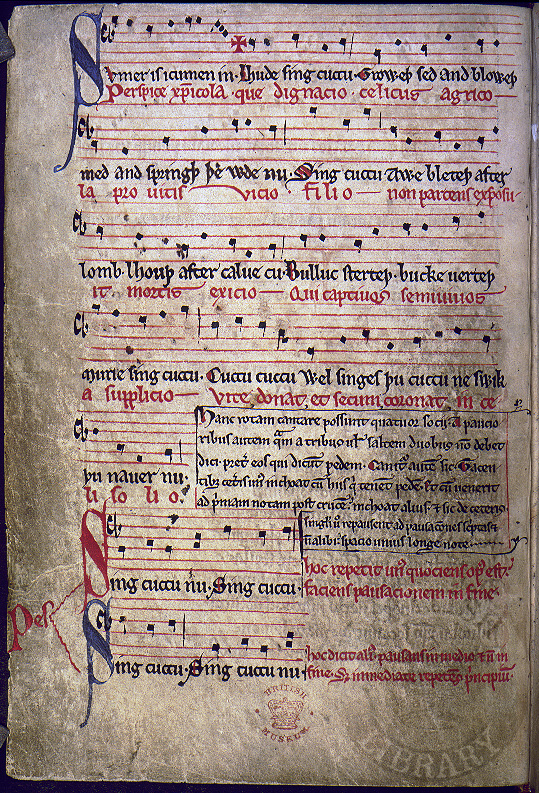
The manuscript is a page from the sketches for the finale of Bruckner's Ninth Symphony, which raises all sorts of questions about when a piece of music is or isn't finished. More tomorrow...

Wednesday, June 25, 2008

Composing is a political act

I thought Morton Feldman was long gone, but you can't keep a good man down, it seems - I see he's now running Ireland, although I suspect he may be ruing the day he took the job at the moment. I'm sure he's taking the long view of it all, though.


taoiseach composer


Tuesday, June 24, 2008

KSO Programme Notes: 24 June 2008

Bedřich Smetana (1824-1884)
Vltava


Czech nationalism was a sentiment borne more on hope than experience in the 19th century. The country then known as Bohemia was a province of the Austro-Hungarian Empire, and it would not emerge with any autonomy until the creation of Czechoslovakia in the wake of the First World War: true independence had to wait until the Czech republic disconnected itself from Slovakia in the aftermath of the collapse of the Soviet Union at the end of the last century.

So music was one of the few areas that offered any palpable outlet for patriotic expression, and Smetana, as the leading Czech composer of his day, found himself at the head of a movement, and his music emulated as the basis for a Czech school of composition. The cycle of six tone poems called Má Vlast [My Homeland] that he composed between 1872 and 1879 represent a self-conscious attempt to encapsulate the essence of Bohemia in music.


The original title of the cycle was the more demonstrative Vlast; the later addition of the pronoun perhaps suggests an unease with the idea of being a spokesman for the nationalist cause at a time when he was the subject of increasing hostility from critics. The project must also have taken on a great personal significance as the composition of the first part, Vyšehrad, coincided with the sudden loss of Smetana's hearing. For a composer this was serious enough, but the deafness itself was a symptom of undiagnosed syphilis, which would eventually kill him. Má Vlast therefore represents a remarkable fusion of the political and the personal.

Vltava is the second part of the cycle. It depicts the flow of the eponymous river from its source in the Šumava Mountains to Prague and beyond. On the way it passes a hunting party and a village wedding, and sprites dance on its moonlit waters before the current builds as the river reaches the St. John rapids, then flows broadly through Prague, past Vyšehrad Castle and disappears into the distance where it will flow into the Elba.


Nikolai Myaskovsky (1881-1950)
Symphony No.21 in F sharp minor, op.51

Posterity is a harsh mistress, as is seen in the case of Myaskovksy, a classmate of Prokofiev and pupil in Rimsky-Korsakov's composition class, who built himself a reputation as the finest symphonist in the Soviet Union before a young upstart called Shostakovich came along and stole his thunder. His 27 symphonies constitute one of the most extensive sequences since the classical era of Haydn and Mozart, and together form the backbone of his career.

After a time in the armed forces, he took a post at the Moscow Conservatory and became a leading light in the promotion of contemporary music in the 1920s, and later became a member of the Organising Committee of the Composers' Union. An introvert by nature, he showed little interest in politica and an overwhelming absorbtion in his work, but this was not enough to keep him from criticism, and he was periodically attacked for what the authorities saw as the excessive individualism and pessimism of his music, and in 1948, along with Shostakovich and Prokofiev, found himself one of the main targets of the infamous Zhdanov decree attacking "formalist" music. His style is, however, less abrasive than either of those two composers, and is more obviously in the Russian romantic tradition of Tchaikovsky and Rimsky-Korsakov.

His 21st symphony was composed in 1940 concurrently with his 20th, and dedicated to the Chicago Symphony Orchestra and their principal conductor Frederick Stock, who had asked Myaskovsky to compose something for them in 1938. Their performance of it on December 26 1940 was billed as a world première, but in fact the first performance had been given on 16 November by the USSR State Symphony Orchestra under Aleksandr Gauk.

The symphony is cast in a single movement, and although there are passages of livelier temprament, the predominant mood is withdrawn, epitomised by the clarinet solo which opens it, and the quiet string chords which bring it to a close. It is a testament to the inconsistencies of Soviet Arts policy that this introverted and melancholic symphony by a composer who had been condemned for these qualities was awarded a Stalin Prize in 1941.


Antonín Dvořák (1841-1904)
Symphony No.6 in D major, op.60

1. Allegro non tanto
2. Adagio
3. Scherzo: Furiant: Presto
4. Finale: Allegro con spirito

If Smetana effectively created the Czech musical character, it was Dvořák who took it to the world. By the end of the 1870s he was, thanks to the patronage of Brahms, establishing himself internationally as a composer, and in 1879 he achieved the distinction of having his third Slavonic Rhapsody performed by the Vienna Philharmonic conducted by Hans Richter. The performance was a great success, and as a result Dvořák found himself in the position of promising his next symphony to the orchestra. So in 1880 he set to work, completing the new work by October for a projected performance in December.

The orchestra, however, had other ideas: rumbles of discontent were heard at the prospect of playing new Czech music two years in a row; to present overtly Czech music in the capital of the Austro-Hungarian empire, of which Bohemia was a subject, was potentially an unwise political act. In the end the first performance of the symphony was given in March 1881 by the Prague Philharmonic under Adolf Čech. Richter himself finally conducted the symphony of which he was the dedicatee in London the following year.

Ironically, the work that the Viennese musicians had objected to on the grounds of its ethnicity has a distinctly Germanic tang to it; Dvořák went out of his way to write something that related to the traditions of musical Vienna. Not least of these is a clear indebtedness to his mentor Brahms, and in particular his second symphony (also in D major), which was then still a recent work. Dvořák also peppers the score with reference to Beethoven's symphonies, which were highly regarded in Vienna (not necessarily the case when that composer was alive), in what seems a ploy to present himself as an heir to those traditions.

That notwithstanding, this symphony, the first of his to be published (which is why for many years it was known as his first), sees Dvořák's style fully formed, the thick scoring of his earlier symphonies now replaced by the colourful, translucent sound that characterises his mature output. The first movement's allusions to the musical world of Brahms, Beethoven and Schubert only serve to highlight the confidence Dvořák has in his own voice, which is never swamped by his illustrious forbears.

The second movement takes for its principal theme a tune from an early string quartet that dates back to 1862, around the same time as the youthful Dvořák composed his first symphony, The Bells of Zlonice. As is his way, the movement proceeds less through contrasts than ruminations on and tangents to the main theme in a thoroughly relaxed and generous manner which finds time to make reference to the slow movement of Beethoven's Ninth Symphony.

Having doffed his cap to Vienna, the third movement is entirely and unashamedly Czech in character, taking the form of a furiant, a dance notable for its forceful cross-rhythms, that takes the folk ideas he had thoroughly explored in such works as the Slavonic Dances and propels them into an entirely new plane of thought. The opening of the finale that follows evokes the equivalent movement of Brahms' second, before launching off on its own expansive course, finally culminating in an outrageously lively dash for the finish.

Inobservant

Take a look at Anthony Holden's review from this week's Observer. Skip the bit about Strauss - Mr Holden doesn't like to stray too far from the opera house, so his reviews are usually about operas, especially expensive ones with big names in them. But occasionally he remembers that there are other classical music genres, and manages to get himself to one of those concert hall places. This week he's managed to navigate his way to Snape Maltings in Aldeburgh (probably relatively easy, as it was established by Britten, who of course was primarily a composer of operas). He's also aware of the current artistic director of the Aldeburgh Festival, Thomas Ades (presumably because he's seen his name about the Royal Opera House advertising one of those high-profile opera commissions that stop Mr Ades writing something more interesting), although the sub who prepared the copy doesn't seem to realise that Ades doesn't feature in this concert. But the excellent French pianist Pierre-Laurent Aimard, who's due to replace Mr Ades as thge Aldeburgh Festival'sartistic director next year, does.

Consider this:

"taste-free modern slices of Schoenberg, Kurtag, Webern and Charles Ives amid some nourishing Haydn and Mozart."

Taste-free? I've heard the above composers accused of many things in my time, but blandness certainly isn't one of them. How anyone can think such things of The Unanswered Question, or Webern's Five Movements, is beyond me. And "modern"? Kurtág's still living and breathing, sure, but of the rest the most recently animate is Ives, and he died in 1954 (that's 54 years ago, Mr Holden). Those four composers represent a remarkably wide spectrum of twentieth century musical trends, and it seems unfair to brush them aside in this manner.

Mr Holden also seems confused at the difference between conducting and directing from the keyboard. He describes Aimard's conducting of Haydn's Symphony No.22 as "sprightly", and specifically states that "All went well until Aimard attempted to conduct from the keyboard." And yet his conclusion is that it's
"Just as well, perhaps, that Aimard has disavowed any ambition to give up the piano for conducting."
Huh? You just said his conducting was good! It was his directing from the keyboard in the concerto that went wrong, you said. So not only is that little dig at the end nasty and petty, it's also factually wrong.

So there you go - three paragraphs which say next to nothing about the music, and are a set-up for a punchline that doesn't work.

If someone's got a narrow viewpoint, I can put up with it (well, just about, as long as you don't ask me to talk to them for any length of time). But if you're going to be a narrow-minded music critic, you'd better write with a Swiftian level of wit and be prepared to back your opinion up rather than just casually dismiss the past century of music. Maybe if you didn't gorge your palate with late-romantic opera you'd have taste buds clear enough to appreciate other flavours.

Wednesday, June 18, 2008

Computer Love

The earliest known recording of computer generated music has been unearthed.

(Intriguingly, the 1950s computer shows a healthy disdain for the puny human concept of the tempered scale, as you'll hear every time it hits the dominant.)


Careful! We know where this sort of thing leads:


Wednesday, June 11, 2008

Big Ideas: Don't get any

Some time ago Radiohead held a competition for remixes of "Nude" from "In Rainbows". This is one of the entries. Be patient, it kicks off at about 1'10". It's not samples, it's actual equpiment playing live, as James Houston explains on the YouTube page:

Sinclair ZX Spectrum - Guitars (rhythm & lead)
Epson LX-81 Dot Matrix Printer - Drums
HP Scanjet 3c - Bass Guitar
Hard Drive array - Act as a collection of bad speakers - Vocals & FX


Utterly brilliant.

Friday, June 06, 2008

Friday link-o-rama

It's time for one of those posts you do when you can't think of anything interesting to say!


There's a wonderful tribute to Bo Diddley in today's Grauniad by John Moore.


Top violinist and David Badiel lookalike Leonidas Kavakos interviewed.
EMI's shameless cash-in Best of Radiohead CD given the kicking it so richly deserves.


His Bobness has an art exhibition opening next week.


I'm writing programme notes for this concert at the moment, and I must admit I'm struggling to find interesting things to say about some of the music -which is no reflection on the music itself, I hasten to add. I adore Dvořák, it's just tricky to find an angle on him that isn't the usual boring rubbish you read in programmes. But I'll get there.

Tuesday, June 03, 2008

Bo Diddley Is Jesus


R.I.P. Bo Diddley. One of those guys who, hovering behind a huge number of bands in my record collection as a kid, influenced me before I even knew it.

Monday, June 02, 2008

Happy Birthday!

Many happy returns to Cheerful One.


I'd sing "Happy Birthday", but as Warner-Chappell claims that the song is in copyright, I can't afford to. You can read more about the arguments over who owns the world's most popular song here and here.

Sunday, June 01, 2008

Sound in place


So, the move is done, the crappier crap has been thrown out, and everything has found its place (or at least been put in a pile small enough to ignore). Normal service may be resumed shortly.

Saturday, May 24, 2008

RVW: Let's Get It On

The Passions of Vaughan Williams was an entertaining, if slight, documentary last night that took as its thesis that all that stuff we thought was about cows and country meadows was actually about shagging and fighting. It featured a lot of old ladies talking about sex, which is always an instructive experience.

I'd say more, but I'm trapped in relocation hell at the moment and really should get on with the packing. Normal service will be resumed shortly.

It's repeated tonight at 7.00 on BBC4, or you can blahblah iPlayer. And while I'm at it here's an interview with the man himself.

Obviously I'll be deeply possessed with Euro-fever by then. Assuming I'm not trapped under a collapsed tower of boxes.

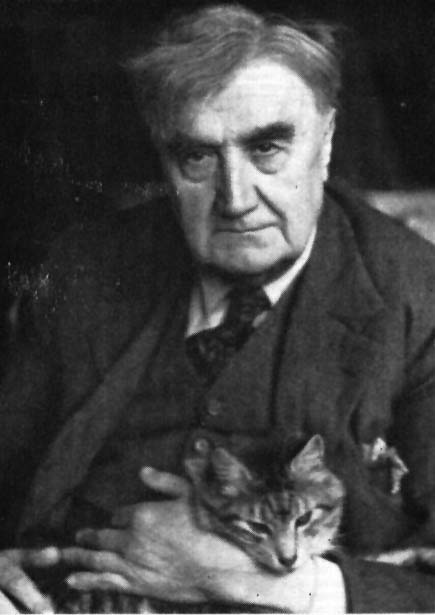
RVW would have felt right at home in the world of blogging, as this photo of him with a cat demonstrates.

Wednesday, May 21, 2008

A life in boxes

I am surrounded by stuff.

Packing is an activity that inevitably leads to a certain amount of introspection; it's like a ritual, sifting through the lives once led in preparation for the life to come. Those books, CDs, pieces of random paper that bring to mind times you'd half-forgotten, smiles and rueful wonderings about what might have been, if only. But there's no if only in life, only what was, is and shall be.

So the difficult decision becomes, what stays and what goes? There are of course things that retain their immediate usefulness or potency, and those that can be happily discarded (CDs that will never again be played, books that will never be re-read). But there's also a slew of things that fall between; things that you can't entirely justify keeping on any practical level, but bring warm feelings of nostalgia. How do you decide about these?

I try to be reasonably callous about it; I believe in looking forward, not becoming mired in things past. But at the same time, that past is what made me, and I need to keep something to remind me of where I've been. Judging the line between these is a difficult one.

Mostly, though, at the moment I feel overwhelmed. When you've been in the same place for over seven years, you don't notice the accumulation of things, and it's only when you come to put it in boxes that you realise how much you are defined, and weighed down, by possessions.

There's a piece of me that wants to stand up, walk out and leave all the things. That knows I only need what I carry within me, really, and that everything else is detritus. But I can't let go of it all. I'm possessed by objects, and it's a worrying feeling. But we cannot entirely escape the detritus we have produced, and must accept responsibility for it.

Tuesday, May 20, 2008

Near and far


I ride a new way, aiming for the same destination. It's amazing how little deviation it takes to make the familiar seem like unexplored territory. I whistle a happy tune, with obscene lyrics rewritten as I ride. I reflect on how good it feels to be alone, out of the city, disconnected from the daily grind. At one point I almost look at the time, but think better of it. Why spoil the wonderful freedom from the temporal whip? I think of how strange it is that we strive to isolate ourselves from the wilderness, and then construct an artificial one. Of how fragile our existence is. Of how wonderful it is that this freedom is there for the taking, even in the city, if you take the time to find it.

Then I stop thinking, and look at the world.

Thursday, May 15, 2008

Irony in action

Gordon's famously reduced the strength of their gin after an EU directive defined the minimum strength for gin as 37.5%. What was that about cutting corners and losing your edge again?

Mr Ramsay's very big on quality control. Obviously not that big, though..

Wednesday, May 14, 2008

Prometeo (RFH)

Time's a funny thing; or the perception of it. Prometeo runs for over two hours, two hours in which not very much happens. And yet, in another sense, an awful lot happens, because by the end of it you're in a different space to the one you started out in.

It's a bit different for me perhaps; I've sat through the five hours of Morton Feldman's For Philip Guston*, so a couple of hours is peanuts in comparison. And Bruckner wrote 90-minute pieces in which, in a very profound sense, nothing really happens (and yet everything!). So there's plenty of precedent.

Not everyone can take this sort of thing: there were several people who walked out, some after less than half an hour. But it takes a half-hour or so to acclimatise yourself to this sort of music, and you need the patience to do that if you're going to get something out of it.

The spacial element of Prometeo is of course one of its main selling points. Stockhausen of course experimented with breaking down the traditional relationship between performers and audience in the 60s with Gruppen, and playing Strauss's Alpine Symphony recently, with its army of off-stage brass, reminds me that playing about with these things is nothing new in itself. But Prometeo takes these ideas and runs with them. There are clusters of musicians everywhere, even before you consider the sound field created by numerous speakers distributed all around. This creates a slight tension, as the Royal Festival Hall is clearly designed for the traditional layout of audience all pointing towards a stage, so our sitting position works against what Nono is trying to achieve. But in a strange way this only seems to point up how entrenched we are in our concert-going habits, the very thing Nono wants us to question.

The (excellent) programme contained the texts used in the piece, but this is really better studied later on, as Nono deliberately abstracts the words in his setting so that it's really incomprehensible in any conventional sense. Rather, he exploits the libretto as a source of sounds and timbres for the voices. There didn't seem to be any need to think about the text or the legend of Prometheus except in the most general, abstract way, and this is part of what it's about: it's not about comprehending, it's about the pure experience of listening.

Normally when you hear something involving a combination of instruments and electronics you expect the electric part to be superimposed on the acoustic, but what Nono does is much more subtle than that, and it's a credit to him that you hardly think about the presence of the sound system, so carefully are the two elements integrated; this is use of technology as a subtle enhancement rather than a bludgeoning club. The effect as you hear sounds from their original source drift across the room and transform into complex textures is serenely discorporating.

The actual music itself seems much more eclectic than I'd have expected, ranging from terrifying clusters to the sweetest of perfect fifths, and pretty much everything in between. Occasionally a roar emerges from the orchestras, but largely the music is a great drift.

Nono is classed as one of those nasty modernists we're all supposed to reject these days in favour of Golijov. But what's striking is that this music (as well as being far more immediate than the anti-modernists would have you believe) doesn't sound "modern" at all. It sounds extraordinarily, immensely ancient. We leave the hall at the end, and to return to the bustle of London after this feels like returning from a journey to an unimaginably distant world, perhaps even time. The world seems too fast. Nono gives our thoughts space to breathe. And time.

There's so much more to be said, and yet also nothing. I go about my day as before. But behind it somewhere there's the memory of this other place, and it'll be a while before it's absorbed. it's all a matter of time.


Tim Rutherford-Johnson has a good roundup of reviews of the performances.


*I've sat through the even bigger String Quartet No.2 (over six hours on the Flux Quartet's recording, helpfully available on DVD to avoid those annoying disc changes). But somehow it seems cheating, doing it in the comfort of your own living room.

Friday, May 09, 2008

Playing with fire

A big weekend looms: tomorrow night I'll be off to the South Bank to hear Luigi Nono's Prometeo, about which I shall doubtless have more to say later. I'll be rehearsing on Sunday for the KSO concert on Monday, so annoyingly I won't get to see the Bowmans at the Borderline, but you should if you can.


And just to show it's not only BBC Young Musician that's had a lobotomy, I see the Classical Brits gave Emperor Palpatine an outstanding achievement award, and think the best classical release of the last year was cod-operatic karaoke act Bleak. To which the only sensible response is to laugh like a drain.

Apparently Villa-scum supporting mockney fiddler Nige pulled out because they wouldn't let him perform with FHM-stylee quartet Bland. Which after the above seems an odd point at which to make a stand on artistic integrity.

Wednesday, May 07, 2008

Young Musician of the Year 2008 (BBC4)

I missed last night's string programme (general consensus: the guitarist was streets ahead of the others, and the violinist shouldn't have even been there) but I did see the wind finalists paraded before me and the 3 other people who watch BBC4 on Monday. I'm sure the Scottish flautist who won ("He's so camp!" squealed one of the other contestants, and I'm sure he'll thank her for that when he's lying in some street late at night having his head kicked in) fully deserved his place in the grand final, but it's difficult to be sure, because one of the defining features of this programme was that you didn't get to hear very much music at all. Instead you got treated to lots of shots of the players walking about, going on Facebook (they do little else, at least that's the impression the programme gives; well, as every coked-up London TV executive knows, that's what da kidz do, innit bro?), hugging each other endlessly in the wake of auditions and recitals, thinking about what shoes to wear, lots of voice overs about how nervous they are but also how excited to have got this far... I looked at my watch at one point and realised it was halfway through the programme and not one of the four contenders had performed anything. Not long after that I realised none of them would, beyond a few seconds.


Is this starting to sound familiar? It should, because it's pretty much the same format as every other X-stars-in-Britain-have-talented-operatunity show out there; that stumbling mass of rotten-headed zombie programmes that shuffles unstoppably across the TV schedules, with the sole aim of removing the brains from our skulls.


And that's the point: you can see exactly how we arrived at this sorry abortion of a programme - lots of brainstorming by telly people, lots of guff about how classical music's seen as elitist and we've got to show how these lids are just normal teenagers, not stuck up posh kids (except that they are, because music's been sliding down the priorities of educational policy in the country for years, and only posh kids have parents who can afford to pay for them to have the lessons) - oh, and isn't it lucky one of them's Scottish, because another thing that every coked-up TV executive knows is that Scottish kids are automatically NOT POSH, so let's have lots of focus on him. Make it normal, make it accessible, don't let any hint through that there might be anything special or exceptional about these kids, certainly don't scare anyone off by showing them play an entire piece uninterrupted, get lots of reaction footage of the bods on the jury, much better to have someone tell you how good it is, can't trust the fucking plebs who watch TV to listen and form their own opinion, can you?


So you end up with a programme that fails on every count, because it's too scared to show us the only thing that makes these kids worth our time: their talent as musicians. This is how television likes to deal with classical music; anything, anything but the music itself.


You can see and hear complete performances on the website, I'm sure they would say. And it's true, you can. But why can't you see and hear them on TV? It's not as if the schedules are so stuffed full of content that they can't ever find time to devote hours of transmission time to talking heads spouting inanities about what they loved about the 1970s. I think there's a simpler explanation. I think the people who run TV don't like the music, they resent having to make space for it, they resent its very existence. They know little of it, and care less. All they care about is squeezing the last drop of life from exhausted formats while they wait for the next bandwagon to roll up. I'll bet when they put this programme together they talked a lot about journeys, about personalities, about relevance, about elitism and outreach. I wonder how much they talked about music?

Saturday, May 03, 2008

Dear London

You are a fucking idiot.

That is all.

Thursday, May 01, 2008

"Writing about music is like dancing about architecture"


Erin raises the subject of programme notes. It's something that I've thought about a bit over the years, not least because I've written a few myself, both for my own and other composers' music.

And the conclusion I've reached is this: most of them are a complete and utter waste of time.

I can't remember the first one I wrote, but I suspect a big factor in my starting to do them is that you're expected to do them for your own pieces if you're a composer. And most composers are terrible at it. I went to an spnm workshop on this very subject once, and some of the examples given were astonishing in their obtuse unreadability.

There's a basic problem, in that the way you think about a piece when you're writing it is almost exactly the opposite of how you perceive the same piece as a listener. One often gets the impression that many young composers are treating their note as an exercise for their musical analysis class.

It's not just composers who are bad at this. When I think of the times I heard Stockhausen discuss his music, and compare his clear, simple, lucid introductions to the reams of obfuscatory rubbish I've seen written by others about it, it's no wonder he ha a reputation as incomprehensible to anyone without a PhD in music and mathematics.

There's no point in putting musical analysis into a programme note. it's almost entirely irrelevant. Those who can understand such things don't need to be told about it, and those who can't, well, can't, so why confuse them further? it's distracting, confronted with Schoenberg, say, to be told to play spot the tone-row when what you should be concentrating on is the emotional import of the piece.

Tovey wrote wonderful pieces of musical analysis that are held up as exemplary programme notes, but what's rarely pointed out is that these wonderful essays were sent out to subscribers weeks before the concert they related to. There's an argument for bringing that back, of course,. but in the context I'm thinking of - the interested layman sitting in his or her seat waiting for the concert to start - it's way too much to take in.

I'm also confused by this habit of writing long descriptions of what happens in the piece. I don't want to know the plot of a book or film before my first encounter with it, why should I be denied the excitement of finding my own way through a piece of music?

What does help is context. It's good to know where the composer was coming from when he/ she wrote; so in the note I've just finished* for Strauss's Alpine Symphony I've talked a lot about the influences of Nietzsche's Anti-Christ and Strauss's friendship with the recently deceased Mahler. I also like to put in any odd facts I may discover relating to the composer of the piece, simply because I like that sort of thing. What I want to do is write something that is actually enjoyable to read and puts you in the world of the music and puts you in the mood for it. I like to put a bit of humour in as well, if possible. A lot of people feel like there's a barrier between them and this fancy-dan classical music stuff, and a joke or two helps reduce that, I hope.

So, my rules for a successful programme note, partly influenced by Orwell's six rules of journalism:

  • Talk about historical context
  • Put in something unusual or entertaining about composer or piece, the more trivial the better.
  • Don't use any technical musical terms.
  • Don't write descriptions of the music, except in the most general terms
  • It's acceptable to mention something specific near the end of the piece, so the listener will know they're near the end.
  • Entertain the reader.
  • If at all possible don't mention the actual music at all.


*Sorry, no free lunch here - you'll have to go to the gig and buy the programme if you want to read it.

Wednesday, April 30, 2008

The Minotaur

Say what you like about the parasitical/elitist/upper class* crowd, they get service. I hardly had to queue at all to pick up my ticket from the Royal Opera House box office for tonight's performance of Harrison Birtwistle's latest show, The Minotaur. A pleasant change from some venues I could mention. The man behind the desk almost smiled, too.

They're obviously not used to folks from the regions in the bar though, as I had to repeat my request for a bottle of Pride several times, my minimally Brummie accent proving virtually indecipherable to the barman. Of course I was in the cheap sets, but i got to feel like a flash rich person with wads of cash to chuck around through the ROH's thoughtfully charging £4 for a bottle (that's about eight quid a pint - nightclub prices if ever I saw them. Maybe this is their way of reaching out to the ordinary punter).

I must make a confession: I'm not really that mad on opera. It's fundamentally a fairly ridiculous medium that seems to attract deranged fanatics who take no interest in any other form of music. So it's a credit to the composer and the production that I was thoroughly engaged in the evening, managing to sit through the 85 minute first half without fidgeting very much a all (just as well, as there's not much room in the cheap seats, certainly stretching's a no-no).

Death's always a problem on stage. It's difficult to feel genuine horror at the sight of some skinny lass writhing around the floor smearing ketchup over her smock. I suppose this is just one of those things you have to put up with, though, and Birtwistle's score and the production are both sensible enough to present something heavily stylised that makes almost no attempt to acknowledge the concept of realism. So when the Minotaur goes on his second killing spree, taking the body tally from one to a dozen in a few minutes, it's presented more as ballet than anything actorly, and is all the better for it.

As I've noted before, Birtwistle seems to be in the process of a strange image-metamorphosis from bogey man to the cuddly face of modernism in the press at the moment, and while it would be stretching it to suggest this is no more work than a night at Madam Butterfly, this is a compelling, clearly orchestrated and emotionally direct score, and hell, yes, lyrical. The narrative proceeds in a linear fashion, and one suspects Birtwistle's in danger of becoming respectable. I particularly liked the cimbalom that popped up fairly regularly, reminding me strangely of Portishead (I guess because they're in my mined this week).

There are lots of startling moments, particularly the Keres who come to feast on the dead left in the beast's wake, and the Oracle who tells Ariadne how to help Theseus escape the labyrinth. The message of the piece - the closeness of humanity and baser nature, and the way we create our demons - isn't one of startling revelation, but it's resonant, and presented subtly without being bashed around the head, and the melancholy of the Minotaur's monologues particularly is very affecting.

All the cast were excellent, but of course special mention must be made of John Tomlinson, whose head was visible as a human ghost inside the bull's head (a particularly good example of the way the design in the show uses simple ideas effectively) and brought the pathos to the role to make us sympathise with the beast. The chorus goading him on to kill come over as school bullies, creating the beast by treating him as one.

Looking round the audience at the interval, it struck me that it didn't look at all like what cliche would suggest an audience at a contemporary opera would look like, which must be a good sign. Although there was present that man who gos to all concerts it seems, and makes sure he leaps in like a demented seal as soon as the orchestra finishes to clap, thus entirely destroying the atmosphere (this was particularly annoying at the interval). No-one thinks you're clever for knowing when it's ended, mate, so give it a rest, eh?

At the curtain call I was startled to see a fat bloke in drag with a pair of comedy plastic breasts strapped on come on stage, it was the oracle. Sometimes it's best to keep the lights down low and keep the magic.

*Delete according to personal prejudice.

I tried to take a picture of the nice sandpit with a bull's head in it at the front of the stage before the show began, but it came out terrible, so I've nicked this picture from MusicalCriticism.com
instead.

Tuesday, April 29, 2008

Telly Savalas looks at Birmingham

Beautiful. Just beautiful.


Portishead: Third

Just to show there's more than one way to skin a cat, the other excellent new release this week is from a band who are pretty much the opposite to the Fall's work ethic, this being their third album proper in 14 years, and their first for 11. But if Scott Walker (of whom more later) can take 11 years between records, so can Portishead, and who cares when the results are as good as this?

Parr-zed (as you call them if you actually come from Portishead) are also pretty much The Fall's polar opposite in terms of their style, too, but there's a connection in the way they've managed to revitalise their sound while remaining recognisably themselves - "always the same, always different".

What's remarkable about this album is the juxtaposition of two entirely different textures: most of the music is harsh and stark, underpinned by brutally minimalist beats, and this is thrown into sharp relief by Beth Gibbons's fragile, pleading vocals. The effect isn't too far removed from Scott Walker's latter-day stuff, and it's interesting that this album is getting a lot of positive mention where Tilt was received with bafflement by many when it came out. Maybe this is a sign of how we've moved on.

The other music that comes top my mind as I listen to this album is that of Galina Ustvolskaya - there's a similar feel of supplications to an indifferent God, humanity somewhere deep in the midst of a vast, uncaring machine of a universe.

This isn't easy listening - there'll be few dinner parties with this on in the background, as Portishead's first album was unfairly condemned to - but it's powerful stuff, that reveals itself more and more with each listen. And it takes a very special kind of confidence to be able to produce this stark, oppressive sound, and then throw a ukulele into the middle of it, as happens on "Deep Water".

Monday, April 28, 2008

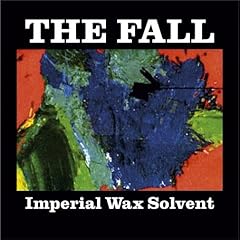
The Fall: Imperial Wax Solvent

32 years in, and Mark E. Smith shows no sign of quitting, with the 27th(ish) Fall album out today. Good.

There are, apparently, still some people who remain wilfully blind to the genius of The Fall, and I suppose at this stage it's too late for them; I can only pity them and the drab lives they must lead.

Because there is not one band who has managed what Smith and his many cohorts have achieved: to sustain a career in this strange beast we call rock and roll for three decades that maintains an extraordinarily high quality level (I maintain they've never released a bad album: sure, there are Fall albums that are less good than the others, but their slightest effort is still several rungs above almost anyone else) and still retains its full creative force and originality.

Having established recent incarnations of The Fall as the Ur-garage band, Smith on this album seems to be playing with that sounds, pulling it apart and reconstructing it from the inside out. So what we get are a lot of startling jump cuts between textures and tempi, which seem to bring The Fall's latent Beefheart influence to the fore. now Beefheart's not someone you can emulate unless you're very sure of yourself, and of course The Fall manage to let that sound come out without ever once sounding like anything other than the Fall, which of course is the essence of their genius.

It's compelling, genuinely adult music ("I'm a 50-year old man, and I like it!" exclaims Smith) ; a big thick juicy steak of a record, in comparison to the thin gruel so many bands serve up. And it's great to dance to, too. The Fall come from the land of Northern Soul, remember; they understand the value of dancing.

Sunday, April 27, 2008

R.I.P. Humph

Humphrey Lyttelton: Jazz great, master of the double entendre, a man who worked almost til the day he died. If I can die half as active as him I'll die a happy man.

Friday, April 25, 2008

slipping past


slipping past
Originally uploaded by petemaskreplica.

The days pass. I'm not dead or anything, just busy with other things.

There are two courses of action when you hit the weekend with a stinking cold:

i) eat plenty of fruit and veg to get your vitamins and have an early night.

ii) fill yourself with booze and comfort food.

Guess which plan I'm going with?

Wednesday, April 23, 2008

written on the wind and the running waters

I had a big long rant about Airport security in my head, something to do with being made to feel like a criminal for wanting to travel within my own country, with the way an airport reflects the world and this is how we shall live soon, but I was too tired to type it by the time I got home, and too busy the next day, and today the spleen has dissipated. So it goes on the internet - it's important to get these things online immediately, less you should have time to reflect and start being rational or reasonable about it.

Anyway, more interesting things are in the air, namely that the third and final cartoon I drew for Rhinegold is in the shops now, in the Festivals supplement to the current issue of Classical Music, so rush out and buy that, and then write letters to them saying how great I am and that I should have a regular strip in there.

Tuesday, April 15, 2008

A hard climb

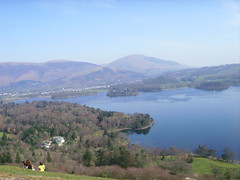
Not the Alps at all, but the view from Catbells

I'm writing a programme note about Richard Strauss's Alpine Symphony for the next KSO concert at the moment, and it's an interesting contrast with the last one I did for Shostakovich 4. This is partly due to the fact that I just don't like Richard Strauss very much.

it's difficult to pin down just what it is that doesn't appeal to me; I can see that it's well written - Strauss is never less than effective with an orchestra - and there's plenty to say about the origins of the piece, what with the connections to Nietszche and Mahler. It's not even his dodgy Nazi links - the more I read about him the more I become convinced that he was naive and blinkered and self-serving rather than actually evil. It's that I can't see anything beneath the (admittedly attractive) surface. So I struggle at those sentences, desperately trying to convey an enthusiasm I don't really feel, talkign about hidden depths I'm not convinced are there.

He's the musical equivalent of a page 3 girl - very well built, but once you've got past the beautifully contoured orchestration, there's nothing to engage the intellect*. Someone once said something to the effect that of the three late-romantic Austro-German composers, Bruckner found God, Mahler searched for God and Strauss wondered what all the fuss was about. And that's the effect his music has on me. It drifts by, beautifully composed and utterly vacuous.

Composing to entertain the audience is a perfectly legitimate strategy, as valid as composing without a care for the audience, and on some level Strauss must be successful, because I certainly seem to be in a minority in my apathy. But as much as I like to look at a well built figure, it's more fun if there's a conversation to be had too.


*I'm not suggesting that all page 3 girls are air heads, of course. I'm sure there are plenty of them with degrees in comparative philosophy or quantum physics.

Tuesday Link-o-rama

Oh, has it come to this? Am I now on that slippery slope to being just another blog with a bunch of links to the words of other, far more intelligent and interesting people than me? I'll try not to make a habit of it. Anyway, in the absence of anything interesting to say coming out of my brain, here are a few things to read:

EMI's planned job cuts have been delayed by some piddling legal process. Damn those pesky Europeans with their crazy ideas that big multinational corporations can't just shit on people as they please.

The Graunaiad is publishing daily extracts from one of the Defeatist's number one heroes, Mark E. Smith. Part one is here and part two is here.

Harrison Birtwistle's new opera The Minotaur premieres tonight. Here are some interviews with the composer, director and protagonist. I'm interested in the way the media seem to have moved from portraying Birtwistle as a terrifying figure to almost the cuddly face of modernism.

Monday, April 14, 2008

And the painted ponies go up and down

Music publishing behemoth Boosey & Hawkes has been sold off, I read.


HG Capital's press release about the sale has this to say about its period of ownership:

During that time the firm supported Boosey & Hawkes’ management in executing
a transformation from a traditional classical music publisher into a 21st
century music rights group. It has outsourced a number of non-core activities
such as printing and distribution and developed a series of new revenue streams.
In particular it has developed a strong presence in the market for music in
advertising and film, where revenues are currently growing at approximately 30%
per annum.

A company deeply committed to new music, whose number one mission is artistic.

Here's Daniel Wolf on the changing relationship between composer and publisher. My own experience dealing with all levels of music publishing suggests to me that an outfit such as Frog Peak can be a very effective way for composers to pool resources, while self-publishing composers vary in their effectiveness, from someone like Christopher Fox, who runs a very effective cottage industry, to the Stockhausen verlag, which, surprisingly for the imprint of a composer who was so much at the forefront of technology, doesn't even take credit cards. Meanwhile, the big old publishing houses seem to expend more effort in restricting access to their music than promoting it.


Mothman about the house

I thoroughly enjoy reading Ben Clark's Magic Beans Comics. And so should you.

Thursday, April 10, 2008

You've spun me round And knocked me off my axis mundi

The 2008 Proms have been announced.

And you know what? There's some pretty darn good stuff in there. Obviously the Stockhausen day will be a highlight for me, but there's also a hefty wad of Messiaen and Carter (and it's not often you get to celebrate the centenary of someone who's not only still alive, but still very active), and a couple of "populist" gigs which I think are both excellent ideas - although not everyone agrees with me.

It's all very well to say "If we build it they will come", but the fact is that kids today have next to no experience of classical music, concert halls are seen as forbidding places, and many people simply won't enter one (a bit like the way quite a lot of people won't watch a programme simply because it's on BBC2 - which is why shows that transfer to BBC1 get such a huge hike in viewing figures). Personally I think that juxtaposing Doctor Who and Turnage is a great idea, not only in terms of getting people inside the hall who might never otherwise go, but putting a message out that it's ok to like both. It's not going to create a brand new audience overnight, but it's a step in the right direction, and puts the whole thing ahead of the usual game for "family" concerts.

The folk day is also exactly in line with what the Proms ought to be doing - a type of music that's intimately linked with so-called classical music, and presented with some of the cultural paraphernalia that surrounds it rather than in isolation like a butterfly in a glass case. I'm looking forward to having a dance round the maypole, so there! And the Ceilidh is a great way to finish it off. If we take it for granted that the Proms is bound to the Albert Hall for the foreseeable future (and I think it is), then for all the place's faults it should be embraced, and stuff like this makes an imaginative use of the space.

Some of the concerts look a bit bizarre to my eye in terms of the wild oscillations between full symphonic works and solo piano pieces, not to mention some strange programme orders (Mahler 5 as an opener??) , but if the Proms are to survive and flourish they have to be open to innovation and experiment, and one of the things about experiments is that they don't always work. The point is, it feels like a fresh breeze is blowing over the season after the increasingly stultifying Kenyon years. There's an eclecticism and a lack of reliance on tired barrel-scraping themes and the like that leaves me feeling uncharacteristically upbeat.

So bring on the daleks, the maypole, the electronica, I say: If it works, great; if it doesn't, at least they tried. Next year they could try putting a big Wicker Man up in Kensington Gardens.

... and everything decays.

Wednesday, April 09, 2008

Scenes from a life I did not live

Am in Lon tmw so could meet you at waterloo after my meeting around 5? All well my end. Speak tmw Tx

I've never texted the wrong person by mistake myself*, but I suppose it must be easy-ish to do. I occasionally get a random message, or sometimes am treated to a long voicemail message consisting of the sound of half heard muffled voices through the phone owner's pocket.
There's a strange illicit thrill to receiving a random unintended moment of someone else's life. Who is meeting whom? Why at Waterloo? Is that kiss a meaningless friendly thing, or something more significant? Before you know it, I've constructed an entire scenario of affairs, desire, deception, furtive assignations and stolen kisses on train platforms. It's one of those rare moments when you're suddenly taken out of your own life and catch a glimpse of the normally unimagined, unnoticed, hidden or ignored world of others. A reminder that as we shuffle through our own concerns, other lives are happening, everywhere, indifferent to us.

*My phone's decided to text or call random people by itself plenty of times, though.

Friday, April 04, 2008

Alone again with the dawn coming up

There's a link here somewhere with yesterday's post; something to do with blurring the boundaries of what constitute sound and music, of what sounds we might use to make music. This all goes back to John Cage, of course, and quite possibly beyond; Berlioz scored for thunder in The Trojans, after all*.


Anyway, after yesterday's orgy of feedback (which some spoilsports want to eliminate - boo!), today I'm in an entirely different place, namely the sun-bleached deserts of middle America - well, that what I'm put in mind of when listening to the KLF's album "Chill Out". Like Bill Drummond, I've never been there, but it certainly sounds like what it ought to feel like there, so much so that I suspect I should never go there in case the reality doesn't live up to the place in my mind.
It's a seamless collage of samples and original music that drifts by like clouds, essentially static, as is Metal Machine Music, but that's partly an illusion - things are happening, and by the end of the album you are somewhere different to where you started, it's just that the movement is glacial. I might make another connection, this time forwards to the mid 90s when I first heard Morton Feldman's music, which similarly uses apparent lack of development to mask a much deeper and more powerful progression.


It's about space, as is the other music I've mentioned; this is something Miles Davis learned from Stockhausen and used to good effect on "On the Corner". It's perhaps the great unrecognised concern of 20th century music that reverberates still: the creation of an almost physical sense of space. You can do it by the placing of your players, in the performance area or mix; you might do it by the careful placement of notes in time; it's difficult to describe adequately, but it sure is powerful when you hear it. And feel it, because it's as much about the physical sensation as the aural.


By the way, I thought this album was long out of print, but apparently you can get it on Amazon. It's getting increasingly hard to find music that's hard to find, isn't it?


*How he thought he was going to get a roll of thunder to order is an interesting question. Of course the practical answer is that you play it on a bass drum, but the fact remains that the score specifies "roule de tonnerre", not drums.

Thursday, April 03, 2008

chaos and beauty

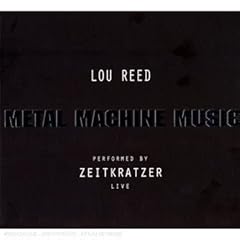
Lou Reed's Metal Machine Music, one of the more remarkable albums of the seventies, has always had a special place in my heart. It's, in essence, an hour of feedback, and is often voted somewhere near the top of lists of the worst albums ever made. When I was a sullen pretentious teenager this clearly made it a cause to be championed in my own contrary way. Hell, Ian Curtis had once said it was his favourite album, and it was, y'know, really loud.

Actually, there was always more to it than that, but my appreciation of it has only grown over the years as I've gotten old enough to drop the posturing nonsense, and heard enough of the right sort of music to begin to appreciate the place it occupies in the scheme of things. It's stating the obvious that it's in part the extreme logical conclusion to what Reed did with John Cale in the Velvet Underground, but there are deeper roots in there, in Cale and original Velvets drummer Angus MacLise's earlier work with LaMonte Young's Theater of Eternal Music.

What got me thinking about it again was the remarkable CD by the German ensemble Zeitkratzer, who perform a painstakingly transcribed arrangement for acoustic instruments (joined in the latter stages by Reed himself on guitar). So what better way to follow this up by digging out the original for a comparison? And what better time to do this than a Thursday lunchtime?

The thing that strikes you coming back to it, is how un-atonal it is, in direct contradiction to its reputation. Reed knew this, of course - the deadpan sleeve note he specifies "avoidance of any type of atonality". The thing about feedback is, that it originates from the overtones in the source vibration, and so when you use specific open tunings, as Reed does to the guitars he used to record the album, you actually end up with something that has the sort of oblique tonal/modal feel that a lot of contemporary classical music references.

The other thing, quite unexpected if you're coming to it through its reputation, is that if you turn the volume down it's not harsh at all, simply a glittering web of melodies and harmonies, an energetic tumble of waves of notes dancing on the surface of a vast, deep ocean of drones.

It's always portrayed as a vicious, harsh, masculine "fuck you" record, but what keeps me coming back to it, and what should bring you to it, is the increasing realisation that it's a sensuous, beautiful piece of music. Try it with your sandwiches on a sunny day.

Wednesday, April 02, 2008

Let's go to work

Little time for blogging at the moment, as you may have noticed from the few and inconsequential posts lately. Well, I'm afraid you'll have to get used to that, because inane witterings about Doctor Who is about as good as it's likely to get in the immediate future. This is not in itself a bad thing, as it's at least partly down to the exciting thing that I'm now working on, of which I shall not speak, as talking about these things seems to have a tendency to kill them off in my mind. Maybe once you've expressed the thought behind it the need for the piece evaporates. Better to explain in retrospect, if at all. I will say there's an element of thinking about rhythm involved, in a different way to what I've done lately. All these months I've been worrying about my drained pool of ideas, wondering if I need to take a long hard look at things and reassess what I'm doing, and it turns out what I really needed was a few days off. There's a lesson for us all there.

Anyway, Doctor Who. I'm getting quite excited about that.