Thursday, September 25, 2008

Survival strategies for the average composer (3)

Great things are afoot at Defeatist Towers, but it's important not to let real life get in the way of procrastination, so here is the third in what remains for the moment a regular series.

3. It's not your fault... but you still have to deal with it.

Bobbins's comment on strategy no.2 raises some points that regularly come up if you're in the business of what we are pleased to call Contemporary Music, and just like a drunk in the pub, no matter how friendly the initial approach, when they appear you know in your heart that things are bound to turn nasty eventually.

But, like the lairy pisshead waiting outside the pub at 11 o'clock to deck you for looking at his pint or spilling his bird, there's no avoiding it, so we may as well pile in. There is, ahem, a debate continuing about what's happened in SCCM* since the turn of the last century, whether it's a valid development, whether it has any future or will ever attract a large audience, whether classical music is dead**, and whether the perpetrators should be dragged outside and given a damn good kicking by hoards of indignant Classic FM listeners.

Arnold Schoenberg, knocking up a few volleys in between alienating the masses


Now there are many arguments and counter-arguments here: Who abandoned whom first, composers or audiences (answer: audiences, as it happens, during the 19th century), whether it's allowable to write music not based on the tonal system (answer: of course it's "allowed", I'll write whatever the hell I like, thank you very much), and so on and so forth. As with the drunk man we met in the pub at the start of this post, an awful lot of this fractiousness is down to some misunderstandings, but that doesn't make the outcome any less violent. Except that it's down to a lot of misunderstandings that happened years ago, long before you and I were around.

The practical upshot of this is that as soon as you're outed as a composer, and just after the inevitable question is asked "Do you write modern music?", you'll be expected to be on the defensive about what your interrogator perceives as a century of atrocities that were perpetrated out of personal malice for them.*** The honest answer is that a) it was like that when you got here, b) yes, there is a lot of bad modern music about, but there's a lot of bad old music as well, it's just that we've had time to forget about that, c) not all modern music sounds the same, d) there's nothing inherently wrong, as it happens, in writing music with a limited audience, e) Hey, Schoenberg's really not that bad, have a listen to this great Hilary Hahn CD of the Violin Concerto! and f) actually this whole argument is at least 20 years out of date anyway, if you took the trouble to pay any attention to current trends. Unfortunately, such arguments will fall on deaf ears. Sorry, but as far as the world's concerned, everything's ruined, and it's all your fault, you composing bastard.


*SCCM: So-Called Classical Music.

**
Classical music actually died in about 1827, of course.


*** I remember an occasion as a boy when a piece I wrote for a school music competition making limited use of serial techniques was denounced by my housemaster (yes, it was that kind of school) as "a sick joke". I argued back in a very cogent fashion, explaining the history of Schoenbergian technique and the long establishment and academic respectability of such methods, and was I think very restrained in that I never once used the phrase "you narrow-minded wanker". Or even anything worse.

Wednesday, September 24, 2008

Fight!


Jessica Duchen provides a handy roundup of the opening salvos of the London orchestras' new seasons today. But what's this?

So Stravinsky and Vaughan Williams emerge as flavours of the month, which is an interesting combination since Stravinsky could probably have eaten Vaughan Williams for breakfast, given half a chance.

I'm not convinced. A Google Fight would appear to back Jessica up, but given that Vaughan Williams was very tall and hefty (over 6', I think), and Stravinsky was a measly 5'3", surely Ralph would whup Igor's ass?

Tuesday, September 23, 2008

Survival strategies for the average composer (2)

Judging by the swelling stats for yesterday, this is is obviously a topic that has gripped the imagination of literally some people. So let's not hang about! Strategy number two awaits.


2. Accept your insignificance

Yesterday I discussed the unavoidable fact that the normal thing for a composer to do is stop composing, which means that if you're still doing it past college, you must be some kind of weirdo. But what drives those of us who do to do the thing we do?
There's a fallacy that's common in SCCM: that because, say, Beethoven's late quartets weren't immediately understood or accepted by his contemporaries, and as they're clearly a work of genius, then anything that's not immediately understood or accepted by one's contemporaries must therefore be a clear work of genius. It hardly seems worth pointing out that this is false logic, but so many composers still seem to fall into the trap that I suppose I must.

This isn't something that's limited to the Average Composer, by the way: it's a nonsense that infects the entire business from top to bottom. Closely related is the delusion that because you're writing SCCM, what you produce is therefore more significant than whatever happens to be in the charts or on the front of the music press. As the logical conclusion to this line of thought is to declare that Paul McCartney's Liverpool Oratorio is a more significant piece of music than Penny Lane, I fell no need to dissect this one further for now.

The reason I mentioned Beethoven was that this stuff is largely his fault: before him composers were admired and revered, but it was after Beethoven that the composer as Artist took a hold, and it was only a step from there to the morass of self-importance that the Classical Music business finds itself mired in now. Even now, some 200 years later, composers are expected, indeed encouraged, to measure themselves against a deaf German from the early 19th century.


Now, I'm not saying that you're not as culturally significant as Beethoven; but let's face it, as composers have been trying, and mostly failing, to live up to his example ever since, it's pretty unlikely. Most of the top composers now, whatever they may like to think, are nowhere near that level, and probably neither are you. And the fact that nobody's ever heard of you (and come to think of it, pretty much nobody outside the tiny, tiny clique surrounding them has heard of the top composers either), does not mean that you're a misunderstood genius. It just means no-one's ever heard of you. Accept this, stop worrying about your place in posterity, and you'll be a big step on the way to happiness.


Monday, September 22, 2008

The writing's on the wall

New Tale from the Back Desk online now.

Survival strategies for the average composer (1)

Average, a.


1. Estimated by average; i.e. by equally distributing the aggregate
inequalities of a series among all the individuals of which the series is
composed.

2. Equal to what would be the result of taking an average; medium, ordinary; of the usual or prevalent standard.


Most composers, if we are honest (and few of us are) are average. This isn't necessarily a qualitative judgement - although that comes into it. What I mean is that most of us are neither in the shining stratosphere of success, from which a few names look down beatifically while the rest of us stare sullenly back with a barely concealed jealous rage, nor in that sad category of people who persist in pursuing the muse despite ample evidence that they have no talent whatsoever for it, on whom the rest of us look down with a mixture of disdain, smugness and relief. Most of us bumble along, turning out pieces as and when we can squeeze them between the demands of a day job and the need to get the groceries in, occasionally getting a performance and filling with optimism that this time, our big break is coming, before sinking back into our routines as the recognition fails to erupt, and we carry on with the next piece, slightly crestfallen, but soon once more hopeful that what we write holds some significance beyond ourselves, and will be recognised eventually, and preferably before we fulfil the essential condition of being a composer and die.

Of course, as Morton Feldman pointed out, being a composer is inherently abnormal, as the normal thing for a composer to do is give up, probably soon after he or she leaves university or college and realises the full extent of the world's indifference to SCCM*. But given that you've failed to fall at that hurdle, and are bobbing by, neither sinking nor swimming, what you need to do is take on board certain facts. Hence this, the first in a series of posts designed to enlighten and educate, and make the average composer's life if not better then at least slightly more tolerable. And following from the sage words of Mr Feldman, let's proceed:

1: Admit it, you're weird

You are though, aren't you? If you had any sense you'd have quit this composing lark years ago. Unfortunately, you somehow managed to leave the education system without having the idea that anyone might be interested in anything you have to say knocked out of you, and if you're still scribbling now, it's probably too late for you. Admitting to yourself that what you do is weird is the first, and possibly most important step to take if you're going to cope with being a composer in the 21st century. You can expect the world to tolerate what you do, but by and large, you can't expect it to show any interest in it. Occasionally someone will appear to express something greater than apathy, but it'll very rarely lead anywhere, so don't get your hopes up.


*SCCM: So-called classical music

Wednesday, September 17, 2008

Till the money runs out

The days pass, and I find myself on the brink of the new season, preparing to take up my cello and start rehearsing once more. After a good long summer break, it's good to feel some enthusiasm building for the coming year.

That's tempered with some trepidation, though. The credit crunch is biting everyone, and the orchestra's no exception. Rising costs, venue hire, the difficulty in persuading people to part with some cash in return for an evening's entertainment are all things that impinge on the activities of an amateur orchestra, and one that receives no subsidies at that. We rely on the subs that players pay, ticket sales and any sponsorship we can attract to keep going, and while it'd be exaggerating to say that we're on the brink of collapse, that fact is that an orchestra's an expensive thing to run; we made a big loss last year and we expect to this year. A lot of imaginative thinking will be needed to find new ways to raise money to keep the band going. (Any other amateur bands having the same worries round here?) >eanwhile hard decisions must be made, programmes changed and belts tightened.

Performing arts organisations must all be looking over their shoulders at the moment, as they're usually prime targets to have their grants cut when the economy starts to nosedive, no matter how well they seem to be doing. There have already been scare stories in the recent past when the Arts Council cut off all support to a number of prominent bodies. It's hard to avoid the conclusion that the time's coming when the best place to be is in an amateur band, working on a small scale and, for all the financial worries, perhaps better placed to ride out the storm than a large pro organisation that depends on public subsidy. One of the points trumpeted about the new Kings Place development is that it's funded entirely by private money, which I suspect is another sign that no-one sensible would want to be relying on public money at a time when there seems to be something in the air against the very idea of it.

On a tangent, there's some interesting (and quite long, don't try printing this out if you want to save trees) reading in this government report on amateur music-making. There's a bit of techno-waffle and stating the bleeding obvious, of course - this is a government document, after all - but I shouldn't be churlish, as it's good to see something vaguely official that propagates the notion that the Arts are something that people do, rather than a product to be passively absorbed. Whether this leads to the conclusion that amateur organisations should be cherished and supported in a way that officialdom doesn't really do at the moment, or that by some twisted logic their presence and popularity should serve as a reason to slash public arts funding remains to be seen.


Sunday, September 14, 2008

Something fishy (2)


This week's Tale from the Back Desk is online.

Friday, September 12, 2008

Something fishy

One of the interesting sideshows to the McCain-Palin shebang is big-haired soft rock giants Heart's reaction to the appropriation of their song Barracuda. The Wilson sisters issued a cease and desist notice to the McCain camp, which they dutifully ignored, as unlike previous occasions, they were fully paid up and entirely entitled to play it.* Co-writer Roger Fisher has now decided to make the best of a bad situation and pledge his royalties from the Republicans' appropriation of his song to the Obama campaign, which is a neatly ironic resolution.


What this does highlight (apart from the double edged sword of copyright law) is an interesting question: how much a composer can really be said to own his work once he or she has put it out into the world, and whether (s)he should even be able to exert any influence.

It's perfectly natural for composers to wish to retain control over their creations, of course, just as a parent would like their children to grow up and act like they'd like them to. But with music as with offspring, once they're in the world they rarely end out how you imagined. Some children grow up to be junkies, and some songs grow up to be Republican soundtracks - just ask Bruce Springsteen. All you can do is hope that the gentle nudge you gave them as you sent them out will be enough to put them on the right path. It's difficult to let go, but music can't be preserved in aspic, nor should it be. Composing begins with following the example of those who've gone before you, and you have to accept that if you have any decent ideas, they in turn will be taken up by those who come after you.

Here's something for the weekend: a different take on the song in dispute, by the splendid Rasputina:


*McCain's habit of violating copyright is a bit unfortunate, given his zealous support of extension and protection of it. Hey, maybe if he hadn't supported all those term extensions there'd be more public domain music he could use for his campaign.

Sunday, September 07, 2008

A hairy situation

Another Tale from the Back Desk is now available for your delectation.

Saturday, September 06, 2008

Stuck in the middle with you

Pity the poor sixth.

Doing the washing up, I find my head filled with "Do-Re-Mi" from the Sound of Music. You know the one, the song that gives cutesy names and puns to all the notes of the diatonic scale. Except one.

"La - a note to follow So [sew]."

That's the sixth, what's technically known as the submediant, and Rodgers and Hammerstein hold it in such contempt that they can't even be bothered to think up a decent line. It's nothing special, La, it's just a stopping place on the way from the bright lights of So to the glittering wonders of Ti (a drink with jam and bread). Sort of like a motorway service station - you need the facilities, but you wouldn't choose to go there if you had any real choice in the matter.

Even the technical term's an insult - submediant, i.e. like the mediant, only not as good. Don't get any ideas above your station, Mr Sixth, we're only hanging round with you because we can't get close to the mediant for all the cool kids crowding him as he determines major and minor.

It doesn't get any better when you consider the unfortunate interval from a tonal perspective, either. In the tonal hierarchy, the submediant is the location of the relative minor key. Now, you may think the minor mode's proved its popularity over the years, but consider this: When you're in a major key, you modulate to the dominant. The exciting, virile, even more major dominant. Never to the relative minor. Yet when you begin in a minor key, the accepted path is to get away as quickly as possible to the relative major (which is located in the prime territory of the mediant. Yes, the Mr Big Shot mediant, so much more U than the boring old submediant. Who'd want to go there, eh? It's the tonal equivalent of Wolverhampton.

Not everyone hates the submediant - Brahms loved nothing better than to pile the sixths on, and there's a wonderful bit in the finale of Beethoven's Choral Symphony, when a massive dominant chord is emptied of its harmony, and then the single note left behind is reinterpreted in a new context, which swings the tonality unexpectedly towards the submediant key. It's an awe-inspiring moment, although Beethoven ruins it by prancing off on a thoroughly silly march, so maybe he didn't like our middling friend so much after all.

Well, I say it's time to stick up for the little guy. What's so bloody great about all these so-called perfect intervals, anyway? Let's hear it for the submediant - the tone that's not afraid to be different.

Tuesday, September 02, 2008

First thoughts on Haydn

There are always things you have on a list of things to do that you'll probably never get around to: Read big important books, do Significant Acts, that kind of thing. Occasionally it's good to gird your self and set out to conquer one of these cultural Everests. In the last couple of years I've ticked a couple of musts off my list: Ulysses and The Gulag Archipelago (Which I'm crawling through at the moment). But this is a blog about music (well, most of the time), and so I've embarked on an aural quest. Listening to Haydn's 104 Symphonies in order probably isn't on most people's lists. Ever since I first started listening to Haydn (and I started young - he's my dad's favourite composer, so I've been indoctrinated from an early age) I've always been amazed, and slightly intimidated, by the sheer amount of music he produced. It somehow seems more extraordinary than, say, Bach: his genius lies in seeing the harmonic and contrapuntal potential in a theme, so once you've done that it's a matter of writing it out. But Haydn's era was one that raised originality to the peak of what was expected from a composer. As I crawl through one of my own compositions at a tortuously slow rate I feel a bit jealous of old Joe, churning out a symphony every week. Fortunately the machinations of economics mean that I can now do something that would have been prohibitively expensive until not all that long ago, and buy myself a nice big box of 33 CDs containing all 104* of them. (I got it rather cheaper than that link, but the Grauniad shop doesn't seem to have it anymore.) I considered for a moment blogging each and every one of them, but decided that would be too much like hard work, so I'll content myself with popping up with random observations every now and then as I work through what must be just about the least known body of hugely important and influential music there is.


I'm always surprised how dismissive some musicians are of him; something along the lines of "well, it all sounds the same doesn't it?" - which is a sure sign they can't have listened to very much of it. I find it amazing, and inspiring, that anyone could produce such a huge amount of music, with such constant innovation, coupled with equally consistent quality and no hint of routine at all.


*Some count 107, but they're nit-picking.

Sunday, August 31, 2008

View from the back

The latest Tale from the Back Desk is online.

Wednesday, August 27, 2008

Johannes Brahms?!

I wouldn't normally do this sort of thing, but this is such a headfuck I just had to. Poor old Brahms must rue the day he quit the job playing in a brothel.


found via Michael Sippy.

Tuesday, August 26, 2008

Tales From the Back Desk

The latest episode is online.

Wednesday, August 20, 2008

Kingdom of the Bland

Oh Jesus shitting Christ, Classic FM are at it again. Not content with encouraging awful, awful acts like G4, Bleak, and The Divs to sing REM and Queen in a horrible cod-operatic warble, sometimes in Italian, as if that offered any insight into anything at all, now they're encouraging artists such as Emma Johnson and Julian Lloyd Webber to sully the air with instrumental "classical" arrangements of pop songs, which will apparently reveal some inner genius we weren't aware of already. This is apparently a reflection of a new genre, they tell us.

Actually, Classic Fucking Mediocre dissemble, because it's a very old genre - the genre of Fucking Horrible Arrangements Of Recent Pop Hits To Make A Quick Buck. FHAORPHTMAQB has a long and frequently ignoble history, although I have to confess to an entirely unjustifiable fascination with Deep Purple and Malcolm Arnold's seminal* collaboration, Concerto for Group and Orchestra, which is not quite the same thing, admittedly, but is a closely related genre, also being of the phylum "Terrible Things That Happen When the Rock and Classical Worlds meet" (see also: Metallica's gig with the San Francisco Symphony, Philip Glass's rotten orchestral inflations of David Bowie and the Queen Symphony). I don't include the Orchestral Tubular Bells here because it's no worse than the original.

It works the other way around too, of course, and honourable mention here must go to Waldo de Los Rios's fantastically tasteless '70s arrangements of popular classical pieces by Mozart, Dvořák, and others, which, like doughnuts and crack, are irresistible even though they're clearly not good for you.

These chimeras differ from Classic FM concept in one important respect though; they're ill-advised, overblown and gloriously lacking in taste or restraint, which in time lends them a certain charm. Classic FM's album is all about being tasteful, music to put on in the background as you sit round your coffee table with your estate agent friends discussing what car you're driving these days and when mortgage rates might come down. There's a terrible and insidious snobbishness about the whole enterprise: the implication is that, on the one hand, these songs must be tarted up in "classical" clothes in order to be acceptable, and on the other hand that Classic FM's audience isn't really clever enough to listen to proper classical music, and shouldn't get any ideas that they deserve any better than this. The first is the sort of thinking that leads to Paul McCartney's "classical" follies, which only a lunatic could believe can hold a candle to his magnificent work with the Beatles; the second is essentially the same sort of mindset that thinks it's a jolly big shame that the natives are now running their own countries in the former British Empire, and that the working classes no longer doff their caps to the toffs. it betrays an attitude of paternalistic contempt by Classic FM for its listeners: it does nothing for either pop or classical or any other type of music, it creates nothing, refreshes nothing; it just leaches and leaches until the blood is drained from its victim.

When I was a kid, you'd see "Top of the Pops" albums in the bargain bins in Woolworth's and W.H. Smiths, offering the promise of the latest chart smashes all on one disc. When you got it home and slapped it on the record player, what you got was a bunch of cheap knocked off cover versions performed by session musicians. But you couldn't really complain, because they'd never actually said it was the original recordings, so you were stuck with the record and a vague sense of empty despair. This is the legacy of FHAORPHTMAQB, and Classic FM's tawdry product is no better, demeaning everyone and everything its fetid embrace encompasses.

Of course, it's entirely possible that I'm wrong, and that, far from being a cynical piece of opportunistic marketing tat, Songs Without Words (see what they did there?) is a triumph of artistic innovation that provides hitherto unglimpsed insights into the songs featured, and charts new lands in music. In which case, Yay, Go Classic FM.


*seminal: consisting of semen, i.e. a load of wank.

Tuesday, August 19, 2008

Tales From the Back Desk

Just post-holiday's always a good time to summon up some vague enthusiasm for doing something new, so with that in mind I've started a new project: Tales from the Back Desk. It's a regular (weekly, if I can summon the time and energy) comic about music and musicians, that grows out of the three strips I drew for Classical Music earlier this year. I was hoping they might be enthused enough about those to have such a series in the magazine, but hey, their loss is the internet's gain.

Monday, August 18, 2008

Stormy Monday

Well, goddam. I return from a lovely holiday to discover that Ronnie Drew and Isaac Hayes have both died while I was away. Tempting though it is to stick up the theme from Shaft or one of his South Park Songs, here's something slightly less obvious to remember Hayes by:


And here's Ronnie and his band raising some quality hell with the Pogues:

Friday, August 08, 2008

On holiday


It's so nice when you can finally stop.

Back next week.

Wednesday, August 06, 2008

Vibrato Wars: The Left Hand Strikes Back

One of the great things about summer is there's bugger all happening, so a small matter like whether some German orchestral players shook theirs left hands during a performance of Elgar at the Proms the other day becomes a major incident. I was having a conversation with a friend about this, and one of the things that came up was the question of Elgar's own recording of his first symphony, made in the early 1930s. Norrington's argument is that vibrato only came into use then, so that's not relevant. I'll pass over the fact that it shows Elgar knew about vibrato, and was happy for it to be used in a performance under his baton, and instead give you this wonderful recording, from 1903, of Joseph Joachim. He certainly doesn't use vibrato continuously, but equally, he does use it. Not to mention the portamento that's liberally splashed over this Hungarian Dance by Brahms, which was conspicuously absent from the Stuttgart Elgar.


The really silly thing is that on one level Norrington's right: there's a huge amount of received wisdom about performing styles that coats the way we hear old music, and there's a lot to be learned from studying old recordings like the one below that can change our ideas about how to play a piece - the very different way vibrato was used then is well worth thinking about. But what he actually does has no basis in fact, and a questionable effect. He's allowed to play Elgar however he wants, of course - there are no morals in music - but it's just not true to claim that what he's doing is historically accurate, or the only way to perform.

Tuesday, August 05, 2008

Prom 24: Smyth, Rachmaninov et al.

Ethel Smyth- now there's an interesting character. She cut a singular dash in the early 20th century, a force of nature who mixed with the foremost musicians of her time, when she wasn't in prison for throwing bricks through the windows of those who wouldn't support the suffragettes. Her memoirs are about to be republished to celebrate her 150th birthday, and they're well worth reading - sharp, perceptive and funny.

I wish I could say the same about her music, but the fact is that her Concerto for violin and horn, which formed the main part of the first half of yesterday's prom, isn't very good. I'm perhaps being harsh here - there are some lovely moments, particularly in the slow movement and the opening of the finale. But overall it lacked any real sense of purpose, meandering on in a somewhat directionless and verbose manner, before finishing fairly arbitrarily.

On the other hand, there are plenty of crap pieces by male composers of the period that get a regular hearing, so why shouldn't Smyth be allowed out now and then?

I wonder how much the performers had to do with my perception? Richard Watkins is a wonderful horn player, but I don't like Tasmin Little's sound at all - it's very wobbly, with an excessively wide vibrato that somehow reminds me of Edith Evans, and makes me rethink Roger Norrington's viewpoint on the use of vibrato in early 20th century music. The BBC Scottish Symphony Orchestra play well, though.

Talking of crap music by men, the two arrangements by Sir Henry Wood - of Bach's Toccata and Fugue in D minor an Rachmaninov's Prelude in C sharp minor - that began the first and second halves respectively were the sort of orchestral lollipop that was once commonplace, but has largely died out, and thank god, as these muddy, overblown orchestrations did nothing to serve these two very famous keyboard works, both of which I'd far rather hear on their intended instruments than this way.

But that's not to say it's not worth hearing all these things now and then - it's important to have a chance to realise why some things get left behind, and other endure. Rachmaninov's music was dismissed as schmaltz in his day, and critics regularly opined that no-one would want to listen to it in 50 years. Well, they were wrong, and the reason, as made clear by the wonderful performance of the Second Symphony the SSO gave here, is not because audiences have no taste, but simply because this is very powerful, taut and well made music. Tchaikovsky used to be dismissed the same way, and just as he has survived and his reputation has had to be reassessed, perhaps it's time to give Rachmaninov his due too.

Monday, August 04, 2008

R.I.P. Aleksandr Solzhenitsyn

By coincidence, I'm in the middle of reading The Gulag Archipelago, one of those books everyone's heard of, but few have actually read. It's an astonishing book, that describes events that are hardly imaginable in their horror, and I hope you understand what I mean when I say that if it weren't so readable it would be unreadable. So it gave me an extra jolt this morning to turn on the radio just as the newsreader announced the death of Solzhenitsyn.

I feel like I've chickened out a bit, reading the abridged version rather than the full three volumes, but at the time the abridged version seemed less intimidating, and was also in the bookshop. Now that I'm about a third of the way through, I wish I'd gone straight to the unexpurgated version, so compelling is his prose. It's not just a catalogue of violence though; what shines through the relentless stream of nightmarish scenes is an extraordinary indomitableness of spirit. To read about such things may seem difficult, but it is necessary: because it's important, not just to know what depths humans are capable of sinking to, but to know that there are those who are brave enough to survive them.

Sunday, August 03, 2008

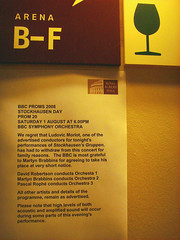
Proms: Stockhausen Day

My feet are killing me. Three hours is a long time to stand up. One thing Stockhausen isn't into is the ten-minute modern piece that sits embarrasedly on the edges of a lot of orchestral concerts. If I was ten years younger I'd have gone to the film screenings and discussions that formed the first part of the Proms Stockhausen day, but I' m getting on and have domestic concerns like getting the shopping done and recovering from the sort of hangover I never used to get after a night playing ukulele in a pub, so I skip all that and go straight to the first concert of the day.

I first heard Gruppen about 10 years ago, when it was performed by the CBSO in Birmingham. Then, as now, the piece was given twice; this works very well, as the piece is so much about the spacial placement of sounds that shuffling about to a different spot for the second performance seems almost a necessity to start to have a proper sense of it. So this is the third time I've heard it.

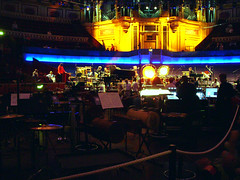
It doesn't grab me as much this time as before; we're standing in a very crowded arena, with all the really tall people in front of us obscuring any view. Two of the groups have been placed in the arena itself (hence the crowding), but they're at the front end, close to the stage where the third is, so there's very little scope to get right in the middle of the sound field. This seems like poor planning. Wouldn't it have been better to have them at the back, or even construct platforms over some of the stalls? It's not as if they're full, although the turnout's quite respectable (I'm reminded of the adage that there's no hall like the Albert Hall for looking half-empty when it's half-full). That would have left both more space in the arena and more space between the orchestras. As it is, it feels like I'm only really hearing half a performance, only getting a dim sense of the interplay between the groups. And the iconic brass chord that hockets around towards the end doesn't seem to take flight, quite.

There's some shuffling as the players leave the stage (and arena), and I'm briefly distracted by a man in an orange T-shirt (which I think of as a sure sign of a wanker) telling his girlfriend how this is what it's all about, all pop music is crap, the Beatles are crap . The next piece is purely electronic - Cosmic Pulses, the 13th Hour of Klang, the cycle Stockhausen was working on when he died last year. it's always a slightly odd experience, sitting in a concert hall listening to disembodies sounds, but then again Stockhausen's so wildly ambitious in what he does that what seems awkward in lesser talents seems perfectly proper here. The hall is in almost total darkness, and the pinpricks of light coming through the dome make it feel like we're looking up at the night sky searching for UFOs, appropriately, as it turns out.

There are 24 loops repeating at 24 different speeds (I read later in the programme notes - one occasion where I should have read them before, I think). From the point of view of the listener, there's a swirling, pulsating mass of sound hanging in the air above us, and it's maybe closer to the aural equivalent of looking at a sculpture than listening to a conventional piece of music. I change my mind about it at least three times during its 32 minute course, at first fascinated by its whirling texture, and overwhelmed by the experience of hearing the sounds swoop around in such a large space. Then as it continues it seems to become oppressive, and I wonder if this isn't a perfect demonstration of the megalomania that many wild accuse Stockhausen of, the sense of himself as God. Certainly I feel like I'm a tiny mortal gazing up at an ineffable and indifferent universe. I feel pinned down by one enormous ego, forcing me to accede to his will. Perhaps this is the sound we will hear when the aliens arrive from Sirius to take over our world. By the end, as the loops gradually complete their cycles and the texture thins out, I'm filled with wonder again, as the skies seem to clear.

The solo trumpet of Harmonien, part of the fifth hour of Klang, follows, and it seems like a breeze blowing though the hall after the swirling dense clouds of Cosmic Pulses. It's a very simple piece, essentially a succession of elaborately embellished melodies that seem heartwarming in their straightforwardness.

Finally, an interval! I've heard some wonderful music, but I've been standing up for an hour and a half, and I'm grateful for a chance to sit for a bit. When I go back in I still can't get into the middle (although that tall man who stood in front of me and farted all the way through Cosmic Pulses has managed to get there - honestly, there's no justice), so I settle for a position right by the other orchestra in the arena. At least I'll get a view of something this time. I become aware of a voice droning on behind me. The wanker in the orange shirt (who talked all the way through Cosmic Pulses, by the way - obviously not so enamoured of Stockhausen that he feels the need to listen that hard) has moved too and is still behind me! I'm obviously being punished by the cosmic forces for my doubts earlier on.

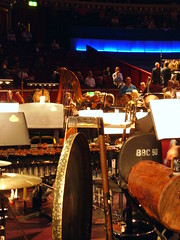
Kontakte seems like a glimpse into another world. I've seen old black and white film of this sort of thing in the 50s, a couple of men surrounded by percussion bashing away in the heart of a tape maelstrom, and here it is, brought forward into the living colour 21st century. It is dated in only the way as yesterday's vision of tomorrow can be. This isn't necessarily a bad thing - I love old sci-fi movies, and this has something of the same innocence about it, an excitedness in Creating the Future that remains inspiring rather than laughable because, well, a lot of the future (your present) was created here. The taped sounds' movement through space is of course less sophisticated than a recent work like Cosmic Pulses, but this was created, after all, at a time when computers barely existed, let alone anything that was available to a musician to play with. It seems somehow to have passed through being dated and become in its way timeless.

Gruppen's much better the second time round - whether this is because it's played better or just because I'm in a better position I couldn't say, but it suddenly seems to come into focus, and the drama of the interaction of the three groups seems more apparent. Although the percussion section's maybe not the ideal place to be right by if you want to hear anything else when they're in full swing.

Afterwards, I reflect on how there often seems in Stockhausen's music to be a moment, near the end, when the violent, thorny textures subside, and something more introspective and lyrical comes through, a lyricism that he tries to suppress but can't entirely. If you ignore the received wisdom about his fearsome reputation and just listen, you come to the conclusion that he is in essence a Romantic composer.

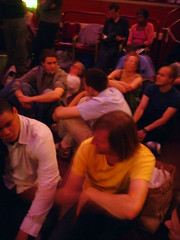
It's been a long evening, but I can't miss the opportunity to hear Stimmung live. It's a piece like no other, by Stockhausen or anyone else (although LaMonte Young would probably disagree with me on that). I'm annoyed by the Radio 3 woman who comes on and subjects us to one of those slightly inane introductions you get on the radio. I don't want to hear this drivelling bollocks, I want to hear the fucking music, thank you. Fortunately it doesn't last long, and the performance begins. The stage is set up according to Stockhausen's strict instructions, the singers entering silently one by one (only one person didn't get the hint in the announcement that the long silence at the start is integral to the piece and tried to clap them on) and sitting in a circle on cushions on a rug in "earth colours" (beige) round one of those globe lights that was so popular in the late 60s.

It's easy to make fun of this sort of thing, but it works because it's done with sincerity, and it highlights the home-made feel that a lot of Stockhausen seems to have, which gets derided by some but to me is an essential part of his appeal.

That one chord, slowly changing through time, punctuated only by occasional speech, is an extraordinary thing to experience, lying on your back staring up at the ceiling once more. There's a terrible wrench when it finally winds down to its close, and I have to run out as the applause starts to catch the last train home. I feel awake, and don't want the evening to end. That chord gets inside you and resonates, so that long after the performance is over it still seems to be sounding, buzzing inside your skull as you walk home.

Wednesday, July 30, 2008

The centre cannot hold

Some interesting and thought provoking stuff in this article, which I found via Molly Sheridan.

I was particularly taken by this:

Nobody in Winnipeg's classical community was upset last year when the Winnipeg
Symphony Orchestra played a new concerto for turntable and orchestra written by
Nicole Lizée, who plays keyboards for the Montreal band Besnard Lakes. I think
that's because the WSO and Lizée (who studied composition at McGill University)
were seen to be absorbing a dynamic bit of pop culture into the body of
classical music.
That's not so different from what Bartok did when he
imported elements of Hungarian folk music into his works for classical
performers. In both cases, something was pulled from the margin into the centre,
and the centre became stronger.

It occurred to me that this is actually phrased the wrong way round: it assumes that So-Called-Classical-Music is the mainstream. But surely it's the DJ who's at the centre of contemporary culture, and the orchestra that's at the margins?

Dvořák once thought that Black American music, in the form of spirituals, would be the future of composition. He was right, but not in the way he thought. He assumed that the melodic and harmonic principles of the spiritual would be absorbed into the traditional structures of European art music (the symphony and so on) and renew them. In fact, what happened was that the melodic and harmonic principles of European art music were imported into an entirely new structural aesthetic to create Jazz. I wonder if something similar might be happening here.

Monday, July 28, 2008

Scaledown

The trouble with gigs in pubs, of course, is that your memory of them will tend towards the hazy next day. So if you don't get around to writing about Friday night until Monday lunchtime you're ineviatbly going to end up a bit vague. Fortunately I have the excellent people behind Scaledown's website to remind me more or less who played, and the rest I must piece together as best I can.


Everyone here's an amateur tonight, in the best sense: that is, they're here for the love of what they do, and barring whatever pennies get thrown into the hat that's passed around halfway through the evening they're getting no payment for their performances.


First up is Alain Lacroix, who is both small scale in that his act consists of just him and his guitar, and large scale in that his 15 minute set consists of just one song. It's all about the story, he tells us. I'm not sure what the story was, to be honest. The sound's a little bit prog, with a dash of XTC in it. Perfectly pleasant, if meandering and ultimately not my thing.

Dave Hopkins represents something rather different for Scaledown, not least because he's not actually here. His 30 second films are very funny, and I recommend you go over to YouTube and watch them, it'll be a lot easier than craning to see a laptop as we had to do. There are a couple of gig shorts at the end of his set that aren't as interesting, as there it turns into a camera pointed at a band, and his links between films ramble, but the main meat of it's very good indeed.

Vic Goddard was supposed to open the show, but he got stuck on the tube from work (his day job is as a postman these days), but he manages to get here and performa several songs, accompanied by Scaledown hosts Mark Braby and Dan Whaley on ukes and the guitarist from Subway Sect (can't remember his name, sorry - this is what happens when you try to remember details from a night in the pub several days ago). Goddard's a legend, and again, the vibe is, in the best sense, amateur - a man who's standing up becasue he has something he's passionate about, with no ulterior financial motive.

The Southern Tenant Folk Union have played here befroe, I see, but I wasn't there. At the moment I'm partial to anythign with "Folk" in the title though, so I'm looking forward to this one. Disappointment looms when they announce a song called "Cocaine" thjat turns out not to be the one Davy Graham sang. Every song seems to be preceded by a mention of their two albums, and that palls fairly quickly. They play very well, very slickly, but there's something not quite right about them. Maybe it's the over-earnest, mannered replication of a certain style, maybe it's the fact tht they sing in cod-American accents, which seems fake after Goddard.

There's always one act at Scaledown you think's wank, and tonight Oli Mayne, Thanos Chrysakis, and Jerry Wigens are it for me. As my companion notes, anyone advertising their use of a "Chaos board" is boding ill, and so it proves. I'm sure it's great fun playing with your knobs, but that's no reason to do it in public. Music to stroke chins by (or other parts of the body. But not in puiblic).

John White also twiddles knobs, but as you'd expect from the man who invented Systems Music, played a leading role in the British experimental music movement of the early '70s (that also gave rise to such diverse composers as Howard Skempton and Michael Nyman) and has written over 160 piano sonatas, it's of a different order to the previous turn. It's determinedly lo-fi stuff, a couple fo cheap casio keyboards wired together and forced out of their comfort zones. What makes it fascinating rather than self-indulgent though is White's keen ear for what works, and his sense of humour. He's very serious about what he does, but never po-faced, and will happily title a piece "Significant parachute jumps of 1910", after the fact that the first successful paarchute jump took place in 1911. It's this combination of seriousness of purpose with a sense of the ridiculous that gives his music substance, and it's a priviledge to be able to see this inventive and under-appreciated man peform.

I do have some photos, but they're not great, so here's something different, a little extract from the sound between sets:


Friday, July 25, 2008

Veneer

It's very easy, if you're white and middle-class like me, to assume that we live in a more tolerant world than the one of, say, 30 years ago. That prejudices once taken for granted are now equally taken for granted as unacceptable. And yet if you stop and listen, it's amazing how quickly you'll hear casual, unthinking prejudice raise its voice in the most adamantly liberal quarters. I count myself lucky to have friends who face this at first-hand, because it gives me a second-hand view, which is better than ignorance. Whether it's the funny voices of those funny foreign people with their funny foreign names and extra melanin, or the utter lack of awareness of the issues involved in day-to-day getting about if you're disabled, or the assumptions people make about people whose chromosomes developed rather differently to most of us, or those who fuck their own sex, don't assume that because we don't have advertising like the picture above (memorably featured in the film of Daniel Clowes' Ghost World) we're necessarily better than we once were. Just not quite as gob-smackingly awful, all of the time.

Other people have fought battles to bring us even the tiny step forward we've come, and one such man was Julius Eastman, whose remarkable music I've been listening to and will write about soon.

I'm just as bad as anyone else, of course, it's just that I have people in the immediate vicinity who keep me aware of the awful thoughts that lurk within. Everyone's a little bit racist, after all.

Cue music...


Prom 10: BBC Philharmonic / Tortelier (RAH)

Another dish of meat and potatoes? I must watch it, I'll get fat(ter).

Arnold Bax is one of those composers. You know the sort - English, tonal, vaguely post-romantic, championed by a lot of slightly scary obsessive middle-aged men who can't understand why this doesn't get played all the time on the radio instead of all that modern rubbish, and form a society (fan club) to prove their devotion. There's nothing exactly wrong with In memoriam, which receives its first public performance here. It's inoffensive waffle, and slightly less glum than Bax often is. But I was still bored by the end, as I always am by Bax. In a while I'll forget about this piece and start fretting again that he's a compose I ought to listen to more of. But i don't think I'll ever hear anything that'll actually make me want to.

Rachmaninov is surely near the top of anyone's list of composers you ought to think are a load of rubbish but don't. He ought to be irredeemably cheesy, but there's something about him that stops short of that. He's at least as glum as Bax, but people don't seem to comment on that much. His First Piano Concerto isn't played as often as the later ones, and it becomes clear that this is because it's not as good as them. It's okay, all the elements of his sound are there, but at this stage in his career he hadn't quite worked out how to stitch the bits together effectively. Yevgeny Sudbin plays brilliantly (as do the orchestra), and also looks frighteningly young from my perspective in the foothills of middle age. "But he's a child!" I think. He was born in 1980, so he's hardly a prodigy by now. But that seems practically foetal to me.

Vaughan Williams' Fourth Symphony is one of those pieces that always astonishes, not least because it's by Vaughan Williams. When I was young and foolish, I thought old RVW to be a crashing bore (Yawn Williams, I called him. God, I was funny). Then I heard this and the Sixth and realised I was going to have to change my mind. Would this extraordinary, violent and dissonant work get such an enthusiastic reception if it wasn't presented under the name of the patron saint of Classic FM, composer of The Lark Ascending?

Everything's here that hasn't really been about so far in the concert: anger, tension, and also a very sardonic sense of humour. Not a cowpat in sight. It's hot in the hall tonight, very close and sweaty. But that hardly registers when you're gripped by music this powerful.

Thursday, July 24, 2008

Simplicity is a complex business

Obviously, living in this Google-Age of interweb ionformation overload, nowadays I've got the attention span of a goldfish, and not a particularly bright one at that. But I would like to draw your attention to this excellent post by Kyle Gann, which says a lot of very intelligent and insightful things that I agree with but don't posess the writing ability to express as beautifully as like wot he does, and is so good that I read right to the end, despite it being more than two paragraphs long.

Tuesday, July 22, 2008

Prom 7: Stuttgart Radio Symphony Orchestra/Roger Norrington (RAH)

There are fancy cordon bleu dishes, exotic Eastern cooking, and then there are meat and potato dishes. The classical equivalent of meat and potatoes is overture-concerto-symphony, and that's exactly what was served up at tonight's Prom.

The thing is, meat and potatoes may not have much in the way of an exciting reputation,but sometimes you need something straightforward instead of all the fancy stuff, and the fact is that unglamourous as it may seem, a well-cooked side of beef and perfectly roasted tats is a meal that's hard to beat. And, to stretch this tortuous food metaphor a little further (don't worry, I'll drop it in a minute), the chefs of Radio Stuttgart delivered in many ways a perfectly timed roast dinner. Having said that, I have some doubts. But I'll come to those in due course.

Rossini's William Tell Overture is one of those pieces that's so famous I'm not even going to bother linking to Wikipedia about it, so famous that the prospect of hearing it fills me with almost no excitement at all. Luckily, Norrington and his band aren't as jaded as me, and a nimble performance reminded me that heck, this is really fun music. Obviously no-one these days can entirely pout the Lone Ranger out of their mind, and Norrington seemed to acknowledge as much by turning to the audience and winking when that bit started.

Jean-Guihen Queyras was the soloist in Haydn's wonderful C major Cello Concerto, and a very fine performance he gave too, the slimmed down band behind him providing able support, while Norrington hovered behind him, wisely leaving the players largely to it. This was an interpretation that seemed to point out Haydn's debt to Vivaldi, although the cadenza seemed to point forward to Beethoven.

My doubts set in in the second half. Not that the performance of Elgar's First Symphony wasn't in many ways a rewarding experience. But Norrington's advocacy of "authentic" performance practice seems to have hardened into dogma, and where he once seemed iconoclastic he now seems like a fundamentalist. It's true that players in Elgar's day tended to use less vibrato than they would now, and I'm generally all in favour of a more restrained use of it. But it's just not true that they used none at all (we do, after all, have recordings of Elgar himself conducting this work, albeit in the early '30s), and a device they would certainly have used much more liberally than modern orchestras would, which was entirely absent from the Stuttgart players' technique, is portamento. Norrington also shied away from any great rubato too, which, as can be heard in his recordings, Elgar certainly wouldn't have done. There were moments when the lean string sound brought great benefits to the piece, but others where it didn't. To call this style of performing historical/authentic is simply inaccurate, and I found these worries nagging at me throughout, which stopped me enjoying what was, I should emphasise, some very fine playing.

Another thing about Norrington's idea of performance practice involves that perennial bugbear, applause between movements. Now I'm pretty relaxed about this sort of thing on the whole: people clapped between movements in the Haydn, and it was fine as far as I'm concerned. But Norrington goes beyond asserting a right to do this into insisting on it, and in a piece like the Elgar, which is clearly conceived as one large span of music, and even ends its first three movements quietly and anticlimactically this seems to destroy the mood. If it's wrong to stop people applauding, it's equally wrong to stop people having a moment's quiet reflection after the heartfelt slow movement before the finale creeps in. Norrington's a fine, eccentric showman, and he'll undoubtedly handle the dreaded Last Night very well, but in this instance what once seemed a fresh approach seems to have ossified into willfulness.

Monday, July 21, 2008

Folking about: Proms 4&5 (RAH and Kensington Gardens)

A day devoted to folk music has been sneered at in some quarters, but I think it's absolutely right that the Proms should do this sort of thing, not least because the SCCM* scene could take instruction from the folk scene: a small, minority interest that for many years seemed threatened with extinction at the hands of indifference, a perception that this was a dead or dying genre with nothing to say of any relevance to the modern world, and well-meaning but misguided fundamentalism on the part of some of its most zealous advocates. Sound familiar?

We sauntered into Kensington Gardens at lunchtime to find the Folk In The Park mini-festival in full swing; scratch choirs and orchestras merrily hacked their way through some choice tunes, if to slightly limited effect to those of us who weren't right at the front (but that's open-air singing for you), while nearer to my eyes and ears some Morris Dancers did their stuff. Morris Dancing's had a terrible press over the years, unfairly I think, which I suppose is down to the general public's desensitisation to the point where jumping over each other with bells strapped to your legs and whacking clubs together can't substitute for actually getting your cocks out and waving them about. A shame, because in the right hands (stop it) it's a raucous affair with a healthy lack of reverence for its own traditions. I hadn't realised what a major part of it all was having the musicians hurl abuse at the dancers. The climax to our outdoor sojourn was a short set by Bellowhead (of whom more later).

The clouds began to cover the sky, so it seemed fortunate that it was time to head over to the Albert Hall for the first concert of the Proms's first Folk Day (the way they went on about it, you'd think folk hadn't existed before Roger Wright decided to bring it to South Ken, but I shall not continue in this measly-mouthed vein, as I come to praise the Folk Day, not to bury it).

This was a bit of a hodge-podge of a concert (rather as the First Night was): We began with an a Capella turn from the excellent young singer Bella Hardy (of whom more later also) which then segue into a performance of Vaughan Williams' English Folk Song Suite by the Royal Northern College of Music's wind band. Being an afternoon concert, and hence rather more al fresco than your normal RAH affair, there was a smattering of applause after the first movement, which obviously utterly confused the lighting technicians, as the stage then went dark, then after a while the lights went up, but on the wrong group, and finally the RNCM were given back enough illumination to continue. They played very well, too.

The other group was the London Sinfonietta, which now lit up a second time to play for the first time: a couple of Percy Grainger arrangements. Grainger's a fascinating figure in the history of the folk revival, and undoubtedly we owe him a great debt, but his arrangements outstay their welcome and come across now as an eccentric curiosity. Then, after another turn from Bella Hardy, they were joined by Monica Bacelli for a performance of Berio's Folk Songs, the work he composed for his sometime wife, the late, great Cathy Berberian.

These are wonderful arrangements, subtle and glowing. They're also completely lost in the cavernous Albert Hall, and especially after the (miked) Hardy, the (unmiked) Bacelli) came across as distant and affected. She's a fine singer, but fell between the stools of not sounding folky enough, yet also sounding less convincing in her theatricality as Berberian would (a problem anyone's going to have in this work). The audience was getting restless, and that didn't really help. So all in all, this first half ended with proper folk:1, art-folk 0.

The second half began with Folkestra, a group of Northeastern young players organised by Katheryn Tickell, who turned out to be largely the flowery-dressed young lasses we'd had standing next to us in the first half. They play beautifully, and have an easy-going air about them that doesn't however distract from the evident care they put into their performance. And they had a clog-dancer, which is always a good thing.

For me, the highlight was the next act: Muzsikás, a quartet of Hungarian fiddlers who played a selection of traditional tunes with an energy and authenticity that was a marvel to behold. The audience began clapping along spontaneously, and I realised that what I really wanted to do was listen to this lot all evening, preferably in some small Eastern European bar. This was something quite startling: folk music, not reconstituted and revived, as English folk of necessity is, but a living tradition, ancient and yet utterly contemporary. They then joined forces with the London Sinfonietta for a performance of Bartók's Romanian Folk Dances, the classical ensemble alternating with the folk one, presenting their own versions of the dances, then coming together for the finale. This was a stunning performance by all involved, an entirely successful coming together of the art and folk strands of the concert. It also confirmed the suspicion I've long held, that contrary to what you might think Bartók's use of folk song is a watering down rather than a spicing up of the original's rough, dissonant harmony.

Which left Katheryn Tickell's "Confluence" rather redundant, as that was clearly intended to do the same thing, adding Folkestra into the mix for the climax of the concert. Unfortunately, having brought everyone onstage there seemed to be no real reason for the work beyond this inter-disciplinary jam, and the whole thing meandered along pleasantly but inconsequentially. It came across like a precis of what had gone before, done for no real reason than because they could.

The evening concert, meanwhile, featured three acts, two of whom we'd already caught a glimpse of. Bella Hardy had already demonstrated during the afternoon what a beautiful voice she has, and her set here was equally impressive, adding her own fiddling and harp and concertina to the palette to produce a sound that managed to fall entirely within what you might call a purist definition of folk, but never seeming anything other than fresh.

Martin Simpson, meanwhile, represents another aspect of tradition in a set that I wasn't sure I was going to like at first, as after Bella Hardy it seemed to have a whiff of noodling about it. However, he's such a persuasive performer that I soon settled into the more introspective mode, and ended up thoroughly bewitched by his mellifluous guitar style (and was impressed by the way he avoided those awkward pauses you often get while a player re-tunes by making little sketches of music out of his string adjusting, wryly commenting on the unashamed way classical musicians tune up.

Bellowhead are in some respects about as far from traditional or purist as it's possible to get, and yet they escape the trap of crossover hell by the simple fact that no matter how loud they get, no matter how many Latin rhythms or dance beats they throw in, everything they do has its roots very firmly in the folk tradition. There are different ways to extend and revitalise a tradition though, and giving it a good (friendly) kicking can be just as effective a way as tender care.

It's easy to knock this sort of day as tokenism, and I guess the proof of that particular pudding will be in whether further potions are served up in future years. I hope that happens, as this day has scratched the surface of a very deep mine that could be profitably explored for a long time. When you think that a century ago, as Vaughan Williams and Cecil Sharp travelled around the British Isles collecting folk songs, that this was a tradition on the brink of extinction, it's remarkable what a healthy and diverse landscape now exists, and it's a thought worth dwelling on that without Vaughan Williams there might not be Bellowhead. It's fascinating both in its apparent unlikeliness and its potential to spark new connections and evolutions, and this is just the sort of thing the Proms ought to be nurturing.

*So-Called Classical Music

Friday, July 18, 2008

each moment gone as it comes

There's an undeniably manic-depressive element to composing (or any creation): ideas, and the energy to work on them, do not flow constantly, but splutter, sometimes disappear to the extent that one is ready to declare them extinct, then suddenly flood forth without warning, to such an extent that one struggles to catch them, and must surreptitiously scribble while keeping paperwork handy to preserve the illusion that one is getting on with the uninteresting things that are nevertheless what justify the wage that keeps the bills paid and the food stocked. Notebooks become like buckets, filled with as much of the deluge as the clumsy pen skittering across the page can manage, in hope that these fragments may provide some nourishment when the drought returns. Fecundity ought to be something to be celebrated, revelled in, but it becomes another source of anxiety: what happens if this doesn't last?

This is the root of it: to get down the ideas, as many of them as quickly as possible, while they still come. While they do come it feels as though this is the only way it could be; and the same is true when they disappear and will not come, no matter how much one may long for it.

Too much or too little; dissatisfaction; achievement. And the hope that what has been achieved will serve us through the lean times.

And what then? The hope that it begins again. And so we continue.

Thursday, July 17, 2008

My precioussss!

Just when you thought we'd seen off this sort of thing, I see on Coolfer that the record companies are up to it again.

I can see why the EU is concerned about artists' income, but it really isn't about starving singers, it's about big corporate companies clinging onto their cash cows.

95 years? 95?? Just how long do you need to recoup an investment? Forever, I'm sure they think.

I'm not at all convinced by the get-out clause, either. It reminds me of the sort of contractual thing that DC used to screw Alan Moore.

If the record companies put half as much effort into nurturing new talent as they do in clinging onto their old warhorses, the music industry would be in a hell of a rosy state.

Wednesday, July 16, 2008

Is your critique really necessary?

This interesting article (which I found via the splendid folks at the Detritus Review) provides much food for thought on the place and aesthetics of criticism. Defeatist Towers is of course on the whole a repository of half-witted ranting and raving rather than proper criticism that actually says clever stuff, like, but I like to believe that it all serves some sort of purpose in exploring ideas and thoughts about music and whatever else I drone on about. I sometimes wonder if there's any real value in what I type here, it being all pretty subjective and often outright ignorant, so it's good to have someone with more brains than me justify the utter lack of critical distance I so often display. And as there's a debate in the air about critics, bloggers and the relationship/divide/overlap of the two, it's always good to have some more ideas chucked in the pot. Call it work in progress.

Friday, July 11, 2008

Judas

They've just finished the second song, and the crowd seem restless. There's a lot of slow clapping going on. They carry on, anyway. The sound's raw, loud, kind of sloppy. But it's exciting and immediate too. At least that's how it sounds to me. I'm not hearing it like those unhappy people in the audience, a sinking in that we're not in Kansas anymore. I know I'm not in Kansas anymore, I wasn't even born when we left.

There's some enthusiastic cheering as they reach the end of song 3. So it's not a given that what they're doing is alienating. Some people like it.

It really is loud, though. I want to turn the volume down on my earphones (an option not available to the people in the hall), but I'm going to stick it out, because there's a thrill in it, a sense that I'm transgressing something, even though it's only in my own mind (and whatever tinny hiss is escaping my headphones and reaching those at the desks next to me).

The slow hand-clapping starts off, and he tails off his introduction to the next song... the audience falls silent, and he continues. The cat-calls resume, and are starting to grow. There's a definite air of menace. I can only hear, of course, but it sounds fair to say the audience is divided.

Well, that one seemed to push them a bit far. The guitarist's tuning, and the jeering is growing. The singer is mumbling into his mike, speaking nonsense as far as I can tell. Eventually the claps subside as people realise he's talking and they can't hear what he's saying: "...mblmblmblmblmblif you only wouldn't clap so hard." There's a smatter of applause at this, so I guess he still has his supporters, they haven't all turned against him.

The thing is, you can't really tell what the audience is doing during the songs, because it really is fucken loud.

The guitarist is tuning again now, and the atmosphere really does sound like it's getting ugly. The piano starts off, and this song' different to the rest; where there's been a lot of exuberance before, now there's palpable menace, the hostility in the audience reflected back at them. "Something is happening, and you don't know what it is..."

They finish, there's more heckling, the audience laughs. One man shouts out. He's just saying what he thinks, he doesn't know he's just become part of a myth.

The singer's exasperated. "I don't believe you!". Then he realises the literal meaning of what he's just said. "You're a liar!"

Then, to the band:

"Play it fucking loud!"

How does it feel?

Thrilling.

(There's some clapping at the end. A few stuck it out, then. Animated discussion. The national anthem comes across the tannoy. Then the tape cuts out.)

(Seems someone's always upset about something, aren't they?)

(Now go here.)

Wednesday, July 09, 2008

Eight Songs for a Mad King

A heated debate on the Grauniad blogs in response to an article by Joe Queenan on why all modern SCCM* is rubbish (of course I put my tuppenceworth in) takes me back to when I was 11 or 12 and encountered my first bit of real, proper, honest-to-god modern music: Peter Maxwell Davies' Eight Songs for a Mad King.

It was an LP in school, performed by the excitingly named Fires of London, conducted by the composer and with a chap called Julius Eastman singing (well, vocalising, anyway) and it was one of the most extraordinary things I had ever heard. I started off laughing, then being delighted at the extraordinary sounds that were coming out of the speakers, then finally captivated and shocked by the realisation that what I'd first taken for comedy was in fact searing horror.

I grew up in a house where music abounded, but I'd heard nothing like this: my parents' favourite composers were Mozart and Haydn, and the other sounds I heard were my brothers' and sister's rock and pop records. This was something entirely new: it was wild, crazy, untameable stuff, and it felt as though I'd lived a life in black and white** and suddenly been catapulted into the most garish technicolour imaginable.

I (and several of my friends) became obsessed with the piece; I ordered in the score from my local music shop and marvelled at it - it seemed to function as much as a work of art in itself as a set of instructions for which notes to play when. We harboured the idea that we might try and get hold of the parts, construct the giant cages in which the players sit, and perform it. We never did of course. I wish we had, though. It would almost certainly have been a terrible performance, but it would have been a hell of an exciting thing to do.

It's that feeling of intense excitement, that I'd discovered a new world and could never think of things in quite the same way ever again, that set me off on the road to this disreputable role we call "composer", and it's the feeling I still look for even now, which is why I still listen to new music and refuse to sink into comfortable middle-aged predictability. It's also why, when I want to explain what contemporary SCCM is and how magical it can be, I think of that record first.


*So-Called Classical Music

*Well, orange and brown; I grew up in the 70s, after all.

Friday, July 04, 2008

What we call the beginning is often the end

And then there are those pieces that are indisputably unfinished. I think in particular of Bruckner's Ninth Symphony, which I've been listening to and thinking about a lot recently. And in particular the realisation of the finale, a controversial project.

Where his finished symphonies offer one sense of an incomplete project in their multiple workings of the same material, the surviving sketches for this movement offer another side: the work that can only be experienced as work in progress.

This is where facts, traditions and romanticism collide: the tradition has grown up that the three complete movements are in themselves complete, and therefore it's unnecessary to attempt to complete the fourth. But it's certain that Bruckner didn't think this: on his deathbed, realising he wouldn't live to finish the symphony, he suggested that his Te Deum be used as a substitute finale. So whatever else he may have thought, he definitely didn't consider it as a three-movement piece.

In was amazed when I discovered that there was a playable version of the finale: I grew up, like most people, thinking that nothing existed of it beyond a few scraps, and yet it turns out that there's enough there to show that Bruckner had the design fully formed in his mind, and was probably only weeks from completing a draft score.

It's remarkable how hostile some people seem to be to the idea of this reconstruction. Of course it's to some extent speculative, as it has to be to provide a satisfying listen (you can't listen to an unfinished piece of music and really get much from the fragments in the way you can look at an unfinished painting), but isn't it better to have an idea of what the composer intended rather than cling to a delusion?

Gottfried von Einem, by the way, wrote a piece called "Bruckner Dialogue", which uses the chorale from the finale of the ninth, which seems another alternative. It's certainly far from what Bruckner would have intended, but it does acknowledge the truth that there is an enormous vacuum in the wake of the slow movement. It seems to me better to recognise, and not deny, this absence.

The finished and the incomplete are two extreme ends of a spectrum, and there's a lot of space in between, a strange and forbidding place that nevertheless can offer great rewards to those brave enough to explore it.

Wednesday, July 02, 2008

The end is where we start from

When is something finished?

I crawl through my manuscript, typing it slowly and painstakingly onto my PC, changing notations here, making cuts there, elsewhere inserting or rewriting passages. When I've got to the final bar I'll go back again and may well see other points ripe for change. And then I may do it again.

But at what point will I decide that enough's enough? It's a question that every composer has to face. One of the composers who taught me told me that his rule of thumb is that a piece will have to be draughted about six times before it's ready. If you're lucky you might get it done by the third or fourth.

Art is never finished, only abandoned, as one artist said; some take this to extremes - Pierre Boulez designates pretty much his entire oeuvre as "work in progress", which seems a bit extreme to me. When I worked for a music publisher, often were the times that a piece seemed doomed forever to stay in revision hell - one (very fine) composer in particular had enormous trouble with the concept of letting go, and continued to tweak and tweak at scores for years after their premieres. It's one thing to rewrite music that doesn't work as well as it might, but endless tiny alterations seem top me to be a symptom of neurosis, which I guess stems from the awful pressure on composers to produce "Masterpieces" - that strange quirk of the so-called classical music world where it seems unacceptable to admit that a piece may be a great work while still containing weaknesses.

I think of Bruckner as well, re-writing his symphonies (sometimes on his own initiative, sometimes at the behest of well-meaning but misguided supporters) to such an extent that different versions stand as entirely different works that just happen to use the same material. There's a parallel to be drawn here with Boulez and his re-writes - the piece as an ever-evolving entity, that cannot be definitively fixed. This goes against the dogma of the score as Bible that underpins all SCCM since the late 19th century, the same dogma that sparks the kind of neurosis mentioned above, and perhaps, as infuriating to librarians and cataloguers as it is, it represents a way out of the straitjacket of the score, and the Masterpiece.

Access all areas*

The Internet Music Score Library Project is back online.


Attention, publishers: This sort of thing could be good for you, if you work with it rather than against it.


*Well, except the ones you can't access, of course.