The excellent Campaign for the prevention of Joss Stone draws my attention to some very naughty record company minions posting wildly enthusiastic reviews on Amazon for the yet to be released album by sub Il Divo* (if that's possible) blandtastic goons Blake. Go there and redress the balance. Together we can defeat this thing.
(Incidentally, how do clowns like these get away with describing themselves as "opera singers"? They wouldn't last five minutes on stage at Covent Garden.)
* Italian for "The Divs"
Wednesday, October 17, 2007
We're not gonna Blake it.
Monday, October 15, 2007
Dodecaphony 2.0

(Link from the estimable Alex Ross.)
Saturday, October 13, 2007
A word from our sponsor...

Friday, October 12, 2007
Time, please, gentlemen
I read on a crappy free paper on the train home that a survey of 3,000 people who downloaded the new Radiohead album reveals that a third of them paid nothing for it, but the band still got an average of £4 per copy, which puts them quids in on what they'd get if they were signed to a major label. Apparently 12 out of these 2000 paid over £40, which must mark them out as insane, as they could have got the lovely discbox like 351 others of the sample (and me) and got the download thrown in free.
Overall I think this makes the experiment a success, and a heartening one at that, as it suggests that far from the internet heralding the death of the business of recorded music, that people will pay up for music they have faith in. Great news for those producing good music, bad news for corporate companies churning out soulless crap. Which is exactly how it should be.
Wednesday, October 10, 2007
ill tempered klavier

Blüthners have a very different tone to the Steinway sound you're almost certain to hear in a concert hall - it's a dark, rich, velvety sound. It feels different to play, too - the action on the keyboard is very heavy, and even now, whenever I play any other piano the action seems strangely insubstantial.
It's an interesting question, whether the near-ubiquity of the Steinway sound is inhibiting composers in their writing for piano - maybe the prepared piano is in part a subconscious rebellion against this homogeneity of sound. I also think of such things as Thomas Ades' Asyla, which features in its scoring grand, upright and honky-tonk pianos. Another piano-related memory of mine is when my university bought a fortepiano. I was fascinated by the sound, and the feel of playing it - it felt like a revelation to hear something that was a piano, yet radically different to the archetype in my mind.
There's always a danger that homogeneity will stifle creativity - but there's always the hope thatimagination will subvert conformity.
* I am particularly excited by the fact that Pleyel use fossilised mammoth tusks for the ivory on their keys!
In Rainbows
So, how much did you fork out for the new Radiohead album? Me, being the nerd I am, I forked out the forty quid for the big exciting box with books and pictures and extra music and lovely vinyl. So I have a posh bit of product to look forward to in 6 weeks or so. In the meantime, there's the download version, which I was emailed the link for this morning.
And hurrah! It's absolutely brilliant! What immediately strikes me at the first listen is that they've managed to combine their experimentalism with their undoubted knack for a good pop song in the killer way they've been threatening to for a while. So you've got twisted dance beats, weird retro-futurist sounds, but also big guitars and tunes. So it sounds more than anything like a band.
I ummed and ah-ed for a while about whether to have the big box, or whether to go for the pay-what-you-want download only option. I wonder what I'd have paid if I'd done the latter? Of course it's tempting to pay nothing, but that just seems wrong to me. I vaguely wondered about getting the download and then if I liked it going the whole hog, but in the end I decided to put my faith in them to deliver, and they've come through for me.
I think the way they've released "In Rainbows" is a fascinating experiment (apparently there'll be a conventional CD release next year), and I hope they give us an idea of how many people downloaded and what most people paid. They're lucky enough to be in a position where they can take a risk like this, and if it works, it'll have huge consequences for the record business and bands' relations with record labels.
Monday, October 08, 2007
Know Nono? No?
In the absence of any coherent thing of my own to say (hey, I'm busy), may I point you in the direction of an excellent post about Luigi Nono.
Reach for the facts
If it's on the internet, it must be true, mustn't it? Not necessarily... there's a lesson for anyone doing a research job here: actually do some research.
Friday, October 05, 2007
Scenes from the death of classical music #1
"So, do you think we'll be playing Julian Anderson in 100 years?" a violinist friend asked me last night in the break during our rehearsal for the next KSO concert. Well, will we? Does it matter?
The shortest and probably most honest answer is "I don't know". Who can possibly say with certainty what will and won't be heard in a century? Acclaim in your own lifetime is no guarantee of an equal posthumous reputation - just ask Spohr, Clementi, and any number of other dead also-rans. Who can even say with certainty whether the symphony orchestra will still exist as a performing group? (I have my doubts about this.)
Does it matter? One one level, not at all, as I'll be long dead by then. On another level, it matters immensely, as I'm a composer, and no matter what I may say, I'll always have one eye on posterity. At least some of the motivation for creating anything, whether it be art, music, a building, social reform, whatever, is ego-driven: the desire for immortality. At a tangent to this is professional envy - I don't want some other bugger being remembered if I'm not.
I hope he isn't. This isn't anything to do with him or my opinion of his music. Up until comparatively recently it was normal for a composer to be forgotten after his death, because it was normal to have new music. But something happened in the 19th century, starting with Beethoven - the first composer whose work remained in the standard repertoire after his death, and has never left it* - and now new music is seen as at best novelty, at worst something to be actively avoided. There's too much posterity now. We need to remember to forget. Then there will be room for new musics. Otherwise classical music is just an embalmed corpse. Embalmed corpses are of course interesting to study, but they don't make very good conversationalists. I'd rather spend time with the living.
*"Beethoven started the rot", said Britten. Messiaen on the other hand speculated that music went wrong sometime in the 11th or 12th century, roughly when we started to write it down.
Thursday, October 04, 2007
Free Burma
Today is Blog about Burma Day. I have my doubts about whether such things make any difference at all, (rather like the Facebook Burma group), or are just an easy way for middle-class westerners to feel better about themselves, but on the principle that it is better to light a candle than curse the darkness, and the realisation that there are some things more important than music or the petty gripes I put down here (i.e. almost everything), I shall mention the crackdown that the Burmese government is embarking upon, and add one more voice to the protest.
(And if you're confused by the whole issue of whether it should be called Burma or Myanmar, read this.)
Wednesday, October 03, 2007
There are none so deaf as those that will not hear

Now, maybe I'm going out on a limb here, but it seems obvious to me that this is a deeply ambiguous work, steeped in suggestions that not all is well (and, I suspect, not necessarily in relation to the war). Double meanings in the arts were endemic in Stalin's Russia, and that's what I hear in the ferocious bombast of much of this symphony. I expect to read positivist guff in "official" soviet articles and the like, but what about all those who've written the books, sleeve notes etc since? How can they seriously write that this is a piece that ends happily? Have any of them actually listened to it?
Tuesday, October 02, 2007
RIP
Ronnie Hazlehurst. Rumour has it that he cut a rakish figure, with a Zappa-style moustache, but as I've never found a photo of him I can't confirm it. Spitting Image did a fantastic sketch years ago around the time Andrew Lloyd Webber did his Requiem, in which Melvyn Bragg presented a South bank Show portrait of Ronnie Hazlehurst on the occasion of the premiere of his Requiem. When I was a kid it seemed like there wasn't a show on TV he hadn't written the theme tune for.
Update: Here's a couple of photos. The second one is him conducting at the Eurovision Song Contest. Those were the days.


Sunday, September 30, 2007
PJ Harvey, Royal Festival Hall
"Ooh, no drum kit!" says someone behind me. They're right, too. It must be a small band Polly's got with her tonight.
No it isn't. It's no band at all. PJ Harvey slides onstage in a Victorian frock (as seen of the cover of her new album) and proceeds to play for an hour an a half all on her own. She's got an array of instruments - guitar, piano, autoharp, synths, drum machines - and a couple of roadies who bring them on and off ("Aren't they lovely boys?" she grins). Otherwise, it's just her. There aren't many people who could do this, but her songs actually become more impressive in this spartan setting, somehow seeming even rich and more complex than they do in their recorded incarnations. And of course the most extraordinary instrument of the evening, her voice, ranging from bluesy growl to angelic shimmer, with everything in between.
She's in a fine mood, pottering about the stage from instrument to instrument like a dotty aunt, chatting to us as though we were watching her in the back room of a pub rather than the Royal Festival Hall. In this setting, songs which we always thought of as blues based turn out to sit very nicely in the English folk tradition, and the new songs turn out to be a perfectly natural enriching of what she's already achieved. She plays guitar, and without a band around it, we're reminded just how good she is at that. She plays piano, and seems a bit nervous about that (she doesn't need to be). She plays synths, and does that slightly weird dancing she does, that looks even more singular in that dress. She swears at a drum machine that won't work, then shrugs, noting with a grin that "sometimes you have to accept that when you turn these things on they just don't work... like a lot of people, I guess." Then she plays the songs without the drum machine, and it's mesmerising anyhow.
At the end she gets a standing ovation. "Thank you for coming, and thank you for supporting me!" she says. She means it. She's clearly enjoyed herself, and so have we.
It wasn't at all what I expected. It was an hour and a half long. there was no support. The tickets cost 40 quid. It was one of the best gigs I can remember going to, worth every penny. Polly's a genius.

Saturday, September 29, 2007
You know you've been on the internet too long when...
You fire up the browser to check something, get distracted by something else, eventually shut down your browser, and only then realise you haven't actually done the thing you set out to do.
Friday, September 28, 2007
The end is where we start
When I was a lad, I was determined that I was going to be an artist. I had this dream from very early on (since 3 or 4, I think), and later on it crystallised into something more specific: I wanted to draw comics. I spent hours copying the characters in comics like the Beano, Buster and Whizzer & Chips, and later on the Doctor Who comic strips, 2000ad and the Eagle were obsessions for me. I marvelled at the wonderful worlds that appeared in them, remembered the artists' name and watched out for my favourites, studying their styles and resolved that one day my name would be listed in the credit cards of 2000ad (at that time pretty much the only comic that credited its creators).
It didn't work out like that of course; I failed my art 'O' level (there's a bit of me that wishes I had had the paper remarked, I'm sure I failed at least partly because my main project was done in a very unashamedly comic-book style), but it didn't really matter, because by then I'd started writing music, and it made me focus on that, and despite my intention to keep drawing for my own pleasure, I stopped making pictures (although I continued to, and still do, doodle voraciously).
Then a few years ago, through comics fans I met through the web, who decided to stop being passive consumers and produce their own small press comics, I started again. I was very unsure of myself at first, in fact to begin with I wrote scripts for others to draw, but gradually I dared to put pen to paper and draw once more. It was wonderful, and all the better because the motivation wasn't any idea of career or success, but a love of the medium and a delight in producing something of my own that was there (as opposed to a piece of music, which once finished must lie in limbo until someone can be persuaded to perform it). And now I find myself drawing for payment, something I've never achieved as a composer, and wondering if this might lead somewhere. Strange how things turn out.
Thursday, September 27, 2007
Wednesday, September 26, 2007
White Chalk

Hot on the heels of Joni Mitchell comes Polly Harvey with her latest album, White Chalk. And like Mitchell, Harvey is someone determined not to rest on her laurels. This album finds her abandoning her guitar for piano and an array of string instruments (by which I mean zithers and autoharps rather than violins), as well as abandoning her growly, bluesy voice for a much higher, purer tone, almost like a choirboy.
This is the sort of sound that chimes very well with all sorts of things I've been thinking of lately, so it may be that I'm feeling particularly receptive, but this album's absolutely brilliant. To step so far out of one's comfort zone is an achievement in itself, to do it with such aplomb and success is astonishing. It's also strangely uplifting, in a macabre sort of way. I've loved Polly's music for a very long time, and my admiration for her has grown pretty consistently with each new release, but it's rocketed with this one. To be able to come to this from "Rid of Me" all those years ago puts her into the same league as Joni.
Two wonderful albums from two fantastic musicians in one week is a rare treat. Just to reassure you that the world hasn't suddenly started making sense, there's a new Westlife album on the way. Can't win 'em all.
Tuesday, September 25, 2007
They paved paradise and put up a coffee shop
 It does seem odd - Joni Mitchell, countercultural icon, bringing out her album on the label of top corporate exploiticons Starbucks. But Mitchell of all people has earned the right to do what she damn well pleases, and in a way she's being just as stubborn and contrary as she always was. And the legend "© 2007 Joni Mitchell" reveals the reason she's decided to take her first new material for over a decade to the mocha-mongers; artistic freedom, and ownership of the result. After the things she said after her spectacular exit from the music business, it was never likely she'd want anything to do with a conventional record company again.
So Shine represents an unexpected return to a business she once described as "a cesspool". And it's a very welcome one, because this is a very fine album. It's an album that demands attention though - while it's much easier going than Mingus, it's decidedly quirky and unpredictable, Mitchell's latter day, huskier voice and jazz stylings being put up against often brittle arrangements, staccato wind chords and a palette that nods to pointillism. If I have one real complaint, it's that she uses synths rather than real wind instruments. There's an old-fashioned feel to many of the sounds here (maybe it's simply because after such a long time since her last compositions, she simply doesn't have any new equipment) but it only serves to heighten the individualism of the sound. A lot of reviews I've read note the serenity of the record, which contrasts with the overall theme of the record (that we're all going to hell in a handcart, and Joni told us so), but I think that's a simplistic view of an album that is admirably determined not to rest on its creator's laurels. There's an underlying tension that undercuts the surface calm.
"You don't know what you've got til it's gone", sings Joni in the startling (and effective) reworking of "Big Yellow Taxi". Sometimes you're lucky enough to get it back.
"You don't know what you've got til it's gone", sings Joni in the startling (and effective) reworking of "Big Yellow Taxi". Sometimes you're lucky enough to get it back.
Thursday, September 20, 2007
Silence

It's 50 years since Sibelius died, and approximately 80 years since he produced any significant work. I can't think of any parallel to this. It seems he worked on an eighth symphony for some years, before burning everything he had written in 1943. Tom Service in today's Guardian suggests that this 30 year silence was simply the only appropriate response Sibelius could make after what he achieved in his final symphonies and Tapiola; he simply could say nothing which would not diminish those achievements.
There's probably some truth in this, although it may be romanticising crippling self-doubt on the part of Sibelius. After he burnt the eighth symphony, he became much happier. Maybe this was because he had reached a point where he felt able to let go of his idea of himself as a composer.
I often think about what makes one a composer*, especially when I'm not actually writing anything. If I at what point do I cease to be a composer? Elisabeth Lutyens used to say "If you're a composer, you bloody well compose", which implies that you're only a composer if you're actually writing. This appeals to me, as I've always felt uncomfortable with the presumption and pretension that seems to go with a declaration of "I am a COMPOSER!". And yet, I'm always conscious, even during those dry, unproductive periods, that I feel that I am, in some way. And this is a disturbing feeling, because if I'm a composer, why am I not composing? Generally, before the suspicion that I'm not a composer anymore takes complete hold, I have an idea, start writing,and become myself again.
But that awesome, oppressive 30 year silence of Sibelius continues to haunt me, and sometimes seems as powerful as anything he wrote. I wonder if that happiness that was noted in him after his immolation was due to a sense of freedom, that he had finally abandoned ambition, had unshackled himself from reputation, had admitted to himself that he was a man who had once been a composer, but no longer was.
*Harrison Birtwistle once gave a talk to an audience of schoolchildren, one of whom asked him, "But how do you become a composer?" Birtwistle replied, "Well, you've got to write music. There's no way round it."
Thursday, September 13, 2007
A sell-off by any other name...
The BBC Philharmonic has announced a £20 million sponsorship deal with Salford Council. I believe that having an orchestra to call its own (in riposte to the Hallé's association with Manchester) was a major selling point for Salford Council to become the BBC's new Northern host. The band will retain its name, but this means it has effectively been outsourced. I wonder how long it will be before the other BBC orchestras find themselves the subject of such schemes? As the Beeb is merrily selling off all the means to make television programmes, it seems hard to believe they will continue to fund several orchestras.
Tuesday, September 11, 2007
Comics Britannia

It's quite a decent show, although I'd rather read Little Plum myself than watch Steve Bell reading it, to be honest. Comics is such a personal medium (as the great Leo Baxendale pointed out) and it seems intrusive to watch other people reading them out, as well as inadequate - it's a medium you really have to engage with yourself.
It's an exaggeration to say that Baxendale, Dudley D. Watkins and Ken Reid were single-handedly responsible for all British comics from the 30s to the 80s - but not that much. it was great to see their work discussed like this, and BBC 4 have assembled a wonderful array of talking heads. Good to see such issues as the incredibly racist (to our 21st century eyes) characters that have been quietly forgotten, as well as the wartime propaganda strips.
It tends towards a bit of a nostalgia-fest for my liking, but maybe the impression that comics are something that happened in the past will dissipate as the series goes on, and I suppose given the parlous state of the industry in this country, it's inevitable that it's going to be rather backward-looking. I'd have liked to see some mention or discussion of, say, the recent relaunch of the Dandy, but maybe that would have been too depressing a note to end on.
Anyway, it's worth watching, it seems to be repeated about 20 times over the week, and there's two more programmes to follow, as well as a welter of associated documentaries and reruns of Batman, so give it a look. Or better still, go out and buy some comics and stop them going down the pan.


Friday, September 07, 2007
All Prommed Out
Coming out of the Albert Hall the other night, I felt a mixed bunch of things: a certain elation, but also relief and weariness. As much as I've enjoyed pretty much all the concerts I've been to over the summer, there's a slight but inescapable gladness that it's over now, rather like the feeling you might get after a delicious meal where all the portions have been slightly too big. While the Proms are undoubtedly a Good Thing, you can have too much of a Good Thing, and I wonder how those people who turn up night after night for the best part of three months do it. Perhaps this is why the audience seems to disappear rather than decamp to the Barbican, Festival Hall etc; they're simply sated, and need nine months to let their ears refresh before the next marathon. I wonder if it's entirely healthy to binge on music like this. So I'll raise a glass to another year done, and briefly wonder what the regime change will bring next year. I'm not sure what I'll be doing tomorrow night, but I know where I won't be.

Thursday, September 06, 2007
Pavarotti R.I.P.
So farewell then, Fat Lucy. In between all the references to the World Cup, and possibly the odd reference to the fact that he was an actual proper opera singer who sang whole operas, on stage (not something certain other "opera singers" can claim to have done), let us not forget his abiding fondess for elephants.
Wednesday, September 05, 2007
A post about Nothing
I am saying Nothing. Actually, that's not accurate: I'm not saying anything, but I am typing Nothing. As the time progresses, I type more and more of Nothing. I shall shortly type Nothing again, and then I shall be done, until I type Nothing once more and finish this paragraph.
This is the second paragraph of this post, and I am still typing Nothing. As time passes I am typing more and more Nothing. Is Nothing happening when I type Nothing, or does typing Nothing preclude the possibility of Nothing happening? I continue to type Nothing. More and more I am typing Nothing. This is the end of the second paragraph.
I have now reached the third paragraph of this post. I am typing Nothing. As time passes the amount of Nothing increases. I am not the first person to type Nothing, nor shall I be the last. I shall continue to type Nothing until the end of this post, whereupon I shall type no more. I shall stop typing Nothing. This is the third paragraph of this post, and it ends with Nothing.
The previous paragraph ended with Nothing, but now I am in the fourth paragraph, and still typing Nothing. Nothing will be typed after this paragraph ends. This paragraph will end after the last time I type Nothing in this paragraph. This does not mean that there will be no more typing after the last time I type nothing in this, the fourth paragraph, only that it will end after the last time I type Nothing within it.
Nothing begins the fifth paragraph of this post. As the time passes I am typing Nothing more and more. The fifth paragraph continues with Nothing, and ends with Nothing. Nothing is present in this paragraph. The next paragraph will consist of Nothing.
Nothing.
I am now typing the seventh paragraph of this post, and I am still typing Nothing. I shall shortly stop typing Nothing, as I have been typing for approximately 4 minutes and 33 seconds, which seems a reasonable amount of time to spend typing Nothing.
I have now typed Nothing for the penultimate time in this post, and shall shortly end it. John Cage would have been 95 today. I have now finished typing Nothing.
Tuesday, September 04, 2007
Prom 68: Vienna Philharmonic Orchestra (RAH)
The Vienna Philharmonic have one hell of a history behind them, and a tradition that stretches way back. This isn't necessarily a good thing: it's only within the last five years that they've abandoned the tradition that women may not play in the orchestra. I recall Mahler's definition of tradition as "sloppy habits". They make a fabulous sound, rich and warm and unlike any other orchestra. But it's also a comfortable and slightly lazy sound. And that doesn't entirely suit Bartók, whose Music for Strings, Percussion and Celesta opens this concert. They play with astonishing virtuosity, and conductor Daniel Barenboim brings out a wealth of detail, but it lacks the edge that's needed. The same can be said of Kodály's Dances from Galánta, which is given a surprisingly soporific performance, which nevertheless manages to whip itself into a lively finale.
They play better in Enescu's Romanian Rhapsody No.1; a shame, because it's a less substantial piece than either Bartók or Kodály. The piece that comes off best in this (for the VPO) unusual programme is, curiously, the most modern: the slowly shifting textures of Ligeti's Atmosphères seem to suit the VPO's lush sound very well, and I find myself wondering if this is because its glacial thought processes resemble those of Bruckner, whose music is part of the orchestra's soul.
Barenboim is an astonishing man, buzzing with energy that belies his 64 years. The VPO are an astonishing band, too, rich in tone and dazzling in virtuosity and style. They play an encore, something by Johann Strauss (I presume). They play it wonderfully. That's both what's great and wrong with them.

Monday, September 03, 2007
Who: It's back, then gone, then back again
The Beeb have announced that there will be a fifth season of the resurgent Doctor Who, but not until 2010, with 3 specials bridging the gap after season 4.
I'm not sure what to make of this. Is it a sign that David Tennant will stay for another series, and they're taking a break to accommodate his other commitments? Will Series 5 be an effective relaunch with Tennant and Rusty Davies replaced with new blood? Will they move the show to Autumn/Winter (which is where it ought to be, after all)? Who can say? Well, Who fans can, of course, and you can read some thoughts here. (And probably here, too, but possibly not such sane thoughts.)
I'm apprehensive at the prospect of an almost Who-less year. Still, there's always Torchwood to tide us over, isn't there?
Oh god...
Sunday, September 02, 2007
Two wheels, solitude
It's surprising how many people you see by the riverside at night. Those kids having a smoke, maybe a cigarette, maybe something else, giggles from the dark far bank, men with fishing rods eking out those last few moments before they must return home. Riding in the dark, it occurs to me that if something were to happen, if a tyre were to burst or if I were to twitch so that I steered myself into the water or the other way into a barbed-wire lined ditch, there'd be no-one to help me, it'd be all up to me, and that thought seems more adult than going to work or paying bills. It seems true self-reliance, responsibility for one's own actions, but in a liberating way, not the things that ties us down that we define as "grown-up".
It's also rather satisfying to get home, see that there's a tube strike tomorrow, and realise that it doesn't matter to me. Fuck you, the RMT!

Friday, August 31, 2007
Sonic Youth, Roundhouse
Sonic Youth have always trodden a fine line between experimentalism and indulgence, occasionally stepping over it. One thing they don't have much truck with, though, is nostalgia, so this performance of their classic 1988 album Daydream Nation was never going to be a matter of running through a reproduction of what's on the record. They didn't go as far as John Martyn did when I saw his Don't Look Back concert, where Solid Air was performed in a completely different order and completely different arrangements to the original recording (Martyn's reasoning being that as he didn't have his 1973 band with him there was no point in playing it like that), but when you're a band that deals in feedback as a staple of your sound a certain amount of unpredictability is inescapable before you've even played a note.
Listening to the album before the gig I was struck by how gentle a lot of it sounds now (which may be due to the fact that pretty much all music now seems to be recorded at a monotonously blistering level). Live, you're reminded that Sonic Youth's roots are in the New York punk scene, with the emphasis put on the driving rhythms and a much rawer sound than on record. Then there are those extended moments of feedback, where they sit back and let nature take its course with just the odd movement to manipulate the sound. Although (of course) very loud, there's a strange beauty in here (I'm reminded of the extended feedback Neil Young and Crazy Horse are prone to live, which they even edited into an album). In a way, they're at their most compelling when there's almost nothing happening.
It'd be easy to poke fun at the idea of a band with "youth" in its name consisting of people mostly in their 50s, but Sonic Youth belie this contradiction. Daydream Nation stands up well after 20 years, and, gangling enthusiastically about the stage like the Bash Street Kids with guitars, they play it with the same enthusiasm and commitment they bring to the newer songs they play as encores. Although "encores" isn't really the right word, as it's effectively a whole other set. They bring to mind the observation that youth is simply a state of mind.

Wednesday, August 29, 2007
Prom 59: Tchaikovsky/Prokofiev (RAH)
It seems almost inconceivable that there could be any such thing as a little heard piece by Tchaikovsky, but that was exactly what we had here: his Hamlet Overture, which began the second half of the concert. It's cut from very much the same cloth as his considerably less unheard Romeo and Juliet Overture, which opened the show, and it would be nice to hear it again, if a few concert programmers might want to think beyond the blindingly obvious every now and again.
The main meat in this concert by the LSO and their principal conductor, the hardest working man in show business Valery Gergiev, was two works by a more recent Russian composer, Prokofiev. His Second Piano Concerto is a behemoth of a piece, and finds the composer in full-on enfant terrible mode. You need a big personality to stand up to this piece, and fortunately we had one in the form of the wonderful Alexander Toradze. I've seen him play this and other concertos before, and he's mesmerising to watch; a great bear of a man whose gesticulations as he prepares to attack the keyboard are an extraordinary sight, and who, when he's not playing (not that that happens often in this particular piece) turns round and pays keen attention to what the orchestra are doing. Entertaining as this eccentric stage presence is, it'd be nothing if he didn't have the musical intelligence to back it up, and he certainly does: there's a fierce intelligence to his playing, as well as an emotional depth, and a variety of touch that stretches from the most delicate playing to a full-on assault on the instrument. An extraordinary performer in an extraordinary piece, he receives rapturous applause at the end of this marathon, although strangely he suddenly seems to come over rather shy at this point, and I'm suddenly struck with a sense that he feels unhappy with his performance. I suppose it must be difficult to feel satisfied when your standards are this high.
Prokofiev's Seventh Symphony is at the other end of the spectrum. A product of the end of his life, it's tuneful and lush occasionally to the point of blandness, hardly recognisable as the same composer who wrote the concerto. It's partly a reworking of ballet music, and that's reflected in its simplicity: themes tend to be repeated rather than developed, and sometimes the material seems a bit thinly spread. By the end of his life when he wrote it, Prokofiev was a broken man, both in body and spirit, and what redeems the symphony is the palpable sense of this; beneath its surface sheen of divertimento atmosphere and lush yet oddly pale orchestration there's an overwhelming sadness suffusing it. Prokofiev later wrote an alternative, "upbeat" ending which sounds as tacked on as it is. Gergiev and the LSO eschewed this in favour of the original, which winds down to a wistful, heartbreaking close.

Monday, August 27, 2007
Proms 53 & 54 (RAH)
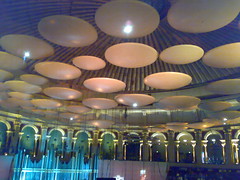
Well, Bruckner's like that, and it took me years to get him. Once I've got something, though, I tend to forget how much work it took to find my way in, so it was a salutary reminder when my companion at Prom 54, at which Bernard Haitink and the Royal Concertgebouw Orchestra performed his Eighth Symphony, came out with this conclusion. Bruckner is hard work, especially when you're stuck in a hall for an hour and a half, and it's a credit to him that although she was left bemused, she was also surprised that it had been that long. My first impressions of Bruckner as a lad were that nothing happened, and it didn't happen for a very long time. My mature impressions are actually pretty much the same, only now I think that this is a Good thing. It seems superfluous to say that the performance was superb, but I shall say so nonetheless, because it was.
It's not often I have the luxury of going to a late-night Prom, so it was especially fortunate that one of the few occasions when circumstances allowed me to stay for the late shift that we should be treated to the wonderful Pierre-Laurent Aimard performing some of Ligeti's wonderful Piano Studies. These works are real gems, mind-bending in their complexity, yet also generous in their approachability, and I can never tire of hearing them, especially in the hands of such a wonderful player as Aimard. Before this, he took on the role of conductor for a romp through Haydn's 102nd Symphony with the Mahler Chamber Orchestra. This juxtaposition emphasised the generosity and humanity of both composers. Next to these, Beethoven, whose 2nd Piano Concerto finished the concert, seemed overbearing, though this may have been down to the fact that we were tiring rapidly by this point. They played it beautifully though, and those parts where Beethoven wasn't intent on showing off were beautiful. These two concerts constituted a marathon, and we struggled to stay awake on the train home, though our exhaustion was tempered with a sense of worlds traversed.
Thursday, August 23, 2007
Slint (Koko's, Camden)

I say neglected - it was neglected in 1991 when it was released. It's accrued a following since then, and Koko's is absolutely rammed full. When we entered, there was a sign at the door saying that tickets were available, but god knows how that was possible given the crush inside. Maybe there were a lot of people who turned up on the off chance.
I wonder what it must be like for the band, to reconvene after the best part of 20 years and revisit their songs? When I look back at things I wrote in 1991 they seem the product almost of a different person, and I've remained active since then.
It's a strange atmosphere - even more so than when we saw Low here, and heard audience members calling out for them to play their favourite song: "Whore!". On the one hand there's an air of reverence, as though we're hearing some long-lost Beethoven quartet. On the other hand, as a song begins, there'll be a smatter of applause and cheering, much as you might encounter at a Barry Mannilow concert.
It feels odd to be standing in a packed hall listening to music that seems designed to be listened to alone. Which is not to say it's not a powerful experience. Fragments of rock 'n' roll hang in the air, like the tattered curtains in Miss Haversham's house. Innocuous, insignificant meanderings slowly build to thundering, relentless climaxes. This sort of thing gets described as "post-rock", and you can see the meaning of that - it sometimes has the feel of looking at an archaeological find, of a long lost and forgotten thing called rock music. There's a strange combination of intensity and distance, sometimes seeming almost like Led Zeppelin playing Kraftwerk (or should that be the other way around?).
Slint only made two albums, so they've a limited repertoire to follow on after they've taken us through "Spiderland". They do play a new song though, a haunting, majestic beast that's hugely impressive. Rumour has it they may work themselves up to a new album. If they can match what we heard here tonight, it'll be well worth waiting for.
Wednesday, August 22, 2007
A Wing and a Prayer
Reading this post made me think about some of the ideas I've been having lately about what music and/or composition is actually for. Especially this bit:
"it's a tremendous loss that nowadays most people solely consume music,
rather than try to make music themselves. "
I'm reminded of something Ives said: "Can there be any such thing as bad music?" There's such a huge amount of judgmentalism in music, especially classical music. People who sit around comparing different recordings of the same piece, rather than thinking about the piece itself. Who go to a live performance and compare it to an old recording (always unfavourably, of course). I feel sorry for such people. They are missing the point in a spectacular manner, dwelling in the tombs of their recordings when they could be out with the living.
An old colleague of mine used to say, "Professionalism is the enemy of music." And the more I dwell on this sentiment, the truer it seems. I've nothing against professional performing groups, but it seems very unhealthy that the audience is increasingly regarded as a passive absorber of product. Music should be something you do, not something you consume.
Take a stand. Buy a cheap instrument (you can pick up a ukulele for about 20 quid, and they're very easy to play) and make a noise with it. Sing along to your records. tap out a rhythm on your table. it doesn't matter what it sounds like. It just matters that it's a sound you're making.
Tuesday, August 21, 2007
Prom 50: Copland/Adams

I remember playing Copland's Billy the Kid Suite at school, and quite enjoying it. With more years' experience, I now realise it's not one of his better pieces. In fact, in all honesty, it's pretty dull, something a slightly scrappy performance by the BBC Symphony Orchestra does nothing to belie.
My companion remarks that Billy the Kid is the sort of piece that gets played to children to make them like classical music. She's right, and it's a shame. What we should be playing The Kids is something like John Adams' Century Rolls, which follows. It takes me a while to get into this, possibly because I'm slightly jaded from the Copland (I find myself wondering if I'm suffering Proms fatigue), but soloist Olli Mustonen and the band win me over. In the slow movement there's hints of Satie and Rachmaninov, while the driving, angular finale has echoes of Nancarrow and even Ligeti. Which is obviously a Good Thing.
The other Adams work in this prom, his new "Doctor Atomic Symphony" derived from his recent opera about Robert Oppenheimer, is, I fear, not on the same level. The ideas are thin, and spread thinly, the whole thing waffles on without really going anywhere, it's bitty and fussy and frequently sounds like second rate John Williams or Ennio Morricone. There are some nice enough moments, but to paraphrase Rossini, too many bad quarter hours. We find ourselves struggling not to fidget, and when the end finally comes after what seems like an interminable age, we clap politely and make our way out without waiting for the inevitable curtain calls.
Monday, August 20, 2007
It is better to light a candle than curse the darkness
If you didn't see the Simón Bolívar National Youth Orchestra of Venezuela at the Proms last night, you missed a treat, and you should hunt down the TV and Radio broadcasts on your internet without delay. They're an astonishingly accomplished bunch, and play with a verve and enthusiasm that's truly inspiring.
Of course, life's rarely that simple. As an excellent post by the estimable Pliable explains, the orchestra and their conductor Gustavo Dudamel find themselves in an unfortunate political position as representatives of a country ruled by Hugo Chávez, and some accuse them of being de facto apologists for his regime, particularly when they performed the national anthem at the launch of the state-controlled TVes channel, following the closure of RCTV.
it's very easy for the likes of us in Europe to criticize, and I wonder what any of us would do in the same situation. I think of those who condemn Shostakovich for not being openly dissident enough for their liking, and wonder how they'd last in the sort of totalitarian terror he had to endure. I also wonder if, in his choice of Shostakovich, as well as the unapologetically American Bernstein, for their prom, Dudamel is perhaps sending a more ambivalent message about his homeland than we're giving him credit for.

Sound vs. Noise (7)
Article on today's Grauniad blogs debating noise pollution. For myself, what the neighbours are playing is largely irrelevant, I want to get some fucking sleep, thank you. And no, plugging into an iPod isn't a solution. I don't want to listen to music while I'm asleep. I'm quite lucky, in that while the kids next door do occasionally pump up the volume, they generally bring it down again before I reach the point of banging on their door. I'm a very tolerant neighbour, y'know.
Saturday, August 18, 2007
Prom 45: Schoenberg, Knussen, Henze, Stravinsky

It's obviously a day for lookalikes, as with her long blonde hair and blue and white dress, violinist Leila Josefowicz reminds me of no-one so much as Alice. Quite appropriate, as it turns out, as Knussen's Violin Concerto (as all his music) is filled with a quicksilver wit that seems to breathe much the same air as Lewis Carroll. I've long admired Knussen as a composer; he's far from prolific, but everything he produces seems so beautifully judged, expertly crafted and heartfelt without ever becoming overwrought.
I've only started really listening to Henze's music recently, so this was a welcome part of the programme. Sebastian im Traum has the same Tippett-ish feel to some of it as I've previously noted (though considerably more tautly argued than that composer's somewhat more diffuse music), and for a brief moment there even seems to be a hint of Elgarian wistfulness there, which leaves me to reflect on how curious it should be that a composer so much in his own tradition should sound so English.
What can be said about The Rite of Spring? Everything and nothing. It's one of the lodestones of the past century, the last piece that everyone agrees about, as someone wiser than me said, and casts a shadow over anyone who wants to write this stuff we inaccurately call classical music. But really, in the face of it, it's better to shut up, as a good performance leaves discussion unnecessary. This was one of those performances, rugged, rough, violent, full of that contradictory sense that this is the birth of Modern Music, and also a monument that defies all who stand before it.
Friday, August 17, 2007
Last Orders

Well, there's a lot of harm, because Sawhney is exactly the sort of intelligent, open-minded person the Proms should be attracting, and if his overriding impression of the season is one of an orgy of jingoism, then it's fair to say there's a major image problem here. It's not just the cringe-worthy sight of socially inadequate persons of questionable personal hygiene dressing up in tails and bawling along like the chinless wonders they are to Rule Britannia while draped in the Union flag, it's not that even someone with a classical background like Sawhney takes that as the image of the entire Proms season. It's that for the vast majority of people, this bunch of idiots represent the entire classical music world. This is the harm - all the talk of elitism, dumbing down, accessibility, artistic integrity, etc etc, is a side show to the real problem. The rot spreads beyond the actual event - look up listings at this time of year and you'll see a plethora of "Last Night of the Proms" events advertised, that strip the model of even the limited integrity it has and plump wholesale for the flags and rampant nationalism. If this is most people's only experience of classical music, no wonder they don't want to experience any more of it.
Tradition? Sloppy habits, as Mahler defined it. All this guff about the sacred tradition of the Last Night is just that, guff. The whole thing dates back no further than Malcolm Sergeant's tenure after the war, and the timing of its introduction tells you all you need to know about why it is as it is, and why it is so purely awful. This sorry sight of a nation in decline, drunk on nostalgia for its imperial past is an affront to all human dignity, and the most poisonous cup from which all classical music drinks. Why else was it such an affront to the Daily Mail and their like to introduce Harrison Birtwistle into the pantomime 10 years ago? Because for a moment they were confronted with the Now, a real Dionysian moment that showed up the moth-eaten pomp and that peculiarly stilted, forced "party" atmosphere so unique to the British in public around it as the shabby rot that it is. The single act that could do more than anything else to restore the reputation of concert-going would be to get rid of it. But that, alas, is only slightly less likely to happen than getting rid of the monarchy. And like that similarly archaic institution, it keeps us retarded, in thrall to an imaginary past and unable to grasp a future. We need to put the Last Night behind us, and face the dawn.
Thursday, August 16, 2007
Thangyuhvurrmush

30 years since Elvis died (or did he?). Here's a picture of him with a ukulele.
Elvis ate a million cheeseburgers and died on the toilet, the one true rock 'n' roll death. I salute you, Elvis.
One day since Tikhon Khrennikov died. Good riddance.
Wednesday, August 15, 2007
Prom 42: Sibelius (RAH)
Sometimes, it's all about context.
Listening to incidental music in a concert setting is in many ways a frustrating experience. In this case we had over a hour's worth of Sibelius' music for The Tempest, and while there was much beautiful music in it, ideas tended to flit by briefly, and overall the whole thing would be better heard with the play around it. As the evening progresses I become aware of a strange background noise which, it gradually dawns on me, is the sound of rain pummeling the Albert Hall's roof - a tempest outside becoming part of the Tempest within. Sometimes you need something like that to transport you to where you need to be, and allow the magic of Shakespeare's island to take you.
Sibelius wrote many songs, and the selection we hear after the interval demonstrate how good he was at it, the miniaturist in him coming to the fore in these exquisite jewels, evoking worlds with a few brushstrokes.
We finish with his Seventh Symphony, a piece whose tragic nobility rarely fails to affect me. Some conductors like to squeeze every drop out of the last bar, to wrench a triumphant peroration from it, but Osmo Vänskä (surely the best living conductor of Sibelius) and the Lahti Symphony Orchestra are better than that, and allow it to do what Sibelius intended - to evaporate, leaving an aching sense of loss and leave-taking hanging in the air.
Sometimes context creeps up on you.

Tuesday, August 14, 2007
Prom 41: Gershwin (BBC4)
What a fascinating, if flawed, experiment this was. The BBC Scottish Symphony Orchestra joined forces with the Marcus Roberts Trio for Gershwin's Rhapsody in Blue, with the trio contributing extensive improvised passages.
As the talking heads before noted, Rhapsody in Blue is itself a clash between jazz and "classical" styles, so on the face of it it's entirely natural to bring a jazz trio into the mix. The problem is that the excellent Roberts and his cohorts play in a post-Coltrane, post-Monk idiom, so what we ended up with was a three-way clash between classicism, pre-war and post-war jazz, with none emerging unscathed. Roberts' solos were wonderful, and when his rhythm section of Roland Guerin and Jason Marsalis kicked in things really took flight, but when they played along with the orchestra in the "composed" bits the result was oddly stilted, the stiffer '20s rhythms jarring against the more fluid post-bop element. I'd love to hear the trio alone improvise on the Rhapsody, as what they gave us tonight was exquisite, but I'm not convinced the middle of a "conventional" reading really works as the place to do it. Having said that, all involved acquitted themselves well, and this was an imaginative piece of programming, so full marks to the Proms for bringing it to us.
Roberts, Guerin and Marsalis gave us an encore, a delicious take on "I Got Rhythm" that had me hungering to hear more of them.
(Sorry, I can't comment on the rest of this show as I was watching Jamie Oliver on the other side, who showed me some excellent ways with courgettes.)
The aesthetics of strumming
I've been aware of the therapeutic qualities of the humble ukulele for some time now, so it was marvellous to be given one as a birthday present. Really, it doesn't even feel necessary to learn songs, or even proper chords - just strumming randomly brings a great peace.
It seems to fit with ideas that have been brewing in my mind for some time now - something to do with music as something that can happen spontaneously, that should be a product of friends coming together rather than some encrusted ritual, that shouldn't be restricted by the sort of thing we're seeing being enacted in law (which seems to me to be all part and parcel of the creeping erosion of our liberties). This is partly why there hasn't been much music posted up here recently. it's not down to laziness*, it's to do with thinking about what I want to do and how what I put up here might fit in with that. There may be some concrete result from this nebulous musing eventually.
*Well, only partly; But also, sometimes when you can't think of something to say it's best to say nothing.

The out sound from way in
We go to the seaside, eat fish and chips and paddle in the sea. I try to capture the place, but as my companion points out, it's an impossible task, because there's so much more than sight - all the sense are involved. And particularly for me, hearing. I've always loved the sound of the sea, whether from land or on board ships. My attempts to conjure up soundscapes seem so tiny and insignificant compared to this natural symphony.
It sharpens my ears, though, and returning to work I find myself listening afresh to the sounds surrounding me as I travel - something I've drawn on in the past for my own music - the angular, crippled clattering of the tube rails a stark contrast to the smooth rush of the sea and shingle.
This is part of why it pains me that people fill their ears with tinny distorted sounds from their i-pods and phones. What a shame to reduce music to something with which to smother the world. There's music all around, if you want to hear it.

Monday, August 13, 2007
It's all about me
Normally I wouldn't approve of blatant whoring for comments, but sod it, it's my birthday, so tell me how great I am. I'm off to the seaside. Here's a video including George Formby's little known version of Subterranean Homesick Blues, in celebration of the fact that I got a ukulele*:
*Although as any fule kno, George Formby didn't play the uke, he played the banjolele.
Thursday, August 09, 2007
Fun for social pariahs
fun hats
Originally uploaded by petemaskreplica.

Regular readers will be aware of my passion for the medium of comics, a medium I will stand up and shout for in the face of its reputation as an interest for sad freaks. I feel much the same about real ale, and the Great British Beer Festival reminds me somewhat of the Bristol Comics Con, for many of the same reasons; largely that when you go, the crowd there is a lot less freakish than your prejudice might lead you to believe, but this doesn't mean the freaks aren't there. But as a freak myself, I salute them.
There's been a bit of talk about the introduction of 1/3 pint glasses, apparently in an attempt to attract more women. I can see the advantage in having the smaller measure,. but for myself I prefer the pint glass (despite drinking largely halves) as it's more likely to find use at home. Interestingly, many of the 1/3 pint glasses I see are in the hands of men, in the afternoon, and as evening approaches they become a rarer sight. There are plenty of women there, but thy seem largely to hold half or pint glasses.
We wound up going on Thursday this year, something we've previously avoided, as for one thing the earlier days in the week tend to be more selective (i.e. less full of twats in suits getting pissed) but also because Thursday is Fun Hat Day, the mere thought of which fills me with unspeakable horror. Fortunately we went in the afternoon so avoided the worst of the twattery.
As ever, there were many delicious and unusual beers to try, as well as some excellent food stalls to help keep the stomach lined. As the afternoon wears on, the place begins to seem less like a large barn and more like a large pub, until at about 8.00 we consider one more beer, then realise that the place is now packed and resembles a very busy pub that we don't really want to be in (I'm not queueing for 3/4 of an hour to buy a half). We retire to a real pub for one for the road, and then stagger our separate ways.
This year I especially enjoyed a Scottish stout called "Black Gold" (which tastes very little like Guinness), a Finnish Dark Lager (which tastes a bit like mild, although it smells just like lager), some lovely milds ( a mild won the Beer of the Year award for the first time this year, which I hope will lead to a more general availability of this fine beer), and the fruit wines and meads, which stand I left laden with bottles.
Wednesday, August 08, 2007
Songs for Swingin' Tyrants
Everyone and his dog is talking about Hitler's record collection, but I'm not going to join in this pathetic... oh, hang on, I just did. There seems to be some surprise that Hitler owned records involving composers and musicians officially prohibited by his regime. What, you mean Hitler was a hypocrite? Well, he's gone down in my estimation, then.
It's a sure sign of the silly season, I guess, that otherwise sensible people such as Stephen Isserlis feel bound to express surprise that someone responsible for the deaths of millions had some quite good records. I thought we'd established long ago that listening to classical music doesn't, in fact, make you a good person. Not least from the evidence of Camp Commandants who sent Jews to their deaths to the strains of Bach and Beethoven.
Which major work of Alban Berg are you?
I'm this one, apparently:
What major work of Alban Berg are you!?!?! |
 You are Berg's ridiculously complicated Chamber Concerto. No one will ever figure you out and when they do, it probably won't be right. Take this quiz!  Quizilla | Join | Make A Quiz | More Quizzes | Grab Code |
Monday, August 06, 2007
The 'wood life
Exciting news for fans of Garth Marenghi's Torchwood! The excellent Behind the Sofa reveals that sit-com legend Richard Briers is to appear in the new series. Briers describes the script as "terrifying", which could be taken more than one way, of course. Still, it does look as if they're getting some names in for the cast, so I continue to nurse the hope that it may turn out not to be complete shit. Hell, it can't be worse than the first series... can it?
In other, actually exciting Whoniverse news, I see that British comics legend Pat Mills is scripting one of Big Finish's upcoming 8th Doctor stories. A friend of mine opined on top sci-fi loony forum Outpost Gallifrey that Mills would be an ideal writer for Torchwood, and you know what, he's right. They'd never allow it on screen, mind.
Sunday, August 05, 2007
No direction home
We rouse ourselves from our heat-induced torpor (what greater pleasure is there than a hot sunny Sunday morning, drinking coffee and languidly contemplating the crossword?) and go to an exhibition, How We Are at Tate Britain. It's a collection of photographs showing how this island has documented itself through the camera, and it's fascinating and well worth a visit. It begins with the dawn of photography, and the excitement of this new medium is vivid, pictures of the construction of Nelson's Column that turn my perceptions all over (I mean, hasn't Nelson's Column always been there? Certainly too long to be photographed half-finished?). Pictures of Pit Girls in the 1890s that give the lie to the idea that women at work is a post-war phenomenon (that's only true if you're middle class), and women at work during the war, true pioneers of female equality. Images of folk traditions you thought were a distant memory, being played out as living and vital within the memory of my grandparents.

Images vivid and startling in their feeling of contemporaneity, some great pictures, some not, bu all with a palpable sense of an era. As I look at the pictures from the Second World War, I am jolted by the realisation that I am seeing things that are within the experience of my parents. From then on there is paradoxically a growing sense of distance, and as we reach the 1970s and 1980s I feel a melancholy as I look at these scenes that resonate with personal memories, but which suddenly seem as ancient and lost as the 1950s. The time is passing and falling behind us rapidly, as we scramble vainly to grasp and keep moments. By the final gallery we are in our own century, but the scenes and portraits from within a few years of now seem as self-conscious, stiff and formal as anything from the Victorians, who now seem almost more real than the contemporary faces before us. Time runs on and on, indifferent to us, slipping through our hands like water as I sit here, clumsily trying to capture memories already fading, unable to return.
Friday, August 03, 2007
Provisional thoughts on Ulysses
What they rarely seem to tell you about Ulysses is how funny it is.
We all know about the literary canon - very large books by very eminent authors (usually dead white European men) that time and academia have declared Great. They are books you're quite likely to find in a school or university syllabus, books that everyone's heard of, but nobody's actually read, and you suspect that those who claim they have are lying. Ulysses is such a book - perhaps the quintessential Great Book. Only the other day I heard Will Self on the radio relating the experience of siting next to an Eminent Professor of English Literature at a dinner, who told him quite happily that he'd never read Ulysses.
Because why bother actually reading it? We all know about it, don't we? We know that it's hardcore Modernist writing, that it's some kind of meta-textural comment on Homer, that it's got some rude bits in it and ends with a Very Long Sentence. It is the Book Everybody Should Read, But Almost Nobody Has. Well, I don't know anyone who's actually read it, do you?
I've always had an awkward streak, the kind that seeks out those things that are generally considered difficult. It's why when I wanted to hear Captain Beefheart I went past the earlier easier albums and dived straight into Trout Mask Replica. So an author with such an obscuritan reputation as James Joyce was something that in a way I'm surprised I hadn't attempted before.
So I began to read out of a combination of duty and bloody-mindedness. But I didn't carry on that way.
Because (and now I come to type this, it seems to read as an awful example of stating the obvious) Ulysses is a fantastic book. Sitting on a train into work first thing in the morning, half asleep, I found the rambling half-sentences that represent Leopold Bloom's internal thoughts as he goes about his business early in the morning on June 16th, 1904 coincided very closely with my own frame of mind, which certainly helped - a bit of personal recognition is often all you need to find your way into something be it a book or painting or piece of music - and I rapidly discovered that if you imagine the whole thing in an Irish accent, it suddenly starts to make a lot more sense. I might even suggest that Joyce's comic element has a direct parallel with that other masterpiece of Irish-logical humour, Father Ted.
And it can't be stressed enough, a lot of Ulysses is very funny. Whether it's Bloom's Pooterish thoughts, the drunken ramblings and rantings of men in a pub, a scene in a newspaper office rendered in the style of a tabloid, there's a great deal of pure fun involved, and it was all a lot less frightening than its reputation might suggest (as I often find is the case with reputedly "difficult" work). Why this should come as a surprise, I don't know - is it because we expect modernism to be dour, scowling stuff, do we somehow think that comedy and Art are incompatible?
Now, this is not to say that it's an easy read. It needs a lot more effort than Harry Potter, and there are moments when, like a roller coaster, you have to hang on and hope you're still in your seat at the end, and just plough through. This is particularly true in the later parts of the book, in which our protagonists are heavily under the influence of beer and absinthe, with all the woozy hallucinatory quality that implies. But it's extraordinary how effectively Joyce manages to make his themes emerge from the swirl of the language, the deluge of word-play and allusion that characterises so much of the writing. You almost certainly won't pick up on every reference first time round, but it doesn't matter, pay attention and you'll find your way through (and Joyce helpfully recapitulates at certain points to help you keep track) - and of course, you can always read the book again - and it's very obviously a book that will repay repeated reading.
There's an immense emotional scope through the course of the book, through the dazed fug of early morning through to the drink-fuelled madness of evening, and the final clearing of the mind, and finally the rapid wakeful cascade of thoughts in bed that form the final soliloquy of Bloom's wife Molly. I compared Bloom to Pooter earlier, but that's only the start of his story. Through the course of his day, as we gradually learn more about him and his life, he evolves from a comic anal-retentive to a figure of pity, tragedy, integrity, and finally even hope. The closing sequences, after all that has gone before, are as moving as anything you're ever likely to read.
What people always ask you when you mention you're reading a book (especially a well-known but hardly read one) is, "What's it about?" Well, one one level, it's about what happens to a group of people on one day in Dublin. On another it's about Ireland past, present and future. On another level it's about literature, and what it's for, and what it might be capable of. Then again, it's about Life, what it means and how we might live it. In some ways it's about nothing, and in others it's about Everything.
The point is, it is Great Literature. But it's not because someone high in an ivory tower has decided that it is, it's great because it just is. And I could sit you down and tell you for hours all the things that make it great, but really the only way to understand is to read it.
How strange, that it should be a revelation that a Great Book is a book you'd actually want to read. What does this say about our culture, I wonder.
You should read this book. Not because it appears on lists of Great Books, or because it's studied in universities, or because it's "challenging" (although it undoubtedly is). You should read this book because it has something to say, and it says it with force and elegance and poetry. And it is worth the effort.
Wednesday, August 01, 2007
Prom 25: Boulez/Birtwistle (Radio 3/ online)
Pierre Boulez is a composer notorious for reworking his music, sometimes over many decades, and never quite reaching a conclusion (he has commented that works of art are never finished, only abandoned), with the result that his catalogue is full of torsos and "works in progress". Ironic then, that due to the late running of the earlier prom and the vagaries of London's public transport network this late-night offering from the London Sinfonietta and the BBC Singers was already up and running by the time I got home and turned on the radio, so I only heard his recent completion of Dérive 2 as a fragment. I shall certainly be taking advantage of the excellent BBC Radio player to listen to the full work, though, as it was an extraordinary and beautiful work. Boulez is the man fingered by many of those who oppose all avant-garde music since 1900 who ruined it all, and I'll admit I have issues with parts of his aesthetic*, but you'd have to be fairly cloth-eared not to be able to revel in the luxurious sounds he conjures up here. I wonder how the fact that I shall hear the opening of his piece after the close relates to his ideas challenging the idea of a "complete" work?
Coupled with this sensuous, glowing music was another of the bogeymen of contemporary music, Harrison Birtwistle. Again, Birtwistle is a man much misunderstood, as the frequent extreme complexity of his textures belies a thoroughly direct, even blunt, approach. Neruda Madrigals is one of his gentler works, and its more austere sound world, conjuring up thoughts of the Northern landscapes that he inhabits, made an excellent pairing with the Boulez, and made me regret that it was impracticable for me to stay and hear it live. What a shame this sort of thing gets increasingly and timidly relegated to late night slots. One hopes that this is a trend that will not continue when Roger Wright takes over the Proms from Nicholas Kenyon (aka the Doctor out of Star Trek Voyager) next year.
Players and singers were as good as you'd expect, and isn't it good to see in Susanna Mälkki a woman at the forefront of was is still largely a male domain?
* Maybe I'll get round to writing a post about this eventually.
Coupled with this sensuous, glowing music was another of the bogeymen of contemporary music, Harrison Birtwistle. Again, Birtwistle is a man much misunderstood, as the frequent extreme complexity of his textures belies a thoroughly direct, even blunt, approach. Neruda Madrigals is one of his gentler works, and its more austere sound world, conjuring up thoughts of the Northern landscapes that he inhabits, made an excellent pairing with the Boulez, and made me regret that it was impracticable for me to stay and hear it live. What a shame this sort of thing gets increasingly and timidly relegated to late night slots. One hopes that this is a trend that will not continue when Roger Wright takes over the Proms from Nicholas Kenyon (aka the Doctor out of Star Trek Voyager) next year.
Players and singers were as good as you'd expect, and isn't it good to see in Susanna Mälkki a woman at the forefront of was is still largely a male domain?
* Maybe I'll get round to writing a post about this eventually.
Prom 24: Sibelius/Britten/Varese/Debussy (RAH)

There is plenty more to be said in this concert, however, and the next is Britten's Piano Concerto. Again, the orchestra dispatches it with aplomb, and soloist Steven Osborne plays beautifully and engagingly, but, as with quite a number of Britten's pieces, I find that my attention keeps wandering, then is dragged back by something arresting, then wanders again.
The second half also features two pieces. Varèse's Ecuatorial features retro-chic electronics in the form of two ondes martenots, to evoke an ancient past. it's a strange and powerful piece, the swooping of the ondes contrasting with the guttural sounds of brass and percussion, as well as the strange alien chanting of the male singers. There's really nothing very much to compare it with, even in Varèse's own output, and it lingers in the mind long after it finishes, an unsettling presence.
Finally, we hear La Mer by Debussy, a performance that evokes foam flecked, salty air.
So, four works, four good performances... and yet I leave feeling slightly dissatisfied. It's something to do with the two major stage shifts, one in each half, that inevitably drain the momentum from a concert (I work on a theory that one should always try and avoid such things, one large move is manageable, more disrupts proceedings too much). It's also to do with the choice of repertoire. These are all pieces I either know and love, or would be more than happy to hear again, yet I am left with a feeling that I don't really know why they were programmed together. Four big-ish pieces leave a lack of a sense of a core, so that the whole is less than the sum of its parts. It's a shame, because each of these performances deserve to be remembered fondly. But they won't be remembered as one concert, which is the difference between good playing and good programming.
Subscribe to:
Posts (Atom)


