Tuesday, January 15, 2008

Monday, January 14, 2008
Hooray for Radiohead!

So many hearty cheers for the lovely people at Radiohead's online shop, who were very kind and helpful and have sent me a replacement box which now sits enticingly by the hi-fi, waiting for me to get the vinyl out and give it a spin. Good, heavy vinyl too, none of your flimsy rubbish. It was great today to hear the album on CD, the better-than-the-download sound quality makes it glow.And the CD of extra songs is great as well. All in all it's a very beautiful object, definitely worth the 40 quid, and you won't be disappointed if you order one yourself while they still have some left.
I've written before about the possible impact the "honesty box" release of In Rainbows might have on the record industry, and it's wonderful to see them leading the way through the innovative method of being nice to their customers beyond what's strictly necessary. I'm a very happy bunny, for once.
Wednesday, January 09, 2008
How Pop Music Works
Oh, Charlie, Charlie, Charlie. Don't you look fashionable in your unbuttoned shirt and Converses? Look at you, grooving to "Tomorrow Never Knows", nodding sagely to Joni Mitchell, telling us how great Imagine and Bohemian Rhapsody and Wyclef Jean are, making it OK to like pop. Well, you know what? I don't need your patronising waffle to justify listening to anything. I don't need you pinning songs down like butterflies.
The thing is, there are some interesting people on this programme, with pertinent things to say about what makes a great pop song. But why do we have to put up with you bringing your relentlessly average thoughts to bear? It's bad enough that you're becoming ubiquitous in the field of classical music on telly, a middle aged, dressed twenty years too young television producer's wet dream of half-arsed ideas of "accessibility" and "relevance". Why do you have to ruin pop as well?
Bastards
The very excellent Supergrass are playing a "secret" gig at Barfly in Camden this evening, showcasing songs from their new album. Unfortunately I'm not going because the bloody bastard underground's up the spout. Bastards.
The internal post at work has lost my Radiohead discbox. They're bastards too. Bastards bastards bastards.
Oh well, back to the drawing board, then.
Monday, January 07, 2008
I'm Not There

There can't be anyone alive who's been so mythologised as Dylan, to the point where he hardly seems like a real person. For years he's fought against his own legend - I remain convinced that all those notoriously, um, wayward performances and records from the 70s until the 90s represent him trying to destroy Bob the Legend. Then, when he realised that being a shambles only reinforced the myth, he resigned himself to his status, and decided not to worry about it, after which we got the wonderful trilogy of albums of the past few years, the delightful Theme Time Radio Hour, and Chronicles, all of which showcase a Bob apparently more at ease with himself than he's seemed for years.
So what we get in this film isn't any kind of conventional biography. Instead there are 7 different characters, all standing in for various aspects and periods of Dylan's career and persona: a young black kid trying to fake his way through the blues, a young Rimbaud obsessive called, er, Arthur Rimbaud; an earnest young Woody Guthrie-a-like; the iconic super-hip sharp talker of the mid-60s (played by a woman); an actor with a failing marriage; a born-again preacher; and a country hobo who turns out to be more than he seems.
None of these personae presents any accurate depiction of events; this is clearest in the "60s" Bob, where events documented on film are presented in versions that play up to the mythology of what happened. Cate Blanchett's astonishing turn as "Jude Quinn" is the only one of the seven Dylans that is pitched as an impersonation of him; these are intended as archetypes that resonate with one or more perceptions of Dylan and his work. Even Blanchett's performance is more myth than reality, and comes across as the one attempt to "do Bob" more because Dylan's 60's image is one that rock stars ever since have appropriated in an attempt to seem sharp.
If you try and fit the film to the life too closely you'll end up frustrated. I'm reminded to some extent of Burrough's later work such as The Place of Dead Roads, where one character plays out his story in multiple times and dimensions. I suppose in a way one of the major themes of this film is the impossibility of nailing down who Dylan is or what he represents. At the end of the film, as Richard Gere rides off on a train, strumming one of his younger selves' guitar, perhaps a nod to Dylan's recent work, where he's become for real the great bluesman he started of pretending to be, we finally see Dylan himself, in a piece of footage from a live concert. He doesn't sing, he just blows his harmonica and strums his guitar, inscrutable and unreachable, and strangely peaceful. It's a moment that, like a lot of this film, lingers in the mind long after the credits have rolled. Maybe it shows what Dylan himself has always insisted: whatever roles and significances we may try and pin to him, he's really just a song and dance man.
Whether it's a help or a hindrance to know a great deal about Dylan before you watch this film I'm not sure. It'd be interesting to hear the views of someone who knew next to nothing about him
Friday, January 04, 2008
To travel hopefully is a better thing than to arrive
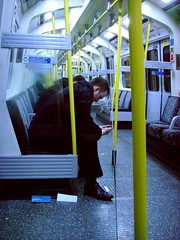
I spend my tube journeys reading Will Self's Psychogeography, which chimes with my own feelings about travelling round on my bike: the sense of place that you don't get underground, rushing about at the commuters' pace. The other London, hidden beneath roads and rails, on towpaths and riverbanks.
Monday, December 31, 2007
List fatigue
Well, did you have a Happy Christmas? I did: thanks to the relentless plugging of my Amazon wish list to all and sundry I ended up with a bunch of presents I actually wanted, we managed to slim down the commitments and travelling so that it actually feels like we've had a holiday, and now I'm looking forward to a cosy New Year's Eve with a shepherd's pie and a bottle of fizzy booze.
So now's the time of year when we all make up big lists of what we liked in 2007, isn't it? Top Tens, all that. Well, I thought about doing that, but you know what? I'm not going to. I've written about most of the things I've liked (and not liked) here at some point over the year, so if you're really interested in what I think you can spend a while browsing through the last 12 months' posts.
And anyway, why make lists? Of course, being a boy I spent a fair portion of my youth drawing up lists in the semi-autistic way that boys do; top ten records, TV programmes, films, books, gigs, and so on. But now it all seems so pointless and arbitrary. Why try to make value judgements between, say, Radiohead and Bill Callahan? How can I choose which goes higher up my book list, Ulysses or Strontium Dog Case Files Volume 3? Can I say that Vialka were a better gig than PJ Harvey? Did I enjoy either more than the other? And isn't whether I liked something just about the least interesting thing I can say about it anyway? And haven't there been way too many rhetorical questions in this paragraph?
So, no lists here*. Because it's all worthwhile. The good things (such as those mentioned above) and the bad things too, because the jewels stand out all the better for the shit thy float in. Because what I may say is my favourite today may change tomorrow. Because lists attempt to set in stone something that is, and should be, fluid. Because a butterfly is more beautiful fluttering than pinned to a board. And experience changes every moment.
And may I wish you a happy new year, and more of it in 2008, whatever it may be.
* I did briefly consider doing a list of the best lists I've read. But that would be too much smart-arse wankery, even for me.
Tuesday, December 18, 2007
The hibernation period
 It's that time of year again, when things wind down and we prepare for the traditional season of over-consumption (albeit under the shadow of looming deadlines and commitments, as ever). Have a Merry Christmas, thank you for reading (there are definitely some of you out there) and see you the other side of the holiday.
Monday, December 17, 2007
Removing the safety net
Alex Ross (whose excellent book The Rest Is Noise I'm reading at the moment) calculates that today is the centenary of atonality. This of course is something you can argue about until the cows come home, and is probably a bit arbitrary, but I like the idea as today is also Beethoven's birthday, and happenstance always appeals to me.
Beethoven these days is rather less controversial than he once was, but atonality still has a power to annoy, which pleases me greatly, as those who get annoyed are on the whole small-minded people who deserve to be annoyed.
Atonality has a special significance for me, as it was those school exercises in listening to and repeating an atonal melody, and later writing one (which I found quite easy to do, despite its being trailed as a more difficult exercise than the similar tasks we were given with tonal melodies) that really first put the idea in my head that composing wasn't necessarily just practised by dead people, but was something I might have a go at myself.
Schoenberg didn't actually like the word, preferring to talk about pantonality. It's a significant distinction, as it makes it about extending and enriching something rather than removing it, which is what you can hear happening in Schoenberg's music leading to his break with key signatures. It was something that was in the air (Schoenberg wasn't the only composer moving in this direction), but he was the first to stand up and say what he was doing (and more importantly the first that anyone took any notice of). It wasn't the action that was radical, so much as speaking its name.
Sunday, December 16, 2007

Saturday, December 15, 2007

Friday, December 14, 2007
What's next?
Once upon a time composers were artisans, servants like any other. Composing was part of musicianship; all composers performed and most performers composed. Then Beethoven came along and suddenly composers were Artists. Beethoven went deaf and was forced to retire as a performer, and thus was born the Great Composer, the mystic sage who came down from on high bearing the Score, which the musicians then dutifully followed.
This was the end of the Classical style, and the beginning of Classical Music - the canon, the tradition, the myth of the unbroken line inexorably moving forward through history: Beethoven, Wagner, Mahler, Schoenberg, Webern, Stockhausen... at the turn of the 19th and 20th centuries Mahler codified the rituals of concert-giving and going, and the Classical Concert became a quasi-religious ceremony. The composer was a Shaman, exalted and separate.
Stockhausen is dead, and with him dies the Great Composer. We no longer believe the march of that history. Our history is messier, less sure. It seems to me that the music of the future will most likely be collaborative; the roles of composer and performer will merge again, we will all become composers, all performers. There are plenty of talented composers writing fine music (and even more untalented ones writing bad music - and who may judge which is which?), but there are no more Great Composers, and there may never be.
We shouldn't mourn this. This is simply the way things are. Creativity is being democratised, and there is no longer a place for the shaman. Music is not a god to be worshipped. It's not a product to be passively consumed. It is an activity to be participated in, a means for people to come together. There will be new music, and some of it will grow from his ideas, but Stockhausen is part of another time. What's next? We shall find out.
Thursday, December 13, 2007
Stockhausen is dead
But didn't he die a long time ago? What about the people I overheard in Huddersfield in 1996, dismissive and contemptuous of pretty much anything he'd written since the 70s? Wasn't he regarded as someone who'd long since ceased to be worth paying attention to, who'd disappeared down a path of self-indulgent, egomaniacal mysticism? I used to hear such opinions regularly. The he died and no-one wanted to say that anymore.
I was thinking more about that Brian Eno interview, where he suggested that he was more interested in Stockhausen's ideas than his music. Is the actual music so ungrateful? John Humphreys lapped up any suggestion that you wouldn't want to listen to it, of course. Personally I never found his music that hard to listen to. Thorny, certainly. But those people in Huddersfield were berating him for producing music they regarded as too accessible, too easy on the ear, too melodic, not confrontational enough.
So, to the avant-gardists (or at least former avant-gardists; is there actually any such thing as an avant-garde anymore?) he's frozen in amber, a figure from a long time ago, when giants walked the earth. To the anti-modernists he's the bogeyman, the frightening creature under the bed who ruined it for everyone, who can't be buried quickly enough. There's precious little room for Stockhausen himself, underneath all the opinions about him. Either way, there seems to be a consensus between the two poles that he's a figure of the past, whether a past you wish to revive or to bury is up to you to decide.
To the vast majority of people, of course, he means absolutely nothing. Innovation, adventure, risk; these are qualities that find little resonance today in our lowest common denominator Tesco world. Is Stockhausen dead? Did he ever live? The avant-garde is no longer the terrible threat it once was, not something to be railed against, just a curiosity, maybe worth a snigger, then brushed aside. Not relevant. To many people it never was, if they even stopped to think about it, or even became aware of it, however briefly.
Stockhausen is dead, and all we have left is ourselves. And what shall we do with that?
Wednesday, December 12, 2007
Immortality
Is an idea enough to ensure a name survives? So much talk of Stockhausen's ideas; comparatively little of his actual music. And yet it's the music that matters. Isn't it? What are the ideas worth if their worth is not found in their expression? For myself, the ideas were a barrier, not a path. Not the ideas of Stockhausen himself; rather I mean the fog of ideas that other minds smothered him with. The talk of technique, of ways and means, the impression that nothing less or other than a total mathematical understanding of construction could be any help in understanding his music. A path to understanding that instead led to darkness, fear and confusion. And then the revelation of the actual music. The realisation that all this waffle was just that, and clearing that aside left the music itself standing gleaming, not turning the listener away or demanding penance, but welcoming and inviting. No need for analysis or deconstruction, only a willingness to listen. "Don't give me ideas, give me sounds."
Ideas matter. A disciplined, committed approach to one's art is necessary. Because if one does one's job properly and thoroughly, it should be easy for those that listen to the result, if they have the inclination.
Stockhausen was a great font of ideas, and a great philosopher of sound. But we should not let ourselves forget that he was firstly a Great Composer. Perhaps the last one. Is that enough?
Life on Sirius
Tuesday, December 11, 2007
Posterity
A lot of people, including me, have pointed out the influence Stockhausen had beyond the supposedly marginal constituency he occupied. (You can hear Brian Eno discussing this with John Humphreys on Today at The Rambler. Eno is as considered as you'd expect, Humphreys is as ignorant and simplistic as you'd expect.*)
But is that really the most important thing? No Stockhausen, no Radiohead? It's very odd, the way so much of the coverage of his death that tries to express his importance takes this tack. The man who fearlessly pursued his own path, regardless of whether anyone followed him, remembered in terms of commercial success by others.
What about the integrity, the single mindedness, the spirit of exploration, the willingness to pursue an idea?
*By the way, Mr Humphreys, the last time I went to a Stockhausen gig it was sold out. So there.
Monday, December 10, 2007
Arrival
Give up everything, we were on the wrong track.
Begin with yourself:
you are a musician.
You can transform all the vibrations of the world into sounds.
if you firmly believe this and from now on never doubt it,
begin with the simplest exercises.
Become quite still, until you no longer think, want, feel anything
Sense your soul, a little below your chest.
let its radiance slowly permeate your whole body
both upwards and downwards at the same time.
open your head on top in the center, a little towards the back,
and let the current that hovers above you there, like a dense sphere
enter into you.
Let the current slowly fill you from head to foot
and continue flowing.
Quietly take your instrument and play, at first single sounds.
Let the current flow through the whole instrument.
Whatever you want to play, even written
music of any sort, begin only
when you have done what I have recommended.
you will then experience everything on your own.
before you play, you may let your thoughts
run free, you may train the muscles
of your fingers, of your larynx, etc.
But now you know what you think and train for,
and even the thinking and training
will be completely new, completely different from before.
Nothing is as it used to be.
as long as you retain this consciousness,
everything you do will be right and good.
excerpt from Aus den Sieben Tagen, by Karlheinz Stockhausen. © 1970 by Universal Edition.
Sunday, December 09, 2007
Idiots attack other idiots
The Observer today features an attack by director Tony Palmer on the BBC after he received a rejection letter demonstrating some quite spectacularly slack-jawed meejaspeak drivel. This sort of thing should rightly be lambasted, but before the Observer gets on its high horse it might like to double check such things as what a symphony is, which isn't The Lark Ascending, or indeed the Fantasia on Greensleeves. The fact that the same paper goes on to feature this witless tribute to Stockhausen, which seems to think his greatest contribution to music was "realising that Wagner was rock 'n' roll", in a section featuring a large photo of Simon Cowell on the front, says quite a lot about the Observer's cultural priorities.
Karlheinz Stockhausen 1928-2007

I can't, of course. Stockhausen's influence is so profound that entire movements define themselves by opposition to him (or at least their idea of what he stands for, which is generally wrong), so pervasive that you often don't even realise it's there. Half the music in the charts owes something to him, even if its creators don't realise it.
But there's more to him than just an outré name for art-school graduates to drop. Stockhausen's music carries with it ideas about the space created by sound, both literally and figuratively, that have profound consequences for our understanding of our relationship with music, with the people who create and perform it, and those who listen to the results.
What struck me most the first time I heard his music was how approachable it was. His name had such a fearsome reputation, and the texts written by the greybeards who propagated his cult seemed obfuscatory and impenetrably complex and cerebral. But the actual music isn't like that at all. It's visceral and playful, and filled with wonder at the possibilities of sound. To hear the man himself introduce his music was to have all the fog lifted. He used complex methods to produce his scores, but, he insisted, it wasn't at all necessary for the listener to worry about the method. All the listener has to do was hear a sound, then another, and another, and follow these sounds as they grew and changed through time and space. Whether it's the literally visceral approach to the piano he takes in his Klavierstücke (one of which hangs on my wall) or the quiet spirituality of Stimmung, or the grasping of space of Gruppen and Sternklang, his music always seems to me to speak directly and immediately, in a way that isn't always recognised. He was feared as a terrifying, complex and forbidding composer, but I always found the reality simple and instinctive and wonderful.
I encountered him three times, and not once did I pluck up the courage to speak to him (although I'm pleased to report that on two of those occasions he was wearing his famous orange jumper). I remember once in Huddersfield seeing someone go up to him and expound some long, complicated theory as to what had happened to the characters in one of his operas after the end, and whether Mr Stockhausen could confirm whether he was right? Mr Stockhausen replied, bemusedly, that nothing had happened to them, as that was the end of the opera and they were fictional characters.
I wish I had spoken to him. Just to say how much I loved his music; its humanity and its wonderful directness. Stockhausen wasn't a difficult composer, whatever anyone says. In many ways he was as straightforward as anyone could be. It's just difficult to explain ideas as big as his. Far easier to understand them. What I take most of all is a sense of endless, boundless possibility.
Friday, December 07, 2007
Tabula Rasa

A typical sort of thing that people say when you tell them that you write music goes along the lines of, I don't know how you do that. How do you do that? To which the answer is, well, I don't know really. I just do. So when this happens, that I just can't get going on something, it's like I've suddenly been put in the heads of all those people who just can't understand how I do it.
The thing is, I have a very clear idea of the concept of the piece, and I even have a pretty good idea of its trajectory. I just don't have any actual ideas. And as Douglas Adams observed, sometimes ideas come rushing into your head and it's wonderful and rewarding and exhilarating. But sometimes they don't, and then you just have to sit there and think of the buggers. So I just have to keep scribbling away, writing notes down, and hope that eventually I'll see something good on the page. The annoying thing is, I know I'll know when I see it. I just haven't a clue how to go about finding it. Maybe I'll go for a walk. Maybe I'll get stuck in a meeting without a pen and paper and suddenly be overwhelmed with fantastic ideas that will disappear as rapidly as they came the moment I get the opportunity to write them down. There's no Muse more powerful than the Muse of Meetings.
Thursday, December 06, 2007
Sound vs. Noise 6: I do not whistle a happy tune

Whistling is to me very nearly as annoying as the tinny scratching of someone else's personal stereo gouging at my eardrum. That comes simply from a person being a thoughtless twat - I suspect most of the i-Podded different drummers crowded onto the morning tube have somehow managed to convince themselves that they're not playing their music that loud and no-one else can hear it - but to whistle requires a conscious decision to foist your sound on others.
Many years ago, in another job, in another city, there was someone at work (isn't there always?) who was in the habit of whistling. he whistled in that especially irritating old man's style, which was inevitable, I suppose, given that he was an old man. Now I am in a different job in a different city, but still there is someone at work. Although he is younger than my previous irritant.
Apart from the inherent high-pitched annoyance of the tone of it, the whistler is nearly always notable for the paucity of his repertoire, sometimes not even getting to the end of a single tune, but repeating the same four or five-note phrase over and over, like a concussed budgie. The addition of monotony only furthers the pain.
Of course, being English, I'm far too repressed to jump up, make a grab for the offender's throat and throttle him wildly, while shouting "SHUTUPSHUTUPSHUTUP!" I'm so inhibited I probably wouldn't even do it if he weren't my boss.
So I do what I must - I retreat into my headphones and hope whatever I put in the CD drive of the PC can be turned up loud enough to drown the tweeting awfulness of it all. Of course, I can d this, because it's not that loud, and no-one can hear any leakage from my headphones, can they? And so the cycle goes; man hands on misery to man.
Wednesday, December 05, 2007
Record company in good idea shock

Sunday, December 02, 2007
Late Starters
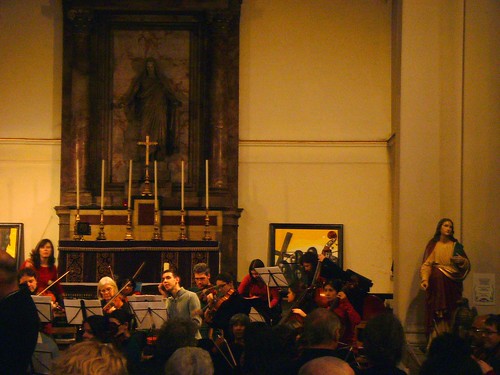
I've been playing the cello for over 30 years now, and composing nearly as long, so I ought to have some sort of handle on how this music lark works by now. But not everyone is as lucky as I was as a kid to have access to the wherewithal to pursue it, and the way music education is going there'll be even fewer in the future, so organisations like the East London Late Starters Orchestra are doing something very valuable. The idea is that people who've never had the opportunity to learn an instrument, or perhaps learned as a child then abandoned it for years, can have the opportunity to pick one up and have a go.
It's not really about the result (although of course all involved want to play the best they can), but about the act of getting up and doing it, I think; some of the players I hear had never touched an instrument until a couple of months ago, and to stand up and perform in public after that short a time takes a huge amount of guts, much more than I have certainly. And it also makes a statement that classical music isn't something obscure or difficult, to be the preserve of a few, but something that anyone can have in their life, if they want it.
There's such a strong vested interest in the music industry from professional bodies, record companies and the like that wants to promote music as a product to be passively consumed. This is so wrong. Music is an activity, something to be participated in, something to do, and it's this idea that really makes projects such as this important, not worrying about the "excellence" that ministers like to talk up (translation: leave it to the professionals, sit back, consume, buy, buy, don't think, BUY) but revelling in the act of creating it. Music's a social force, and that's what I bring away more than anything from this evening. There's little division between performers and audience; there's a unity of community, a joy and pleasure in the gathering together and the sharing of a moment.
Friday, November 30, 2007

Thursday, November 29, 2007
Black Dossier

Black Dossier is the latest episode in Alan Moore and Kevin O'Neill's magnificent League of Extraordinary Gentlemen (try to put the rubbish film out of your mind). It's not Volume 3 proper; rather it's the "short intermission" promised at the end of Volume 2, which through the plot device of the eponymous dossier explores the background of the League, both in Mina Murray's group and earlier incarnations.
What this entails is a collection of spoofs and pastiches of all kinds of literature, from lost Shakespeare plays through Bertie Wooster vs. Cthuhlu and the New Adventures of Fanny Hill to a migraine-inducing Kerouac homage. The strips that link these (all documents in the Dossier, which our heroes read through the course of the book) are set in a post-WW2 world derived from 1984, Dan Dare and Ian Fleming. There are, as in the previous books, hundreds of allusions to all sorts of fictional worlds and characters, some obvious (a suave yet sadistic secret agent called "Jimmy"; the character who turns up towards the end to save our heroes, whom I can't describe, because it'd ruin an absolutely brilliant and funny reveal), others obscure. This is par for the course, of course, but what's remarkable about the Black Dossier is that where the first two volumes were clever, beautifully constructed romps, this raises the whole idea of the series above the level of a brilliant conceit to something much more substantial, relating it to the ideas on magic and creativity Moore has increasingly been concerned with in recent years, particularly in Promethea. The final sequence is presented in 3-D (you get the glasses with the book), and is both a very funny and affectionate spoof on a lot of the elements of '50s 3-D movies, and a magical conclusion (both literally and metaphorically) which makes very effective and imaginative use of what could easily have been just a gimmick.
This is the final book of Moore's to be published under Wildstorm's ABC banner; he has been vocally unhappy since DC bought the company, and volume 3 of the League, and all his future comics work, will be published by Top Shelf Comics. This book is also unavailable in the U.K., allegedly due to copyright restrictions - although I would have thought the get-out clauses of transformative parody would apply (there seems to have been no issue with the previous books containing allusions to H.G. Wells' work, which remains copyright in Europe), so perhaps this is indeed DC spiting the great bearded one. Anyway, there are ways and means around this, and it's well worth getting hold of a copy, because it certainly left a big stupid grin on my face. I mean - 3D!
Wednesday, November 28, 2007
What's difficult?
What I found particularly interesting, though, was the response of the audience (or at least those who came because I badgered them). These people (in the main not musically educated) all said they preferred the Sibelius. Now, the Fourth Symphony is a powerful work, one of the greatest symphonies of the twentieth, or any century, but it's also the part of the programme that would be considered a "difficult" piece - essentially because it' s relatively dissonant, emotionally dark and introverted, ending in grey resignation rather than any kind of triumphant peroration (or indeed the opposite, breast-beating despair). And it occurs to me that this is obviously how it should be, not because the Schubert's not a wonderful and great piece (it is, of course it is) but because Sibelius lived in a time closer to our own, and we need to do less work to understand the context he worked in. But the conventional approach to concert programming is entirely based on the premise that anything modern or contemporary is inevitably harder to understand for the non-cognoscenti, and should be approached with caution, buttered up with Beethoven or Brahms.
Is there any other art form where this sort of thinking is considered normal? Can you imagine anyone suggest that you shouldn't even attempt to watch a modern play before you've got to grips with Shakespeare? Or that you should avert your eyes from Picasso or Damien Hirst until you've got the hang of Holbein?
What rot. All my experience tells me that this idea that "uneducated" people need to be coddled in the face of new music is just rubbish. They may not like it, but give them the opportunity to listen and they'll appreciate it - in fact, I suspect the untrained ear may be more open to new sounds than that conditioned and brow-beaten by years of propaganda dripped into it by the education system. We live in an age, after all, where the charts contain music far more abrasive than anything Schoenberg ever wrote, and where the influence of that giant of the post-war musical bogeymen, Stockhausen, can be heard in ways beyond anything you, or he, might have imagined. Isn't it time the classical music establishment woke up to itself and admitted it's got everything the wrong way round, and that this misguidedly timid approach is helping to destroy the art form it's supposed to be enriching?
When a newspaper such as the Observer can print such a closed-minded viewpoint as this review of the Huddersfield Festival by Anthony Holden, there is something deeply rotten at the heart of our relationship with music, an awful combination of intolerance and conservatism that seems to betray an active hatred of music. The point about something like Huddersfield is that it's experimental, it's not going to conform to preconceived ideas, and yes, it will inevitably attract a small audience, and not everything you hear there will work (because it's experimental, remember?) but that's OK, because it's not meant to be mainstream, any more than Stockhausen's works were before they influenced the likes of Warp records' roster. For a major broadsheet paper's music critic to fail to grasp this is an extraordinary failure of the critical process.
It's time we started treating audiences as grown-ups who can listen without prejudice, not as children who need to be protected from the nasty frightening modern composers.
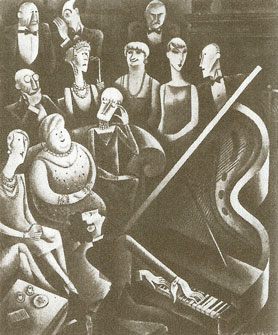
Image (a cartoon from Vanity Fair in 1929) swiped from here.
Monday, November 26, 2007
On the Corner
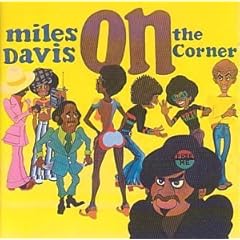
Its origins lie in Miles' realisation in the early '70s that jazz had been largely abandoned by young black kids, who were listening to Sly Stone and James Brown instead. He realised he needed to do something that would connect with them, speak to the kids on the street. So he made a funk album, of course. But being Miles, he couldn't make any old Stone-derived sound. He needed to bring something new to the party. And what he decided was the killer concept, that would bring his sound to the kids on the street was the ideas and processes of Karlheinz Stockhausen. Well, obviously.
I remember when I was a teenager first listening to Miles, and finding things like Bitches Brew bewildering, in a way probably only matched by Trout Mask Replica, another album it took me a long time to get my head round. But I always felt there was something in them, something that was just out of reach, that I needed to keep digging and find. Anything of real worth requires effort, because the effort makes the reward that much sweeter. So when Miles decides that what funk-jazz needs is the influence of the German avant-garde, god dammit, you've just got to go with it, because in the end you'll see he's right.
What Miles specifically takes from Stockhausen is his concept of space. On the Corner is an album that isn't much concerned with harmonic progressions, being on the surface a sequence of one-chord jams (or to be more accurate, cut and paste collages derived from one-chord jams). It's in the placing of the sounds that it gets its power, taking what could almost be described as a pointillist approach, short staccato phrases juxtaposed in varying combinations, never resting, always moving, but also static, creating a real sense of an environment in which we stay for a while. I'm reminded of the way Birtwistle describes many of his works, in terms of a single unchanging object viewed from changing perspectives.
If this sounds dauntingly intellectual, the effect on the ear is visceral and immediate (as is the actual music of Stockhausen and Birtwistle, if you ignore all the talking about it and just listen). Those foam-mouthed jazz-heads need to open up their perspectives and stop worrying about whether this is jazz or not. It's an extraordinary record that even now sounds like something that arrived in our midst from outer space.
Oh, did I mention that it's also damn funky?
Thursday, November 22, 2007
Abscheid

Wednesday, November 21, 2007
No Music Day

10.13: I sat down on the sofa and very nearly picked up the uke. A close shave. I put the instrument away in its case.
10.29: Last night I was thinking about the fact that my orchestra rehearses on a Thursday, and therefore next year I'd have to bunk off, but my brother points out that 2008 is a leap year, so November 21 will fall on Friday. Which surely proves that God is on the side of this enterprise.
11.17: There's been some interesting stuff on Radio Scotland so far, including an article about beards (including an interview with a man with a large beard) and an interview with Shane out of Boyzone, which concluded with them telling him they wouldn't be playing his record today. He sounded like he might cry. It was great.
11.38: Now here's a dilemma: I have on the table a half-finished theremin kit. If I were to do some soldering work on it (just the kind of little job I've not got round to due to business but could usefully get done on a day off), am I going against the spirit of the day? I mean, I'd be soldering, not playing music, but constructing a musical instrument is after all a step in the process of producing music. Hmm. I decide to defer this dilemma by going to the shops.
12.50: I never thought I'd say this, but hurrah for Tesco, who have a policy of not piping music in their stores (well, not in the food section, anyway. There may have been a whiff of something coming from the upstairs CD/DVD bit, but I didn't go there today, and it was noisy enough that I can't be sure I actually did hear any music). If only they could introduce a policy of not rearranging their store layout for no very good reason.
It's the little mental twitches that I'm noticing - on returning home I had a brief mental itch to put on a CD. Only a very brief one, but it just shows how ingrained such behaviour is that this action should suggest itself without any thought whatsoever.
By the way, the word is spreading - here's an article from the New York Times.
1.00: I nearly switch on the TV news, but realise it has theme music, not to mention lots of background music as they read headlines. I switch on Radio 4 instead.
2.00: Bill Drummond is on Radio Scotland talking about recorded music (having already covered Shetland woolwear), and he says a lot that chimes with thoughts I've had myself - the idea that recorded music is so ubiquitous now that it's in decline, and live performance, which can only be experienced in one place at one time, will become the important thing. Also some interesting thoughts about how kids' attitude to music differs to old farts like him (and me).
Interesting coincidental fact - today is the 130th anniversary of Edison's unveiling of the phonograph.
2.42: Having decided that circuit work is OK, I then proceed to swear very loudly and aggressively as I inadvertently pull a wire out of the board, pretty much impossible to put back without dismantling the entire thing. Cocking hell. I decide to take this as a sign that I'm not meant to tackle such things.
15.15: One of the nice things about going to the shops on a day off rather than after work is that you have more time to think about it and so you actually remember to buy things like washing up liquid. And then you have time to wash up the dishes which have dried food stains welded to them because you kept forgetting to buy washing up liquid. Now I shall go for a spin on my bike before it starts to get dark.
I find songs come to mind (and have done throughout the day. Even when music is absent, its ghost haunts my conscious.
I ride, with no particular aim, simply enjoying the feeling of being out, away from everything. I see people walking their dogs, a few schoolkids fishing, but otherwise I am alone.
I return home, and am drawn into a conversation on Resonance FM about radio - its past, its future, memories of it. Radio engages in a way television can't. I think of childhood, of comedy on the radio - the Hitchhiker's Guide, the Goons, of Jazz Record Requests on Saturday evenings as my dad cooked, of nights under the duvet listening to John Peel on my brand new transistor radio. Television is an intruder; radio is a companion.
7.38: Too much chili in the stir-fry! Would I have made such a basic error if I had music?
I have been having a slightly brain dead period, cooking, flummery, gazing distractedly into space. I did read an article in New Scientist about why it is worth individuals doing carbon-reducing green-type stuff. I am also greatly amused by a still from a Simpsons episode featuring Alan Moore as guest star, in which Millhouse holds up a DVD of "Watchmen Babies: V for Vacation".
7.56: I want to watch the football. I was going to leave it until kickoff to put the sound on, so as to miss national anthems and stray jingles. But the fans might be singing! I'm not sure what to do. I wonder if the radio commentary will have the crowd sounds sufficiently backgrounded to get away with it? It'd be better than listening to the witless drivelling of Motty or whoever's commentating on telly. I shall see how the radio goes. If necessary I will have to turn it off and use the Grauniad's online commentary.
8.09: If England carry on like this, I won't have to worry about singing, that's for sure.
8.12: England flailing about. I flail at the radio switch as the crowd starts singing the National Anthem. Silence it is, then.
8.28: Watching football in silence is a very odd experience, detached and impassive. Which in the circumstances is just as well. Second-choice Steve looks bemused. It's quite simple, Steve - you're not going to have a job in an hour or so the way things are going.
8.50: Watching football in silence is just too weird. I am playing with the tactic of having the sound up and my finger hovering over the mute button. Interestingly, if you mute for a few seconds, when you bring the sound back on it can take several moments to register if the crowd are singing. Although they're generally booing at the end of the first half.
The pundits are struggling to find anything to say. It must be hard to fill 15 minutes of air time with variations on "they're shit".
9.03: Beckham comes on, and the thumb twitches to spare me the national anthem again. Can the preening, non-fit, crappy American League lag and publicity whore bring us back from the brink?
9.07: A question that interests me is, does chanting count as music? As in the cries of "Come on England!" that occasionally punctuate the stadium. And where does chanting slide into singing? Like sexuality, maybe music exists on a spectrum rather than absolutes.
9.11: On comes the mute again as those brass-playing twats start up.
9.18: Fat Frank's penalty seems to have got the team looking a bit more lively, if not much better quality, and had inspired "England til I Die" singing. Muted til they stop, I'm muted til they stop, I know I am I hope I am, muted til they stop.
9.24: Replying to a text means I'm slow on the draw, and the brass playing twats are several bars in before I get rid of them. Well blimey, the preening publicity whore came good, and now we're level. Is it wrong of me to feel slight disappointment? What a traitor I am.
9.36: Now I feel bad because I feel a certain satisfaction as Croatia go ahead again. Looks like we're in for a quarter hour of desperate scrabbling, then.
Those brass-playing twats are the bane of my life at the moment.
9.53: Well, that's it, we're out, and we deserve to be. What a bunch of useless tossers. I can only hope this now means there'll be some proper rethinking at the FA and we actually start to address all those problems we've ignored for too long.
Well, that was a tense couple of hours, and not just because of the football. There's a bit of me that thinks I've made it too easy for myself staying at home today, and the song-dodging felt like I was having to work to avoid music more than at any point today. Still two hours to go. I can't watch Heroes (the only other telly I'm bothered about seeing tonight) because it's laden with music, being a TV drama, so I'm taping it, and I reckon I'll watch it after midnight. I'll probably regret it in the morning and be yawning all day, but what the hell, after last week's (BBC3, i.e. this week's BBC2) episode, I can't wait. Now to ponder how to pass the rest of the day.
10.52: I decide to vent my frustrations through the medium of cartoon dogs. Now I shall see what Resonance and Radio Scotland are up to. Soon the experiment will be done for another year.
11.03 I am Mohinder Suresh, according to the Facebook "Which Hero Are You?" application. How dull.
11.05: Slightly bored with Scotland (the station I mean, not the country. I've nothing against Scotland. I like Scotland.), I switch to Resonance and am hit with a slab of Reggae. Bah! I scramble for the switch. So, let the final minutes be quiet contemplation.
11.17: Determined to make some use of the final haul, I hit on an idea: I shall watch a silent film. With the sound down, obviously. How necessary is music to the enjoyment of Buster Keaton?
11.40: I watched "Cops", a classic Keaton short with a cynical streak of black humour that's always appealed to me. It's odd watching it silent; as with the football it seems slightly distancing. You can appreciate the gags alright, and maybe I had to pay even more attention than I would normally, but you don't feel the same need to laugh out loud. Funny how music seems to be such an important part of a style of film-making that has no sound. But of course there would have been sound - the musical accompaniment, which seems almost like another character when done well, but is something the film maker has no control over. I like that idea, it appeals to me in the same way that chance does in composition, forcing the composer to cede control. I think too much control is stifling.
So what have I learned today? Well, the importance of music (or sound, at least) in certain situations. It helps you get carried away into the world of whatever you're experiencing. Which is I suppose why shops pipe muzak, a kind of brainwashing exercise, and something we should all fight against.
I've also been made aware of how much music seeps into every corner of our lives, to the extent that I've had to avoid most television and radio today. That to avoid music is often to avoid rather a lot of life. If I can take something from today, it's an idea that it'd be good to take some of that life back, not to drown it in sound. And make a decision to listen, not just hear.
12.00: Hail! Bright Cecilia, and all that. No Music Day is done for 2007.
Oh yes... the smurf/wank video is here. Astonishing.
Tuesday, November 20, 2007
Preaching to the unconverted

Still, they were good-humoured about it all, at least. What I find extraordinary is the vitriolic antipathy expressed by many people, posting on the No music Day site, and some of the reactions I get when I suggest that a day without music might be a good idea. You'd think I'd asked them to kill some puppies and then invade Poland before finally throwing themselves in front of the 149 with 30 pounds of gelignite strapped to their waist, the way they react. Or that I'd told them to forego their skag for the day. Which is more what they remind me of - junkies, long past the phase when they got any pleasure from their habit, and locked into a cycle of miserable dependency, each hit just a way of staving off the next hit.
Will you turn off your radio, put away your instrument, leave your CDs on the shelf tomorrow?
Monday, November 19, 2007
Inconvenient inspirations
Periodically I find myself returning to the question: at what point does a composer's inactivity pass a point where he is no longer a composer? The idea of a piece floats before me constantly, but any actual content with which to realise this idea remains elusive. I think on this from a slightly different perspective today as I contemplate the prospect of No Music Day, which I found a very thought-provoking experience last year and shall be observing again this year. I bet I'm suddenly overwhelmed with brilliant ideas on the day I'm committed to having nothing to do with them. It's a variant on the muse of meetings, who brings you all your best ideas when you're stuck in some tedious pointless meeting and can't write it down.
Sunday, November 18, 2007
Time and the instrumental factor
Friday, November 16, 2007
The art of gestures

All this offers me an opportunity to plug the next Kensington Symphony Orchestra concert on November 27th. It's going to be good, of course it is. Come along if you're around.
Strangely, only a couple of days ago I had a dream about a concert I conducted at university, more years ago than I care to divulge. What could it all mean?
Monday, November 12, 2007
Catherine Kontz
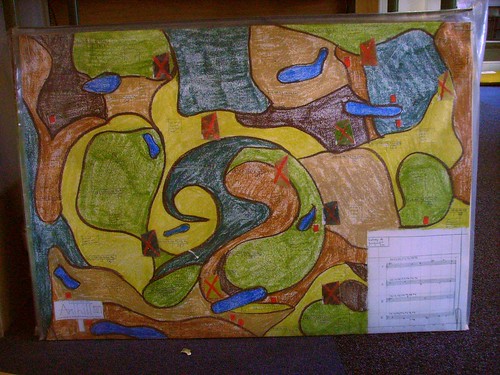
(Of course, it being essentially a graphic score, some of the people I work with scoffed at it. How sad it must be to live a life of such narrow horizons. I thought it was a marvellous, imaginative thing.)
* Regular readers may be surprised at the idea of two composers meeting without blood being spilt. I should point out that for the purposes of this encounter, I was in a non-composing capacity.
Thursday, November 08, 2007
Raising Sand

Monday, November 05, 2007
Another gratuitous plug
Bryan,who describes himself as a long time reader of this blog (something I find flattering and terrifying in equal measure), draws my attention to a band called Your 33 Black Angels, who have released an album all by themselves without a big record company, and are therefore Splendid (even though I haven't had time to listen to them properly yet). Rolling Stone like them too, but don't let that put you off ;)
As I haven't had time (etc), feel free to pop over to their MySpaz and come back here and say what you think. This is of course an example of internet democracy in action, and not just a lazy way of whoring for comments. Honest.
Sunday, November 04, 2007
History of the future.
It's only slightly distracting that Gerry Finley-Day looks like Lou Carpenter out of Neighbours.
He's at the ICA for an ultra-rare public appearance with Pat Mills as part of Paul Gravett's Comica festival, to talk about their work on comics, and in particular on Tammy. In an ironic reflection of what various sources have claimed about their relationship when Pat was editor and Gerry writer for 2000ad, Gerry is filled with marvellous stories but has some trouble getting to the point, while Pat seems to spend a lot of time telling us what Gerry thinks. They're clearly revelling in the chance to talk about Tammy though - Pat is adamant that those early 70s girls' comics were an important part of the history of the medium in Britain whose significance is yet to be fully appreciated, and it's a wonderful privilege to be able to hear these two grand old men of British comics trade stories and reflections. Gerry joined the T.A. at one point, essentially for reference purposes. Now that's commitment. Halfway through, a man sidles in through the door and sits down next to me, it's Kevin O'Neill. I struggle to maintain a dignified composure and not jump up and down shouting "YOU'RE KEVIN O'NEILL!" or anything embarrassing like that. I succeed, just. When I was about 12 and sure my future was as a comics artist, Kevin was the artist I wanted to be like more than anyone.
He's up at the front for the second half of the talk, and it's an equal pleasure to hear him and Pat talk about the early days of 2000ad, the struggles with management, the strip by Ken Reid they almost got for 2000ad (the greatest lost strip in British comics, according to O'Neill), how Action got away with it and eventually didn't, and the fact that, astonishingly, Mills and the estate of Joe Colquhoun still aren't getting any payment for reprints of Charley's War.
Access no areas
Missed Mark Ronson's critically acclaimed Electric Proms gig? Never mind, you can still catch it online at... oh, er, you can't, apparently.
"Music rights restrictions" suggests either a record company or a publisher's hand at work. Either way, it's another piece of heavy-handed idiocy. Who benefits from this gig being made unavailable? One more example of the way the music industry dinosaurs would rather go out of their way to stop their music being heard than attempt to engage in any way with the possibilities music has online. In a way, this is a good thing, because every clodding act like this brings the day when these vile organisations are consigned to history.
Friday, November 02, 2007
"It's either Romana, or Fred"

The Key to Time is the complete 16th series of Doctor Who, first broadcast in 1978, and a novelty for the series at the time in having what we'd now call a story arc throughout the season, i.e. a vague plot linking all the stories together. This comes from the height of my first obsession with Doctor Who, so buying this was a shameless act of nostalgia on my part. I remember vividly reciting all the best lines from each episode on Monday morning in the playground, but of course it's 30 years later, and everybody knows the effects were crap and you couldn't get away with that now, don't we?
Well, ya boo sucks. I thoroughly enjoyed it. It's surprising how well it all stands up. See, it doesn't matter that the effects were crap (and actually, considering how little money they had, what they achieved and the ingenuity they show in achieving it is remarkable), or that it's sometimes a bit hammy, because there's more imagination in the least of these stories (probably "the Power of Kroll") than a month of most kids' TV now. Tom Baker's in great form, funny and mad and not yet a parody of himself, Mary Tamm as Romana talks back, not something the Doctor had been used to before, and there are some genuinely wonderful stories in here, best of the bunch being the Prisoner of Zenda spoof "The Androids of Tara". And in "The Armagedon Factor" K-9 actually gets something to do other than make smart-alec comments to cover up the fact that he's got stuck in the gravel again. Lots of extras (I've not listened to any of the commentaries yet, but as Baker, Tamm and John Leeson are all present, along with a number of supporting actors and directors, I anticipate some fun there), including a very funny interview with Tom Baker on Nationwide where he accuses Frank Bough of being a fictional character. And of course in "The Pirate Planet" and the final scene of "The Armageddon factor" you've got some significant early writing by the late Douglas Adams. Perhaps not the very best of old-skool Who, but a welcome reminder nevertheless of why it was the best thing on TV ever when I was 8.
Gratuitous pimping
I was supposed to be dining with a certain long-haired writer from Northampton this evening. No, not him. I'm talking about Andrew Jerdin, creator of the popular fictional character Andre Jordan. Unfortunately the lurgee still has me in its grasp, so I'm stuck here at home, plugging his new book. I've read it, it's good. So buy it. Go on.
Go on, then.

Tuesday, October 30, 2007
following a line
 You'd think that, being a cellist myself, drawing a cellist would be a simple matter. But it's actually incredibly difficult to do something that looks even vaguely convincing. I persuaded two fellow cellists in my orchestra to let me take photos of them for reference at the last rehearsal. The results revealed that the sketches I'd done, which seemed plausible at the time, were way off the mark as to how the boy wraps itself around a large, annoyingly curved object. The players in question were a bit suspicious at first - "This sounds a bit suspicious", they said - but I persuaded them it was all in a good cause, and I'd show them the result. Here's a bit of it - I'll put the whole thing up once it's been published. it was weird, typing that; I still can't quite get used to the idea. After all the worries, about whether the idea was strong enough, about whether i was up to executing it, I'm quite pleased with the end result. I think it has one or two nice subtle touches, and I'm pleased with the page layout I came up with, which is (I hope) easy to read while also being reasonably complex. I've tried to use everything, from the poses of the figures, to the colours, to even the hairstyles, to add layers to the story. Strangely, drawing makes me think afresh about composing, of different ways of putting ideas together, of creating a form that serves rather than dictates the content.
I hope someone finds it funny...
So, one deadline conquered, and another immediately looms. So, thoughts now turn to Schubert, and Sibelius, and the prospect of thinking about bassoons grows closer.
Monday, October 29, 2007
"I love dealines. I like the whooshing sound they make as they go past" - Douglas Adams
It's not easy, this being creative lark. Especially when you find yourself doing it for cash, in a medium you're not entirely confident in, with a deadline looming ominously, as I do now. It's at times like this you find out what you can do if you're stretched, I guess. I used to think that being arty involved following your muse without concern for practicalities, writing for posterity, like what the Great Composers like that Beethoven did. Except of course this is all a big fat lie. Beethoven was as much a businessman as a composer, he made damn sure his music got an audience in his lifetime, because if you try to write the music of the future, it'll end up being the music of the past without ever being the music of the present. So hang posterity; just get on with it and let others worry about that sort of thing. I have realised (possibly too late in life) the tremendous creative spur that a deadline offers, and so maybe in my own small way I have achieved a small amount of wisdom, which can only be a good thing.
Many things going on in the world of classical music blogs that I ought to be pontificating on if I had the time, but I shall make mention of the new project Daniel Wolf is planning for his November posting, because it's very similar to how I started this blog. I'm going to start doing that again soon, I promise. As soon as I've got all these deadlines out of the way. I'm very conscious of my almost total lack of compositional activity recently, especially as I'm supposed to be starting work on a new piece for bassoon (something a bit special, sort of a follow-up to "Le tombeau de Feldman").
And now I must stop this internet navel gazing and do the things I am paid to do, and then go home and finish the damn comic strip.
Wednesday, October 17, 2007
We're not gonna Blake it.
The excellent Campaign for the prevention of Joss Stone draws my attention to some very naughty record company minions posting wildly enthusiastic reviews on Amazon for the yet to be released album by sub Il Divo* (if that's possible) blandtastic goons Blake. Go there and redress the balance. Together we can defeat this thing.
(Incidentally, how do clowns like these get away with describing themselves as "opera singers"? They wouldn't last five minutes on stage at Covent Garden.)
* Italian for "The Divs"
Monday, October 15, 2007
Dodecaphony 2.0

(Link from the estimable Alex Ross.)
Saturday, October 13, 2007
A word from our sponsor...

Friday, October 12, 2007
Time, please, gentlemen
I read on a crappy free paper on the train home that a survey of 3,000 people who downloaded the new Radiohead album reveals that a third of them paid nothing for it, but the band still got an average of £4 per copy, which puts them quids in on what they'd get if they were signed to a major label. Apparently 12 out of these 2000 paid over £40, which must mark them out as insane, as they could have got the lovely discbox like 351 others of the sample (and me) and got the download thrown in free.
Overall I think this makes the experiment a success, and a heartening one at that, as it suggests that far from the internet heralding the death of the business of recorded music, that people will pay up for music they have faith in. Great news for those producing good music, bad news for corporate companies churning out soulless crap. Which is exactly how it should be.
Wednesday, October 10, 2007
ill tempered klavier

Blüthners have a very different tone to the Steinway sound you're almost certain to hear in a concert hall - it's a dark, rich, velvety sound. It feels different to play, too - the action on the keyboard is very heavy, and even now, whenever I play any other piano the action seems strangely insubstantial.
It's an interesting question, whether the near-ubiquity of the Steinway sound is inhibiting composers in their writing for piano - maybe the prepared piano is in part a subconscious rebellion against this homogeneity of sound. I also think of such things as Thomas Ades' Asyla, which features in its scoring grand, upright and honky-tonk pianos. Another piano-related memory of mine is when my university bought a fortepiano. I was fascinated by the sound, and the feel of playing it - it felt like a revelation to hear something that was a piano, yet radically different to the archetype in my mind.
There's always a danger that homogeneity will stifle creativity - but there's always the hope thatimagination will subvert conformity.
* I am particularly excited by the fact that Pleyel use fossilised mammoth tusks for the ivory on their keys!
In Rainbows
So, how much did you fork out for the new Radiohead album? Me, being the nerd I am, I forked out the forty quid for the big exciting box with books and pictures and extra music and lovely vinyl. So I have a posh bit of product to look forward to in 6 weeks or so. In the meantime, there's the download version, which I was emailed the link for this morning.
And hurrah! It's absolutely brilliant! What immediately strikes me at the first listen is that they've managed to combine their experimentalism with their undoubted knack for a good pop song in the killer way they've been threatening to for a while. So you've got twisted dance beats, weird retro-futurist sounds, but also big guitars and tunes. So it sounds more than anything like a band.
I ummed and ah-ed for a while about whether to have the big box, or whether to go for the pay-what-you-want download only option. I wonder what I'd have paid if I'd done the latter? Of course it's tempting to pay nothing, but that just seems wrong to me. I vaguely wondered about getting the download and then if I liked it going the whole hog, but in the end I decided to put my faith in them to deliver, and they've come through for me.
I think the way they've released "In Rainbows" is a fascinating experiment (apparently there'll be a conventional CD release next year), and I hope they give us an idea of how many people downloaded and what most people paid. They're lucky enough to be in a position where they can take a risk like this, and if it works, it'll have huge consequences for the record business and bands' relations with record labels.
Monday, October 08, 2007
Know Nono? No?
In the absence of any coherent thing of my own to say (hey, I'm busy), may I point you in the direction of an excellent post about Luigi Nono.
Reach for the facts
If it's on the internet, it must be true, mustn't it? Not necessarily... there's a lesson for anyone doing a research job here: actually do some research.
Friday, October 05, 2007
Scenes from the death of classical music #1
"So, do you think we'll be playing Julian Anderson in 100 years?" a violinist friend asked me last night in the break during our rehearsal for the next KSO concert. Well, will we? Does it matter?
The shortest and probably most honest answer is "I don't know". Who can possibly say with certainty what will and won't be heard in a century? Acclaim in your own lifetime is no guarantee of an equal posthumous reputation - just ask Spohr, Clementi, and any number of other dead also-rans. Who can even say with certainty whether the symphony orchestra will still exist as a performing group? (I have my doubts about this.)
Does it matter? One one level, not at all, as I'll be long dead by then. On another level, it matters immensely, as I'm a composer, and no matter what I may say, I'll always have one eye on posterity. At least some of the motivation for creating anything, whether it be art, music, a building, social reform, whatever, is ego-driven: the desire for immortality. At a tangent to this is professional envy - I don't want some other bugger being remembered if I'm not.
I hope he isn't. This isn't anything to do with him or my opinion of his music. Up until comparatively recently it was normal for a composer to be forgotten after his death, because it was normal to have new music. But something happened in the 19th century, starting with Beethoven - the first composer whose work remained in the standard repertoire after his death, and has never left it* - and now new music is seen as at best novelty, at worst something to be actively avoided. There's too much posterity now. We need to remember to forget. Then there will be room for new musics. Otherwise classical music is just an embalmed corpse. Embalmed corpses are of course interesting to study, but they don't make very good conversationalists. I'd rather spend time with the living.
*"Beethoven started the rot", said Britten. Messiaen on the other hand speculated that music went wrong sometime in the 11th or 12th century, roughly when we started to write it down.
Thursday, October 04, 2007
Free Burma
Today is Blog about Burma Day. I have my doubts about whether such things make any difference at all, (rather like the Facebook Burma group), or are just an easy way for middle-class westerners to feel better about themselves, but on the principle that it is better to light a candle than curse the darkness, and the realisation that there are some things more important than music or the petty gripes I put down here (i.e. almost everything), I shall mention the crackdown that the Burmese government is embarking upon, and add one more voice to the protest.
(And if you're confused by the whole issue of whether it should be called Burma or Myanmar, read this.)
Wednesday, October 03, 2007
There are none so deaf as those that will not hear

Now, maybe I'm going out on a limb here, but it seems obvious to me that this is a deeply ambiguous work, steeped in suggestions that not all is well (and, I suspect, not necessarily in relation to the war). Double meanings in the arts were endemic in Stalin's Russia, and that's what I hear in the ferocious bombast of much of this symphony. I expect to read positivist guff in "official" soviet articles and the like, but what about all those who've written the books, sleeve notes etc since? How can they seriously write that this is a piece that ends happily? Have any of them actually listened to it?
Tuesday, October 02, 2007
RIP
Ronnie Hazlehurst. Rumour has it that he cut a rakish figure, with a Zappa-style moustache, but as I've never found a photo of him I can't confirm it. Spitting Image did a fantastic sketch years ago around the time Andrew Lloyd Webber did his Requiem, in which Melvyn Bragg presented a South bank Show portrait of Ronnie Hazlehurst on the occasion of the premiere of his Requiem. When I was a kid it seemed like there wasn't a show on TV he hadn't written the theme tune for.
Update: Here's a couple of photos. The second one is him conducting at the Eurovision Song Contest. Those were the days.


Subscribe to:
Posts (Atom)


